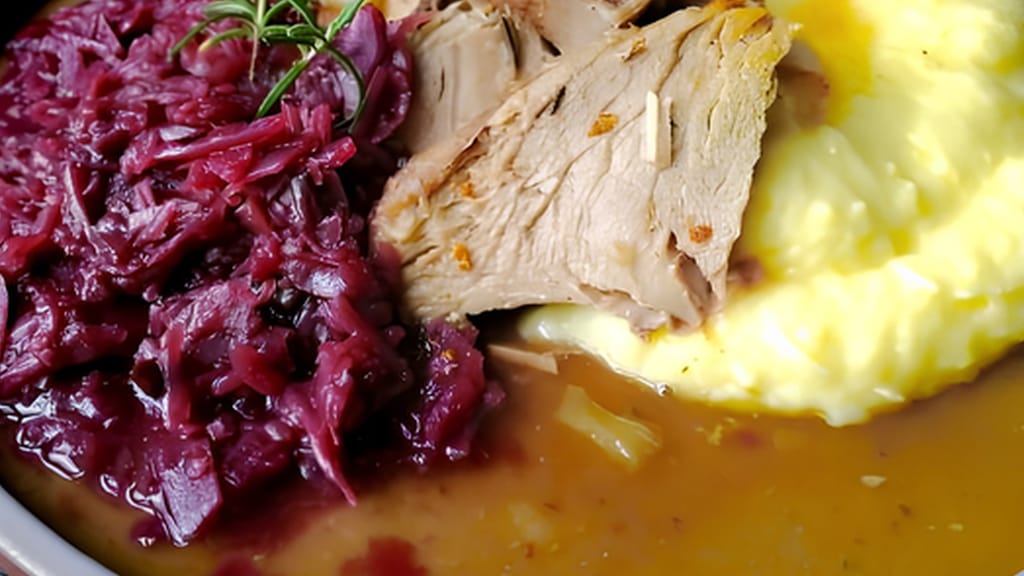
Slow-roasted pork with red cabbage
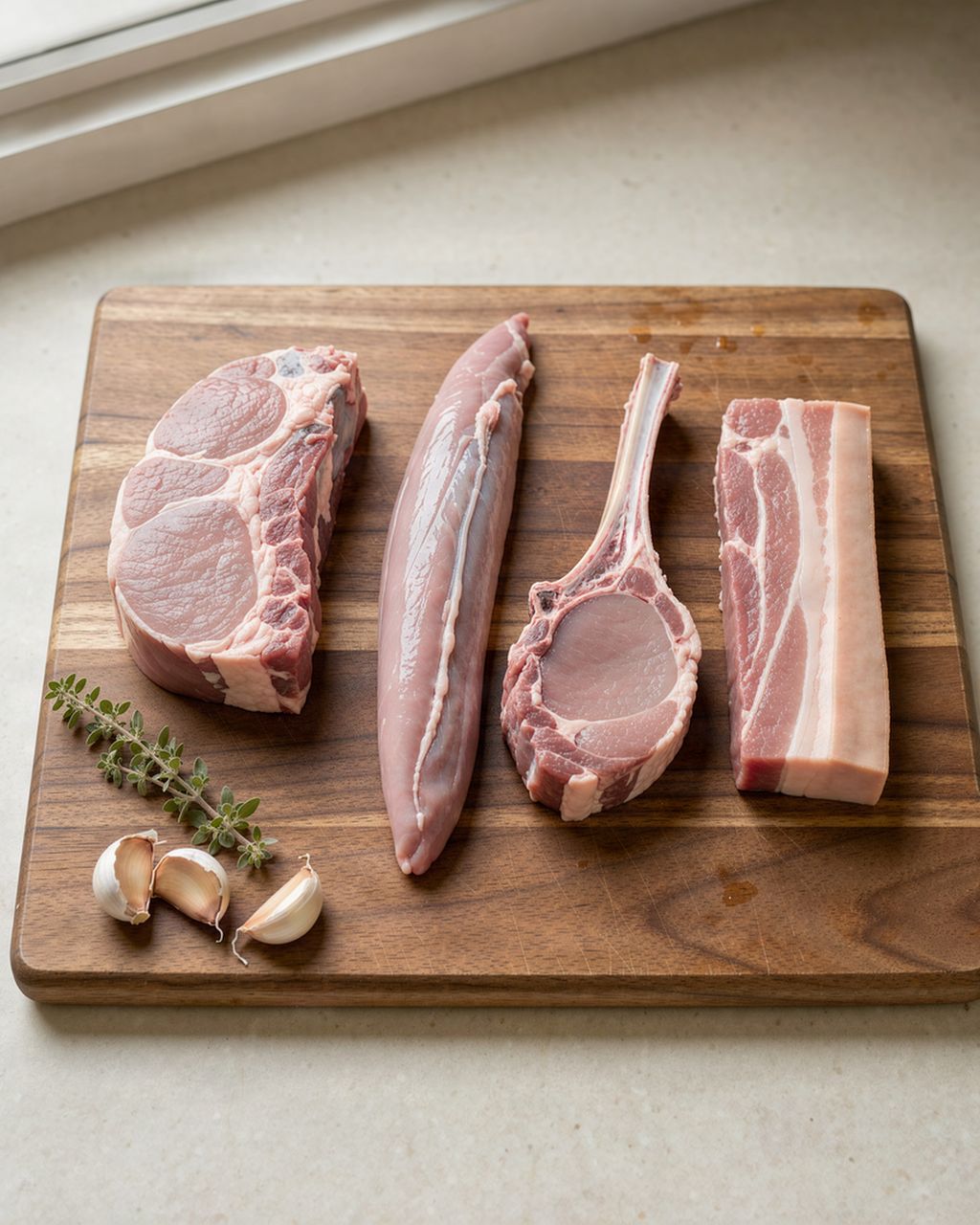
What to Cook With Pork: Leg, Shoulder, Neck, Chops, Tenderloin and Belly
Updated Nov 18, 2026
What you cook with pork depends mostly on which cut you're holding. Lean leg and tenderloin need quick cooking and an exact temperature, while marbled shoulder, pork neck and belly need time and gentle heat. We'll go cut by cut: which cuts make the best schnitzels, roasts and goulash, how to cook pork neck whole or sliced, chops that don't dry out, tenderloin, crispy belly and ground pork. For each dish you'll find the method, time, temperature and what to serve with it, plus safe internal temperatures and how long pork keeps in the fridge.
The rule is simple: lean cuts (leg, tenderloin, chops) are cooked briefly and precisely; marbled cuts rich in connective tissue (shoulder, pork neck, belly) are cooked long and slow. At a glance:
Pork leg – schnitzels, strips for stir-fry (čína), stuffed leg, braised leg with mushrooms. It works for goulash but turns out drier.
Pork shoulder – roasts to serve with dumplings and sauerkraut, goulash, pulled pork. The best cut for long braising.
Pork neck (krkovice) – whole in the oven, or sliced for the pan and grill. The most forgiving cut; it almost never dries out.
Pork chops – in the pan or oven, cut 2–3 cm (¾–1¼ in) thick, bone-in or boneless.
Pork tenderloin – roasted whole, or as medallions in a pan. The most tender and most expensive cut.
Pork belly – roasted with crispy skin, grilled, or braised with sauerkraut.
Ground pork – meatloaf, meat patties, stuffed vegetables, sauces.
If you're not sure which cut you actually have, what it looks like or where it sits on the pig, see our guide to types of pork and how to recognize them. Here we focus on what to cook with each cut and how.
We send seasonal cooking and baking plans and recipes made from everyday ingredients. Unsubscribe in one click.
The best things to make with pork leg are schnitzels, strips for the pan, stuffed roast leg and braised leg in sauce. Pork leg is lean with long muscle fibers, so it's great for thin slices and short frying. On the other hand, it dries out easily in long roasting because it has neither the fat nor the collagen to protect it. So cook it either quickly, or with liquid under a lid.
For a classic fried schnitzel, slice the leg across the grain into slices 0.5–0.7 cm (about ¼ in) thick and pound them gently under plastic wrap so they don't tear. Salt them, coat in flour, beaten egg and breadcrumbs, and fry in oil heated to 160–170 °C (320–340 °F) for about 3–4 minutes per side, until the coating is golden brown. Drain on a rack, not on paper, or the underside goes soggy. Serve with potato salad, boiled potatoes with butter or smooth mashed potatoes.
If you don't want to fry, bake the schnitzels in the oven: for inspiration, see the recipe for baked crispy schnitzels in cornflake crumbs. The method works with pork leg too: baking sheet with a rack, 200 °C (400 °F), 18–22 minutes, turning halfway.
For čína (a Czech-style Chinese stir-fry), the best option is leg cut into thin strips, coated in starch and seared fast in batches. Slice it across the grain into strips about 0.5 cm (¼ in) thick, toss with a teaspoon of starch, soy sauce and a splash of oil, and leave for 15–20 minutes. The starch forms a thin layer that keeps the juices inside. Then sear the strips in a hot pan or wok for 2–3 minutes, add vegetables and sauce. Serve with rice. How to marinate the meat and thicken the sauce properly is covered in homemade čína: how to marinate the meat and thicken the sauce.
Make stuffed pork leg from a 1–1.5 kg (2¼–3¼ lb) piece with a pocket, or rolled up as a roulade, and roast it covered at 160–170 °C (320–340 °F) for 60–90 minutes, until the center reaches 63–65 °C (145–150 °F). Cut a deep pocket into the meat (or open it out flat and roll it up) and fill it with stuffing: spinach with garlic and cheese, prunes with bacon, or a bread-roll stuffing with smoked meat like Easter stuffing. Tie with string, salt, brown on all sides and roast, basting with liquid as it cooks. Because leg is lean, keep an eye on the internal temperature; it doesn't need more than 65 °C. Then rest it for 10 minutes and only then slice. Serve with mashed potatoes and the pan juices.
Braise pork leg in cubes or slices under a lid with stock over low heat for about 1–1.5 hours so it doesn't dry out. A good example is pork leg with mushrooms: you brown the slices or cubes, add stock and mushrooms, simmer gently for about an hour until tender, and finish with a splash of milk to soften the sauce. Serve with dumplings, rice or pasta.
You can make goulash from leg too, but the result is drier and more fibrous than with shoulder. Braise 3 cm (1¼ in) cubes for about 1–1.5 hours and don't boil them hard, or the fibers tighten. If your goulash comes out tough, why goulash is tough and the meat won't soften explains what to do.
The best things to make with pork shoulder are a roast to serve with dumplings and sauerkraut, goulash and pulled pork. Pork shoulder is streaked with fat and above all collagen. In slow roasting or braising, collagen turns to gelatin, and that is what makes the meat juicy and tender. Shoulder is therefore unsuited to quick frying, but with time it has no rival. It's sold both bone-in and boneless; the boneless one is easier to cut into cubes and roll up as a roulade.
Roast shoulder in two stages: first covered at 170 °C (340 °F), about an hour per kilogram, then uncovered at 190–200 °C (375–400 °F) for another 30–45 minutes. In the first stage steam and gentle heat melt the collagen without drying the meat out; in the second the surface browns to a golden color and the pan juices thicken. Add just enough liquid to keep the bottom of the roasting pan from burning; the meat should roast, not boil. It's done when a fork slides in without resistance. Rest it for 10–15 minutes before slicing. Dumplings and sauerkraut belong with a shoulder roast; how to make sauerkraut from a jar or a fresh head is in braised sauerkraut: how to cook it.
A slower, more tender version is the recipe for slow-roasted pork with red cabbage, and for special occasions there's very slow-roasted shoulder of young pork with apples and onion.
Slow-roasted pork with red cabbage
Slow-roasted pork with red cabbage
For goulash, shoulder is the best cut of pork: braise 3–4 cm (1¼–1½ in) cubes under a lid over low heat for 1.5–2 hours. Brown the meat in smaller batches first so it doesn't pile up in the pot and stew in its own juices; only that way do you get the browned crust that gives the goulash depth. Thanks to its collagen, shoulder turns tender and stays juicy where leg would go stringy. It's done when a cube can be crushed against the side of the pot.
The basic method is shown in the recipe for classic goulash with chili and bread dumplings. That one is made with beef, but pork shoulder softens 30–60 minutes sooner. Why meat is browned before braising and what it really does is explained in why meat is seared before braising.
Pulled pork is shoulder roasted until it falls apart under a fork: roast a 2–2.5 kg (4½–5½ lb) piece covered at 120–130 °C (250–265 °F) for 7–9 hours, until the center reaches roughly 90–95 °C (195–205 °F). Only then does the collagen break down enough for the meat to shred; at 75 °C it's safe but still tough. You can put the spice rub with salt on the evening before and leave the meat in the fridge so the salt has time to penetrate. After roasting, rest the meat for 30 minutes, shred it with two forks and mix it with the pan juices. Serve in soft homemade burger buns with coleslaw.
If you want to roast overnight, the times and temperatures for pulled meat are summed up in roasting meat overnight. And if there are leftovers, make something like pulled smoked meat with beans and tomatoes.
With pork neck (krkovice) you can make a whole roast in the oven, or slices in the pan or on the grill. Pork neck is marbled with fat throughout, so it forgives a few extra minutes and almost never dries out. It's sold bone-in or boneless, whole or sliced. Boneless is more convenient for slicing, while for roasting whole some people prefer bone-in for the flavor.
Roast a whole pork neck (1.2–1.5 kg / 2¾–3¼ lb) covered at 170 °C (340 °F) for 1.5–2 hours, then uncovered for 20–30 minutes at 200 °C (400 °F), until it reaches 70–75 °C (160–165 °F) at the center. First salt the meat, rub it with mustard and garlic, sprinkle with caraway and leave it for at least an hour, ideally overnight in the fridge. Set it in a roasting pan on a bed of onion, add 200–300 ml (about ¾–1¼ cups) of water or beer and roast covered; the crust forms in the uncovered stage. If you want it more tender, almost falling apart, take it up to 85 °C (185 °F). Rest it for 10–15 minutes before slicing, or the juices run out onto the board. Serve with the pan juices, dumplings and sauerkraut, or with roast potatoes.
For exact temperatures and times for different cuts of pork in the oven, see pork in the oven: what temperature to roast at.
For the pan and grill, cut pork neck into slices 1.5–2 cm (½–¾ in) thick. Thinner ones dry out quickly, while thicker ones won't cook through before the surface burns. Score the fatty edge a few times so the slice doesn't curl as it cooks. In a pan, cook over medium-high heat for 3–4 minutes per side, then rest the slices for 3–5 minutes. This works beautifully in the recipe for grilled pork neck in honey mustard with root vegetables: the meat is grilled and the root vegetables are cooked alongside it on the griddle.
On the grill, first sear the slices directly over the heat for 3–4 minutes per side, then move them to a cooler part of the grate and let them finish for a few more minutes so a marinade with sugar or honey doesn't blacken. For inspiration, try grilled orange pork neck with a pinch of chili. Bread, a vegetable salad and mustard or horseradish go well with grilled pork neck.
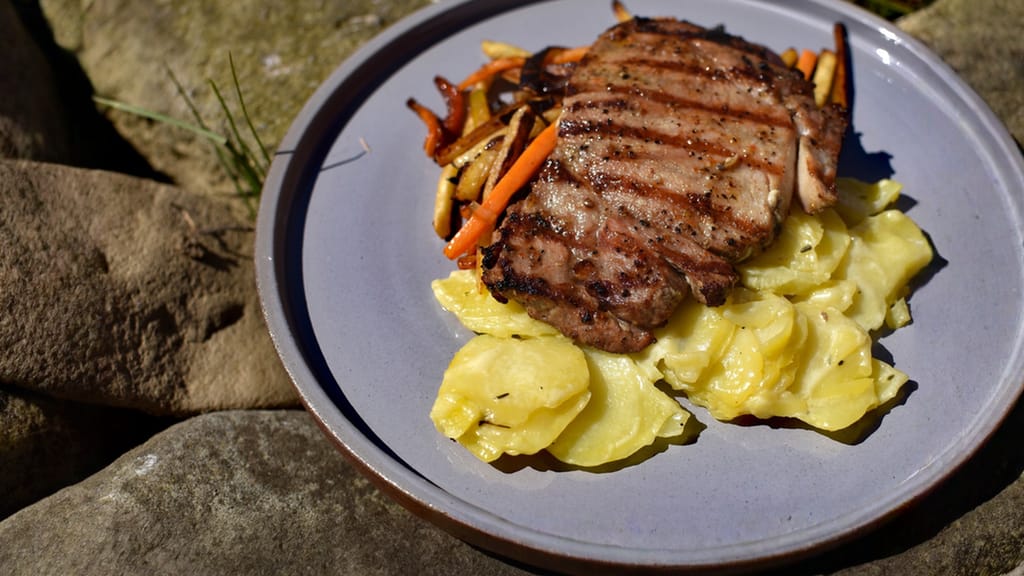
Pork neck in mustard marinade with pan-roasted root vegetables
Grilled pork neck with root vegetables
Buy boneless pork neck for slices and the grill, and bone-in is fine for roasting whole. The differences:
Bone-in – more flavor in the pan juices, and the meat near the bone stays juicier. It takes a little longer and cooks less evenly, so measure the temperature at the thickest point, not next to the bone.
Boneless – cooks evenly, slices easily, and can be rolled and tied into a regular shape or stuffed.
Pre-sliced pork neck is convenient, but it tends to be cut thin. If you want slices for the grill, buy a whole piece and slice it yourself.
Pork chops stay juicy if you buy them 2–3 cm (¾–1¼ in) thick, sear them briefly in a hot pan, take them off at 60–62 °C (140–144 °F) in the center and rest them for 3–5 minutes; check with a thermometer that they have reached 63 °C (145 °F). A pork chop is cut from the loin; it's lean with a fat rim. Bone-in has more flavor and is more forgiving, while boneless (sold as a pork loin roast or boneless pork chop) cooks through faster.
Cook pork chops 2–3 cm (¾–1¼ in) thick in a well-heated pan for 3–4 minutes on one side and 2–3 minutes on the other, to 60–62 °C (140–144 °F) in the center, and rest them for 5 minutes so the temperature reaches 63 °C (145 °F). Pat the chops dry with a paper towel and salt them either at least 30–40 minutes ahead, or right before cooking. Avoid the window in between, meaning salting a few minutes to about half an hour ahead. In that window the salt draws juices to the surface, the meat releases them into the pan and stews instead of searing; with a longer wait the juices are absorbed back. Score the fat rim. Heat the pan with a little oil until really hot, add the chops and don't move them for 3–4 minutes, then flip and cook for another 2–3 minutes. At the end add a knob of butter, a crushed garlic clove and a sprig of thyme, and baste the meat with it for a few dozen seconds. Rest for 5 minutes and serve with mashed potatoes, roast potatoes or vegetables and a mustard pan sauce (deglaze the pan with a little stock and stir in a spoonful of mustard and cream).
Thick chops, 3 cm (1¼ in) and up, are best done by combining pan and oven. Sear them for 2 minutes per side in a hot pan, move them to an oven heated to 180 °C (350 °F) and finish for 8–12 minutes, until the center reaches 60–62 °C (140–144 °F). The reverse method (reverse sear) is even gentler: roast them slowly at 120 °C (250 °F) until the center reaches about 55 °C (130 °F) (25–40 minutes depending on thickness), then sear hard in a pan for color until the center reaches 63 °C (145 °F). For baked chops, after searing spread the meat with mustard, top with a slice of cheese and onion and bake at 200 °C (400 °F) for about 10 minutes. Roast potatoes or a vegetable salad go well with that.
Dry chops almost always come down to one of these causes:
They're too thin. A 1 cm slice dries out before the surface has time to brown.
They're overcooked. The old habit of "cook until it's completely white" means 75–80 °C (165–175 °F) in the center. Lean meat loses most of its juice that way.
You didn't rest them. A chop cut straight from the pan loses its juices onto the plate.
A cold pan. The meat releases water and stews.
If it happens anyway, how to rescue overcooked meat tells you what to do with it: slice it thin and warm it in sauce.
The best things to make with pork tenderloin are a whole tenderloin seared and finished in the oven, or medallions in a pan. Pork tenderloin is the most tender and leanest cut on the whole pig, a cylinder weighing roughly 400–600 g (14 oz–1⅓ lb). It has almost no fat, so long roasting hurts it. Before cooking, cut off the silver skin: slide a thin knife under it and pull along the meat, otherwise it tightens during cooking and curls the tenderloin.
Sear a whole pork tenderloin in a pan for 5–6 minutes and finish it for 10–15 minutes at 180 °C (350 °F), until the center reaches 63 °C (145 °F). Salt and pepper the trimmed tenderloin, brown it on all sides in a hot pan, then move it to a preheated oven. After roasting, rest it for 5–10 minutes under aluminum foil, and only then slice it on the diagonal. Inside it will be lightly pink and juicy. Popular variations: wrapped in slices of bacon (which protects it from drying out), brushed with mustard and rolled in herbs, or in puff pastry. Serve with a pepper or mushroom sauce, potato gratin or green beans.
Cut pork tenderloin medallions about 3 cm (1¼ in) thick and cook them in a hot pan for 2–3 minutes per side, until the center reaches 63 °C (145 °F), then rest them for a few minutes. Before cooking, flatten them only lightly with your palm so they're an even height, and salt them just before they go into the pan with oil. Put the cooked ones on a warm plate and make a sauce in the same pan: soften a shallot, add mushrooms or green peppercorns, deglaze with a little wine or stock, reduce and finish with cream. Return the medallions just to warm through. A bacon-wrapped version is in the recipe for pork medallions in bacon; serve with mashed potatoes or rice.
The best things to make with pork belly are roast belly with crispy skin, Asian-style grilled belly and belly braised with sauerkraut. Pork belly is layers of meat and fat under the skin. It needs long heat for the fat to render and the meat to soften, and fierce heat at the end to crisp the skin.
Roast pork belly with crispy skin, skin side up, for 1.5–2 hours at 150–160 °C (300–320 °F) and then 20–30 minutes at 220–230 °C (425–450 °F); the skin must be dry. Score the skin with a sharp knife in a crosshatch at 1 cm (⅜ in) intervals, but don't cut through to the meat. Dry the belly, salt the skin generously and leave it uncovered in the fridge overnight, where the skin dries out. When roasting, add liquid only under the meat and take care never to wet the skin. In the final high-heat stage (or under the broiler) the skin puffs into bubbles. Watch it: from crispy to burnt is a matter of minutes. Slice with a sharp knife skin side down and serve with mustard, horseradish and bread, or as in the recipe for crispy roast pork belly with homemade gnocchi and spinach.
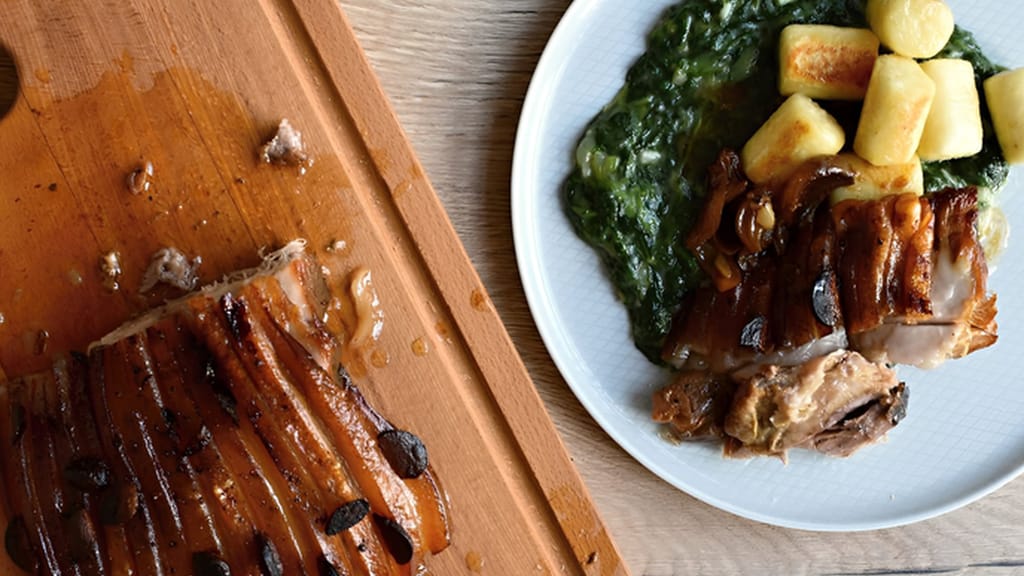
Crispy roast pork belly with homemade potato gnocchi and spinach
Crispy roast pork belly with homemade gnocchi and spinach
For the grill, cut belly into slices 1–1.5 cm (⅜–½ in) thick and grill them 4–5 minutes per side; for sauerkraut, cut it into 2–3 cm (¾–1¼ in) cubes and braise for 1–1.5 hours. Marinate skinless slices for at least 2 hours in a mix of soy sauce, honey, garlic and ginger, then grill over medium heat until the fat crisps at the edges. A similar method with thin slices is in the recipe for Asian-style grilled pork belly; serve with rice and pickled vegetables.
For sauerkraut, either roast the belly whole using the method above and serve it on braised sauerkraut, or brown the cubes and braise them with the sauerkraut. That way the cabbage gives its flavor to the meat and the meat gives its fat to the cabbage.
With ground pork you can make meatloaf, meat patties, meatballs, stuffed vegetables and a quick dinner like burritos. Ground pork is juicier than beef because it contains more fat. That's why the two are often mixed half and half: beef adds flavor, pork adds juiciness. Always cook ground meat to 71 °C (160 °F) in the center; a pink middle is not okay with it.
Meatloaf (sekaná) – bake a loaf of ground meat at 180 °C (350 °F), about an hour for a kilogram one, until the center reaches 71 °C (160 °F). A spring version is in the recipe for meatloaf with wild garlic and sweet potato purée.
Meat patties (karbanátky) – fry patties 1.5–2 cm (½–¾ in) thick over medium heat for 4–5 minutes per side. Exact times for patties and burgers are in ground meat in a pan: how long to fry, and seasoning is in how to season ground meat.
Meatballs – brown small balls until golden and simmer in sauce for 15–20 minutes, as in the recipe for meatballs in vegetable sauce. Serve with pasta or rice.
Stuffed vegetables – pack the meat mixture into zucchini or squash and bake at 180–190 °C (350–375 °F) for 30–40 minutes: zucchini stuffed with ground meat or baked squash with ground meat.
Quick dinner – sauté ground meat with onion, beans and spices and wrap it in a tortilla like Mexican burritos with beans and ground meat.
Ribs, cheeks and knuckle are full of collagen, and so they need long, slow heat; liver, on the other hand, is done in a few minutes in a pan.
Ribs – roast covered at 150 °C (300 °F) for 2–2.5 hours until tender, then uncover, brush with sauce and caramelize at 200 °C (400 °F). Recipe: baked pork ribs with apple cider and BBQ sauce.
Cheeks – after 2.5–3 hours of braising they fall apart. Try pork cheeks with olives and tomatoes in red wine, served with polenta or mash.
Knuckle – boil first, then roast. Times and temperatures are in pork knuckle: how long to boil and roast.
Liver – a few minutes in a pan; longer and it toughens. Add salt only at the end: braised pork liver with apples.
Smoked pork neck, leg and ribs are covered in a separate article, smoked meat: how to cook and roast it.
According to the US agency USDA FSIS, whole cuts of pork (chops, tenderloin, leg, roasts) are safe at 63 °C (145 °F) in the center followed by a 3-minute rest. Ground pork must reach 71 °C (160 °F), and you don't rely on a rest time for it. FSIS lowered this threshold in 2011 and explicitly states that pork cooked to 63 °C with a three-minute rest may still be pink inside and yet safe.
Why the difference? In a whole cut, any bacteria are mainly on the surface, which heats through reliably during searing. Grinding mixes the surface into the whole mass, so the center has to heat through as well.
In practice:
63 °C (145 °F) – the minimum for tenderloin, chops and leg. The meat is juicy and lightly pink.
70–75 °C (160–165 °F) – pork neck or shoulder for slicing, where you want a more cooked-through, firmer texture.
85–95 °C (185–205 °F) – shoulder, belly, cheeks cooked to fall-apart and pulled pork. Here it isn't about safety but about breaking down collagen.
71 °C (160 °F) – ground meat, meatloaf, meat patties.
Measure the temperature with a probe thermometer at the thickest point, away from the bone. It's also worth checking the oven itself: home ovens often differ from the set temperature by several or even ten or more degrees, which an oven thermometer placed on the rack will reveal.
According to USDA FSIS, raw pork chops, roasts and other whole cuts keep in the fridge (at or below 4 °C / 40 °F) for 3–5 days, and cooked or roasted pork for 3–4 days. Ground meat keeps for a considerably shorter time; count on 1–2 days, and ideally use it the day you buy it. A detailed overview by type is in how long pork keeps in the fridge.
Raw meat goes in the coldest part of the fridge, usually the bottom shelf above the vegetable drawer. Put it in a dish so the juices don't drip onto other food.
Roast meat should cool for no more than 2 hours after cooking, then be covered and refrigerated. Slice a large roast so it cools faster. It stays juicier kept in its pan juices.
Freezer – at −18 °C (0 °F) meat stays safe; the times relate only to quality. FSIS gives 4–6 months for raw chops (the general chart says up to 12) and 4–12 months for roasts. Freeze it flat, well wrapped and dated. How to thaw it properly is described in frozen meat: how long it keeps and how to thaw it.
Yes, pork shoulder is the closest substitute for pork neck when roasting and braising, though it's a bit leaner. Allow a similar or slightly longer time and add a little more liquid. For slices cooked in a pan or on the grill the swap is worse: shoulder has more sinew and stays tougher with short cooking.
No, don't rinse raw pork. USDA FSIS advises against washing raw meat because the water splashes bacteria around the sink and kitchen and does nothing for safety; only cooking to the right temperature kills bacteria. Just pat the meat dry with a paper towel, which also helps it brown better.
Plan roughly 150–200 g (about 5–7 oz) of raw boneless meat per person, or 250–300 g (about 9–10½ oz) with the bone. Meat loses roughly a quarter to a third of its weight when roasted, and shoulder and belly lose more because the fat renders out. For pulled pork served in a bun, about 150 g of cooked meat per person is enough.
2–12 hours is enough for pork; overnight in the fridge is ideal for pork neck, shoulder and ribs. Don't leave very acidic marinades (lemon, vinegar, pineapple) on the meat for more than a few hours or the surface turns mushy. A dry rub with salt can go on a large cut a whole day ahead, with the meat left in the fridge.
Reheat roast pork sliced, in its juices or stock, covered, at a low temperature of about 150 °C (300 °F) in the oven, or under a lid over low heat on the stove. In 10–15 minutes it heats through to 74 °C (165 °F) without drying out. In the microwave, add a little liquid, cover it and use medium power.
Pork leg turns out tough because it's lean and was cooked to too high an internal temperature, or sliced along the grain. Take it out of the oven at 63–65 °C (145–150 °F), rest it for 10 minutes and slice thinly across the grain. If you want leg that's fall-apart tender, don't roast it dry; braise it under a lid in sauce.
One recipe worth heating the oven for, one tip, and one deal from the shop. Nothing else.