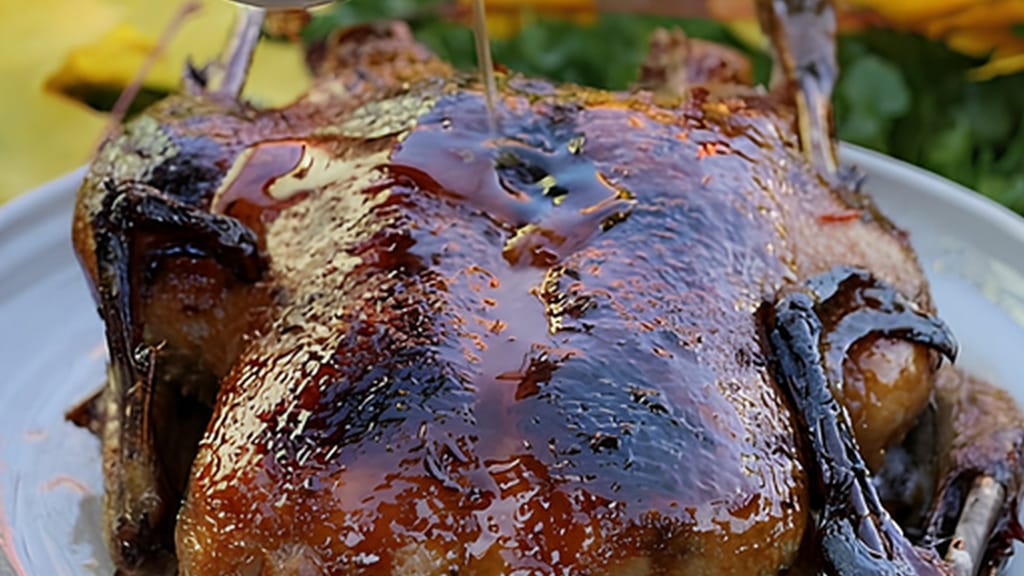
Slow-roasted honey duck
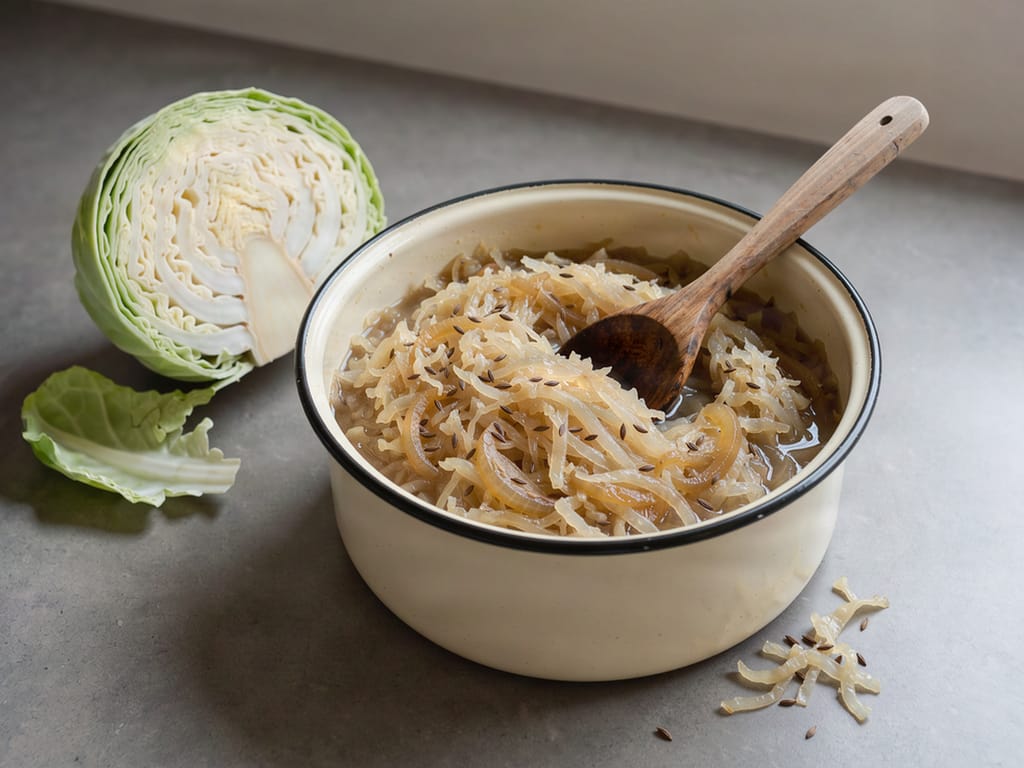
Braised Cabbage: How to Cook It from a Jar, a Bag or a Fresh Head, and How to Freeze It
Updated Nov 17, 2026
Braised cabbage from a jar is ready in 20 minutes: you brown an onion in lard, add the cabbage with caraway, simmer it, then finish with sugar and thicken it. Cabbage from a bag takes 40–60 minutes because it is usually raw, and a fresh head takes 30–60 minutes depending on the type. The principle is always the same. Only the time changes, along with how much acidity you need to add or take away. Below you'll find the method for white, red and sauerkraut-style cabbage, how to store a whole head and how to freeze braised cabbage.
Every braised cabbage rests on five things: fat, onion, caraway, a balance of sweet and sour, and thickening. Once you've got these down, it doesn't matter where your cabbage comes from.
Fat: pork or goose lard gives the fullest flavor, butter is milder and oil is neutral. Use 1–2 tablespoons per 500 g of cabbage.
Onion: one larger onion per 500 g, finely chopped and cooked until golden, not just translucent. Caramelized onion is what separates canteen cabbage from grandma's cabbage.
Caraway: 1 teaspoon of whole caraway seeds per 500 g. Add it to the onion for the last 30 seconds so it releases its aroma into the fat.
Sweet and sour: sauerkraut needs its acidity tamed (sugar, rinsing), while fresh cabbage needs more acidity (vinegar). Start with 1 tablespoon of sugar per 500 g and adjust at the end, when you can taste the whole picture.
Thickening: a raw potato, a roux, or flour stirred into water. More in the thickening section below.
Always braise cabbage covered, over low heat, and watch that it doesn't scorch. If the juices cook away, add a few spoonfuls of water or cabbage brine.
Seasonal baking plans, tested recipes and kitchen tricks that save you time. Unsubscribe in one click.
Cabbage from a jar is already heat-treated, so you don't cook it until soft. You just simmer it for 15–20 minutes so it comes together with the fat, onion and caraway. This applies to sauerkraut in a jar and to sweet-and-sour sterilized cabbage alike.
In 1–2 tablespoons of lard, cook the chopped onion until golden, then add the caraway at the end.
Drain the cabbage, but set the brine aside. Taste it: if it seems too sour, rinse the cabbage briefly (more in the next section).
Add the cabbage to the onion, stir, add 3–4 tablespoons of brine or water and braise, covered, for 15–20 minutes.
Season with sugar (start with a tablespoon) and salt if needed. Sauerkraut is usually quite salty, so you typically won't need any.
Thicken it and let it bubble for another 5–10 minutes.
Sterilized cabbage in a jar is usually already sweetened and milder. Add sugar only after tasting, and don't pour off all the brine, since it carries much of the flavor.
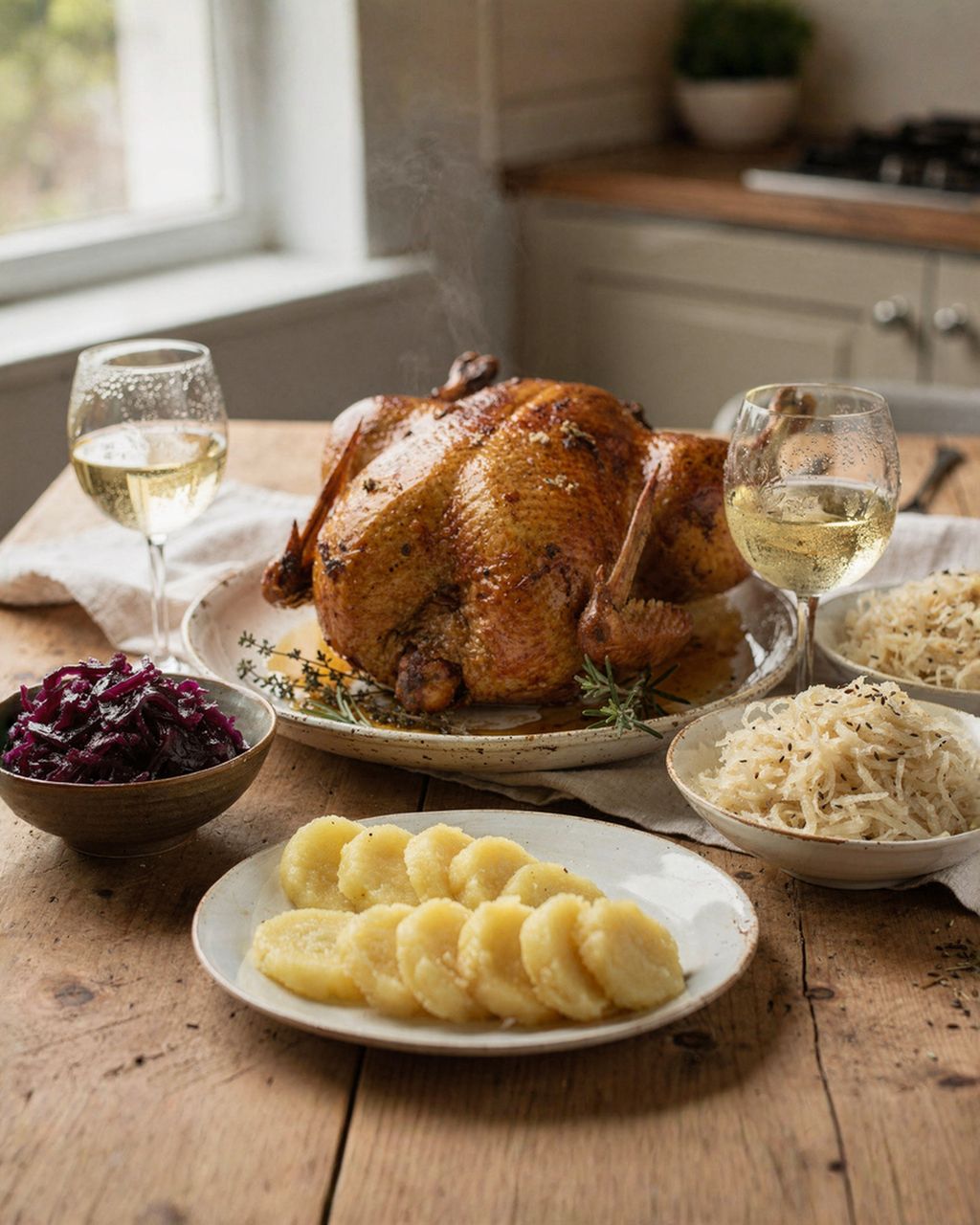
Braised cabbage is even better the next day, so feel free to cook it a day ahead. This white cabbage is just right with roast pork, slow-roasted duck with honey or goose. If you can't decide between white and red, the St. Martin's menu with goose, cabbage and dumplings will help.
Slow-roasted honey duck
Slow-roasted duck with honey, served with braised cabbage
Rinse it only if the cabbage is too sour or too salty for your taste. Rinsing washes away some of the acidity and salt, but also some of the flavor the cabbage gained from fermenting.
Like it sour? Just drain it and keep the brine for adding later.
Too sharp? Rinse it briefly in a colander under cold water and squeeze it out well.
Not sure? Rinse only half of the cabbage. You can then fine-tune the balance with a spoonful of brine or, the other way around, with sugar.
Never pour the brine away in advance. It's your safety net: if the cabbage tastes flat at the end, a spoonful of brine wakes it up right away.
Sauerkraut in a bag from the refrigerated section is often not pasteurized, so it's firmer and more sour than cabbage from a jar and needs 40–60 minutes of braising to soften. Check the packaging: if it says "pasteurized," treat it like jarred cabbage, and 20 minutes will be enough.
The method is the same as for a jar: lard, onion cooked until golden, caraway, cabbage.
Add a bit more liquid (about 100 ml of water per 500 g), because raw cabbage braises longer and the juices evaporate.
Check tenderness by tasting: done cabbage is soft but still holds its shape and doesn't fall apart into mush.
Add the sugar and thickener only at the end, once the cabbage is soft. Flour added at the start could scorch during the long braise.
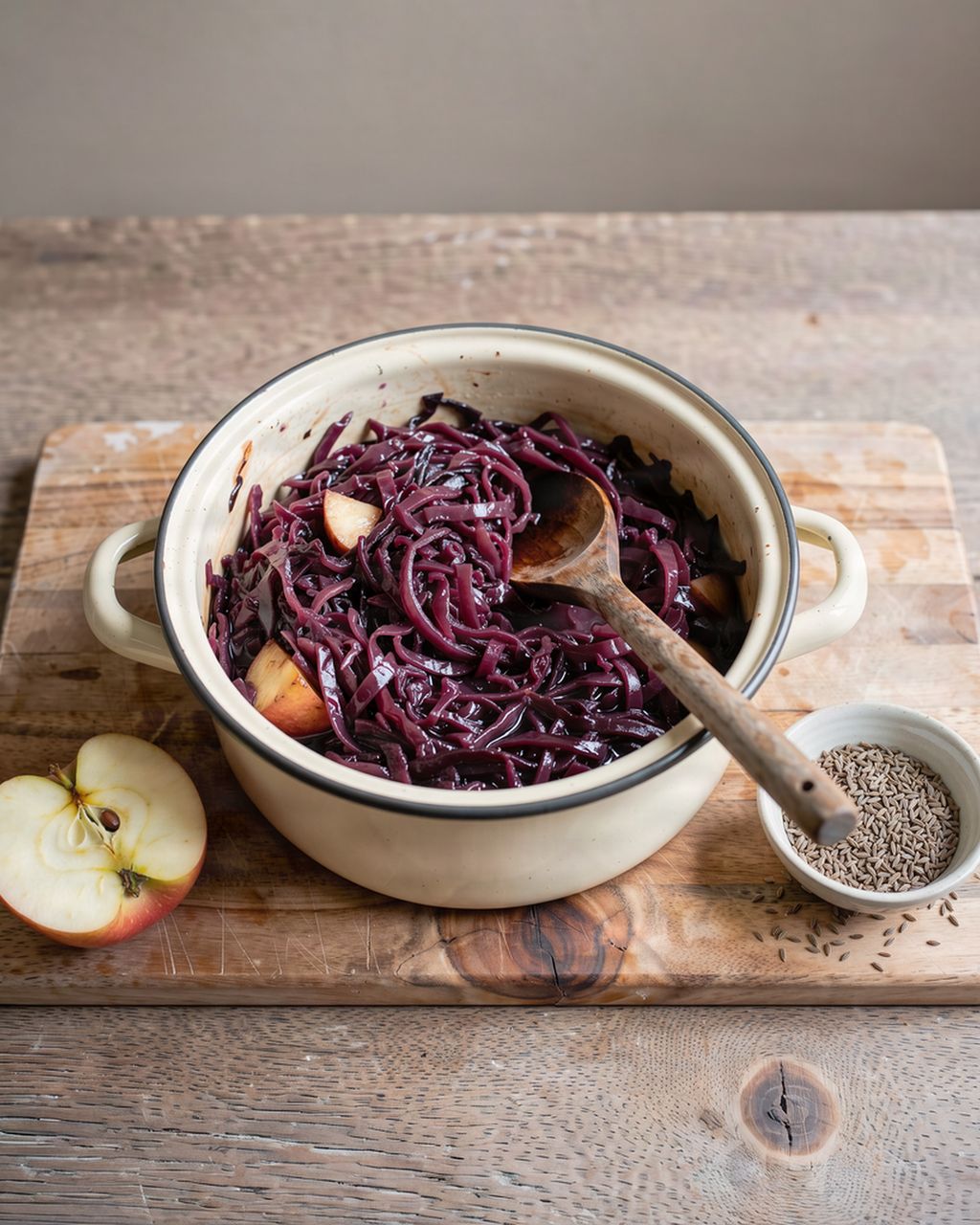
Red cabbage from a jar is already seasoned sweet and sour, often with apple, so don't rinse it and just heat it through in fat for 10–15 minutes. The brine belongs with it.
Melt a tablespoon of butter or goose lard, add the cabbage with its juices and heat it, covered.
To improve it, add a grated tart apple, a pinch of cinnamon or a clove, or a little red wine.
If it's too thin, thicken it with a teaspoon of potato starch stirred into cold water. It stays glossy and doesn't turn cloudy the way it does with flour.
If it's too sweet, balance it with a spoonful of vinegar or lemon juice.
If you have time and want to cook it from scratch from a fresh head, follow the recipe for sweet-and-sour braised red cabbage. It goes well with roast goose, duck and slow-roasted pork with red cabbage.
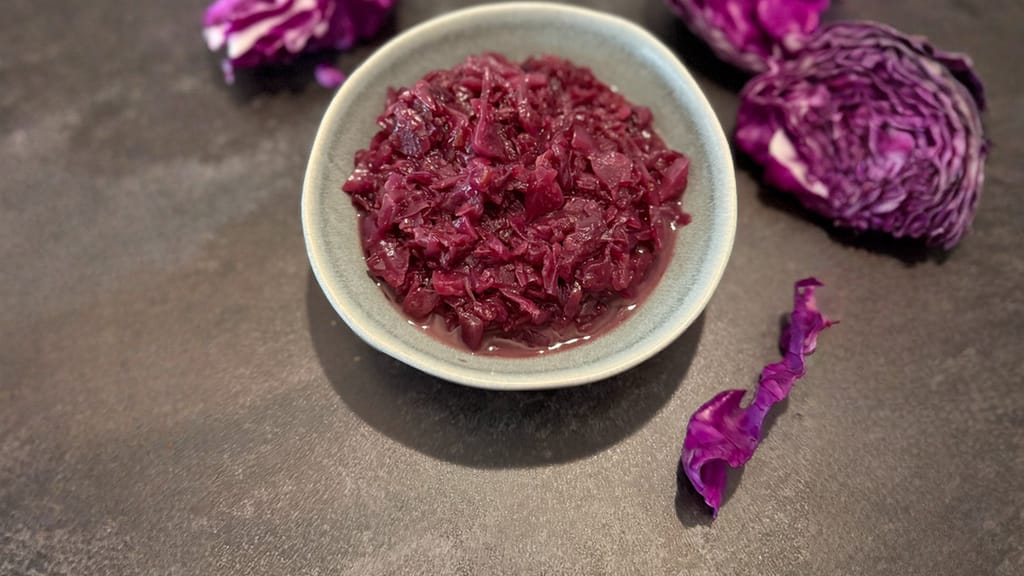
Sweet and sour braised red cabbage
Sweet-and-sour braised red cabbage from a fresh head
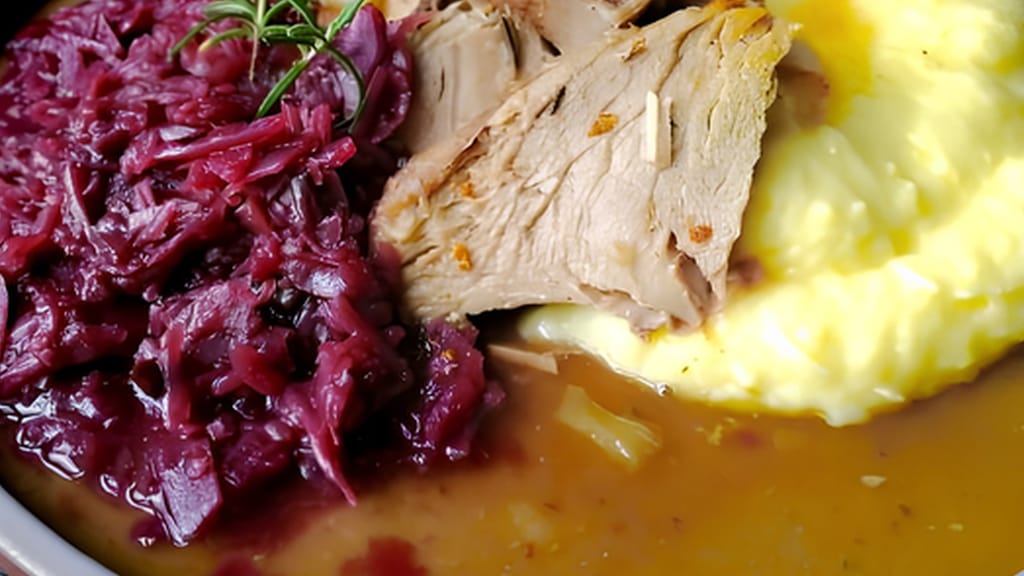
Slow-roasted pork with red cabbage
Slow-roasted pork with braised red cabbage
Fresh cabbage isn't fermented, so you have to add the acidity yourself, usually with vinegar and sugar. White cabbage braises for 30–45 minutes, red for 45–60 minutes.
Prepare the head like this first:
Remove the bruised outer leaves, cut the head into quarters and cut out the hard core.
Slice or shred the quarters into thin strips, about 2–3 mm. The thinner they are, the faster they soften.
From 1 kg of cabbage head you'll have roughly 800–850 g after trimming, which is enough for 4–6 side-dish servings. It wilts down considerably in the pot.
Braising white cabbage: Cook the onion in lard until golden, add the caraway and cabbage, salt it (about a teaspoon per kilogram) and add 100–150 ml of water. Braise, covered, stirring occasionally. When it's soft, season with 1–2 tablespoons of vinegar and sugar until it tastes balanced, and thicken it. If you don't have vinegar, see what to substitute for vinegar.
For red cabbage from a fresh head, add the acid (vinegar, wine, tart apple) right at the start, not at the end. The pigment in red cabbage is an anthocyanin, which stays ruby red in an acidic environment, turns purple in a neutral one and blue to blue-green in an alkaline one. The acid also slows softening, which is why red cabbage braises longer.
You can thicken braised cabbage four ways: a raw potato, a roux, flour stirred into water, or potato starch. Each gives a slightly different texture:
Raw potato (the classic): finely grate one smaller potato per 500 g of cabbage straight into the cabbage and braise for 10 minutes. The potato breaks down, softens the acidity, and the cabbage turns creamy but not gluey.
Roux: in a tablespoon of lard, cook a tablespoon of all-purpose (plain) flour until light golden and stir it into the cabbage. It adds a nutty flavor and makes the cabbage thicker.
Flour in water: stir a tablespoon of all-purpose flour into 50 ml of cold water, pour it into the cabbage and let it bubble for at least 5 minutes so the raw flour taste disappears.
Potato starch: mainly for red cabbage, a teaspoon in cold water is enough. It thickens instantly and the cabbage stays glossy.
Always thicken at the end and a little at a time. The cabbage keeps thickening even after you take it off the heat.
A whole head of cabbage keeps 1–2 weeks in the fridge, according to the US FoodKeeper app (USDA/FSIS) on FoodSafety.gov. Store it unwashed in the vegetable drawer, loosely wrapped in a bag so it doesn't dry out.
Leave the outer leaves on the head, as they protect it. Remove them only just before cooking.
Wrap a cut head tightly in plastic wrap or put it cut side down in a container. Thinly trim off any edge that darkens or dries out before cooking.
We don't recommend washing it before storing, as moisture speeds up spoilage.
Sauerkraut in a jar keeps unopened at room temperature in the pantry until the date on the lid (per the manufacturer). Once opened, put it in the fridge: the US Department of Agriculture (USDA) gives 5–7 days for opened pickled canned foods, store-bought sauerkraut included. Cabbage in a bag always belongs in the fridge, and you should use it by the date on the package (per the manufacturer).
Yes, braised cabbage freezes very well. It's already soft, so it loses almost nothing in the freezer. According to the FoodKeeper app (USDA/FSIS), cooked vegetables as a side dish keep for 1–2 months in the freezer at −18°C (0°F) at best quality. At a steady −18°C it stays safe even longer, it just slowly loses flavor.
Cool it quickly. The US FSIS (USDA) recommends refrigerating cooked food within 2 hours of cooking at the latest. Don't leave it out at room temperature any longer. Spread it in shallow containers so it cools faster.
Freeze it in portions in containers or zip-top bags, press out the air and write the date on them.
Thaw it in the fridge overnight, or reheat it straight from frozen in a pot with a spoonful of water, covered.
Cabbage thickened with flour sometimes separates a little after thawing. Just stir it well as you reheat it.
In the fridge at 4°C (40°F) or below, cooked cabbage keeps 3–4 days, according to the FoodKeeper app (USDA/FSIS).
If you're stocking up anyway, do the side dish too: how to freeze bread and potato dumplings. Have meat left over after the feast? Here's what to do with leftover roast goose and duck. And if you want to freeze raw white cabbage, check out freezing vegetables and blanching.
You can make a main dish from braised sauerkraut too, such as šunkofleky with cabbage (Czech baked pasta with ham) or a savory autumn strudel with cabbage and English bacon. Leftover cabbage from the day before works well in both.
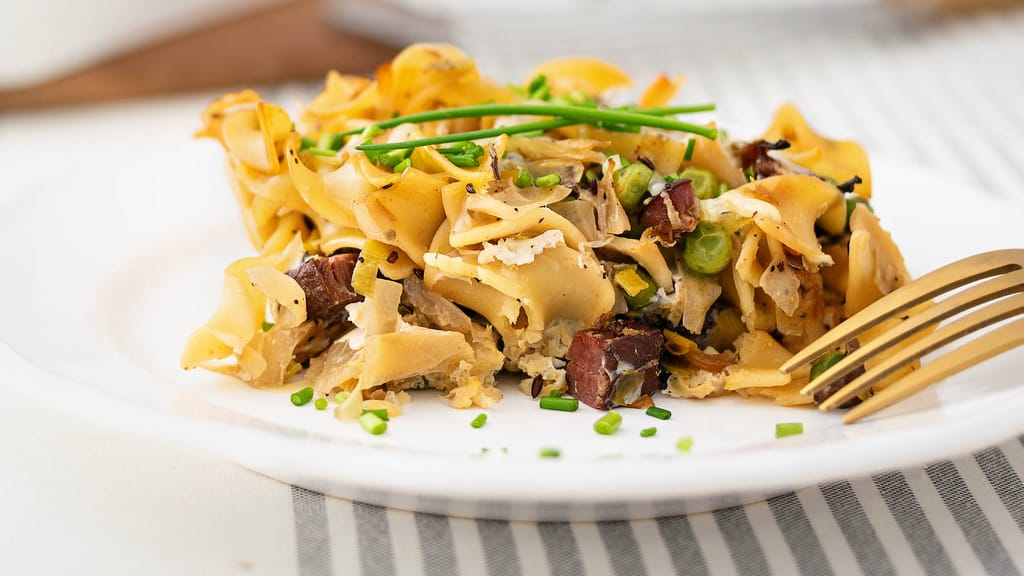
Ham and cabbage flecky pasta bake
Šunkofleky with cabbage made from braised sauerkraut

Autumn cabbage and bacon strudel
Autumn strudel with cabbage and English bacon
For one side-dish serving, allow 150–200 g of cooked braised cabbage. For 4 people, that's roughly 700–800 g of sauerkraut or 1 kg of a fresh head, because the cabbage shrinks after trimming and braising. When cabbage is the main part of the meal, for example with šunkofleky (Czech baked pasta with ham), allow more like 200–250 g per person.
Sterilized cabbage is already heat-treated, so you can eat it just heated through. It will taste much better, though, if you simmer it for 15–20 minutes in lard with onion and caraway so it soaks up the flavor of the fat.
Cooked braised cabbage keeps for 3–4 days in the fridge at 4°C (40°F) or below, according to the FoodKeeper app (USDA/FSIS). Refrigerate it within 2 hours of cooking at the latest (USDA/FSIS) and don't leave it out at room temperature any longer.
Yes, raw cabbage can be frozen, but it's best to shred it and blanch it briefly first. After thawing it's soft, so it suits braising and soups, not salads. According to the FoodKeeper app (USDA/FSIS), it keeps 10–12 months in the freezer.
Opened sauerkraut from a jar keeps 5–7 days in the fridge, according to the USDA guidance for opened pickled canned foods. Transfer it to a clean, airtight container and keep it submerged in its brine.
One recipe worth heating the oven for, one tip, and one deal from the shop. Nothing else.