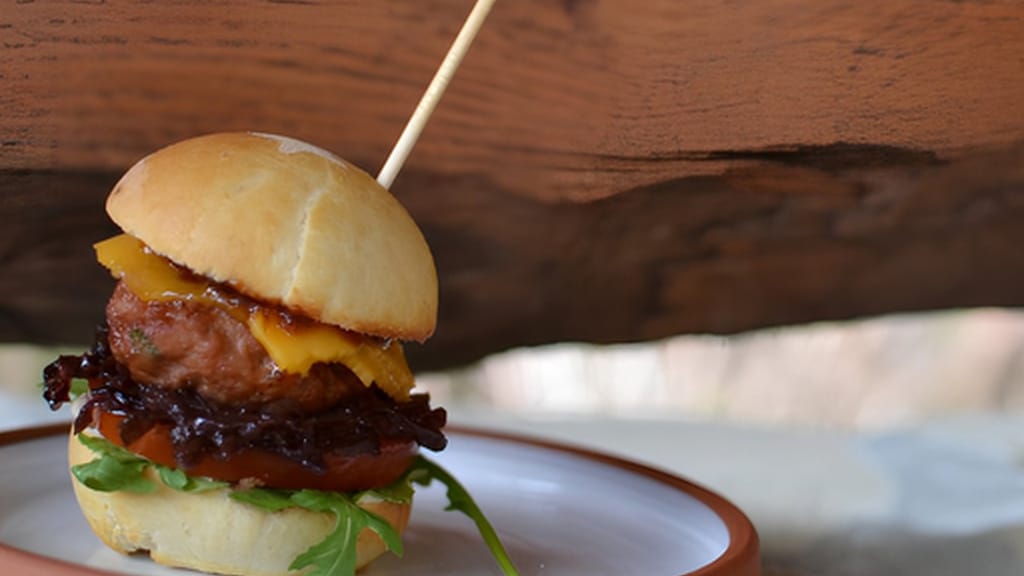
Amazing homemade cheddar and onion burgers
Ground Meat in a Pan: How Long to Fry Burgers, Patties and Meat for Sauce
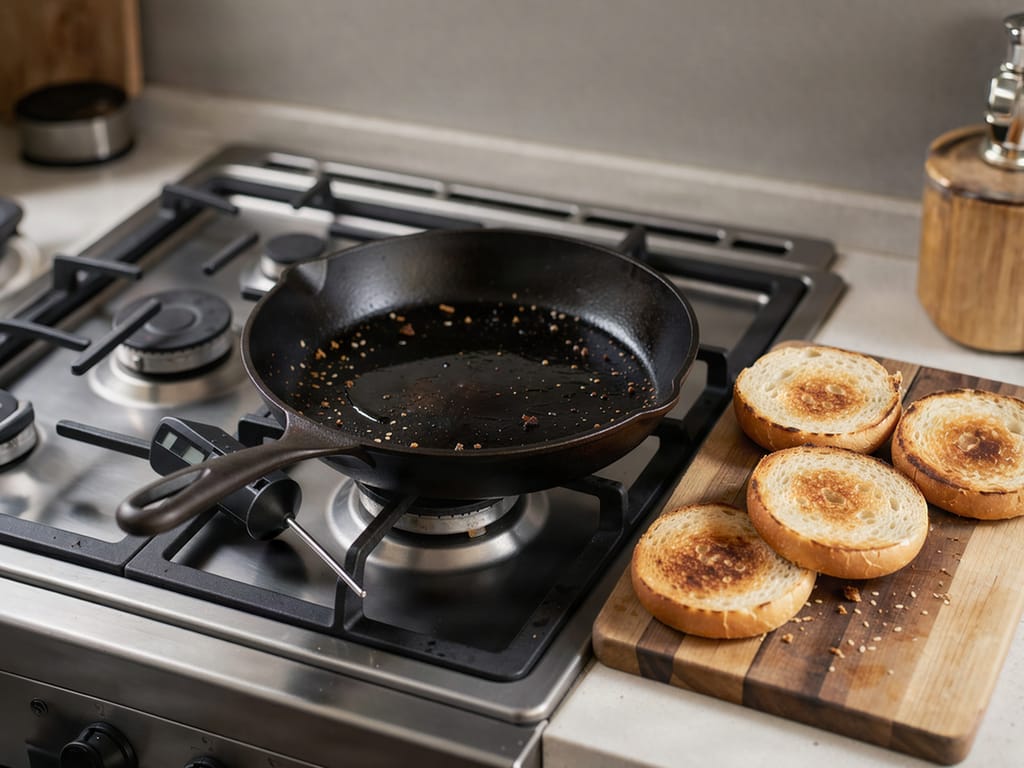
Updated Nov 17, 2026
Ground meat in a pan needs enough time for the center to reach at least 71°C (160°F). For a 1.5 cm (about ½ in) burger, that's roughly 4 minutes per side over medium heat; for karbanátky (Czech-style meat patties), 5–6 minutes per side; and for crumbled ground meat going into a sauce, 6–8 minutes, until every trace of pink is gone. The times are only a guide, though. What counts is the temperature in the middle, because ground meat can't stay pink the way a steak can. Below you'll find times by thickness, a step-by-step method, and how to toast burger buns so they don't go soggy under the juices.
Fry ground meat according to its thickness: a 1.5 cm (½ in) burger about 4 minutes per side, karbanátky 5–6 minutes, crumbled ground meat for sauce 6–8 minutes, always until the center reaches 71°C (160°F). The thicker the piece, the longer it takes and the lower the heat should be, otherwise the outside burns before the middle is cooked. The times below are guideline figures from our kitchen, for meat straight from the fridge, over medium heat (roughly 6 out of 9 on an induction hob). It's done only when a thermometer in the center reads 71°C. According to the US agency USDA/FSIS, that target applies to both ground beef and ground pork.
Smash burger, about 1 cm (⅜ in): 2–3 minutes per side, over high heat
1.5 cm (½ in) burger (about 150 g): 4 minutes per side
2 cm (¾ in) burger (about 200 g): 5–6 minutes per side, covered with a lid toward the end
Burger 3 cm (1¼ in) or thicker: 2–3 minutes per side over high heat, then 8–10 minutes in a 180°C (350°F) oven
Karbanátky 1.5–2 cm (½–¾ in), made with a bread roll or breadcrumbs: 5–6 minutes per side over lower heat
Meatballs, 3 cm (1¼ in) across: 8–10 minutes, turning them as they cook, or just brown them and finish them in the sauce
Crumbled ground meat for sauce: 6–8 minutes, until the pink is gone, then it keeps cooking in the sauce
Meat straight from the fridge needs a minute or two longer than meat that has sat on the counter for 15 minutes. Frozen burgers need more time still. See the questions below for those.
Seasonal baking plans, tested recipes and kitchen tricks that save you time. Unsubscribe in one click.
A burger must be cooked all the way through because on a whole cut of meat the bacteria sit only on the surface, while grinding carries them into the middle of the mixture. A medium steak is safe because searing at high heat kills the bacteria on the surface, and the center was never in contact with the outside. With ground meat, the surface gets mixed through the whole batch during grinding, so as far as bacteria are concerned, the center of a burger is just as "exposed" as its crust.
That's why ground meat is cooked through:
USDA/FSIS: ground beef, pork, veal and lamb to 71°C (160°F) in the center, ground poultry to 74°C (165°F).
UK FSA: burgers cooked so the center holds 70°C for 2 minutes (or 75°C for 30 seconds).
Children, pregnant women, older people and people with weakened immunity should, according to the FSA, eat only well-done burgers. No pink center.
If you want raw beef, make steak tartare from a whole cut of meat. Never from ready-ground meat.
The only reliable way to tell a burger is cooked through is an instant-read probe thermometer: the center must reach at least 71°C (160°F). Insert it from the side into the center of the thickest part and wait until the number settles. Color isn't enough. USDA/FSIS explicitly warns that a burger can turn brown before it reaches a safe temperature, and can stay slightly pink even when it has hit 71°C. The Czech Ministry of Agriculture's food safety portal bezpecnostpotravin.cz (opens in a new tab) gives the same advice: the easiest way to check that poultry and ground meat are cooked through is a probe thermometer.
If you don't have a thermometer, there are backup signs. Don't treat them as proof, though:
the juice that runs out when you press is clear, not red or pink
the meat springs back under your finger and doesn't give like raw dough
when cut open, the center is grayish brown throughout and steam rises from the middle too
For a child's karbanátek, a thermometer is worth it more than anywhere else.
Fry a burger in a hot, heavy pan, flip it only once and don't press it down. Here's how:
Shape it a little wider than the bun. The meat shrinks as it cooks. Make the patty flat and an even thickness so it cooks evenly.
Press a dimple into the center with your thumb. The middle puffs up as it cooks; with a dimple the burger stays flat and cooks more evenly.
Salt only right before frying. Salt mixed into the meat ahead of time draws out proteins and makes the burger dense like a sausage. We have a separate article on how to season ground meat.
Heat a heavy pan with a little oil until the oil starts to ripple. Cast iron or a thick base holds its heat; a thin pan cools down when the meat goes in and the meat starts to steam.
Leave the burger alone until it releases by itself. That's usually after 3–4 minutes. If you move it sooner, you'll tear the crust.
Flip once and don't press it with the spatula. Pressing squeezes out juice and fat. The exception is a smash burger, which is pressed down in the first few seconds and not again.
Add the cheese for the last minute and cover the pan. The steam melts the cheese while the center finishes cooking.
Check the center with a thermometer and let the burger rest for 2 minutes on a board before putting it in the bun.
If your burger cracks and falls apart in the pan, it's almost always down to the binding, not the frying. You'll find the fix in why meatloaf and karbanátky fall apart. For a heartier version, try the recipe for homemade mushroom burgers.
To try the whole process, from shaping the patty to stacking the burger, make these homemade hamburgers with cheddar and caramelized onions:
Amazing homemade cheddar and onion burgers
Homemade hamburgers with cheddar and onions, fried in a pan
Fry karbanátky 1.5–2 cm (½–¾ in) thick for 5–6 minutes per side, over lower heat than for a burger. They contain soaked bread roll, breadcrumbs or egg, so they scorch more quickly, especially with a coating. At a lower temperature they last longer, giving the middle time to cook through.
Oil: about 5–7 mm (¼ in) in the pan, so the karbanátky are submerged to about a third and don't fry dry.
Coating: breadcrumbs turn golden in 2–3 minutes. If they brown sooner, turn the heat down.
Lid: cover the pan for the last few minutes. The steam helps cook the center without burning the coating. Fry the last minute without the lid so the coating crisps up again.
Large batch: fry both sides until golden and finish in a 170–180°C (340–350°F) oven for about 10 minutes. Check that the center reaches 71°C (USDA/FSIS).
Karbanátky with grated vegetables release more water, so fry them a minute longer and cook fewer at a time. You can see this well in beef karbanátky with beetroot, where the beet adds both juiciness and color:
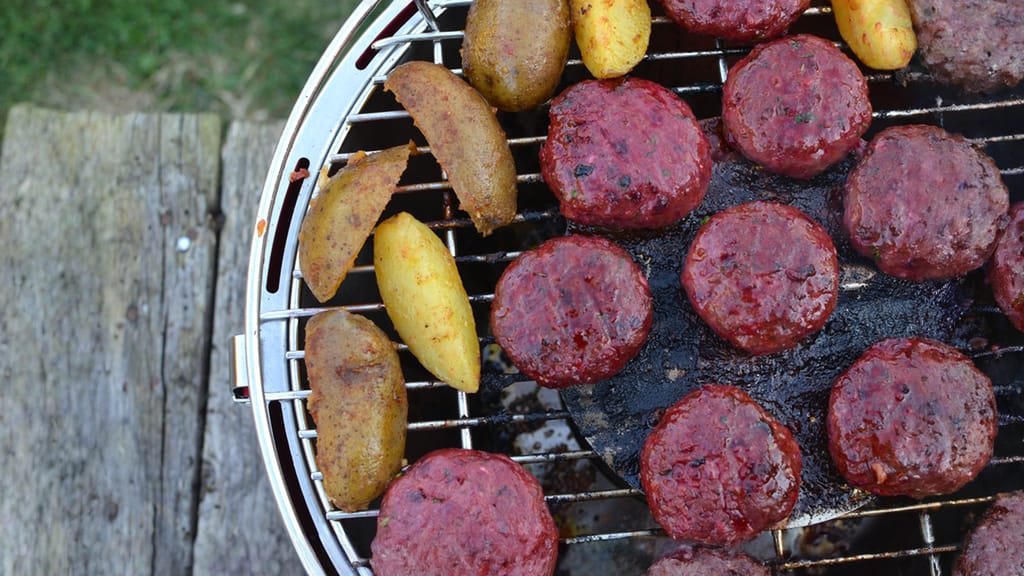
Weekend tip: beef burgers with beetroot
Beef karbanátky with beetroot in a pan
Meatballs 3 cm (1¼ in) across can be cooked through in the pan in 8–10 minutes, or browned for 3–4 minutes and then finished for 10–15 minutes in sauce. In the pan, keep rolling them so they brown all over. Finishing them in gently bubbling sauce is easier, and the meatballs flavor the sauce too.
Just don't crowd too many meatballs into the pan at once. If they touch, they steam instead of browning and won't take on color. That's how it works in the recipe for meatballs in vegetable sauce; for a lighter version with zucchini, try spicy meatballs with zucchini noodles.
Brown ground meat for a sauce over high heat in a thin layer for 6–8 minutes, and don't touch it for the first few minutes. Then break it up with a wooden spoon and keep cooking until all the pink is gone. Gray, watery meat is almost always a sign of a crowded pan.
Max. 500 g per 28 cm (11 in) pan. For more, brown it in two batches.
Let it catch. For the first 2–3 minutes the meat just sits and browns on the underside. That's the flavor you're browning it for.
Let the liquid cook off. When the meat releases juice, don't add anything; wait until it evaporates and the meat starts to sizzle again.
Cook the onion and garlic separately or after the meat. Together with the meat they release water and the meat starts to stew.
After that the meat keeps cooking in the sauce, so you don't need to watch the center temperature here. Just never add meat that's still pink to the sauce. The classic is a slow-cooked Bolognese sauce; a quicker option is a Mexican burrito with beans and ground meat.
Place the halved bun cut side down on a dry or lightly buttered pan over medium heat and toast for 30–60 seconds, until golden. The toasted layer forms a barrier that the juices from the meat and sauce can't soak through, so the bun holds its shape until the last bite.
In butter the flavor is best, but butter burns quickly. Keep the pan on lower heat.
In the pan after the burgers (pour off the fat, leaving only a thin film) the bun soaks up the meat's flavor. The pan is hot, though, so watch it every second.
In the oven under the broiler (grill) at 200°C (400°F), cut side up, for 1–2 minutes. Handy when you're making several burgers at once.
The top of the bun only needs toasting on the inside. Leave the outside soft.
Toast the buns only once the burgers are resting. In a few minutes you'll manage both and nothing goes cold. The ones that hold up best are soft homemade burger buns, which are dense enough not to wilt after toasting:
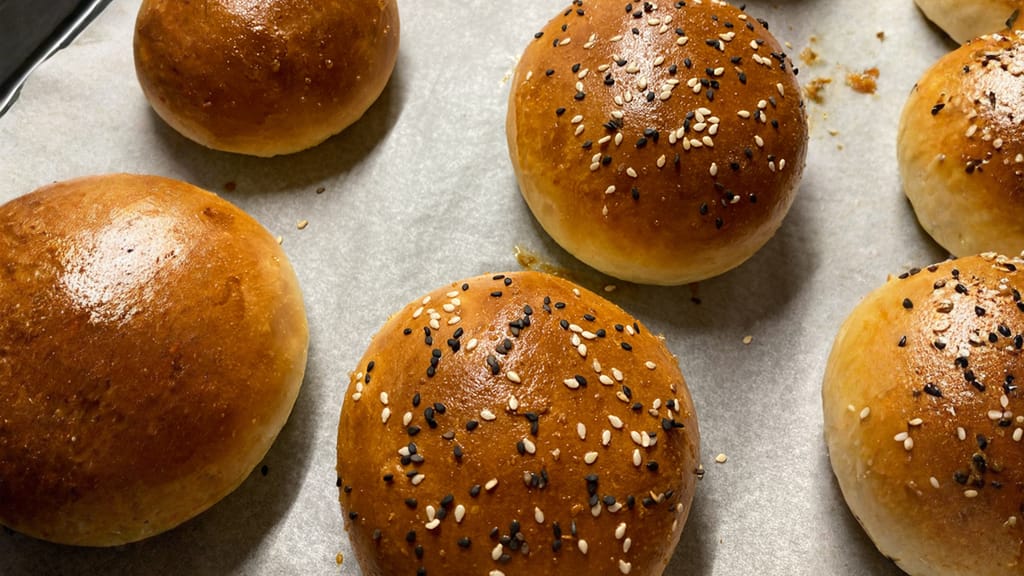
Super soft homemade burger buns
Soft homemade burger buns for toasting
Fry frozen burgers for roughly half as long again as fresh ones. A 1.5 cm (½ in) burger takes about 6 minutes per side over lower heat, so the center can thaw and cook through before the outside burns. USDA/FSIS says meat can be cooked straight from frozen and that it takes about 50% longer. As with a fresh burger, the center must reach at least 71°C (160°F). If you thaw burgers first, do it in the fridge, not at room temperature.
Fry a 1.5 cm (½ in) chicken or turkey burger for about 5 minutes per side over medium heat, until the center reaches 74°C (165°F). According to USDA/FSIS, that is a higher target for ground poultry than for ground beef (71°C). Ground poultry tends to be leaner, so brush the patties with oil and don't cook them any longer than necessary, or they'll dry out.
Don't partly cook burgers or karbanátky and finish them later, because USDA/FSIS advises against partially cooking meat and completing it later. Bacteria in a half-cooked center haven't been destroyed yet, and in the fridge or during further heating they have time to multiply. Either cook the burgers all the way through right away, or shape them raw, cover them, keep them in the fridge and fry them just before eating.
Reheat fried karbanátky in a pan with a lid and a spoonful of water, or in the oven at 160–170°C (320–340°F) for about 10–15 minutes, until the center reaches 74°C (165°F). USDA/FSIS recommends this temperature for reheating leftovers. Refrigerate them within 2 hours of cooking and eat them within 3–4 days (USDA/FSIS). You'll find more methods in our article [how to reheat food without a microwave](/cs/articles/jak-ohrat-jidlo-bez-mikrovlnky).
One recipe worth heating the oven for, one tip, and one deal from the shop. Nothing else.