Dill sauce with slow-roasted beef
How to Rescue Dry Overcooked Meat from the Oven
Updated Sep 17, 2026
Dry, overcooked meat from the oven can be rescued — but not by trying to put the water back in, because that's gone for good. What actually works is something else entirely: thin slices cut against the grain, fat, and warm liquid that coat the meat and fake the feeling of juiciness. This guide covers what to do in the next ten minutes, when it's actually worth cooking it longer instead, and what to do with the meat once slicing is no longer an option.
You can rescue dry, overcooked meat in five steps: slice it thinly against the grain, warm the slices in liquid up to 80°C (176°F), add fat, re-season with salt and acid, and serve it in a sauce or ragù. The whole thing takes about ten minutes.
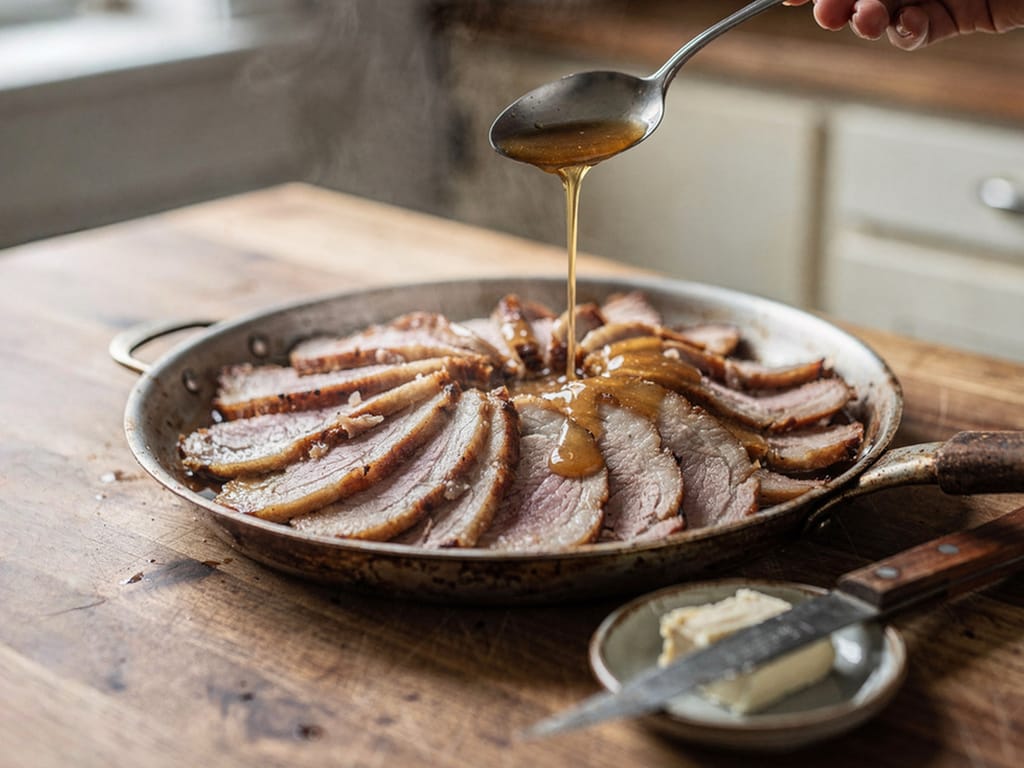
Slice against the grain, 2–3 mm thick. Use a long, sharp knife, cutting perpendicular to the direction of the fibers. This one step alone does most of the work.
Warm it in liquid, not in the oven. In a shallow pan, add about 100 ml of stock or pan juices per 300 g of meat, keep the temperature at 70–80°C (158–176°F), and cover for 5–10 minutes. It must not simmer or boil.
Add fat. 10–20 g of butter, a tablespoon of olive oil, or 2 tablespoons of cream per portion. Fat is what your palate reads as juiciness.
Season it again. Overcooked meat tastes bland because it lost flavor along with its juices. Add salt, pepper, a few drops of lemon juice or vinegar, and a teaspoon of mustard.
Serve it in sauce, not on a dry plate. Let the slices sit in the liquid right up until serving, and spoon the sauce over them, not alongside them.
Seasonal baking plans, tested recipes and kitchen tricks that save you time. Unsubscribe in one click.
Meat dries out because its proteins tighten up as they heat, literally squeezing water out of the fibers — like wringing out a sponge. It doesn't happen gradually; it happens in two distinct jumps.
Myosin starts to firm up around 40°C (104°F) and is fully set by about 53°C (127°F) — moisture loss up to this point is still mild. The second jump happens, according to food science measurements, between 66 and 73°C (151–163°F), when actin denatures — the fibers clamp down hard and force out most of the remaining water. This is the exact point where juicy meat becomes dry.
The other half of the problem is carryover cooking. After coming out of the oven, the internal temperature of a large cut keeps climbing: expect 5–10°C (9–18°F) for big cuts, and up to 14°C (25°F) for a very large roast. So if you pull a chicken exactly at your target temperature, it'll keep climbing several degrees more on its own — and that's what finishes it off.
Key point for any rescue attempt: once actin denatures, the meat's ability to hold onto water drops permanently. Soaking the meat in liquid won't make the fibers reabsorb it. That's why none of the techniques below bring the juiciness back — they all just replace it.
Dry meat crumbles and falls apart into fibers; tough meat, on the other hand, won't chew through and feels rubbery. The distinction matters because each one needs the opposite fix: dry meat can't be cooked back to tenderness, but tough, collagen-rich meat actually needs more time in the oven.
Falls apart into dry fibers, crumbles in your mouth, tastes powdery → overcooked lean meat. Go for slicing, fat, and sauce.
Holds together, feels rubbery, and takes real chewing → undercooked collagen. Put it back in the oven.
If you're dealing with shoulder, pork neck, ribs, chuck, or beef brisket and the meat is tough rather than dry, it's not overcooked — it's undercooked. Collagen only converts into soft gelatin above 70°C (158°F), and that takes hours, not minutes.
What to do: put the meat back in the roasting pan, add 1–2 cm of stock or water, cover it tightly (with a lid, not just foil), and roast at 140–150°C (284–302°F) for another 1.5 to 3 hours, until it falls apart with a fork. Internally, the meat will sit around 85–95°C (185–203°F), which is exactly where you want it.
That gelatin, by the way, is why slow-roasted shoulder tastes juicy even though its muscle fibers are technically long "overcooked" — the melted collagen coats everything, and your palate reads that as juiciness.
Chicken breast, turkey, pork tenderloin, beef tenderloin, and fish can't be brought back to tenderness — they simply don't have enough collagen to convert into gelatin, and the fibers won't reabsorb water. More time in the oven only makes it worse.
The only thing that actually works is substitution: adding fat and gelatin from the outside to coat the fibers and stand in for the lost juiciness. The rest of this article is about how to do that so well no one notices.
The fastest fix for overcooked meat is a knife: slice it 2 to 3 mm thick, cutting perpendicular to the grain. Nothing else improves the texture this quickly or this reliably.
It works for two reasons. First, cutting against the grain shortens the muscle fibers down to a few millimeters, so your jaw doesn't have to tear through them — the toughness disappears even though the meat is still dry. Second, a stack of thin slices has far more surface area than one thick piece, so it picks up much more sauce.
Two practical tips:
Chill the meat before slicing. 20 minutes in the fridge lets you cut noticeably thinner slices, since the meat won't crumble under the knife.
Use a long knife with a smooth blade and pull it through in one motion, not a sawing back-and-forth. We cover how to choose one in our guide to picking the right kitchen knife for every job.
Put the slices in a shallow pan, add enough stock or pan juices to come halfway up the meat, cover, and heat for 5 to 10 minutes at 70–80°C (158–176°F). The liquid must not boil — boiling would squeeze out whatever moisture is left.
Ratios that work: roughly 100 ml of liquid per 300 g of meat, plus 10–20 g of butter or a tablespoon of oil per portion. The fat and liquid form a light emulsion that clings to the slices and stays there right through to the plate.
The best liquid is one that contains gelatin: homemade stock that sets in the fridge, or chilled pan drippings. The gelatin wraps the fibers in a film that reads as juiciness in your mouth. The next best option is a ready-made sauce — cream, tomato, or mushroom based.
One extra trick: overcooked meat is also bland, because the flavor left along with the juices. Season the liquid more boldly than you'd expect — salt, acid (lemon, vinegar, white wine), and a teaspoon of mustard or Worcestershire sauce will bring the flavor profile back.
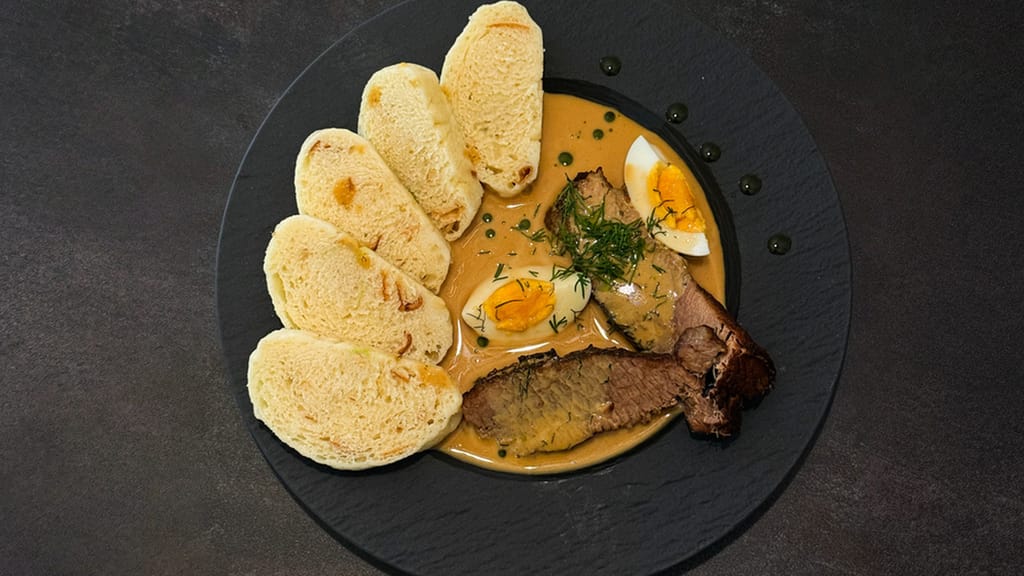
Dill sauce with slow-roasted beef
Dill Sauce with Slow-Roasted Beef — a sauce that hides overcooked beef slices completely
Shredded overcooked meat works five ways: in a pasta ragù, in soup, in a dressed salad, in a mayo-based sandwich, and in a baked dish with sauce and cheese. In all five, the meat gets coated in fat or liquid, so the dryness stops being noticeable.
Shred the meat along the grain into thin strips, using forks or your hands, and do it right over a bowl — any juice still left in the meat should end up there, not on the cutting board.
Pasta ragù. Toss the shredded meat into a tomato or wine-based sauce and let it simmer gently for 20 minutes. For a sense of how a ragù like this should taste, check out our pork ragù slow-braised in red wine.
Soup. The most forgiving option there is: dry meat is practically undetectable in a hot broth. Add it right at the end so it doesn't overcook further — try it in a thick chicken broth with meat and mushrooms.
Dressed salad. The oil in the dressing does exactly what butter does in a pan. Works beautifully with couscous, bulgur, or rice — see our couscous salad with shredded turkey.
Sandwich. Mayonnaise or aioli coats the fibers instantly — try it in a chicken club sandwich.
Baked dish. Stir the meat into a sauce, top with cheese, and bake. Overcooked duck turns into a fantastic potato gnocchi with shredded duck, while overcooked pork roast makes a great base like the one in pulled smoked pork with beans and tomatoes.
Marinating after cooking, the microwave, adding plain water, and putting it back in the oven under foil at 180°C (356°F) — none of these work. All four try to force water back into the fibers, and that door is closed. Skip them:
Marinating after cooking. Marinade only penetrates raw meat about 1–3 mm, and it won't penetrate set fibers at all. It'll flavor the surface but won't fix the texture.
The microwave. It agitates whatever water is left in the meat and drives it out. Overcooked meat comes out of the microwave even drier.
Adding plain water. Without fat, water just washes out what flavor remains, leaving the meat dry and bland. Always use stock or sauce, and always with fat.
Back in the oven under foil at 180°C (356°F). The classic move that only makes things worse. The one exception is tough, collagen-rich meat — but even then it needs a lower temperature, liquid, and hours, not twenty minutes.
There's really one thing that prevents overcooking: an instant-read thermometer. Time and color are guesswork; temperature is a fact. A few key numbers are all you need.
Poultry: the USDA's safe minimum is 74°C (165°F) — for a whole chicken, check both the thickest part of the thigh and the breast. If you want juicier breast meat, factor in carryover cooking and pull the chicken earlier, letting it climb to 74°C (165°F) while it rests.
Pork, whole cuts: 63°C (145°F) plus a 3-minute rest. The old habit of cooking to 75°C (167°F) is exactly why most people only know pork as dry.
Beef roasts: the target temperature after resting is 54–57°C (129–135°F) for medium-rare and 57–63°C (135–145°F) for medium. The lower numbers you'll see floating around online are actually rare.
Pull it earlier than you think you should. For large cuts, pull it 5–10°C (9–18°F) below your target, and up to 14°C (25°F) below for a very large roast — that's exactly how much carryover cooking will add.
Let it rest: 10–20 minutes for a large cut, 5 minutes for a steak or chop. Loosely covered, not sealed airtight.
Two more things that can make up for a lot of mistakes: brine lean meat (50 g salt per liter of water, 30–90 minutes for chicken breast depending on thickness), and roast at a lower temperature — 120–140°C (248–284°F) instead of 200°C (392°F) creates much less of a gap between the surface and the center, so the outside doesn't dry out before the middle is done.
Yes, overcooked meat is safe — overcooking is a texture problem, not a food safety one. What actually matters is how long the meat sat at room temperature after cooking. Up to two hours (or one hour above 32°C/90°F) is fine; beyond that, no amount of reheating will fix it. Get it into the fridge within two hours of coming out of the oven.
Cooked meat in sauce keeps for 3 to 4 days in the fridge at or below 4°C (40°F). Store it fully submerged in the liquid in a sealed container — the sauce protects it from drying out further better than foil does. Reheat the whole portion to at least 70°C (158°F) for 2 minutes before serving, and only reheat it once.
Yes, but only by shredding and adding fat — slicing doesn't help much with these. Fish and turkey breast have very little collagen, so once overcooked they just fall apart into dry fibers. Break them into pieces and mix with mayonnaise, yogurt, or melted butter for a spread, a salad, or fish cakes. Extra time in the oven only makes both worse.
Yes, and it's actually the best way to freeze it. Cover the shredded meat completely with stock or sauce so it's fully submerged — the liquid protects it from freezer burn and it'll keep for 2 to 3 months. Thaw it in the fridge overnight and reheat slowly in that same liquid.
Only if the meat is tough from collagen, not dried out from overcooking. A pressure cooker will genuinely finish a shoulder or brisket to tenderness in 45–60 minutes by breaking collagen down into gelatin. But dry, overcooked chicken breast or pork tenderloin will just lose even more moisture in either appliance — for those, only slicing, fat, and sauce will help.
One recipe worth heating the oven for, one tip, and one deal from the shop. Nothing else.