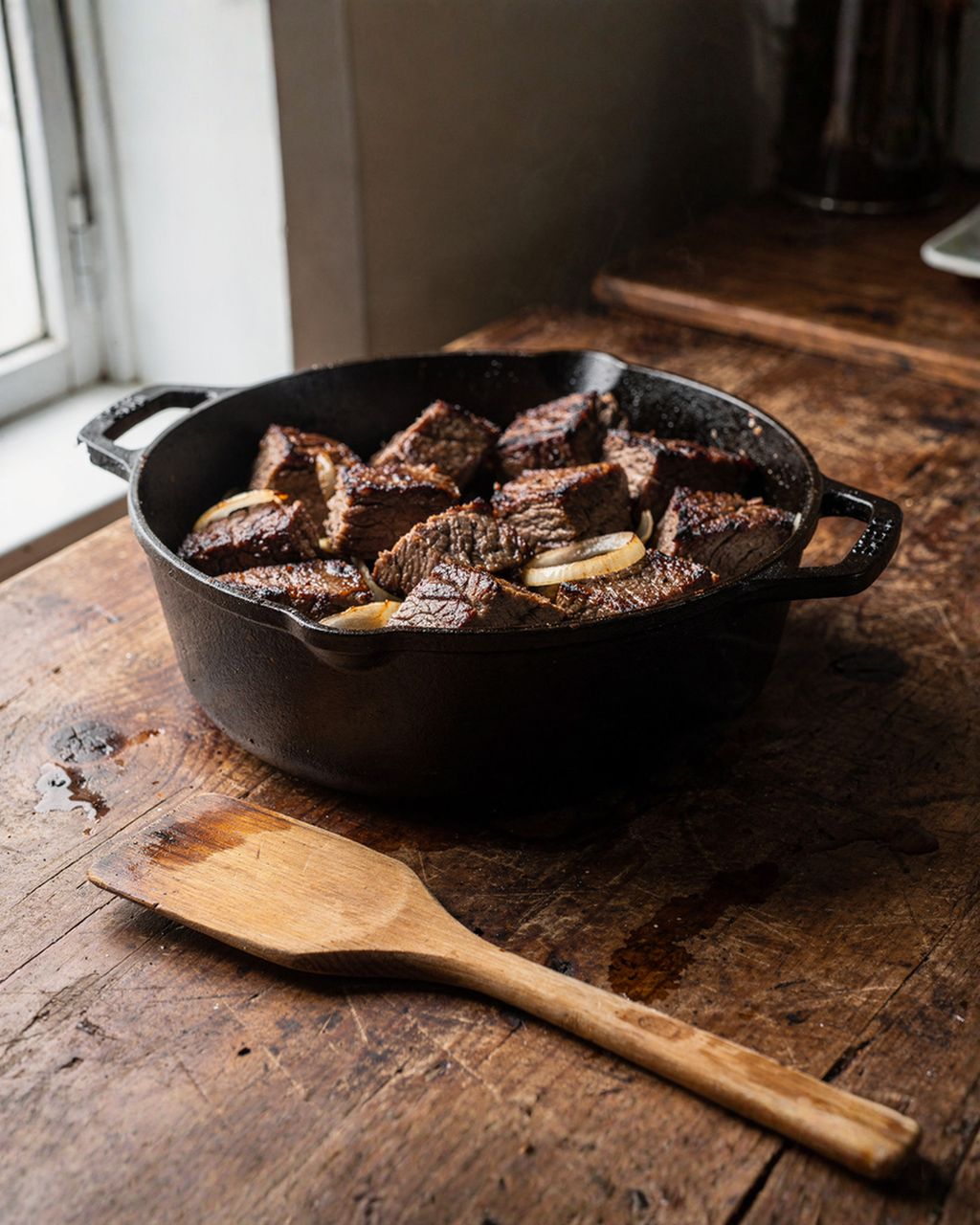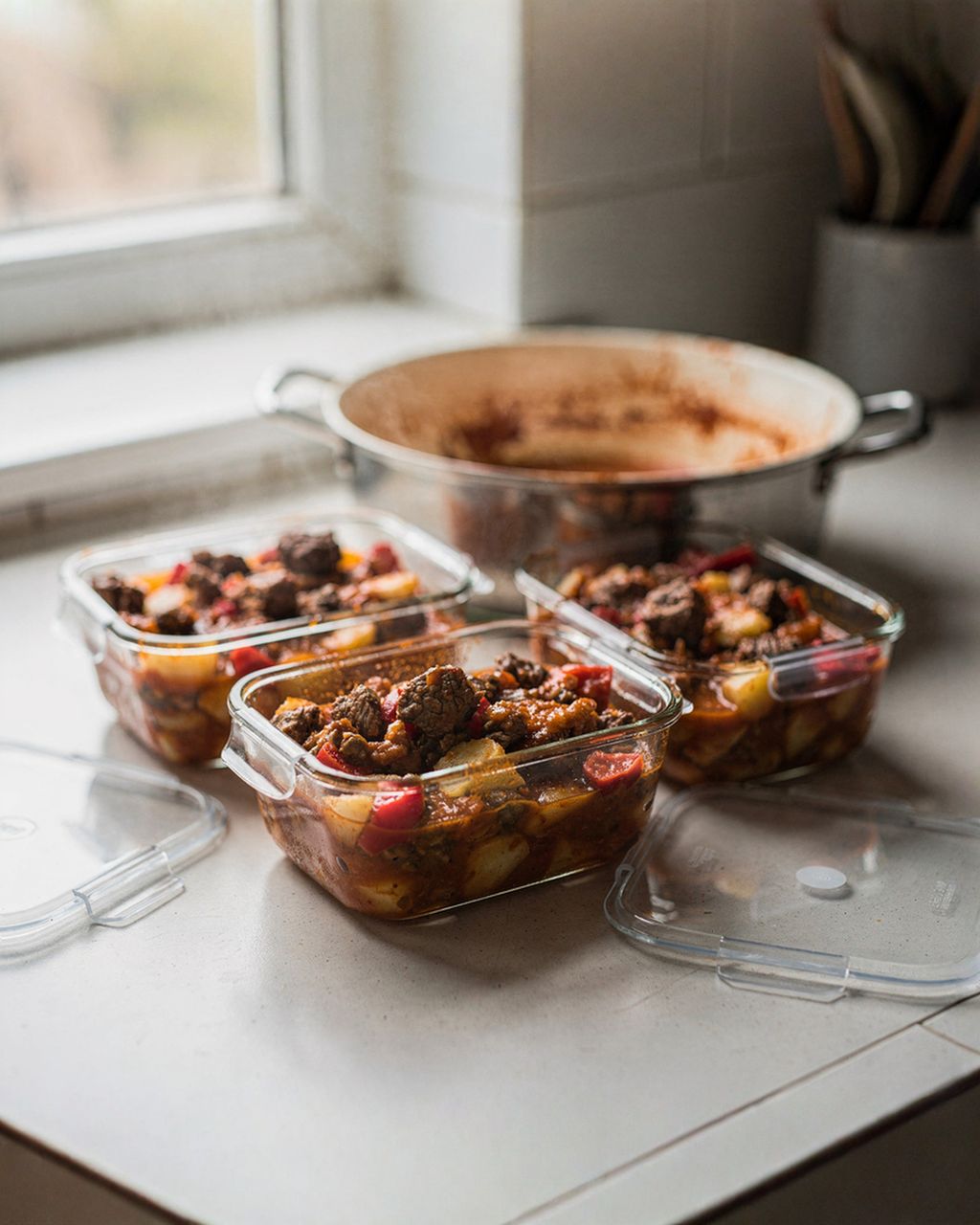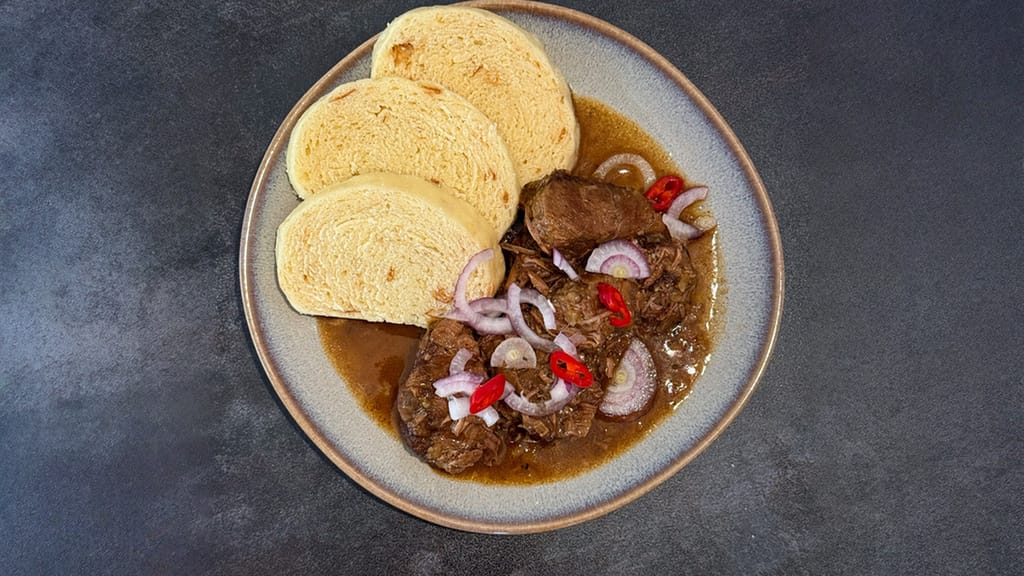
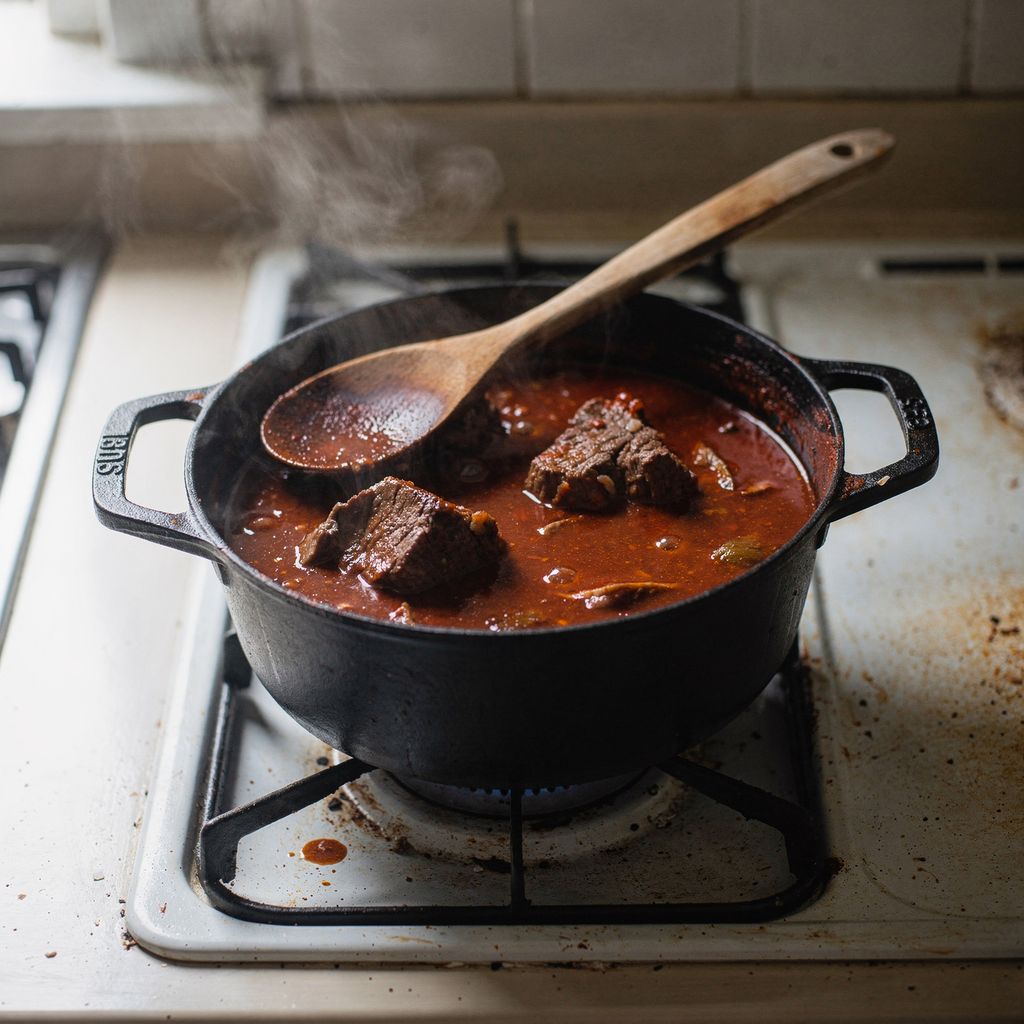
Classic beef goulash with chilli and bread dumpling
Why Is Your Goulash Tough and the Meat Won't Soften?
Updated Oct 6, 2026
Why is your goulash tough? There are five possible causes, but two are by far the most common: the goulash is boiling hard instead of gently simmering, or you took it off the heat before the collagen in the meat had time to break down. The good news is you can fix both today — all you need is more time and a lower flame. Below you'll find all five causes, what's actually happening to the meat in the pot, how many hours it needs, and how to rescue a goulash that's already turned out tough.
Tough goulash almost always comes down to one of five causes: too little simmering time, boiling too hard, lean meat, pieces cut too small, or topping up with cold water.
Not enough simmering time – the collagen in the meat hasn't had a chance to break down yet.
Boiling too hard – at 100°C (212°F), the muscle fibres clench up and squeeze out their juices.
Lean meat – cuts like round or topside don't have enough collagen, so instead of softening they just dry out.
Pieces cut too small – cubes under 2 cm (0.8 in) overcook before they've had time to tenderize.
Cold water added to the pot – this drops the temperature and ends up prolonging the cooking time.
The first two causes are by far the most common — and also the easiest to fix.
Beef for goulash actually gets tougher partway through cooking before it finally turns tender. That's exactly why so many people pull their goulash off the heat at the worst possible moment.
Meat is held together by two things: muscle fibres and collagen, the connective tissue that wraps around them. Each responds to heat differently:
Around 60°C (140°F), the muscle fibres contract and squeeze out moisture like a wrung-out sponge. This is when the meat tightens up and turns rubbery.
From roughly 70°C (158°F) upward, the collagen slowly starts converting into gelatine. This coats the fibres, the meat relaxes, and the sauce thickens and takes on a glossy sheen.
But collagen breakdown isn't just about temperature — it's temperature combined with time. With beef, turning collagen into gelatine takes hours. If you taste it after an hour and a half, you're usually right in that tough middle stage — the fibres have already contracted, but the collagen hasn't let go yet. Don't give up; keep cooking.
Beef for goulash typically needs 2.5-3.5 hours of gentle simmering, depending on the cut and the size of the cubes. As a rough guide:
Beef shoulder: 2.5-3 hrs
Beef neck: 2.5-3 hrs
Shin (fore or hind): 3-4 hrs, but it's the juiciest result of all
Flank, brisket: 2.5-3 hrs
These times are for 3-4 cm (1.2-1.6 in) cubes simmered gently with the lid on, counted from the moment the meat goes into the liquid. Treat the clock as a guide only — it's done once the meat passes the fork test (see below).
Classic beef goulash with chilli and bread dumpling
Classic beef goulash with chilli and bread dumplings
If the meat still hasn't softened after three hours, your goulash is almost certainly boiling instead of simmering. At a full rolling boil (100°C/212°F), the muscle fibres clamp down so hard they force out their juices before the collagen gets a chance to break down. The result is meat that's stringy, dry, and tough all at once.
Here's what the right simmer looks like:
Just the occasional bubble breaking the surface, with the liquid barely trembling. This is called a gentle simmer, roughly 90-95°C (194-203°F).
Turn the heat down as low as it goes – on an electric stove that's often setting 2-3 out of 9.
Keep the pot covered so the liquid doesn't evaporate needlessly.
If your stove can't hold a gentle simmer even on its lowest setting, move the covered pot into the oven at 150°C (300°F) instead. The heat surrounds it from every side, nothing catches on the bottom, and you barely need to keep an eye on it.
Always top up with hot water or stock. Cold liquid drops the temperature by several degrees, and the time it takes the pot to come back up to heat just prolongs the cooking.
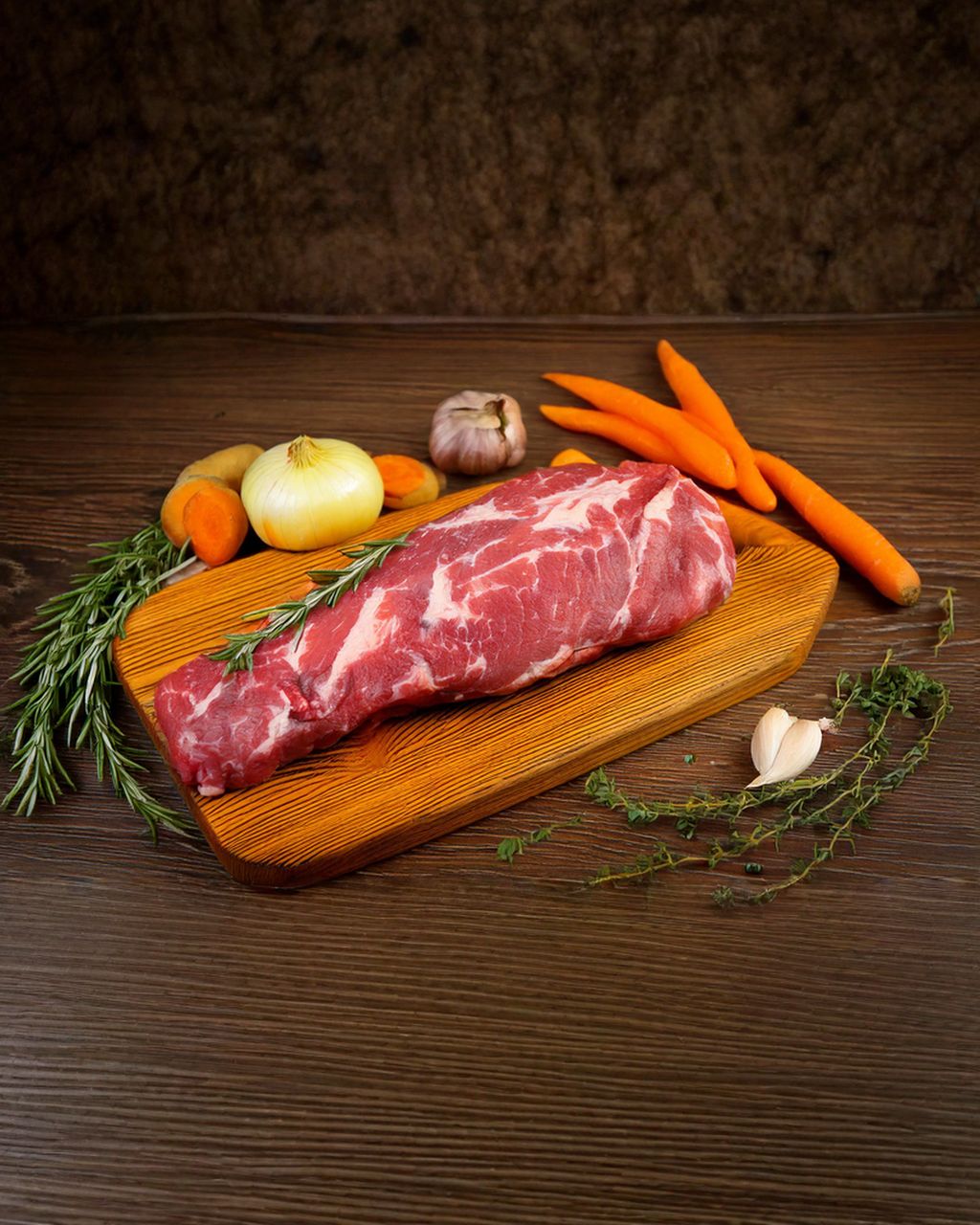
Goulash calls for beef with plenty of connective tissue — shoulder, neck, shin, or flank. Ironically, these "tougher" cuts end up the most tender after a few hours, because their collagen melts down into gelatine.
Lean cuts from the hindquarter, such as round, topside, or silverside, don't have much collagen to begin with. With long simmering there's nothing left to break down — they just dry out, leaving you with a stringy, dry goulash no matter how long you cook it. We break down which cuts suit which dishes in our article Types of Beef: Which Cut for Goulash, Steak, and Roasts.
Two practical prep tips:
Cut into 3-4 cm (1.2-1.6 in) cubes. Smaller pieces overcook before they've softened and fall apart into shreds.
Trim off any membrane or sinew on the surface, but leave the streaks of fat and gelatine running through the inside. These melt down and are what makes the goulash juicy.
The meat in your goulash is done when a fork slides through a cube with no resistance and the cube breaks apart easily with the edge of a spoon. You can't tell by colour or by the clock — you have to taste it.
Fish out two or three pieces from different spots in the pot. Cube sizes vary, and the biggest ones will take the longest to soften.
Let them cool for a minute so you don't burn yourself and can judge the texture properly.
Bite into a piece. If it still springs back rubbery, keep cooking and test again in 20-30 minutes.
The most reliable fix for tough goulash is to keep simmering it — more slowly and for longer. Specifically:
Turn the heat down to barely a simmer, or move the pot into a 150°C (300°F) oven.
Top up with hot liquid so the meat is at least two-thirds submerged.
Cover and give it another 45-90 minutes, tasting every 20-30 minutes.
Hold off on adding more salt. As the sauce reduces, the saltiness will intensify on its own.
If you can't finish it today, let the goulash cool and pick up again the next day — you can pause and resume the simmering with no problems at all.
It's a different story if you've used a lean cut like round or topside and the meat has turned stringy and dry. That won't soften up now, and you can't get the lost juices back. Shred the cubes apart with a fork and let the pieces soak up the sauce — you'll end up with something closer to pulled meat in goulash gravy than classic goulash. Next time, reach for shoulder or shin instead.
If the meat is fine but the sauce is too thin, check out How to Thicken Goulash: 9 Methods and How Much Per Litre.
Acid from wine, vinegar, beer, or tomatoes only tenderizes meat very slightly. It's not a shortcut for fixing tough goulash. It barely penetrates past the surface of the cube, so time and temperature still do almost all the real work. The same goes for marinating meat in something acidic beforehand — it'll flavour the outside, but it won't soften the centre of the cube.
Add wine or beer to your goulash for flavour and colour, not for tenderness. Don't overdo the acidity, either: a very acidic environment can actually firm up the surface of the meat. 200-300 ml of wine or beer per kg of meat is plenty.
Beef goulash made from shoulder or neck, cut into 3-4 cm (1.2-1.6 in) cubes, needs roughly 30-40 minutes under pressure in a pressure cooker, or up to 60 minutes for shin, followed by a slow pressure release. If the meat still isn't tender once you open the lid, put it back under pressure for another 10-15 minutes.
Cook beef goulash in a slow cooker for 7-8 hours on LOW, or 4-5 hours on HIGH. Brown the meat in a pan first — a slow cooker can't sear anything, and without that browning the goulash loses a lot of depth of flavour.
Pork goulash often turns out tough and dry because pork shoulder or neck becomes tender in just 1.5-2 hours, and keeps drying out if you simmer it any longer. If you stew it for three hours the way you would beef, it falls apart into dry strands. Start testing pork with a fork earlier — after about an hour and a quarter.
Pounding, baking soda, and enzymes from pineapple or kiwi don't meaningfully tenderize goulash meat, because only long, slow cooking can break down the collagen inside the cube. Soda and enzymes mainly work on the surface, so with 3-4 cm (1.2-1.6 in) cubes you risk a mushy exterior rather than a tender centre. Baking soda works well on thin strips for a stir-fry, but not on goulash cubes.
Tough goulash is usually just under-stewed, not raw. Cubed beef is cooked through after an hour of cooking — the collagen simply hasn't had time to soften yet. It's safe to eat, but it's better to keep simmering until the meat gives way.
One recipe worth heating the oven for, one tip, and one deal from the shop. Nothing else.