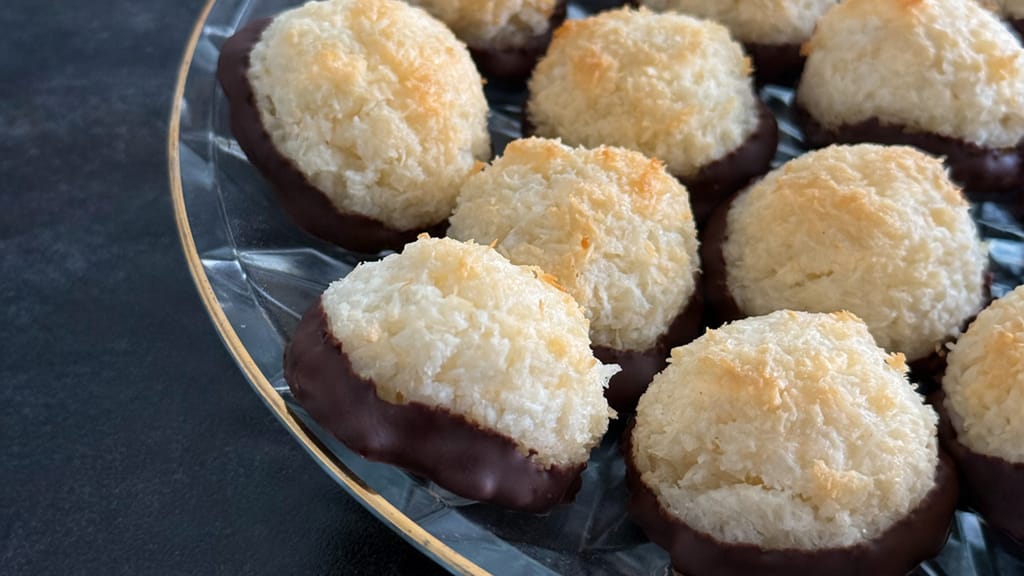
French coconut macaroons with honey and dark chocolate
What to Bake with Coconut: Coconut Macaroons, Coconut Balls, Coconut Cake, Cocoa Stars and No-Bake Treats
What should you bake with coconut? The surest bet is egg white coconut macaroons, followed closely by a coconut sheet cake with a crunchy crust, cocoa stars with coconut cream filling, a banana bundt cake and oat bars. If you'd rather not turn on the oven, make no-bake coconut balls. Shredded coconut goes into almost everything, but not every type of coconut suits every bake: finely ground coconut holds a mixture together, flakes crisp up on top, and coconut flour soaks up liquid like a sponge. Below you'll find which coconut goes where, how to keep macaroons soft inside and what to do with the leftover egg whites.
With shredded coconut you can most often bake macaroons, a sheet cake, Christmas cookies and a bundt cake, and without baking, coconut balls and bites. The whole lineup in one place:
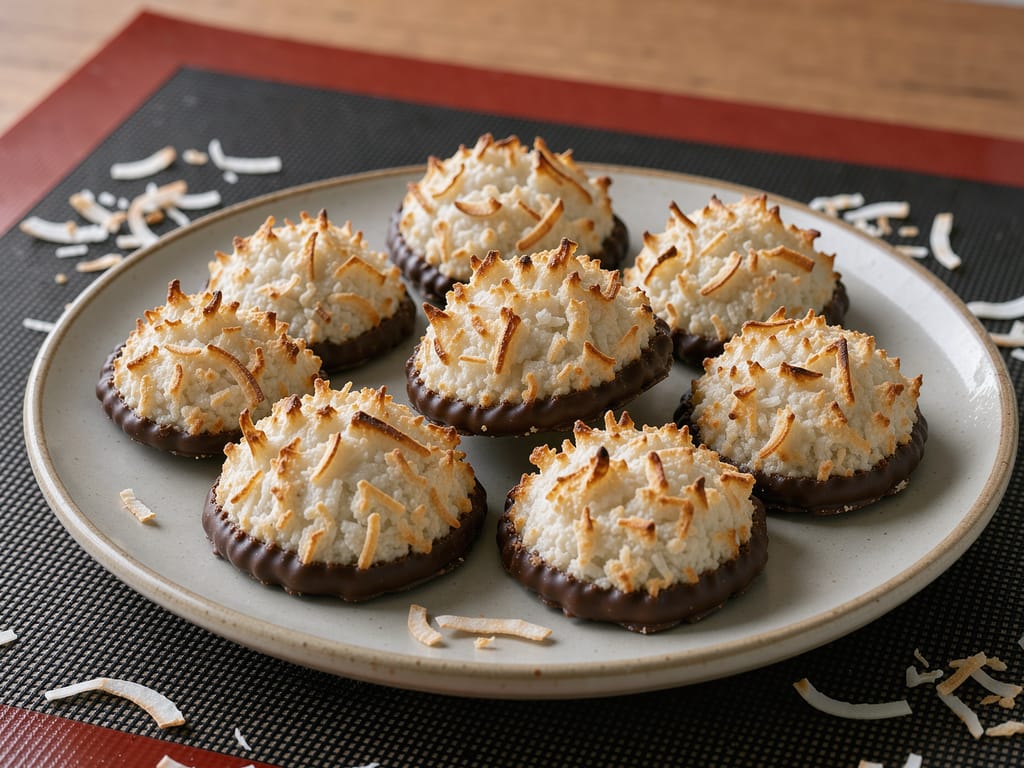
Egg white coconut macaroons with a chocolate bottom: a classic that needs only egg whites, sugar and coconut.
Coconut cake with a crunchy crust: a quick sheet cake for the whole family.
Cocoa stars with coconut cream filling: sandwiched Christmas cookies for your holiday tin.
Coconut balls with almonds and raspberries: no-bake, ready in under an hour.
Cocoa oat and date bites: a no-bake treat with coconut in the mixture.
Banana bundt cake with chocolate: coconut in the batter in place of some of the flour.
Custard cherry tart with coconut: tartlets with a coconut crust and custard filling.
Oat bars with dried fruit: coconut for a snack.
Toasted coconut flakes on peanut butter toast: crunchy coconut for breakfast.
You'll find all of these recipes on Yumsto, and below we add how each one is made and what to watch out for. If you're looking for more ideas for the oven, check out the sweet baking and desserts collection.
We send seasonal cooking and baking plans and recipes made from everyday ingredients. Unsubscribe in one click.
For most coconut baking you need finely shredded coconut, coconut flakes are for decorating and crunch, and coconut flour is added only in small amounts alongside regular flour. All three are made from the dried flesh of the coconut, but they differ in the size of the pieces and in fat content, and that makes a big difference in a batter or dough.
Swapping them isn't just cosmetic. If you use flakes in a recipe that calls for fine coconut, the mixture won't hold its shape. And coconut flour in place of shredded coconut will pull the liquid out of the dough, leaving you with a result as dry as sand. Before you start, read the ingredients carefully and use exactly the type the recipe calls for.
Ground coconut, often sold as shredded, is small pieces of dried coconut flesh with the fat intact. Fine pieces coat easily in egg white, condensed milk or butter and bind into a mixture you can shape. That's why it's the base of macaroons, no-bake balls, coconut fillings and toppings for cakes.
In a bundt cake or tart batter it acts partly like flour: it absorbs a little moisture and adds aroma and fine fiber, but it forms no gluten. That's why recipes combine it with flour, starch or eggs, which hold the structure.
For a stronger flavor, toast it dry in a skillet. Over medium heat, stirring constantly, it turns golden in a few minutes; take it off the heat as soon as it smells fragrant, because the hot pan keeps cooking it even off the burner. So tip the toasted coconut straight onto a cold plate and let it cool in a thin layer. It shines most where there's no more baking: for rolling no-bake balls and bites, or as a topping on finished oatmeal. For macaroons and dough, use it raw, since it will turn golden in the oven. You can toast flakes the same way, though they need an even shorter time.
Coconut flakes are wide, thin slices of coconut flesh that turn golden and crisp in the oven. They're not suited to a dough that needs to bind: large slices don't hold together and your macaroons would fall apart. They're excellent, though, on top of a cake, in breakfast mixes or as baked chips.
If you need fine coconut from flakes, pulse them briefly into small crumbs. The result will be a bit coarser than store-bought shredded coconut, but it works for toppings or balls. It doesn't work the other way around: you can't make flakes from shredded coconut, so buy them separately for toast or for decorating a cake. They toast in the oven in a few minutes, so spread them in a single layer and stir halfway through so they turn golden evenly and the edges don't brown before the center. Sprinkle them on a cake toward the end of baking, otherwise the thin slices will brown before the batter is cooked through.
Coconut flour is made by grinding the flesh after most of the fat has been pressed out. It's fine as powder and extremely absorbent: it takes up much more liquid than wheat flour. So it doesn't replace wheat flour 1:1; roughly a quarter of the amount is usually given, along with extra eggs or liquid. Coconut flour also has no gluten, so it can't bind a dough by itself and crumbles without eggs. It isn't suitable for macaroons, balls or toppings: it lacks the fat and the fibrous pieces that let shredded coconut hold a mixture together. So reach for it only where a recipe specifically calls for it, as in the coconut cake.
In practice you'll most often see it as a supplement alongside regular flour. The coconut cake below uses 80 g coconut flour to 250 g semi-coarse wheat flour (Czech polohrubá), plus 400 ml of milk. If you want to experiment with it more, let the batter rest for a few minutes so the flour has time to absorb the liquid, and only then adjust the consistency. You'll find an overview of other gluten-free flours in the article gluten-free flour and what each one is good for.
You get soft macaroons when you first warm the egg whites and sugar over a water bath, let the mixture rest and bake only until the tips turn golden. Inside they stay soft and chewy, with a thin crisp shell outside. You don't whip the whites to stiff peaks, only warm them with the sugar and stir, so there's no fear of a meringue collapsing. That makes macaroons ideal for egg whites left over from pudding or vanilla cream. They're easiest to work with when the whites are at room temperature, since the sugar dissolves faster.
In the recipe for French coconut macaroons with honey and dark chocolate, you stir the egg whites with sugar and honey in a bowl over gently simmering water to 50–60°C (122–140°F) until the sugar has completely dissolved. After stirring in the coconut, you chill the mixture for at least 30 minutes, then shape pieces of about 20 g and bake them at 170°C (340°F) for 12–15 minutes. You'll find the exact amounts and the full method in the recipe below.
Macaroons most often go hard from overbaking: if you leave them in the oven until they're brown all over, they dry out right to the center. What else matters:
Warming the egg whites with sugar. Dissolved sugar makes a thick syrup that coats the coconut and turns into a chewy center in the oven. Undissolved crystals, on the other hand, make macaroons brittle and crumbly.
Resting in the fridge. In 30 minutes the coconut absorbs moisture, the mixture stops being sticky and the macaroons don't spread on the baking sheet.
Honey. A spoonful of honey holds moisture even after baking, so macaroons stay soft longer than with sugar alone.
Fine coconut. Shredded coconut binds with egg white into a compact mixture; coarser flakes leave air between them and the result dries out.
The same size. Pieces of 20 g bake at the same rate. Small macaroons on a tray with large ones go hard before the large ones are baked through.
Taking them out in time. They're done when the tips are golden but the sides are still pale. Let them cool completely on the baking sheet, where they firm up.
Melt the chocolate over a water bath just until smooth, and dip the bottoms only once the macaroons have cooled completely. On warm macaroons the chocolate would run, soak in and not set.
French coconut macaroons with honey and dark chocolate
French coconut macaroons with honey and dark chocolate: soft egg white macaroons with a chocolate bottom
Macaroons are one of the best ways to use up egg whites: count on roughly two to three whites per 100 g of coconut. If you still have whites left after baking, read what to bake with egg whites and how to use up extra whites.
It works the other way around too. Any yolks left over from the macaroons are good in the custard cherry tart with coconut below, which uses two.
Coconut cake is the quickest way to bake a whole tray with coconut: you mix the batter in a few minutes, and the crunchy crust comes from cream poured over the hot surface.
In the recipe for coconut cake with a crunchy cream crust, a soft batter made with coconut flour bakes under a topping of shredded coconut and powdered sugar, for about 30 minutes at 180°C (350°F), until the topping turns golden. Right after taking it out, you pour whipping cream evenly over the cake. The cream soaks into the coconut and, together with the sugar, turns it into a crunchy crust. You'll find the exact amounts and the full method in the recipe below the text.
Two things decide the result. Let the melted fat cool a little before you add it to the egg and sugar foam: hot, it would combine poorly with the foam. And pour the cream onto the cake while it's really hot: on a cooled cake it would just sit on top and no crust would form. The tray cuts into 16 pieces, and the whole thing takes 52 minutes.
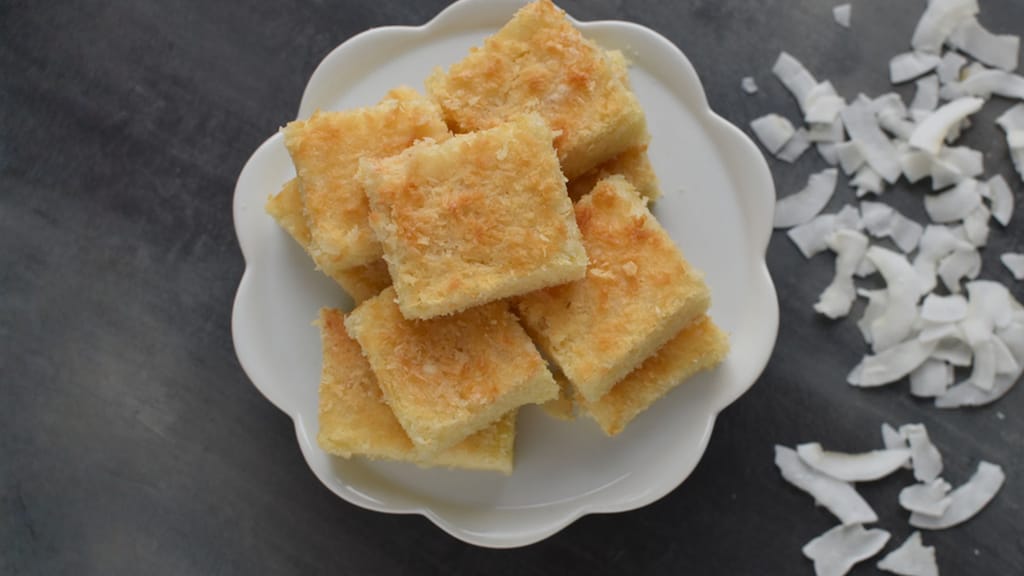
Coconut sheet cake with a crunchy cream crust
Coconut cake with a crunchy cream crust made with shredded coconut and coconut flour
For a holiday tin, the best coconut option is sandwich cookies with coconut filling, because blended coconut cream holds its shape and doesn't crumble.
Cocoa stars with coconut cream filling are cut-out cocoa stars sandwiched with coconut cream and dipped in a dark chocolate coating melted with coconut oil. The dough needs to rest in the fridge, ideally until the next day, and the filling is made from shredded coconut blended with coconut oil into a smooth cream. You'll find the whole method step by step in the recipe below the text.
Blending the filling isn't a pointless step: it makes the shredded coconut finer, so the cream doesn't crumble. The coconut oil in the coating makes it glossy and slightly flexible, but it also sets slowly at room temperature, which is why the recipe sends the stars to the fridge. If you don't have coconut fat at home or don't want to use it, read what to use instead of coconut fat in cookies and coatings. Keep in mind that, with the overnight rest for the dough, this is a two-day job.
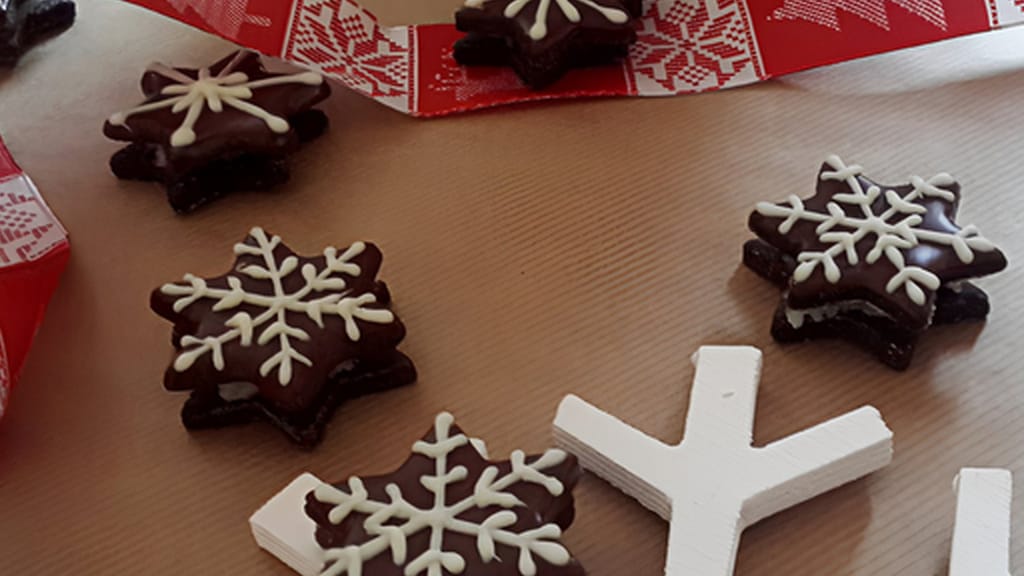
Cocoa star cookies with coconut cream
Cocoa stars with coconut cream filling: sandwiched coconut Christmas cookies in chocolate
Without baking, the easiest things to make from coconut are coconut balls, where condensed milk binds the shredded coconut, or bites, where dates hold it together.
Coconut balls with almonds and raspberries hold together thanks to sweetened condensed milk, which binds shredded coconut with ground almonds. A whole almond hides inside each ball, and a coating of crushed freeze-dried raspberries gives them color and tartness. They're ready in 55 minutes and you store them in the fridge; you'll find the batch size and method in the recipe below.
Cocoa oat and date bites are even quicker, ready in 20 minutes. Blended dates and rolled oats hold the mixture together, and the coconut is there mainly for aroma. If the mixture sticks to your hands, dampen them lightly. You'll find the exact amounts in the recipe.
You can also roll no-bake balls in colored coconut, which looks festive on the table. How to do it at home is explained in the guide how to color coconut with food coloring.
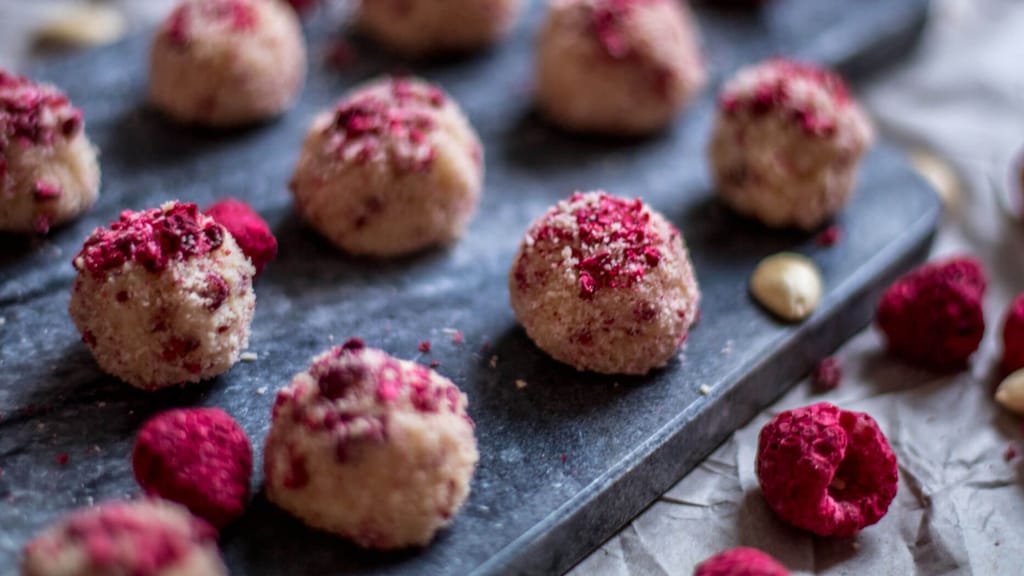
Coconut almond balls with raspberries
Coconut balls with almonds and raspberries: a no-bake coconut treat with an almond inside
In a bundt cake or tart, coconut replaces part of the flour, adds aroma and moistens the batter; in gluten-free baking it helps keep things soft.
The gluten-free banana bundt cake with chocolate relies on cornmeal, cooked jasmine rice and 100 g of shredded coconut, which gives the gluten-free batter aroma and moisture. You grease the pan and dust it with cornmeal or coconut; the recipe points out that the flour for dusting should also be one labeled gluten-free. You can replace part of the shredded coconut in the bundt cake with ground almonds: the batter stays moist, it just smells less of coconut. Don't put flakes or coconut flour in the batter instead. Flakes won't bind in the mixture, and flour would soak up the moisture a gluten-free bundt cake needs. You'll find the full method in the recipe below.
The custard cherry tart with coconut, scented with cardamom is almost entirely coconut: you fill tartlets made from coconut dough with a custard of coconut milk and egg yolks and arrange cherries on top. The filling is runny, but it sets into a custard as it bakes; the tart is done when the filling is set and starts turning pink around the edges. You'll find the method in the recipe below.
Coconut milk appears here only as the liquid in the dough and filling. What else you can cook with it, from curries to soups, is covered in the article what to cook with coconut milk.
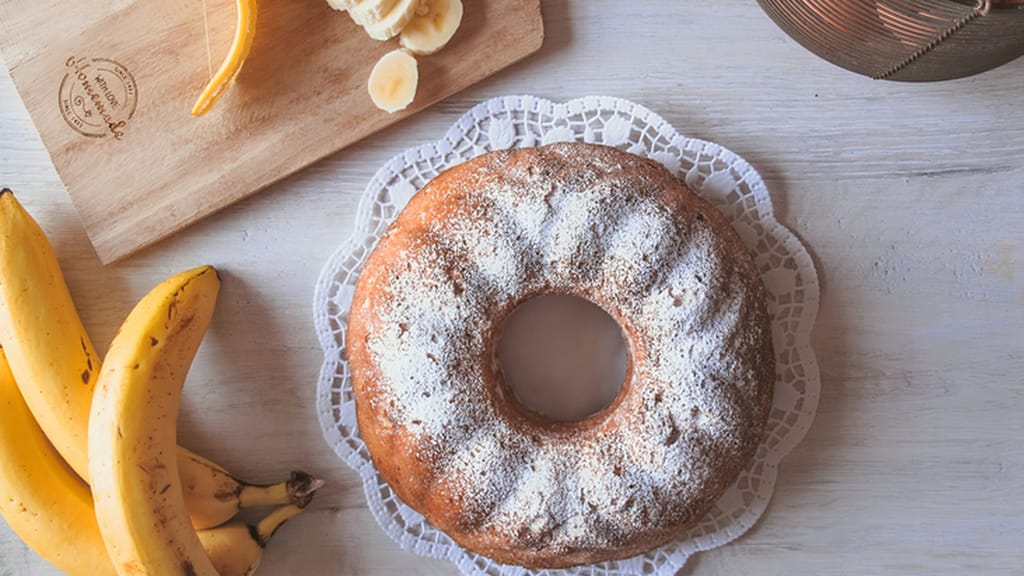
Gluten-free banana bundt cake with chocolate
Gluten-free banana bundt cake with chocolate, made with cornmeal and shredded coconut
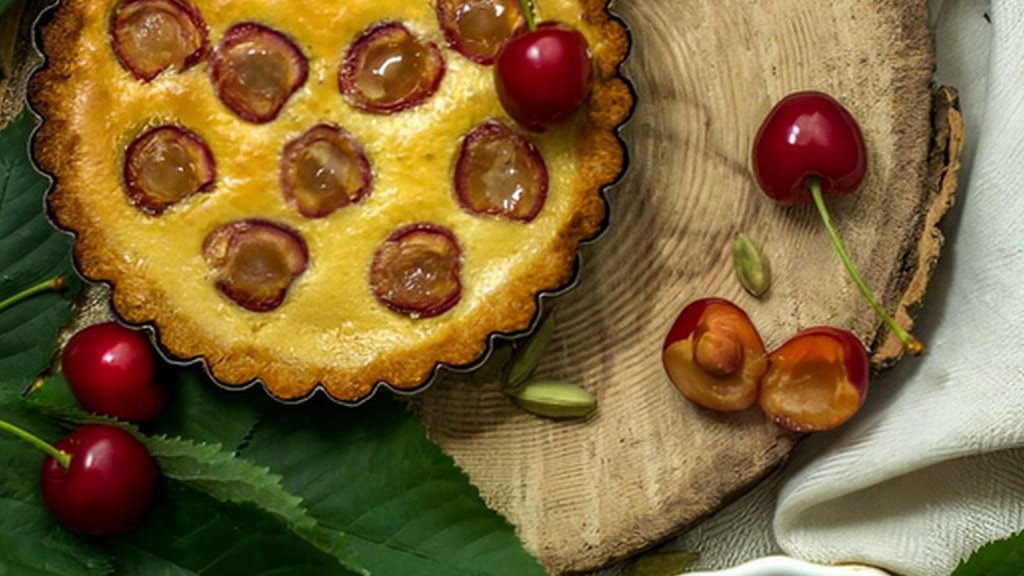
Cardamom coconut pudding cake with cherries
Custard cherry tart with coconut, scented with cardamom: coconut tartlets with custard filling and cherries
For everyday baking, coconut suits oat bars, where there's just a little for aroma, and toasted coconut flakes, which add a crunchy accent to bread.
Oat bars with dried fruit are so simple that you can make them even with kids. Plain yogurt binds a dough of rolled oats and whole grain spelt flour, dried fruit adds sweetness and 15 g of shredded coconut is there just for aroma. You bake the mixture in a baking pan as one slab and cut it into bars once cooled; the whole thing takes 40 minutes. If you don't have coconut at home, feel free to leave it out or replace it with the same amount of sunflower seeds, which are already in the dough. If you like coconut, sprinkle it over the top of the slab before baking. It turns golden in the oven and scents the bars more than coconut hidden in the dough. You'll find the exact amounts in the recipe below.
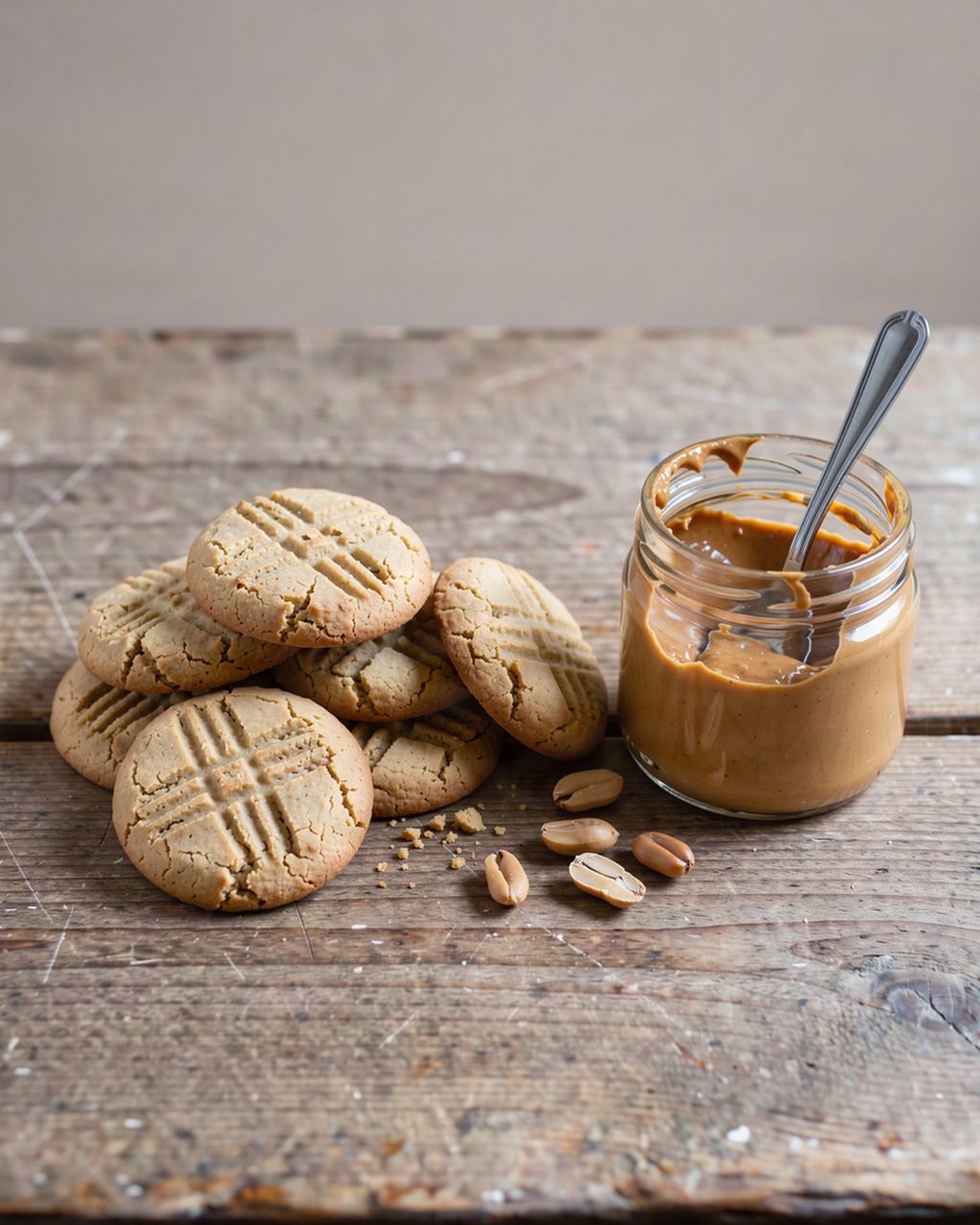
Coconut flakes can also be baked savory. In the recipe for peanut butter toast with coconut chips, you season them with smoked paprika and tamari soy sauce and bake them briefly in the oven until crisp. Keep an eye on the flakes: thin slices brown within a minute, so don't leave them in the oven unattended. You'll find what goes on the plate with them in the recipe.
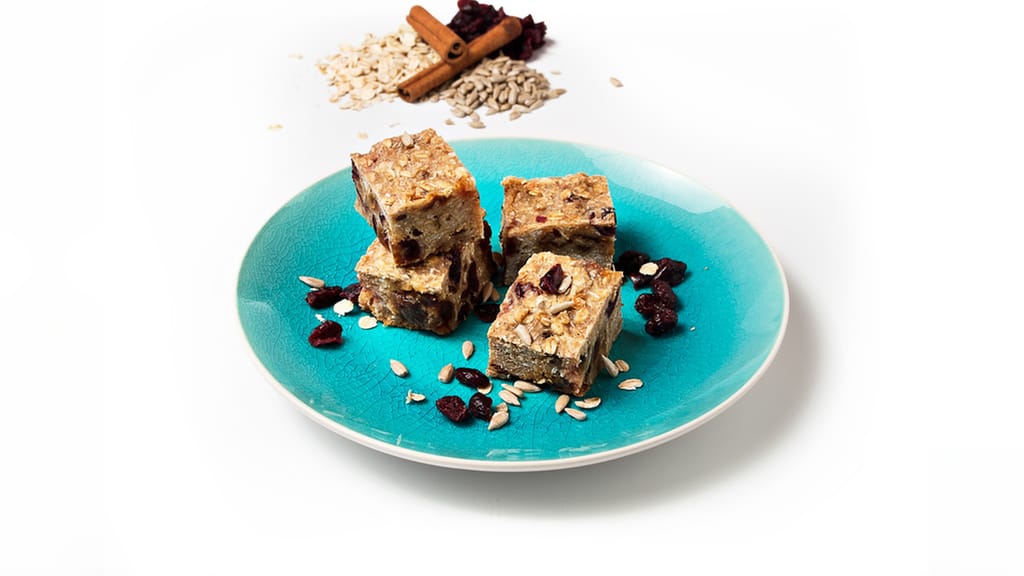
Oat bars with dried fruit
Oat bars with dried fruit and shredded coconut for a snack
Store macaroons in a closed tin at room temperature, and no-bake balls with condensed milk in the fridge. Each type of coconut bake has different needs:
Macaroons: a closed tin at room temperature, layers separated with parchment paper so the chocolate bottoms don't stick together. Don't put them in the same box as crisp cookies, since the moisture from the macaroons would soften them.
Coconut balls with condensed milk: in the fridge, as the recipe says.
Cocoa stars: the coating with coconut oil softens in warmth, so keep the box somewhere cool.
Coconut cake: because of the cream crust, store it covered in the fridge.
Oat bars and bundt cake: covered, so they don't dry out.
And the coconut itself? Shredded coconut and flakes both contain enough fat that, in an open bag in light and warmth, they will eventually go rancid. Transfer them to a resealable container and store in a dry, cool pantry. Give them a sniff before using: fresh coconut smells sweet and nutty, while rancid coconut smells sharp, like old butter, and doesn't belong in a batter.
No. Besides coconut flour, it contains semi-coarse wheat flour (Czech polohrubá, slightly grittier than all-purpose). If you're baking gluten-free, go for the banana bundt cake made with cornmeal, and use flour labeled gluten-free for dusting the pan too.
Most often because the mixture is too loose: the sugar hasn't dissolved, or the coconut hasn't had time to absorb the moisture. Warm the egg whites and sugar over a water bath until completely dissolved, then let the mixture rest in the fridge for at least 30 minutes before shaping.
Yes, macaroons without honey bake just the same, but they will be a little drier and go hard sooner, because honey holds moisture in the mixture. So watch the oven time closely and take them out as soon as the tips turn golden.
Because it contains coconut oil, which sets slowly at room temperature. Put the dipped stars in the fridge, where the coating will set.
The closest substitute is ground blanched almonds, which behave similarly in dough and also appear in coconut balls alongside the coconut. The flavor will change, though, and in egg white macaroons almonds can't fully replace coconut, because the mixture holds its shape less well.
One recipe worth heating the oven for, one tip, and one deal from the shop. Nothing else.