Lentil salad with pork tenderloin
Pork Tenderloin: Oven and Pan Recipes with Plums, Stuffed, with Sauce, and What Temperature to Cook It To
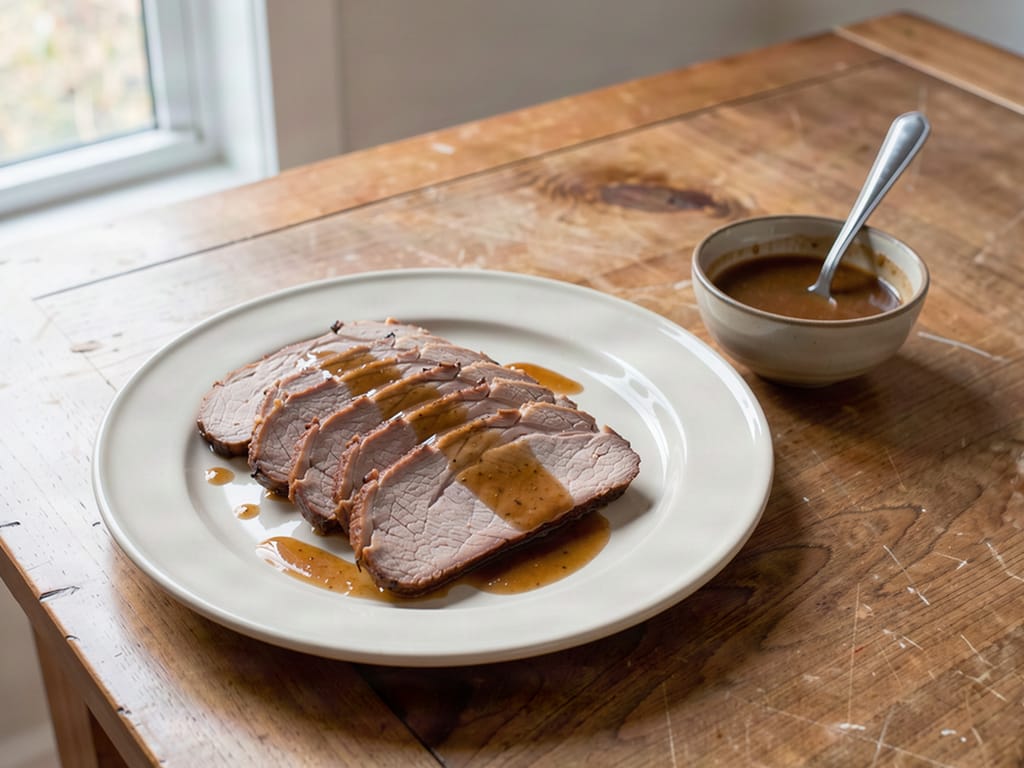
Pork tenderloin is the most tender, leanest cut of pork, and it suits quick, short cooking best: sear it hard in a pan and finish it whole in the oven, or slice it into medallions and cook it like a quick pan-fry. It's done when the center reaches 63°C (145°F) on an instant-read thermometer, followed by a rest of at least 3 minutes. That's the guidance of the US food safety agency FSIS. Below you'll find how to trim the silverskin, how to slice it, six tested recipes with plums, bacon, zucchini, mustard and noodles, and three sauces you can make from the pan drippings.
Pork tenderloin is a long, narrow muscle that runs under the spine inside the loin area of the pig. It barely works, which is why it's tender, with no sinew and very little visible fat. A whole one usually weighs 400–700 g (14 oz–1.5 lb) and is about 30–40 cm (12–16 in) long: it has a thick head at one end and tapers to a thin tail at the other.
That explains the whole rule for cooking it. Ham or shoulder needs hours to break down connective tissue. Tenderloin has none, so long braising adds nothing and only drives out the juices. It wants intense heat on the surface and a short, closely watched time inside. Overcooked tenderloin is dry and stringy; properly cooked, it's pinkish-white, juicy and practically slices itself.
If you're choosing between cuts, you'll find a comparison in types of pork and what to cook from each cut. For ideas using leg, neck and belly, there's an overview of what to cook with pork and a whole collection of pork recipes.
Plan on 150–200 g (5–7 oz) of raw tenderloin per person. One average tenderloin therefore feeds two to four people, depending on how hearty a side you serve with it.
One recipe and one tip every Thursday until the end of the year. Unsubscribe in one click.
For the holidays: the morning of December 24, carp roasting times by size and December 31, New Year’s Eve canapés.
A good tenderloin is light pink to pinkish-red, firm to the touch, and smells neutral, almost slightly sweet. Gray edges, a sticky surface or a sour smell mean it's old.
Pick a piece of even thickness along its whole length. It cooks more evenly than a tenderloin with a big head and a very thin tail.
There shouldn't be much liquid in the package. A lot of liquid is often a sign the meat was thawed or has been sitting a long time.
At home, store it in the coldest part of the fridge, on the bottom shelf so nothing drips onto other food, and cook it by the date on the package.
Before cooking, let it sit on the counter at room temperature for about 20–30 minutes. Meat that's less chilled cooks more evenly, but don't leave it out for more than 2 hours.
Cut off the silvery membrane, or the meat will curl as it cooks and the membrane will stay tough as a rubber band. It's a shiny, pearly white strip on the surface, most of it near the head. Fat and silverskin aren't the same thing: leave the soft white fat, but not the membrane.
Don't rinse the tenderloin. Water would only spread bacteria from the raw meat around the sink. Pat it dry with a paper towel.
Slide the tip of a thin, sharp knife under the edge of the membrane and cut it free along a strip about 2 cm (¾ in) wide.
Grab the loose end with your fingers, angle the knife blade slightly upward toward the membrane, and run it along the meat. Pull the membrane the opposite way with your other hand.
Keep going in strips until the surface is a matte pink. Throw away the trimmed pieces of membrane.
The thin side muscle (the "chain") that comes away from the tenderloin on its own can be cut off and sliced into strips for a quick wok stir-fry.
You'll know it's done when you run a finger over the surface and nothing feels slippery or crunchy. If the tail is still much thinner than the rest after trimming, tuck it under the meat and tie it with kitchen string, or cut it off and use it separately. Otherwise the tail will be long overcooked before the head is done.
Cut medallions from the trimmed tenderloin across the grain, ideally 3–5 cm (1¼–2 in) thick. Thinner slices overcook quickly in the pan, while thicker ones stay juicier inside and can be stuffed.
Start at the head and cut with one stroke of a long knife, without sawing.
Leave the thin tail whole, or cut two pieces from it and stack them, so the medallions are similar in height and finish cooking at the same time.
Stand each medallion on its cut side and press it lightly with your palm. It evens out and browns uniformly.
If you like, wrap a strip of bacon or kitchen string around the edge. It holds the shape and keeps the medallion from spreading into a patty.
Salt the medallions right before searing. Salt applied long beforehand draws water to the surface, and the meat then steams instead of browning.
What matters is the temperature inside the meat, not the oven temperature: tenderloin is done when the thickest part reaches 63°C (145°F) and it then rests for at least 3 minutes. That's the safe minimum the US food safety agency FSIS gives for whole cuts of pork (roasts, chops, tenderloin). Measure with an instant-read thermometer inserted from the side into the center of the thickest part, not into the tail and not down to the bottom of the pan.
During the rest, the internal temperature rises a few more degrees and the juices redistribute through the whole piece, so they don't run out onto the board when you slice. Meat at 63°C (145°F) is often slightly pink in the center. According to FSIS, that's fine for pork that has reached a safe temperature: color says nothing about doneness, the thermometer does.
A moderate oven of 160–180°C (325–350°F) is usually enough, because the surface has already browned in the pan. You'll find exact temperatures and times for whole tenderloin and other cuts of pork in pork in the oven: what temperature to roast neck, tenderloin, leg and shoulder.
Sear a whole tenderloin hard on all sides in a pan first, then finish it briefly in the oven. The pan gives you crust and flavor, and the oven cooks the center evenly without drying out the edges.
Heat the oven to 170–180°C (340–350°F). Trim and dry the tenderloin, tuck the tail under and tie it.
Season with salt and pepper and sear it in an ovenproof pan in hot oil for about 1–2 minutes per side, until it has a brown crust all over.
Move the pan to the oven and roast until an instant-read thermometer in the thickest part reads 63°C (145°F).
Transfer the meat to a board, tent it loosely with aluminum foil and let it rest for at least 3 minutes, preferably 5–10.
Slice across the grain into slices about 1 cm (⅜ in) thick.
A whole-roasted tenderloin is good hot or cold. If you're cooking for a crowd, say for a New Year's Eve spread at home, you can roast it whole ahead of time to 63°C (145°F), refrigerate it within 2 hours and serve it cold in thin slices. Just don't half-cook it intending to finish it right before serving: FSIS explicitly warns against partially cooking meat and finishing it later.
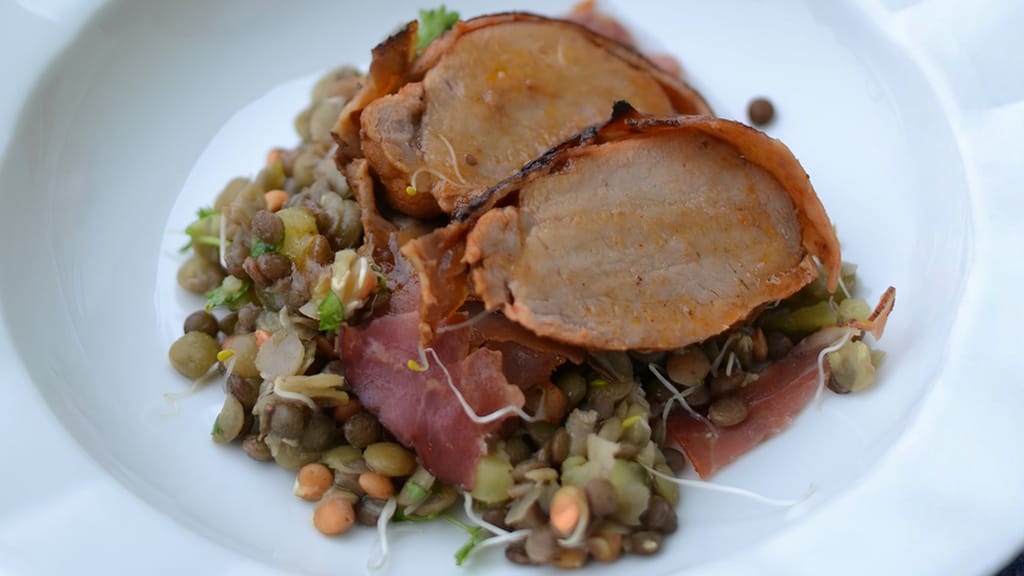
Bacon protects lean tenderloin from drying out and adds salt, smoke and a crisp surface. The lentil salad with bacon-wrapped pork tenderloin shows it best: you can happily cook the tenderloin from it on its own.
In that recipe, a trimmed tenderloin is coated in a mix of brown sugar, salt, smoked paprika and cayenne pepper, wrapped tightly in slices of back bacon, and the ends are secured with toothpicks. It's then browned on all sides in a cast-iron pot until the bacon turns golden. Once seared, it's generously brushed with a glaze of Dijon mustard and mango chutney and finished in an oven turned down to 160°C (325°F); the recipe gives 10–15 minutes. Before taking it out, check with an instant-read thermometer that the center is 63°C (145°F). Then wrap it in aluminum foil and let it rest for 15 minutes.
The recipe serves the meat with a salad of brown and green lentils, sprouted lentils, cucumbers and crisp-fried Black Forest ham with parsley. It's good warm or cold, so it also makes a great packed lunch.
Lentil salad with pork tenderloin
Bacon-wrapped pork tenderloin with mustard and mango chutney, served with lentil salad
The pan is the fastest way to cook tenderloin: slice it into medallions, sear them hard on both sides and finish over gentler heat. The recipe for bacon-wrapped pork medallions in a pan is ready in 25 minutes, butter sauce included, and needs only tenderloin, back bacon, butter, salt and pepper.
The tenderloin is cut into chunks about 5 cm (2 in) tall, each wrapped around the edge with a strip of back bacon and secured with a toothpick. On a properly hot grill pan, the medallions are seared hard on one side and then the other until the meat tightens up and the bacon browns. Then the heat is turned down and shorter medallions cook for about 4 minutes per side, taller ones longer, so the bacon doesn't blacken.
They're done when an instant-read thermometer in the center of a medallion reads 63°C (145°F). Move them to a warm plate and let them rest for 3 minutes. Meanwhile, stir a piece of cold butter into the drippings in the pan and stir quickly until it combines with the browned juices into a glossy sauce.
To make a quick pan-fry work, keep to three things:
Heat the pan before the meat goes in. In a lukewarm pan, meat releases its juices and simmers in them.
Don't crowd the medallions. Leave at least a finger's width between pieces, or the pan turns into a steamer.
Don't flip them every minute. A crust only forms when the meat sits undisturbed, and once it has one, it releases from the pan by itself.
Plums and pork tenderloin are a classic pairing: sweet-tart fruit balances the lean, delicate meat, and the caramelized juice turns into a ready-made sauce. The recipe for pork tenderloin with plums and back bacon is done in under an hour.
The sauce comes first. Diced back bacon is rendered in a pan, pitted plum halves are added and fried until they fall apart, release their juice and darken. Then balsamic vinegar and a fruit liqueur are poured in, the alcohol cooks off as you stir, brown sugar is sprinkled in, and the sauce is seasoned with salt, pepper and thyme. At the end, eight plum pieces set aside earlier go in for just two or three minutes so they stay whole.
The tenderloin is cut into rounds about 5 cm (2 in) tall. Each is pierced through the center with a narrow knife, and a piece of plum wrapped in bacon is pressed into the hole. The medallions are salted, peppered and grilled for just a few minutes per side. The recipe aims for at least 70°C (158°F) inside. But these medallions are stuffed, so measure in the center of the plum filling: it must reach at least 74°C (165°F), as FSIS gives for stuffing in meat. If they brown faster on the grill than the filling heats through, finish them at the edge of the grate with the lid closed or in the oven. They're served drizzled with the hot sauce, with bread or pan-fried potatoes: cut potatoes boiled in their skins into quarters and fry them in a pan with a little fat until golden.
If you don't have a grill, you can sear the medallions just as well on a hot grill pan using the method from the previous section.
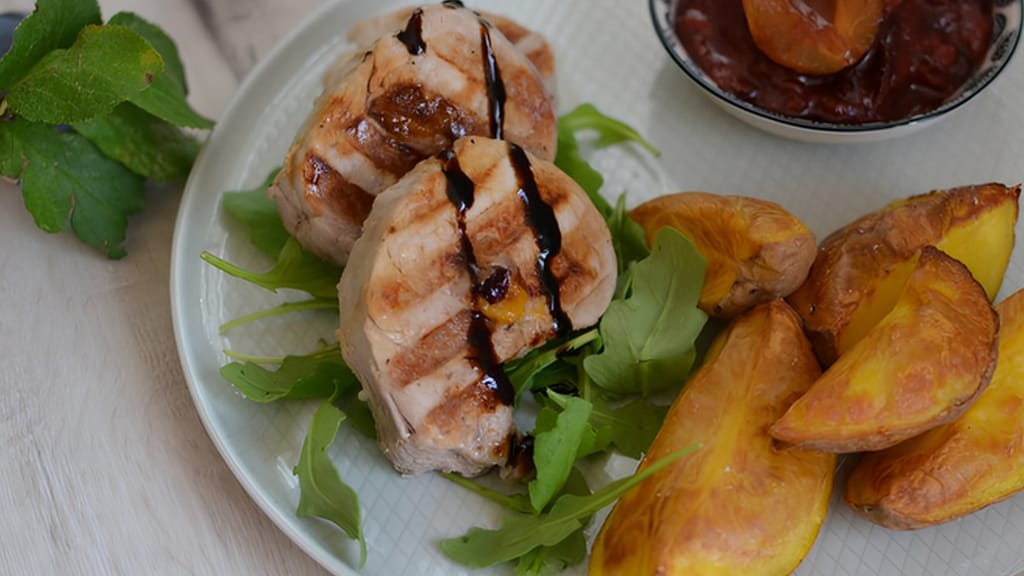
Pork tenderloin with plums and streaky bacon
Pork tenderloin with plums and back bacon, stuffed medallions with caramelized sauce
There are two ways to stuff tenderloin: either cut a pocket into medallions, or slice the whole piece open into a flat sheet, lay it out, spread it with filling and roll it up. Medallions are quicker and cook through more easily, while the roll looks more festive.
Our recipe for stuffed pork tenderloin with zucchini goes the medallion route. The tenderloin is cut into tall pieces, each is seasoned with salt and pepper on both sides, and a narrow knife cuts a pocket into it, which is filled with feta. A slice of dry-cured ham goes on top and is pressed firmly with the palm so it sticks and the medallion flattens a little. The medallions are fried in olive oil ham side down for about five minutes, until the ham turns crisp.
The side is made in a large pot: thin slices of unpeeled zucchini are fried with pressed garlic in hot olive oil for about five minutes, then chopped cilantro with chili pepper and feta are stirred in and everything is sautéed for about ten more minutes, until the zucchini is tender. The medallions are stacked on the zucchini and drizzled with the pan drippings.
With stuffed tenderloin, measure the temperature in the center of both the filling and the meat, because the filling heats up most slowly. Unstuffed meat needs only 63°C (145°F) and 3 minutes of rest, but stuffed meat doesn't: the filling must reach 74°C (165°F) in the center, whatever is in it, including cheese, dry-cured ham, plums or vegetables. That's what the US food safety agency FSIS gives for stuffed meat. Insert the thermometer right into the center of the filling.
Ideas for other fillings: dried plums with bacon, spinach with garlic and cheese, sun-dried tomatoes with basil, or sautéed mushrooms with onion. Always squeeze out or cook off the moisture from the filling well, because a wet filling would stew the meat from the inside.
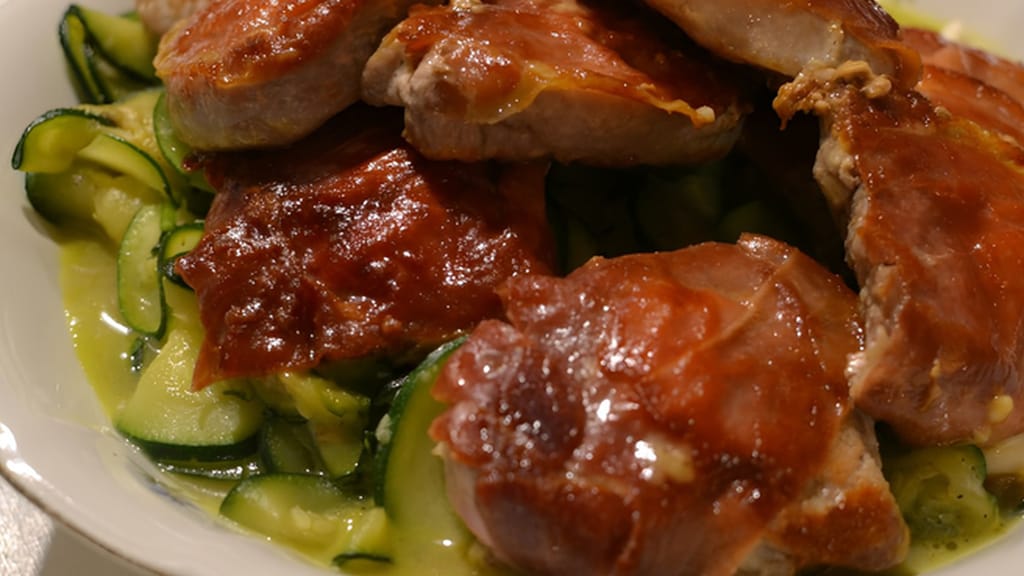
Feta-stuffed pork tenderloin with zucchini
Stuffed pork tenderloin with feta and dry-cured ham on zucchini with garlic and cilantro
A honey-mustard marinade turns grilled tenderloin into a glossy, sweet-and-tangy piece of meat, and because it marinates overnight, all you do in the evening is grill. The recipe for grilled pork tenderloin in mustard needs just seven ingredients.
The tenderloin isn't rinsed, only dried so the marinade clings, then seasoned with salt and pepper on all sides. In a bowl, whisk honey with Dijon mustard and a teaspoon of olive oil into a smooth, glossy mixture; more honey gives a milder glaze, more mustard a sharper one. The coated meat is left in the fridge until the next day, and before it goes on the grill, excess marinade is wiped off, because honey burns quickly over direct heat.
Grill it first over direct heat until the tenderloin is browned on all sides, then move it to the edge of the grate, where it finishes with indirect heat under the lid. It's done at 63°C (145°F) in the center, measured with an instant-read thermometer, after a 3-minute rest. You can cook it the same way in the oven, using the method for whole tenderloin.
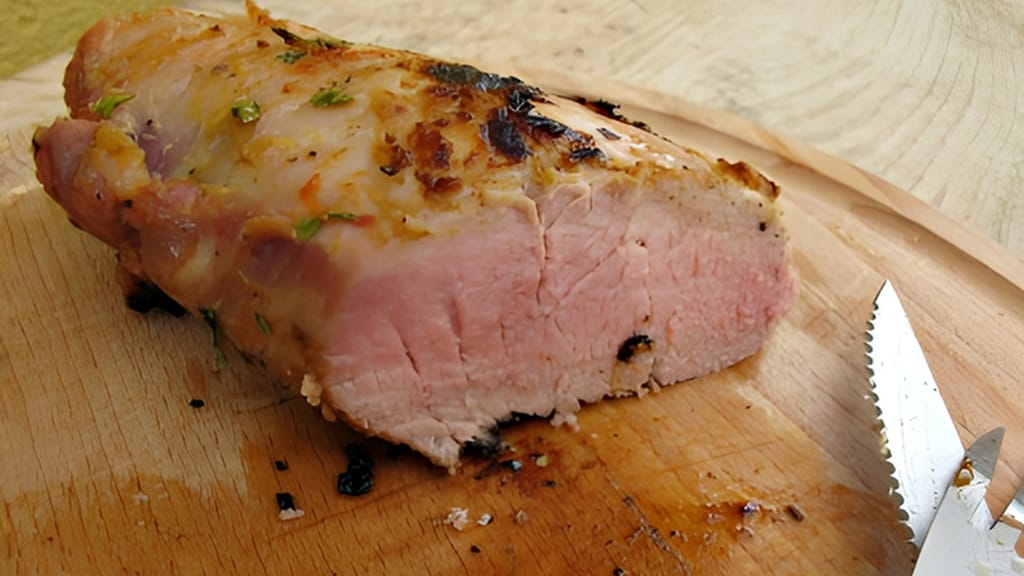
Grilled pork tenderloin in mustard marinade
Grilled pork tenderloin in a honey-mustard marinade with thyme
Sliced tenderloin also suits the wok, because it cooks in a few minutes and stays tender. The recipe for noodles with meat and Mexican spices turns it into a quick dinner for four.
The tenderloin is sliced, coated in three tablespoons of oil with half a packet of Mexican spice mix and left in the fridge overnight. Half an hour before cooking it's taken out, so it doesn't cool down the pan, but it shouldn't sit out for more than 2 hours. The slices are browned on both sides in a hot wok and moved to a clean plate, not the one the raw meat sat on. In the drippings, red onion is then fried, and corn, green beans, drained kidney beans and strips of red and yellow bell pepper are added, along with the rest of the spices, the meat, rounds of chorizo and about two deciliters (¾ cup) of water.
Everything is served over cooked Asian wheat noodles or tossed with them right in the pan; the recipe also suggests rice or pita. Thin slices of tenderloin finish quickly, but the same rule applies here: 63°C (145°F) in the center of a thicker slice. The side muscle trimmed off earlier is a good fit for this recipe too.
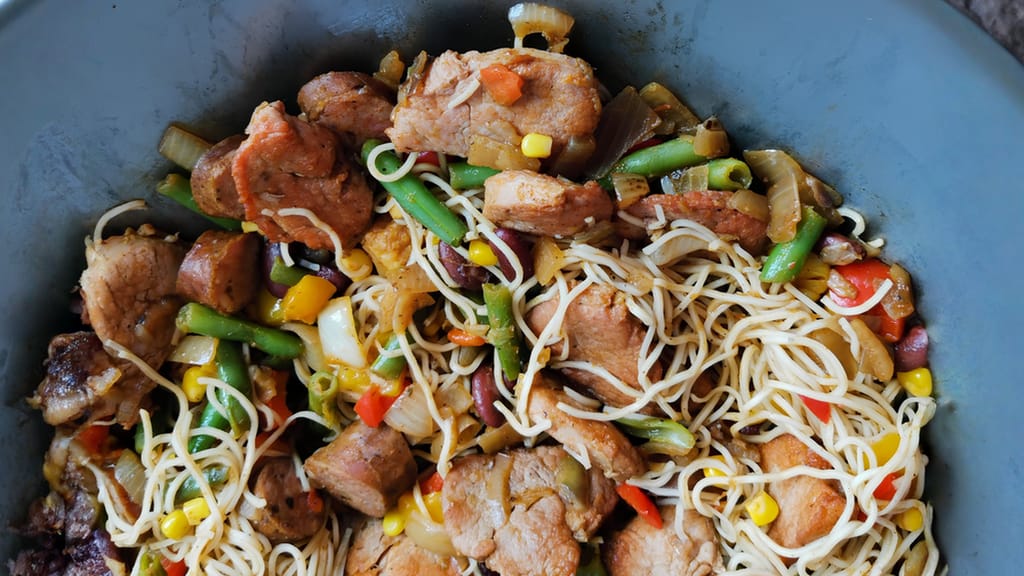
Noodles with pork and mexican spice mix
Noodles with pork tenderloin, vegetables, chorizo and Mexican spices from the wok
The best sauce for tenderloin comes from the drippings in the pan where the meat was seared: you loosen the browned bits with liquid, reduce it and mellow it. It's ready in 5–10 minutes while the meat rests. The three most popular versions are cream, pepper and mushroom, and all start from the same base. After them, you'll find what side to serve with tenderloin and sauce.
You can make a cream sauce for pork tenderloin in 10 minutes from the pan drippings, shallot, 100 ml (⅓ cup) of stock or wine and 150–200 ml (⅔–¾ cup) of whipping cream.
Add finely chopped shallot or onion to the drippings left after the meat and cook briefly until translucent. Pour in about 100 ml (⅓ cup) of stock or white wine, scrape everything stuck to the bottom loose with a wooden spoon and let the liquid cook down by half. Then pour in 150–200 ml (⅔–¾ cup) of whipping cream and simmer over low heat until the sauce thickens enough to coat a spoon. Season with salt, pepper, a squeeze of lemon or a teaspoon of Dijon mustard. Use whipping cream (30–33%) because it doesn't curdle when boiled; thinner cooking cream flakes more easily.
Pepper sauce is a cream sauce with green or coarsely crushed black pepper. Add a tablespoon of crushed black pepper or two tablespoons of brined green peppercorns to the drippings, warm them briefly until fragrant, and deglaze with a little brandy, wine or stock. Cook the liquid down, pour in the whipping cream and let it thicken. Taste only at the end, because the pepper keeps infusing the sauce as it cooks, and add salt carefully, since brined pepper can be salty.
Mushroom sauce needs mushrooms that are truly browned, not sweated. Put sliced button, oyster or wild mushrooms into the hot pan with the drippings in a single layer and leave them until they release their water, it evaporates and the mushrooms brown. Then add shallot and thyme, deglaze with stock, cook it down and mellow it with whipping cream. With dried porcini, soaked beforehand in lukewarm water, and a little of their strained soaking liquid, the sauce will taste much more of mushrooms.
Rice is the simplest side for tenderloin with sauce, because it soaks up the sauce and nothing overpowers it. Cook it while the tenderloin roasts and serve slices of meat on the rice, drizzled with sauce. With cream and mushroom sauce, smooth, creamy mashed potatoes with nutmeg also work well, whipped from boiled potatoes with butter, milk and whipping cream, as do baked potato halves with herbed quark (quark is tvaroh, a Czech fresh curd cheese), which bake in their skins for 30–40 minutes at 180°C (350°F). Tagliatelle works well too: cook it al dente in salted water and toss with a spoonful of the sauce. For pepper sauce, oven fries baked until golden or a baguette are a good fit. For plum sauce, the same mashed potatoes, whipped into a smooth purée, balance its sweetness.
For kids, prepare tenderloin as small medallions in a pan, with just salt and a little oil or butter, and season the sauce mildly. It's tender, with no sinew or bones, so even smaller children can bite through it.
Cut the medallions thinner, about 2–3 cm (¾–1¼ in), and slice them into strips or small cubes after cooking.
Add seasoning only at the table, and leave out hot paprika, cayenne pepper and crushed pepper.
Leave the wine out of the cream sauce and flavor it only with stock and parsley.
Watch the temperature just as for adult portions: 63°C (145°F) in the center and 3 minutes of rest.
Pork tenderloin with plums is also a hit with many kids, just make the sauce without the liqueur.
Dry tenderloin is almost always overcooked: lean meat with very little fat has nothing to make up for a few extra degrees. The most common mistakes and how to avoid them:
You cook by the clock, not by temperature. Tenderloins vary in thickness, so the same time works once and fails the next. An instant-read thermometer solves this.
You slice it right away. Without a rest, the juices run out onto the board. Give the meat at least 3 minutes, and 5–10 for a whole piece.
You left the silverskin on. It shrinks as it cooks, curls the meat and stays tough in your mouth.
You slice with the grain. Always slice across the grain, and the slices are much more tender.
You braise it. Tenderloin isn't braised like goulash; longer cooking in sauce only toughens it. Make the sauce separately and return the meat to it only on the plate.
If it does get overcooked, slice it thin and pour warm sauce over it so it soaks up moisture. You'll find more tricks in how to rescue dried-out meat from the oven.
Refrigerate cooked pork tenderloin within 2 hours of cooking and eat it within 3–4 days, which is what the US food safety agency FSIS gives for cooked leftovers. In the freezer it stays safe indefinitely, but the flavor is best within about 3–4 months. Reheat it gently in sauce under a lid, or eat it cold in thin slices.
Yes, pork tenderloin suits sous vide well, because it's harder to overcook in a water bath: the water sits exactly at your target temperature. Cook the vacuum-sealed tenderloin in a bath set to 63°C (145°F) until it's heated through to the center, usually 1.5–2 hours for a normally thick piece, and don't leave it there longer than about 3–4 hours, or the meat turns mushy even at the right temperature. Then sear it briefly over high heat in a hot pan for a crust and serve right away. Don't let it sit in lukewarm water or on the counter.
Marinating pork tenderloin for 2–12 hours in the fridge is enough, and overnight is the most convenient. Leave marinades with a lot of lemon juice or vinegar for only a few hours, or the surface of the meat turns mealy. Always marinate in the fridge, not on the counter, and don't use a marinade that raw meat sat in as a sauce unless you boil it thoroughly first.
Yes, you can freeze raw pork tenderloin, ideally right after buying it, wrapped tightly with the air pressed out. Thaw it slowly in the fridge, not on the counter at room temperature, and pat it thoroughly dry before cooking. Thawed tenderloin releases more juice, so cook it just like fresh, to 63°C (145°F) in the center, and let it rest.
The closest substitute for pork tenderloin is a boneless pork chop cut into thick slices. It's similarly lean and cooks just as quickly, but it's a little less tender. Pork neck (shoulder) is juicier thanks to its fat, but it needs longer cooking, so the times in the tenderloin recipes don't apply to it.