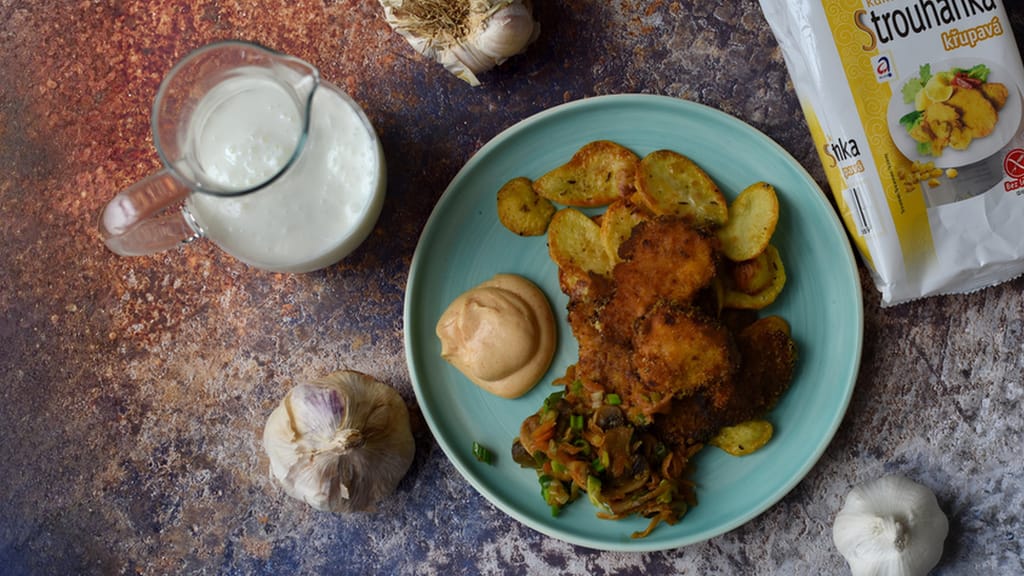
Baked crispy cutlets in extrudo cornmeal breading
Schnitzel: How to Make Fried Pork, Chicken and Veal Schnitzel
Updated Nov 19, 2026
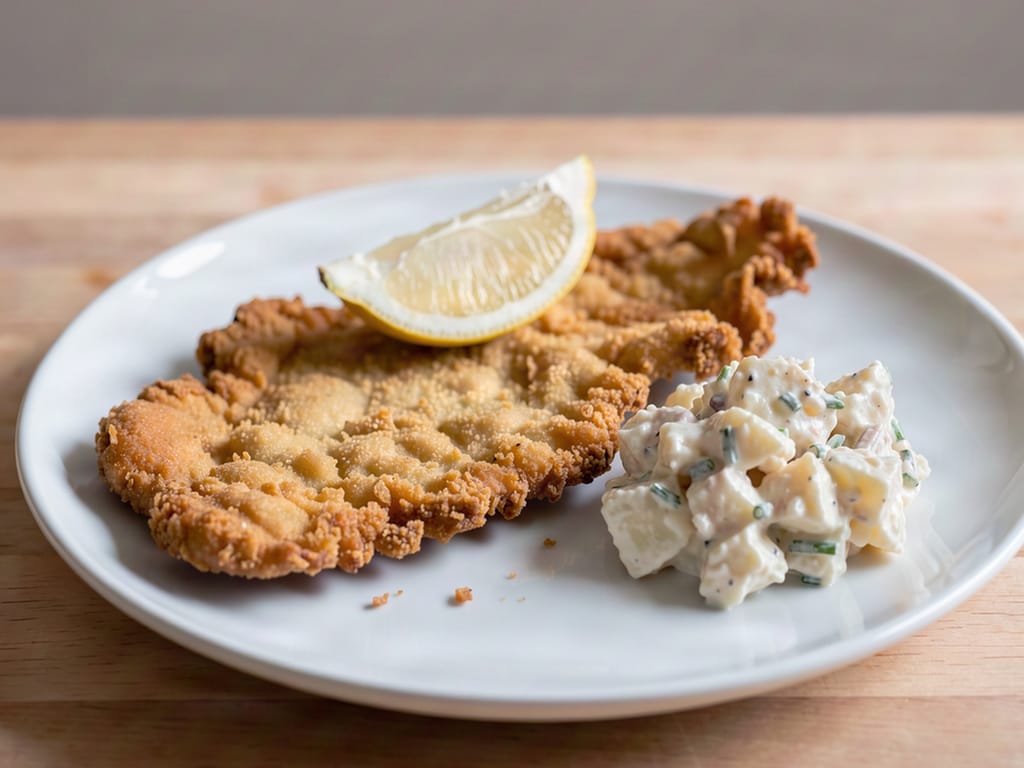
Schnitzel (řízek) is a thin slice of meat coated in flour, egg and breadcrumbs and fried until golden. To get it juicy inside and crisp outside, you have to nail four things: choose the right meat, pound it to an even thickness, bread it so the coating stays on, and fry it in properly hot fat. Here you'll find everything from pork leg schnitzel to chicken and veal, plus schnitzel baked in the oven, made in the air fryer, in batter and inside out.
The best schnitzel comes from lean, whole-muscle meat with no sinews. Pork leg is the classic, pork shoulder (krkovice, the neck end) is the juiciest, pork tenderloin the most tender, chicken breast the quickest, and the Viennese legend is made from veal leg. Each meat behaves differently, so cut and fry it accordingly.
Pork leg: pork leg is the most common choice. The top round, the knuckle (nut) and the roll cuts suit schnitzel best. They're lean, whole muscles that give you nice, even slices. Leg has little fat and dries out easily, so fry it briefly and don't overcook it.
Pork neck (krkovice): it's marbled with fat, which makes it the juiciest and the most forgiving. Cut neck schnitzels 1 cm thick and pound only lightly so they don't fall apart along the fat seams. They take about a minute longer to fry than leg.
Pork tenderloin: the most tender, the priciest and the quickest to cook. Slice it into medallions about 2 cm thick and pound them flat. Tenderloin has almost no sinew, so just trim off the silvery membrane and it won't turn rubbery.
Pork shoulder: shoulder schnitzel is the cheaper option. Shoulder has membranes and sinews between the muscles that you need to trim carefully, or the schnitzel will curl up in the pan. It has more flavor than leg and is a bit juicier.
Chicken breast: skinless chicken breast cooks the fastest and also dries out the most easily. Chicken schnitzel is decided at the cutting stage: slice the breast horizontally into two thin cutlets so it's the same thickness all over.
Veal leg: the meat for a true Wiener schnitzel. It's delicate and pale, and its flavor won't be overpowered by the coating. It's cut from the leg (the frikando or the nut) and pounded thinnest of all, to roughly 4 mm.
A juicier alternative to breast is chicken thigh schnitzel; you'll find more in chicken thighs: what to cook with them. For an overview of all the pork cuts and what each is good for, see pork cuts: shoulder, leg, neck and tenderloin.
Plan on 150–200 g of raw meat per serving, which is one large or two smaller cutlets. From 1 kg of pork leg you can cut roughly 8–10 schnitzels. The breading makes each one a little bigger, so the plate looks fuller than the amount of meat you bought. For Christmas Eve or hungry teenagers, add half a schnitzel per person. Leftovers keep in the fridge for 2–3 days, or you can freeze them right away. See the storage and freezing section below for how.
Seasonal baking plans, tested recipes and kitchen tricks that save you time. Unsubscribe in one click.
Cut the meat across the grain into slices 6–10 mm thick and pound them evenly to 4–5 mm. An even thickness matters more than the exact number: a thinner edge will fry through before a thicker center is cooked.
Cut across the grain. Look at which way the muscle fibers run and cut at a right angle to them. A slice cut along the grain stays tough no matter how much you pound it.
Remove the membranes and snip the edges. Cut off the silvery membrane on the surface. Snip any fatty edge or remaining membrane every 2–3 cm. Otherwise the schnitzel will curl into a bowl in the hot fat and the coating on the raised spot won't touch the pan.
Pound through plastic. Put the slice in a freezer bag or between two sheets of plastic wrap. The meat won't tear, the mallet won't stick and the kitchen stays clean.
From the center outward. Pound with the flat side of the mallet, not the toothed side. The teeth tear the meat and make holes that let the juices escape. Start in the middle and work out toward the edges.
Salt just before breading. Salt draws water out of the meat. If you salt an hour ahead, the surface will be wet and the coating won't stick.
If you don't have a mallet, the bottom of a small heavy pot or pan will do. Chicken breast cut into cutlets often needs hardly any pounding, just a few taps to even it out.
The three-step breading means coating the meat in all-purpose (plain) flour, beaten egg and breadcrumbs, always in that order. The flour dries the surface, the egg acts as glue and the breadcrumbs make a crisp crust.
Set up three plates. Put all-purpose flour on the first, eggs beaten with 2 tablespoons of milk and a pinch of salt on the second (2 eggs are enough for 4 schnitzels) and breadcrumbs on the third. Beat the eggs really well so the white blends completely with the yolk. Otherwise the schnitzel gets uneven layers.
Dry the meat. Pat the slices with a paper towel. On a wet surface the flour turns to paste, which peels off during frying.
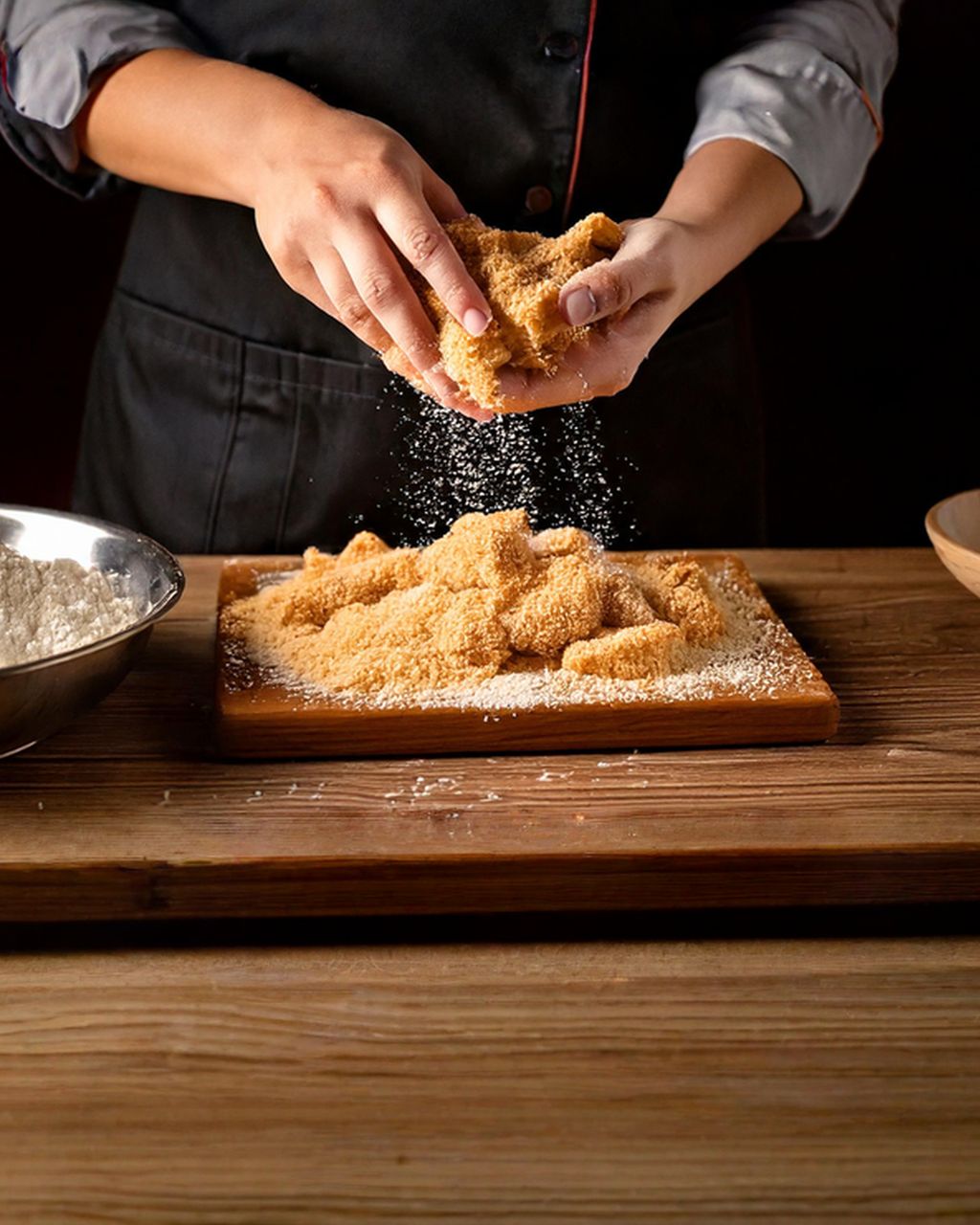
Flour, and shake well. Coat the slice in flour on all sides, then shake off the excess thoroughly. The layer should be as thin as a dusting. Extra flour between the meat and the egg makes a slippery layer that the coating slides off.
Egg, and let it drip. Pull the slice through the egg and hold it over the plate for a moment so the excess runs off. Too much egg means a thick, rubbery coating.
Breadcrumbs, lightly. Lay the slice in the breadcrumbs, scatter some over the top and press only lightly with your palm. Don't press hard: packed crumbs soak up more fat and turn hard.
Bread right before frying. Don't let a breaded schnitzel sit for more than 15–20 minutes. While it waits, the crumbs soak up moisture from the egg, go soft and then flake off more easily in the pan. It's best to bread in batches: while one is frying, you bread the next.
For breading, keep one hand for the dry plates and the other for the egg. Your fingers won't get clumped with coating and the flour in the dish won't turn lumpy.
The coating most often falls off because of wet meat, too thick a layer of flour or fat that isn't hot enough. Other culprits worth knowing:
Cold fat. The schnitzel doesn't sear in it but simmers. The coating soaks up oil and slides off.
Overcrowded pan. Every schnitzel you add lowers the oil temperature. Fry two at a time, three at most.
Flipping often and poking with a fork. Flip once, with a spatula or tongs, gripping the edge. A fork hole lets steam get under the coating and tear it off.
A schnitzel curled into a bowl. Edges that weren't snipped lift it up, and the coating separates at that spot.
A breaded schnitzel that sat longer than 15–20 minutes. Soft, soggy crumbs flake off easily in the fat.
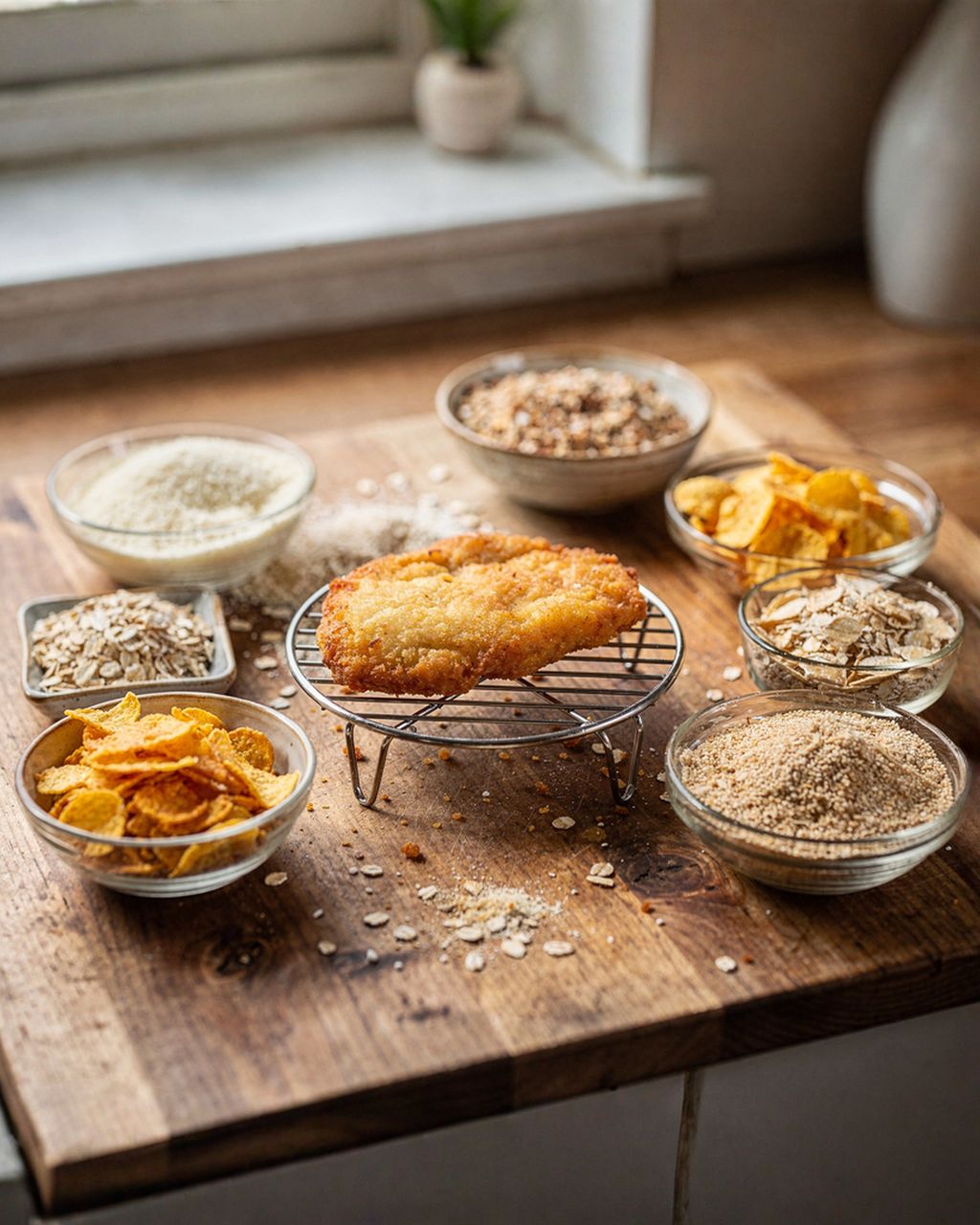
If you want an extra-crisp coating, mix the breadcrumbs half and half with crushed unsweetened cornflakes or with Japanese panko. For Wiener schnitzel, on the other hand, use only fine breadcrumbs from white bread.
The best place to season a schnitzel is in the coating: add spices and cheese to the eggs or the breadcrumbs, and season the meat itself only with salt and pepper. Spices sprinkled directly on the meat scorch and turn bitter while frying.
In the eggs: a teaspoon of whole-grain or full-flavored mustard, a pressed clove of garlic, sweet or smoked paprika. Mustard also thickens the egg so it holds better on the meat.
In the breadcrumbs: 2–3 tablespoons of finely grated hard cheese (such as Parmesan), dried herbs like thyme or marjoram, grated lemon zest. With cheese, fry at a temperature 10°C (about 20°F) lower, because it browns faster.
For chicken schnitzel: curry, turmeric or gyros seasoning in the eggs. Chicken is mild and can handle more seasoning than pork.
For pork schnitzel: caraway and garlic, or just salt, pepper and lemon on the plate. A classic that needs no improving.
If you've already salted the meat, don't add salt to the breadcrumbs. It's easy to oversalt the schnitzel, especially with cheese in the coating.
Fry schnitzel in fat heated to 160–170°C (320–340°F), in a layer 1–2 cm deep, for roughly 2–3 minutes per side. Then let it drain on a rack. These four things decide whether the coating comes out dry and crisp or soaked in fat.
Which fat. Pick a fat that can take higher heat: rapeseed (canola) oil, sunflower oil (ideally high-oleic), lard or clarified butter. Lard makes schnitzel taste like grandma's, and clarified butter gives it a Viennese nutty flavor. Don't use plain butter on its own, as its milk solids burn before the schnitzel is fried. Extra virgin olive oil is needlessly expensive for frying schnitzel.
How much fat. Enough for the schnitzel to float in the pan, about 1–2 cm. In a shallow layer the coating browns only where it touches the bottom and the edges stay pale.
What temperature. The ideal is 160–170°C (320–340°F). A thermometer is the surest way. Without one, dip the end of a wooden spoon into the fat: if tiny bubbles form around it right away, the fat is ready. If the oil smokes, it's too hot and the coating will blacken before the meat is cooked through.
How long. A thin pork or veal schnitzel (4–5 mm) needs 2–3 minutes per side, a chicken cutlet about 3 minutes and a thicker pork neck schnitzel 3–4 minutes. The color should be an even golden, not dark brown.
Waves like in Vienna. While frying, gently swirl the pan so hot fat washes over the top of the schnitzel. The coating then lifts away from the meat in places into the typical waves.
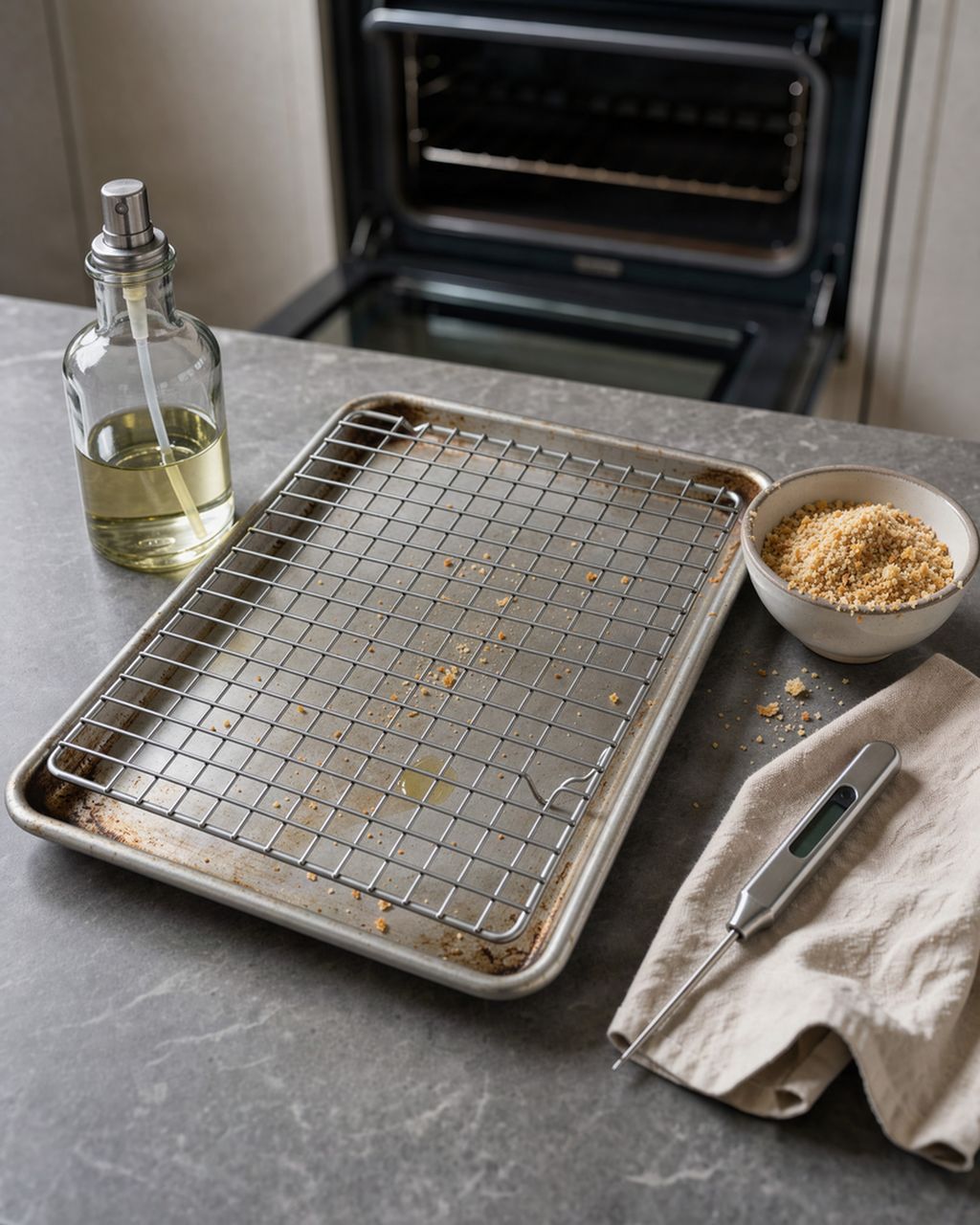
Draining on a rack. Put the finished schnitzel on a rack, not on a paper towel. On paper the underside steams in its own moisture and the coating softens. Put a baking sheet or a plate lined with paper under the rack to catch drips.
Between batches, skim the burnt crumbs out of the fat, or they'll stick to the next schnitzels and turn bitter. For four servings, one batch of fat is plenty. But if you're frying in bulk, say on Christmas Eve, and the oil darkens or starts to smell burnt, replace it with fresh.
Schnitzel is safely done when the center reaches the right internal temperature. The US Department of Agriculture's Food Safety and Inspection Service (USDA FSIS) gives 63°C (145°F) followed by a rest of at least 3 minutes for whole cuts of pork and veal, and 74°C (165°F) for chicken.
Pork schnitzel (leg, neck, tenderloin, shoulder): 63°C (145°F) in the center and a 3-minute rest, per USDA FSIS guidance for pork steaks, chops and roasts. At this temperature the center may still be slightly pink.
Veal schnitzel: FSIS gives the same value for whole cuts of veal, 63°C (145°F) and a 3-minute rest.
Chicken schnitzel: 74°C (165°F) in the center. FSIS gives this temperature for all poultry, including breasts and thighs.
Ground meat schnitzel, such as a breaded ground-meat patty, falls into a different category. FSIS gives 71°C (160°F) for ground pork and ground veal.
A thin schnitzel is harder to measure with a probe thermometer. Insert it from the side into the thickest spot, parallel to the surface of the meat. If you don't have a thermometer, go by the times above: a properly pounded 4–5 mm slice at 160–170°C (320–340°F) is usually cooked through before the coating darkens.
Per USDA FSIS, don't rinse raw chicken under running water, because the splashing spreads bacteria around the sink and surroundings. Wash the cutting board and mallet in hot soapy water after raw meat, before anything else touches them.
Bake schnitzels in the oven at 200–220°C (400–425°F) for roughly 20–25 minutes. Put them on a rack or perforated mat and turn them halfway. They need only a few tablespoons of oil, and you don't have to stand over a pan.
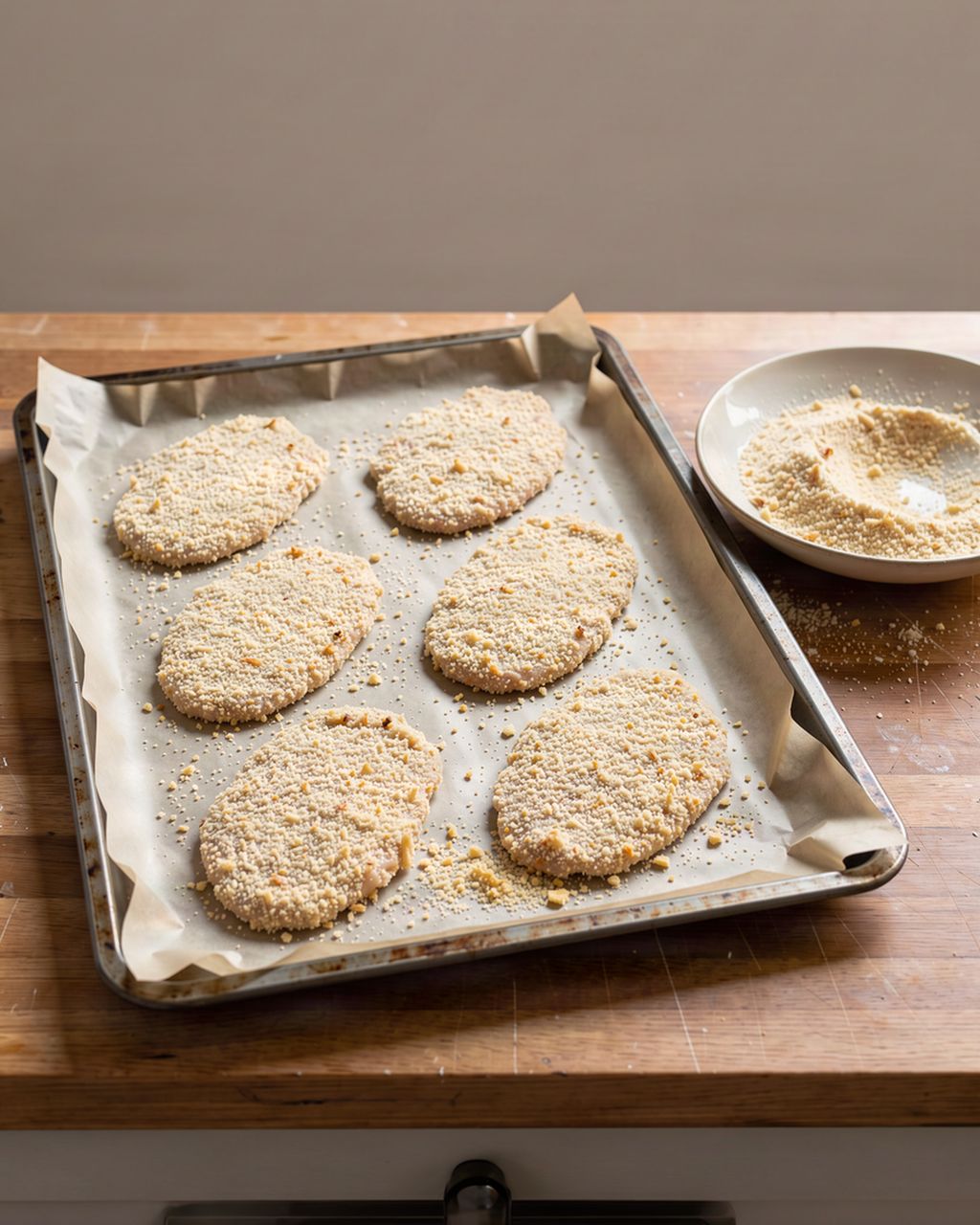
Prepare the coating as for frying, except toast the breadcrumbs dry in a pan until golden beforehand or mix them with 2–3 tablespoons of oil. Otherwise they'd stay pale in the oven. Lightly spray or brush the breaded schnitzels with oil and set them on a rack over a baking sheet. You can also use a perforated silicone baking mat, which lets hot air reach under the schnitzel too. Bake on the convection setting. Chicken cutlets are usually done in 18–20 minutes, while thicker pork neck needs 25–30 minutes. Serve with mashed potatoes or a vegetable salad.
For exact temperatures for different ovens and tricks for crispness, see schnitzel in the oven: what temperature and how long to bake. The recipe below uses a tested method with cornflake crumbs.
Baked crispy cutlets in extrudo cornmeal breading
Crispy oven-baked schnitzels in cornflake crumbs
In an air fryer, cook schnitzel at 180–200°C (350–400°F) for about 10–14 minutes, turning it halfway. It's crispier than from the oven and needs only a few sprays of oil.
Spray the breaded schnitzel with oil on both sides or brush it lightly. Dry breadcrumbs would stay pale and dusty in the air fryer. Place it in the basket in a single layer so the pieces don't overlap, or the bottom one steams. A thin pork cutlet is usually done in 10–12 minutes, chicken in about 12 and thicker pork neck in 14–16. For chicken, check that the center reaches 74°C (165°F). Preheat the air fryer for 3 minutes, or the coating will start sticking to the basket. Serve with potato wedges, which you cook in the air fryer beforehand and just reheat at the end.
Battered schnitzel is coated in a thick pancake-style batter instead of breadcrumbs and fried over gentler heat, 3–4 minutes per side. It's softer and fluffier than the three-step breading and works best with chicken breast and for kids.
Make the batter from 1 egg, 100 g all-purpose flour and roughly 120 ml milk or sparkling water (which makes the coating lighter). Salt it and season to taste, for example with sweet paprika, garlic or grated cheese. It should be as thick as sour cream. If it's too thin, add more flour. First coat the slices of meat lightly in flour so the batter clings, then dip them and fry in 1 cm of oil at 160°C (320°F). They go well with mashed potatoes and cucumber salad. For chicken thighs fried in batter with thyme, garlic and balsamic glaze, see the recipe for crispy smoky fried chicken.
Inside-out schnitzel (řízek naruby) is breaded in reverse order: first breadcrumbs, then flour and finally egg. The egg stays on the outside and forms a soft, omelet-like coating while frying, with a lightly crisp layer of crumbs underneath.
Pound and salt the slices as usual, coat them in breadcrumbs, dust with flour and pull through egg beaten with a pinch of salt and a tablespoon of milk. Fry them in 1 cm of fat at 150–160°C (300–320°F) for about 3 minutes per side. The egg surface scorches quickly at a higher temperature. The coating is darker and speckled rather than smoothly golden, and that's how it should be. It's best with pork leg schnitzel, boiled potatoes and cucumber salad. Inside-out schnitzel was once fashionable and is more of a curiosity today, but it's worth trying if you want a soft coating that doesn't crunch.
Wiener schnitzel is the thinnest, made from veal leg and fried in clarified butter or lard. Dutch schnitzel (holandský řízek) isn't made from a whole piece of meat but from ground meat with cheese, coated in the three-step breading. The same breading rules apply to both.
Wiener schnitzel: pound a veal slice to 4 mm, coat it in fine breadcrumbs and fry in plenty of clarified butter or lard. Keep rocking the pan so the coating puffs into waves. Wiener schnitzel is traditionally made from veal, which is why the pork version is called "Wiener Schnitzel vom Schwein" in Austria and "Schnitzel Wiener Art" in Germany. It's served with lemon, lingonberries (cranberries in the Czech version) and potato or cucumber salad.
Dutch schnitzel: a ground-meat patty with cubes of cheese inside, breaded and fried like a classic schnitzel. Fry it at 160°C (320°F) a bit longer, 4–5 minutes per side, so the meat cooks through to the center and the cheese melts. A tested method is in the recipe for Dutch schnitzel with cheese below.
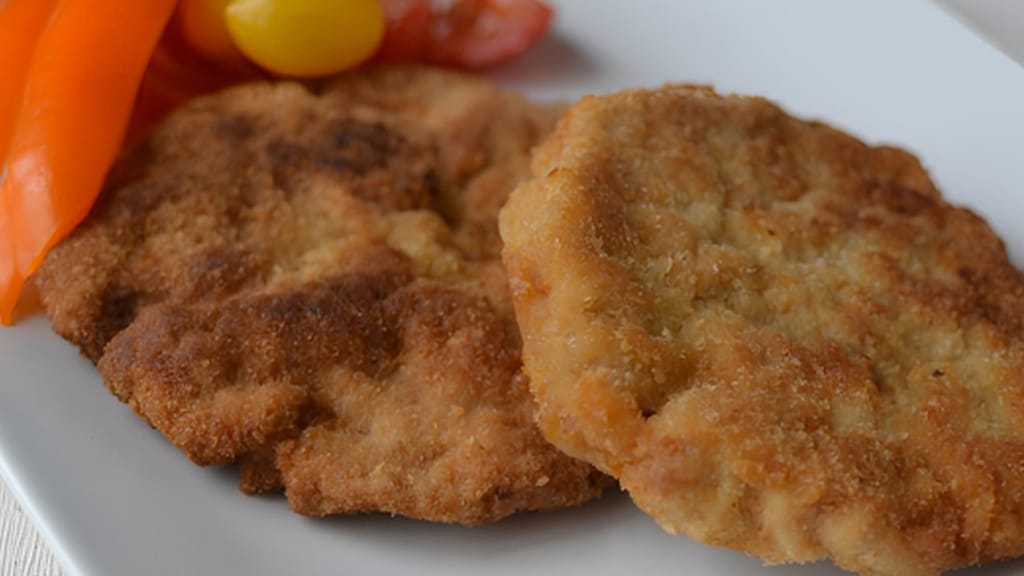
Dutch-style pork schnitzel
Dutch schnitzel with cheese made from ground meat
In many Czech families, schnitzel with potato salad is as much a part of the Christmas Eve dinner as carp, and for anyone who doesn't eat fish it's the sure bet. Fry the schnitzels just before dinner. Make the salad a day ahead, on the other hand, so the flavors come together.
A Christmas schnitzel doesn't have to be pork. Many families fry half chicken and half pork, or serve breaded carp alongside the schnitzels. For a big family it pays to fry in two pans and keep the finished schnitzels on a rack in the oven at 80–90°C (175–195°F). They stay warm and the coating doesn't go soft the way it would under a lid. Carp takes the same three-step breading and the same oil temperature; details are in Christmas carp: fried, baked and the black-sauce way. To plan the whole Christmas Eve so you aren't stuck at the stove at the last minute, see a Christmas menu at home with a prep plan. And for what to do with leftover schnitzel and salad the next day, see what to cook from Christmas leftovers.
For a gluten-free schnitzel, coat the meat in gluten-free flour and breadcrumbs labeled "gluten-free". For an egg-free schnitzel, use a thick mixture of flour and milk (plant-based works too), or mustard thinned with milk. The frying and temperature stay the same.
Gluten-free: use rice or corn flour instead of wheat flour, and instead of breadcrumbs use breadcrumbs or crushed cornflakes labeled "gluten-free" (regular cornflakes often contain barley malt), or ground almonds. An almond coating browns faster, so fry it at 150–160°C (300–320°F). Check the spices too, as some blends contain wheat flour.
Egg-free: replace the egg with a thick mixture of 2 tablespoons all-purpose flour and 100 ml milk, or a tablespoon of mustard stirred into 3 tablespoons of milk. The coating is thinner and less fluffy, but it holds well if you dry the meat thoroughly beforehand and coat it in flour.
If you're making schnitzel for someone who has to avoid gluten, fry it in fresh oil and in a clean pan. Crumbs of regular breadcrumbs from a previous batch would carry gluten over.
Schnitzel is most often served with potato salad, boiled potatoes with butter and parsley, mashed potatoes or fries, always with a lemon wedge. Fried food calls for something sour: lemon, cucumber salad or a pickle brightens the flavor so the schnitzel doesn't feel so heavy.
Potatoes: boiled with butter and parsley, crushed with onion, or smooth, creamy mashed potatoes with nutmeg. For how to boil potatoes so they don't fall apart, see the guide how to boil potatoes in their skins and peeled.
Salads: cucumber with cream or vinegar, tomato with onion, cabbage. For a lighter side, see the recipe for fresh cucumber salad with dill.
To go: cold schnitzel in bread or in a roll with mustard and a pickle. A classic for trips.
Chicken schnitzel is only one of many things to do with breasts. For more ideas, see what to cook with chicken breast so it isn't dry.
Fried schnitzels keep in the fridge in a closed container for 2–3 days. In the freezer, both raw breaded and fried schnitzels keep for 2–3 months. Reheat them in the oven or air fryer, because in the microwave the coating goes soft.
Reheating from the fridge: in the oven on a rack for 8–10 minutes at 180°C (350°F), in the air fryer for 4–5 minutes at 180°C (350°F).
Reheating fried schnitzels from frozen: don't thaw them. In the oven on a rack for 15–20 minutes at 180°C (350°F), in the air fryer for 8–10 minutes at 180°C (350°F), turning halfway. The schnitzel should be hot through to the center.
Raw breaded schnitzels from frozen: fry them without thawing at 150–160°C (300–320°F), 4–5 minutes per side. At the lower temperature the meat has time to cook through before the coating darkens. Check the center with a thermometer: chicken 74°C (165°F), pork 63°C (145°F).
The best way to freeze raw breaded schnitzels is to spread them on a baking sheet lined with parchment paper and freeze each one separately, and only then put them together in a bag. They won't freeze together and you can take out as many as you need. For detailed timings and packing, see schnitzels ahead of time: how long they keep and how to freeze breaded and fried schnitzels.
Schnitzel turns out tough when the meat is cut along the grain, and dry when it's too thick or fried too long. Cut across the grain, pound to an even 4–5 mm and fry 2–3 minutes per side at 160–170°C (320–340°F). Pork leg and chicken breast have little fat, so every extra minute shows. If your pork leg schnitzels keep coming out dry, try pork shoulder (krkovice, the neck end).
No. Bread schnitzels right before frying, 15–20 minutes ahead at most. Otherwise the breadcrumbs soak up moisture from the egg, go soft and flake off in the pan. If you need to prep ahead, freeze the breaded schnitzels right away and fry them from frozen at 150–160°C (300–320°F), 4–5 minutes per side.
You can use the oil once or twice more if you strain it through a fine sieve or cheesecloth once it has cooled and store it in a closed bottle in a cool, dark place. If it's dark, thick, foams or smells burnt, throw it out. Oil used for schnitzel is best kept for more schnitzel or other breaded foods, not for sweet frying.
For a reliable result, store-bought breadcrumbs are better because they're perfectly dry and evenly ground, so the coating holds and browns evenly. Homemade crumbs from rohlíky (Czech bread rolls) smell more of fresh bread, but work just as well only if the rolls are completely dry and the crumbs are ground fine and even. Damper or uneven homemade crumbs clump, soak up fat and flake off. For extra crunch, mix them half and half with panko.
One recipe worth heating the oven for, one tip, and one deal from the shop. Nothing else.