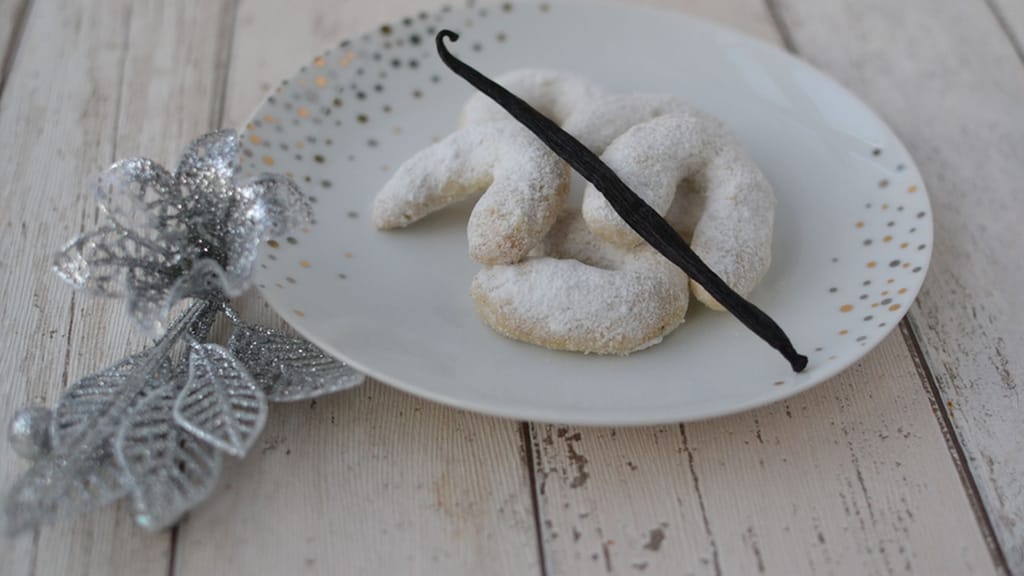
The best christmas cookies? vanilla crescents, of course!
How Many Trays of Christmas Cookies to Bake at Once (and How to Rotate Them)
Updated Sep 25, 2026
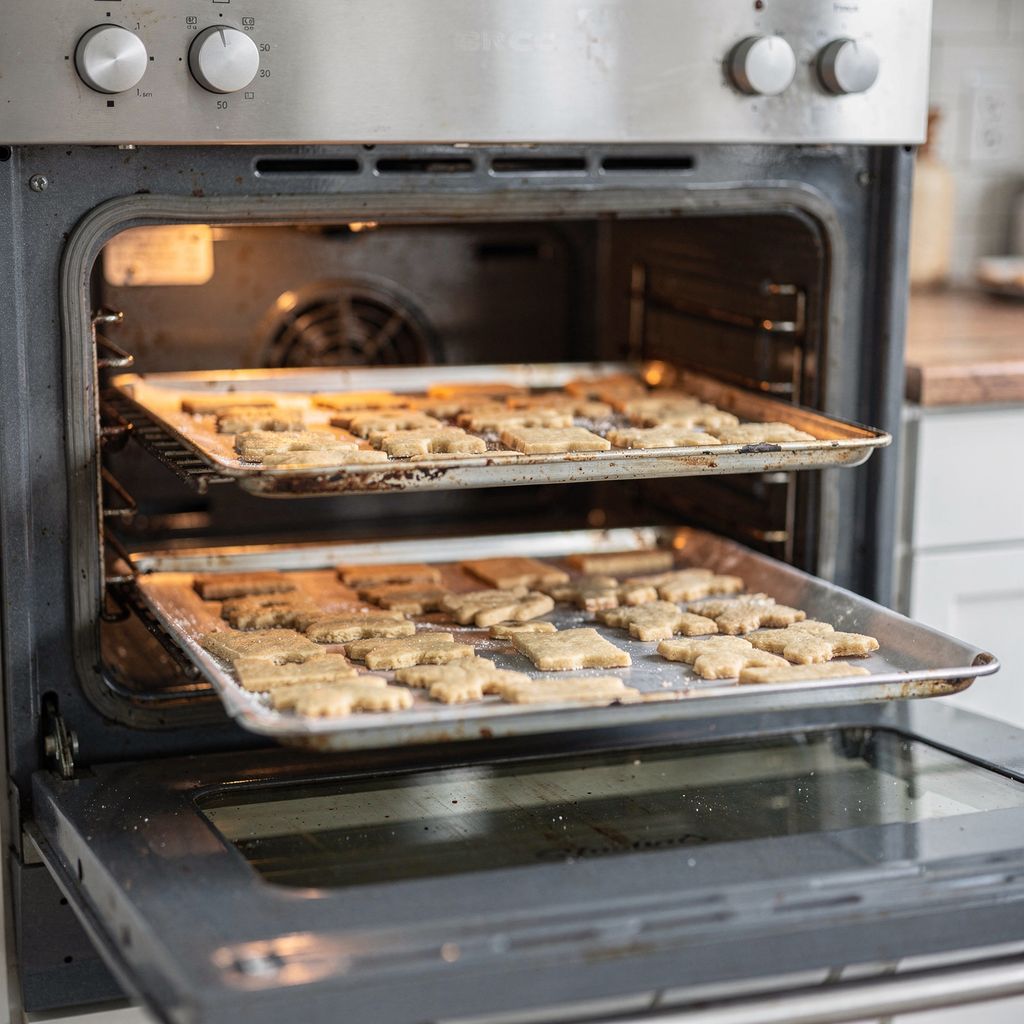
How many trays of Christmas cookies you can bake at once comes down to your oven setting: with conventional top/bottom heat, bake one tray on the middle rack; with fan/convection, you can do two (three only if your oven's manual specifically allows multi-level baking), at a temperature about 20°C (35°F) lower. With more than one tray, swap their positions halfway through and rotate each 180° — otherwise the top batch stays pale while the bottom one browns underneath. Here's the full method, including how to bake batch after batch without the dough melting on a warm tray.
With conventional top/bottom heat, bake one tray of cookies at a time; with fan/convection, you can do two, at a temperature about 20°C (35°F) lower. What matters is your oven's heat setting — not how many trays you happen to have:
Top/bottom heat: 1 tray, middle rack.
Fan/convection: 2 trays, at a temperature roughly 20°C (35°F) lower than for conventional heat.
Fan/convection in a large oven: 3 trays only if your oven's manual specifically mentions multi-level baking.
More trays doesn't mean you're done faster if half the cookies end up burnt and the other half stay pale. Two trays baked properly always beat three baked badly.
You'll find exact temperatures and times for each type of cookie in our guide What Temperature to Bake Christmas Cookies At — here we're focusing on how to position and rotate the trays in the oven.
With conventional top/bottom heat, bake cookies on just one tray, because a second tray splits the oven in two and each level then gets heat from only one direction.
With conventional heat, warmth comes from two heating elements — one above, one below. Air barely circulates inside the oven, so a tray on the middle rack gets even heat from both sides. Add a second tray and that balance breaks down:
the top tray browns on top but stays pale underneath,
the bottom tray turns dark on the bottom while the top stays pale.
Swapping the trays only partly fixes this. So stick to the rule of one tray, middle rack — it's slower, but it's the most reliable approach, especially for pale cookies like vanilla crescent cookies, where every shade of brown shows.
The best christmas cookies? vanilla crescents, of course!
Vanilla crescent cookies – pale cookies, bake one tray at a time
With fan/convection, bake cookies on two trays at once, at a temperature about 20°C (35°F) lower than for conventional top/bottom heat, with at least 10 cm (4 in) between the trays. The fan circulates hot air throughout the oven, so it reaches the trays from every side.
Things to keep in mind:
Lower the temperature by about 20°C (35°F) compared to a recipe written for top/bottom heat. Circulating air transfers heat faster, so at the same temperature the cookies would scorch on the outside before baking through.
Leave a gap between the trays. A good rule of thumb is at least 10 cm (4 in) — typically the 2nd and 4th rack slots from the bottom. Trays stacked too close together block airflow, and the lower one bakes more slowly.
Allow 1–3 minutes extra baking time. Two cold trays of dough cool the oven down more than one, so it takes a little longer to come back up to temperature.
Don't bake on the very top or very bottom rack. That close to the ceiling or floor of the oven, airflow is poor and the cookies bake unevenly.
Only bake three trays at once if your oven's manual specifically mentions multi-level baking. Otherwise, stick with two.
Halfway through the baking time, rotate the trays by swapping their positions (top to bottom, bottom to top) and turning each one 180° so the back edge faces the door. Even the best oven has a hotter back wall and a hotter top shelf.
Step by step:
Set a timer for half of the recipe's baking time.
Get your oven mitts ready and clear some counter space, so you're not searching for anything with the oven door open.
Open the oven, pull out both trays, swap their positions, and turn each 180°.
Close the oven as quickly as possible — ideally within 20–30 seconds. Every second with the door open means lost heat.
For the second half of the baking time, start checking early: do your first check 1–2 minutes before the time is up.
If one tray finishes before the other, don't wait for the second one. Take it out and let the other keep baking — finished cookies left in the oven just keep darkening.
Rotating pays off for cookies that bake for at least 10–12 minutes. For shorter bakes, it does more harm than good:
Small linzer cookies and other thin cookies (8–10 min): opening the oven at the 4-minute mark loses so much heat that the baking time stretches out and the cookies dry out. Better to bake one tray at a time, or only swap trays (without rotating) in the final third of baking.
Risen, airy dough: a sudden temperature change in the first half of baking can make it collapse. Leave it undisturbed and bake one tray at a time.
If your oven genuinely bakes evenly: if a test tray comes out the same at the back as at the front, skip the rotating and just swap the shelf positions.
Treat the first tray of each season as a test run — see where the cookies turn darkest, and decide from there.
The fastest system is a relay: one batch bakes, one cools, one waits ready to go.
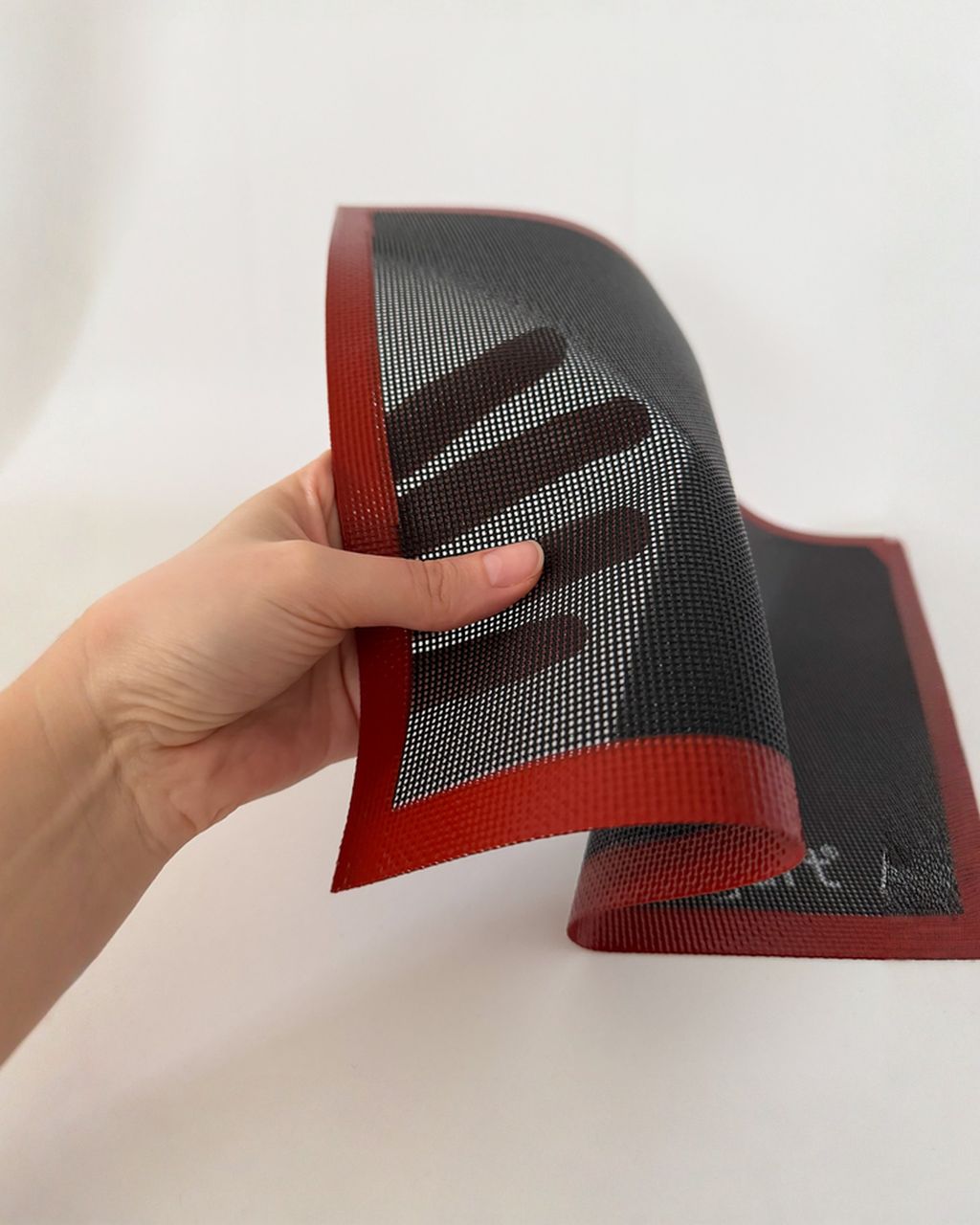
Arrange the dough on parchment paper, not directly on the tray. Lay out the cut-out cookies on parchment on the counter, and as soon as a tray is free and cool, just slide the paper straight onto it.
Two or three trays are enough. One in the oven, one cooling, one waiting with dough ready.
Let the oven come back up to temperature between batches. Once you pull out a finished tray, wait until the heating indicator light turns off before putting the next one in. Otherwise the second batch bakes at a lower temperature and turns out differently from the first.
Bake the same type of cookie together. On one tray, and within the same batch, stick to one type, size, and thickness. A small star and a large heart will never be done at the same time.
To fit in more baking without staying up all night, plan your cookies by how long they keep — our Christmas cookie baking calendar tells you what to bake first and what to leave until just before Christmas. Any dough you don't get to can be frozen and baked later — see our guide How to Freeze Christmas Cookies and Cookie Dough.
Five mistakes that lead to unevenly baked trays of cookies: using fan/convection without lowering the temperature, using two trays with top/bottom heat, an under-filled tray, unevenly rolled dough, and blindly trusting your oven's dial.
Using fan/convection at the recipe's stated temperature without lowering it by 20°C (35°F). The cookies brown on the outside before baking through inside. If this happens, check out how to rescue overbaked cookies.
Two trays with top/bottom heat. The bottom batch scorches underneath while the top one stays pale.
An under-filled tray. A handful of cookies on a large tray bake faster, and the edges brown too much. Spread the cookies evenly across the whole tray, with about 2 cm (¾ in) between pieces.
Unevenly rolled dough. Thinner pieces burn before thicker ones finish baking. Keep the thickness consistent — around 3 mm for linzer cookies.
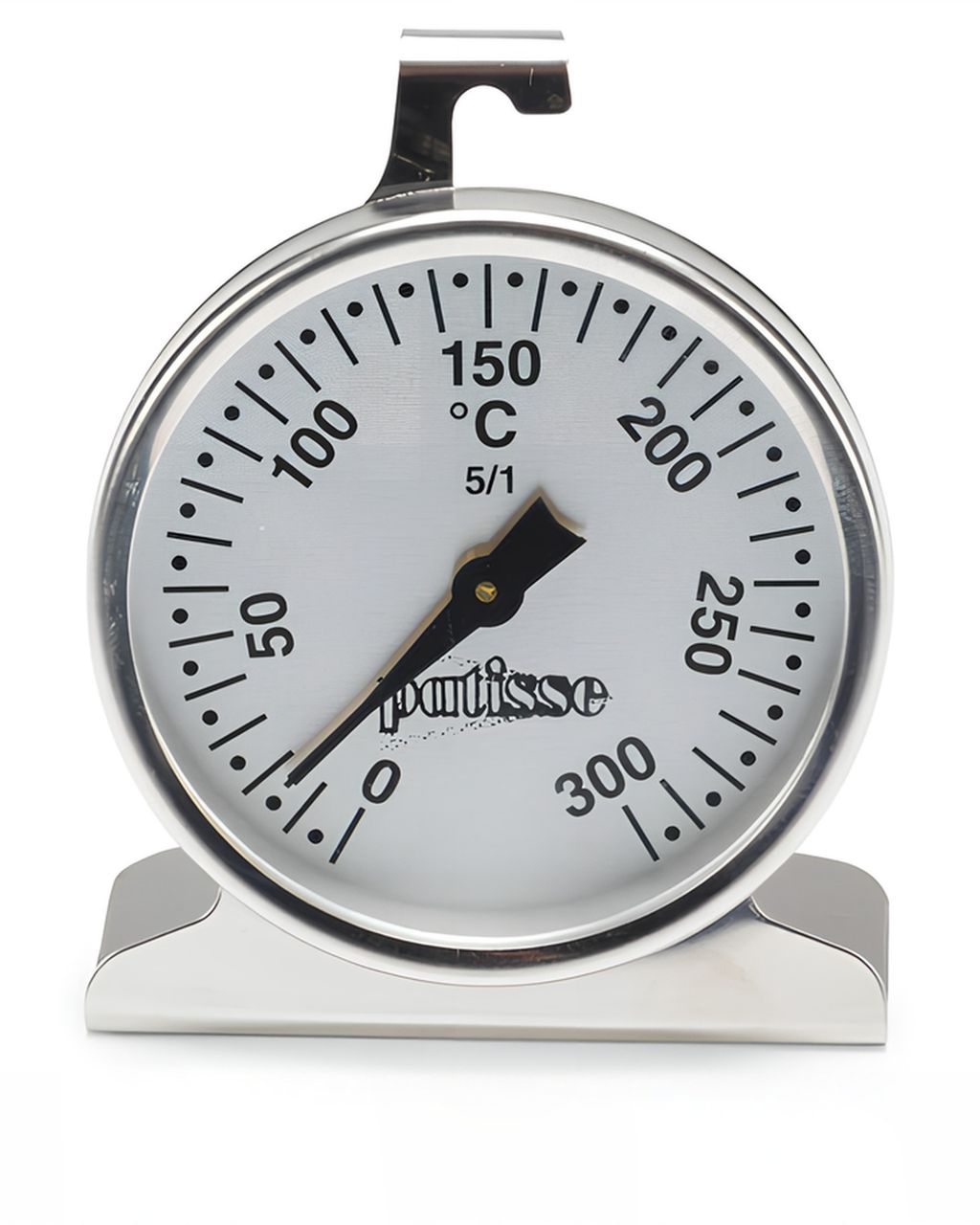
Trusting your oven's temperature dial. Home ovens often run 5–15°C (10–27°F) off their set temperature. A cheap oven thermometer will tell you what's really going on inside.
Two concrete examples to try this out on: classic crisp linzer cookies (thin, short baking time — better on one tray) and soft honey gingerbread (handles two trays on fan/convection with no trouble). For gingerbread, it also helps to know 5 signs your gingerbread is done.
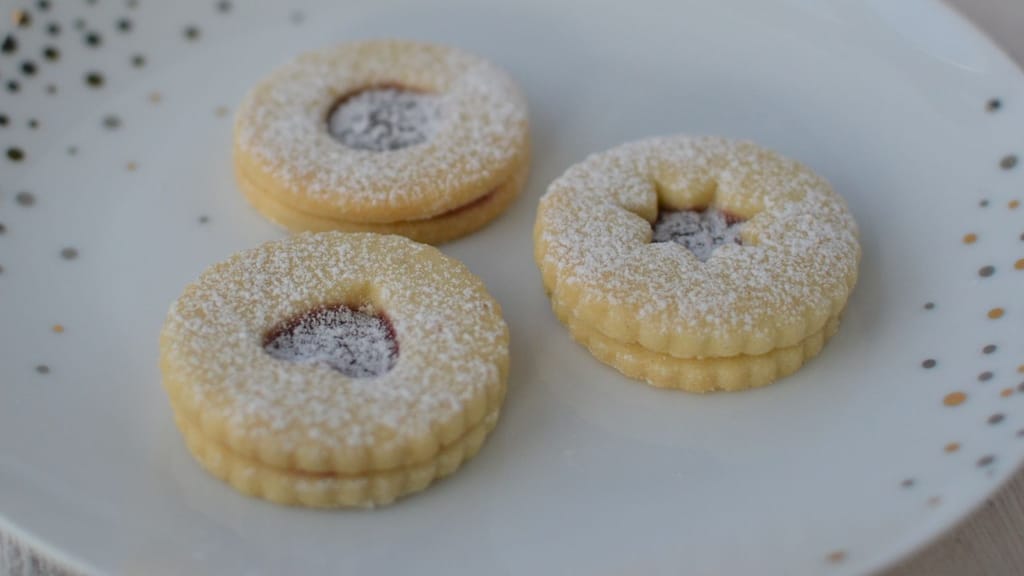
Classic christmas cookies: delicate linzer cookies
Classic crisp linzer cookies – thin dough, bake one tray at a time
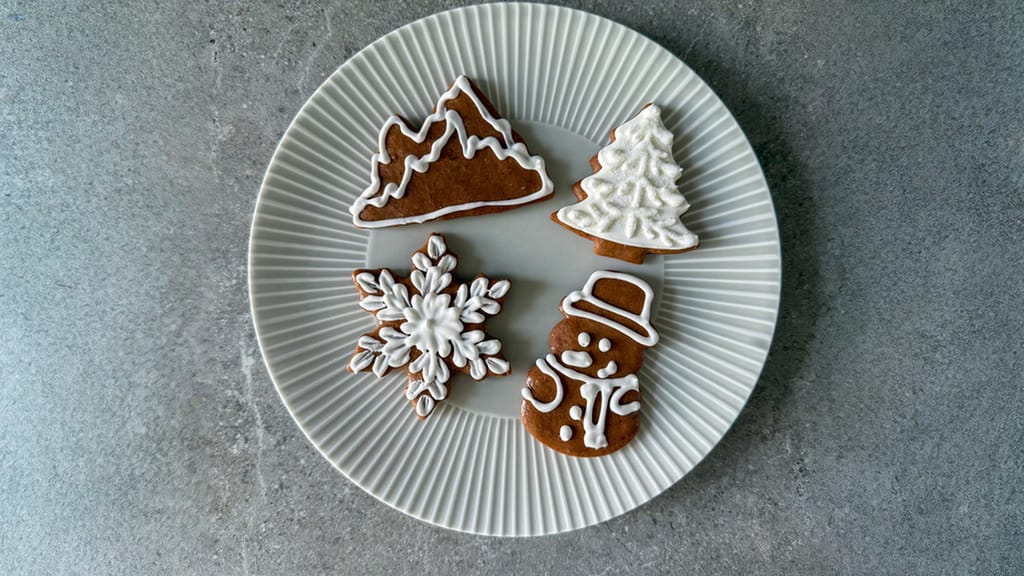
Soft honey gingerbread cookies that never go hard
Soft honey gingerbread – handles two trays at once on fan/convection
Let the baked cookies rest on the tray for 2–5 minutes, then move them to a wire rack so the bottoms don't turn damp. Only put them in storage boxes once fully cooled. Find out how to store them to keep them crisp in our article How to Store Christmas Cookies, and how many days each type keeps in our guide How Long Christmas Cookies Keep, by Type.
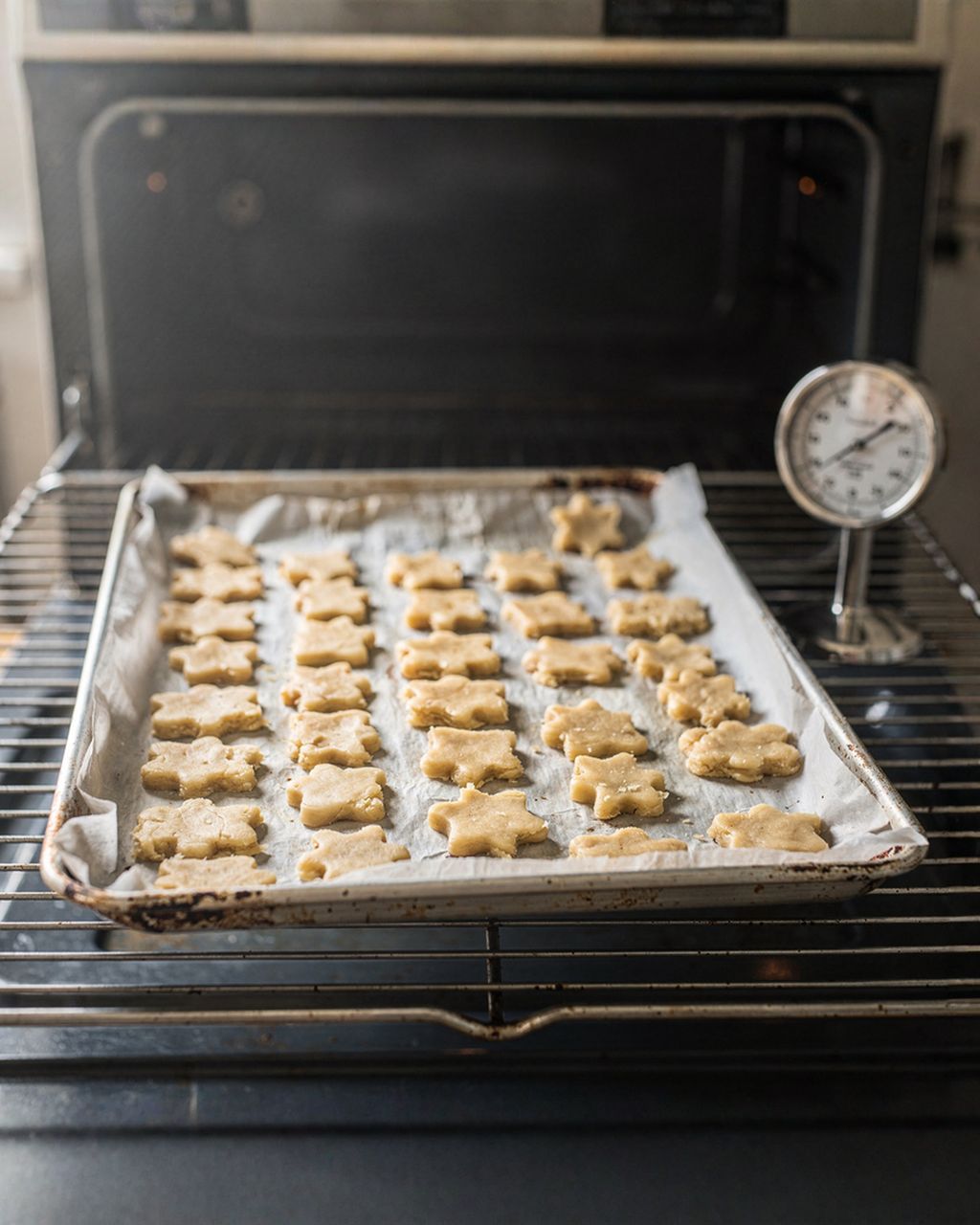
A standard oven tray holds roughly 25–35 cookies about 4–5 cm (1.5–2 in) across. Leave about 2 cm (¾ in) between pieces — butter dough spreads slightly as it bakes, and cookies that touch won't brown evenly at the edges.
The edges of the tray sit closer to the oven walls and heating elements, so they get more heat. It helps to rotate the tray 180° halfway through baking and spread the cookies evenly across the whole tray rather than clustering them in the middle.
Yes — on a dark tray, cookies brown faster on the bottom because the dark surface absorbs more heat. Check cookies earlier when using a dark tray; for pale cookies, a light-colored tray is the safer choice.
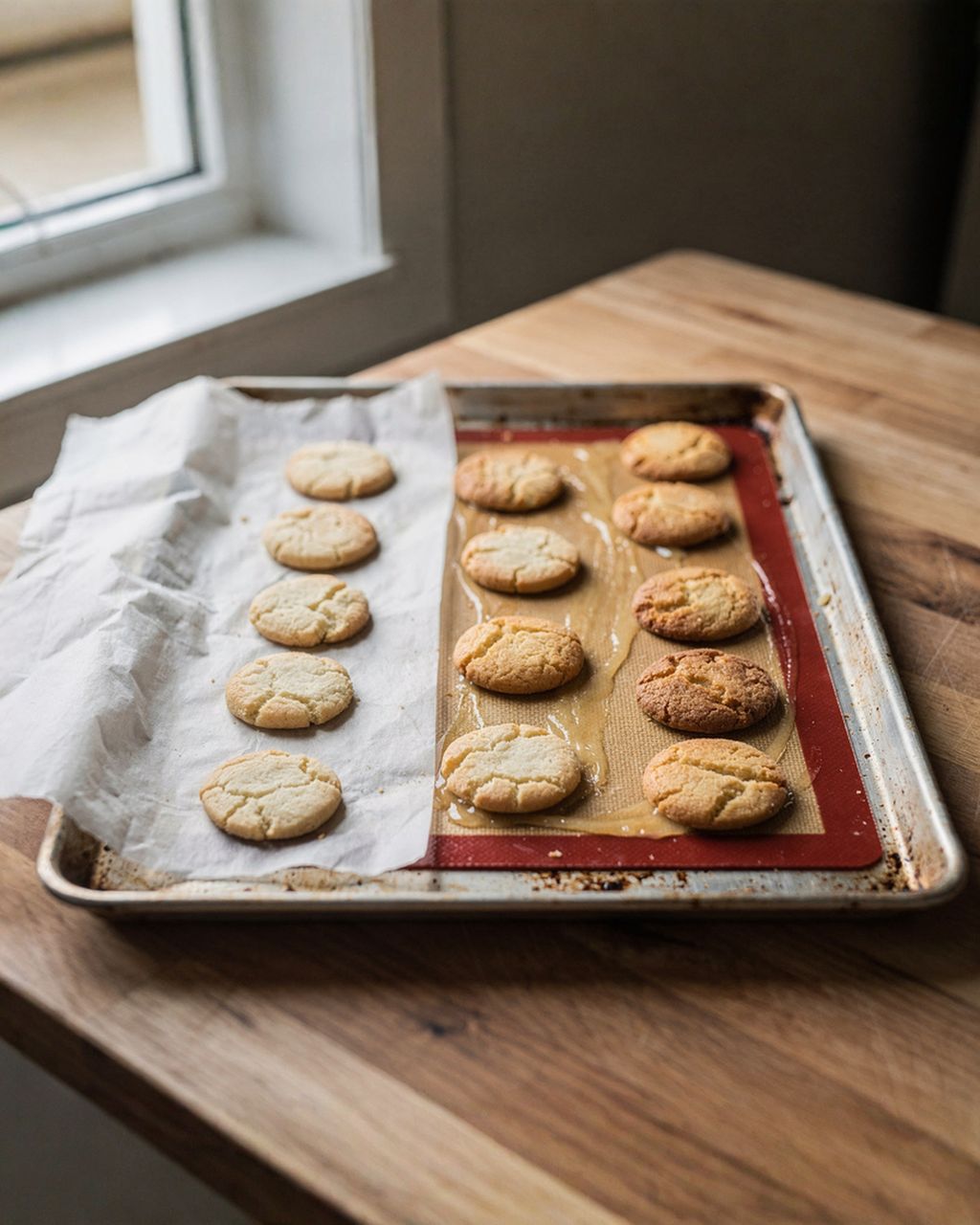
Parchment paper is usually good for 2–3 batches, as long as it hasn't darkened, gone brittle, or turned greasy. After that, replace it — scorched parchment passes an off flavor to the cookies and makes the bottoms brown faster.
No — don't bake soft butter cookies directly on a rack lined with parchment; the paper will sag between the bars and the cookies will lose their shape. A rack with parchment can only handle firm dough, like gingerbread, and even then the bottoms bake faster than they would on a tray.
One recipe worth heating the oven for, one tip, and one deal from the shop. Nothing else.