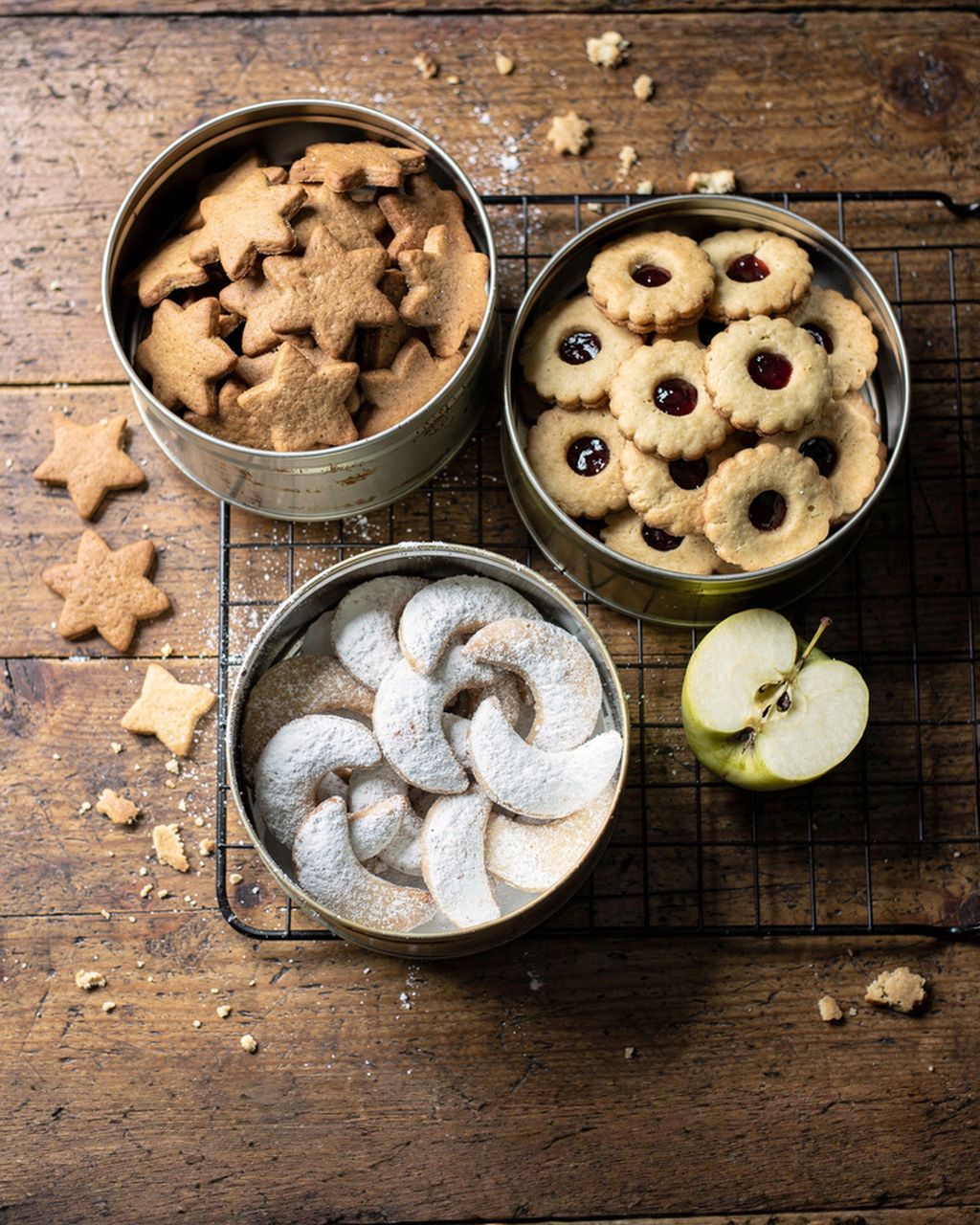
Classic christmas cookies: delicate linzer cookies
How to Freeze Christmas Cookies and Dough (and Thaw Them Without Going Soggy)
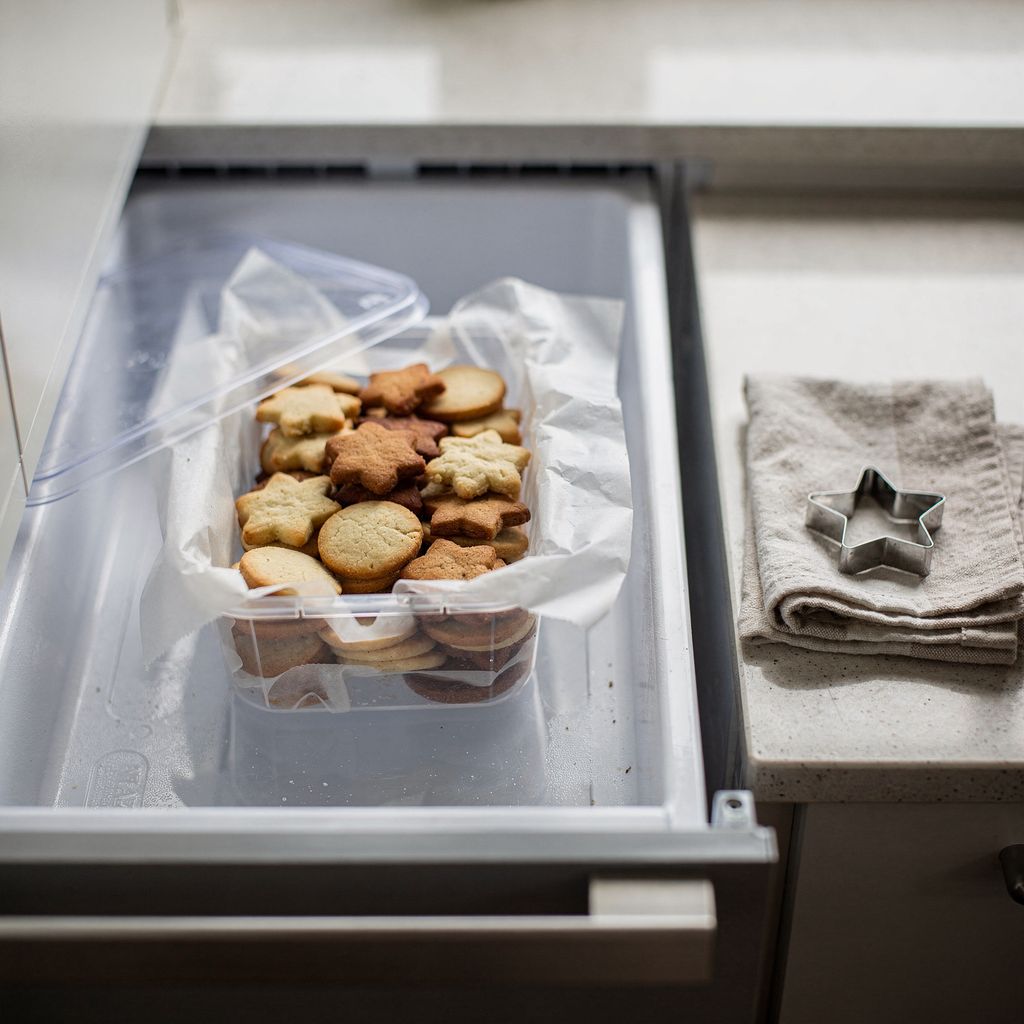
Updated Aug 29, 2026
Yes, you can freeze Christmas cookies — and it's the best way to have a stress-free December: the freezer handles linzer cookies, vanilla crescents, gingerbread, walnut crescents and raw dough without any trouble, and with a bit of care, even perfectly dried meringues and macarons — though each one needs a different thawing method. What it can't handle is no-bake balls, pavlova with whipped cream, and anything with fresh cream filling. Baked cookies keep their full flavour in the freezer for two to three months, raw shortcrust and puff pastry wrapped tightly for about three months (store-bought puff pastry in unopened packaging up to six, per the manufacturer), and yeasted dough for just one month. And there's really only one trick to stop cookies going soggy after thawing: thaw them sealed in the same container they were frozen in, and only open the lid once the contents have reached room temperature — with meringues, it's exactly the opposite: take them out of the container straight away.
There's one simple rule: the freezer handles anything dry and undecorated just fine, and can't handle anything moist, unbaked, or freshly finished with decoration. Sandwiched and filled types sit right on the border — the filling is moist, the pastry around it soaks up that moisture, and crumbly linzer pastry gradually turns into a soft biscuit even below freezing. That's why you should freeze sandwich halves separately and only join them after thawing. Ganache is the exception among fillings: it has little free water, so it holds up to freezing better than jam or buttercream.
Seven types of cookies freeze well: unfilled linzer cookies, vanilla crescents and butter biscuits, plain gingerbread (no icing), walnut crescents and coconut biscuits, perfectly dried meringues, macarons, and raw dough.
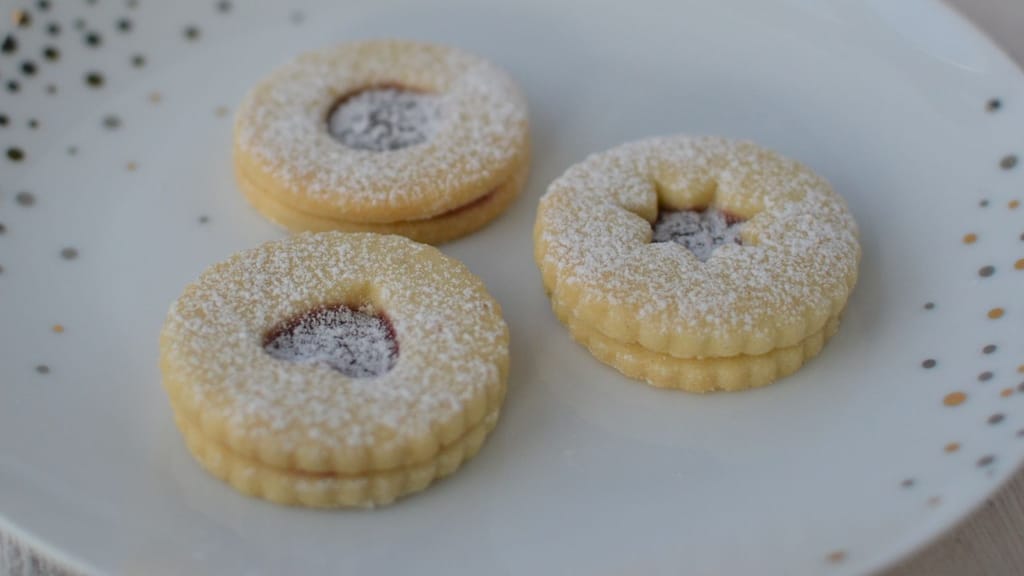
Unfilled linzer cookies — dry pastry with a high fat and minimal water content; freezing doesn't affect it at all.
Vanilla crescents and butter biscuits — freeze them unrolled; coat them in icing sugar only after thawing. Sugar would go damp and clump together in the freezer.
Plain gingerbread (no icing) — a slightly moister type, but freezing doesn't bother it. Decorate only after thawing.
Walnut crescents and coconut biscuits — freeze without issue, though their high fat content makes them a bit more time-sensitive.
Meringue-based cookies. They can be frozen, but they need to be completely dry and kept in an airtight container. Thawing is the tricky part: meringues are pure sugar, and sugar draws in moisture even from the small amount of air left in the container — so take them out the moment you pull the container from the freezer and let them thaw uncovered on a wire rack, otherwise a crisp meringue turns rubbery.
Macarons. Freeze them in an airtight container in a single layer, but thaw them sealed — leave the container closed on the counter and only open it once the contents have come up to room temperature. An opened macaron immediately picks up condensation and its shell goes soft.
Raw dough — shortcrust, yeasted and puff all work. This usually turns out better than freezing the baked cookies themselves.
Two types don't belong in the freezer: no-bake balls, rum balls and salami-style rolls, and anything with fresh cream or whipped cream, including pavlova.
No-bake balls, rum balls and salami-style rolls. They hold together on fat and sugar, and after thawing they fall apart and the fat rises to the surface.
Anything with fresh cream or whipped cream, including pavlova. Freezing breaks the emulsion, and the cream separates into fat and water once thawed.
Decorated cookies actually do better than people usually think. Cookies with royal icing can be frozen, but only once the icing is completely dry (let it set overnight, ideally 24 hours). Then pack them into an airtight container, layer with paper, and thaw them sealed — if you open it before the contents reach room temperature, the icing turns dull and sticky. Coloured decorations are less certain: colours and sugar sprinkles can sometimes bleed in the freezer, so test a few pieces first. The safest bet is still to freeze cookies undecorated and finish decorating after thawing.
If you know you'll be baking, freeze the dough — once baked, it's indistinguishable from fresh. If you have leftover cookies, or you're baking in bulk ahead of time and want things done, freeze the baked pieces. Both work; each suits a different situation.
Freezing raw dough pays off in four situations:
you want the best possible result — freshly baked cookies have a crispness that no thawing process can restore,
you're short on space: a kilo of dough takes up a fraction of the volume of what you'd bake from it,
you want simple, uniform shelf life — dough has no icing or filling, so three months applies to the whole batch equally, whereas baked cookies' storage time varies by type,
you're baking gradually and don't want ten different types sitting around the house at once.
Freezing baked cookies pays off in one of these three situations:
you want things ready to go, with thawing taking two hours, not an afternoon by the oven,
you're dealing with post-holiday leftovers — freeze them right away, not after a week in a container,
you're baking types that need to rest anyway: gingerbread and linzer cookies can effectively "pause" their resting period in the freezer and finish resting after thawing.
One rule applies to both: freeze it at its best, not once it's already starting to go stale. The freezer stops time — it doesn't turn it back.
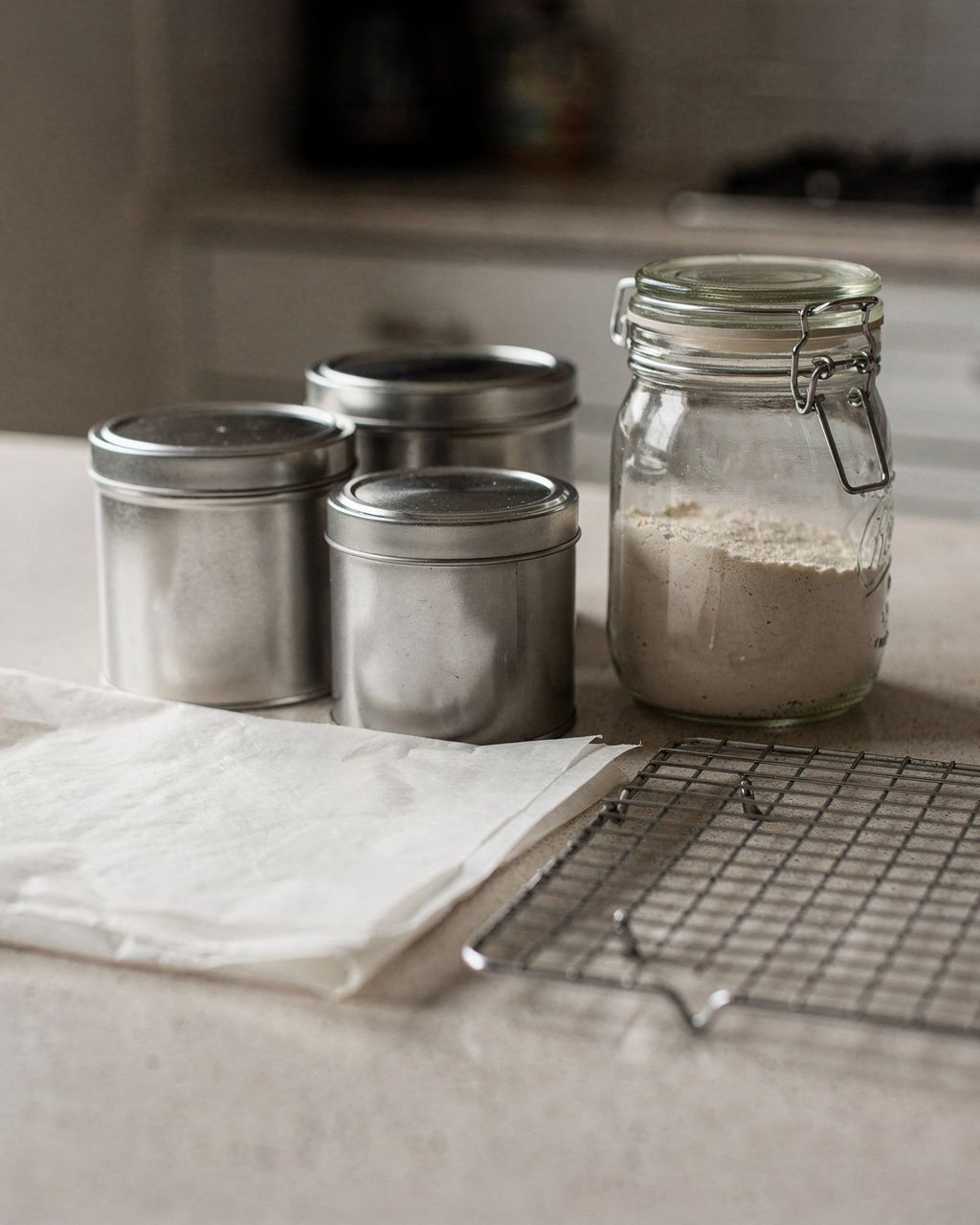
Wrapping comes down to six steps: cool → freeze first on a tray → layer with paper in between → fill empty space → keep types separate → label with date and type. The basis is double wrapping — a solid container lined with baking paper inside, plus a bag or wrap around it — and the container filled right to the top, because the air around the cookies is what dries them out and lets odours in. Step by step:
Let the cookies cool completely. Warm cookies sealed in a container release steam, which turns to frost in the freezer and ends up back in the biscuit after thawing.
Freeze on a tray first. Spread the pieces in a single layer on a tray lined with paper and freeze for 30–60 minutes. Only then transfer them to a container — they won't stick together or break under their own weight.
Layer with paper in between. Put a sheet of baking paper between each layer. For delicate types, go with two layers rather than five.
Fill empty space. Pack any remaining gap in the container with scrunched-up baking paper. Less air means less drying out and less frost.
Keep types separate. Crumbly and soft cookies don't get along, whether in a container or in the freezer — moisture travels from gingerbread into linzer cookies even below freezing, just more slowly.
Label with date and type. After two months in the freezer, everything looks the same, and guessing isn't worth it.
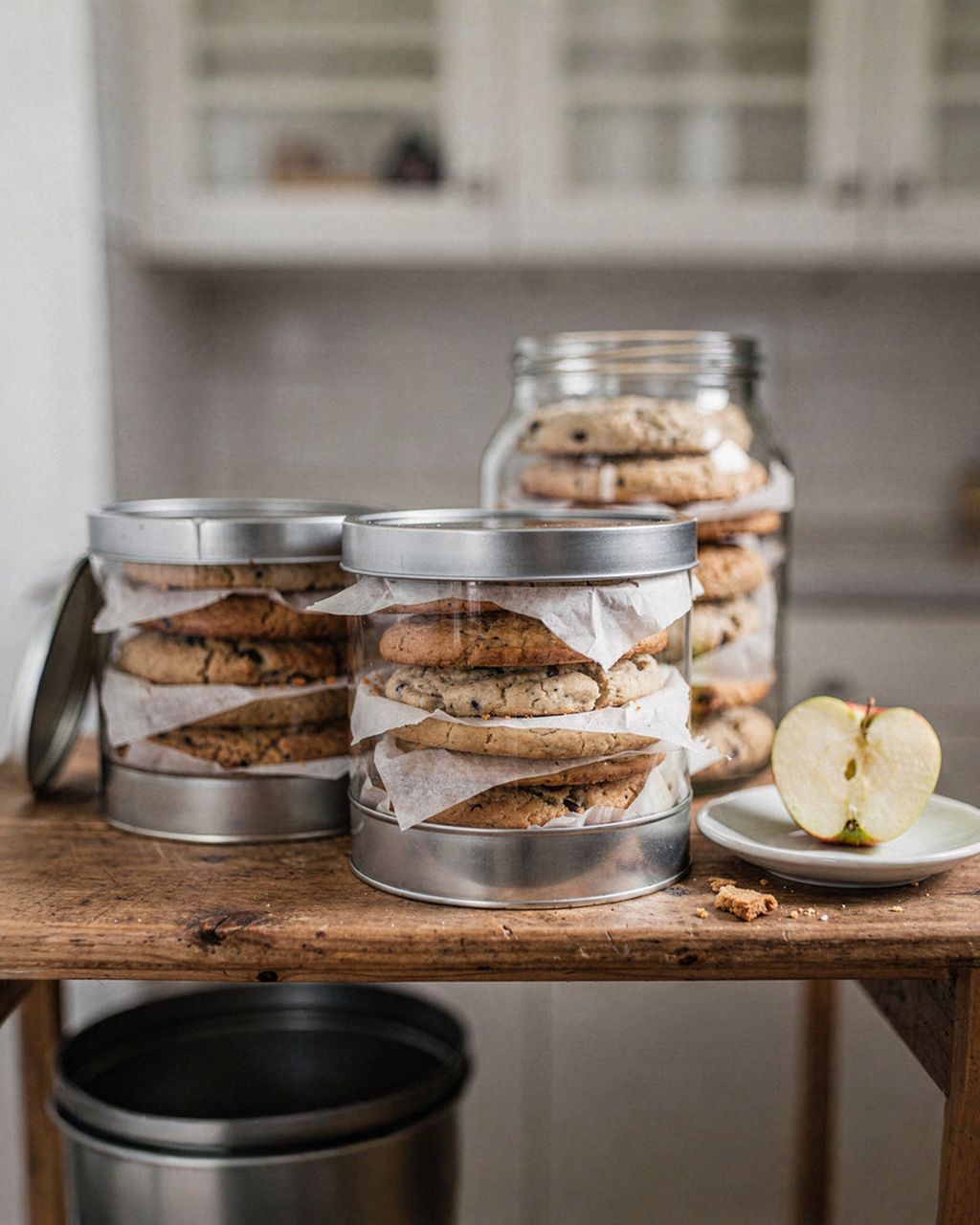
Use a solid container, not a bag — cookies are fragile and the freezer is rough terrain. Skip metal tins in the freezer; they don't seal well and attract condensation. A sturdy plastic container with a rubber seal, or a glass one with a clip lid, is ideal. And set your freezer to -18°C or below: it won't stop fat oxidation, but it will slow it down significantly.
Baked cookies keep their full flavour in the freezer for two to three months, raw shortcrust dough for three months. Longer times you sometimes see quoted (six months or more) are still flavour recommendations, just more generous ones — at a steady -18°C with an unbroken cold chain, cookies stay safe for practically indefinite periods, but the fat inside still oxidises even below freezing, and over time it starts to smell like old cooking oil. (This is food storage guidance, not a food safety verdict — if the freezer thawed out at some point or you're not sure about the temperature, it's safer to throw the cookies out.)
Unfilled linzer cookies, baked — 3 months
Linzer cookies sandwiched with jam — 1 month, and it's better to sandwich them only after thawing
Vanilla crescents, butter and nut-based types — 2 months; high fat content means a shorter shelf life
Plain gingerbread (no icing) — 3 months
Walnut and coconut biscuits — 2–3 months
Meringues and macarons — about 1 month in an airtight container
Raw shortcrust (linzer) dough — 3 months
Yeasted dough — 1 month; beyond that, the yeast won't stay in usable condition
Puff pastry — 3 months homemade; store-bought in unopened original packaging up to 6, per manufacturers
There's a direct relationship worth remembering: the fattier the cookie, the shorter its freezer life. Butter is the first thing to turn, and you'll notice it by smell before you notice it by taste — if the container smells musty or like old oil when you open it, the cookies' best days are behind them.
Thaw cookies sealed in the same container you froze them in, at room temperature, and only open the lid after two to three hours, once the contents are the same temperature as the room. That's the whole secret — and the reason is physics, not cooking technique.
The freezing-cold surface of a biscuit sits well below the room's dew point. The moment you take it out of the container, moisture in the air condenses on it instantly into a film of water, the biscuit soaks it up, and there goes the crispness — icing turns dull, gingerbread gets sticky, linzer pastry goes soft. If you leave the container sealed, that same water condenses on the outside of the container instead, where it doesn't matter to anyone.
Take the whole sealed container out of the freezer and set it on the counter. Don't open it, don't even peek.
Leave it for 2–3 hours at room temperature. Not near a heater, not in the sun — fast thawing makes the surface damp before the inside has warmed through.
Not in the fridge. For cookies, the fridge is the worst option: it takes all day, and the biscuit stays cold throughout — moisture will still condense on it the moment you take it out. (For raw dough, it's the opposite — that's exactly where it should thaw.)
Open the container and wipe the lid. Water that condensed on the outside belongs in a tea towel, not back inside the container.
Restore the crispness if needed: 5 minutes at 140–150°C, then cool completely on a wire rack. Putting warm cookies straight back in the container is the fastest way to make everything damp all over again.
With meringues, do exactly the opposite. Meringues are pure sugar, and sugar draws in moisture even from the small amount of air left in the container — so take them out the moment you pull the container from the freezer and let them thaw uncovered on a wire rack, where the surface moisture can evaporate. Macarons, on the other hand — just like linzer cookies — need to stay sealed; that's why meringues should never be frozen in the same container as anything else.
Don't thaw cookies in the microwave. It heats the fat and water inside unevenly, the crisp structure turns soft, and there's no getting it back.
Always freeze dough in the shape you'll need it in — portioned for a single bake, rolled into a disc no more than 2cm thick, or already cut into shapes. A thin disc or a narrow log freezes quickly and evenly, while a large lump of dough freezes from the outside in over several hours, giving coarse ice crystals time to form inside. Wrap it tightly in plastic wrap with no air pockets, then put the whole thing in a bag as well.
Shortcrust dough is the most freezer-friendly of the three: it's high in fat, low in water, and has no live yeast, so freezing barely affects it. It keeps for 3 months, after which texture and flavour noticeably decline.
Wrap it as a disc, not a ball. A disc 1–2cm thick freezes within an hour and thaws overnight; a ball will take all day to thaw in the fridge and stay hard in the middle.
Thaw overnight in the fridge, then let it come to room temperature on the counter for 20–30 minutes. Straight from the fridge, cold dough is hard, crumbly, and cracks when you roll it out.
Freeze cut-out shapes on a tray in a single layer, then transfer them to a bag. Bake them straight from frozen, just adding 1–3 minutes. Shapes cut before freezing hold sharper edges than ones cut from fresh dough.
If your dough crumbles after thawing, that's not down to the freezer — it's the fat-to-flour ratio and the temperature you're working with.
Of the three types, yeasted dough is the most delicate, since freezing kills off some of the yeast. Freeze it after the first rise and before the second — at that stage it's already developed its gluten and flavour, but still has enough strength left to rise again after thawing.
Add roughly a quarter more yeast than the recipe calls for. This makes up for the yeast that won't survive freezing.
Shape it before freezing. Freeze rolls, buns and sweet buns already shaped on a tray, then transfer them to a bag — shaping icy dough after thawing is a losing battle.
Keeps for 1 month. Any longer and the rise noticeably suffers.
Thaw overnight in the fridge, then let it rise at room temperature until doubled in size. Allow 2–3 hours, sometimes longer — dough from the freezer always rises more slowly than fresh dough. Don't try to rush it in the oven; over-warm proofing gives a thin, sour result.
Puff pastry freezes brilliantly — that's actually how it's sold in shops — but one strict rule applies: never thaw it and then freeze it again. On a second cycle, the butter layers between the sheets melt and merge into the dough, and it will never puff up again.
Homemade keeps for 3 months; store-bought in unopened original packaging up to 6, per manufacturers.
Freeze it rolled out and layered with paper, not rolled up into a log — dough thawed from a log unrolls with cracks.
Thaw in the fridge, not on the counter. Warm puff pastry turns greasy, the butter leaks out, and the layers merge together. Work with it cold and quickly.
Bake small pieces straight from the freezer — pastries, hand pies, straws. Cold butter layers don't have time to soak into the dough in a hot oven, and the water in them turns to steam, which lifts the layers. (Whole rolled-out sheets, on the other hand, should be thawed first as per the manufacturer's instructions, or they'll crack when you unroll them.)
Bake cut-out shapes and small pieces straight from frozen; always thaw whole blocks of dough in the fridge first. The dividing line is size: anything thin and small warms through before it has a chance to fall apart.
Bake from frozen: cut-out linzer and gingerbread shapes, shortcrust cut-outs, puff pastry pastries and straws, biscuits sliced from a log. Add 1–3 minutes and, for larger pieces, drop the temperature by 10°C so the centre has time to warm through before the edges get too dark.
Thaw first: whole blocks of shortcrust dough, rolled-out sheets of puff pastry, anything yeasted, and anything you still need to roll, shape or fill.
Judge by colour, not by the timer — baking from frozen always behaves slightly differently than baking from room temperature.
Four types freeze best: linzer cookies, honey gingerbread, vanilla crescents and puff pastry hand pies. Shortcrust pastry handles the freezer better than anything else, gingerbread loses nothing to freezing, crescents just need to be frozen unrolled and coated in sugar after thawing, and puff pastry pieces bake straight from frozen.
Classic christmas cookies: delicate linzer cookies
Classic shortcrust linzer cookies — the dough that handles the freezer best of all
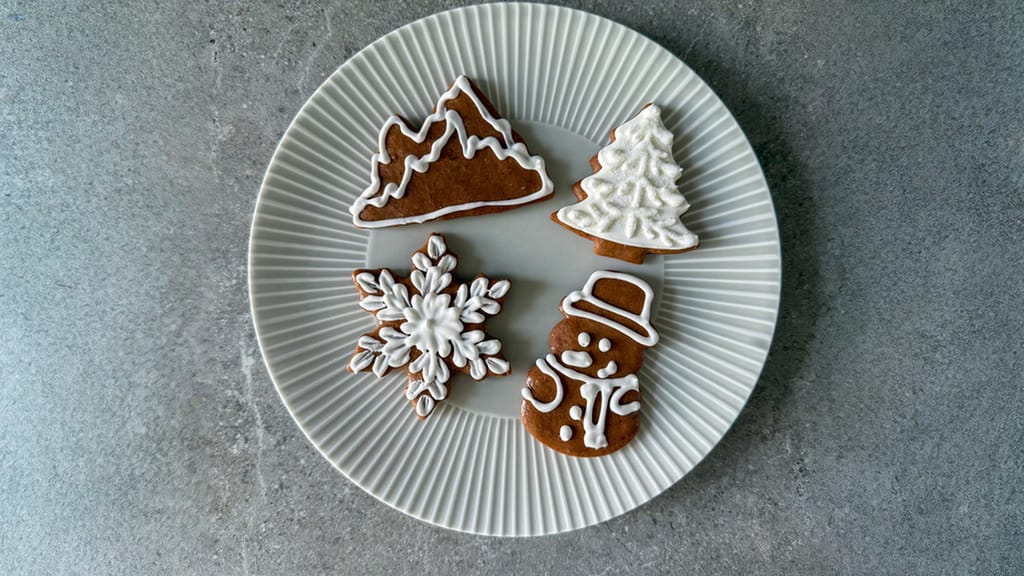
Soft honey gingerbread cookies that never go hard
Soft honey gingerbread: freeze it without icing and decorate after thawing
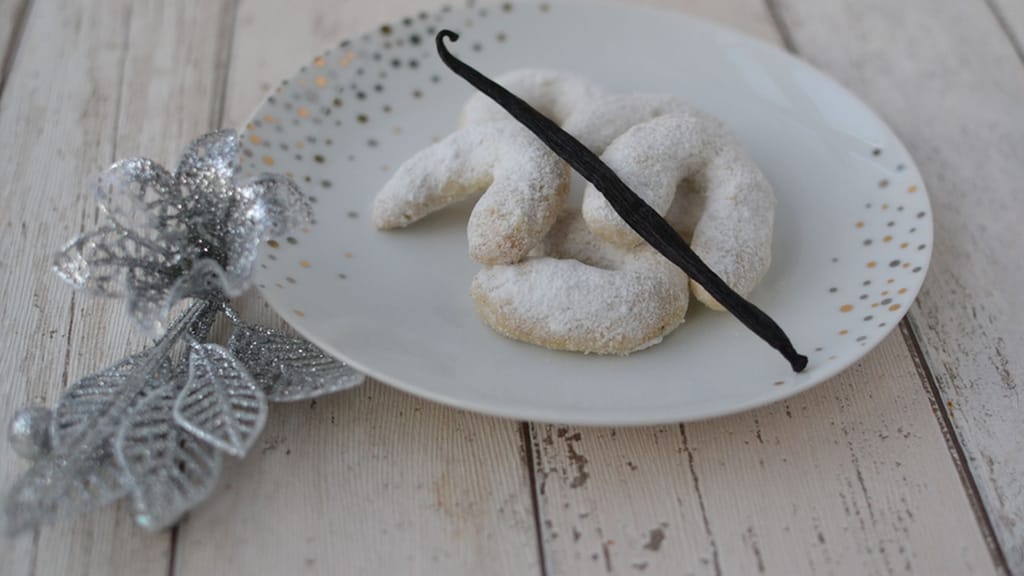
The best christmas cookies? vanilla crescents, of course!
Vanilla crescents to freeze unrolled — coat in sugar only after thawing

Puff pastry bites
Puff pastry hand pies that bake straight from frozen
The freezer is just one part of storage. For the rest — which containers to use, which types can't go together, and when to actually start baking — you'll find it here.
You can freeze cookies filled with ganache — it holds up to freezing better than buttercream or jam, because it's a stable emulsion of chocolate and cream with very little free water, so it won't separate once thawed. Just bear in mind that moisture from the filling migrates into the pastry even below freezing, so only freeze sandwiched ganache cookies for up to a month, and thaw them sealed in their container, otherwise water will condense on the chocolate. The best result still comes from freezing the halves separately and whipping the ganache fresh on the day you plan to serve the cookies.
You can start baking and freezing from the beginning of November — that's roughly seven weeks before Christmas Eve, and every type is still well within its freezer life. Plan the order by what keeps longest: unfilled linzer cookies, plain gingerbread (without icing) and raw shortcrust dough first; butter and nut-based cookies and meringues last — freeze those about two to three weeks before the holidays. Save the last weekend for thawing, sandwiching and decorating, not baking: thawing one container takes two to three hours, and you can only assemble and decorate afterwards.
Yes, cookies in the freezer will absorb odours from their surroundings, and that's one of the most common reasons thawed cookies taste off. The fat in butter binds odour molecules from the surrounding air, so crescents stored next to unwrapped meat or fish will gradually start to smell like it. Double wrapping protects against this — a solid, sealed container plus a bag around it — and the container should be filled right to the top so as little air as possible is left inside.
Don't refreeze cookies that went soft or sticky in the freezer — the cold chain was broken, and they shouldn't go back in. If they stayed rock solid the whole time and the freezer started running again before they had a chance to thaw, you can leave them frozen. If you're not sure about the temperature, eat them straight after thawing, not a month later. (This is food storage guidance, not a food safety verdict — if you don't know how long the cookies were without freezing, it's safer to throw them out.)
You can tell cookies have spoiled in the freezer by smell and by frost: a musty or oily smell means the fat has oxidised, while ice crystals inside the packaging and dry white patches on the surface mean freezer burn. Freezer burn isn't a health risk, just a dried-out, flavourless spot — those pieces are still edible, just not very enjoyable. A foreign smell (fish, garlic, frozen vegetables) means the container wasn't sealed properly and the cookies picked up odours from the freezer.
You can freeze cookies that have been sitting in a container for a week, but the freezer will only preserve them in the state they're in now — it won't bring back crispness they've already lost. For gingerbread, this actually works in your favour: let it sit and soften first, then freeze it. For linzer cookies, crescents and butter biscuits, the opposite is true — freeze them within two to three days of baking, while they're still dry. Before wrapping, check the container isn't damp and that different types haven't mixed together; if cookies have gone slightly damp, dry them out for 5 minutes at 140°C, let them cool completely on a rack, and only then wrap and freeze them.
One recipe worth heating the oven for, one tip, and one deal from the shop. Nothing else.