Silky celeriac cream soup with pear
What to Cook With Celery Root: Creamy Soup, Roasted Celery Root, Waldorf Salad, and Celery Root in Broth or Under a Roast
Updated Nov 25, 2026
What can you cook with celery root? You can make creamy soup, roasted celery root (cubed or whole), Waldorf salad, fried celery root and oven fries. You can also add it to broth or put it under a roast, where it gets blended into the sauce. We go through the dishes one by one, with methods, tricks and recipes that work.
You can make seven good dishes from celery root. Here they are:
creamy celery root soup, classic or made with roasted celery root,
oven-roasted celery root, cubed or whole,
celery root under a roast, where it gets blended into the sauce,
celery root in broth and braised meat as part of the vegetable base,
celery root salad, whether Waldorf or a simple carrot and celery root salad,
fried celery root, breaded or in batter,
oven-baked celery root fries.
This article is mainly about celery root, the big knobbly ball you find in every greengrocer's in winter. It is cheap, keeps for a long time and can do more than we give it credit for: raw it is crunchy and slightly peppery, roasted it turns sweet and nutty, and blended it gives soup a velvety body with no flour. If you want more ideas for cooking vegetables, browse our collection of vegetable, fruit and herb recipes.
Celery stalks come from the same plant, bred for long, fleshy stems. In soups and broths you can combine the two, but for salads or dips the stalks are the better fit. For how to handle them in the kitchen, see the article on how to store and freeze celery stalks and what to substitute for them. Here we stay with the root.
If you are choosing by time, this is roughly how it breaks down:
under 30 minutes: celery root salad, fried celery root, quick soup from boiled celery root,
under 1 hour 15 minutes: creamy roasted celery root soup, celery root fries, roasted celery root cubes,
for the weekend: whole roasted celery root, wild boar leg on celery root, tafelspitz or braised beef cheeks.
We send seasonal cooking and baking plans and recipes made from everyday ingredients. Unsubscribe in one click.
The fastest way to peel celery root is with a knife, because a peeler can't handle its knobbly skin. Here's how:
Wash the root well and cut off the top, where the leaves grow, and the bottom with the rootlets. You now have two flat surfaces.
Stand the celery root on one of them and, with a sharp knife, slice the skin off in strips from top to bottom, the way you would peel a pineapple. Don't be shy about cutting deep: the skin is tough and dirt clings between the bumps.
Cut out any remaining dark pits with the tip of the knife.
Halve the root and cut it to suit what you're making: cubes for roasting and soup, slices about 1 cm thick for frying, sticks for oven fries, thin matchsticks for salad.
Peeled celery root browns quickly in the air. If you're cutting it for a salad, sprinkle it with lemon juice right away. For cooking it doesn't matter, because the color fades in the pot anyway.
You rarely use a large celery root all at once. Wrap the cut half and put it in the fridge. For what to do with a whole root over winter, see the article on how to store root vegetables over winter.
Creamy celery root soup is the easiest way to use up a whole root. Celery root has firm, fibrous flesh that turns into a smooth cream after roasting and blending, with no flour needed to thicken it. Its flavor does need something sweeter to round it out, such as a pear, roasted onion or a potato.
Both of our recipes skip boiling in water. You roast the vegetables first and only then blend them with a little broth. Roasting evaporates the water from the celery root, concentrates the flavor, and the caramelized edges give the soup a depth you wouldn't get from boiling. For more methods and ratios for cream soups, see the article on cream soups.
Three things decide whether the soup turns out smooth and tasty:
Blend longer than seems necessary. Celery root is fibrous, and an immersion blender needs a minute or two to break the fibers down completely. If you want a totally velvety result, push the soup through a sieve as well.
Add the liquid gradually. It's easier to thin a soup than to thicken it, so start with less broth and pour in more until it reaches the consistency you want.
Season at the end. A blended soup often needs more salt than you'd expect, and a few drops of lemon juice or a pinch of nutmeg freshens it up.
For a topping, anything crunchy that contrasts with the cream works: toasted nuts, seeds, croutons, browned celery root cubes or a drizzle of good oil.
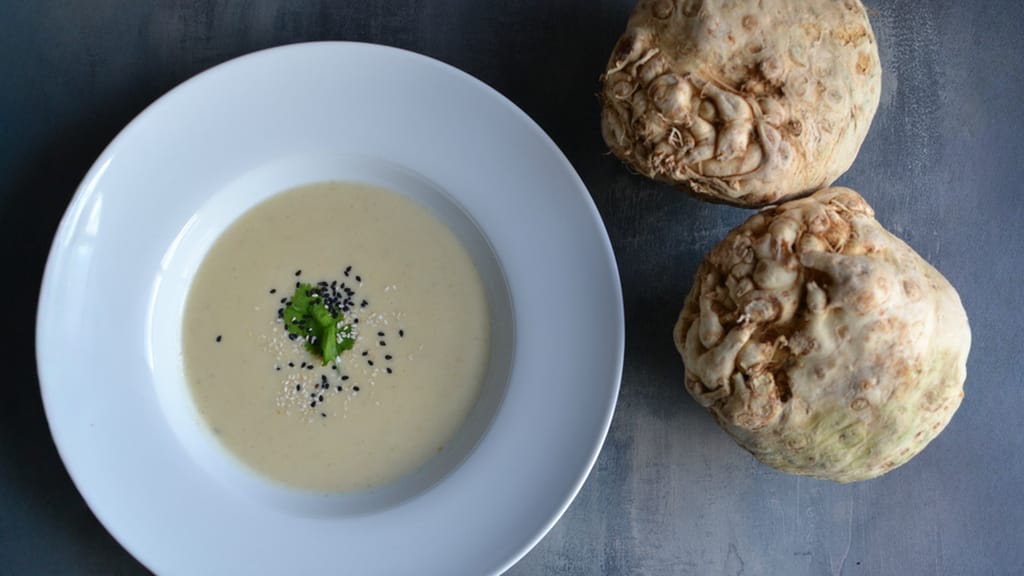
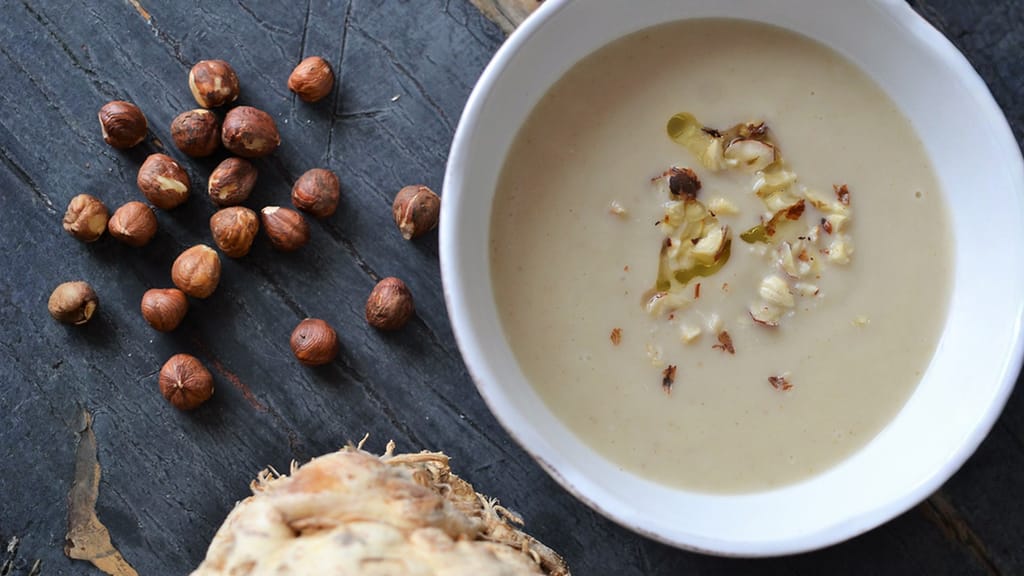
This delicate creamy celery root soup with pears is built on one whole celery root, one onion and three pears. You cut the celery root into pieces, halve the onion, and peel and core the pears. Season everything with salt and pepper, drizzle with olive oil and roast until soft in a roasting pan or roasting bag at about 160°C (320°F). Then blend it with 200 ml of broth and 200 ml of whipping cream and serve topped with toasted hazelnuts. The whole soup takes about 68 minutes.
The pear does the same job here as the apple in Waldorf salad: its sweetness and juiciness soften the earthy flavor of the celery root. Choose ripe, fragrant pears. Hard, unripe fruit is bland and won't sweeten the soup.
Silky celeriac cream soup with pear
Creamy celery root soup with roasted pears and toasted hazelnuts
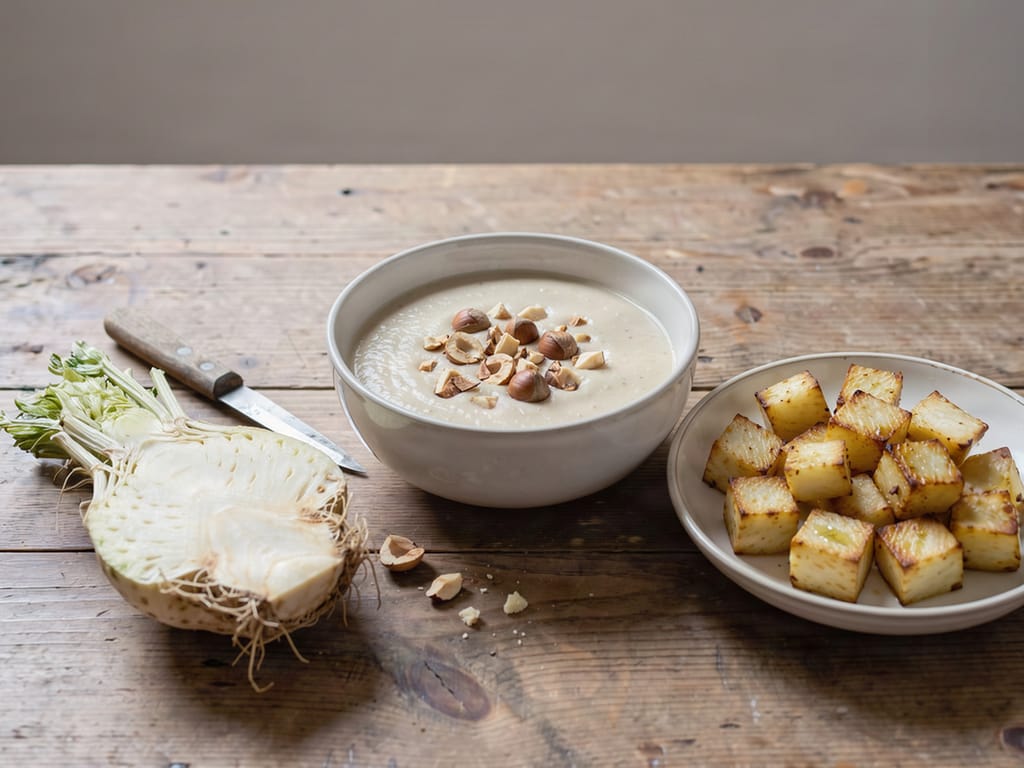
This creamy roasted celery soup combines both kinds, the root and four celery stalks. They're joined by two potatoes, a parsley root, an onion and two cloves of garlic. You chop the vegetables, season with salt and pepper and roast until soft at about 160°C (320°F). While still soft, you blend them with 200 ml of water or vegetable broth, adding more liquid if the soup is too thick. On the plate, sprinkle it with sesame seeds and garnish with parsley or cilantro. Count on 75 minutes from start to finish.
The potatoes do the work of cream here. Their starch thickens and softens the soup, so it needs no dairy at all.
You can roast celery root three ways: cubed, whole, or as a celery root steak. Cut into cubes, it's done in roughly 30–40 minutes at 200°C (400°F). A whole root cooks more slowly but stays as creamy inside as a potato. All three methods do the same thing: the hot air draws water out of the celery root, and its natural sugars caramelize on the surface. That's why roasted celery root tastes sweeter and milder than boiled.
Cubes. Cut the celery root into evenly sized cubes of about 2 cm, toss with oil, salt and perhaps thyme or rosemary, and spread on a baking sheet in a single layer. Roast at 200°C (400°F), tossing halfway through. It's done when a fork goes in without resistance and the edges are golden brown. Don't overcrowd the sheet, or the cubes will steam in their own moisture instead of roasting.
Whole root. Just wash the celery root and scrub the dirt off with a brush, leaving the skin on. Rub it with oil, salt it, wrap it in aluminum foil and roast at 180°C (350°F). For a large root that takes around two hours. It's done when a knife slides through the center like butter. Then unwrap the foil and roast for another 15–20 minutes until golden. At the table, cut it into thick slices and let everyone cut off their own skin. Serve with butter and herbs, or with yogurt and nuts.
Celery root steak. The third option sits in between: cut the celery root into slices about 2 cm thick and sear them in a pan in oil until golden on both sides. Add a knob of butter, a sprig of thyme and a clove of garlic, and baste the slices with the melted butter. Then move them to a 200°C (400°F) oven and roast for 15–20 minutes until tender. You get a slice with a browned crust and a soft center that holds its own on the plate as a main course with a sauce or mushrooms.
Roasted celery root also suits warm grain bowls. This couscous with chickpeas and roasted vegetables roasts carrot and 400 g of celery root with drained chickpeas, whole garlic cloves and spices, such as coriander, chili and cinnamon, at 180°C (350°F) until tender. Then you mix everything with the couscous, squeeze the roasted garlic into it and finish with plain yogurt and fresh herbs. The recipe suggests cutting the harder celery root slightly smaller than the carrot so both cook at the same time.
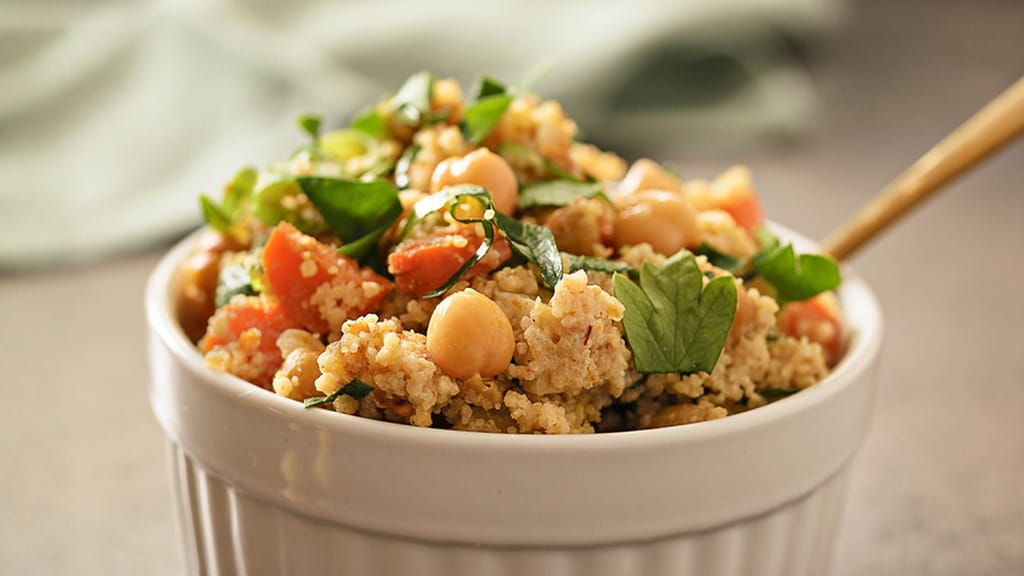
Couscous with chickpeas and roasted vegetables
Couscous with chickpeas, roasted carrot and roasted celery root with yogurt
Celery root under a roast serves as both a rack and the future sauce. The meat sits on a bed of vegetables, so it doesn't stick to the bottom of the pan, and the celery root soaks up the pan juices. At the end you blend it, and the sauce is thickened with vegetables instead of a roux.
This wild boar leg roasted on celery root, with chocolate sauce shows the principle best. You cut a whole celery root into cubes and two onions into wedges and brown both in a pan until golden. Then you tip the vegetables into a roasting pan, sear the salted and peppered leg whole in the same pan and set it on the celery root with rosemary. It roasts covered for several hours, until a fork slides into the meat without resistance. Finally, you blend the celery root with the onion and pan juices and whipping cream, and melt dark chocolate into the hot sauce. The recipe takes roughly 220 minutes and suggests tarhoňa (Czech egg barley) as a side.
The chocolate sounds bold, but it belongs with game. 30 g of dark chocolate doesn't make the sauce sweet, it only gives it a dark color and a slight bitterness that balances the sweet roasted celery root.
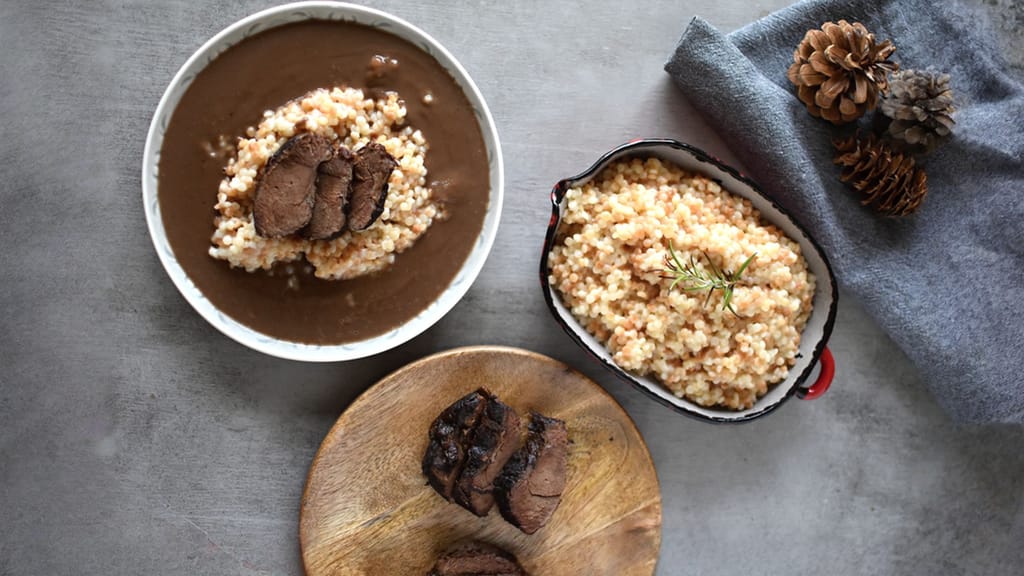
Roast wild boar leg on celeriac with chocolate sauce
Wild boar leg roasted on celery root with a sauce of blended celery root and dark chocolate
In broth and braised meat, celery root is one of the ingredients in the vegetable base, along with carrot, parsley root and onion. On its own it doesn't play the lead, but without it the broth tastes flatter: celery root adds an herbal, slightly peppery note that links the sweetness of the carrot with the meat. That's why you'll find it in almost every recipe for broth or svíčková (Czech beef in a root-vegetable cream sauce).
You can also turn the celery root from the broth into a side dish. Cook part of the celery root in the broth and let it give up its flavor, and cut the other part fresh and briefly sauté it separately. The first gives flavor, the second gives texture on the plate.
This tafelspitz with broth, vegetables and potato pancakes is beef tri-tip (Czech květová špička) simmered with marrow bones. Celery root is one of several vegetables: 250 g of it goes into the broth along with carrot, parsley root and onion. You first brown the vegetables in butter, brown the onion, halved and unpeeled, almost black, and then cover everything with the meat and bones in cold water and season with allspice and a bay leaf. The broth should barely simmer, for about five hours. A second celery root is then sliced with carrot and leek and briefly sautéed in butter so it stays lightly crisp to the bite. The meat is the main star, while the celery root helps build the broth and supplies the vegetable for the plate.

Tafelspitz with broth, vegetables and potato pancakes
Tafelspitz: beef broth with celery root and celery root sautéed in butter as a side
These beef cheeks in red wine with vegetables use celery root twice: half is braised in the sauce, the other half is sautéed as a side. You season the cheeks with salt and pepper and sear them hard in oil until dark brown. Add two carrots and two parsley roots, cut into rounds, and half of 350 g of celery root, pour in red wine and beef broth and braise, covered, for about three hours. Then you reduce the sauce and mellow it with a piece of cold butter. For the side, you sauté the second batch of carrot, parsley root and celery root with mushrooms. Here too the celery root is only one part of the root vegetables, but without it the sauce would be simpler and flatter.
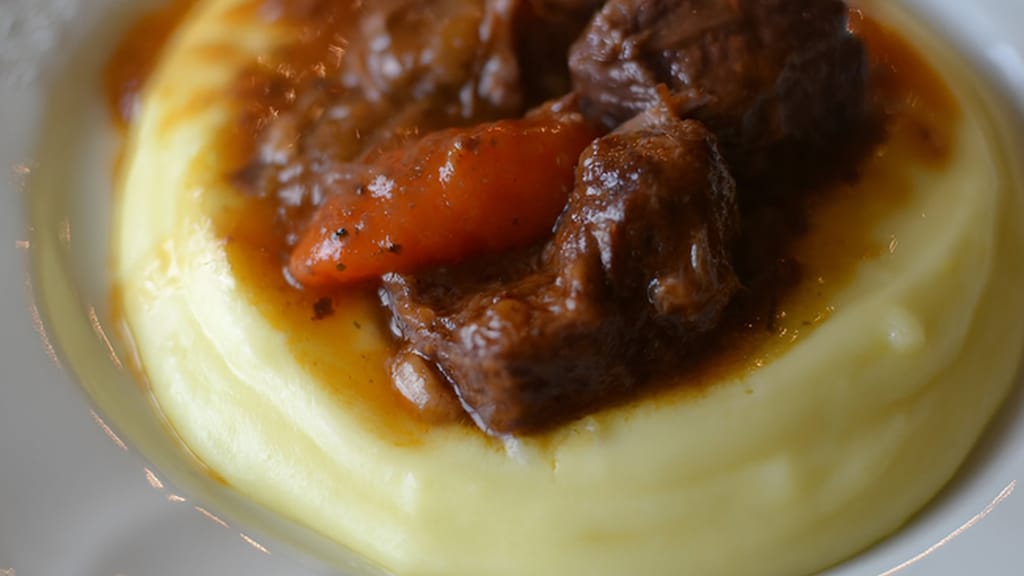
Beef cheeks in red wine with vegetables
Beef cheeks braised in red wine with root vegetables and celery root
For celery root salad, raw celery root is cut into the thinnest possible matchsticks or grated. Raw, it's tough, and thick pieces are hard to chew. Thin strips also soak up the dressing better. Celery root swallows the flavor of a dressing, so make it punchier than seems necessary: more lemon, more salt, more pepper.
This celery root Waldorf salad with Greek yogurt is built on Greek yogurt instead of mayonnaise and topped with chicken, which makes it a whole dinner. You pat the chicken breast dry, season with salt and pepper and sear it in canola oil until it reaches at least 74°C (165°F) at the thickest point. Cut 200 g of celery root and 200 g of apple into the thinnest possible matchsticks and sprinkle with lemon right away so they don't brown. Add red onion, grapes and walnuts, coat everything in yogurt mixed with salt, pepper and lemon juice, and finish with lamb's lettuce. It's ready in about 32 minutes.
The whole flavor of a Waldorf rests on contrast: earthy celery root, sweet apple and grapes, slightly bitter nuts and tangy yogurt. Leave out any one of them and the salad loses its balance.
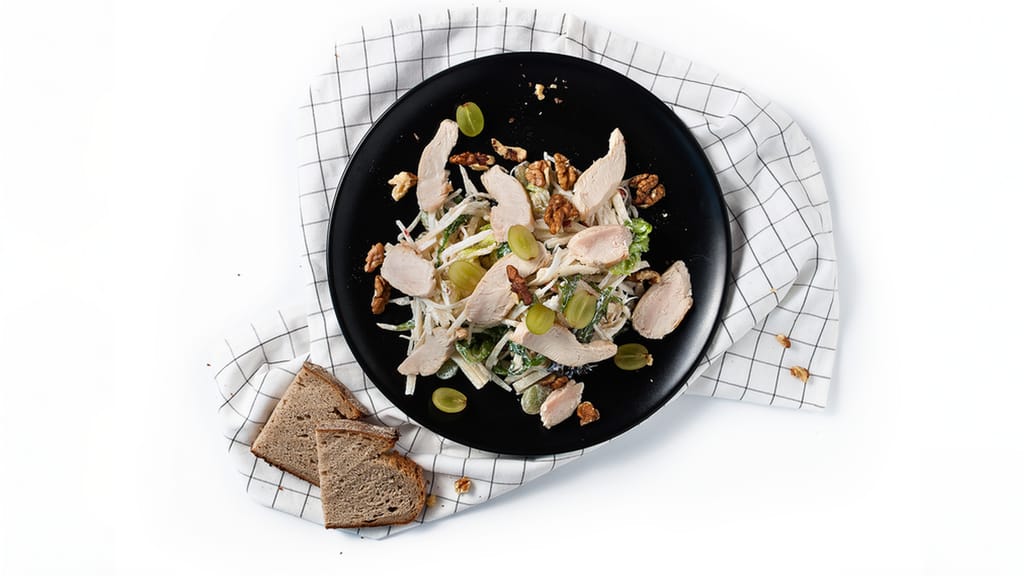
Celery waldorf salad with greek yogurt
Waldorf salad with raw celery root, apple and walnuts in Greek yogurt
Celery root with carrot is the quickest winter salad. Coarsely grate equal parts celery root and carrot, add a grated tart apple, drizzle with lemon and oil and season with salt and a pinch of sugar. Let it sit for ten minutes: the celery root softens and releases a little juice, which blends with the dressing. If you want to make a spread for bread from celery root, you'll find ratios and seasoning in the article on celery root, carrot and beet spreads.
Fried celery root is a slice of the root that is first par-boiled, then coated and fried, just like a schnitzel. Boil slices about 1 cm thick in salted water for 5–8 minutes, dry them thoroughly so the coating doesn't slide off, and coat them in breadcrumbs (flour, egg, breadcrumbs) or in batter. Fry them in oil heated to 170–180°C (340–355°F) until golden.
You can bake celery root fries in the oven at 200–220°C (400–425°F) in roughly 30–40 minutes. Cut the celery root into fries about 1 cm thick, toss with a little oil, salt and smoked paprika and spread on a baking sheet lined with parchment paper so they don't touch. Turn them halfway through.
Keep in mind that they won't be as crisp as potato fries. Celery root is more watery and less starchy than potato, so it stays soft inside and only browns on the outside. It helps to dry the fries before baking, sprinkle them with a spoonful of cornstarch and toss. That forms a thin crust on the surface. Serve the fries right away, because they soften as they cool. You can also make them in an air fryer, just in smaller batches so air can circulate around them. A garlic yogurt dip or ketchup goes well with them.
Of all the recipes in this article, the creamy roasted celery soup described above comes out free of animal ingredients: the creaminess comes from potatoes, not cream. These methods are also vegan as they are:
celery root roasted in cubes or whole, with oil instead of butter,
oven-baked celery root fries,
celery root and carrot salad with lemon and oil.
Fried celery root can be made vegan if, instead of breading it, you dip it in a batter of all-purpose (plain) flour and chilled sparkling water and fry it in oil. The flour and water alone take the place of the egg here, and the bubbles in the sparkling water make the batter light and crisp.
Don't throw away the boiled celery root left over from broth. It has given much of its flavor to the broth, but it still works in dishes where it is blended or mixed with something more assertive:
Blend it with a little broth and an onion sautéed in butter. In five minutes you have a small creamy soup.
Mash it with boiled potatoes and butter. The celery root adds a delicate herbal flavor.
Chop it finely into a sauce or vegetable risotto, where it thickens and won't be seen.
Make a spread out of it with quark (tvaroh, a Czech fresh curd cheese) or cheese, garlic and pepper.
If you're cooking celery root on purpose, for example as a purée to go with meat, boil it in salted water until soft, drain it and blend with butter and a drop of lemon. The creamy texture comes close to mashed potatoes, but the flavor is lighter.
Celery root pairs best with ingredients that balance its earthy, slightly peppery flavor with sweetness, fat or acidity. Tried-and-true combinations:
sweet fruit: apple, pear, grapes,
nuts: walnuts, hazelnuts, toasted seeds,
fat: butter, whipping cream, olive oil, cheese,
acidity: lemon, yogurt, mustard, a little wine vinegar,
herbs and spices: thyme, rosemary, parsley leaves, nutmeg, bay leaf,
meat: beef, game, chicken.
You can build your own combinations from this list. Roasted celery root with butter and thyme, raw celery root with apple and yogurt, celery root cream with pear and nuts: each time the principle is the same, with one ingredient rounding out the flavor of the celery root and another freshening it.
The most common mistake is cooking celery root for as long as carrot or potato. The tougher root needs either smaller pieces or more time. Other mistakes that are easy to avoid:
Raw celery root in thick pieces. In a salad it ends up tough and woody. Cut it into thin matchsticks or grate it.
Frying without par-boiling. The coating burns before the celery root softens inside.
An overcrowded baking sheet. Cubes or fries steam in their own moisture and don't turn golden. Leave space between them.
A weak dressing. Celery root swallows flavor, and the salad then tastes bland. Add more lemon and salt than you would for a leafy salad.
Short blending. A fibrous soup feels undercooked. Blend longer or strain it.
Peeled celery root left in the air. Cut into a salad, it browns. Sprinkle it with lemon right after cutting.
Use celery leaves as an herb: chopped into soup, broth or sauce, where they smell stronger than the root. Add the tough leaf stalks to broth whole and fish them out at the end. Chop the delicate leaves and add them to the finished dish or to herb butter. The leaves wilt quickly, so cut them off the root right after shopping and use them first.
Yes, celery root can be eaten raw. Just cut it into thin matchsticks or grate it, because thick pieces are tough. Raw, it tastes sharper and slightly peppery, so it needs a punchy dressing with lemon. It is typically used this way in Waldorf salad and in carrot and celery root salad.
In broth and soup, the best substitute for celery root is celery stalks. They smell similar but are milder. For roasting and purées, parsley root or parsnip work in its place, though both are sweeter. No other vegetable matches the flavor of celery exactly, so the result will be a little different.
A good celery root is firm and heavy for its size. A light root is often hollow or spongy inside. The surface should have no soft or weeping spots, and if it still has its leaves, they should be fresh green. Small and medium roots tend to have finer flesh than giant ones.
Yes, creamy celery root soup freezes well in a sealed container. Soup made with cream can split after thawing, so freeze it without the cream and stir the cream in when you reheat it. Reheat it slowly after thawing and blend it briefly again so it is smooth once more.