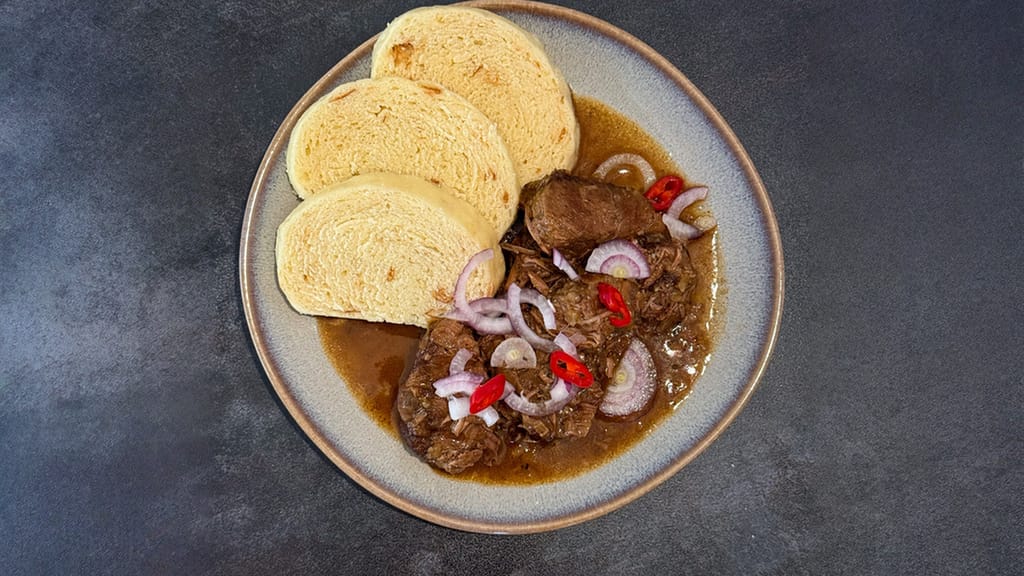
Classic czech beef goulash with chilli and bread dumplings
Goulash: Beef and Pork Recipe Step by Step, Meat, Onions and Sides
Updated Nov 19, 2026
Goulash is slow-braised meat in a thick onion sauce with paprika, caraway and marjoram. For a classic Czech beef goulash you need meat rich in collagen (shin or shoulder), roughly the same weight of onions as meat, and 2.5–3 hours of gentle simmering. Here you'll find the whole method step by step, plus pork goulash made from pork neck, Szeged goulash, wild boar goulash, oyster mushroom goulash, goulash soup, fixes for when it goes wrong, and what to serve with it.
The best beef goulash is made from beef shin or shoulder (přední), with onions at roughly 1:1 to the meat, paprika stirred in off the heat, and 2.5–3 hours of braising until the meat can be crushed with a fork. These five things decide the result: meat, onions, paprika, time and thickening. Everything else is seasoning.
Goulash calls for cheaper, hard-working cuts full of connective tissue, not lean, expensive meat. During long braising, the connective tissue (collagen) melts into gelatin, the meat turns tender, and the sauce gets a gloss and body you'll never get from a lean cut.
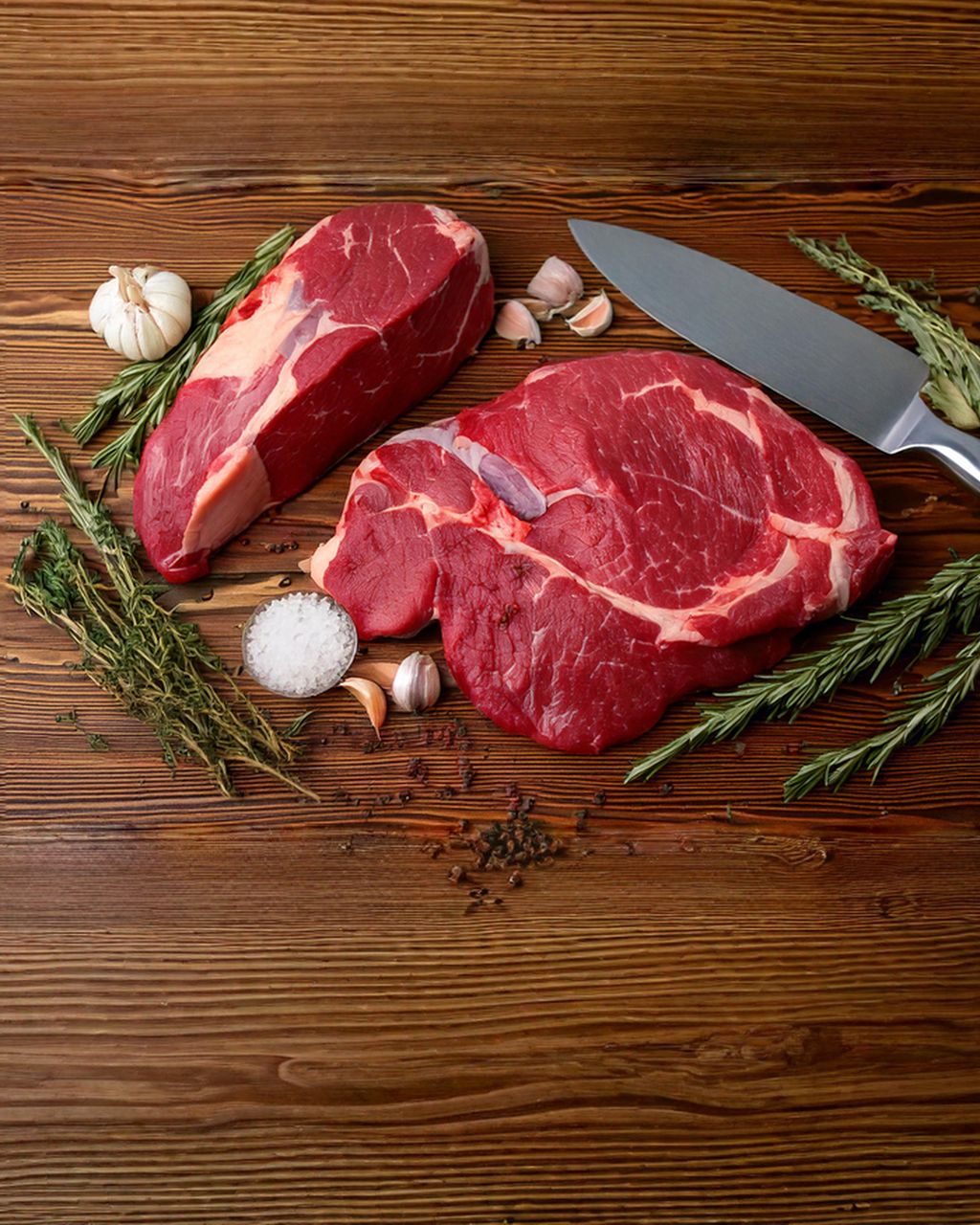
Beef shin – leg muscle laced with sinew. The number one goulash cut: after three hours it's juicy and the sauce thickens on its own.
Beef shoulder (přední) – shoulder and chuck. A little leaner than shin, it holds its shape as cubes and is easier to find. For more on which parts of the shoulder suit which dishes, see the article beef shoulder: what it's good for and what to cook with it.
The ideal is a combination: half shin, half shoulder. The shin gives the sauce gelatin, the shoulder gives nice cubes.
Round, sirloin or tenderloin (svíčková) are not suited to goulash – they have little connective tissue, dry out during long cooking and fall apart into stringy fibers. For a complete overview of the cuts, see the article types of beef: which cut for goulash, steak and svíčková. Cut the meat into 3–4 cm cubes. Smaller ones cook down to shreds, larger ones take needlessly long to braise.
Use the same weight of onions as meat: 1 kg of onions for 1 kg of meat. That's not excessive – onion is the main thickener in goulash. Over two to three hours it falls apart completely and turns the sauce into a smooth, sweetly dense gravy with no flour. If you want a thinner sauce, cut back the onions, but don't go below half the weight of the meat (meat to onion 2:1). With less than that, goulash tastes like braised meat with paprika.
Onions reward patience. Chop them finely and fry in lard or oil over medium heat for 20–30 minutes, until they turn golden, start to go light brown and stick to the bottom. These caramelized onions are the foundation of both color and flavor. If they stick too much, add a spoonful of water and scrape up the bottom – nothing is burning and the flavor stays in the pot.
Stir the paprika into the onions only after you take the pot off the heat, and add liquid within 20–30 seconds. Ground paprika contains sugars that turn bitter on hot fat in moments, and burnt paprika turns brown and makes the whole goulash bitter. Off the heat, it only releases its aroma and color into the hot fat.
Sweet paprika is the base: 2–3 heaped tablespoons (roughly 20–35 g) per 1 kg of meat.
Add hot paprika to taste, usually a teaspoon to a tablespoon.
Smoked paprika adds a smoky note, but a teaspoon is enough, otherwise it overpowers everything else.
If it does happen, you'll know right away: the paprika darkens to a brick brown and smells acrid. How to rescue such a goulash is covered in the article bitter, sour or sweet goulash: why it tastes off and how to save it.
Besides paprika, a classic goulash needs four things: crushed caraway, marjoram, garlic and a little tomato paste. Each does something different and each has its moment.
Caraway (1 teaspoon per 1 kg of meat) goes in right after you add the liquid. Crushed in a mortar, it releases more flavor than whole seeds and doesn't crunch between your teeth.
Tomato paste (1 tablespoon) goes in right after the paprika. It deepens the color and adds acidity that balances the sweet onions. More than two tablespoons turn goulash into tomato sauce.
Marjoram (1–2 tablespoons dried) goes in only for the last 5–10 minutes, rubbed between your palms to release its essential oils.
Garlic (3–4 cloves) also goes in at the end. Cooked long, it turns sweet and loses the sharpness you add it for.
Some people add bay leaf, allspice or a piece of dark chocolate. These belong more with wild boar and game; for beef, the four above are enough.
Traditional Czech goulash is made with lard, and you can tell: the onions brown evenly in it and the sauce has a fuller, rounder flavor. Oil (canola or sunflower) works too, with a more neutral taste. Don't use butter – it burns during the long frying of the onions. Allow roughly 50–70 g of fat per 1 kg of meat; you can skim off the excess from the surface at the end.
The whole beef goulash takes roughly 3.5 hours, of which about 40 minutes is active work.
Meat (10 min): pat the cubes dry with a paper towel and salt them. Wet meat doesn't sear but cooks in its own juices.
Searing (10–15 min): sear the meat in batches on hot lard until browned on all sides, then remove it. If you put everything in the pot at once, the temperature drops and the meat releases water.
Onions (20–30 min): in the same fat, fry the finely chopped onions until golden to brown. They dissolve the browned bits left from the meat.
Paprika (30 s): take the pot off the heat, stir in the paprika and immediately add a little water or stock.
Spices and meat (5 min): add a tablespoon of tomato paste, the crushed caraway, and the meat along with the juices it released, and add liquid until the meat is almost submerged (roughly 0.8–1 l per 1 kg of meat).
Braising (2.5–3 h): cover and let it bubble only gently. Stir every 20–30 minutes and add water as needed. Goulash shouldn't boil hard – a rolling boil tightens the fibers and the meat turns tough.
Seasoning (10 min): at the end add pressed garlic and marjoram rubbed between your palms, then add salt and pepper to taste. Garlic and marjoram cook for only a few minutes, otherwise their aroma fades.
It's done when a cube of meat can be easily crushed with a fork against the side of the plate and the sauce is thick and glossy. A tested recipe with exact amounts is on Yumsto: classic beef goulash with chili and bread dumpling.
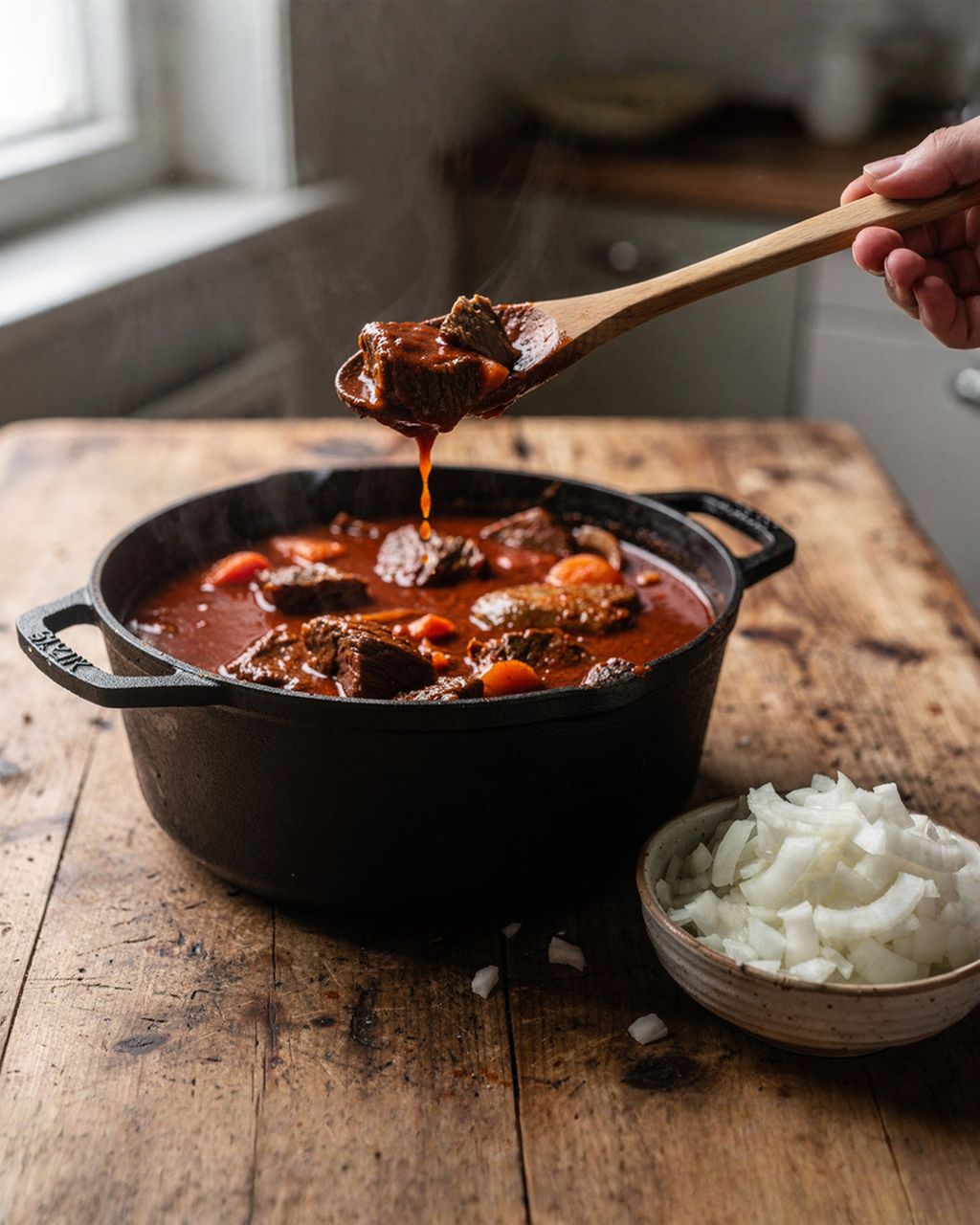
Classic czech beef goulash with chilli and bread dumplings
Classic beef goulash with chili and bread dumpling – step-by-step recipe
Beef goulash braises for 2.5–3 hours from the moment you add the liquid – shin more like 3 hours, shoulder more like 2.5. Treat the time as a guide, though: tenderness decides, not the clock. An older animal or big cubes may well need 30–45 minutes more. If the meat is still tough after three hours, don't boil it harder – add time and let it bubble quietly. What can cause tough meat is explained in the article why goulash is tough and the meat won't soften.
A well-made beef goulash doesn't need thickening: the cooked-down onions and the gelatin from the shin thicken it. If it's still thin, you have four common options:
Uncover and reduce for 15–20 minutes over gentle heat – the cleanest flavor.
Grate in a raw potato (1 smaller one per liter) and simmer for 10 minutes – it thickens and adds nothing else.
Roux: cook a tablespoon of all-purpose flour in a tablespoon of fat and whisk it into the sauce (per liter), then simmer for at least 10 minutes.
All-purpose flour stirred into cold water (1 tablespoon per liter), poured in while stirring and simmered for at least 10 minutes so the sauce doesn't taste of flour.
More methods and exact amounts per liter are in the article how to thicken goulash: 9 ways and how much of what per liter.
Seasonal baking plans, tested recipes and kitchen tricks that save you time. Unsubscribe in one click.
Pork goulash is best made from pork neck (collar): it's marbled with fat, stays juicy and turns tender in 1–1.5 hours, roughly half the time of beef. The method is the same as for beef; what changes is the meat, the time and a little of the seasoning.
Pork neck has streaks of fat between the muscles that melt during braising and keep the meat moist. Pork shoulder works too, just a little drier. Don't use leg or lean roast for goulash – they dry out within an hour and stay woody.
Pork goulash is sweeter and milder than beef, so it can take more hot paprika or a spoonful of mustard at the end. Just watch the fat: pork neck releases a lot, and if you want less, let the goulash rest for a while and skim the excess off the surface with a spoon.
Pork neck goulash is ready in roughly 1 hour 45 minutes, of which the meat braises for only 60–80 minutes.
Cut the pork neck into 3 cm cubes, salt them and sear in batches until golden (10 min).
Fry the onions in the pan drippings – the ratio close to 1:1 applies here too, though for pork you can use about a quarter less (20 min).
Off the heat, stir in the paprika, add liquid, then the meat and caraway. Caraway suits pork more than beef, so a heaped teaspoon per kilo is fine.
Braise covered for 60–80 minutes, until the meat gives but still holds its shape.
At the end add garlic, marjoram, salt and pepper. If you like, add some chopped green pepper for the last 15 minutes.
Pork goulash is done twice as fast, is milder and fattier, and therefore needs more caraway and fewer onions. Beef has a deeper, "meatier" flavor and a thicker sauce thanks to the collagen. When braising pork, watch the time more closely than with beef: beef usually gains from an extra hour, while an extra hour punishes pork neck with disintegrated fibers and dry meat. Check it every ten minutes from the 60th minute.
Szeged goulash (segedínský guláš) is a pork goulash braised with sauerkraut and finished with cream. The sour cabbage balances the fatty pork and the cream ties both into a smooth pink sauce. Classically it's made from pork shoulder or neck.
The quality of the sauerkraut decides the whole flavor. How to choose and prepare sauerkraut from a jar, a bag or a whole head is in the article braised sauerkraut: how to cook it from a jar, a bag or a whole head. Szeged goulash is served with bread dumplings; potatoes work too, but the dumpling soaks up the sauce better.
The base (seared meat, onions, paprika off the heat, adding liquid, caraway) is made the same way as for beef goulash. Three things differ:
Sauerkraut only halfway through: let the meat braise alone for 30–40 minutes to get a head start, and only then add the sauerkraut with a little of its brine, roughly 500–700 g per 1 kg of meat. Then braise for another 30–40 minutes.
Sourness: if the sauerkraut is very sour, rinse it once with cold water.
Cream at the end: stir sour cream with a tablespoon of all-purpose flour so it doesn't curdle, pour it into the goulash and simmer gently for just a short while, stirring constantly.
Wild boar goulash is made like beef goulash, except the meat is marinated beforehand and braised for 2.5–3.5 hours. Game is leaner and stronger-tasting, so it needs extra fat and seasonings that support its flavor rather than overpower it.
For wild boar goulash take the shoulder or neck; save the leg and loin for roasting. The shoulder has more connective tissue and is juicier after long braising. Boar from a young animal (lončák, a yearling) is mild and hardly needs a marinade, while meat from an old boar calls for overnight marinating and longer braising.
Wild boar goulash differs from beef in five ways: overnight marinating, extra fat, adding the marinade to the liquid, longer braising (2.5–3.5 h) and finishing with currant or lingonberry jam.
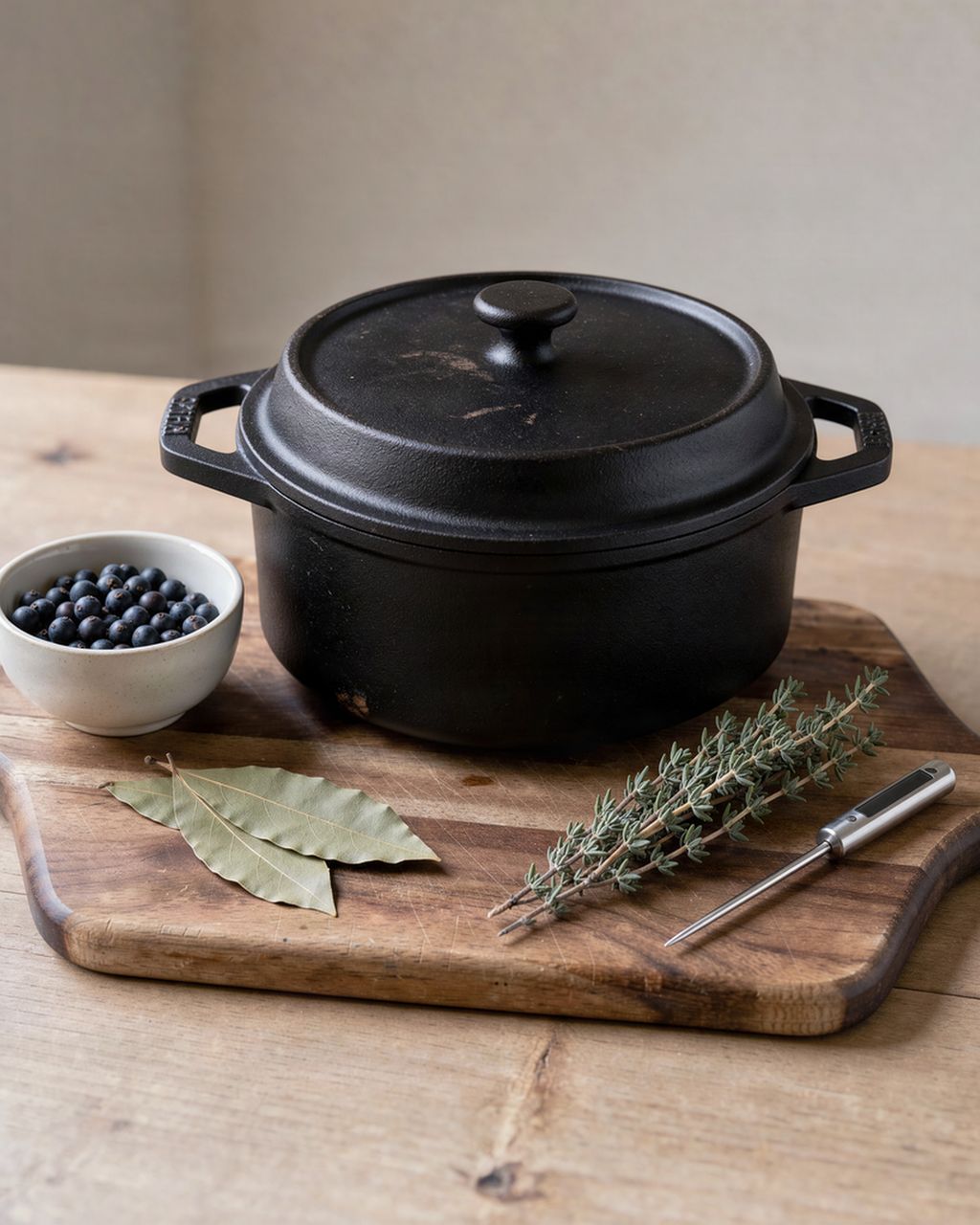
Marinating ahead (12–24 h in the fridge): cover the meat with red wine or buttermilk with onions, bay leaf, juniper and allspice. The marinade mellows the flavor and the meat begins to soften.
Extra fat: pat the meat dry before searing and sear it in lard or in fat rendered from thick-cut bacon. Wild boar doesn't have much fat of its own.
Adding liquid: add a little strained marinade to the water or stock.
Longer braising (2.5–3.5 h): a younger piece softens sooner, an older boar may take 4 hours.
Seasoning: a teaspoon of currant or lingonberry jam at the end balances the acidity of the wine.
More tricks for keeping game from drying out are covered in the article how to roast game so it isn't dry: venison, wild boar and hare.
Oyster mushroom goulash is a meatless version that is ready in 40 minutes and, thanks to the mushrooms, still has a "meaty" texture and full flavor. Oyster mushrooms don't need long braising – after 15–20 minutes they're tender, and if you cook them longer, they fall apart.
Oyster mushroom goulash differs from the meat version in five steps: you tear the mushrooms, sear them separately, braise them for only 15 minutes, thicken the sauce with potato or flour, and deepen the flavor with soy sauce or vinegar. You make the sauce (onions, paprika off the heat, tomato paste, caraway) as for beef, just with oil and vegetable stock.
Tear, don't cut: tear the mushrooms along the fibers into strips as wide as a finger. Torn ones hold their structure better.
Sear separately: sear the mushrooms in batches in a hot pan until golden and salt them. This is where the flavor comes from – seared oyster mushrooms smell nutty, boiled ones are just rubbery.
Into the sauce only at the end: braise the seared mushrooms in the finished sauce for just 15 minutes.
Thicken: without collagen the sauce won't thicken on its own; grated potato or flour stirred into cold water will help.
Depth of flavor: a teaspoon of soy sauce or a few drops of vinegar at the end.
If you want goulash with no mushrooms at all, try zucchini goulash – a summery one that's ready about as quickly.
Goulash soup is a soup in its own right, not diluted goulash. The base (onions, paprika off the heat, caraway, marjoram) stays the same; three things change:
Smaller cubes of meat, roughly 1.5–2 cm, so they fit on a spoon.
Roughly three times as much liquid as for goulash, in which the meat cooks from the start.
Potatoes only for the last 20–25 minutes; some of them cook down and thicken the soup naturally.
Why isn't it enough to just thin out goulash? Finished goulash diluted with water tastes flat and bland. A soup needs the flavor of the meat cooked out into a large volume of liquid, and that only happens when the meat cooks with the liquid from the start. Goulash soup isn't served with dumplings but with a slice of bread. How to bake your own at home is described in the article how long to bake bread and how to tell it's done.
In a pressure cooker, beef goulash is ready in roughly 35–45 minutes under pressure; in a slow cooker, in 6–8 hours on low. Always sear the onions and meat first in a pan or directly in the pot using the sauté function – without that, color and flavor are missing. And add less liquid than on the stovetop: in a closed pot almost nothing evaporates, so about half the liquid is enough.
Exact times for beef, pork and game, how much liquid to add and how to make goulash in the oven are in the article goulash in a pressure cooker, slow cooker and oven: how long and how much liquid.
The three most common goulash mistakes are tough meat, a thin sauce and a bitter taste – and all three can be rescued if you know what caused them.
Tough goulash is almost always undercooked or cooked too hard, or made from unsuitable meat. The collagen in shin dissolves only after hours of gentle braising. The fix: add liquid and keep braising under a lid on the lowest possible heat. All the causes and the rescue method are in the article why goulash is tough and the meat won't soften.
Thin goulash has too few onions, too little collagen or too much liquid. The fastest fix is to reduce the sauce without a lid, grate a raw potato into it, or add flour stirred into cold water. All nine methods with amounts are described in the article how to thicken goulash.
Bitter goulash most often has burnt paprika or burnt onions. The bitterness can be softened with a teaspoon of sugar or honey, a spoonful of tomato paste, a little cream or a piece of dark chocolate. You can't remove a burnt taste completely, though, so it's better to prevent it. More in the article bitter, sour or sweet goulash, and on why chocolate goes into goulash in the article chocolate in goulash and chili.
Beef goulash goes with bread dumplings (houskový knedlík, Czech bread dumplings), and so do pork and Szeged goulash; wild boar suits dumplings or potato pancakes, and goulash soup goes with bread. The rule is simple: the side should soak up the sauce, not compete with it.
Bread dumplings – the classic, soaking up the sauce best. Try steamed bread dumplings.
Bread – fresh homemade bread with goulash and with the soup. A tried and tested one is homemade bread.
Potato dumplings – with pork and with wild boar.
Potato pancakes (bramboráky) – pubs serve goulash in a potato pancake: goulash wrapped in a crispy bramborák.
Boiled potatoes – the simplest side, especially good with Szeged goulash. How to cook them so they don't fall apart is described in the article which potatoes to choose and how to cook them so they don't break up.
On top of the plate – rings of raw onion, a few slices of hot pickled pepper (feferonka), and for Szeged goulash a spoonful of cream.
To drink, goulash traditionally comes with beer, a lager or a semi-dark. Those who don't drink reach for sparkling mineral water with lemon.
If you prefer bread rolls to dumplings, bake homemade lard crescent rolls.
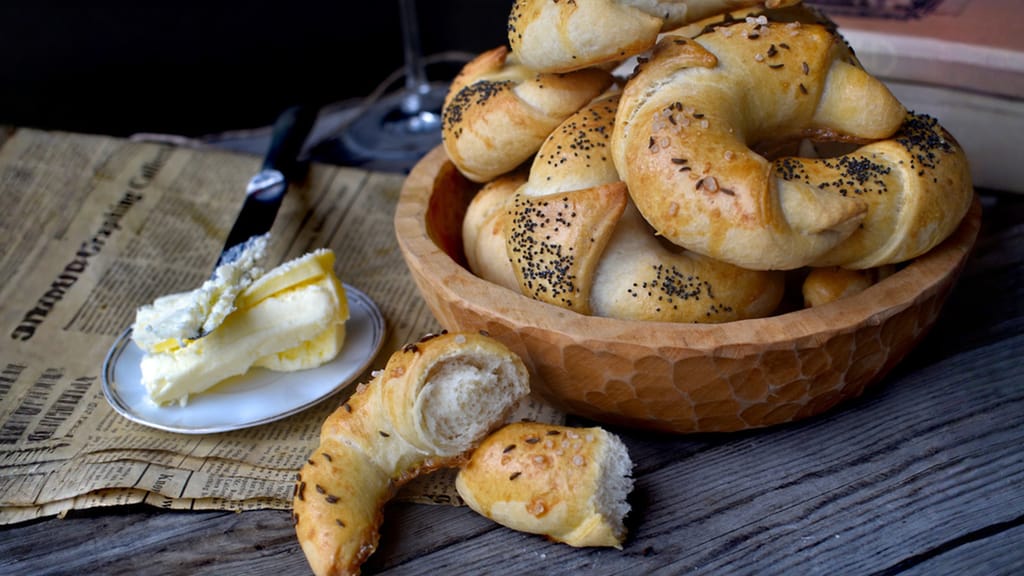
Lard rolls
Homemade lard crescent rolls to serve with goulash
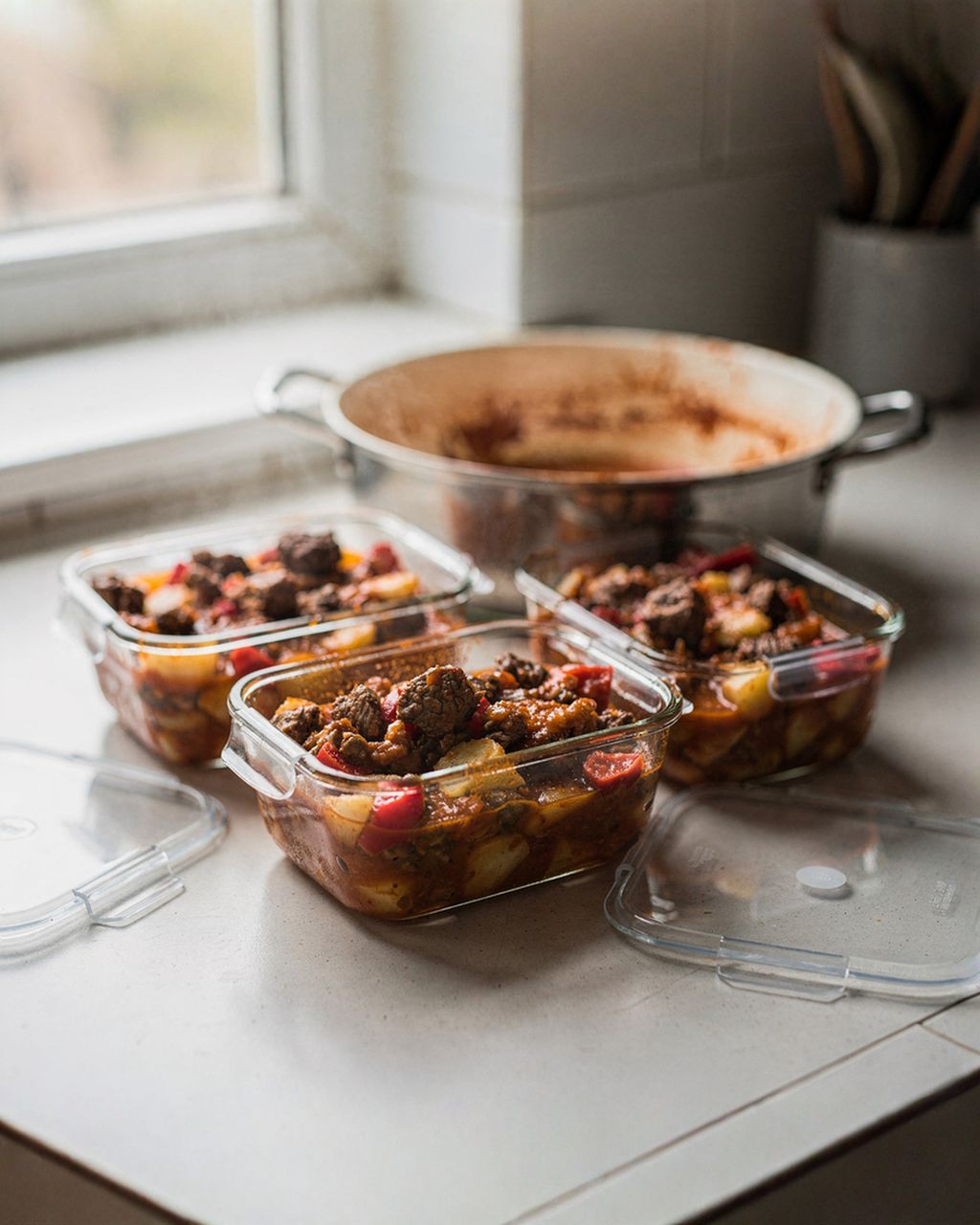
Goulash stored in the fridge keeps for 3–4 days and tastes better the next day, because the flavors meld and the sauce thickens. What matters is cooling it quickly: the US Department of Agriculture (USDA) recommends refrigerating cooked food within 2 hours of cooking and using leftovers within 3–4 days. A big pot of goulash takes hours to cool, so don't leave it on the stove overnight: divide it among several shallow containers so it cools quickly and gets into the fridge within 2 hours.
When reheating, the USDA says to bring sauces and soups to a boil. Reheat only as much as you'll eat, and add a spoonful of water, because chilled goulash thickens. How to freeze and thaw goulash is covered in the article how long goulash keeps in the fridge and freezer.
Allow 200–250 g of raw meat per person. Beef shrinks by about a third as it braises, so 1 kg of shin or shoulder feeds 4–5 people with dumplings. If you're cooking ahead, make a double batch right away – goulash tastes better the next day.
Hungarian gulyás is a thick soup with meat, potatoes and vegetables, whereas Czech goulash is braised meat in a thick onion sauce, eaten with a side. The closest Hungarian relative of Czech goulash is pörkölt. Czech goulash soup is therefore closer to Hungarian gulyás than Czech goulash is.
Yes. Chicken goulash is made with boneless thigh meat and braised for only 30–40 minutes. Don't use chicken breast, as it dries out in that time. The method is otherwise the same: onions, paprika off the heat, adding liquid, marjoram and garlic at the end, and a spoonful of sour cream if you like.
You can add either beer or wine, but classic Czech goulash is made only with water or stock. Dark beer (about 0.5 l per 1 kg of meat, replacing part of the water) adds malty depth to beef, while red wine suits wild boar better. Pour in the beer or wine right after the paprika so the sharp taste cooks off during braising. The alcohol doesn't evaporate completely, though – after 2.5 hours of braising, roughly 5% of the original amount remains in the goulash, so for children and drivers make it with water or stock only.
For kids, use only sweet paprika and leave out hot paprika completely. Adults can adjust the heat on their plates with a pickled hot pepper (feferonka) or hot paprika. Sweet paprika, plenty of onions and a spoonful of tomato paste give goulash full flavor even without any heat.
One recipe worth heating the oven for, one tip, and one deal from the shop. Nothing else.