Divine zucchini goulash
How to Thicken Goulash: 9 Methods and Exact Amounts Per Litre
Updated Sep 18, 2026
There are nine ways to thicken goulash, but the best one won't cost you a penny extra: a generous amount of onion plus slow-braising collagen-rich meat will thicken the sauce on their own, no flour needed. If your goulash is already done and still tastes like soup, the cleanest way to fix it is to take the lid off and let it reduce, since you're not adding anything to the pot at all. Only after that come the roux at a 1:1 ratio, a beurre manié, grated potato, and finally starch, which thickens fastest of all but can't handle sitting around or being reheated. Below you'll find every method with exact amounts per litre, when to add each one to the pot, and what each choice does to the flavour.
You can thicken goulash nine ways: with onion, by reduction, with grated potato, roux, a flour slurry, beurre manié, starch, gingerbread, or breadcrumbs. The amounts below are per 1 litre of goulash, meaning sauce plus meat.
Onion – the same weight as the meat, finely chopped and melted down in fat. The best method, and the cleanest for flavour.
Reduction – take the lid off and let it bubble for 15–20 minutes. You're not adding anything at all.
Grated raw potato – 1 medium potato (about 100 g) on the coarse side of a grater, then simmer for another 20 minutes.
Roux – 20 g fat + 20 g plain flour for a light thickening, 40 g + 40 g for a thick sauce.
Flour slurry – 20 g plain flour whisked into 100 ml cold water or stock.
Beurre manié – 20 g softened butter kneaded with 20 g plain flour, added in small pieces at the end.
Starch – 10–15 g cornstarch or potato starch mixed into 3 tablespoons cold water.
Grated gingerbread – 30–50 g; thickens and seasons at the same time.
Breadcrumbs or stale bread – 30 g, and only for dark goulash.
If you're not sure which to pick, go with the first two. A method that adds nothing to the pot can't ruin the flavour.
Thin goulash almost always comes down to one of four causes: not enough onion, lean meat with no collagen, too much liquid added, or braising with the lid on, which stops anything from evaporating.
Not enough onion. Two onions per kilo of meat is seasoning, not thickening. You need enough onion that it melts into the sauce and gives it body.
The wrong cut of meat. Neither top round nor sirloin has much collagen, so they release almost no gelatine — the sauce stays watery no matter how long you braise it.
Too much liquid. Add just enough liquid to barely cover the meat. The meat will release its own juices too, so the level will rise further on its own.
A closed lid. Under a lid, the steam just condenses and drips back into the pot. The goulash braises tender, but it never reduces.
The good news: the first three causes can be fixed after the fact, and the last one costs nothing at all.
In goulash, onion is a thickener, not a vegetable. Long slow cooking breaks down its cell walls, releasing pectin and sugars, and the onion essentially melts into the sauce — giving it body, sheen, and natural sweetness. The Hungarian ancestor of goulash traditionally isn't thickened with anything else.
This is the whole difference between real goulash and just meat in gravy. Everything else in this article is a fix — this is prevention.
The proper ratio is 1 kg onion per 1 kg meat. It sounds like a lot, and it is meant to be — a kilo of onion shrinks to barely a third of its volume once cooked down.
Chop the onion finely, or grate it. Large pieces won't melt down, and you'll spot them in the finished goulash.
Sauté it in 3–4 tablespoons of lard over medium heat for 15–20 minutes, until it's glassy and golden. Not browned, and definitely not crisped — burnt onion will turn the goulash bitter.
Add the paprika only after taking the pan off the heat, and pour in liquid right away. Sweet paprika scorches within seconds in hot fat and turns bitter.
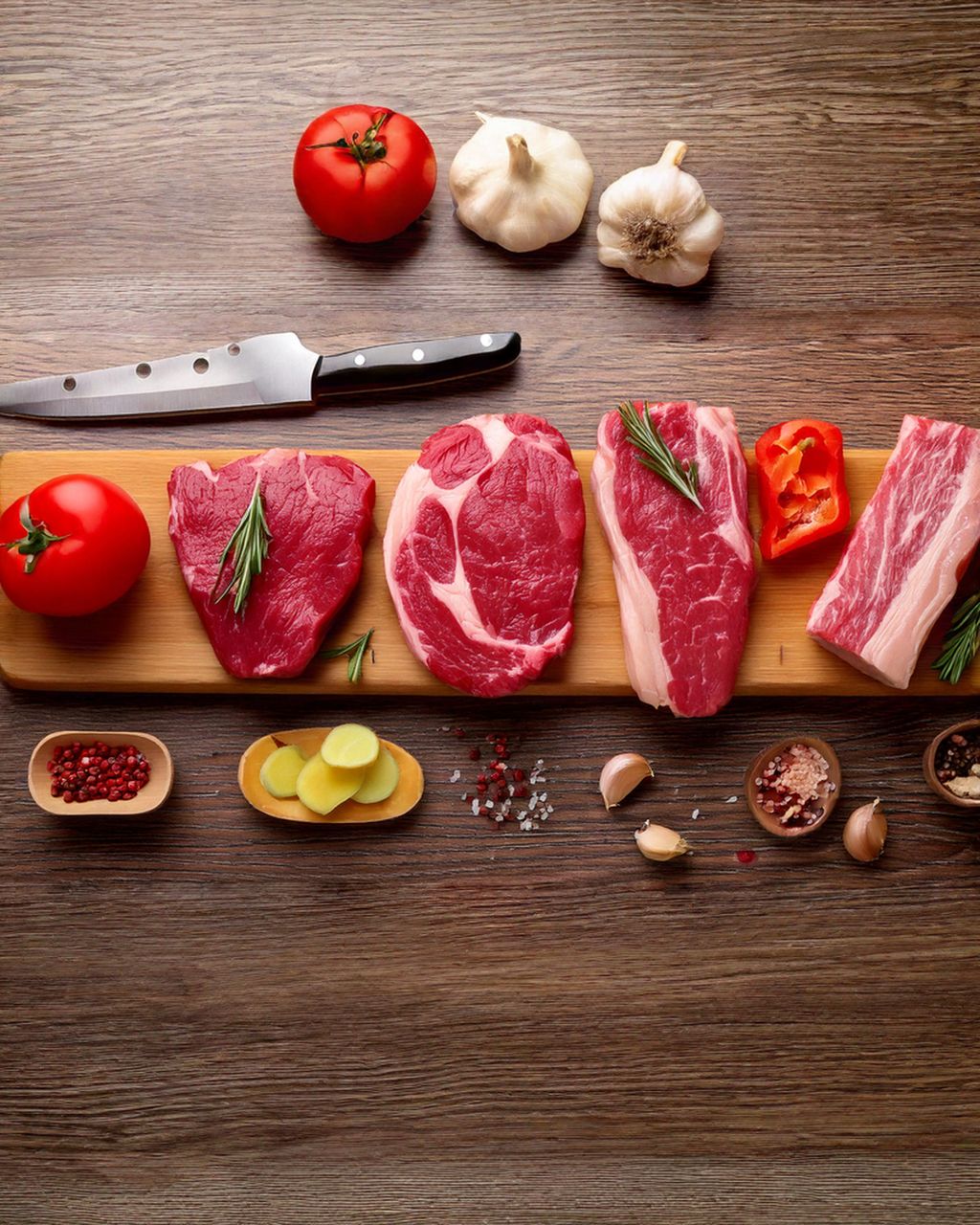
Choose cuts with collagen: beef shin, chuck, short rib, or neck, and for pork, shoulder or neck. Collagen converts to gelatine during slow braising, starting around 70°C, and that gelatine thickens the sauce from within — which is why goulash is thicker and richer the next day than it was the evening you cooked it.
This takes time: beef shin needs 2.5 to 3 hours of gentle simmering, pork shoulder about 90 minutes. Never let goulash boil hard — the meat would seize up and dry out.
We've covered the different cuts in more detail in our article on types of beef and which cut works best for goulash.
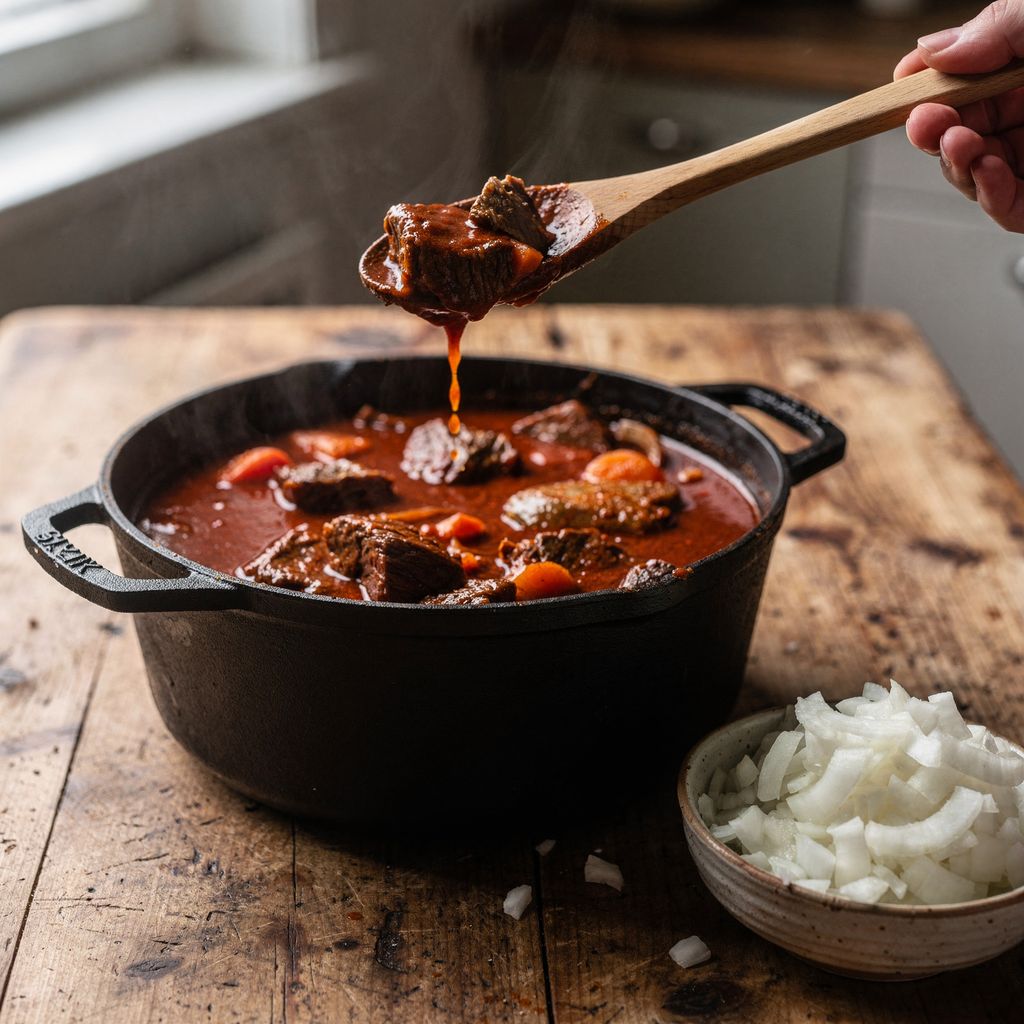
The cleanest way to thicken a finished goulash is to let the water cook off. Take the lid off for the last 15–20 minutes and let the goulash simmer gently until the sauce visibly thickens and coats the spoon — the flavour concentrates at the same time, since nothing is diluting the pot.
Two things that speed this up and keep it under control:
Use a wide pot. Evaporation happens across the surface, so a wide pot reduces much faster than a narrow one.
Season last. Reduction concentrates the salt too. Only adjust seasoning once you've reached the final consistency, or you'll end up with oversalted goulash.
Stir down to the bottom every few minutes. Thickened goulash catches on the bottom far more easily than thin goulash.
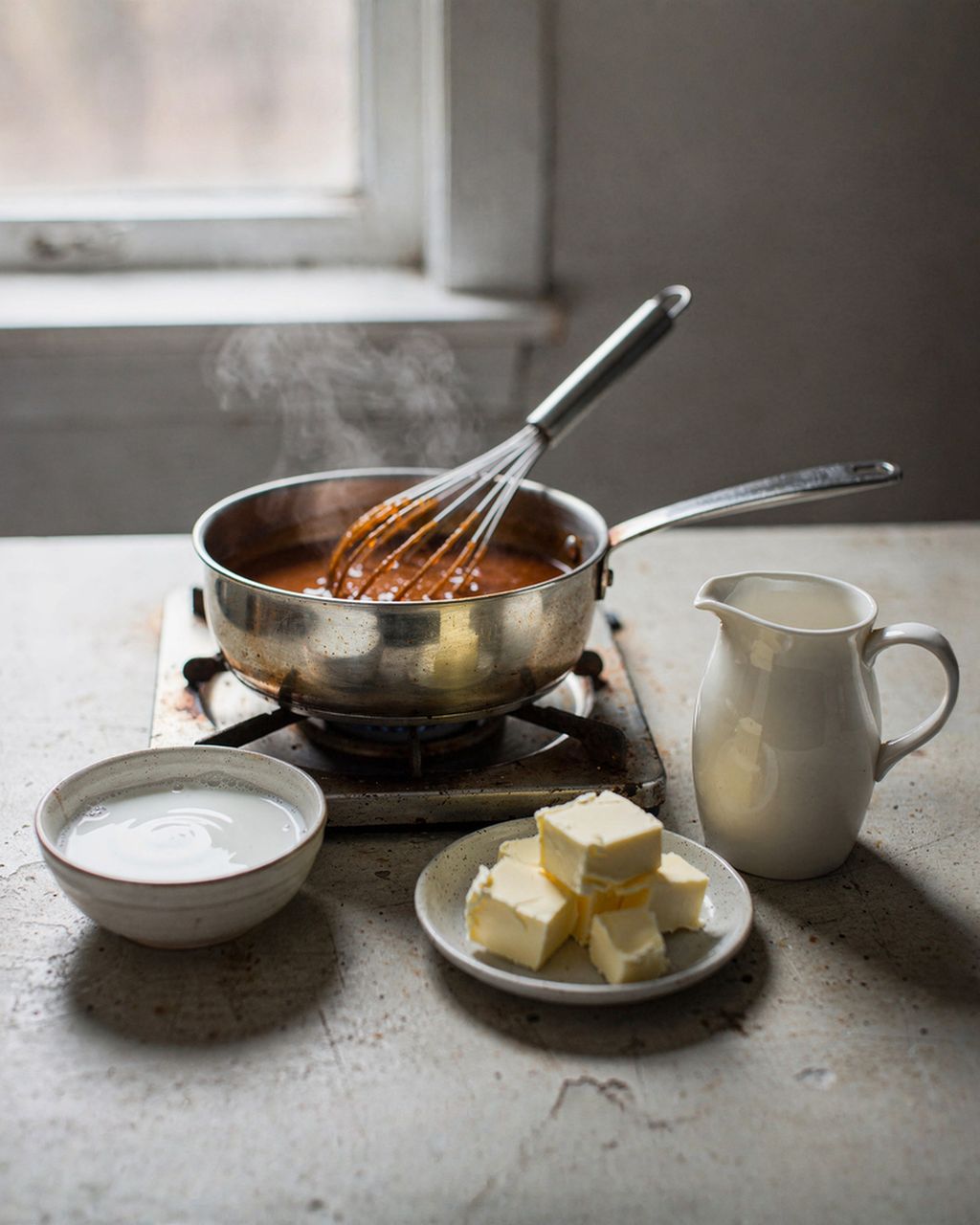
A roux is equal weights of fat and plain flour, cooked separately, thinned, and then stirred into the goulash. For 1 litre of goulash, use 20 g lard and 20 g flour for a light thickening, or 40 g and 40 g for a really thick sauce.
Melt 20 g of lard or butter in a small pan and sprinkle in 20 g of plain flour.
Stir for 2–3 minutes, until the roux smells nutty and turns a light golden colour.
Take the pan off the heat and whisk in a ladleful of hot liquid from the goulash until completely smooth.
Pour it back into the pot and let it simmer for 3–5 minutes. The flour needs a few minutes of simmering, otherwise the sauce will taste floury and will thin back out once it cools.
The rule against lumps is: cold roux into hot liquid, or hot roux into cold liquid. If you combine hot with hot, the flour seals instantly on the outside while staying dry inside — and that's exactly what creates lumps.
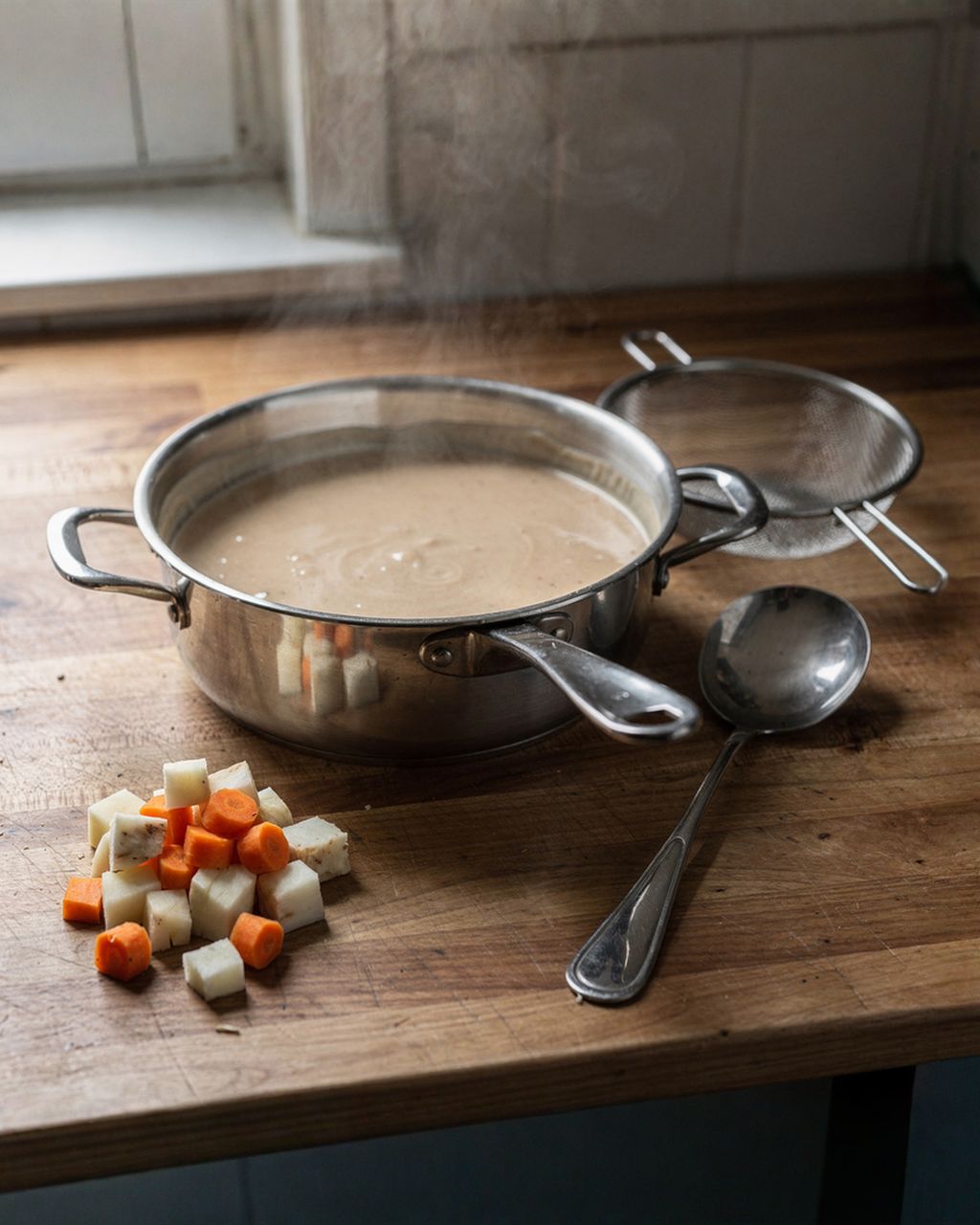
A slurry thickens goulash without any fat: 20 g plain flour whisked into 100 ml cold water or stock, per 1 litre of goulash. Whisk it until smooth — a sealed jar you shake works best — then pour the mixture through a fine sieve straight into the simmering goulash while stirring constantly.
Let it simmer for 3–5 minutes, otherwise the goulash will look cloudy and taste of raw flour. A slurry thickens slightly less than the same weight of roux and won't add a nutty flavour, but it's ready in a minute.
Beurre manié is 20 g softened butter kneaded together, cold, with 20 g plain flour, enough to thicken 1 litre of goulash. Add it in small pieces to the hot goulash while stirring constantly, right before serving.
The butter melts gradually and releases the flour bit by bit, so lumps have practically no chance to form. Let the goulash simmer for another 2–3 minutes afterwards so the flour cooks through. The advantage over a roux: you add it piece by piece and can see exactly when the consistency is right.
For goulash you're serving right away and want a glossy, translucent sauce, use potato starch; cornstarch holds up better to a longer simmer but gives a slightly matte sauce. Either way, use 10–15 g per litre (2 heaped teaspoons) mixed into 3 tablespoons of cold water — pour it into the simmering goulash while stirring, and it will thicken within a minute. Only reach for starch, though, if you're serving the goulash straight away.
Cornstarch thickens roughly twice as strongly as plain flour. It starts to swell at 62°C but only reaches full thickness around 95°C — so add it to simmering goulash and let it cook briefly. It gives a slightly matte sauce and can handle a short boil.
Potato starch thickens even faster, around 60–65°C, and gives a glossier, more translucent sauce. But it breaks down with longer cooking and the goulash thins back out — stir it in right at the very end and take the pot off the heat immediately.
The catch is shelf life: starch-thickened sauce doesn't hold up to sitting around. The next day, or after freezing and thawing, the sauce thins out and weeps water. For goulash you plan to reheat, go with a roux or grated potato instead.
Goulash can also be thickened with grated raw potato (100 g per litre), grated gingerbread (30–50 g), or breadcrumbs (30 g) — though each affects the flavour differently. Grated potato is the most neutral of the three, gingerbread adds extra spice, and bread mellows the goulash and adds a slight tang.
Grated raw potato – 1 medium potato (about 100 g) per litre, grated on the coarse side of the grater, straight into the simmering goulash. Keep cooking for at least 20 minutes: the starch releases and the potato breaks down completely. Use a starchy (floury) variety — it has the most starch. Diced potato won't work — it just stays diced.
Grated gingerbread – 30–50 g of firm gingerbread per litre. A classic in game, dark, and beer goulash. Besides thickening, it adds cinnamon, clove, star anise, and a touch of sweetness, so factor that in and cut back on sugar or tomato paste.
Breadcrumbs or stale bread – 30 g of breadcrumbs, or two slices of stale rye bread with the crust removed. Let it simmer for 10 minutes and blend the goulash with a stick blender, or you'll end up with lumps. Sourdough bread adds a light tang that suits dark goulash well, but not so much the lighter kind.
You can thicken goulash gluten-free with onion, reduction, grated potato, or pure starch — none of these methods need wheat flour. Among the flours, these work well:
Cornstarch or potato starch – 10–15 g per litre, mixed into cold water.
Rice flour – 20 g per litre. Neutral in flavour and, unlike potato starch, holds up to long simmering.
Buckwheat flour – 20 g per litre. Has a strong, earthy flavour that suits beef and game goulash.
Chickpea or pea flour – 20 g per litre. Thickens and adds body, but you'll taste it — simmer it for at least 10 minutes so the raw legume flavour cooks off.
And one trick that needs no extra ingredients at all: scoop out a ladleful of the sauce along with some vegetables, blend it with a stick blender, and stir it back into the pot. You're thickening with what's already in the goulash.
Watch out with gingerbread and breadcrumbs — they're not gluten-free unless you specifically use a gluten-free version. You'll find more methods in our article on how to thicken a sauce without flour.
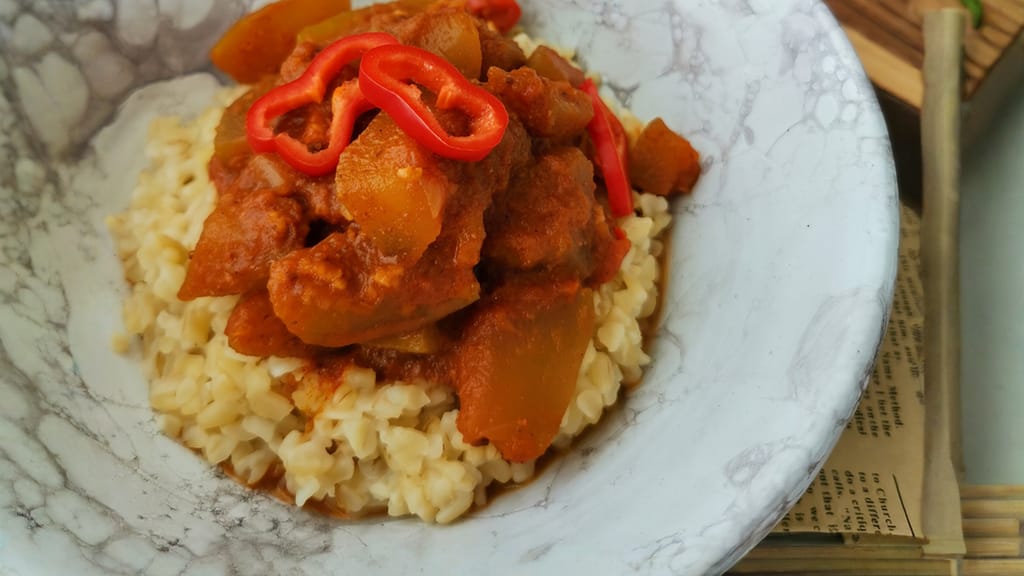
Divine zucchini goulash
Amazing courgette goulash — the vegetables break down and thicken the goulash on their own, no flour or starch needed.
Properly thick goulash coats the back of a spoon in an even layer, and a line drawn through it with your finger holds for a moment. If the sauce runs off like soup, it needs more thickening. If the spoon stands up in the pot on its own, you've overdone it.
Two things people forget when checking this:
Goulash thickens as it cools. On the plate it will always be thicker than in the simmering pot, so don't push it all the way to its final consistency while it's still on the heat.
It thickens even further overnight. Gelatine released from the meat sets as it cools. When reheating, thin it out with 50–100 ml of stock and warm it through for a bit.
Goulash soup is a different case: it's meant to stay thinner, so half the amount is enough — 10 g of flour or half a grated potato per litre.
The most common mistakes are thickening too early, sprinkling in dry flour, not simmering the flour long enough, thinning with water, using lean meat, and adding starch to goulash meant for reheating.
Thickening too early. Let the goulash braise until tender first. The meat will still release juices and some liquid will still evaporate, so leave the thickening until the very end.
Sprinkling dry flour straight into the pot. You'll get lumps you can never stir out. Always mix it into cold liquid first.
Not simmering the flour long enough. Without 3–5 minutes of simmering, it will taste floury and the thickening will thin back out once it cools.
Thinning with water. If you've over-thickened the goulash, thin it with stock or meat juices, not water — water dilutes the flavour too, and you'll end up oversalting it to compensate.
Expecting miracles from lean meat. Neither top round nor sirloin has much collagen, so they release almost no gelatine, and the sauce stays watery.
Using starch in goulash you plan to reheat. The next day it will be thinner than it was the day you cooked it.
In both a slow cooker and a pressure cooker, thicken the goulash right at the end, since almost none of the liquid evaporates during cooking in either one. In a pressure cooker, once you've released the lid, let the goulash simmer uncovered for 5–10 minutes, or stir in a flour slurry (20 g flour whisked into 100 ml cold water per litre) and let it cook through. In a slow cooker, switch to high for the last half hour, prop the lid slightly open, and add a slurry or a beurre manié. In both cases, sauté the onion in a pan beforehand — it will never caramelise on its own in a slow cooker, and the goulash would stay thin.
Thin it out with hot stock, 100 ml at a time, letting it heat through for two minutes after each addition before checking the consistency again. Don't use water — it dilutes both the flavour and the seasoning, leaving you with bland goulash that you'll then oversalt trying to fix. If you don't have stock on hand, use hot water with a spoonful of tomato paste or the juices from braised meat instead.
Yes, you can freeze thickened goulash, as long as it's been thickened with onion, reduction, roux, or grated potato — these all hold up fine to freezing. Pure starch doesn't: as it thaws, the starch gel structure breaks down and the sauce weeps water. If you know you'll be freezing it, keep the goulash slightly thinner and finish thickening it only when you reheat it.
No, sour cream mellows and rounds out the flavour, but it barely thickens anything — you'll need to handle thickening separately. It also curdles easily in a hot, acidic sauce. Stir it first with a little hot liquid from the goulash, then fold it into the pot, and don't let it boil again after that. A teaspoon of plain flour stirred into the cream will prevent curdling and thicken at the same time.
No, that's just one option among several — the flour on the meat's surface releases into the sauce as it braises. Use roughly 1 tablespoon of plain flour per 500 g of meat, and if you coat the meat this way, don't thicken the goulash with anything else until you see the final consistency. The downside: coated meat doesn't brown as well, so you lose some of that seared flavour.
One recipe worth heating the oven for, one tip, and one deal from the shop. Nothing else.