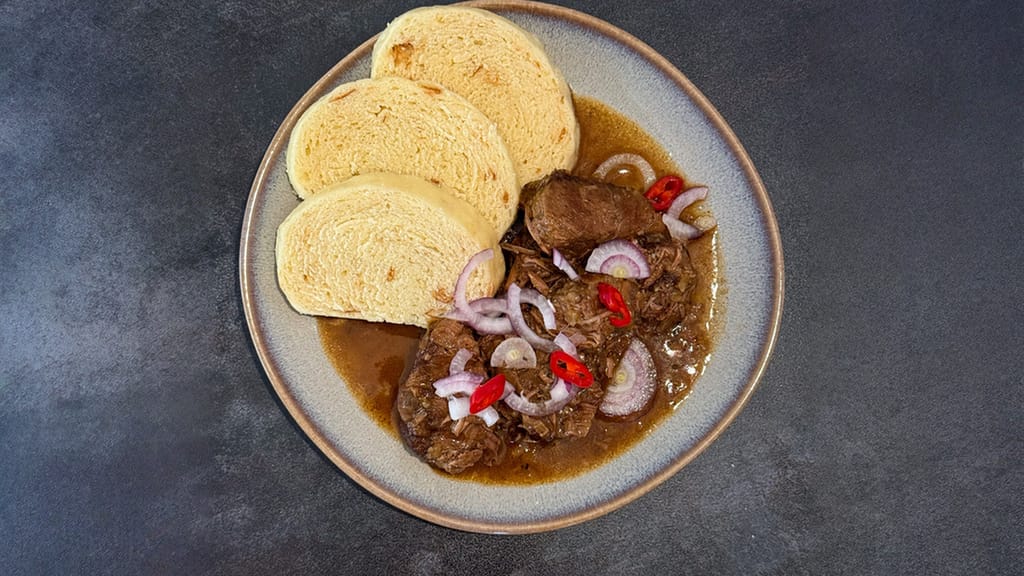
Classic czech beef goulash with chilli and bread dumplings
What to Cook With Beef: Goulash, Sauces, Cheeks, Braises and Quick Skillet Dishes
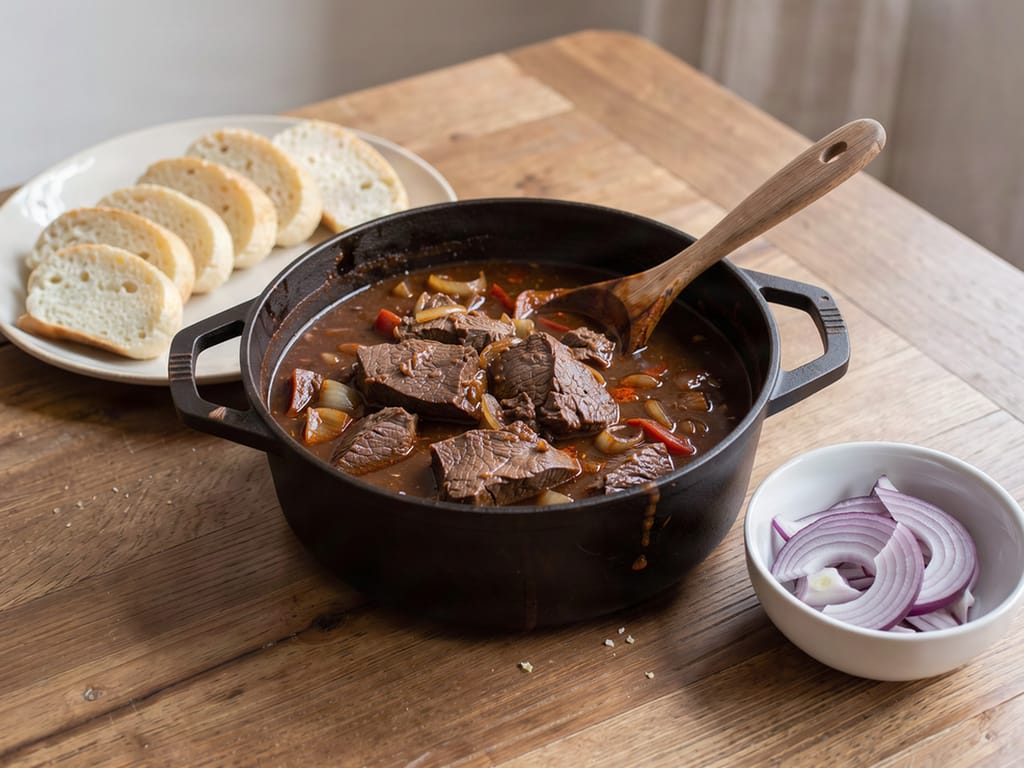
Updated Nov 20, 2026
What to cook with beef depends mostly on the cut you have in your hands. Sinewy, well-marbled cuts like shin, shoulder, neck or cheeks belong in goulash and long braises. Lean hindquarter cuts and tenderloin work in sauces and in covered roasting, thin strips of forequarter beef cook in a skillet in half an hour, and ground beef becomes meatballs in sauce or a burger. For each cut you'll find specific dishes from our recipes, how they're made and why it works.
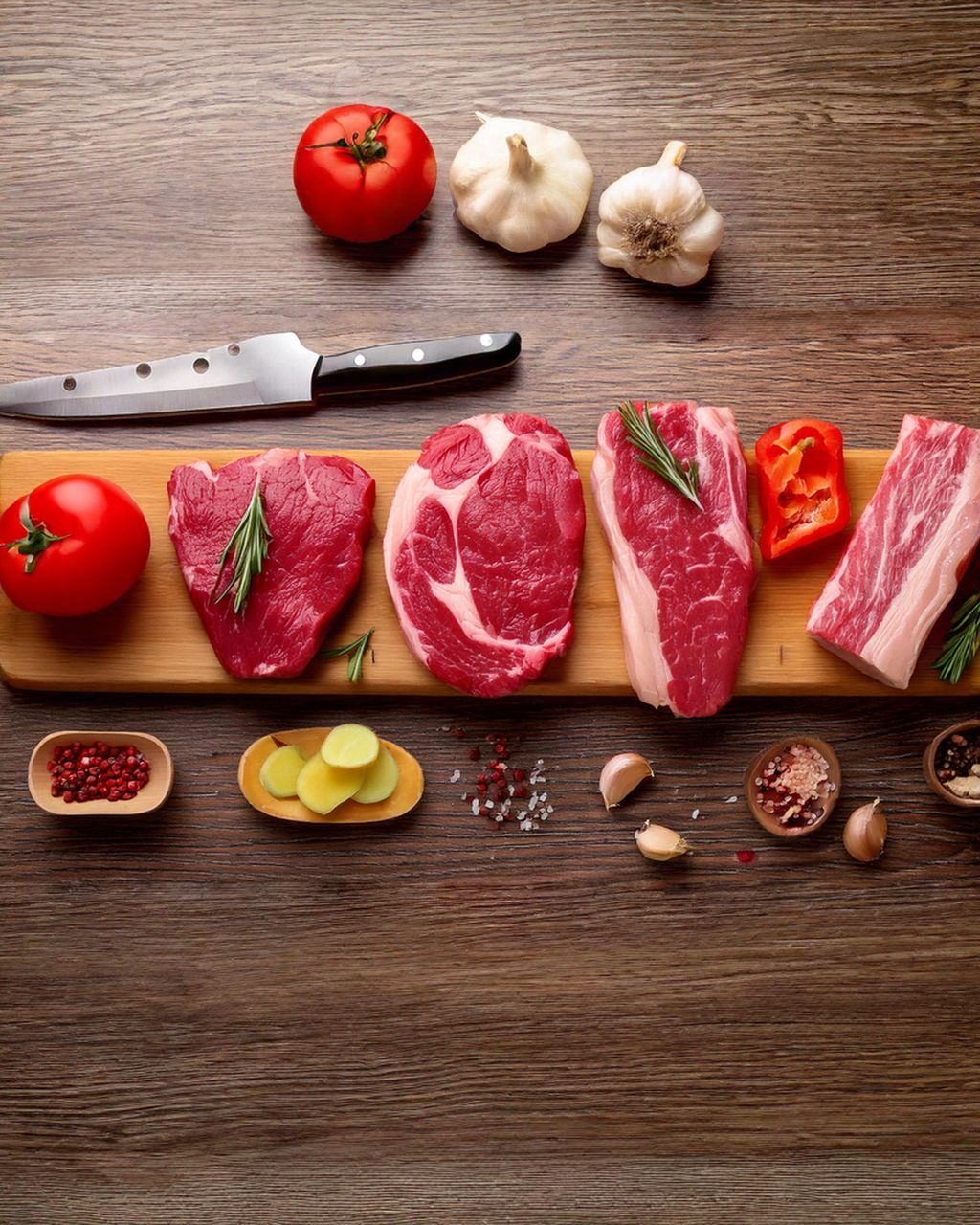
With beef you can make goulash, sauces (svíčková, a Czech beef in a root-vegetable cream sauce, plus dill sauce and tomato sauce), braised cheeks, beef in wine, boiled beef with broth, a quick Asian-style stir-fry or meatballs from ground beef. The cut decides which one:
Goulash and braised cubes: shin, neck, shoulder. Braise for 2.5–3 hours.
Sauces: svíčková na smetaně (in cream sauce), beef in dill sauce, beef in tomato sauce.
Cheeks: in red wine or dark beer, around 3 hours.
Braised in wine: beef bourguignon, Provençal beef, oven-braised beef with wine and vegetables.
Boiled: tafelspitz and a rich beef broth.
Quick in the skillet: Mongolian beef in 35 minutes.
From ground beef: meatballs in vegetable sauce, baked squash, burger.
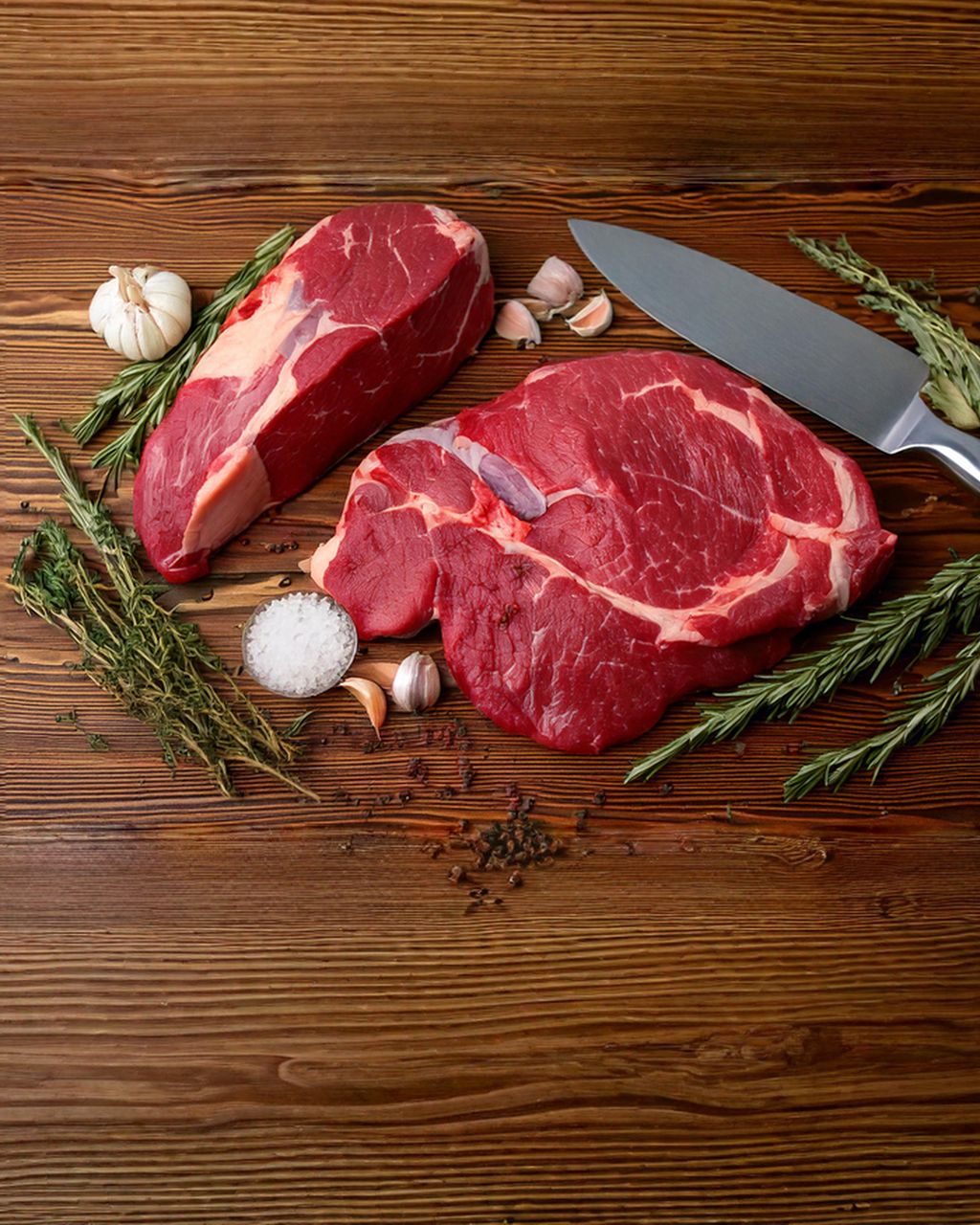
It all comes down to one rule. The more a muscle worked during the animal's life, the more connective tissue it has. Raw or briefly seared, that tissue is tough, but during long, slow braising in liquid it gradually melts into gelatin. The meat then falls apart under a fork and the sauce thickens and turns velvety. Lean cuts without sinew, like tenderloin or the round, easily dry out in a long simmer, so they are either seared briefly or roasted or braised in larger pieces, covered, with plenty of liquid.
If you're not sure what exactly you bought, check the practical guide to cuts of beef. Here we focus on what to cook with them.
We send seasonal cooking and baking plans and recipes made from everyday ingredients. Unsubscribe in one click.
The best cuts for beef goulash are shin, neck or shoulder, meaning cuts with plenty of sinew that turn tender and fall apart in about three hours of braising. Lean round would turn dry and stringy in goulash.
Our classic beef goulash with chili and a bread dumpling is built on a kilo of shin and the same weight of onions. You season the cubed meat with salt and pepper, sear it hard in lard until golden, then take it out and slowly sauté the onions in the drippings. Only after turning down the heat do you add three tablespoons of sweet paprika, chili flakes and caraway, and you immediately pour in half a liter of beef stock, because paprika turns bitter quickly in dry fat. The meat goes back into the pot and braises, covered, for about two hours, then for roughly another hour, until the pieces start to fall apart. Finally you thicken the goulash with potato starch stirred into cold water and season with marjoram and crushed garlic.
Why so many onions? During the long braise they cook down and thicken the goulash themselves. That's why the recipe has no roux, just a spoonful of starch for fine-tuning. Sear the cubes in batches: an overcrowded pot releases juices, the meat boils in them instead of browning and the goulash loses depth of flavor.
The dumpling in the same recipe is a yeast dumpling made with coarse flour (Czech hrubá), milk, egg and yeast, with cubes of stale roll. It steams for exactly 25 minutes and is sliced with a thread or a sharp serrated knife. You serve the finished goulash topped with thin rings of red onion and fresh chili.
Classic czech beef goulash with chilli and bread dumplings
Classic beef goulash from shin with chili and a bread dumpling
Beef neck is a marbled, juicy cut with lots of connective tissue, which makes it ideal for goulash, braised cubes and grinding. It's not suited to steaks or quick skillet cooking, because after a few minutes it stays rubbery.
In practice you use it wherever a recipe calls for shin or shoulder. In the goulash above you can use neck instead of shin in the same amount, just check tenderness as you go: neck tends to be fattier and, depending on the piece, softens a bit sooner or later. You can skim the fat released during braising off the surface with a spoon, or let the goulash cool overnight and simply lift off the solidified fat. Neck is also good for braising in coconut milk, which we cover below under lunches.
From forequarter beef you mainly make braised and roasted dishes: goulash, dill sauce, beef with vegetables or broth. If you slice it into thin strips across the grain, you can also make a quick skillet dish.
Forequarter beef is a collective name for shoulder, neck, brisket and shin from the front leg. They have one thing in common: more connective tissue and fat than the hindquarter, and therefore more flavor after long cooking. Shoulder is the most versatile; you can roast it whole, braise it in cubes or grind it.
An interesting exception is the fragrant Mongolian beef, which uses 700 g of forequarter beef and is done in 35 minutes. The secret is thin strips and a cornstarch coating, which protects the meat during fast frying and thickens the sauce at the same time. You'll find the method below under quick lunches.
For how to approach the forequarter from shopping to slicing, see the detailed article how to use forequarter beef for perfect dishes.
For a beef lunch you can manage Mongolian beef with rice in 35 minutes and beef braised in coconut milk in about an hour and a half. Goulash and svíčková don't fit into an ordinary lunch; they're worth cooking the day before.
Mongolian beef in 35 minutes. Coat strips of forequarter beef in cornstarch. Meanwhile, heat three tablespoons of oil in a pan, stir pressed garlic with grated ginger in it for three minutes, pour in soy sauce, water and brown sugar and let the sauce simmer. Then sear the meat hard on all sides in a wok in four tablespoons of oil, drain it on a paper towel and simmer it in the sauce for another two to three minutes. Serve with rice, chopped peanuts, scallions and sesame. You'll find more dishes like this in the article Asian dishes at home.
Beef pieces in coconut milk. Beef pieces braised in coconut milk need 600 g of shin and about 90 minutes in total. Spread the dried meat in a single layer on hot coconut oil and let it sear without stirring. Then add finely grated ginger and garlic, dust the meat with cornstarch, stir in the white part of a leek and add water to cover the meat completely. When the water has almost evaporated, pour in 400 ml of coconut milk and keep braising until a piece of meat can be pulled apart with a fork. Stir in the green part of the leek only at the end so it stays fresh, and serve with jasmine rice. The article what to cook with coconut milk has more ideas for this ingredient.
And if you're looking for lunches in general, not just beef, check out what to cook for lunch.
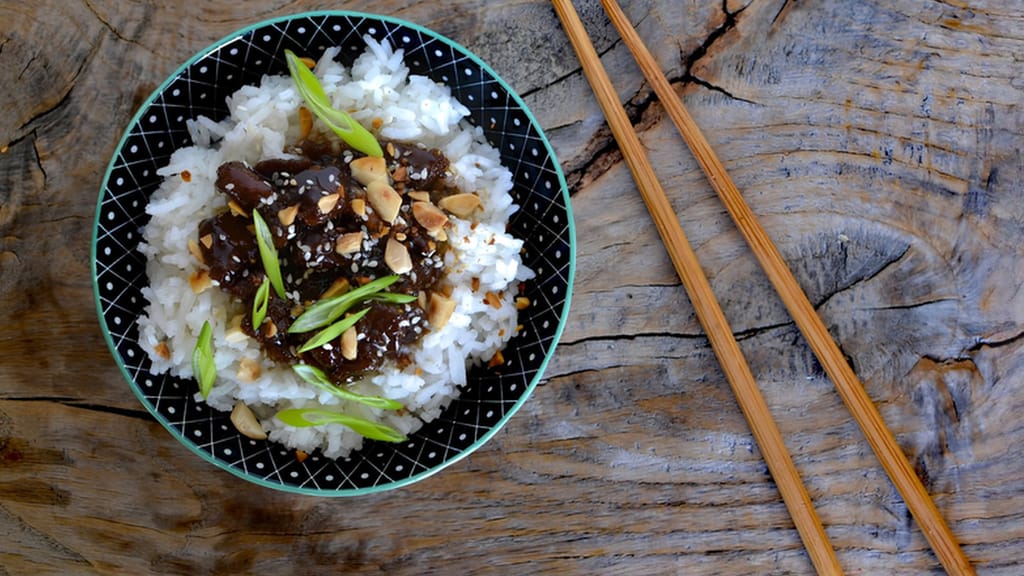
Fragrant & bold mongolian beef
Mongolian beef from forequarter beef in 35 minutes
Hindquarter beef is best in dishes where it's roasted or braised in larger pieces with wine and vegetables, and you can also grind it for meatballs. The hindquarter is lean, so protect it from drying out: large cubes, enough liquid, a lid and a gentle temperature.
Oven-roasted beef with wine and vegetables does exactly that. You cut the round into larger cubes so it doesn't fall apart into strands during the long braise, and marinate it overnight in the fridge in red wine with carrot, celery, garlic, whole peppercorns, juniper, a bay leaf and rosemary. The next day, dry the meat and sear it until brown. Then sauté the vegetables from the marinade with onion, lemon slices and a spoonful of sugar, pour in port wine and stock, and braise covered in the oven. Mashed potatoes or purée go best with the meat, since they soak up the sauce.
Why dry it? Wet meat first boils in its own water in the fat and never develops the brown crust that gives the sauce its flavor. The same goes for every braised beef dish in this article.
The round also hides in the meatballs (below under ground beef). For recipes where the hindquarter is the star, see the article how to make perfect hindquarter beef.
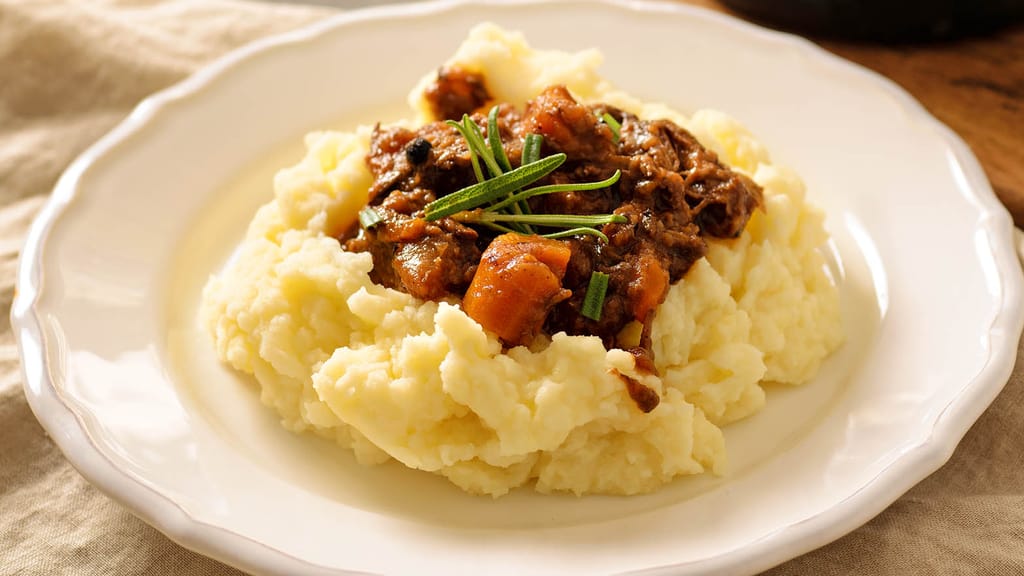
Oven-braised beef in red wine with vegetables
Hindquarter beef braised in wine with vegetables, from the oven
In Czechia, beef tenderloin is most often made into svíčková na smetaně: meat larded with bacon, roasted covered on root vegetables and served with a blended cream sauce and dumplings.
Beef tenderloin is the most tender and most expensive cut. It's lean, which is why the traditional method protects it with bacon fat. Our recipe for svíčková na smetaně starts the day before: bacon cut into strips about 1 cm thick goes into the freezer, because frozen it slides into the meat far more easily and doesn't squash. Don't rinse the tenderloin, just pat it dry, lard it using a narrow knife, tie it with kitchen twine and sear it hard in lard until brown.
In the drippings you then brown carrot, parsley root and celery root until golden, add onion and sprinkle everything with sugar, which you caramelize briefly. Next comes red wine vinegar with mustard, which you cook off so the sharp vinegar smell evaporates. Then you return the meat, pour in stock, add allspice, pepper, a bay leaf and thyme, and roast covered for about two hours in an oven at 180 °C (350°F). The meat is done when a fork slides in easily. Wrapped in aluminum foil, it rests while you fish the whole spices out of the sauce, blend the vegetables until smooth and stir in the cream. Add a roux only if the sauce is thin.
The most common mistake? Burnt vegetables. You can't get the bitterness back out of the sauce, so keep stirring the vegetables while they brown. And slice the meat thin, across the grain, or even the svíčková will seem tough.
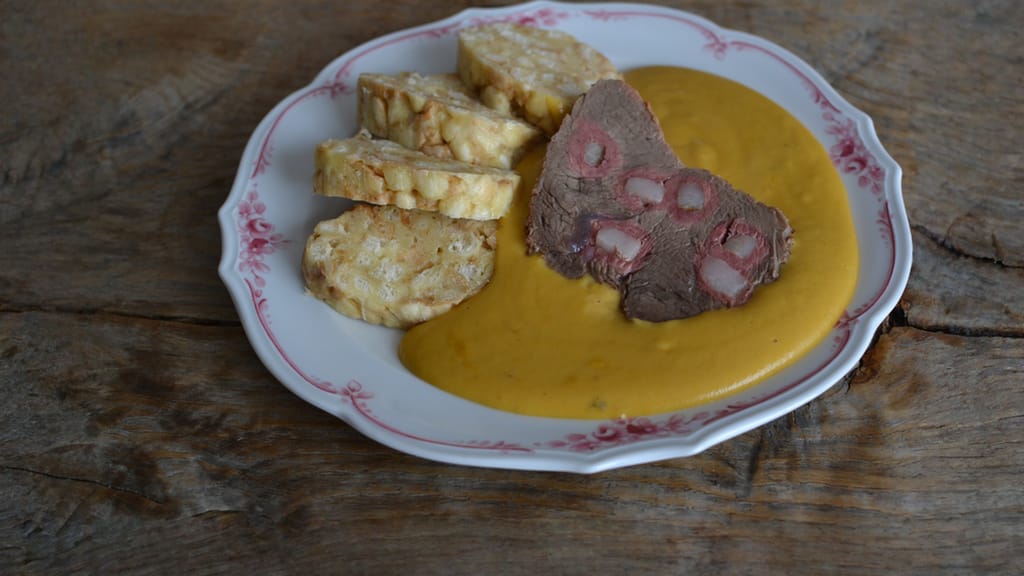
Beef sirloin in cream sauce (svíčková)
Svíčková na smetaně made from larded beef tenderloin
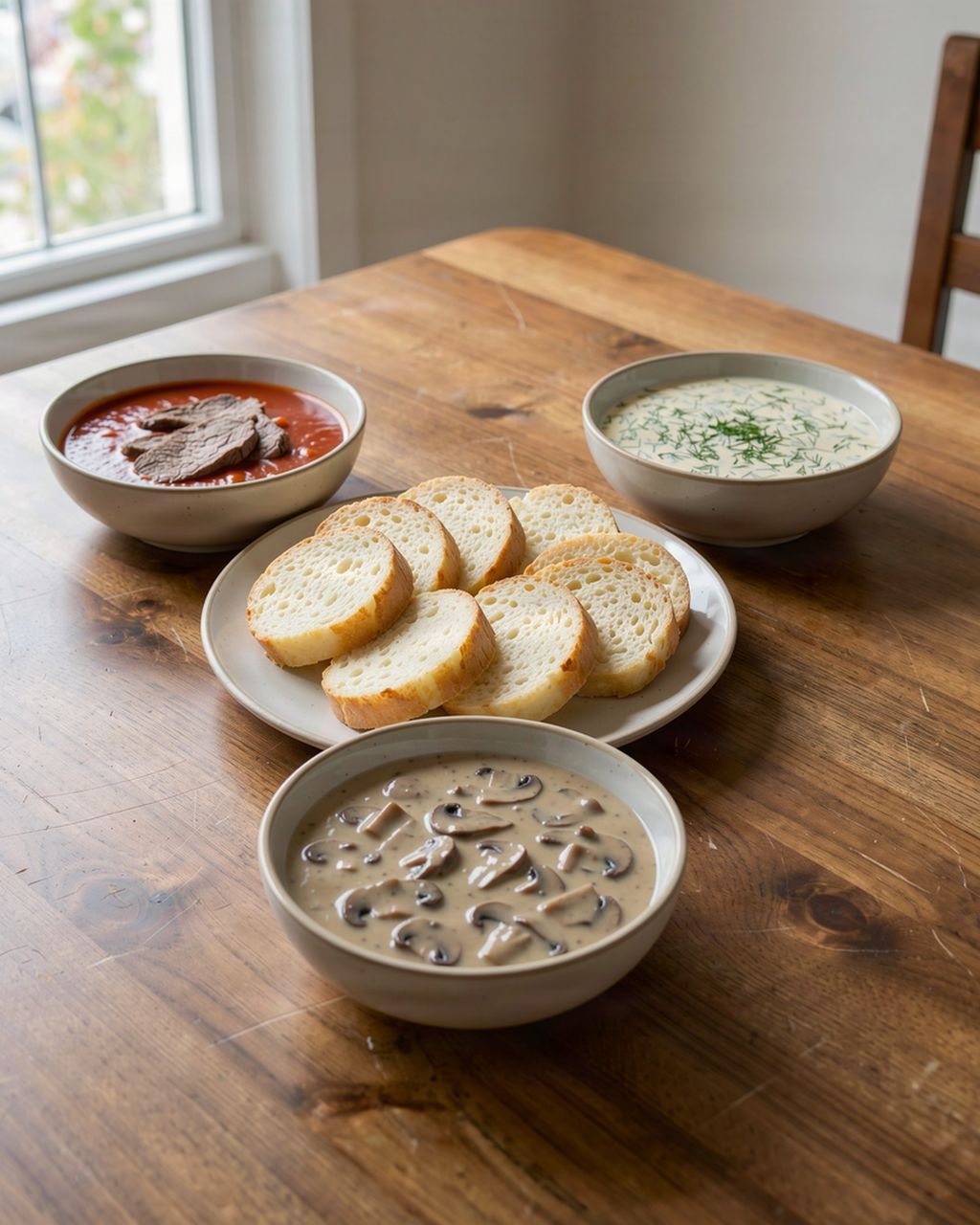
Besides svíčková, beef in Czech sauces most often appears in dill sauce and tomato sauce. In both cases the cuts are braised or roasted until tender, and the sauce is made from the drippings and stock.
Dill sauce with slow-roasted beef. Dill sauce with slow-roasted beef uses a kilo of beef shoulder. The meat is seared hard until golden, carrot, onion, celery root and garlic are sautéed in the drippings, then deglazed with stock and joined by a bay leaf, allspice and pepper. It then roasts covered for 4 to 5 hours at 140 °C (285°F) until completely tender. You strain the sauce, simmer dill stems in it and finish it with cream, sugar, vinegar and butter. The recipe also adds a bright green dill oil: the dill is blanched for 15 seconds, cooled in ice water and blended with oil.
Tomato sauce with beef. Here a piece of beef (shoulder or shin) is first boiled or simmered until tender in stock with spices. The sauce is then made from tomatoes, thickened and seasoned to a sweet-and-sour taste, and the sliced meat is warmed through in it. Like the other classics, it's covered in detail in the article Czech sauces: tomato, dill, mushroom and svíčková.
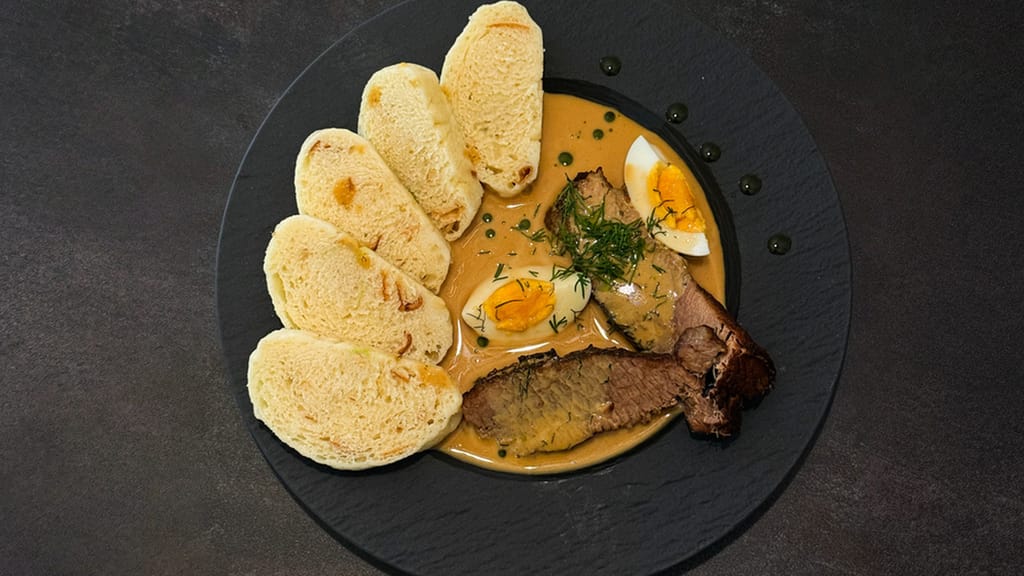
Dill sauce with slow-roasted beef
Dill sauce with slow-roasted beef shoulder
Beef cheeks turn tender after roughly three hours of gentle braising in liquid. They're done when they fall apart under a fork, and thanks to all that collagen they give the silkiest sauce of any cut.
Beef cheeks are a chewing muscle that never stops working in the animal's life. Brief searing makes no sense, but after a long braise cheeks are more tender than tenderloin. On Yumsto we have them in two versions.
In red wine with vegetables. For beef cheeks in red wine, you dry a kilo of cheeks, season them with salt and pepper and sear them on all sides in hot canola oil until brown. Don't overcrowd the pan. Add rounds of two carrots, two parsley roots and half a celery root, pour in 300 ml of red wine and half a liter of stock, and braise covered for about three hours so the liquid barely bubbles. Then take the cheeks out, reduce the sauce over high heat to the thickness you want, and off the heat stir in a piece of chilled butter, which gives it shine. As a side, a second batch of root vegetables is sautéed with mushrooms.
In dark beer. Beef cheeks in black beer are cut into smaller pieces and seared in lard with onion. They're covered with a liter of dark beer so they're fully submerged, and seasoned only with cloves and allspice. Boil for five minutes uncovered, then cover and braise for about three hours. Keep the finished cheeks warm in the oven at 70 °C (160°F), strain the juices and reduce them by roughly half. Taste as you go, because reducing intensifies the slightly bitter flavor of the beer. Serve with mashed potatoes or parsnip purée.
And why reduce only at the end? While the meat braises, it needs liquid around it. The sauce is thickened only after the meat comes out, otherwise the cheeks would scorch on the bottom before turning tender.
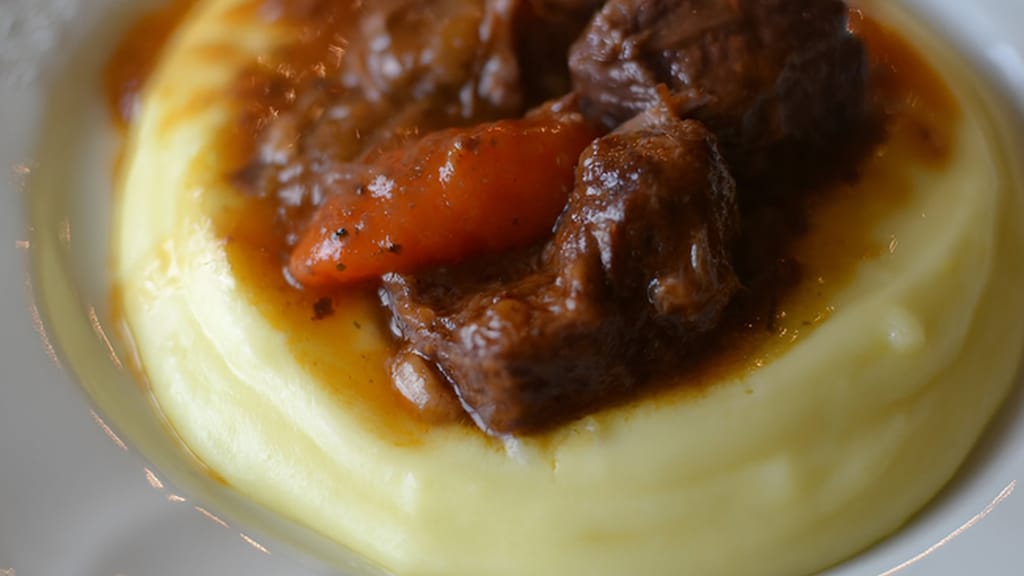
Beef cheeks in red wine with vegetables
Beef cheeks in red wine with vegetables
Beef braised in wine is made from cubes of meat seared with bacon, covered with red wine and herbs, and braised for several hours. Wine doesn't tenderize the meat by itself, but it gives the sauce an acidity and depth that balances the fatty bacon.
Beef bourguignon. Beef bourguignon, or boeuf bourguignon, is built on 500 g of sirloin cut into cubes of about 5 cm and carefully dried. First you fry cubes of bacon until brown and remove them. In the rendered fat you then sear the meat in a single layer, and finally the onion and carrot. Everything goes back into the pot with a bay leaf, thyme, rosemary and tomato paste and is covered with 300 ml of red wine, 100 ml of port and a little stock or water. Braise covered on the stovetop or in the oven, allowing a little over three hours in total, and serve with fresh baguette.
Provençal beef. Provençal beef with vegetables goes a step further: a kilo of sirloin is marinated overnight in the fridge in a marinade of red wine, orange juice, onion, celery stalks, carrot, garlic and a bunch of thyme, rosemary and parsley. The next day you dry the meat, sear it in bacon fat for about three minutes per side and pour the warmed marinade over it in a roasting pan. Then it roasts covered for about three hours at 130 °C (265°F). The recipe suggests baking it a day ahead, because the flavors come together overnight.
Both dishes punish a single mistake: a full pot when searing. The cubes must lie in one layer with gaps between them. It's better to sear in three batches than to cook them in one.
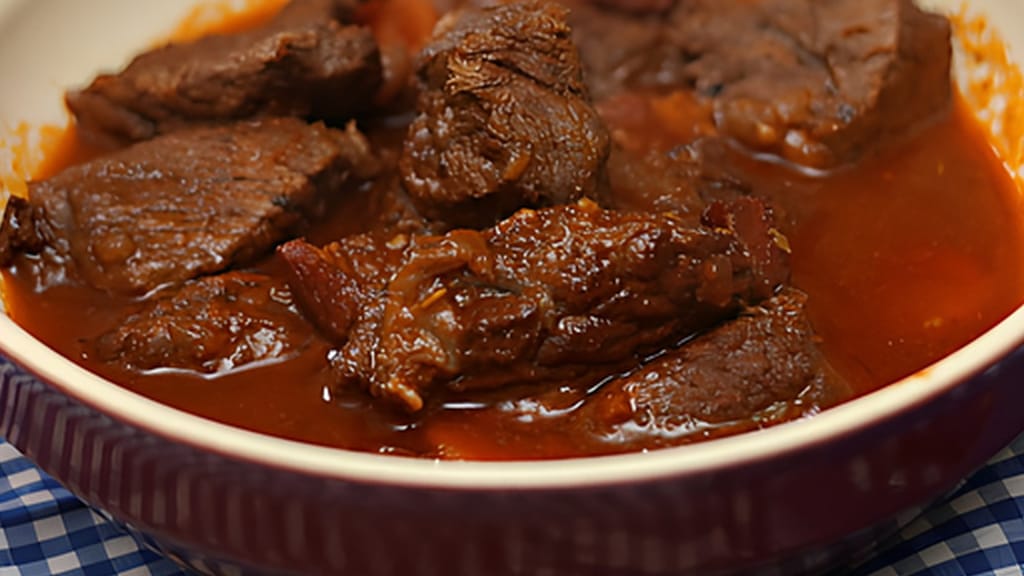
Beef bourguignon (beef burgundy)
Beef bourguignon (boeuf bourguignon) from sirloin in red wine
Boiled beef is mainly served as tafelspitz: sliced meat with broth, vegetables and horseradish. The broth that forms during cooking then serves as a soup or the base for sauces.
Tafelspitz. Tafelspitz with broth, vegetables and potato pancakes is a Viennese classic made from a kilo of beef top-round tip. First you roast marrow bones in the oven at 200 °C (400°F) for about 15 minutes, brown root vegetables in butter, and sear an onion halved with its skin on, cut side down in a pan, almost to black so the broth turns golden. Then cover the meat, bones and vegetables with cold water, add salt, pepper, allspice and a bay leaf and let it barely simmer for roughly five hours. Test tenderness with a fork; the meat should let it slide in. The meat is served with briefly sautéed celery root, carrot and leek, and with pancakes of potato and coarsely grated apple, onto which you can spread the marrow from the bones.
Broth with leftover meat. The strained tafelspitz broth from the same recipe can simply be served with noodles and finely sliced beef as a soup of its own. It's the easiest way to use leftover boiled meat the next day.
Boiled beef salad. Slice cooled boiled meat across the grain into thin strips and mix with finely chopped onion and pickles. Dress with oil, vinegar, salt and pepper and leave in the fridge for at least an hour. We don't have our own recipe for it yet.
The potato pancakes with tafelspitz are close relatives of bramboráky (Czech potato pancakes). Those have their own article: Bramboráky and potato pancakes.
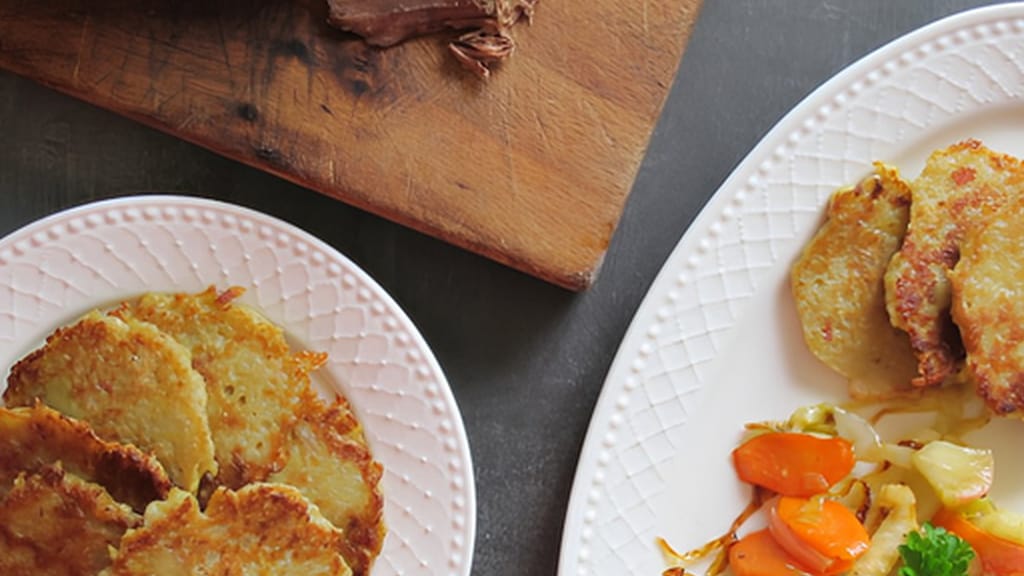
Tafelspitz with broth, vegetables and potato pancakes
Tafelspitz from boiled beef with broth and potato pancakes
From ground beef you make meatballs in sauce, baked vegetables with meat or a burger. Ground meat cooks through quickly, so it's the fastest route to beef without hours of braising.
Meatballs in vegetable sauce. Meatballs in vegetable sauce use 360 g of beef round that you grind yourself. First you sauté onion, then carrot, celery root and garlic, pour in beef stock with tomato purée and let the sauce simmer slowly. Meanwhile you mix the meat with a whole-grain roll soaked in milk, an egg, salt, pepper and thyme and shape meatballs. These go into the sauce and braise, covered, for 45–60 minutes. Don't stir them for the first few minutes, until they firm up, or they'll fall apart. Bulgur, rice or mashed potatoes go well with them.
The roll soaked in milk isn't just filler. It holds moisture in the meatballs, so they stay tender even after an hour in the sauce.
Squash baked with ground meat. Squash baked with ground meat in the recipe uses mixed ground meat, but the principle works for any ground meat. You crumble the meat over shallots and simmer it with thyme, and separately cook a pale béchamel from butter, flour, milk and nutmeg. Then you layer 1–2 cm thick slices of Hokkaido squash with the meat and béchamel and bake for about 45 minutes at 200 °C (400°F), until the squash is tender.
Burger. For a burger you need ground beef with a bit of fat so the patty doesn't dry out. Press the meat only lightly into a patty, salt it just before cooking and sear it on both sides in a hot pan or on the grill. The whole topic, from the meat to the buns, is covered in the article Homemade burger.
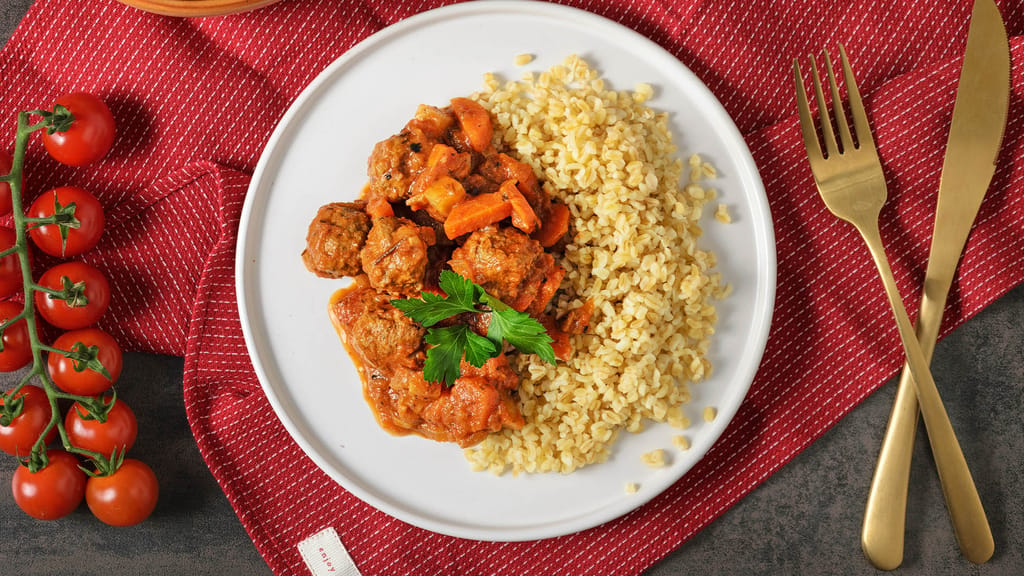
Meatballs in vegetable sauce
Meatballs from ground beef in vegetable sauce
Of the beef dishes, kids are happiest with meatballs in vegetable sauce, beef pieces in coconut milk with rice and goulash without hot ingredients. What they share is tender meat, a mild flavor and a sauce to dip the side dish in.
Meatballs in vegetable sauce: ground meat is easy to chew and the vegetables almost fall apart in the sauce. If you chop them finely, the recipe itself says the sauce will thicken.
Beef pieces in coconut milk: coconut milk softens the sauce, the ginger and garlic are in small amounts and there is no chili in the recipe.
Goulash: the same method as above, just leave out the chili flakes and the fresh chili for serving. Sweet paprika and caraway give flavor without any heat.
In practice, for younger children it pays to cut the meat into small pieces across the grain after cooking. Braised beef then falls apart on its own and doesn't need much chewing.
Cooked beef dishes keep in the fridge for 3 to 4 days, according to the US food safety agency USDA FSIS. The same source says to refrigerate them within two hours of cooking, ideally in shallow containers so they cool quickly.
Yes, braised beef dishes with sauce freeze very well. According to USDA FSIS, stews with meat keep their best quality in the freezer for 2 to 3 months; at a constant −18 °C (0°F) they stay safe even longer. A cream sauce may separate slightly after thawing; just whisk it as you reheat it.
Tough braised beef is almost always undercooked, or the cut was a poor choice. Sinewy cuts like shin or cheeks need around three hours of gentle simmering and look tougher halfway through than at the start. Lean hindquarter beef, on the other hand, dries out during a long simmer. It helps to braise longer at a lower temperature and to slice across the grain.
No, raw beef shouldn't be washed; just pat it dry with a paper towel. USDA FSIS advises against washing raw meat because the water spreads bacteria around the sink and countertop. Dry meat also browns better and forms a nicer crust.
You can replace the wine with beef stock plus a spoonful of tomato paste and a little vinegar or lemon juice. The paste and the acid add the depth and brightness that wine would otherwise bring. Another option is dark beer, which is also used in Czech cooking for braising beef cheeks.
Slice beef across the grain, meaning perpendicular to the direction the muscle fibers run. That cuts them into short pieces, which makes the meat easier to chew. This applies equally to raw strips for the skillet and to a finished roast, ideally using a sharp knife and cutting thin slices.
One recipe worth heating the oven for, one tip, and one deal from the shop. Nothing else.