Soups: Types, Grandma's Recipes, Quick Soups, Soups for Kids, and How to Thicken and Freeze Them
What Is Kulajda? The Czech Potato, Mushroom and Dill Soup Explained
Updated Nov 20, 2026
Kulajda is a creamy, tangy Czech soup of potatoes, mushrooms and dill, soured with a splash of vinegar and served with an egg. It most likely comes from South Bohemia, and its vinegar tang sets it apart from most Czech soups. Here is what it tastes like, where it comes from and how it differs from the other soups on a Czech menu.
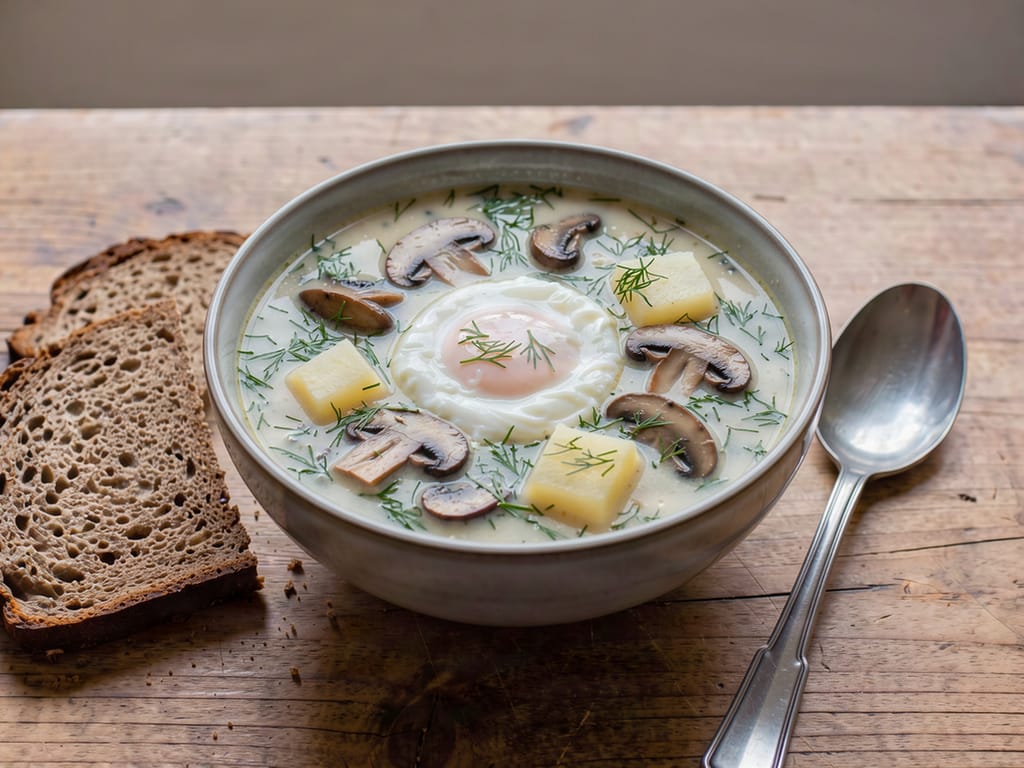
Kulajda (KOO-lie-dah) is a Czech soup of potatoes, mushrooms and dill in a creamy base, thickened with a little flour and sharpened with vinegar. Each bowl usually gets an egg: poached in Czech homes and restaurants today, or simply boiled.
It is a soup in its own right, not a cream-of-anything. The potatoes stay in cubes, the mushrooms stay in slices, and the dill goes in generously. In Czech kitchens it is a lunch starter before a main course, but a bowl with bread is filling enough to be a meal.
Think of a creamy potato soup that has been pulled in two directions at once:
Sour. Vinegar is what makes kulajda kulajda. It cuts through the cream, so the soup tastes bright rather than heavy.
Herby. Dill is the main seasoning, and there is a lot of it. If you don't like dill, this is not your soup.
Earthy. Forest mushrooms, fresh or dried, give it depth. Dried mushrooms make it taste noticeably stronger.
The egg rounds it all off. Some cooks add a pinch of sugar to balance the vinegar, and a few add caraway seeds while the potatoes cook. The texture should be like thin cream: it coats a spoon but still pours.
In outline, without a full recipe:
Potatoes are diced and simmered in water, often with caraway seeds and a bay leaf or allspice.
Mushrooms go in: fresh ones sliced, or dried ones soaked first, with their soaking liquid strained into the pot.
Cream or milk is whisked with a spoonful of flour and stirred into the hot soup, which then simmers until it thickens.
Vinegar is added a little at a time, to taste, then plenty of chopped fresh dill.
Each bowl is finished with an egg.
Use full-fat cream for the base. The US calls it heavy cream, the UK double or whipping cream; some cooks use sour cream instead. Whisking the flour into the cream first, and warming it with a ladle of hot soup before it goes into the pot, keeps it from curdling. If it does split, our guide to why cream sauces curdle explains the rescue. For the egg, see how to poach eggs so they hold their shape.
Kulajda most likely comes from South Bohemia. Czech sources place the earliest records in the 19th century, in the Kozácko area of South Bohemia, with later mentions from around Pelhřimov and Sušice. From there it spread across Bohemia, and today you will find it on menus all over the country.
Two details are worth knowing:
Mushrooms may be a later addition. According to the Czech ethnographer Vladimír Poštulka, as cited by Czech Wikipedia, historical recipes did not include mushrooms. Today they are standard, and the soup is closely tied to the forested south, where mushroom picking is a national pastime.
The name is uncertain. The most likely explanation links it to the Czech word zakudlat (zakudlení), to thicken a soup with flour stirred into water or milk. A popular story credits a cook from the Šumava (Bohemian Forest) region, but Czech sources treat it as a romantic invention.
Older regional names include kulimajda and kvedlavka.
Czech menus have several potato and mushroom soups, and they are easy to mix up:
Kulajda: cream base, vinegar, lots of dill, an egg on top. Sour and creamy.
Bramboračka (potato soup): a broth with root vegetables, often mushrooms, seasoned with marjoram, garlic and caraway. Savory, not creamy. Our classic Czech potato soup guide covers it.
Houbová polévka (mushroom soup): mushrooms are the star, usually in a light broth or a puréed cream. See our mushroom soup guide.
Česnečka (garlic soup): a clear, garlicky broth with potatoes and croutons, no cream.
Kyselo: a sour soup from the Krkonoše (Giant Mountains) in the north, soured with a bread sourdough starter rather than vinegar.
If a Czech soup tastes of dill, is pale and creamy, and has an egg in it, it is almost certainly kulajda.
Czech cooks use whatever forest mushrooms they picked: porcini, bay boletes, chanterelles or a mix. Only cook wild mushrooms that an experienced forager has identified with certainty; if in doubt, use shop-bought mushrooms. Outside Central Europe:
Dried porcini give the most Czech flavor and are sold almost everywhere. A small handful is enough for a family pot.
Fresh chanterelles are excellent in season.
Button or cremini mushrooms work, but taste mild. Mixing them with a few dried porcini fixes that.
For dill, use fresh. Dried dill is a weak substitute here, because the herb carries the soup. If you are using freshly picked mushrooms, see how to clean wild mushrooms.
Recipe of the week, one tip that saves you time and one deal from the shop. Unsubscribe in one click.
The next issue goes out on Thursday, November 26.
Hot, in a deep bowl, with the egg on top and extra dill. Bread on the side is common, usually a slice of Czech rye bread. In a Czech restaurant it is ordered as a starter before the main course; at home it often becomes the whole lunch.
Kulajda is a year-round soup, though it shows up most in late summer and autumn, when fresh mushrooms are around. To read more about where it fits in Czech cooking, see our overview of traditional Czech cuisine.
Kulajda is made of potatoes, mushrooms, fresh dill and cream or milk, thickened with a little flour and soured with vinegar. It is usually served with a poached or boiled egg in each bowl.
Kulajda tastes creamy, gently sour and strongly of dill, with an earthy note from the mushrooms. The vinegar keeps the cream from feeling heavy, so it reads as tangy rather than rich.
Kulajda most likely comes from South Bohemia, in the south of the Czech Republic. Czech sources trace the earliest records to the 19th century, and the soup later spread across the country.
No, kulajda is not the same as Czech potato soup. Bramboračka is a brothy soup seasoned with marjoram and garlic, while kulajda is creamy, sour and flavored mainly with dill.
Yes, kulajda is often made with dried mushrooms, especially outside the mushroom season. Soak them first and add the soaking liquid to the pot for extra flavor, leaving any grit at the bottom of the bowl.
One recipe worth heating the oven for, one tip, and one deal from the shop. Nothing else.