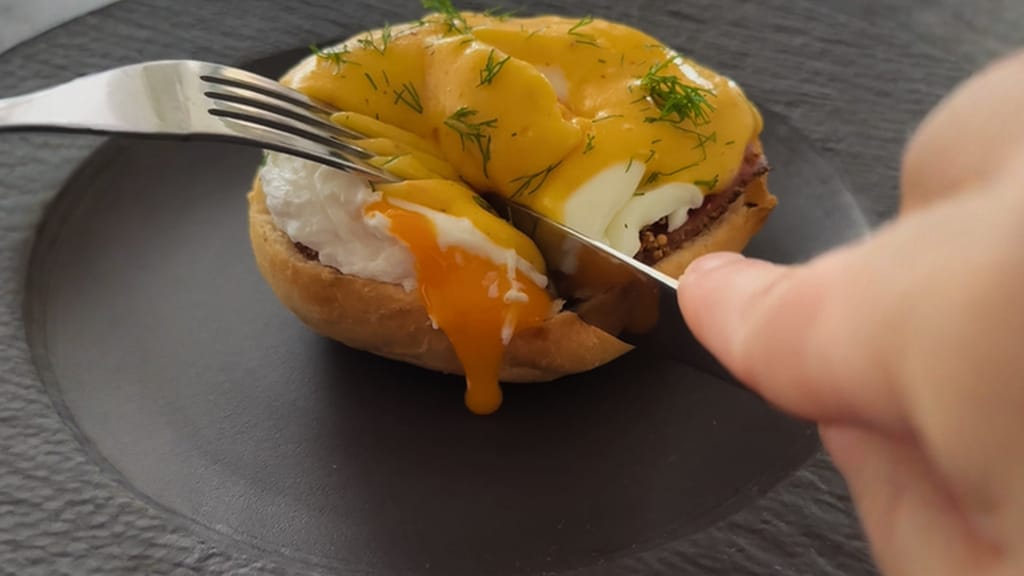
Eggs benedict with spicy hollandaise and pastrami
Poached Eggs: How to Make Them on the Stove or in the Microwave So They Hold Their Shape
Updated Nov 17, 2026
To poach an egg, slide a fresh, shelled egg into gently bubbling water (about 80–90°C / 176–194°F) with a teaspoon of vinegar and leave it for about 2.5–3 minutes, until the white is set and the yolk is still runny. The timings come from the British egg council British Lion (egginfo.co.uk). The whole trick comes down to five things: a fresh egg, vinegar, a sieve, a whirlpool and water that isn't boiling. Below you'll also find a quick microwave method, why you should never microwave an egg in its shell, and how to poach eggs ahead when you're making breakfast for six.
To poach an egg in a pot, slide a fresh egg into a whirlpool in gently bubbling water with a teaspoon of vinegar and cook it for 2.5–3 minutes. Step by step:
Crack a fresh egg into a fine sieve, then into a small bowl.
Pour 1–1.5 l of water into a pot (about 8–10 cm deep), add 1 teaspoon (5 ml) of vinegar and heat it only until it bubbles gently, about 80–90°C (176–194°F), below boiling point.
Stir the water with a spoon to create a whirlpool and slide the egg into the center.
Cook for about 2.5–3 minutes (egginfo.co.uk), then lift it out with a slotted spoon and blot it dry on a paper towel.
Every step has a reason. Skip one and you'll see it in the wisps of egg white drifting around the pot.
A fresh egg holds its shape because it has more thick white, which clings tightly around the yolk. As an egg ages, the thick white thins out and turns into feathery wisps and shreds in the water. The British egg council also says that ragged whites come from older eggs.
Use the freshest eggs you have for poaching.
Save older eggs for scrambling or hard-boiling.
If you're not sure how fresh your eggs are, try the water test for egg freshness.
For poaching you need 1 teaspoon (5 ml) of vinegar per 1–1.5 l of water, which is a pot of water about 8–10 cm deep. The acidity helps the white set faster on the surface, so it spreads out less. Egginfo.co.uk recommends white wine vinegar; plain distilled white vinegar works too.
More vinegar won't help, it will only make the egg taste sour.
Balsamic vinegar will color the egg, so save it for salads.
If you have no vinegar, you can do without, but the egg must be really fresh and the sieve is then a must.
Don't add salt to the water; season the finished egg instead.
To keep a poached egg from falling apart, use three techniques: a sieve to drain off the thin white, a bowl to slide the egg in just above the surface, and a whirlpool that wraps the white around the yolk. All three only work in gently bubbling water (about 80–90°C / 176–194°F, below boiling point). A hard boil batters the egg and tears the white apart.
Sieve: crack the egg into a fine sieve and let it drain for a few seconds. The thin white that would make wisps runs off, and the thick white that holds its shape stays (egginfo.co.uk gives this tip too).
Bowl: move the egg from the sieve into a small bowl or cup. You can slide it into the water just above the surface, and it won't break on the bottom of the pot.
Whirlpool: slowly stir the water in a circle with a spoon and drop the egg right into the center. The current wraps the white around the yolk and gives you a round, smooth little pillow.
A whirlpool works for one egg. For several eggs at once, skip the whirlpool and rely on the sieve and fresh eggs.
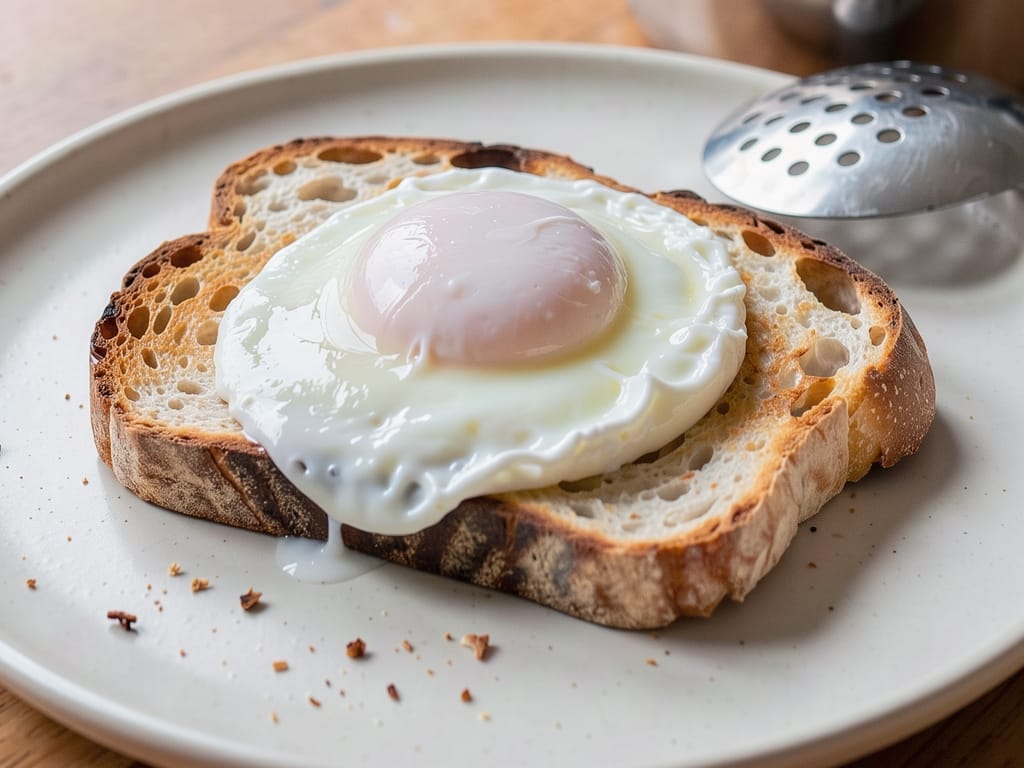
For a poached egg with a runny yolk, cook it for about 2.5–3 minutes, according to the British egg council British Lion (egginfo.co.uk). The white should be completely set, with the yolk underneath still soft.
Lift the egg out with a slotted spoon and gently nudge it from underneath with a finger: the white should be firm and opaque, and the yolk should wobble slightly beneath it.
Trim any stray white from the edges with scissors if you want a neat shape.
Blot it briefly on a paper towel before setting it on toast, or it will make the bread soggy.
Treat the first egg as a test and adjust the time from there. If you're curious about hard- and soft-boiled egg times and how to peel them afterward, you'll find them in our article on how to boil and peel eggs.
Seasonal baking plans, tested recipes and kitchen tricks that save you time. Unsubscribe in one click.
In the microwave, you can poach an egg only without its shell, in a mug with a little water. The method from the British egg council (egginfo.co.uk):
Pour 3 tablespoons of water into a wide microwave-safe mug and heat it on full power for 45 seconds.
Crack an egg into it and pierce both the yolk and the white in several places with a toothpick or the tip of a knife.
Cover the mug with a small plate and microwave on full power for 90 seconds.
Let it stand covered for 30 seconds, so it finishes cooking in the steam.
Microwaves vary in power, so treat the first egg as a test and adjust the time next round. A wide mug matters: in a narrow one the egg gets stuck and cooks unevenly. The result isn't as elegant as from a pot, but in 3 minutes you have an egg for toast with no pot and no whirlpool.
An egg in its shell explodes in the microwave because it heats so fast inside that steam forms quicker than it can escape through the pores of the shell, and the pressure then bursts the shell. That's how the US agency USDA FSIS describes it in its guide Shell Eggs from Farm to Table, and the American egg council does too.
The same principle applies to the yolk itself: it's held in by a thin membrane, and steam builds up beneath it. That's why you should always pierce the yolk, to give the steam a way out. The British egg council advises piercing both the yolk and the white in several places so the steam has somewhere to escape.
Poached eggs can be made ahead: cook them toward the lower end of the time, about 2.5 minutes, move them straight into a bowl of ice water and refrigerate. Just before serving, dip them briefly in hot, not boiling, water and take them out as soon as they're warmed through. None of our sources gives an exact reheating time and temperature, or says how long poached eggs keep in the fridge, so make them in the morning for the same day.
Chill right away: according to USDA FSIS, cooked eggs belong in the fridge within 2 hours of cooking at the latest; don't leave them at room temperature.
Ice water stops the cooking so the yolk stays runny, and it also keeps the eggs from drying out.
Reheat briefly: once the egg is warmed through, take it out, or the yolk will cook hard.
For six people, poach the eggs two or three at a time in a wider pot, without a whirlpool, and move the finished ones straight into ice water. That way you don't have to stand at the stove while everyone else's coffee goes cold.
A poached egg with a runny yolk is a small risk for healthy adults, but for pregnant women, small children, older people and people with weakened immunity, cook it until the yolk is set too. The US USDA FSIS recommends cooking eggs until both white and yolk are firm, and warns that these groups are at the greatest risk from salmonella.
Since 2017, the UK's FSA has considered runny eggs safe even for these groups when they are British Lion eggs, and now also eggs from the Laid in Britain scheme. This doesn't apply to people with a severely weakened immune system on a medically supervised diet. Eggs from other countries, including those from Czech stores, aren't covered by this exception.
So for a pregnant woman, a toddler or a grandmother, poach the egg longer until the yolk sets, or make them a hard-boiled egg instead. Be careful with hollandaise too, since the yolk in it is only lightly heated. When you're away from home and don't know whether an egg is British Lion or Laid in Britain, the FSA advises vulnerable groups to choose eggs that are cooked thoroughly.
A poached egg is at its best where the runny yolk can act as a sauce: on toasted sourdough, on avocado, on leafy spinach, on lentils or on porridge. The classic is eggs Benedict with hollandaise sauce, and for a savory, filling breakfast try pea and oat risotto with a poached egg.
Eggs benedict with spicy hollandaise and pastrami
Eggs Benedict with poached eggs and a zesty hollandaise sauce
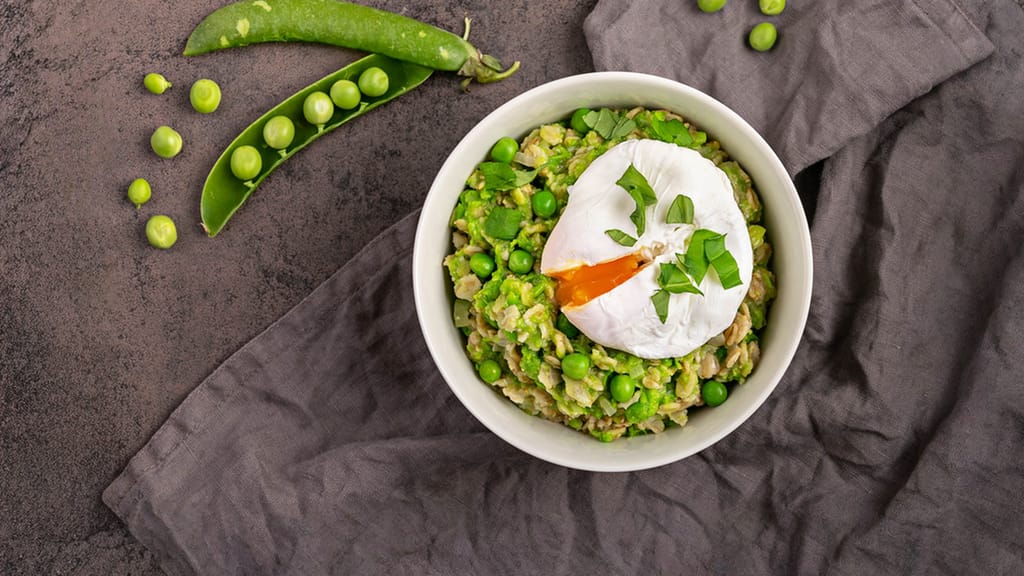
Pea and oat "risotto" with poached egg
Pea and oat risotto with a poached egg
Just keep cooking a poached egg with a broken yolk. The yolk will set in the water and you'll have an egg with a firmer center that still works on toast or in a salad. Yolks most often break when the egg is cracked or when it drops from a height, so crack it into a sieve and lower it into the water from a small bowl just above the surface.
For a single poached egg, a smaller pot that holds 1–1.5 l of water about 8–10 cm deep is enough. The egg sinks far enough for the white to set before it hits the bottom, and a whirlpool is easier to create in a smaller pot. For several eggs at once, use a wider pot so the eggs don't touch.
Yes, a poached egg works in soup and on a salad, just add it right before serving. For soup, set it on top in the bowl rather than in the pot, where the yolk would overcook. For a salad, pat it dry on a paper towel first so it doesn't thin the dressing, and cut into the yolk only at the table.
No, poached eggs don't belong in the freezer. USDA FSIS says "do not freeze" for hard-boiled eggs, because cooked egg white turns rubbery and weeps water after thawing, and with a poached egg you'd also lose the runny yolk. Only prepare poached eggs ahead in the fridge.
One recipe worth heating the oven for, one tip, and one deal from the shop. Nothing else.