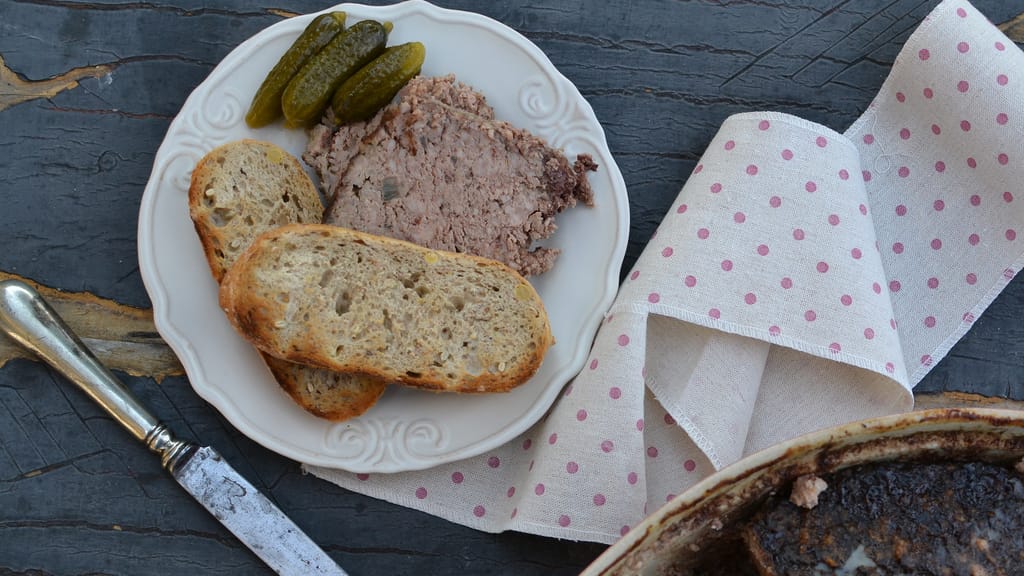
Homemade chunky pâté
Party Platter for New Year's Eve and Celebrations: What to Put on It, How Much per Person and What to Make at Home
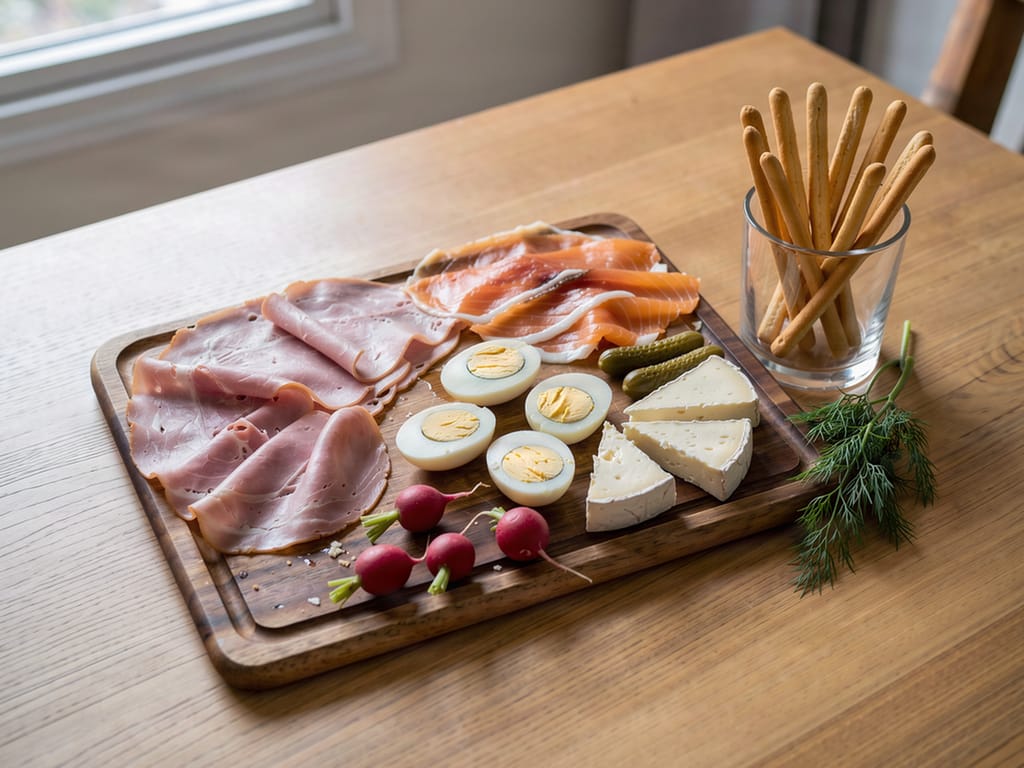
Updated Nov 24, 2026
A party platter is the easiest way to feed a celebration or a New Year's Eve party without standing at the stove. Plan on 150–200 g (5–7 oz) of meat, cheese and fish per person when the platter is the main meal, and 80–100 g (3–3.5 oz) when it's just one of several courses. Add 80–100 g of bread and a handful of vegetables per head, plus one or two homemade items that set your platter apart from a store-bought one: a pâté, a marinated cheese or cured salmon. Below you'll find what to put on the platter, how to arrange it, how much to prepare for 10 people, what to make ahead at home and how long the platter can stay out on the table.
A party platter needs five groups: meat and cold cuts, cheeses, fish or eggs, something sour and pickled, and something crunchy. If you have at least one item from each group, the platter is varied and nobody gets bored.
Meat and cold cuts: bone-in ham as the base, plus one dry salami or sausage and one homemade spreadable item, such as pâté or rillettes.
Cheeses: one soft (hermelín, a Czech camembert-style cheese, or brie), one hard (Edam, Emmental, a mountain cheese) and one bold (blue cheese, Olomouc tvarůžky, a Czech aged cheese).
Fish and eggs: smoked salmon, homemade gravlax or hard-boiled eggs.
Sour and pickled: dill pickles and cornichons, pickled mushrooms, radishes, pickled peppers.
Crunchy and bread: baguette, bread, grissini, crackers, plus a handful of walnuts or almonds.
Why it works: ham, cheese and pâté are all rich and salty, and you tire of them after a few bites. A sour pickle or a mushroom in vinegar "cleans" the palate every time, so guests come back for another slice. Crunchy bread, in turn, balances the soft items; a platter where everything is soft feels flat, however rich it is.
Watch the colors too. Pink ham, white and yellow cheese, orange salmon, green pickles and red radishes make a platter inviting before anyone tastes it. Spread the brown and beige items (pâté, bread, nuts) among the colorful ones so they don't merge into one gray patch.
In Czech cooking, a "cold platter" (studená mísa) is the same thing as a party platter; the term is just used more often for a version with salads and eggs. If you want to build a platter from cheese alone, it has its own rules. The article cheese platter: how much cheese per person and which cheeses to choose covers the selection and amounts.
Buy fewer kinds of higher quality: one good bone-in ham does more than four cheap salamis. What matters is the meat content, the thickness of the slices and how long the sliced product will sit around.
Ham: look for the highest meat content on the label and have it sliced thin but not see-through, about 2 mm. Slices that are too thin tear and stick together when you arrange them.
Salami: slice dry, shelf-stable salami at home, just before arranging. Pre-sliced salami darkens and curls at the edges after a few hours in the air.
Cheese: buy hard cheese in a block, not in slices. Cubes and triangles hold their shape and make the platter look more generous. Take soft cheese out of the fridge about half an hour ahead so its aroma returns, but add it last.
Smoked salmon: choose slices that are springy and glossy, with no liquid in the package. Put it on the platter rolled into rosettes or in loose waves; laid flat, it sticks together.
Shop the day before, not a week ahead. Sliced cold cuts and fish have a short shelf life, and in a fridge full of party food they're easily forgotten at the back. Check the use-by date on every package and treat it as the upper limit, not the target.
Build the platter from the largest items to the smallest: bowls first, then cheeses, then meat and fish, and finally small bits in the gaps. That way nothing gets shifted around, and the platter looks full without needing more food on it.
Choose a base. A large wooden board, a porcelain tray or two smaller platters. Cover wood with parchment paper if salmon or oily marinated cheese will go on it; otherwise it absorbs the smell.
Set out the bowls. Dip, pickled mushrooms, olives and anything runny go in small bowls. Spread them across the surface rather than in one line; they become "anchors" to build the rest around.
Arrange the cheeses. Cut hard cheeses into triangles or sticks; leave soft cheese whole or cut it into wedges so guests can help themselves. Put each cheese in a different part of the platter.
Add the meat. Arrange ham in loose waves or rolls and salami in a fan, with slices overlapping by only half. Folded slices take up more room and look generous; slices laid flat look sparse.
Add the fish and eggs. Salmon needs the cold most, so put it on the platter right before serving, ideally on the coolest part of the tray.
Fill the gaps. Pickles, cornichons, radishes, pepper pieces, nuts, grapes. The gaps are where the platter turns from "a plate of food" into a feast.
Keep the bread separate. Stand the grissini in a glass and put sliced baguette in a basket. On the platter it would go soggy from the meat and cheese, and the platter would quickly fall apart.
Cut pieces a little smaller than you would for yourself. At a party people eat standing up and with one hand, and anything that can't be picked up with fingers or a toothpick gets left behind.
For 10 people, when the platter is the main meal, prepare roughly 1.5–2 kg of meat, cheese and fish combined, 0.8–1 kg of bread and about 1 kg of vegetables. If you're also serving a hot dish or soup, about half is enough.
Per person, plan on:
meat, cold cuts and pâtés: 80–100 g when the platter is the main meal, 40–50 g when it's just one of several courses (alongside a hot dish or soup),
cheese: 50–70 g when the platter is the main meal, 30–40 g when it's just one of several courses,
fish or eggs: 20–30 g of salmon or one egg when the platter is the main meal, about 10 g of salmon or half an egg when it's just one of several courses,
bread: 80–100 g (about a third of a baguette or two slices of bread),
vegetables and pickles: 80–100 g,
dip or spread: 2–3 tablespoons.
In practice, for 10 people that could be this lineup: 500 g bone-in ham, 250 g dry salami, one bowl of homemade pâté, 300 g hard cheese, two hermelín cheeses, 200 g smoked salmon or gravlax, 5 eggs, a jar of pickles, a jar of pickled mushrooms, two to three baguettes and a loaf of bread (or grissini), and a bowl of dip.
A few adjustments for the situation. A long evening where people graze until midnight can take the upper end. An afternoon party with cake can take the lower end. Count children as about half an adult. And store-bought and homemade items go at different rates: homemade pâté and marinated tvarůžky have a stronger flavor than ham, so you need less of them.
Instead of one giant platter, prepare two or three smaller ones and refill from the fridge. The US FDA advises this for buffets and parties: prepare several smaller trays ahead and swap them for fresh ones during the evening. That way food doesn't sit for long in the warmth, and the table looks as good as it did at the start.
For a celebration, you usually serve the platter all at once as the main meal; on New Year's Eve, more likely in three waves through the evening. That changes how much goes on the table at a time: the whole platter for a celebration, about a third for New Year's Eve, with the rest kept in the fridge. You shop the same either way: the three waves together use the amount for a platter as the main meal.
A New Year's Eve plan for 10 people in three waves:
Around eight: ham, salami, some of the cheeses and the pâté.
Around ten: fish, eggs, the rest of the cheeses and fresh vegetables.
Before midnight: whatever is left in the fridge, topped up with grissini, dip and a few canapés to go with a glass of bubbly.
This way nothing sits out in the warmth for too long, and the last guests don't get dried-out leftovers. How to plan the whole evening, including when to serve hot food and when to serve sweets, is covered in New Year's Eve party food: a plan for the whole evening. You'll find bite-size snacks in New Year's Eve canapés you can prepare ahead.
For a celebration where guests arrive all at once, it's better to have a big platter that's full right away; people crowd around it in the first twenty minutes. Then you just top it up from the fridge.
What to prepare when:
Three to four days ahead: gravlax, pâté and rillettes.
Two to three days ahead: marinated tvarůžky (they mature in the fridge the whole time).
The day before: stuffed hermelín, pickled mushrooms, grissini, hard-boiled eggs.
In the morning: dip, and cutting cheese and vegetables into containers.
An hour ahead: assembling the platter, with the meat and salmon last.
It makes sense to make at home what you can prepare ahead and can't buy in that form: pâté, rillettes, gravlax, stuffed hermelín, marinated tvarůžky, pickled mushrooms, grissini and cheese dip. Buy the ham, salami and hard cheeses; making them at home isn't worth it for a party.
Pick two or three items, no more. One homemade pâté and one marinated cheese turn an ordinary platter into one people talk about, and they won't take up your whole weekend.
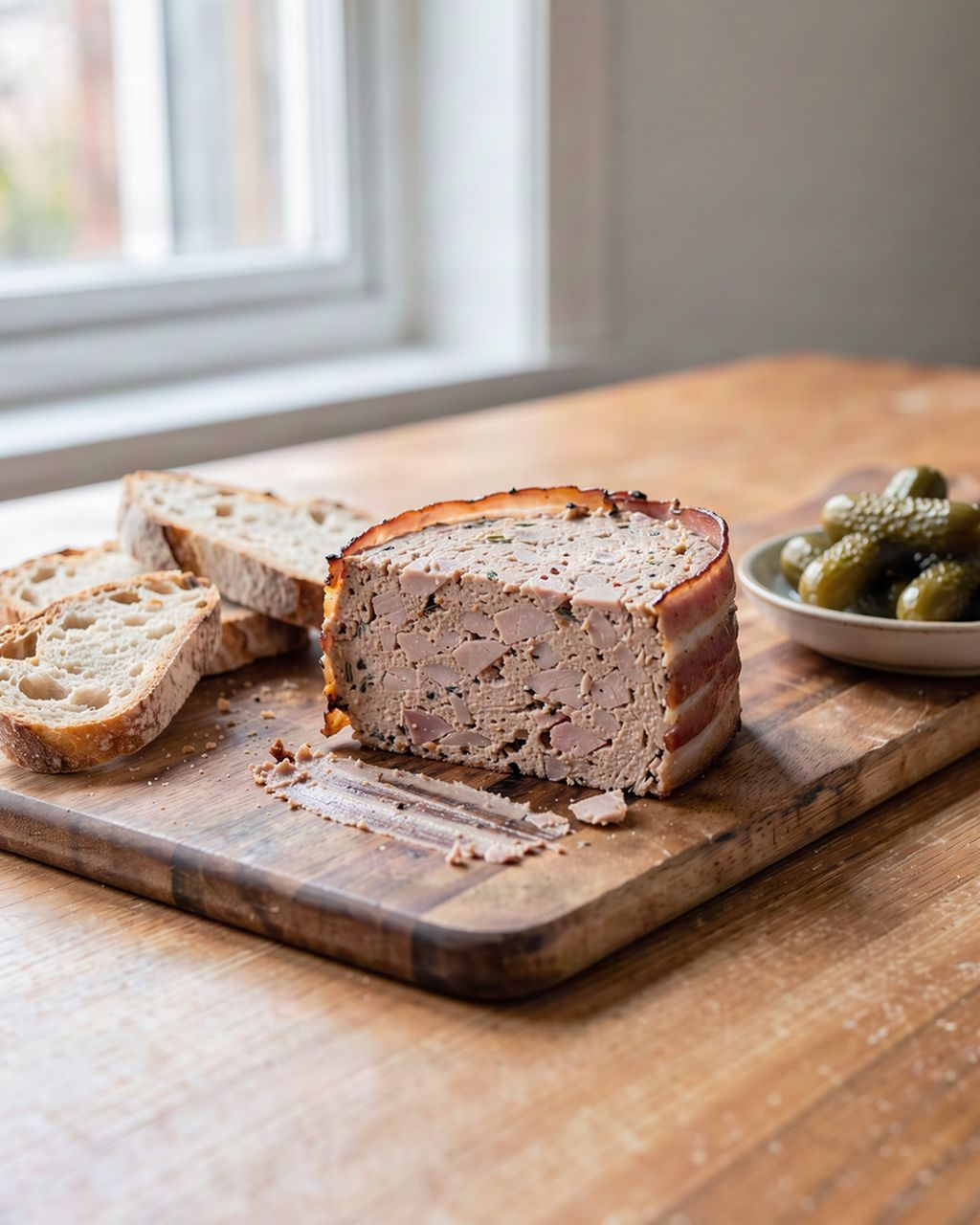
Homemade chunky pâté is made from chicken livers, raw pork fatback and pork shoulder, seasoned with salt, pepper and fresh thyme. You grind everything through a coarser plate so the pâté keeps visible pieces of meat, then press it into a baking dish lined with slices of English-style bacon. Cover the dish with a lid or aluminum foil and bake the pâté in a water bath in the oven at 180°C (350°F) for about two hours. Then let it cool on the counter for no more than 2 hours, cover it and put it in the fridge to settle.
Slice it for the platter only once it's chilled, in slices about 1 cm thick; warm, it crumbles.
Homemade chunky pâté
Homemade chunky pâté made with chicken livers and pork shoulder for a party platter
Lamb rillettes is a French meat spread made from lamb breast slowly cooked in pork lard. You brown the meat in melted lard, add salt, pepper, garlic, red onion and a sprig of sage after three hours, and cook the meat for another 3–5 hours until it falls apart. Then you fish out the bones and sage, pack the meat tightly into jars and cover it with fat from the pot so it's completely sealed. Within 2 hours of finishing cooking, it belongs in the fridge; what you don't eat you can freeze for up to 3 months.
On the platter, serve it in a bowl that guests scoop from with a knife onto baguette. Rillettes is a rich, strongly flavored spread, so one smaller bowl is enough for 10 people.
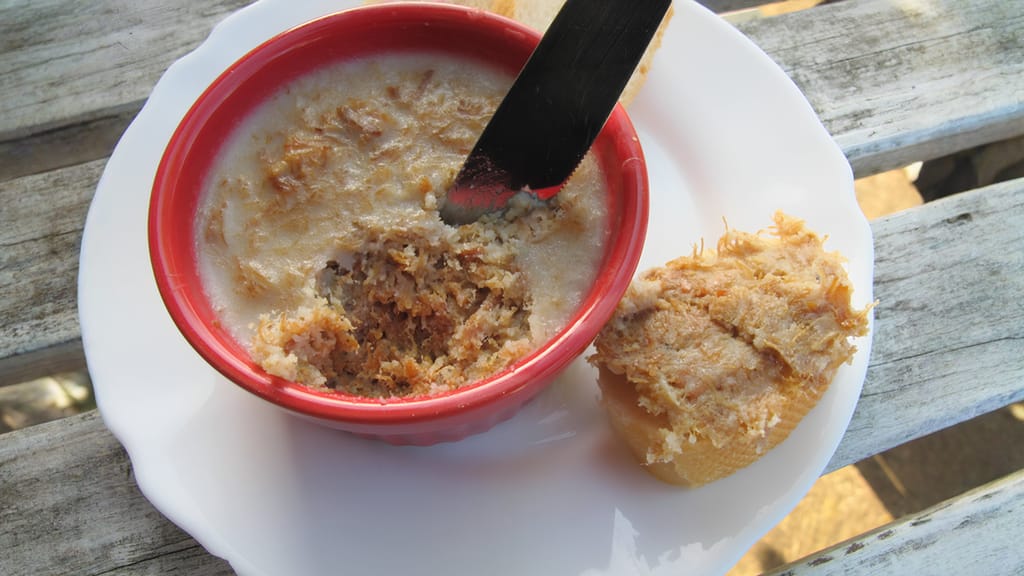
Lamb rillettes
Lamb rillettes slowly cooked in pork lard, as a spread for a party platter
Gravlax is Swedish salmon cured in salt, sugar, pepper and dill. The salmon is eaten raw, so the skin-on fillet should be frozen beforehand for at least 24 hours at −20°C (−4°F) or colder (or at least 15 hours at −35°C/−31°F). A typical home freezer runs at around −18°C (0°F) and doesn't meet this rule, so the surest route is to buy fish sold as suitable for raw consumption, or already frozen this way. Coat it in a mixture of salt, sugar, pepper and coarsely chopped dill, wrap it in plastic wrap and leave it in the fridge for 48 hours, turning it about four times. Then scrape off the mixture with the back of a knife (don't rinse the fish) and slice it on the diagonal as thinly as possible with a very sharp knife.
Next to smoked salmon on the platter, it shows off the difference between smoke and a pure cure.
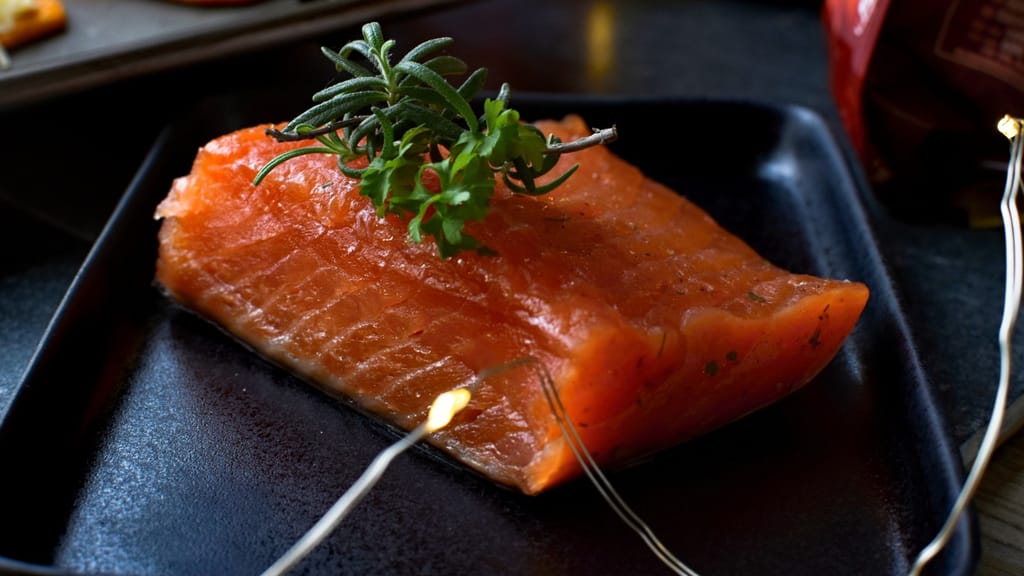
Gravlax
Gravlax, Swedish salmon cured in salt, sugar and dill, for a festive party platter
Garlic hermelín stuffed with walnuts needs only four ingredients: hermelín (a Czech camembert-style cheese), garlic, walnuts and butter. Cut each hermelín horizontally into two rounds and scoop out the soft center with a spoon. Mash it with softened butter, add crushed garlic and chopped walnuts, and put the filling back into the rounds. Press the halves together, wrap tightly in plastic wrap and leave in the fridge, ideally until the next day, so the butter firms up and the cheese can be sliced.
On the platter, cut it into wedges like a cake; the cross-section with the walnut filling is the prettiest thing on the platter.
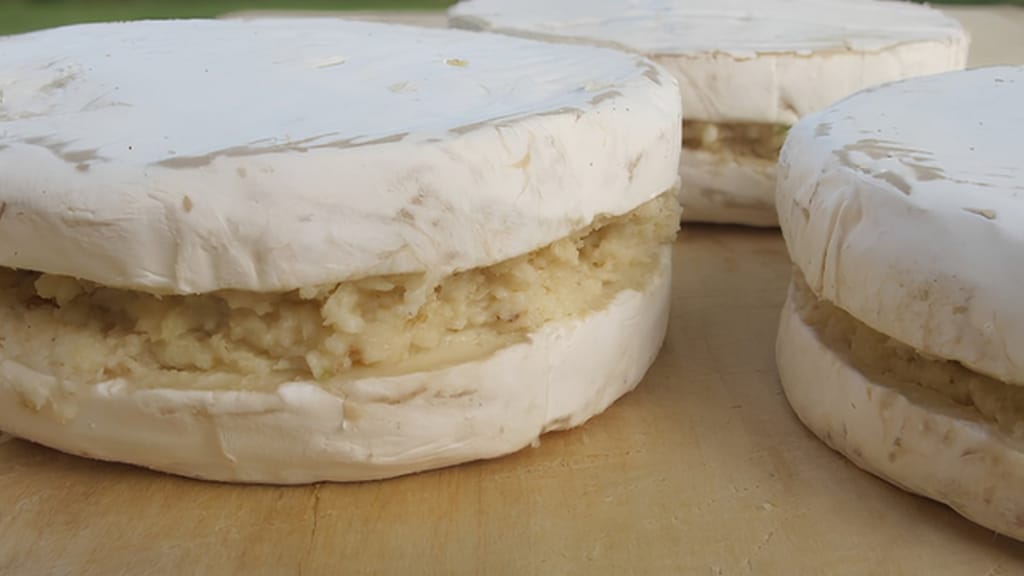
Garlic camembert stuffed with walnuts
Garlic hermelín stuffed with walnuts for a party platter, made a day ahead
Marinated spicy tvarůžky are a Czech classic to go with beer: rounds of Olomouc tvarůžky (a Czech aged cheese) with onion, garlic, sun-dried tomatoes and hot peppers, covered in oil. According to the US CDC, raw garlic, onion and fresh herbs in oil without vinegar are a botulism risk; the CDC advises keeping homemade oil with garlic or herbs in the fridge and using it within 4 days. So let the jar mature only in the fridge (at or below 5°C/41°F), never in the pantry, the cellar or on the balcony, marinate the tvarůžky two to three days before the party, and don't let leftovers sit around.
For the platter, lift them out with a fork along with a piece of onion and let them drain so oil doesn't run across the board. For what drinks go with them and how to match snacks with beer and wine, see snacks for wine and beer: what goes with what.
Pickled mushrooms in vinegar are made from cultivated button mushrooms; wild mushrooms don't belong in this recipe. Boil the brine from water, fermented vinegar with at least 5% acidity, salt, sugar, pepper, coriander and mustard seed, and let it cool. Arrange the mushrooms, prepared as the recipe says, in jars with onion, carrot slices and chili, and pour the brine over them. The jars aren't sterilized: close them with a clean lid, put them in the fridge right after filling with brine and store them only there. How to prepare the mushrooms and how long to keep them is in the recipe itself.
On the platter they work as a sour counterweight to the pâté and cheeses. Put them in a bowl with a little brine so they don't dry out.
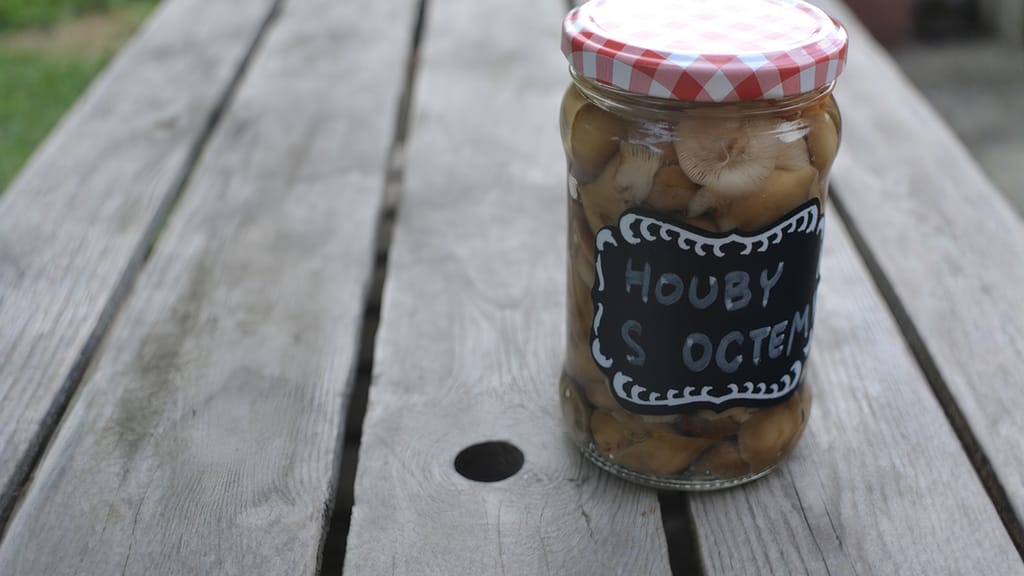
Pickled mushrooms in vinegar
Pickled button mushrooms in vinegar, a sour counterweight on a party platter
Grissini – homemade Italian breadsticks are made from all-purpose (plain) flour, water, salt, olive oil and dried yeast. Knead the dough and leave it to rise for 1.5–2 hours, until it doubles in size. Then divide it into four pieces, roll them out, cut into narrow strips and stretch them between your palms to the length of the baking sheet. Brush them with water and olive oil, sprinkle lightly with salt and bake in an oven preheated to 220°C (425°F) for 20–25 minutes until golden.
Stand them in a tall glass on the platter. The best trick: wrap some of them in a slice of bone-in ham, and the breadstick instantly becomes a canapé with no extra work.
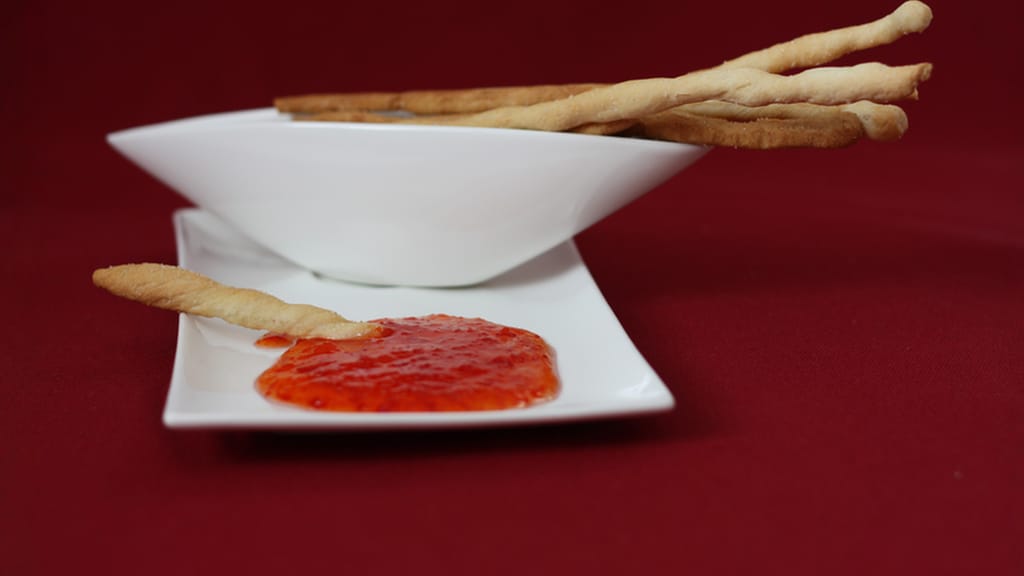
Grissini – homemade italian breadsticks
Homemade grissini, crunchy Italian breadsticks for a party platter
Blue cheese dip with walnuts is ready in a quarter of an hour. Whisk sour cream with mayonnaise and a crushed clove of garlic, stir in finely grated chilled blue cheese and season with salt and pepper. Divide the walnuts into two parts, chopping one coarsely and the other almost to crumbs, and stir in both. Then chill the dip.
The dip belongs on the platter in a bowl next to the grissini, radishes and strips of pepper. Because it contains mayonnaise, the same rules apply as for salads: take it from the fridge to the table only right before serving.
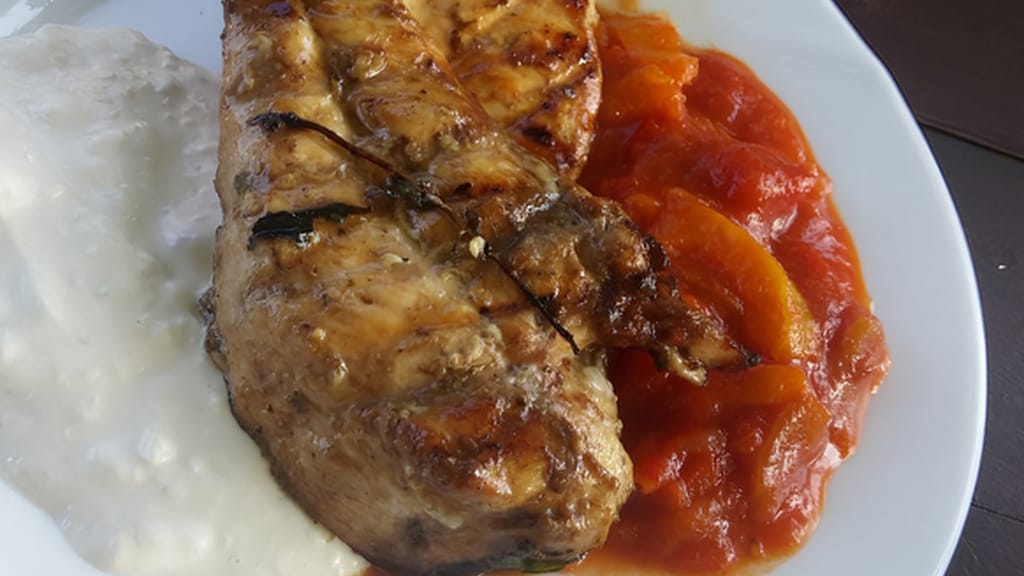
Blue cheese dip with walnuts
Blue cheese dip with walnuts in a bowl for a party platter
Schnitzels belong on a party platter, but cold, cut into strips and on their own tray next to the platter. On the main platter they would make the cheese damp, and the breading would go soft from the ham.
For a party, choose schnitzels that are good cold and don't crumble: baked turkey schnitzels in a cornmeal coating. Cut turkey breast into cutlets about 1 cm thick, salt them and marinate overnight in kefir with garlic. Then coat them in cornmeal breadcrumbs with sweet and hot paprika, lay them on a baking sheet lined with parchment paper lightly brushed with oil and bake at 200°C (400°F) for 15–20 minutes. Because they bake in the oven, you can do a whole sheet in one go and don't have to stand over a frying pan.
Let the schnitzels cool after baking, put them in the fridge within 2 hours and slice them only right before serving. Bowls of pickles and mustard are all they need.
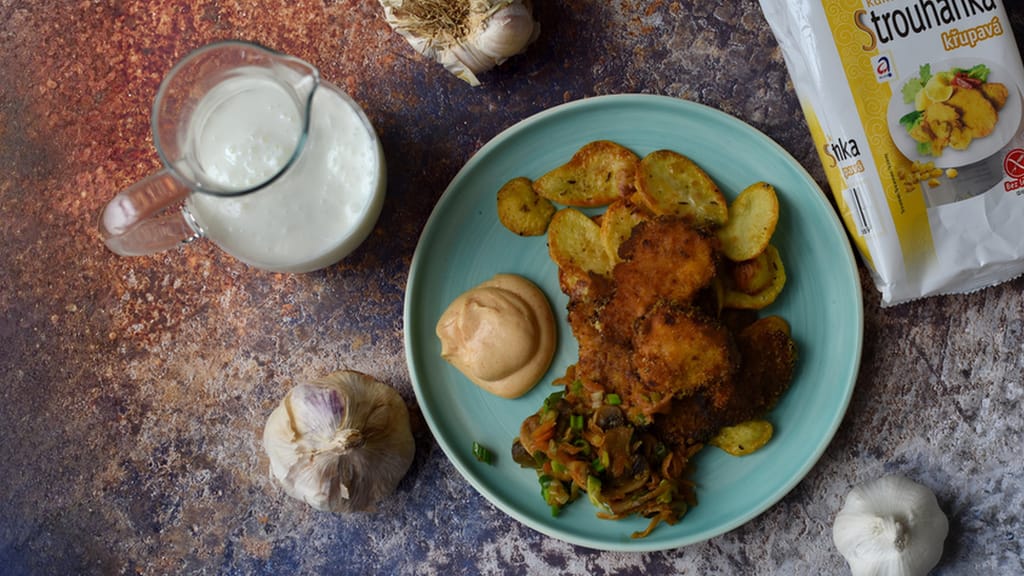
Baked crispy cutlets in extrudo cornmeal breading
Baked turkey schnitzels in a cornmeal coating, good cold on a party platter
Serve the salad for a cold platter in a separate bowl; never spread it directly between the ham and cheese. Keep mayonnaise salad in the fridge and put a smaller bowl on the table, refilling it from the fridge as you go.
The classic choice for a cold platter is usually the traditional Czech mayonnaise salad (vlašský salát). Alongside it, stuffed eggs and ham rolls with horseradish cream go well; roll the ham rolls only right before serving, because the cream loosens quickly in the warmth.
Use homemade mayonnaise salad within 2 days and keep it in the fridge the whole time. On the table, treat it like meat and eggs: no more than 2 hours out of the fridge.
Five tried-and-true party platter lineups: the Czech classic, a New Year's Eve platter with fish, a platter to go with beer, a pâté board and a meatless platter. Each is built around a different main item, so choose based on what you want guests to remember.
The Czech classic: bone-in ham, ham rolls with horseradish, stuffed eggs, Edam, hermelín, dill pickles, radishes and bread. A platter everyone knows, which is exactly why it disappears first.
New Year's Eve with fish: gravlax and smoked salmon side by side, hard-boiled eggs, cornichons, capers, baguette and butter. Festive and fresh, it suits the second wave of the evening.
For beer: marinated tvarůžky, garlic hermelín, pickled mushrooms, dry salami, onion rings, bread with caraway. Bold, salty and sour.
A pâté board: homemade chunky pâté, lamb rillettes, pickled mushrooms, cornichons, baguette and mustard. For a smaller group that likes to eat slowly.
A meatless platter: garlic hermelín stuffed with walnuts, blue cheese dip, marinated tvarůžky, pickled mushrooms, grissini, vegetable sticks, grapes and nuts. Not a single item contains meat or fish.
One piece of advice for all of them: keep to three main flavors on one platter. A platter with twelve kinds of everything looks lavish in a photo, but at the table guests get lost and take only the ham.
Recipe of the week, one tip that saves you time and one deal from the shop. Unsubscribe in one click.
The next issue goes out on Thursday, November 26.
A party platter with meat, cheese, eggs, fish and mayonnaise can stay out of the fridge for no more than 2 hours, or just 1 hour in hot weather. Put it back in the fridge within 2 hours; anything that stayed on the table longer, throw away and put out a fresh platter.
The two-hour rule appears in the Czech edition of the World Health Organization's five keys to safer food, published by the Státní zdravotní ústav (the Czech National Institute of Public Health): don't leave cooked food at room temperature for more than 2 hours. The US FDA uses the same figure for buffets and adds that in a room above 32°C (90°F) the safe time drops to 1 hour. To be safe we round that down and count one hour from 30°C (86°F), which you reach quickly in a crowded room by the fireplace or at a summer garden party.
How to keep to it in practice:
Arrange on a cold base. Chill the tray or board in the fridge for an hour, or set it on a tray of ice.
Swap, don't top up. When the platter empties, replace it with a fresh one from the fridge rather than adding fresh food on top of what has already been sitting out.
Watch the time. Note when you put the platter on the table; at a party it's easy to lose track.
Put fish, eggs and mayonnaise out last. They are the most sensitive, so add them right before serving and in smaller amounts.
Don't put the platter next to the stove, over a radiator or in direct sunlight.
For a party platter, plan on 80–100 g of bread per person and two to three kinds so everyone finds something: baguette for slicing, bread and something crunchy like grissini or crackers. Slice the bread as you go; sliced baguette dries out within an hour on the table.
Serve butter softened in a bowl, not chilled in a block; nobody wants to spread hard butter on a thin slice of baguette while standing. Mustard and horseradish go with ham and pâté, and for cheeses you can add fruit preserves or honey. Put out a pile of toothpicks, small forks and napkins too, because a party platter is finger food.
For a party platter for 10 people, one board or tray of roughly 40 × 60 cm is enough, but two smaller ones of about 30 × 40 cm are more practical. Two smaller trays fit in the fridge, so you can keep one on the table and chill the other in reserve. If you don't have a large board, a baking sheet lined with parchment paper works too.
In Czech, obložená mísa and studená mísa are practically the same thing: cold meats, cheeses, fish and vegetables arranged on one tray. Studená mísa more often means a version that comes with eggs and a mayonnaise salad in a bowl, while obložená mísa usually means one built around cold cuts and cheese. The rules for amounts and for how long it can sit out are the same for both.
Cover the platter with plastic wrap pressed gently right onto the food, not just stretched tight over the rim of the tray, and keep it in the fridge until serving. Stretched wrap traps air underneath, and the ham and cheese at the edges will dry out anyway. Don't slice the bread ahead of time; keep the baguette whole in a paper bag and slice it just before serving.
Transport the platter unassembled: sliced meat, cheese and fish in lidded containers in a cooler bag with ice packs, and assemble it on arrival. Assembly takes about twenty minutes, and the platter arrives without squashed slices. If you have to carry it ready-made, count the journey toward the two-hour limit out of the fridge.
Throw away any leftovers that sat on the table for more than 2 hours. What stayed in the fridge the whole time, wrap separately by type and use up as soon as possible, at the latest by the date on the package. The next day, ham and cheese work well in toasties, omelets or baked pasta, where they get heated through again.