Homemade chunky pâté
Homemade Pâté: Chicken or Pork Liver, With Chunks of Meat, Plus Rillettes and Salmon Farce
Updated Nov 24, 2026
Homemade pâté is a ground or blended mixture of liver, fatty meat and seasoning that you bake slowly in a water bath and chill until set. Every recipe is built on that. They differ in which liver you use, how much fat you add, whether the meat is coarsely ground or blended smooth, and whether you cook it first. We'll go through five methods from Yumsto: a coarse pâté with chunks of meat, a roasted pork liver pâté with pork belly, a smooth pork liver pâté, lamb rillettes and salmon farce. One rule applies to every liver pâté: the liver must be cooked all the way through.
To make homemade pâté, grind or blend liver with fatty pork (lard, pork belly or shoulder), season with salt and spices, pack it into a mold, bake it slowly in a water bath until cooked through, and chill it in the fridge for at least a night to set. Depending on what you want from your pâté, there are three basic routes:
Coarse pâté with chunks of meat: raw liver and meat ground through a coarse plate, baked in a water bath. You can see the pieces in it, and it slices like meatloaf.
Pâté from roasted liver: you first roast the liver and meat, blend them, and only then finish baking in the mold. It tastes more like a roast and is darker.
Smooth pâté: raw liver blended with eggs, cream and butter, baked at a low temperature. It comes out fine-textured and spreadable.
Alongside these are two related techniques that go on the table the same way: rillettes, meat slowly simmered in fat and shredded, and fáš (farce), a fine blended mixture, here made with salmon.
What they all share: cold ingredients, plenty of fat, salt, a water bath and patience while cooling. Fat carries flavor and keeps the pâté tender. Salt binds the meat together and draws out its flavor. The water bath makes sure the edges don't overcook before the center heats through. And chilling is part of the recipe, not extra waiting: only a cold pâté holds its shape and can be sliced.
Seasonal baking plans, tested recipes and kitchen tricks that save you time. Unsubscribe in one click.
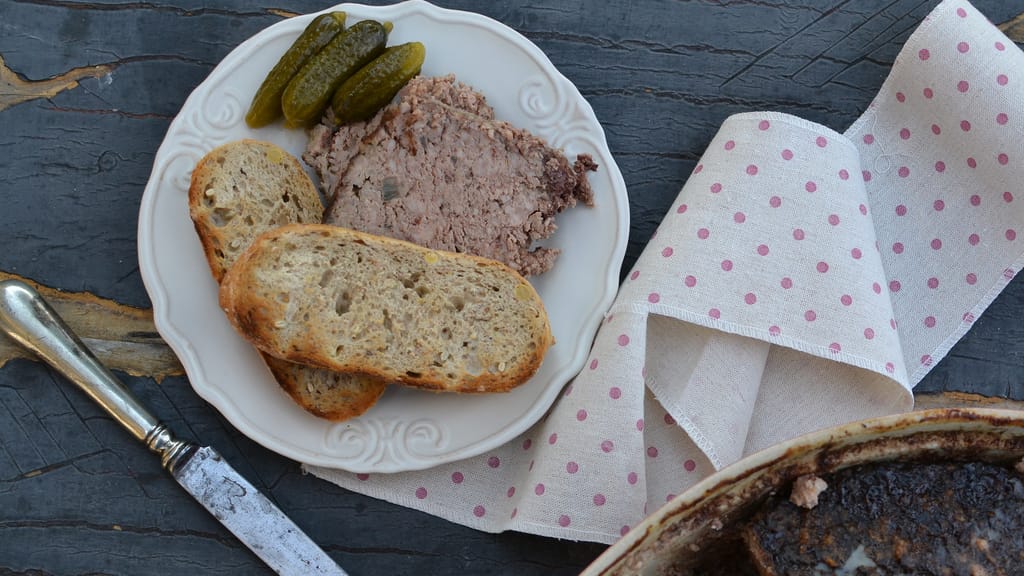
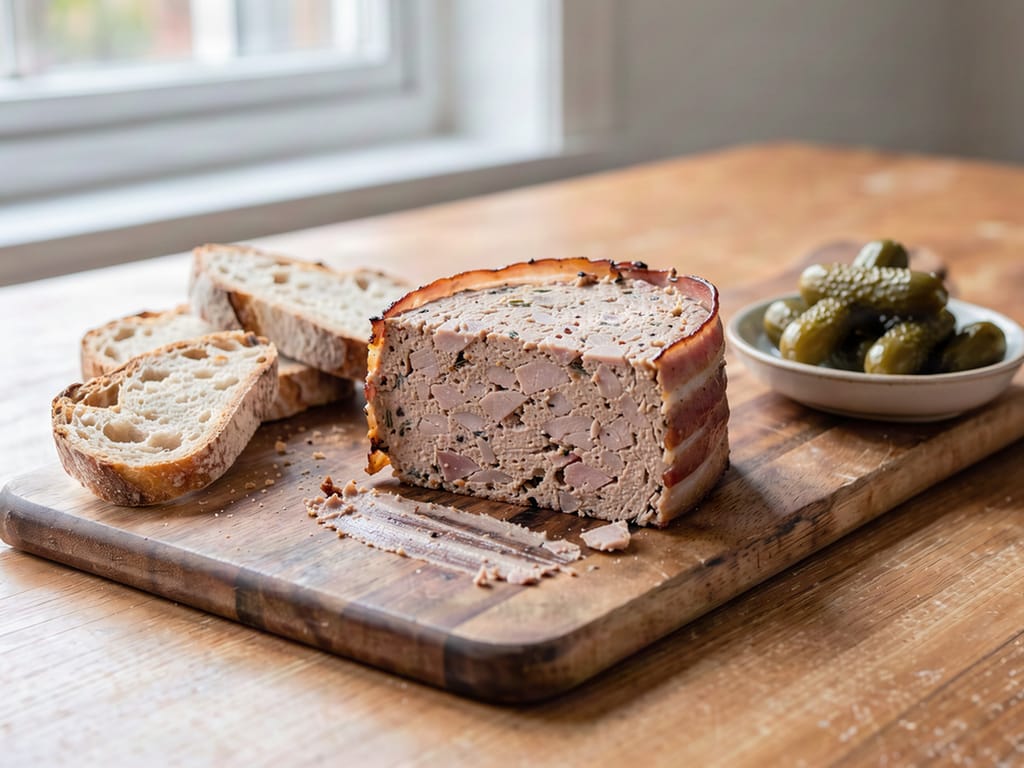
Homemade chicken liver pâté with chunks of meat is the most rustic version: chicken liver, raw pork fat (lard) and pork shoulder, coarsely ground and baked in a mold lined with bacon. For the homemade pâté with chunks of meat recipe, you need 1 kg chicken livers, 1 kg raw pork fat and 500 g pork shoulder, plus salt, black pepper, fresh thyme, a little cognac and bacon rashers.
Method: grind the liver, fat and shoulder through a coarser plate so you can still see pieces of meat in the pâté, then season with salt, pepper, thyme and cognac. Line a baking dish with bacon slices, pack the mixture in, cover with a lid or aluminum foil, and set it in a roasting pan filled with water to between half and two thirds of the way up the dish. Bake at 180°C (350°F) for about two hours; in a shallower, wider dish it will be done sooner. Then let it cool for no more than two hours on the counter, cover it, move it to the fridge and let it rest.
Why it works: the ratio of liver to fat is almost one to one, and it's the fat that makes the pâté juicy and soft. The shoulder adds structure and meaty flavor, the liver that typical deep note. The bacon all around acts as a wrapper that keeps moisture in and adds a salty, lightly smoky crust. If you don't want the bacon you can leave it out, just expect a slightly drier edge.
The most common mistake is warm meat in the grinder. When the fat warms up, it smears instead of grinding, and the pâté then leaks fat in the oven and crumbles. So keep the meat and fat chilled, ideally for half an hour in the freezer before you start grinding.
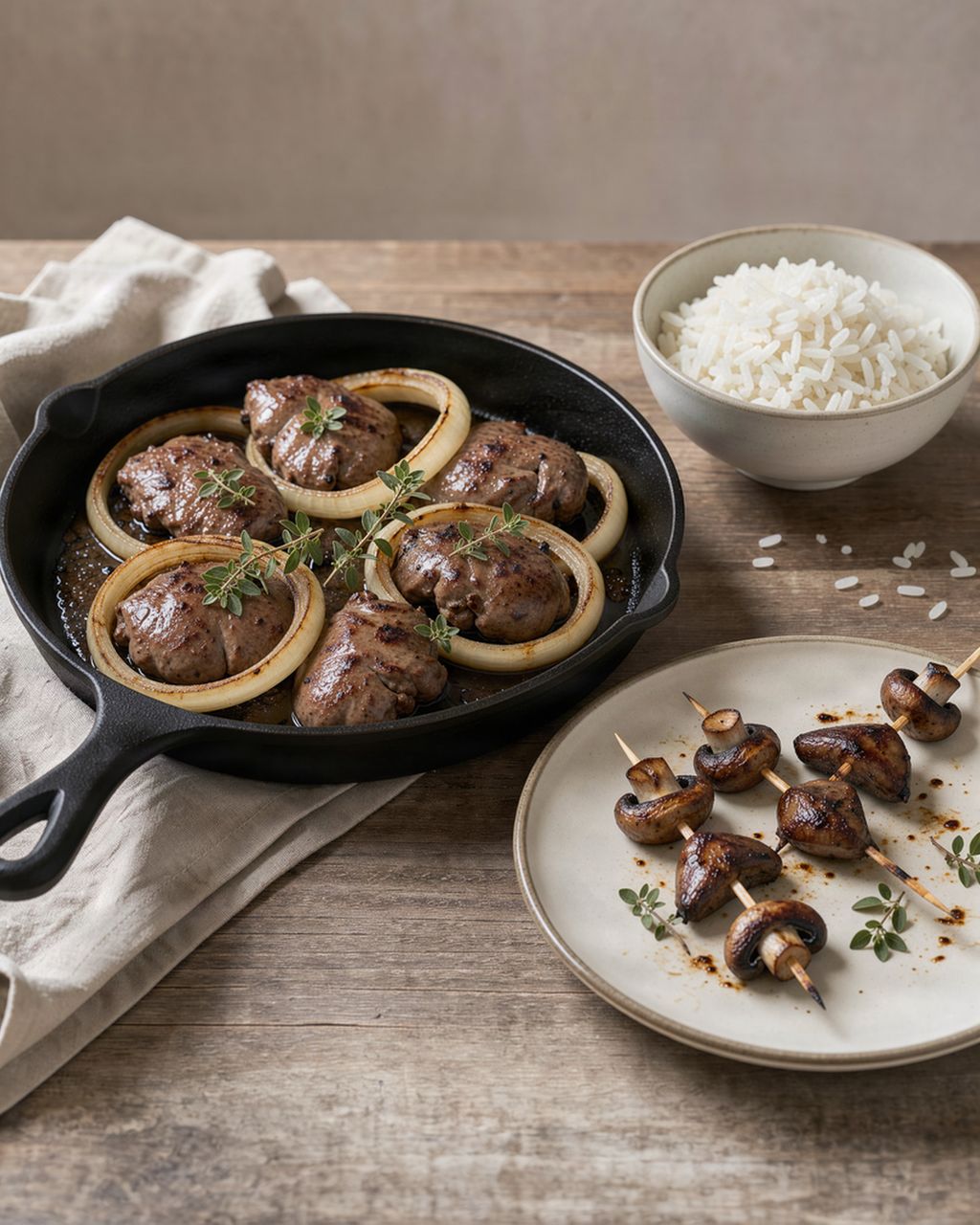
Homemade chunky pâté
Homemade chicken liver pâté with chunks of meat, pork fat and shoulder
Chicken liver and pork belly pâté is the same coarse pâté, except that instead of plain fat and shoulder you use pork belly, which has fat and meat in one piece. It's a practical shortcut: you buy one cut of meat instead of two, and you control the fat ratio by how fatty a belly you choose.
How to do it: cut skinless pork belly into cubes, chill it and grind it together with the chicken livers through a coarse plate. Keep to a 1:1 ratio of liver to belly, so about 1 kg liver to 1 kg belly; with a leaner belly, add 2–3 tablespoons (about 50–80 g) of lard, otherwise the pâté will be dry. Add salt, pepper and thyme, then carry on as for the pâté with chunks of meat: a bacon-lined mold, a water bath, slow baking and a whole night in the fridge.
Belly gives the pâté a slightly firmer, meatier structure than fat alone. Chicken liver is more delicate and milder than pork liver, so the belly comes through more in the flavor. This is a technical variation on the recipe above, not a separate recipe from our cookbook.
Chicken liver pâté without cream is perfectly normal: it needs neither cream nor milk, because the fat keeps it tender. That's exactly how the homemade pâté with chunks of meat and pork fat is built: its ingredient list has no cream, eggs or milk, only liver, fat, shoulder, spices, cognac and bacon.
Cream is added to pâtés mainly for smoothness and a lighter color, typically in smooth blended versions. In a coarse pâté, feel free to leave it out. Just watch two things: enough fat (lard or fatty belly, not lean meat) and slow baking in a water bath, because without cream a pâté dries out more easily if you overbake it.
If you want a smooth pâté with no dairy, blend the liver with lard instead of butter and cream. The texture comes out denser and the flavor stronger. We don't have a separate recipe like that in the cookbook yet.
Homemade pork liver and pork belly pâté has a stronger, more heavily spiced flavor than chicken, because pork liver is more assertive and slightly bitter. On Yumsto you'll find it as roasted liver pâté with pork belly and prunes: 1 kg pork liver, 500 g skinless pork belly, salt, pepper, dried prunes, garlic, whipping cream, fresh thyme and bacon.
Method: cut the liver and belly into small cubes, salt and pepper them, toss, and leave covered in the fridge until the next day so the salt can penetrate the meat. The next day, roast the meat in the oven, let it cool and blend it with an immersion blender; it works well to blend about three quarters smooth and leave the rest coarser. Stir in the chopped prunes, pressed garlic, thyme and finally the whipping cream, which brings the mixture together. Line a terrine mold with bacon, pack the mixture in and bake in a water bath at 160°C (320°F) for two hours.
The prunes aren't decoration. Their sweetness balances the bitter note of pork liver, and in a slice they make dark, juicy spots. Garlic and thyme have always gone with pork liver. The total time for the recipe is over fourteen hours, but almost all of it is overnight marinating and cooling; the active work is about an hour.
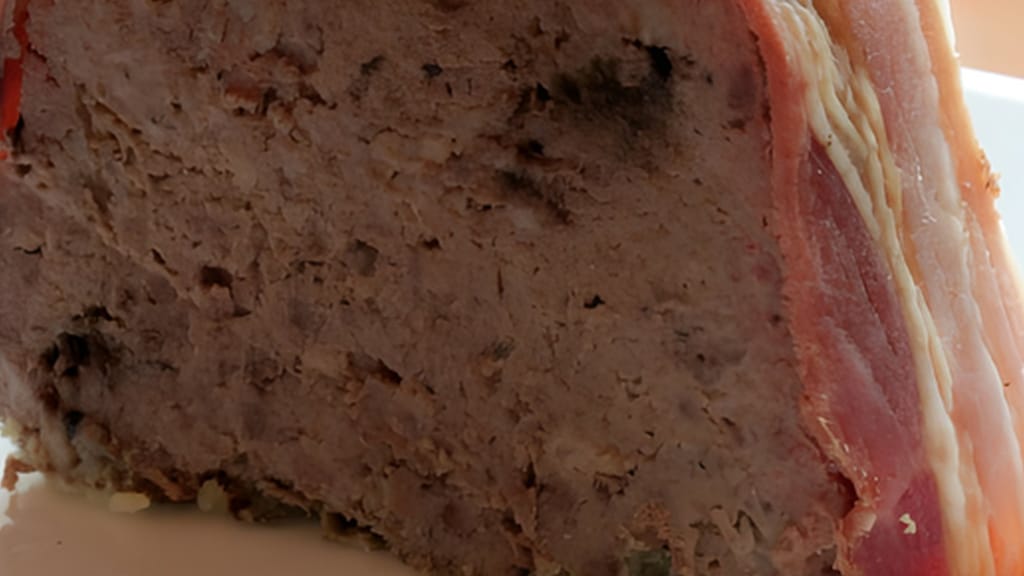
Baked liver pâté
Roasted pork liver pâté with pork belly, prunes and thyme
Homemade pâté from roasted meat and liver is made by first roasting the meat and liver, blending them, and only then finishing the baking in the mold. This is exactly the method of the roasted liver pâté above, and it's worth understanding why you'd choose it.
Flavor: roasting browns the surface of the cubes, giving seared notes that a raw ground pâté doesn't have. The result tastes more like a roast and less like raw liver.
Texture: roasted meat blends differently from raw. It keeps a bit of graininess and the pâté is denser, slicing into firm slices.
Safety: the meat goes through the heat twice, but that doesn't mean you can skimp on the second bake. Once you've stirred in the cream and spices, it's a new raw mixture and all of it has to heat through.
You can use the same principle to use up leftovers from a Sunday roast: grind or blend cold roast pork with sautéed liver, add the fat from the pan drippings, season and finish in a mold in a water bath. We don't have a separate recipe for pâté from roasted meat yet; it's more a way of dealing with leftovers.
Smooth pork liver pâté is made by blending raw liver with eggs, cream and butter and baking it slowly at a low temperature, so it comes out as fine as a spread. The recipe pâté and bread, all homemade uses 500 g pork liver, four eggs, 100 ml whipping cream, 50 g butter, thyme, salt and pepper. And alongside it, homemade rohlíky (Czech crescent rolls) or small round rolls with poppy seeds or caraway.
Method: don't rinse the liver, just pat it dry with a paper towel and use a sharp knife to cut off the white membranes and tough veins, because a blender won't chop them up. Blend it with melted, slightly cooled butter (hot butter would curdle the eggs), the eggs, cream, thyme, salt and pepper. Pour the mixture into dishes, jars or a mold lined with plastic wrap, set the containers in a roasting pan and pour boiling water around them to at least three quarters of their height. Bake at 90°C (195°F) for about three quarters of an hour, until the pâté is firm in the middle and doesn't ripple when you shake it, and check with a thermometer that the center reaches at least 70°C (158°F) for 2 minutes; in a larger mold it will take longer than 45 minutes.
The low temperature is the whole secret here. The eggs in the pâté set much as they do in a custard: if you rush them, they curdle, and the pâté turns grainy and weeps water. At 90°C (195°F) and in a water bath, it sets slowly and evenly. Meanwhile the bread dough rises for about an hour, so you can manage both in a single afternoon.
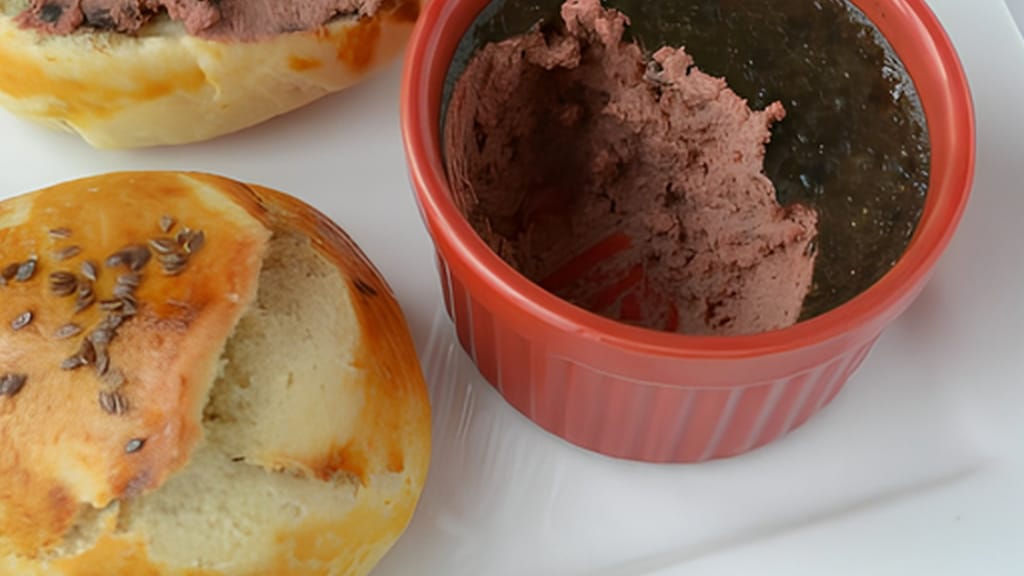
Homemade pâté with fresh rolls – everything from scratch
Smooth pork liver pâté with homemade bread
Homemade wild boar pâté is made just like the pork version, except that the wild boar meat is combined with pork fat or belly, because it's lean on its own. Game has a strong flavor and little internal fat, so without added fat the pâté would turn out dry and crumbly.
How to do it: take lean wild boar (shoulder or neck) and fatty pork belly or lard in a 1:1 ratio (for example 500 g wild boar to 500 g belly) and grind them together with about 250 g pork liver. Add salt and pepper and whatever goes well with game: juniper, allspice, thyme. Bake in a bacon-lined mold in a water bath like the other pâtés and let it rest in the fridge. Always cook wild boar meat through, just like the liver. Only use wild boar meat that has tested negative for trichinella (Trichinella) in a veterinary inspection – in the Czech Republic this is mandatory for every animal killed.
We don't have a separate game pâté recipe on Yumsto yet, so take this as an adaptation of the method, not a tested recipe.
Pâté is cooked through when it reaches at least 70°C (158°F) inside and holds that temperature for two minutes. The UK Food Standards Agency (FSA) explicitly recommends this combination for chicken liver pâté, because poultry liver can carry Campylobacter bacteria inside, not just on the surface. That's why a quick sear on the outside, as you'd do with a steak, isn't enough for liver.
How to check at home:
Push an instant-read thermometer into the geometric center of the mold, at the thickest point. The edge is misleading, as it heats first.
Color is not a reliable guide. Go by the thermometer, plus the rule that nothing inside may stay pink, bloody or raw-looking.
Any juice that runs out when you pierce it should be clear or yellowish, not red.
A smooth pâté must not ripple like liquid when you shake the mold.
In the same guidance, the FSA says it's better to freeze liver before preparing it, because freezing reduces the risk of Campylobacter, and it mentions a water bath and sous-vide as suitable methods. So the water bath that all our recipes use isn't just for texture.
Rillettes is a French meat spread made from meat slowly cooked in its own fat, then pulled apart with a fork and covered with lard. It has no liver, isn't blended, and has strands rather than chunks in it. On Yumsto we have it as lamb rillettes with lard and sage: 2 kg lamb breast, 250 g pork fat (lard), water, salt, pepper, garlic, red onion and sage.
Method: pat the lamb breast dry, cut it into cubes and brown it on all sides in melted lard in a heavy-bottomed pot. After three hours of slow cooking, add salt, pepper, garlic, onion in half-rings and a sprig of sage, and cook for another three to five hours. Then fish out the sage, bones and cartilage, scoop the meat out with a slotted spoon, pack it into dishes and pour the fat from the pot over it so it's completely covered. Put the dishes in the fridge within two hours of finishing cooking.
The layer of fat on top is more than decoration: it separates the meat from the air. The recipe advises freezing whatever you won't eat for up to three months, thawing it slowly in the fridge and then using it within three days. Serve the rillettes chilled but not ice-cold, on toasted bread with a pickle.
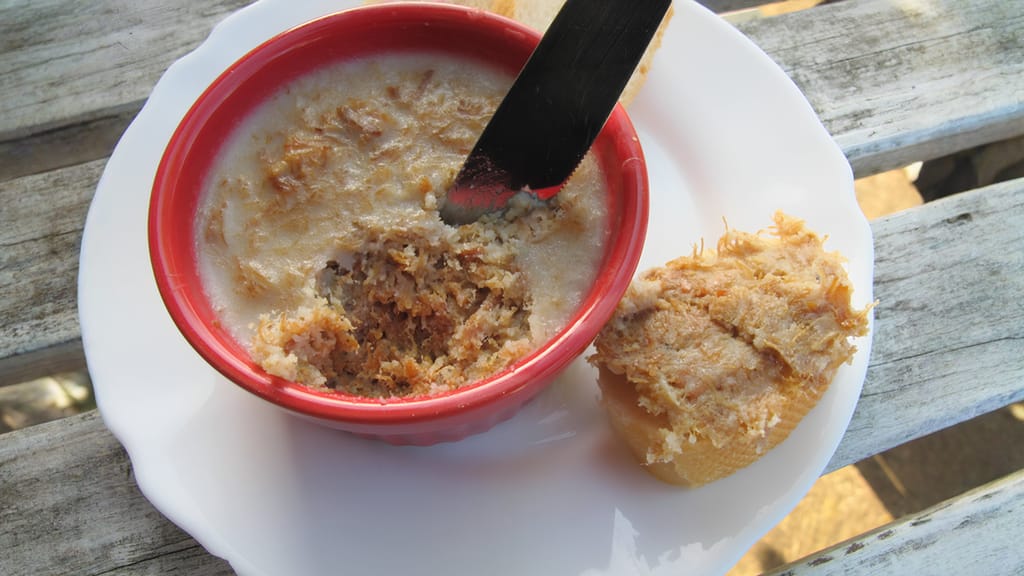
Lamb rillettes
Lamb rillettes, meat slowly cooked in lard with sage
Salmon farce (fáš) is a fine blended mixture of raw salmon, cream and egg white, poached in a water bath, so in a slice it looks like pâté, only lighter in color and on the tongue. Salmon farce with fresh spinach needs 300 g skinless salmon fillet, dill, salt, pepper, one egg white, 150 g whipping cream and 100 g spinach.
Method: cut up the chilled salmon, season it with dill, salt and pepper and blend until smooth. Pour in the cream, add the egg white and combine with just a few short pulses, because long blending would warm the mixture and the farce would turn grainy. Set stainless steel molds on plastic wrap, line them with spinach, fill them with the farce, cover with more leaves, wrap tightly and set on a steamer rack in a pot with water halfway up. Poach for about half an hour in water at around 80–85°C (175–185°F), which must not boil.
Everything here depends on cold. Cold fish and cold cream come together into a smooth emulsion, while a warm mixture curdles. And water that isn't boiling is the reason the farce stays velvety and doesn't release water. You can serve it still warm in slices, or chilled on a buffet with lemon slices, dill and perhaps caviar.
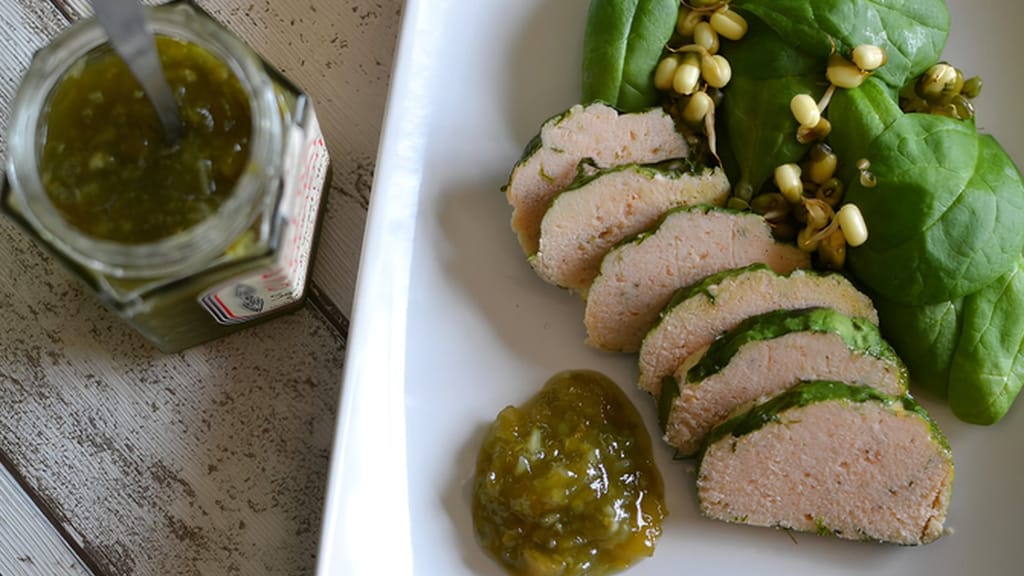
Salmon mousse with fresh spinach
Salmon farce with fresh spinach, poached in a water bath
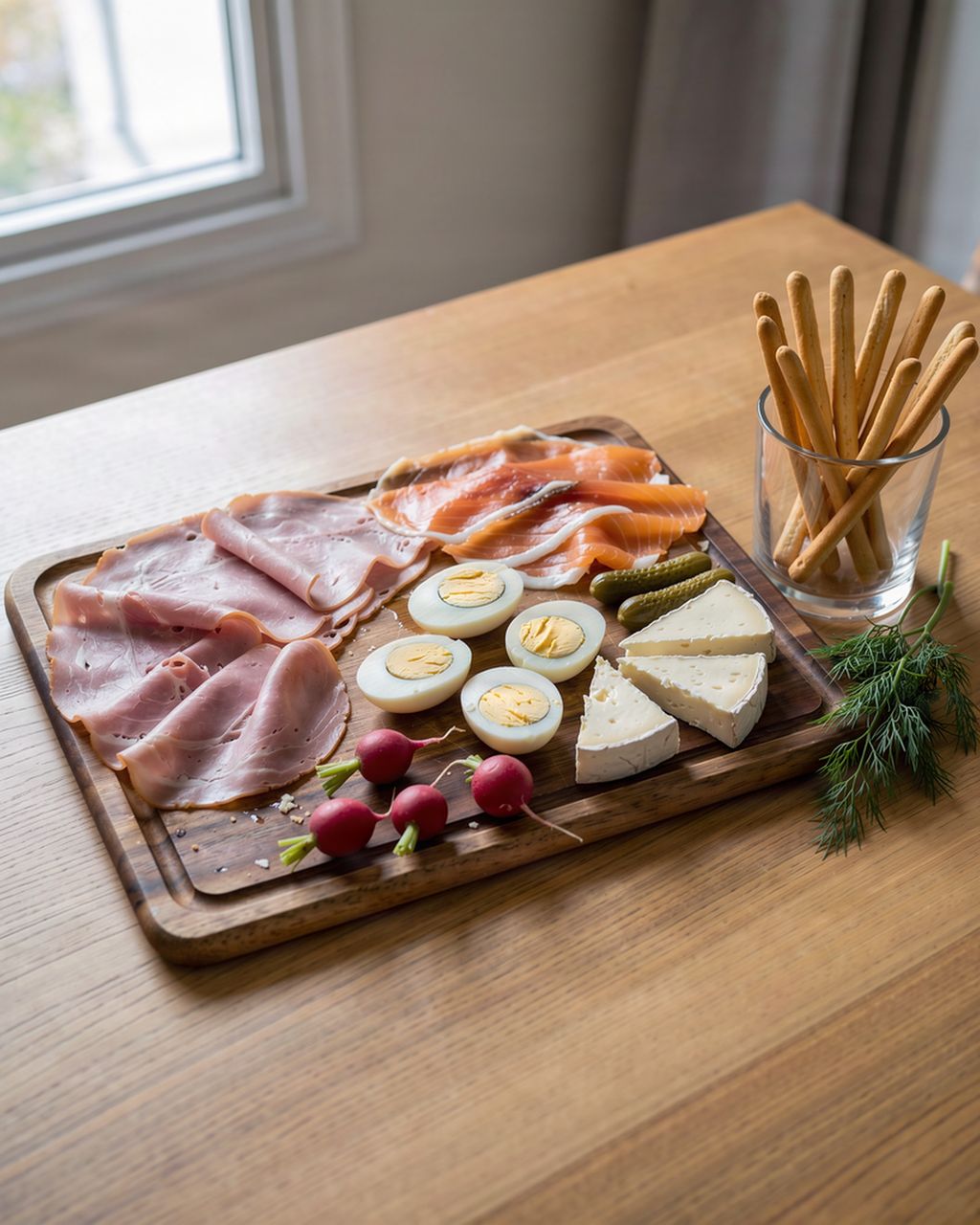
Serve homemade pâté chilled but not ice-cold, with crusty bread and something sour or sweet-and-sour to cut through the fat. The classic trio is fresh bread or a baguette, pickles and lingonberries.
Bread: toasted sourdough bread, a baguette, or the homemade rohlíky from the smooth pâté recipe.
Sour: pickled cucumbers, pearl onions, a dab of mustard.
Sweet: lingonberries, plum butter (povidla) or onion marmalade. Sweetness goes especially well with pork liver.
Chicken liver pâté with lingonberries can be made in two ways. Either you serve the lingonberries alongside as a sauce, or you stir a handful of dried lingonberries into the mixture before baking, just as prunes are stirred into roasted liver pâté. Chop the dried berries coarsely so they distribute evenly through the mixture, and don't cut back on the bacon or salt because of them.
Pâté is great for a holiday table, because you can make it two or three days ahead and on the day of the celebration you only have to slice it. You'll find how to fit it in among other cold dishes in the article New Year's Eve and party platter.
Keep homemade pâté well covered in the fridge and eat it within a few days; take that as a rule of thumb, not an exact deadline. It has no preservatives like store-bought pâté, and once you cut into it, the surface is exposed to air.
Cooling: leave the finished pâté on the counter for no more than two hours, then put it in the fridge. All the recipes above count on this.
Covering: cover it with plastic wrap right on the surface, or pour over a layer of melted lard or butter, as is done with rillettes.
Slicing: cut only as much as you'll eat and put the rest back in the cold right away.
Freezing: you can freeze pâté in portions. For the lamb rillettes, the recipe gives up to three months in the freezer, thawing in the fridge and using within three days; do the same with liver pâté.
Thaw pâté from the freezer slowly in the fridge overnight. The texture may change a little after thawing: a smooth pâté tends to be moister, while a coarse one holds up better.
You can't safely can pâté at home for long-term storage, either in a water bath or in the oven. Meat and liver are low-acid foods, and the US Department of Agriculture (USDA) and university extension services only recognize pressure canning in a pressure canner made for the purpose, because ordinary boiling doesn't destroy botulism spores. But there is no tested procedure for pâté or blended liver even in a pressure canner, since the dense mixture doesn't heat through properly in the middle of the jar. Treat pâté baked in jars as fresh: keep it in the fridge and freeze it for longer storage.
Bitterness in pâté is most often caused by leftover bile or strong-tasting pork liver. Before grinding, trim off the membranes, veins and above all every green spot from the gallbladder, along with the area around it. With pork liver, a sweet ingredient such as dried prunes or cranberries balances the bitter note.
Crumbling and leaking fat usually mean warm ingredients when grinding, too high a baking temperature, or slicing the pâté while it's still warm. Keep the meat and fat well chilled before grinding, bake in a water bath, and slice only after the pâté has cooled completely in the fridge, ideally the next day.
Chicken liver gives a more delicate, milder, lighter pâté, while pork liver gives a stronger, more heavily spiced one with a slightly bitter note. For a first attempt or for kids, reach for chicken liver. If you like a bold flavor, you'll appreciate pork liver with prunes or garlic.
Any baking dish that can handle a water bath will do: a ceramic baking dish with a lid, a terrine mold (the Czech forma na srnčí hřbet), small dishes or jars. Line the mold with bacon for a coarse pâté; a smooth pâté can be poured into a mold lined with plastic wrap. A shallower, wider dish or small dishes cook through faster than a tall mold, so always check the center with a thermometer.
One recipe worth heating the oven for, one tip, and one deal from the shop. Nothing else.