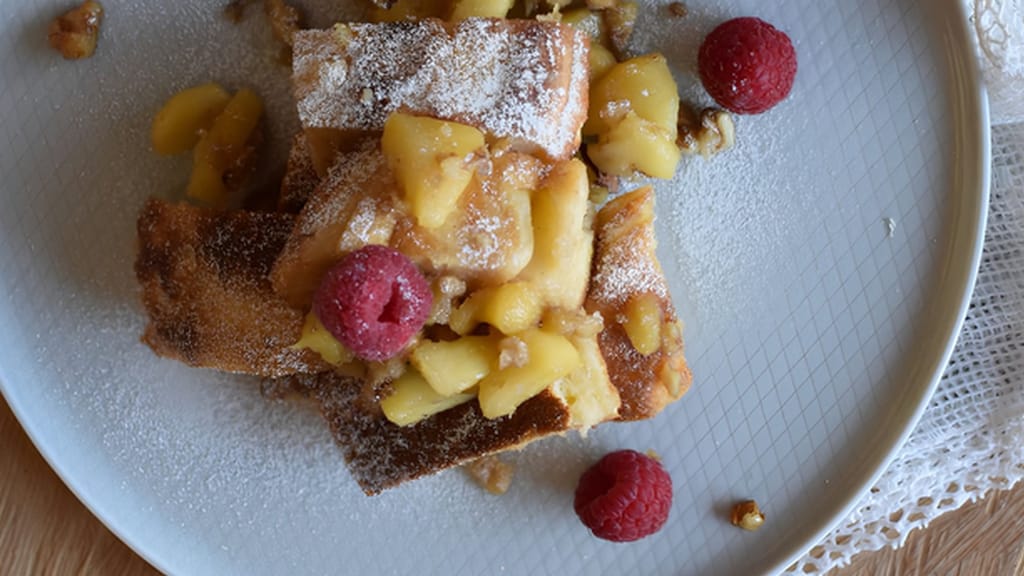
Kaiserschmarrn – emperor's shredded pancake
Austrian Food From the Alps: Kaiserschmarrn, Tafelspitz, Strudel and Sachertorte
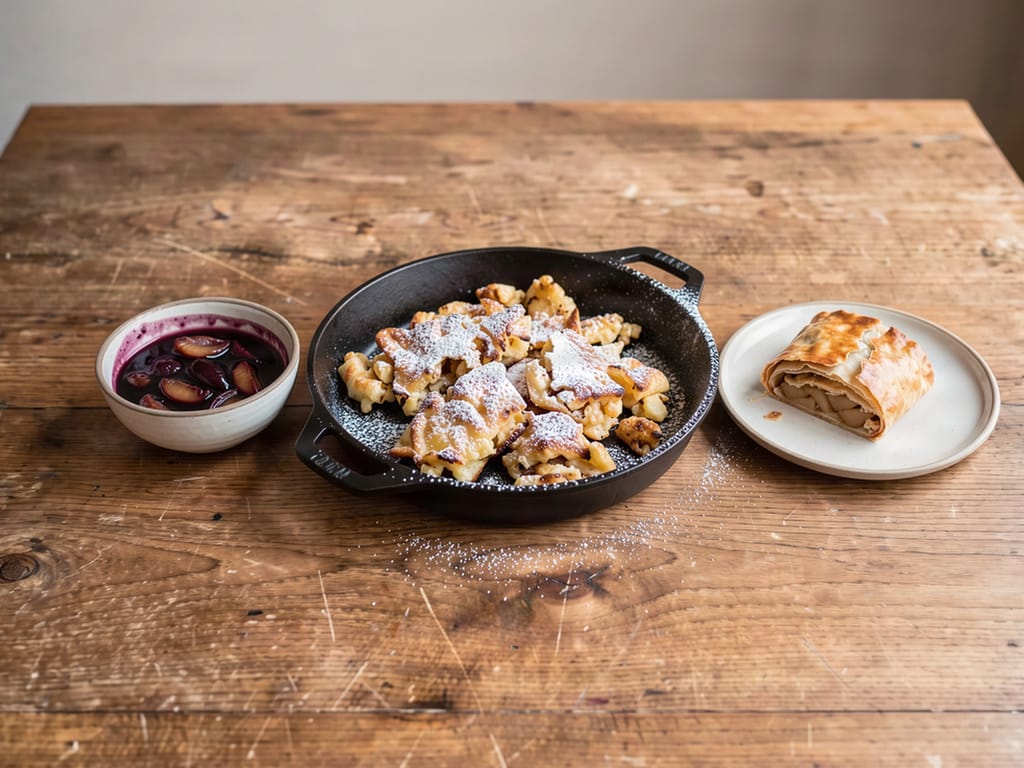
Updated Nov 24, 2026
Austrian food straight from the Alps means butter, eggs, orchard fruit and patience: fluffy kaiserschmarrn torn up in the pan, tafelspitz simmered gently for hours, strudel made with dough stretched paper-thin, and Sachertorte with its glossy glaze. You can make all of it at home. Here you get the method for each one, the tricks it all depends on, and a link to our tested recipe.
The typical Austrian dishes you can cook at home are kaiserschmarrn (the "emperor's pancake," torn into pieces), tafelspitz (boiled beef served with its broth), apple strudel, Sachertorte and linecké (Czech Linzer-style jam cookies). They share an Alpine and Viennese tradition: plenty of butter and eggs, apples and plums, and time you don't want to cut short.
Kaiserschmarrn: a thick, fluffy pancake torn up in the pan, a sweet lunch or a dessert.
Tafelspitz: beef simmered gently for hours, with the broth served first as a soup and then the meat.
Apple strudel: apples rolled up in dough stretched almost until it's see-through.
Sachertorte: a chocolate cake, an apricot layer and a hard, glossy glaze.
Linzer cookies: crumbly butter dough sandwiched with currant jam.
Traditional Austrian dishes have a lot in common with Czech cooking, because for centuries both countries cooked under one crown. Strudel, boiled beef and dumplings will be familiar from your grandmother's kitchen. The difference lies in the details: Austrians serve the broth as a separate course, make more of the sides that go with the meat, and think nothing of a sweet dish for lunch.
One rule applies to all of these dishes: don't rush. Tafelspitz simmers for hours, strudel dough rests overnight, Sachertorte cools until the next day and Linzer cookies mellow for three days. Only kaiserschmarrn is quick, and even that needs a gentle flame.
Recipe of the week, one tip that saves you time and one deal from the shop. Unsubscribe in one click.
The next issue goes out on Thursday, November 26.
The dishes most often considered Austria's national dishes are Wiener schnitzel, tafelspitz, Sachertorte, apple strudel and kaiserschmarrn. There is no official list, but the Austrian Ministry of Agriculture includes both kaiserschmarrn and Sachertorte in its register of traditional foods.
In Austria, Wiener schnitzel is made from veal; when it is made from pork, the name has to say so, for example Wiener Schnitzel vom Schwein or Schnitzel Wiener Art. The breading puffs up into waves and pulls away from the meat because the schnitzel swims in hot fat that also washes over the top. It is served with a lemon wedge and potato salad.
We go through the rest of the national five one by one below, because each dish depends on a different trick: kaiserschmarrn on pan temperature, tafelspitz on a gentle simmer, strudel on rested dough and Sachertorte on patient cooling.
Kaiserschmarrn (Czech: císařský trhanec) is a fluffy egg pancake that you brown on both sides in a pan and then tear into uneven pieces. It is served dusted with powdered sugar, with plum röster or applesauce. In Austria it is a sweet lunch as well as a dessert after a hike.
In Bavarian-Austrian dialects, the word Schmarrn means something worthless, nonsense, and also a dish made from torn-up batter. Several legends explain the emperor in the name, mostly involving Franz Joseph I: a cook supposedly ruined his pancake, tore it up and rescued it with plums. The Austrian newspaper Der Standard points out, however, that the dish appears in a text from a time when Franz Joseph wasn't yet emperor, so the legend is probably false. Historians consider that Kaiser may come from the word Kaser (an alpine dairyman), or simply means the best, just as Kaiserwetter means perfect weather.
It differs from a pancake in three ways. It is much thicker, about like a griddle cake spread across the whole pan. It is fluffy, because the batter is leavened. And thanks to the tearing it has lots of edges that crisp up and soak up the butter, sugar and fruit.
Kaiserschmarrn is pronounced roughly "KY-zer-shmarn," with the stress on the first syllable. Read "ei" as "eye" and "sch" as "sh"; Austrians pronounce the "s" between vowels as a "z" sound. In speech, the final "rrn" is almost swallowed. In Austria it is also spelled Kaiserschmarren, and both forms are correct.
You can make kaiserschmarrn in under 40 minutes from milk, eggs, flour and sugar; our recipe Kaiserschmarrn – císařský trhanec (Emperor's Pancake) takes 37 minutes and serves 4. The batter is made from 250 g whole milk, 4 eggs, 50 g granulated sugar and 100 g all-purpose (plain) flour, flavored with a pinch of salt and dried lemon zest. Finally you whisk in baking powder so the pancake rises evenly high across the whole surface.
Whisk the milk with the eggs, add the sugar, flour, salt and lemon zest and stir until the last lump disappears. Then stir in the baking powder.
Heat clarified butter in a large pan and pour in all the batter.
Turn the heat down to medium and let the bottom slowly turn golden while the top sets. Divide the large pancake in half with a spatula and flip it in sections.
Tear the pancake up with two wooden spoons right in the pan, or cut it on a board. Uneven edges soak up more.
Meanwhile, sauté three peeled, chopped apples in butter, add 20 g coarsely chopped walnuts, sprinkle with granulated sugar and let the sugar caramelize lightly over the highest heat.
Add a second portion of butter and 15 ml rum, turn off the heat and coat the torn pancake in the apples.
Dust with powdered sugar and cinnamon, if you like.
The pan must not be at full heat. Over a high flame the bottom browns before the thick layer of batter inside has set, and the center stays raw and gooey. Many Austrian methods whip the egg whites separately and fold them in at the end; our recipe relies on baking powder instead, so nothing collapses and you don't have to whip. Soak the raisins in rum beforehand, as the recipe says, and scatter them over the surface about a minute after pouring in the batter so they don't sink to the bottom.
If you don't have fresh apples, a handful of peeled dried apples will do. Chop them finely, let them soak in rum or warm water for half an hour and then sauté them in butter just like fresh ones. They will be chewier and sweeter, so use less sugar.
Kaiserschmarrn – emperor's shredded pancake
Kaiserschmarrn – Emperor's Pancake with Caramelized Apples, Walnuts and Rum
Kaiserschmarrn with applesauce is the simplest Austrian variation: warm torn pancake with cold, smooth sauce made from tart apples alongside. The contrast of warm and cold is the whole point, so don't serve the sauce hot.
In our recipe the apples are sautéed with the walnuts and caramel right in the pancake, and the applesauce would be a separate side. Both work: the sauce is fresher and less filling, while the caramelized apples are richer and more dessert-like.
Zwetschkenröster is an Austrian plum röster: plums stewed with sugar and spices just long enough to soften, while the halves still hold their shape. It is thicker than compote and less sweet than jam, and because it is tarter than apples, it goes best with buttery kaiserschmarrn.
In Vienna, kaiserschmarrn is served in cafés and in traditional taverns, which are called Beisl there, often as a sweet main course rather than just a dessert. The portion tends to be big, quite often right in the small pan in which the pancake was finished. The most common accompaniment is plum röster, followed closely by applesauce.
The Viennese style tends to be finer and taller, with egg whites whipped separately and raisins soaked in rum. The mountain-hut version is more rustic, more browned and buttery. If you want a Viennese feel at home, tear the pieces smaller, dust them with more sugar and serve the röster separately in a bowl, so everyone can help themselves.
Tafelspitz is a cut of beef simmered gently for hours with vegetables and bones; first the broth is served as a soup, then slices of meat with sides. The name belongs to the cut itself, the tip of the rump. Choose beef rump, in Czechia most often the květová špička (flower tip), which stays juicy even after long cooking and slices into nice pieces.
Our recipe Tafelspitz with Broth, Vegetables and Potato Pancakes is built on 1 kg of květová špička and eight marrow bones. Don't rinse the meat, just pat it dry. First roast the bones in a 200°C (390°F) oven for about 15 minutes until golden, brown the broth vegetables in butter, and place the onion, halved with its skin on, cut side down in a pan and brown it almost until dark. The skin and the browned surfaces color the broth golden brown. Cover the raw meat, bones and vegetables with cold water, and add salt, pepper, allspice and a bay leaf.
Now comes the most important part. A 1 kg piece simmers for roughly 2.5 to 3 hours; test it for tenderness with a fork from the second hour on. Make sure the broth only bubbles lightly and doesn't boil. A hard boil dries out the meat and clouds the broth. The fork should slip into the meat, and as soon as it does, take the meat out. Strain the broth through a fine sieve and serve it as a soup with noodles and finely sliced beef.
With the meat, the recipe adds celery, carrot and leek cut into slices and only briefly sautéed in butter, so they stay crisp to the bite. And potato pancakes: you grate half the potatoes finely and half coarsely. The fine part holds the pancakes together, the coarse part gives them crispness, and coarsely grated apples are added too. Scoop the marrow out of the cooked bones with a spoon and spread it on the warm pancakes as a starter.
In Vienna, according to its tourist board, tafelspitz is served with, among other things, apple horseradish, root vegetables and fried potatoes. Apple horseradish is a finely grated tart apple mixed with fresh horseradish. Fried potatoes are boiled potatoes cut into slices and browned golden in a pan with onion. Slice the meat across the grain and pour a spoonful of hot broth over it on the plate so it doesn't dry out.
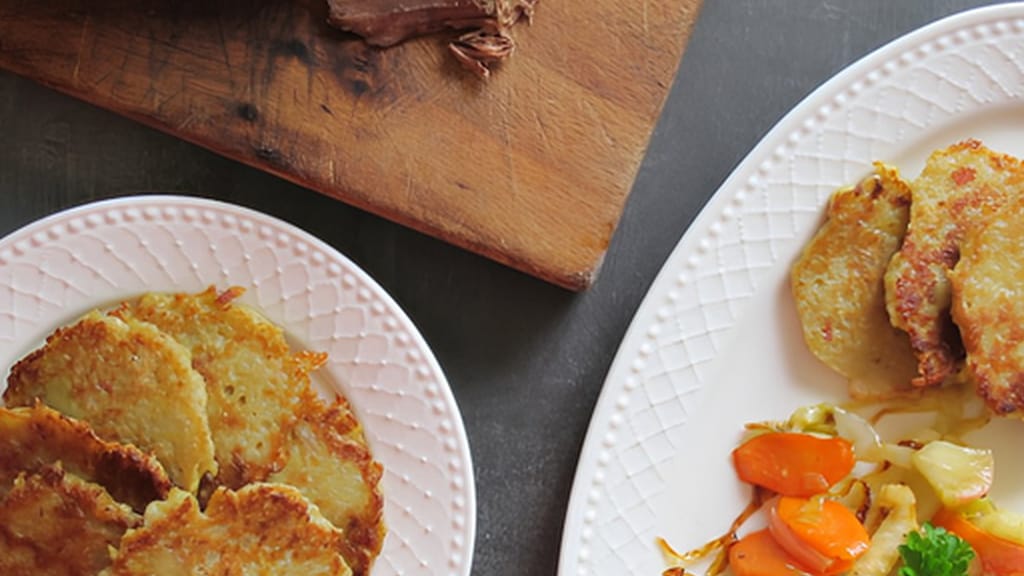
Tafelspitz with broth, vegetables and potato pancakes
Tafelspitz with Marrow Bone Broth, Sautéed Vegetables and Potato-Apple Pancakes
You can make apple strudel in two ways: with homemade stretched dough, which is thin and delicate but needs a night's rest, or with puff pastry in three quarters of an hour. Classic Viennese strudel is the stretched kind.
The recipe Apple Strudel with Homemade Stretched Dough starts with 150 g all-purpose flour and a pinch of salt, lukewarm water, oil, a drop of white wine vinegar and cooled melted butter. You work it into a smooth, slightly sticky dough, drizzle it with oil, cover it with plastic wrap and leave it in the fridge, ideally overnight. The rest is key: the dough relaxes and can then be stretched without tearing or shrinking back. The next day, let it relax for 30 minutes, roll it out a little on a generously floured kitchen towel, and then stretch it with the backs of your hands from the center outward until it is almost translucent.
The filling is coarsely grated apples with sugar, cinnamon, raisins, walnuts and lemon juice. Drizzle the stretched dough with melted butter, scatter ladyfinger crumbs over one third, and spread the well-squeezed apples on top. The ladyfingers soak up the juice, so the bottom doesn't turn soggy. Using the towel, roll up the strudel, brush the loose edge with butter, flip it seam side down onto a greased baking sheet, brush it all over with butter and bake at 180°C (350°F) for about 30 minutes until golden.
We go through it step by step, including how to tell the dough is stretched enough and what to do if it tears, in our guide to homemade apple strudel.
If you don't have time to stretch dough, reach for a quick apple strudel (závin) with puff pastry: you wrap apples set on breadcrumbs in puff pastry, and it's done in 44 minutes.
Tarter apples suit strudel best, because they hold their shape when baked and balance the sugar. Which varieties to choose is covered in our article on apple varieties for strudel and apple butter.
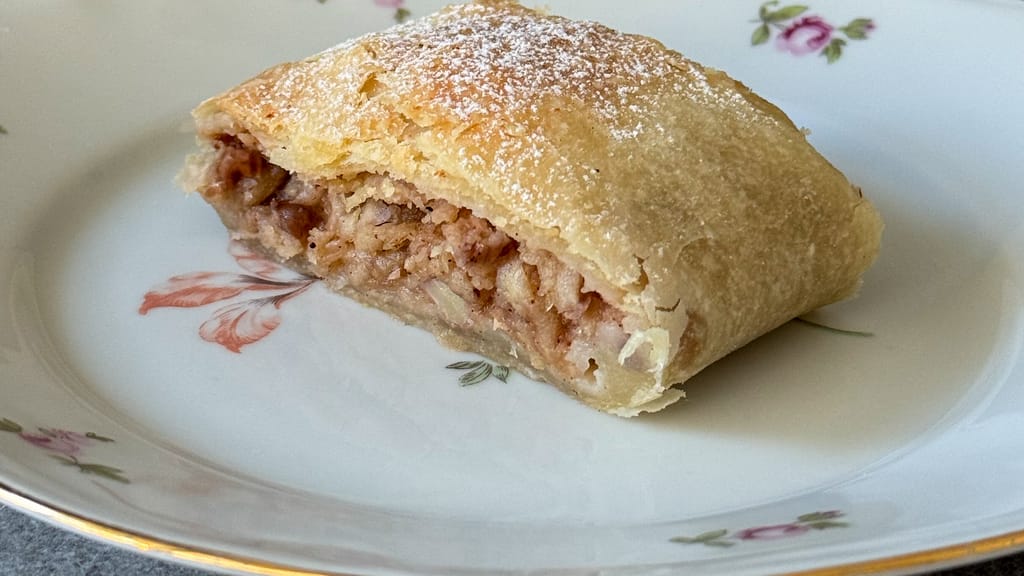
Apple strudel with homemade stretched pastry
Apple Strudel from Homemade Stretched Dough with Apples, Walnuts and Raisins
Sachertorte is a dense chocolate cake, sliced through, spread with apricot jam and covered with a hard, glossy chocolate glaze. According to the Austrian Ministry of Agriculture, its basic form was invented in 1832 by sixteen-year-old Franz Sacher, an apprentice in Prince Metternich's kitchen. The date, however, rests mainly on the later account of his son Eduard.
Our Sachertorte – Viennese Chocolate Specialty calls for 300 g dark chocolate (85 %), 150 g butter, 6 eggs, granulated sugar for the batter and the glaze, 130 g semi-coarse flour (Czech polohrubá, slightly grittier than all-purpose), 350 g apricot jam and rum. Melt the chocolate with the butter in a water bath until smooth and glossy. Beat the yolks with sugar until pale and foamy, whip the whites to stiff peaks that don't move when you tilt the bowl, and fold them into the chocolate mixture alternately with the flour, in about three additions, with a spatula from the bottom up.
Grease a 26 cm pan, dust the sides with flour and line the bottom with paper. Heat the oven to 200°C (390°F) and put a wooden spoon between the oven door and the oven so a gap remains: some of the heat escapes, the cake rises gradually and doesn't dome in the middle. After twenty minutes turn it down to 180°C (350°F) and bake for another 15 to 30 minutes, depending on your oven. Turn the cake out upside down so the top is flat for the glaze, and let it cool for at least 8 hours, ideally until the next day.
Cook the apricot jam with rum until it thickens a little; thick jam spreads well and doesn't soak entirely into the cake. Slice the cake horizontally once or twice and spread the layers, the top and the sides. The glaze is a sugar syrup cooked to 110°C (230°F), into which you briskly stir broken-up chocolate until smooth and glossy. Slice the set cake with a knife you dip into hot water before each cut, so the glaze doesn't crack.
Chocolate with 85 % cocoa gives a distinctly bitter, grown-up cake. If that's too much for you, use 70 % dark chocolate for the glaze: it will be sweeter and rounder. Expect it to set a bit softer, so leave it in the cold longer. We go deeper into the cake, the apricot layer and the glaze in our article on Sachertorte: the cake, apricot layer and glaze.
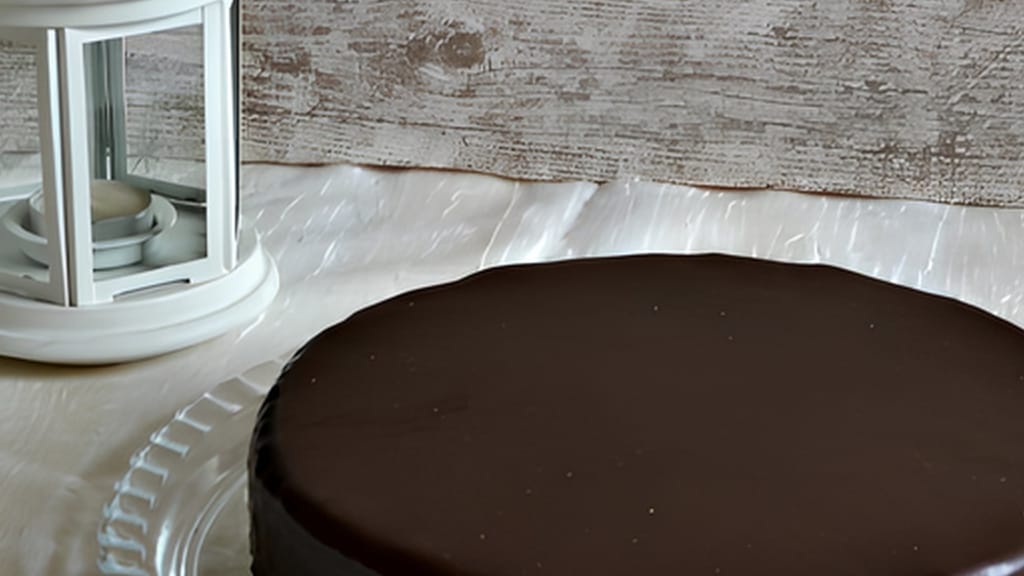
Sacher torte – the classic viennese chocolate cake
Sachertorte with an Apricot Layer and a Glaze Made from Sugar Syrup and Dark Chocolate
Linecké (Czech Linzer-style jam cookies) are named after Linz in Upper Austria. They are crumbly butter dough sandwiched with tart jam, and in Czechia they belong to Christmas. Potato starch in the flour makes them tender, along with handling the dough as little as possible so it doesn't turn tough. Chill the cut-out shapes in the freezer before baking so they don't spread, and let the sandwiched cookies mellow in a tin for at least three days. You'll find the whole method in the recipe Classic Linzer Cookies with Currant Jam.

Classic linzer cookies with redcurrant jam
Classic Linzer Cookies Made from Crumbly Butter Dough with Currant Jam
Most failed Austrian dishes come down to rushing or too high a temperature. These are the mistakes that repeat most often:
Kaiserschmarrn over full heat: the bottom is burnt and the center raw. Keep the heat at medium and flip in sections.
Tafelspitz at a boil: if the broth bubbles hard, the meat tightens and the broth turns cloudy. It should barely tremble.
Unrested stretched dough: without a night in the fridge it shrinks back and tears. Give it time and let it relax before stretching.
Wet apples in strudel: filling that isn't squeezed out soaks the dough. Squeeze the apples and put ladyfinger crumbs or breadcrumbs underneath.
Warm Sachertorte under the glaze: on a warm cake the glaze runs off and the jam soaks in. Let the cake cool overnight.
Linzer cookies from warm dough: the shapes spread. Chill the cut-out pieces in the freezer before baking.
The common denominator is simple: in Austrian cooking, time isn't a loss, it's an ingredient.
The best way to put together an Austrian lunch at home is in three courses: tafelspitz broth with noodles, slices of meat with vegetables, pancakes and apple horseradish, and finally strudel or a small portion of kaiserschmarrn. It goes without stress if you spread out the work.
Three days ahead: bake the Linzer cookies, they need time to mellow.
The day before: bake the Sachertorte cake, which has to cool overnight, and make the strudel dough.
In the morning: start the tafelspitz, which simmers for about three hours. In the meantime glaze the Sachertorte and stretch the strudel.
An hour before lunch: bake the strudel and grate the apple horseradish.
Just before serving: fry the pancakes and sauté the vegetables.
Kaiserschmarrn after the main course: it's done in 37 minutes and tastes best fresh from the pan.
If you enjoy cooking other countries' cuisines at home, take a look at French food at home or Mexican food at home too.
Kaiserschmarrn tastes best straight from the pan, because the torn edges soften quickly. You can, however, mix the batter without baking powder ahead of time and keep it in the fridge. Stir in the baking powder just before frying so the pancake puffs up. Feel free to prepare the apples or plum röster a day ahead and simply reheat them.
The rum in kaiserschmarrn and in the apricot layer of Sachertorte is there only for flavor, so you can leave it out or replace it with a spoonful of apple or orange juice. Soak the raisins in warm tea or water instead. Cook the apricot jam without rum too, just a little longer so it thickens.
Apple strudel belongs to both Austrian and Czech cooking, because the two countries shared a common kitchen for centuries under the Habsburgs. In Austria it is one of the culinary symbols of Vienna, and in Czechia you know it as jablečný závin. The stretched dough and the apple filling are made practically the same way in both countries.
Store Sachertorte covered in a cool room or pantry, so the glaze doesn't get scratched and the cake doesn't dry out. Because it has no whipped cream or cream filling, it tolerates cool temperatures better than cream cakes. In the fridge the glaze can turn dull, so only put it there if you don't have a cooler spot.
You can make tafelspitz without marrow bones, but the broth will be lighter and less full-bodied. Any beef bone roasted in the oven until golden works just as well as a marrow bone. You will miss out on the marrow, though, which the recipe spreads on the potato pancakes as a starter.