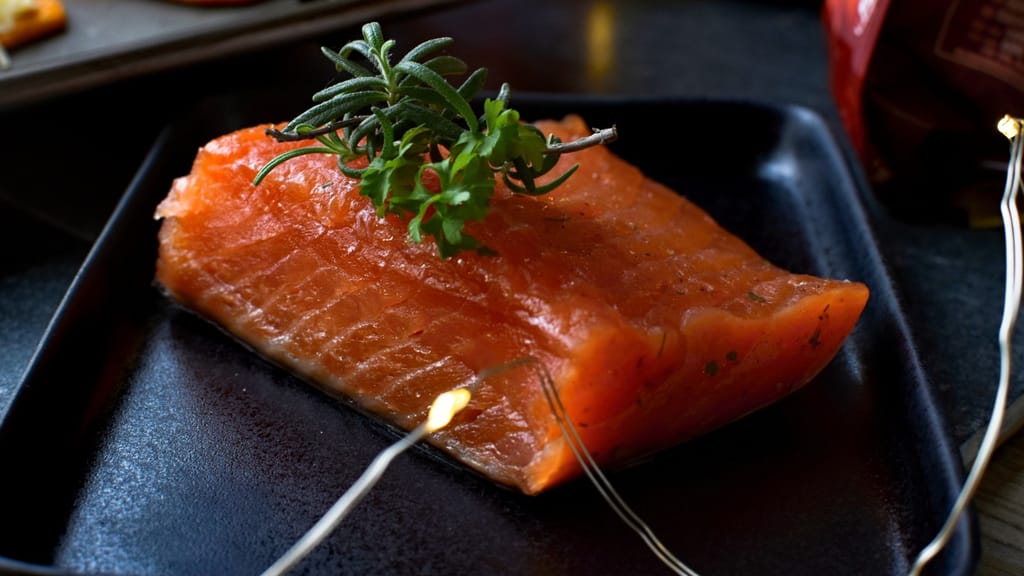
Gravlax
Swedish Food at Home: Gravlax, Cinnamon Buns, Pepparkakor and Almond Cake (Plus Lucia Day on December 13)
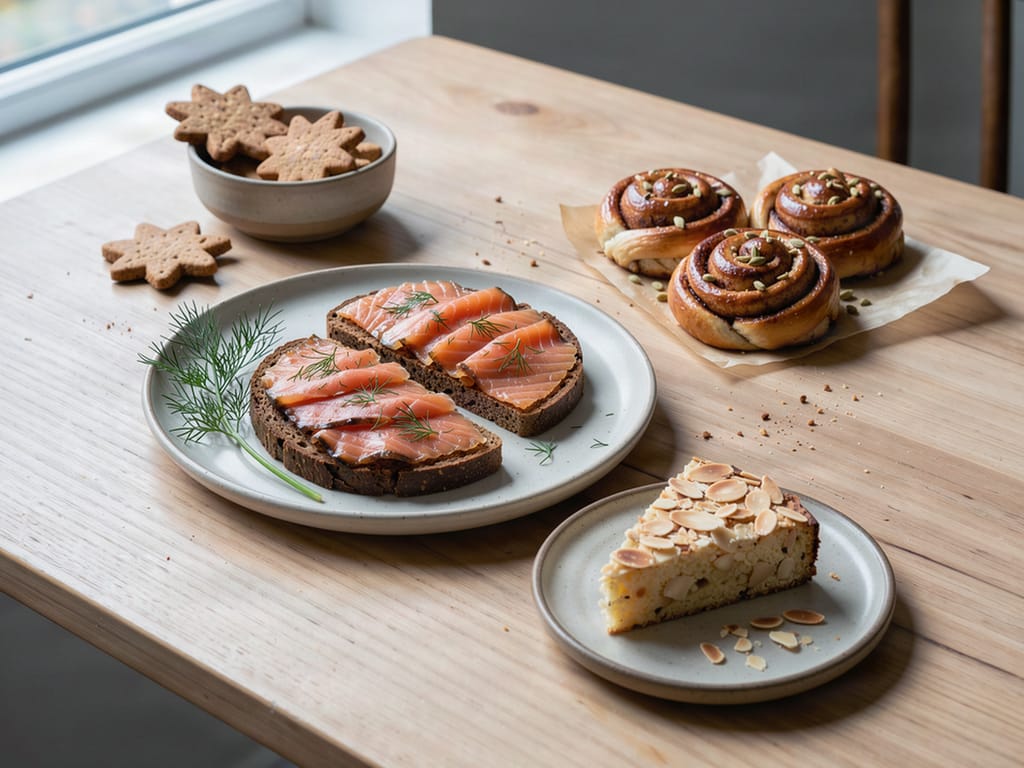
Updated Nov 24, 2026
The Swedish dishes you can make at home without a trip to Stockholm rest on a few simple principles: salt and sugar instead of long cooking, dill with fish, cardamom and cinnamon in yeast dough, and almonds in cakes. Here you'll find gravlax, cinnamon buns, pepparkakor, almond cake and what to bake for St. Lucia's Day on December 13.
The best Swedish dishes to make at home are gravlax (raw salmon cured in salt, sugar and dill), kanelbullar or cinnamon buns with cardamom, pepparkakor (thin spiced gingerbread cookies), köttbullar (meatballs with lingonberries), saffron lussekatter for St. Lucia's Day, and a flourless almond cake. You can manage all of it in an ordinary kitchen, with no exotic ingredients.
Swedish cooking is the cooking of long winters. What couldn't be harvested fresh had to be pickled, salted, dried or baked to keep. That's why you find so much fish cured with salt and sugar, so many spiced yeast bakes and so many things made a day or two ahead. For you at home, that's an advantage: most of the classics don't want you standing at the stove, they just want time in the fridge.
A quick overview by how much time you have:
Two days ahead: gravlax, which you simply cure and leave to work in the fridge for 48 hours.
One day ahead: pepparkakor dough, which has to rest overnight.
One afternoon: cinnamon buns, about two and a half hours from mixing to baking.
Under an hour: kladdkaka, a sticky chocolate cake that bakes for only 15–20 minutes.
For the weekend: almond cake with buttercream and praline, which needs more time because the cream has to chill.
Recipe of the week, one tip that saves you time and one deal from the shop. Unsubscribe in one click.
The next issue goes out on Thursday, November 26.
Three typical Swedish dishes are known even to people who have never been to Sweden: gravlax, kanelbullar and köttbullar. Fish, yeast bakes and ground meat. Each shows a different side of Nordic cooking, and each has one trick it depends on.
Gravlax is raw salmon that salt and sugar "cook" cold over 48 hours in the fridge: they draw water out of the flesh, firm it up and give it a velvety, slightly translucent texture. The name, from Swedish and Norwegian (grav = grave, pit; lax = salmon), means roughly "buried salmon." According to food historians, medieval fishermen lightly salted salmon and buried it in the ground until they came back for it. Today a plate and plastic wrap replace the pit.
Gravlax made with salmon, salt, sugar and dill needs just five ingredients: Atlantic salmon, skin-on fillet, salt, granulated sugar, black pepper and dill. The ratio it relies on:
500 g skin-on, boneless fillet
200 ml salt and 150 ml granulated sugar, so salt to sugar is roughly 4:3 by volume
10 g black pepper and 100 ml coarsely chopped dill
48 hours in the fridge, turning about 4 times
There's deliberately a lot of cure: the fish should disappear under an unbroken layer. Whatever it doesn't absorb, you scrape off at the end.
Why it works: sugar softens the sharpness of the salt, and together they draw out water, so the flesh firms up and can be sliced into translucent slices. You'll know it's ready when the salmon is firm when cut and deep orange all the way to the center, not mushy.
The most common gravlax mistakes:
A piece of fish that's too thin. The tail end cures faster than the back, so while the back is just right, the tail is as salty as an anchovy. Choose a thicker, even piece from the middle of the fillet.
Too little cure. The fish then cures only in patches.
Rinsing. Water makes the fish soggy and washes away the flavor that salt and dill spent two days putting into it. Just scrape off the cure and wipe off any leftovers with a paper towel.
A dull knife. Gravlax is sliced on the diagonal, as thin as possible, and a dull blade tears the slices. It helps to put the salmon in the freezer for 15 minutes before slicing to firm it up.
In Sweden, gravlax is served with dark rye bread or crisp knäckebröd, boiled potatoes with dill and a mustard sauce. You can vary the flavor: add grated lemon zest or crushed juniper berries to the cure.
Gravlax
Gravlax: Salmon Cured in Salt, Sugar and Dill
Gravad lax is the same thing as gravlax under its fuller name, and in Sweden it's almost always served with a sweet mustard and dill sauce. The recipe for marinated salmon gravad lax with mustard sauce cures the salmon similarly, only with a salt to sugar ratio of roughly 1:1 by weight (205 g salt and 210 g sugar per 500 g fillet) plus pepper, for 48 hours in the fridge. Then it adds the sauce that makes it worth the effort.
Why the sauce works: Krems mustard and egg yolk hold the olive oil in an emulsion, vinegar and sugar give a sweet-sour base, and dill ties it to the fish. Krems mustard is milder and sweeter than Dijon, so the sauce doesn't overpower the salmon.
What to watch out for:
The yolk in the sauce is raw, so make it fresh and with eggs you trust.
If the sauce starts to thin while you whisk, stop pouring in the oil and keep whisking for a while until it comes together again.
An extra day or two in the fridge won't hurt the salmon; it will just be firmer and saltier. Keep that in mind if you're preparing it well ahead.
The difference between the two recipes is mainly in what you end up serving: gravlax is plain salmon with dill for bread, while gravad lax is a finished starter with a sauce. Leftovers are great for salmon canapés or for a New Year's Eve platter.
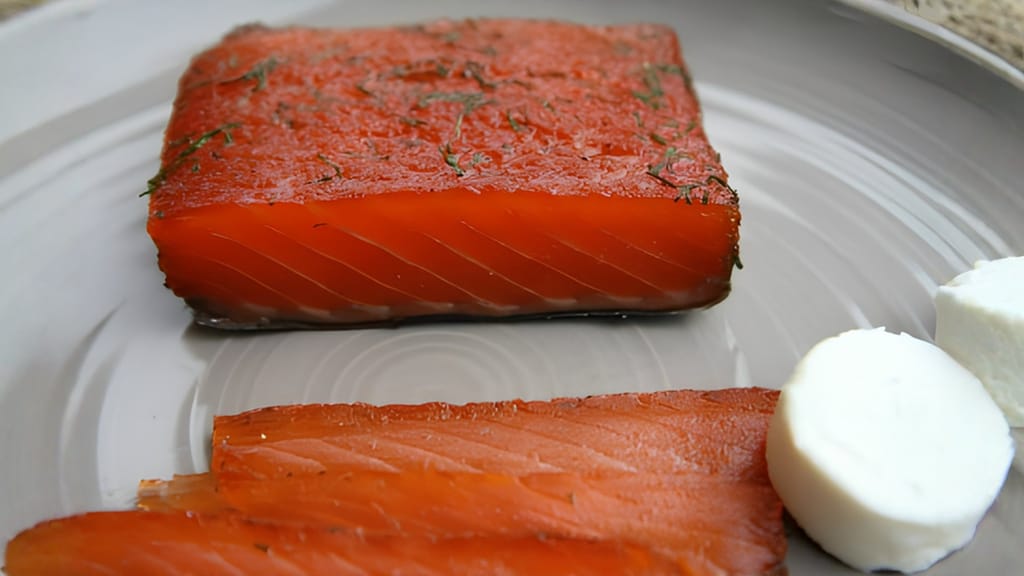
Marinated salmon – gravad lax
Gravad Lax: Marinated Salmon with Mustard Sauce
Kanelbullar are Swedish cinnamon buns made from yeast dough flavored with cardamom, and they differ from American cinnamon rolls precisely in that spice and in being less sweet. Sweden even has a day for them: Kanelbullens dag falls on October 4. According to Swedish sources, it was thought up in 1999 by the Swedish Home Baking Council (Hembakningsrådet) for its 40th anniversary.
Swedish cinnamon buns with cardamom take about two and a half hours, most of it spent waiting for the dough to rise. The cardamom in the dough gives the buns a fragrance you recognize from the first bite, the filling of butter, brown sugar and ground cinnamon caramelizes slightly on the bottom in the oven, and a shiny glaze of butter and maple syrup keeps them soft.
Four mistakes that sink the buns:
Hot milk. The milk should be only lukewarm; hot milk would scald the yeast and the dough wouldn't rise.
Pressing on the knife. If you squash the roll while slicing, you get flat buns with no spiral.
A thin filling. Let it thicken a little, or it squeezes out as you roll and burns on the tray.
Not watching the color. If the surface darkens before the buns are baked through, cover them with parchment paper.
In Sweden the buns are often sprinkled with pearl sugar; this recipe relies instead on a shiny syrup glaze. They're best still lukewarm. If any are left over, warm them in the oven for a few minutes the next day; the butter in the dough melts again and brings back their softness.
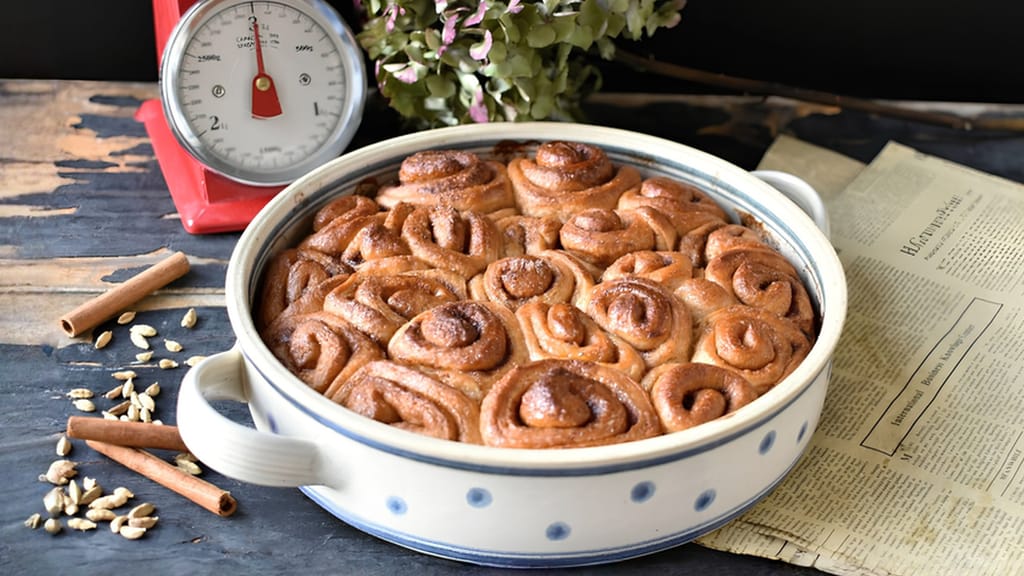
Swedish cinnamon buns
Swedish Cinnamon Buns with Cardamom
Köttbullar are small meatballs made from ground meat, served with a cream sauce, lingonberry compote and mashed potatoes. We don't have a recipe for them on Yumsto yet, so here's at least the principle: add finely grated onion, an egg and breadcrumbs soaked in milk to ground beef and ground pork, season with salt and pepper, and roll balls smaller than a walnut. Brown them all over in butter, deglaze the pan with stock and whipping cream, and simmer briefly into a smooth sauce. The meatballs are done when they reach 71 °C (160 °F) inside. Lingonberries add the tartness that holds the whole dish together. If you like meatballs in different forms, take a look at meatballs in tomato sauce, in the oven and with cheese.
Swedish cooking is built on fish, potatoes, rye and yeast bakes, wild berries, cardamom, cinnamon and almonds. Sweets have a special place in it thanks to fika, the daily break for coffee and something to go with it, which is why more baking happens in Sweden than you'd expect.
Fika isn't just a snack, it's a habit of stopping, sitting down and having coffee with something sweet, at home and at work. That's why Swedish cooking has such a rich repertoire of small bakes: buns, gingerbread cookies, cookies, sheet cakes and cakes that can be cut into small pieces. The savory side, by contrast, is restrained and practical. Potatoes are the base of almost every hot meal, fish is cured in salt, vinegar or mustard, and meat is served with lingonberries, which elsewhere in Europe belong more in desserts.
If you want to get to know Swedish cooking by taste, look out for the pairings that repeat again and again:
Salmon and dill: from gravlax to mustard sauce.
Cardamom and butter: in buns and in almost every yeast dough.
Cinnamon and brown sugar: fillings, toppings, glazes.
Almonds and sugar: cakes, praline, marzipan.
Meat and lingonberries: a sweet-sour accompaniment to hearty dishes.
Swedish almond cake is a flourless cake: the layers are made only from whipped egg whites, sugar and ground almonds, filled with an egg-yolk buttercream and sprinkled with almond praline. Swedish almond cake with praline and buttercream takes around six hours, but most of that is the cream chilling and the cake setting in the fridge.
Why it works: stiff, glossy meringue carries the almonds in place of flour, so the layers are light, moist and smell of nuts. The rich yolk cream holds them together, and the crunchy praline adds a contrast without which the cake would just be soft.
What to watch out for:
Yolks in hot cream. Stir them in quickly and away from direct heat, or they'll curdle into lumps.
Cooling the cream. Leave it at room temperature for two hours at most, as the recipe advises, then it belongs in the fridge.
Warm cream into butter. Beat it in only when it's completely cold and in portions; warm cream would melt the butter.
Cold butter. It must be softened, or it won't whip up pale and the cream will be lumpy.
Stirring the caramel. The sugar would crystallize; just swirl the pot now and then.
A warm cake layer. It breaks; once cooled, it can be cut into two thin layers with a long knife.
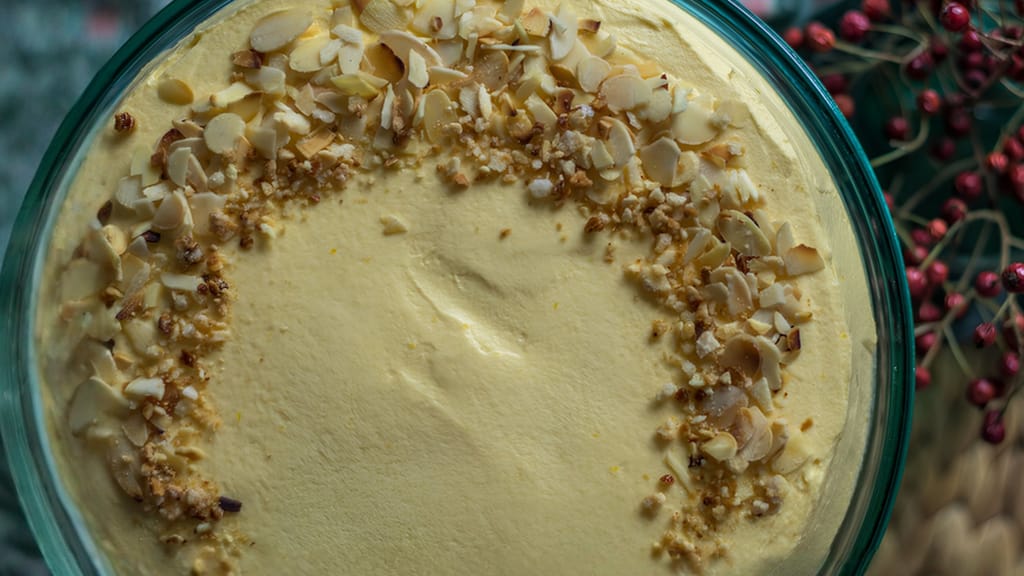
Swedish almond cake
Swedish Almond Cake with Praline and Buttercream
Kladdkaka is a Swedish chocolate cake that is deliberately underbaked so it stays sticky in the middle. We don't have a recipe for it on Yumsto yet, so here's just the principle: mix melted butter with sugar, eggs, cocoa and a small amount of flour, with no baking powder. Pour into a 20–22 cm (8–9 in) pan and bake at about 175 °C (350 °F) for 15–20 minutes, until the edges set and the center still wobbles. In a larger pan the layer would be thin and the cake would overbake quickly. Serve chilled, with whipped cream or wild berries.
Traditional Swedish dishes for St. Lucia's Day on December 13 are saffron lussekatter buns and pepparkakor cookies, usually with coffee or mulled wine. At Christmas comes the julbord, the festive Swedish table, which always includes cured salmon and a potato bake.
Lucia is a festival of light in Sweden in the darkest part of the year. According to Swedish sources on the history of the holiday, the custom of Lucia in a white robe with candles bringing around coffee and saffron buns goes back to at least the 18th century (the first mention is from 1764 in Västergötland), and Stockholm declared its first Lucia in 1927.
Saffron has a long history in Sweden. According to food historians, the oldest mention of its use in Sweden comes from a funeral feast in 1327. Its golden color suits the festival of light, and it used to be a way of showing that the housewife could afford an expensive spice.
Lussekatter are yeast buns colored golden yellow with saffron, shaped into an S with a raisin in each curled end. According to Swedish folk tradition, they were originally called "devil's cats," and the politer name "Lucia cats" came later. We don't have a recipe for them on Yumsto yet, so here's at least the principle: dissolve about 0.5 g saffron per 500 g all-purpose (plain) flour in warm milk with butter, mix with the flour, yeast, sugar and a pinch of salt, and leave to rise. Roll the dough into ropes, curl them into an S, press a raisin into each end, leave to rise again, brush with beaten egg and bake at 220–225 °C (425–435 °F) for 6–10 minutes until golden. Short baking at a high temperature keeps them soft; if you leave them in the oven longer, they dry out quickly.
Pepparkakor are thin, crisp Swedish gingerbread cookies with a pronounced spiced flavor, baked for Lucia and throughout Advent. They differ from Czech gingerbread cookies mainly in thickness: they're rolled to 2–3 mm, and that's exactly why they're crisp.
Pepparkakor, Swedish gingerbread cookies with honey and cloves are built on spiced honey with cloves, pepper, cinnamon and ginger, and on a mix of all-purpose and whole-grain spelt flour. The dough is left in the fridge overnight to firm up and let the spices mellow, so start the day before. Swedish pepparkakor are traditionally sweetened with light syrup; this version relies on honey and whole-grain spelt, so it's a little fuller and darker.
The most common mistakes:
Hot honey. It should be only lukewarm; hot honey would melt the fat and the dough would be sticky.
Overbaking. They come out of the oven still soft and harden only as they cool, so don't bake them longer just because they don't look done on the tray.
Rolling too thick. Over 3 mm they're no longer crisp but rather chewy.
Storing in plastic. They belong in a tin, or they soften. If that happens, just return them to a warm oven for a few minutes.
It's worth having them on hand all December, because they belong as naturally with Lucia, Advent coffee and mulled wine.

Pepparkakor – swedish gingerbread cookies
Pepparkakor: Swedish Gingerbread Cookies with Honey and Cloves
Janssons frestelse, "Jansson's Temptation," is a baked potato dish with onion and Swedish spiced sprats that belongs on the julbord. We don't have a recipe on Yumsto yet, so here's the principle: cut potatoes into thin strips and onion into slices, and layer them in a baking dish with the sprats. Pour over whipping cream with a little of the brine from the sprats, dot with pieces of butter and bake at about 200 °C (400 °F) for 45–60 minutes, until the potatoes are tender when pierced with a knife and the surface turns golden.
Scandinavian cooking is the shared cooking of Sweden, Norway and Denmark: pickled and smoked fish, rye bread, potatoes, dill, cardamom, butter and wild berries. The borders between countries are porous on the plate. Swedes and Norwegians both claim gravlax, everyone bakes buns, and everyone knows open-faced sandwiches, they just call them something different.
Smørrebrød is a Danish open-faced sandwich on dark rye bread and a good example of how Scandinavian cooking treats simple ingredients. We don't have a recipe for it on Yumsto yet, so here's the principle: spread a thin slice of rye bread thickly with butter right to the edges so it doesn't soak through. Top it with one main thing, such as slices of gravlax, a hard-boiled egg or roast meat, and add something sour and fresh, such as a pickled cucumber, dill or a spring onion.
You can put together a Scandinavian table at home from three things: one fish, one yeast bake and one cake or gingerbread cookies. You don't need more, and if you spread the work over several days, on the day of the visit you only slice and serve.
A plan for Lucia on December 13, or for any winter Saturday:
Four to five days ahead, if you're freezing the salmon yourself: buy it and freeze it (see the box above under gravlax), so it gets at least 24 hours at −20 °C (−4 °F) throughout, plus slow thawing in the fridge.
Three days ahead: if you froze it yourself, move the salmon to the fridge to thaw slowly; if not, buy salmon explicitly sold for raw consumption (with that, this three-day plan is enough). Bake the layers for the almond cake.
Two days ahead: cure the gravlax or gravad lax and put it in the fridge for 48 hours.
The day before: knead the pepparkakor dough and leave it in the fridge overnight. Make the cream for the almond cake, assemble the cake and let it set.
In the morning: roll out and bake the pepparkakor and mix the dough for the buns.
In the afternoon: bake the buns, scrape and slice the salmon, and whisk the mustard sauce.
Then put the gravlax on the table with bread and sauce, the buns still lukewarm, the gingerbread cookies in a bowl and the cake as the finishing touch. Coffee goes with everything, just as Lucia serves it.
If you're expecting more guests, you can extend the table with a hot dish: köttbullar with cream sauce and lingonberries, or a tray of Janssons frestelse. Both can be prepared ahead and just reheated. And if you want something quicker than the almond cake, bake a kladdkaka.
A few small touches that complete a Nordic table:
Plenty of fresh dill. It belongs with fish, potatoes and in the sauce.
Dark rye bread or knäckebröd instead of white bread.
Lingonberry compote with meat.
Simple tableware, wood and linen. Swedish cooking values restraint, even on the plate.
If you'd like to use salmon in other ways than raw, you'll find inspiration in the article what to cook with salmon in the oven, in a pan and with pasta.
Gravlax is neither smoked nor heat-treated. The salmon is cured for two days in salt, sugar and dill and stays raw. Smoked salmon is salted and then smoked, so it tastes of smoke and has a drier, firmer texture. Gravlax is milder, sweeter and smells of dill.
The closest substitute for dill in gravlax is fennel fronds, which have a similar fresh, slightly anise-like aroma. You can also cure the salmon with just salt, sugar and pepper, or add lemon zest or crushed juniper berries. Without dill, though, it will be more of a cured salmon than a classic Swedish gravlax.
Other fattier fish can be cured the same way in salt and sugar, but with freshwater fish such as trout or char, buy only fish explicitly sold for raw consumption; a home freezer isn't enough for them. The freezing that is enough for salmon doesn't cover the flukes (trematodes) that can occur in freshwater fish. Their fillets tend to be thinner, so they cure faster and are best tasted early.
Yes, you can freeze Swedish cinnamon buns baked and completely cooled, wrapped in an airtight bag. Thaw them at room temperature and warm them in the oven for a few minutes before serving to bring back their softness. It's better to brush on the butter and syrup glaze only after reheating.
Cinnamon Bun Day, Kanelbullens dag in Swedish, is celebrated in Sweden on October 4. According to Swedish sources, it was introduced in 1999 by the Swedish Home Baking Council to mark its 40th anniversary.
Nothing fully replaces cardamom in Swedish buns, because it's what sets them apart from American cinnamon rolls. If you don't have it, you can leave it out and add a little more cinnamon or a pinch of nutmeg. The buns will still be good, just less Swedish.
One recipe worth heating the oven for, one tip, and one deal from the shop. Nothing else.