Swedish cinnamon buns
Cinnamon Rolls: From Yeast or Brioche Dough, With Frosting and Baked on a Tray
Updated Nov 20, 2026
Cinnamon rolls are a yeast-raised pastry made from a buttery dough. The dough is rolled out, spread with a filling of butter, sugar and ground cinnamon, rolled up and sliced into rounds, which puff up in the oven into soft, sticky spirals. You can make them at home in 2½ to 3¼ hours, most of which the dough spends rising on its own. Below you'll find the classic yeast-dough version, a more tender brioche version, frostings, baking on a tray, a quick puff pastry variation, and what to do if you need them gluten-free.
For cinnamon rolls you need a yeast dough, a cinnamon filling, two rises and a hot oven. The whole method in five steps:
Mix a soft, buttery dough from all-purpose (plain) flour, milk, egg, sugar and yeast, optionally with cardamom.
Leave it to rise until doubled in volume, usually 1–1.5 hours.
Roll it into a rectangle or square, spread it with a filling of soft butter, sugar and ground cinnamon, and roll it up tightly.
Slice it into rounds 2–3 cm (about 1 inch) wide and let them rise again for about 30 minutes.
Bake at 180–200°C (350–400°F) for 25–30 minutes until golden, then brush with a glaze or top with frosting.
This dough is raised with yeast, not baking powder. The yeast creates the air in it, while the butter and milk keep it tender. The more butter in the dough, the finer the crumb and the longer the rolls stay soft. That's why there are two big families: classic yeast dough and the butterier brioche.
How to soften gingerbread that’s gone hard, when to fill Linzer cookies and how to tell the carp is done. One recipe and one tip a week. Unsubscribe in one click.
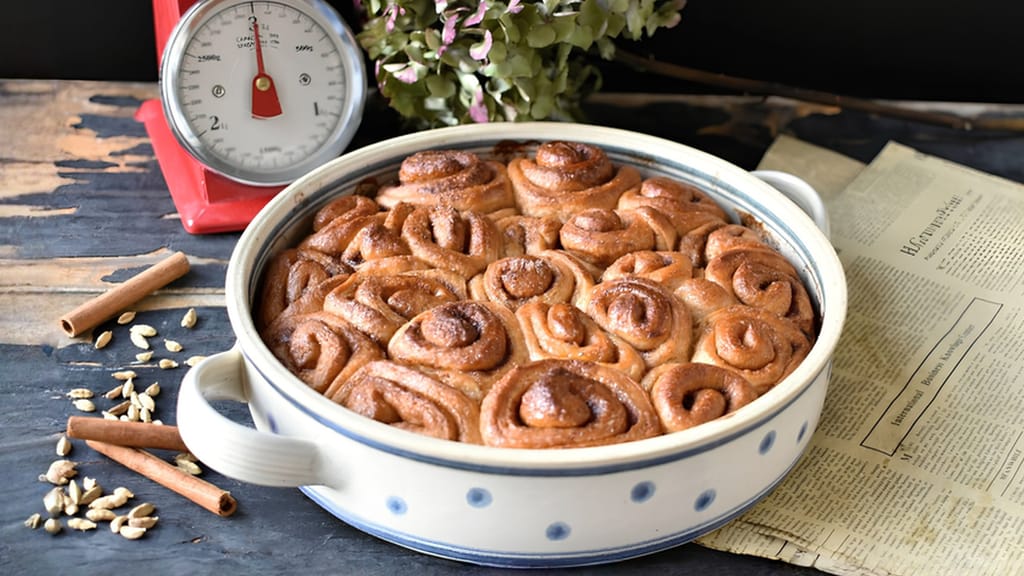
Classic yeast-dough cinnamon rolls are Swedish kanelbullar: a milky dough scented with cardamom, plenty of cinnamon and a shiny glaze on top. In Sweden they even have their own day, Kanelbullens dag, on October 4. According to Swedish media, it was invented in 1999 by the Swedish Home Baking Council, Hembakningsrådet, to get people baking more at home.
Our recipe for Swedish cinnamon buns is built on 500 g of all-purpose flour, dried yeast, lukewarm milk, an egg and melted, slightly cooled butter. Half a teaspoon of ground cardamom goes into the dough. It gives Swedish buns their typical citrusy, slightly resinous aroma, which people here often can't name but recognize right away.
The method:
The dough rises, covered, for about an hour. It's ready when it has doubled in volume and a dent made with a finger fills back in only slowly.
The filling is made from melted butter, brown sugar and cinnamon. By the time the dough has risen, it firms up and thickens a little, and that's a good thing. A thick paste spreads well and doesn't leak in the oven.
The dough is divided into two halves and worked one at a time, while the other waits covered so it doesn't dry out.
The roll is sliced into 2–3 cm (about 1 inch) pieces, set cut side down and left to rise for another half hour.
Bake at 200°C (400°F) for 25–30 minutes, until the buns are golden brown and the filling on the bottom starts to caramelize.
As soon as they come out of the oven, brush them with butter mixed with maple syrup. The hot pastry soaks up the glaze and gets its shine.
Why lukewarm milk and not hot? Yeast is made of living organisms, and hot liquid kills them. The dough then won't rise, no matter how long you wait. To the touch, the milk should feel pleasantly warm, not hot. If you're new to yeast dough, go through the basic ratios for yeast dough. Your rolls will turn out far more reliably.
Swedish cinnamon buns
Swedish yeast-dough cinnamon buns with cardamom and a maple glaze
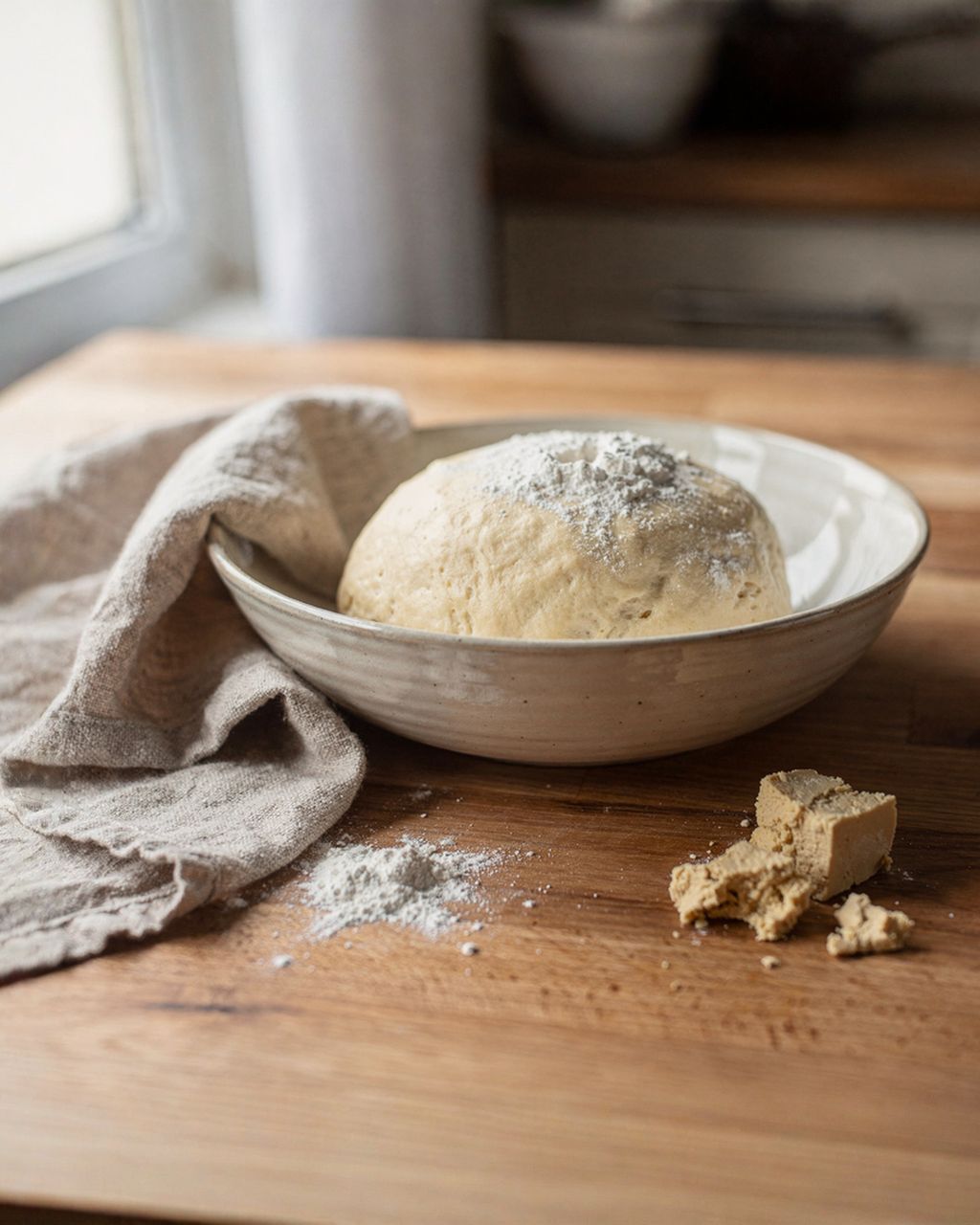
Cinnamon roll dough rises best in a warm place without drafts, in a bowl covered with a kitchen towel or plastic wrap. The times in the recipes, an hour for the Swedish buns and an hour and a half for the brioche, apply to a normally heated kitchen. In a cool apartment it can easily take half as long again, and that's not a mistake, just slower yeast.
Tried-and-true spots:
a switched-off oven with only the light on,
a spot near a radiator, but not directly on it,
the bowl set inside a larger pot of warm water.
Treat the clock as a guide. What decides it is volume and the finger test: make a dent in the dough with a lightly floured finger. If it springs back slowly, the dough is ready. If it bounces straight back, it needs more time. If the dent stays and the dough collapses, it has over-proofed. You can still bake rolls from it, but they'll be a little flatter and taste more of yeast.
A slow rise overnight in the fridge is, on the contrary, an advantage: the yeast works slowly, the dough develops a deeper flavor, and chilled dough is much easier to roll out.
The rolls keep their shape when you roll the log tightly, leave an edge without filling and slice without pressing down. Three things make the difference:
Tight rolling. Roll from the longer side and pull the dough slightly toward you with every turn. A loose log opens up in the oven and the rolls spread into flat discs.
A clean edge. At the end where the log closes, leave a strip without filling. The dough sticks together there and the seam holds.
Slicing without pressure. Move a sharp knife gently back and forth, or use thread. Slide it under the log, cross it over the top and pull, so each round stays round and doesn't get squashed.
If the dough is too soft and sticky, put the log in the fridge for 15–20 minutes. The chilled butter in the filling firms up and the slicing is much cleaner.
Brioche cinnamon rolls are more tender and richer than the classic, because the dough contains more butter, which is worked in only after the first kneading. The result is a fine, almost cotton-soft center that stays soft even the next day.
The recipe for tender brioche cinnamon rolls with frosting uses 300 g of all-purpose flour, light cane sugar, dried yeast, cardamom, vanilla sugar and a tablespoon of honey. The liquid is warm milk with whipping cream, plus an egg. Here's what matters:
The butter goes in later. First you bring together a rough, sticky dough without fat. Only then do you add softened butter in cubes and knead for another 7–10 minutes, until the dough is smooth, shiny and elastic. This gives the gluten time to develop before the fat coats it.
The rise is longer. The dough rises for about 1.5 hours in a warm place until doubled in volume. Butter slows the yeast down, so brioche needs more time than a leaner dough.
The filling is a paste, not a sprinkle. Softened butter, brown sugar, cinnamon, ginger or nutmeg, a spoonful of caramel spread and a pinch of salt are mixed into a smooth mass. It's spread over a square of about 35 × 35 cm (14 × 14 inches).
The rolls are sliced with thread and baked snugly in a greased, floured baking pan. The recipe recommends making the rolls on the larger side, as they'll be taller and fluffier.
Bake at 180°C (350°F) for 25–30 minutes, until golden on top.
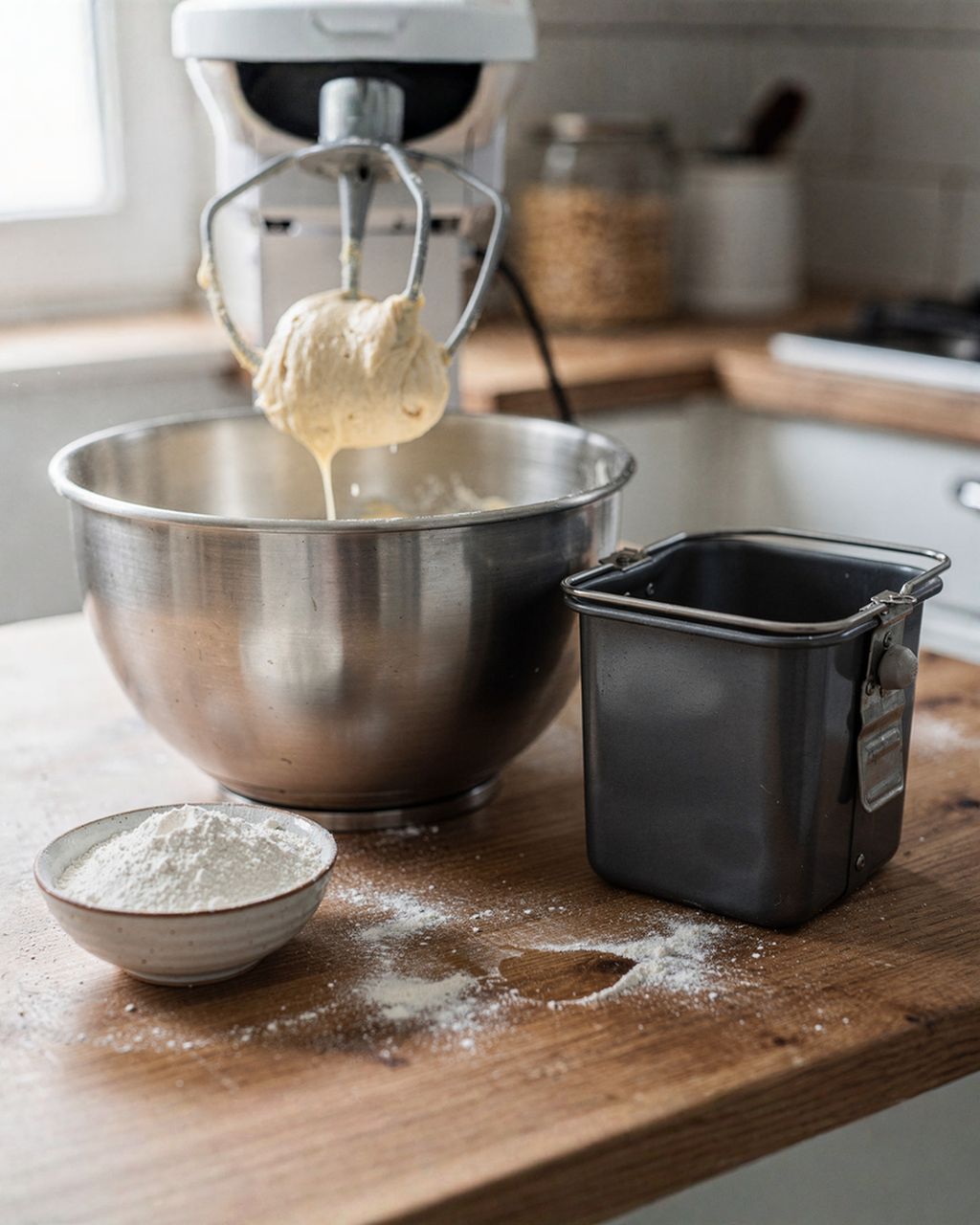
Brioche dough is sticky and hard to knead by hand, so it's best made in a stand mixer with a dough hook. You can do it by hand too; just expect longer kneading and don't reach for more flour even if the dough sticks to your hands. The stickiness disappears on its own during kneading once the butter is in. How long to knead and at what speed is covered in the article yeast dough in a stand mixer and bread machine. You know the dough is done when it pulls away from the sides of the bowl and a small piece can be stretched against the light into a translucent membrane without tearing.
The lower temperature than for the Swedish buns makes sense: a buttery, sweeter dough browns faster, so it needs a gentler oven so the center can bake through before the surface darkens.
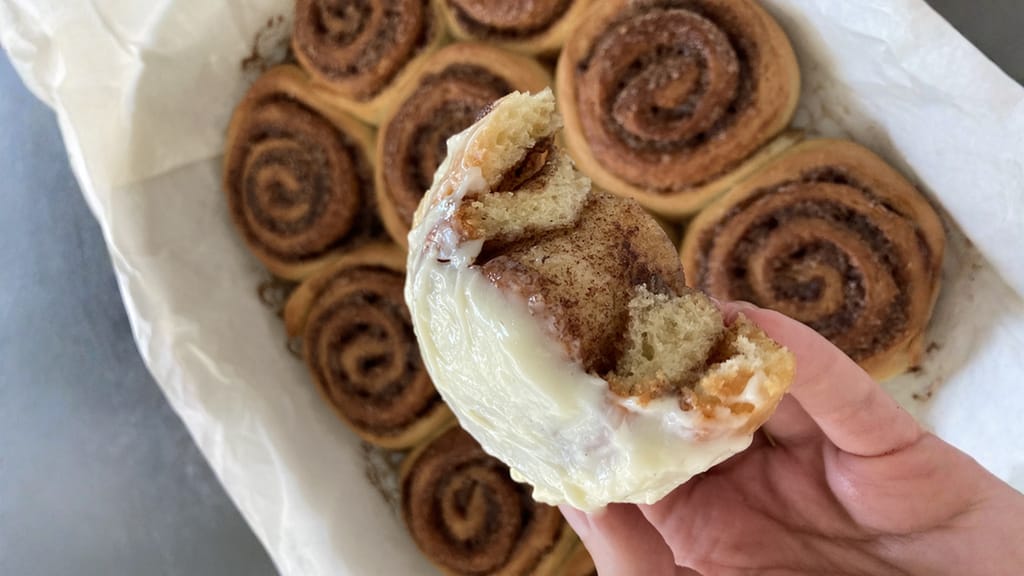
Soft cinnamon rolls made from brioche dough, with icing
Tender brioche cinnamon rolls with cream cheese frosting
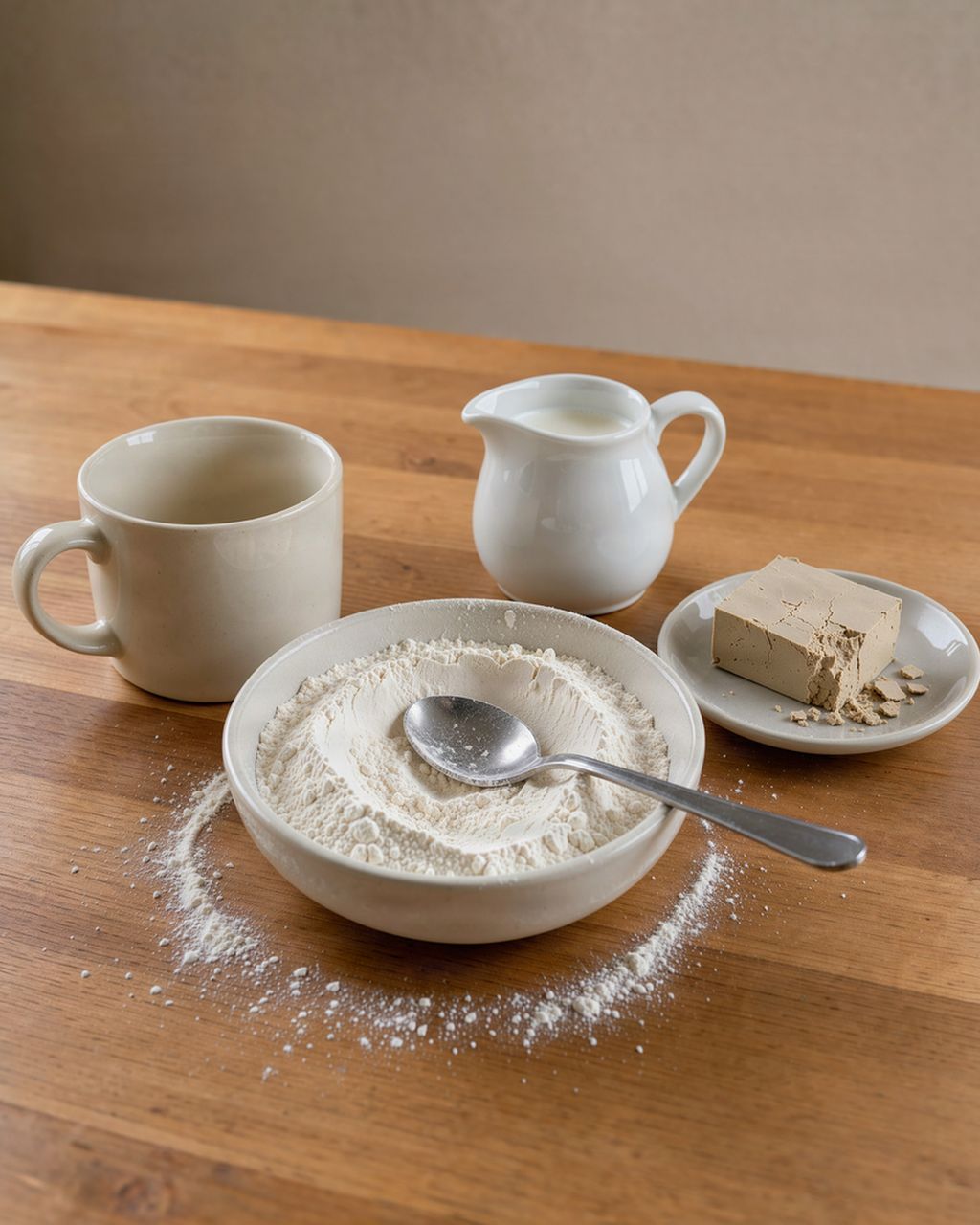
You can bake cinnamon rolls with either dried or fresh yeast; the difference is mainly in the amount and in how you add it. All our cinnamon roll recipes use dried yeast, because it's the simplest route: you sprinkle it straight into the flour.
If you prefer fresh compressed yeast, you'll need to convert it. Going by the packaging of common sachets, one sachet of dried yeast (7 g) corresponds to roughly 21–25 g of fresh, which is about half of a 42 g cube. Manufacturers differ slightly in their conversions, so follow what's printed on your package.
Mix dried yeast straight into the flour, sugar and salt. Add the liquid afterward.
Crumble fresh yeast into lukewarm milk with a teaspoon of sugar and let it stand for a few minutes until it foams on top. This is called a yeast sponge (kvásek).
Don't sprinkle salt directly onto the yeast. It slows the yeast down. Dispersed in the flour, it does no harm.
The yeast sponge isn't mandatory; it just shows you the yeast is alive. When it pays off and when to skip it is covered in the article yeast sponge from yeast. For the beet rolls and cinnamon hearts from the recipes linked below, the yeast sponge is made even with dried yeast, and it works just as well.
Cinnamon rolls are most often topped with one of three things: a creamy cream cheese frosting, a shiny butter glaze, or a simple sugar glaze. Each does something different for the roll.
Cream cheese frosting. For the tender brioche rolls, softened butter is whipped with spreadable cream cheese, powdered sugar, vanilla from the pod and a pinch of salt into a smooth cream. Spread it on rolls that are warm but not hot. On hot pastry the frosting would melt and soak in, and on cold rolls it would just sit on top.
Butter with maple syrup. For the Swedish cinnamon buns, butter is melted, mixed with syrup, and the buns are brushed with it right out of the oven. No crust, just shine and softness that lasts until the next day.
Sugar glaze. The quickest option: powdered sugar stirred with a few teaspoons of milk or lemon juice into a thick, runny mixture. Drizzle it with a spoon over cooled rolls and let it set smooth.
A little salt in the frosting is not a mistake but a trick. It tones down the sweetness of the cream cheese and sugar so the cinnamon stands out more. If you want a stiffer frosting that holds its shape better, add more powdered sugar. If you want it lighter, use less.
Cinnamon rolls call for ground cinnamon, and plenty of it: the Swedish recipe uses 20 g per 500 g of flour, which is roughly three heaping tablespoons. Less comes across only as a shy aroma; more turns bitter and dusty.
In stores you'll find two main types. Cassia, the most common and cheaper cinnamon, is sharper, sweetly hot and bold, exactly the aroma you associate with cinnamon rolls. Ceylon cinnamon is more delicate, floral and citrusy; it gets a bit lost in a filling, but it works wonderfully in frosting or with mascarpone. Ground cinnamon loses its aroma over time, so if an opened jar hardly smells, buy fresh.
Cinnamon likes company. You can add to the filling:
cardamom, which makes rolls "Swedish,"
ginger or nutmeg, as in the brioche version,
chopped walnuts or pecans, scattered over the filling before rolling,
grated apple or raisins, but only a little, as the juice thins the filling,
a pinch of salt, which rounds out the sweetness.
Brown sugar gives the filling a caramel, lightly molasses flavor and more moisture than white granulated sugar, which is why almost all cinnamon roll recipes use it. If you don't have it, use white; the filling will just be a little drier and paler.
Cinnamon rolls with mascarpone are a variation with a softer, creamier frosting. Mascarpone replaces the cream cheese or part of it. We don't yet have a mascarpone cinnamon roll recipe on Yumsto, but the principle is simple.
Briefly whip chilled mascarpone with powdered sugar and vanilla, only until it comes together. Mascarpone is richer and softer than spreadable cream cheese and can curdle or turn runny if whipped for long. Mascarpone frosting is less tangy, so a drop of lemon juice brings back the freshness. Spread it on fully cooled rolls; on warm ones it would melt.
You can also add mascarpone to the filling: a spoonful or two stirred into the butter-cinnamon paste makes it creamier. Don't overdo it, since more moisture in the filling means it leaks onto the bottom in the oven.
Cinnamon rolls baked on a sheet are either spaced apart, each on its own, or snug in a baking pan, where they merge into one "cake" as they rise. Both work, just with different results:
On a parchment-lined baking sheet with gaps, you get rolls with golden-baked sides and slightly crisp edges. This is how Swedish cinnamon buns are baked. Leave space between them, as they swell noticeably during the second rise.
Snug in a baking pan or casserole dish, the rolls support one another, rise upward and keep soft, pale sides. This is typical for the brioche version.
A few tips for baking on a sheet:
Bake on the middle rack. Otherwise the bottom heating element will burn the caramel on the bottom before the rolls bake through.
If the top darkens before the rolls are done inside, cover them with aluminum foil or parchment paper and finish baking.
Put a second baking sheet under the sheet or pan if the filling is strawberries or another juicy one. Any juice that runs off then won't burn onto the bottom of the oven.
If you want a truly crisp, evenly baked bottom, reach for a perforated silicone mat instead of paper.
You can tell the rolls are done by the golden-brown top, the filling beginning to caramelize at the bottom, and a center that springs back when lightly pressed and is neither shiny nor doughy.
Puff pastry cinnamon rolls are a quick version with no rising: ready-made puff pastry, cinnamon sugar, and in half an hour they're baked. They aren't soft like yeast-raised rolls, but crisp and flaky, more like a cookie.
We don't yet have a recipe for puff pastry cinnamon rolls on Yumsto. But the technique is shown by puff pastry snails with nut spread: a sheet spread with filling and covered with a second one, cut into strips that are twisted and coiled into a spiral. For a cinnamon version, instead of the spread, simply brush the sheet with melted butter and sprinkle it with cinnamon sugar.
What always applies: take the puff pastry out of the fridge only just before you work with it, because cold pastry doesn't stick and holds its shape. And bake it until golden brown, underneath too. Pale, shiny layers inside mean the pastry is still raw.
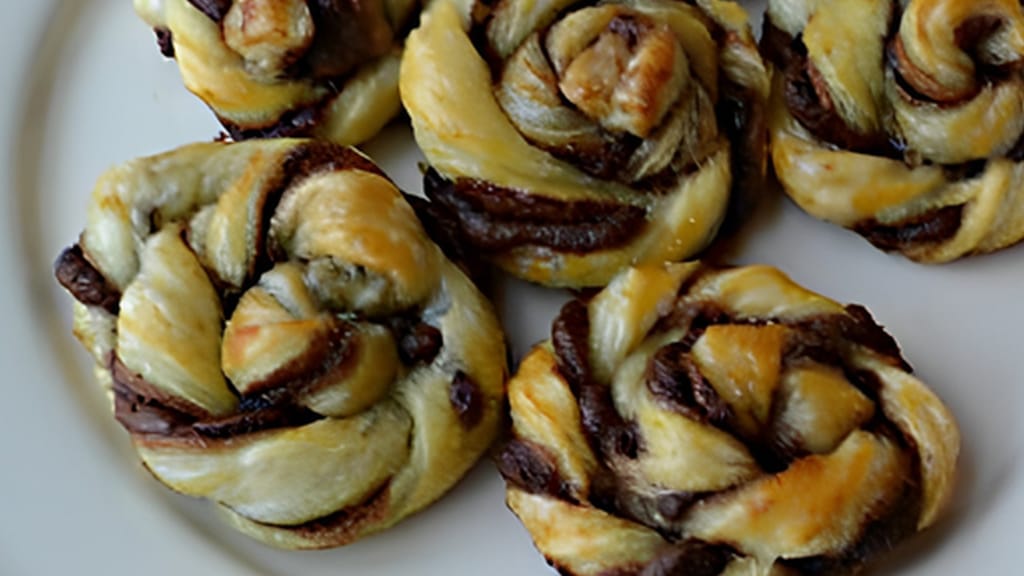
Nutella puff pastry snails
Puff pastry snails with nut spread: quick rolls without rising
Gluten-free cinnamon rolls are a tougher challenge, because gluten is what gives yeast dough its elasticity and lets you roll it out and roll it up. Gluten-free dough tears and breaks. We don't yet have a gluten-free cinnamon roll recipe on Yumsto.
If you go for it, reach for a ready-made gluten-free flour blend intended for yeast baking, ideally with psyllium or another binder. Psyllium replaces part of gluten's elasticity. Such dough tends to be wetter and stickier, so it's easier to roll out between two sheets of parchment paper and slice after a short chill. Expect the rolls to be denser and to go hard faster. They're best while still lukewarm.
If you're baking for someone who can't have gluten, watch for hidden sources too: yeast, baking powders, toppings and caramel spreads. Every ingredient must be labeled gluten-free on its packaging.
On Yumsto you'll find three more forms of yeast-dough rolls: beet rolls, cinnamon hearts and strawberry roll pastries. The same principle, dough, filling and rolling, just in a different form each time.
Beet rolls with cinnamon and ginger have a purée of cooked beets, buttermilk and orange zest in the dough, so they're pink and fresher in flavor. Instead of classic spirals, the log is cut diagonally into small triangles.
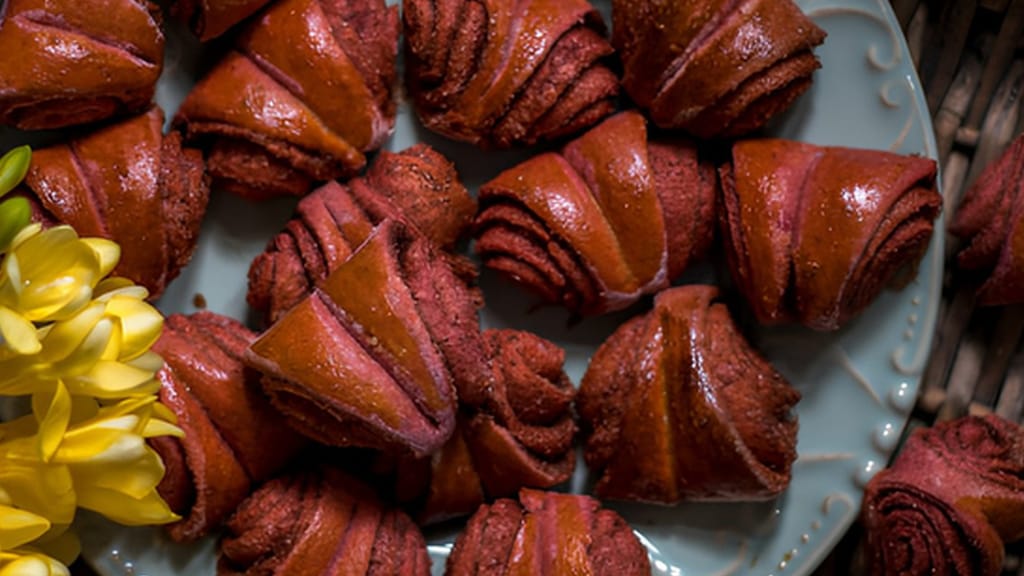
Beetroot cinnamon-ginger buns
Pink beet rolls with cinnamon and ginger
Cinnamon hearts are cinnamon rolls rolled from two sides toward each other into a heart shape. The dough is scented with cardamom, and it uses a butter-flavored plant-based fat instead of butter.

Cinnamon hearts, not just for valentine's day
Yeast-dough cinnamon hearts with cardamom
Strawberry roll pastries are a spring variation on rolls, without cinnamon. Yeast dough is covered with sliced strawberries and rolled up like a strudel, and the rounds are baked in a muffin pan, which helps them hold their shape. The recipe advises putting a baking sheet in the oven under the pan, because strawberry juice may leak out and burn.
If you enjoy yeast baking, you'll find more ideas for sheet-pan cakes in the article fruit and yeast cakes. For a weekend morning, more tips for a sweet breakfast also go well with the rolls.
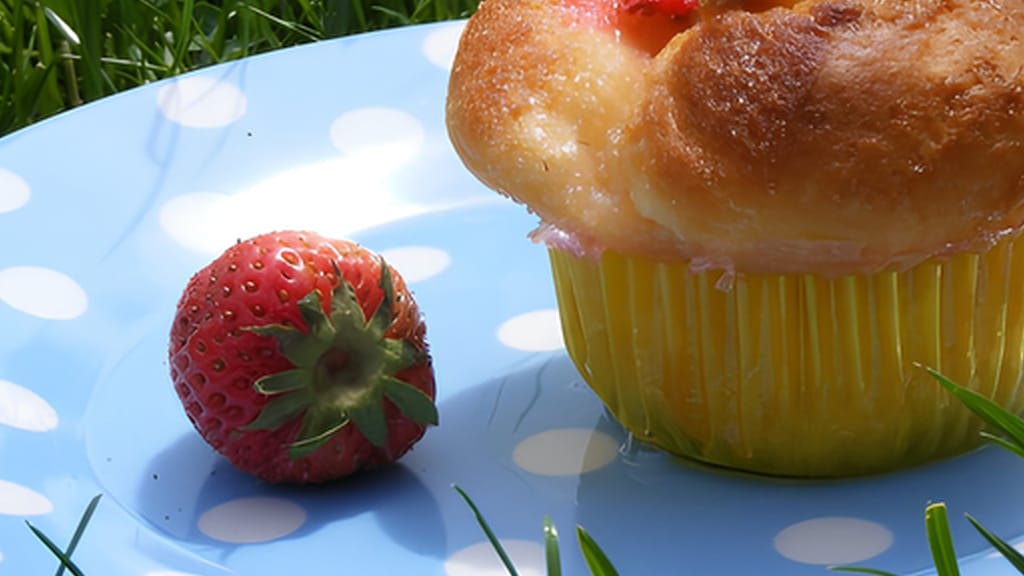
Strawberry swirl buns – a spring dessert
Yeast-dough strawberry roll pastries baked in a muffin pan
Cinnamon rolls most often fail for six reasons: underproofed dough, too much flour, a thin filling or a loose roll, overbaking, an oven that's too hot, and a roll that's too soft or a second rise that's too long. How to recognize and fix them:
Hard, dense rolls: the dough didn't rise. It was cold, the milk was hot, or the yeast was old. Judge the rise by volume, not by the clock.
Dry crumb: too much flour went into the dough while rolling. Yeast dough for rolls should be soft and a little sticky. Deal with stickiness using oil on your hands or a short chill, not more flour.
Filling leaked onto the bottom: it was too runny or the roll wasn't tight. Let the melted butter and sugar thicken, or work with softened rather than melted butter.
Rolls go hard the next day: overbaking or too little fat. Take them out as soon as they're golden. A butter glaze or frosting right after baking keeps them soft.
Raw center with a dark top: the oven is too hot, or the rolls sit too close to the top heating element. Lower the temperature by 10–20°C (20–35°F) and cover them.
Rolls spread: sliced too late, a roll that was too soft, or a second rise that was too long. The second rise is enough once the rolls have visibly swollen, usually around half an hour.
If you want rolls that stay soft on the second day, you can replace part of the sugar in the dough with invert sugar, which binds water. How much to use is covered in the article on invert sugar in yeast dough.
Cinnamon rolls without frosting taste best on the day they're baked; until the next day, keep them in a closed container at room temperature. Rolls with cream cheese or mascarpone frosting belong in the fridge. The US FDA generally recommends not leaving perishable food out of the cold for more than 2 hours, and cream cheese frosting counts as one.
A day ahead: put the sliced rolls in a baking pan, cover with plastic wrap and refrigerate overnight. The second rise happens slowly there. In the morning, let them come to room temperature for 30–60 minutes before baking.
Freezing: freeze baked rolls without frosting individually, then move them to a bag. Thaw at room temperature and warm briefly in the oven.
Reheating: a few minutes in the oven or a few seconds in the microwave brings back softness. Spread on the frosting only after reheating.
For the beet rolls, the recipe recommends putting leftover dough in the fridge, where it rises only very slowly, and baking it within, say, two days, or freezing it and baking later.
Swedish cinnamon buns, kanelbullar, are smaller, have cardamom in the dough and only a shiny glaze or pearl sugar on top, while American cinnamon rolls are bigger, baked snugly together in a baking pan and topped with a creamy cream cheese frosting. American rolls are sweeter and softer, while Swedish ones are more fragrant with spice.
Yes, you can make the classic yeast dough for cinnamon rolls without the egg; just replace it with the same amount of milk. The rolls will be a little paler and less tender, but they will rise normally. In brioche dough the egg matters more, so we don't recommend leaving it out there.
You can replace the butter in cinnamon rolls with a plant-based baking fat, for example one with a butter flavor, in the same amount in both the dough and the filling. The rolls will taste more neutral, so it's worth adding more cinnamon or some cardamom. Oil doesn't work in the filling because it won't thicken and will leak out.
Cinnamon Bun Day, in Swedish Kanelbullens dag, is celebrated on October 4. According to Swedish media, it was created in 1999 by the Swedish Home Baking Council, Hembakningsrådet, to encourage baking at home.
Instead of frosting, brush the cinnamon rolls with beaten egg and sprinkle them with pearl or coarse sugar, or with chopped almonds, before baking. After baking, simply dust them with powdered sugar or brush them with melted butter mixed with honey or syrup.
One recipe worth heating the oven for, one tip, and one deal from the shop. Nothing else.