- Season
- Year-round.
- Price
- Low
Calories and nutrition per 100 g
- 105 kcal
- 8.4 g protein
- 1.9 g fat
- 18.1 g carbs
Fresh Yeast
Fresh yeast (also called compressed or cake yeast) is a pressed block of live baker's yeast, Saccharomyces cerevisiae, used to raise bread and sweet yeast doughs. In Czech shops it is sold chilled as a 42 g cube; it is about 70% water, so it must be kept in the fridge.
Do not leave it on the counter: at room temperature it weakens within a day. Take it out of the fridge just before use; it crumbles fine straight from the cold.
Keep it unopened in the fridge at 2–8 °C, ideally at the back rather than in the door. It lasts about 4–6 weeks from production, which usually leaves 2–3 weeks after purchase; go by the date on the pack. Wrap an opened cube tightly in film, put it in a closed container and use it within a week.
You can freeze it for about 3 months, but some of the yeast cells do not survive. Cut the cube into 10–20 g portions, wrap each tightly and thaw slowly in the fridge. Use about a quarter more than fresh, up to half as much again after 3 months, and test it in a starter first.
Good fresh yeast is light beige to greyish beige, crumbly, smooth where you break it and smells pleasantly yeasty. Skip cubes with dark brown edges, a dry cracked crust, a slimy surface or a sour smell. Check the date: after purchase you usually have 2–3 weeks left, so buy it only a few days before you bake.
Instant dried yeast: divide the fresh weight by three. A 42 g cube equals 14 g of instant yeast, i.e. two 7 g sachets; one sachet replaces half a cube (21 g). Mix it straight into the flour.
Active dry yeast (coarser granules): divide the fresh weight by 2.5, so about 17 g for a whole cube. Let it dissolve in lukewarm liquid for 10 minutes. Nutritional yeast and baker's ammonia cannot replace fresh yeast.
Crumble fresh yeast into lukewarm milk or water at 30–35 °C, or rub it straight into the flour. To check that it is alive, make a quick starter with a teaspoon of sugar and a little flour. Liquid above 50 °C starts to damage the yeast and around 60 °C kills it, so measure it or test it on your wrist: it should feel pleasantly lukewarm, not hot.
If you will not use a cube before its date, portion and freeze it, or make pizza or bread dough with it and freeze the finished bake. Do not dry it at home: you cannot tell how many cells survive, so you will not know how much to use.
Roughly what one measure weighs, scooped the way you normally would in the kitchen.
Fresh yeast to dried and back.
Fresh yeast raises yeast doughs: Czech buchty and koláče, vánočka, mazanec, yeasted dumplings, rolls, langoš, pizza and bread. It works fastest at around 25–30 °C. In the cold it ferments slowly but does not stop, so a dough with a small dose can rise overnight in the fridge. The yeast dies during baking.
Fresh yeast (also called compressed or cake yeast) is a pressed block of live baker's yeast, Saccharomyces cerevisiae, used to raise bread and sweet yeast doughs. In Czech shops it is sold chilled as a 42 g cube; it is about 70% water, so it must be kept in the fridge. It is the same yeast as in dried yeast, just not dried: the cells are fully active and start working in the dough at once. Because of the water it ages even in the cold and keeps for weeks, not years. Nutritional yeast (heat-killed, used for flavour) and baker's ammonia (a chemical raising agent, called "cukrářské droždí" in Czech) have similar names in Czech, but neither raises dough the way fresh yeast does.
Raw fresh yeast smells fresh and yeasty and tastes slightly bitter. At the right dose it is barely noticeable in baked bread. A strong yeasty taste usually comes not from the type of yeast but from using too much of it and proofing too briefly somewhere too warm.
Seasonal baking plans, tested recipes and kitchen tricks that save you time. Unsubscribe in one click.
4 min read
To convert fresh yeast to instant dried yeast, divide by three: a 42 g cube equals 14 g of instant yeast, i.e. two 7 g sachets. The other way round, one 7 g sachet replaces half a cube, 21 g of fresh; manufacturers print the same on their sachets, for example Dr. Oetker (one sachet for 500 g flour equals half a cube of fresh yeast). Active dry yeast is slightly weaker, so divide fresh by 2.5.
The reason is water: fresh yeast is about 70% water, instant only about 4–6%, so a sachet holds roughly three times as much dry matter. A common mistake is assuming one sachet replaces a whole cube. If a recipe calls for a cube and you have sachets, use two. A table for smaller amounts is in our article dried vs fresh yeast: conversion.
Per 500 g of flour, go by the dough: sweet yeast dough (buchty, koláče, vánočka) 20–25 g, white rolls 10–15 g, bread with a 3–4 hour rise 5–8 g, and pizza or bread dough rising overnight in the fridge only 1–2 g. A whole cube per 500 g of flour is more a habit of older recipes than a need.
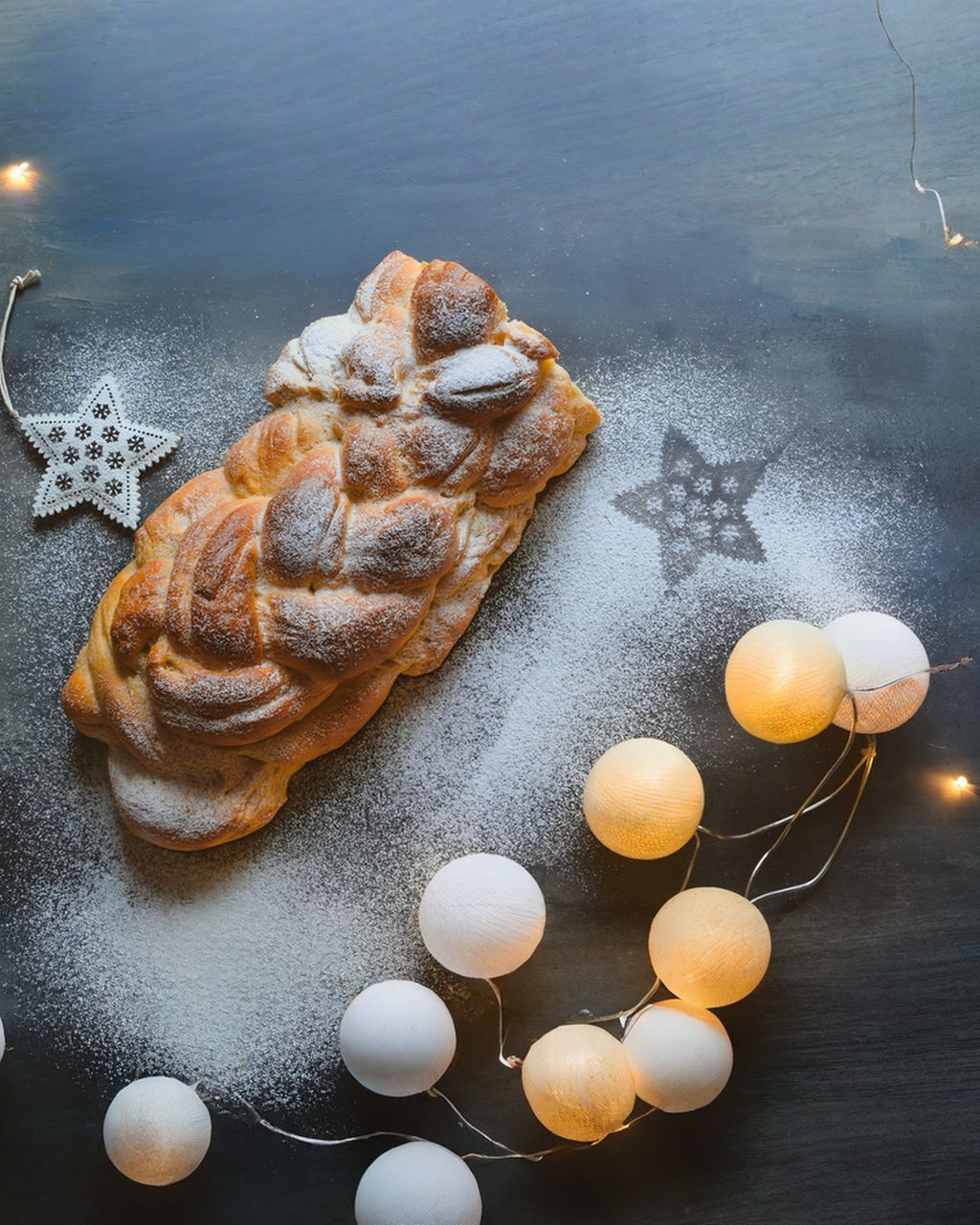
More yeast does not make better bread. The dough rises faster but gets a coarser crumb, stales sooner and tastes of yeast. Sweet dough rises more slowly because sugar, fat and yolks hold it back; give it time, not more yeast. Try it with Mom's Christmas braid.
Unopened in the fridge at 2–8 °C it lasts about 4–6 weeks from production, which usually leaves 2–3 weeks after purchase. Wrap an opened cube tightly and use it within a week. In the freezer it keeps about 3 months but weakens, so use a quarter to half more after thawing. At room temperature it weakens within a day.
Cold only slows the yeast down, it does not stop it, which is why fresh yeast ages even in the fridge. Treat the date on the pack as the upper limit. More on freezing and thawing is in how long yeast lasts and how to tell if it is dead.
Old or spoiled fresh yeast turns dark brown, forms a dry cracked crust, goes slimy, smells sour or cheesy, or grows mould. Darker edges and a slightly dry surface do not mean it is finished; test it. If it smells off, is slimy or mouldy, throw it away.
The test takes a quarter of an hour: crumble a little yeast into some lukewarm milk or water (30–35 °C) with a teaspoon of sugar and a tablespoon of flour and leave it somewhere warm. Live yeast forms a foamy cap within 10–15 minutes and the mixture swells. If the surface stays still, the yeast is dead, and waiting longer or adding sugar will not save it.
In Czech, the word "kvásek" means two different things. A yeast starter (kvásek z droždí) is a loose batter of crumbled yeast, lukewarm milk, a teaspoon of sugar and a little flour that rises within 10–15 minutes. For 500 g of flour use 20–25 g of yeast, about 100 ml of milk at 30–35 °C, a teaspoon of sugar and 1–2 tablespoons of flour, all taken from the recipe. With fresh yeast it is more insurance than necessity; when it pays off is covered in proofing yeast: why you do it and when you can skip it.
A sourdough starter (rye or wheat) is a long-kept culture of wild yeasts and lactic acid bacteria that you feed for days and weeks. It raises dough more slowly than yeast and gives bread a sour flavour. Some recipes combine both: sourdough for flavour, a little yeast for reliability. How to start and feed one is in sourdough starter: how to make it, feed it and tell when it is ready.
Baker's yeast is grown in aerated fermenters on molasses, a by-product of sugar making. It is then separated in centrifuges, washed, stripped of most of its water and pressed into blocks that are cut into cubes. Dried yeast is made from the same yeast by further gentle drying.