Soft honey gingerbread cookies that never go hard
Updated Sep 5, 2026
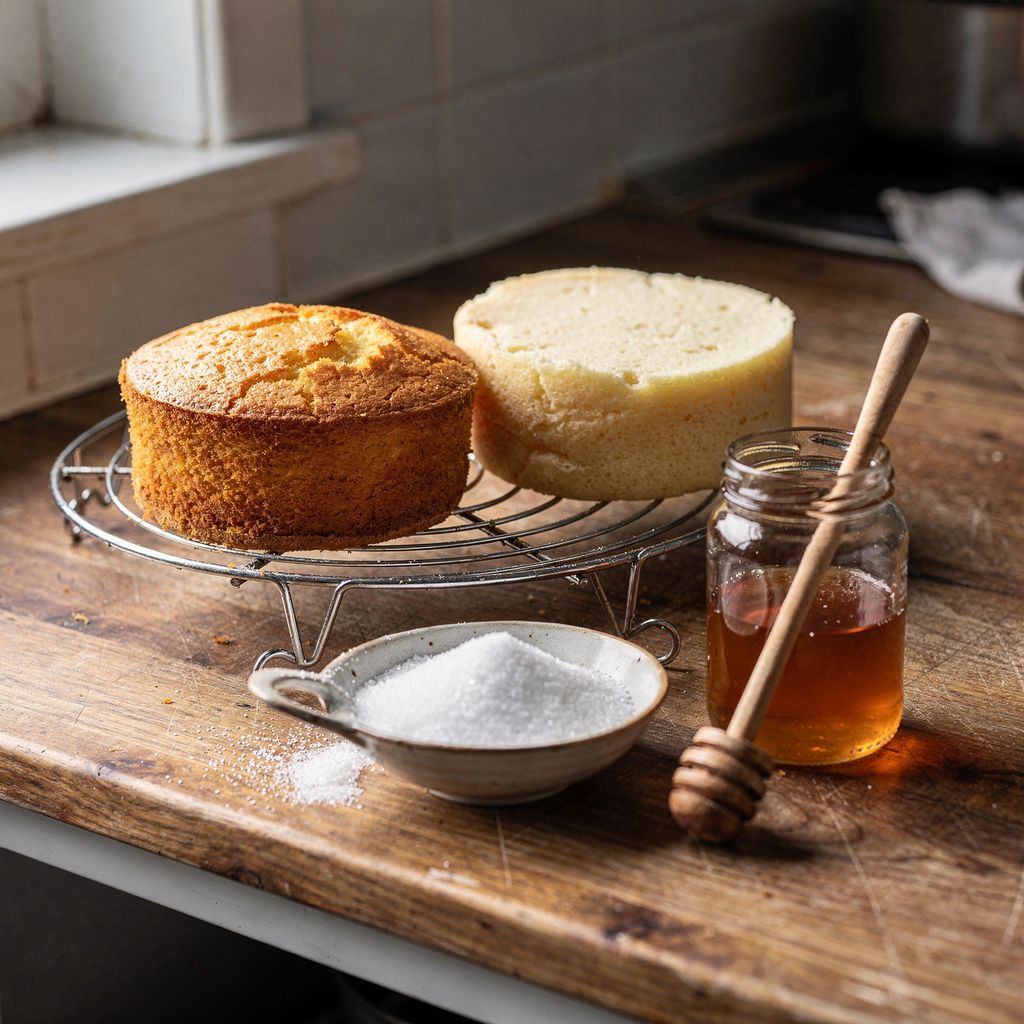
You can replace sugar in baking, but there's no single miracle powder that does it all: erythritol and xylitol preserve both volume and sweetness, honey and syrups add moisture and browning, fruit purée can replace at most half the sugar, and stevia alone won't hold a batter together. That's because sugar in dough doesn't just add sweetness — it binds water, softens gluten, aerates butter when creamed, and browns.
Sugar does five jobs in dough at once: it sweetens, binds water, softens gluten, aerates fat when creamed, and browns. A sugar substitute is only as good as however many of those five jobs it can manage — and none of them can do all five.
Sweetens. The one job every substitute genuinely does. That's why every package touts it, and why it's not a useful basis for choosing between them.
Binds water. Sugar is hygroscopic — it holds moisture in the dough and stops it evaporating. A cake with less sugar dries out noticeably faster.
Softens gluten. Sugar competes with flour for water, slows gluten formation and delays starch gelatinisation. The result is a softer, more crumbly texture.
Aerates. When you cream butter with granulated sugar, the sharp crystals cut tiny air bubbles into the fat. A fine powder with no crystal edges can't do this — and a lot of substitutes are sold precisely as fine powders.
Browns. Caramelisation and the Maillard reaction give the crust both colour and that baked flavour. Most substitutes don't brown at all, because they aren't reducing sugars.
Judge everything below against this list. The question isn't "is it sweet" — it's "how many of the other four jobs survive the swap."
Eight options for replacing sugar in dough — four genuine substitutes and four flavour swaps that don't actually cut the sugar content: erythritol (130 g per 100 g), xylitol (100 g), fruit purée (100 g, but only up to half the sugar) and stevia with sucralose (only with a bulking agent) all reduce sugar; honey (75 g), maple syrup (75 g), date syrup (75 g) and coconut sugar (100 g) only change the flavour and colour.
Erythritol — 130 g per 100 g of sugar. Sweetens at roughly 70% of sugar's strength. Matching full sweetness would need almost 145 g, but that much starts to feel gritty in the finished dough. Doesn't brown. Works best in moist bundt cakes and muffins.
Xylitol — 100 g per 100 g of sugar. Sweetens at practically the same strength as sugar and binds moisture, so baked goods stay moist. Also doesn't brown. Toxic to dogs — more on that below.
Honey — 75 g per 100 g of sugar. A flavour swap, not a sugar reduction: chemically, honey is still sugar. Cut 15–20 ml of other liquid for every 100 g of honey, lower the oven temperature by 10–15 °C, and add ¼ tsp baking soda for every 250 g of honey.
Maple syrup — 75 g per 100 g of sugar. Also a flavour swap — it doesn't reduce the sugar in the dough. Same adjustments to liquid and temperature as with honey, but no need for baking soda since it's less acidic.
Date syrup — 75 g per 100 g of sugar. Another flavour swap, not a route to less sugar. Darker and more caramel-like than honey. Great in gingerbread, chocolate batters and oat bars.
Fruit purée (banana, apple, date paste) — 100 g per 100 g of sugar, but no more than half. Cut 2–3 tablespoons of other liquid for every 100 g of purée.
Stevia and sucralose — as per the packaging, usually fractions of a gram. They sweeten but add no bulk at all, so on their own they can't fix the dough. Monk fruit doesn't have E-number sweetener status in the EU; as a novel food, only a specific water extract has been approved since 2024, so the typical "monk fruit sweetener" you see in recipes from abroad isn't sold here.
Coconut sugar, muscovado, cane sugar — 100 g per 100 g. A flavour swap, not a substitute: chemically, it's still sugar.
All ratios are by weight, not volume. With sugar substitutes, volume and weight diverge far more than with ordinary sugar, so get the scales out for these.
Erythritol is the closest match to sugar's volume: it pours, weighs similarly and takes up nearly the same space in the dough, but it only sweetens at about 70% of sugar's strength and doesn't brown at all. Under EU labelling rules it's rated at 0 kcal/g, while other polyols including xylitol are labelled at 2.4 kcal/g.
What to expect in the oven:
Doesn't brown or caramelise. It's not a reducing sugar, so it doesn't take part in the Maillard reaction. It melts at around 121 °C into a clear syrup that stays colourless. A bundt cake will look pale even after the correct baking time — so don't judge it by colour, judge it with a skewer.
Recrystallises once cooled. This is its main weak spot. It dissolves less readily than sugar (roughly 37 g per 100 g of water versus about 200 g for sucrose), so in anything moist and especially chilled — cheesecake, cream fillings, icing — it turns gritty on the tongue after a few hours.
Cools the mouth. It has a negative heat of dissolution, giving a mild, menthol-like cooling sensation. Nice in a mint or lemon dessert, odd in a cinnamon cake.
Yeast can't ferment it. It doesn't work as feed for yeast in a leavened dough.
How to tame it. Dissolve it beforehand in a warm liquid from the recipe, rather than mixing it dry into the flour. Choose finely ground (powdered) erythritol rather than coarse crystals. And don't rely on it alone for all the sweetness — mix it with xylitol at roughly a 2:1 ratio; xylitol binds moisture and significantly slows recrystallisation.
Xylitol sweetens at practically the same strength as sugar, so you can weigh it 1:1 with no recalculating needed. It's more hygroscopic than sugar, meaning baked goods made with it stay moist longer — exactly what erythritol lacks.
What's different about it:
Also doesn't brown. No caramelisation, no Maillard reaction. Same rule as with erythritol: a pale crust doesn't mean it's underbaked.
Doesn't recrystallise. Unlike erythritol, it doesn't turn gritty once the dough has cooled, making it a better choice for anything chilled.
Yeast can't ferment it. You can add it to leavened dough for flavour, but yeast gets nothing from it — leave at least a teaspoon of ordinary sugar or honey in the recipe to get fermentation going.
Has a laxative effect in larger amounts. It's a sugar alcohol. In the EU, products with more than 10% added polyols must carry a warning that excessive consumption may have a laxative effect, and the same applies at home — don't go all-in on your first attempt, and don't eat half a cake in one sitting.
In practice, the best approach is combining the two: erythritol for most of the bulk, xylitol as the smaller portion that holds onto moisture. Roughly 90 g erythritol plus 45 g xylitol replaces 100 g of sugar with decent sweetness and moistness.
Two general health claims are approved in the EU for this group of sugar substitutes.
Regulation (EU) 432/2012 lists two approved health claims for the group of sugar substitutes; only a product that meets the specified conditions of use may carry them — home baking doesn't fall under this. Only a product that meets the specified conditions of use may carry the claim — it doesn't apply to home baking.
The second approved claim concerns a reduced rise in blood glucose after consumption. This too is tied to conditions of use and belongs on the packaging of an assessed product, not on a homemade cake.
What this means for you. Sprinkling erythritol into your batter doesn't automatically mean your cake meets either condition — it depends on the whole composition, including the flour, fruit and chocolate in it. Think of it as information about the ingredient, not a description of what you've baked.
Both claims apply to the group of sugar substitutes, which includes erythritol, xylitol, maltitol, sorbitol, isomalt, lactitol, mannitol and sucralose, among others. And both only hold under specific conditions:
For dental mineralisation sugars must be replaced such that eating the food doesn't lower plaque pH below 5.7 during consumption or within 30 minutes afterwards.
For blood glucose response sugars must be replaced such that the food meets the conditions for a "reduced sugar" claim — meaning at least 30% less sugar than a comparable product.
And one note on dosage: in 2023, when re-evaluating erythritol (E 968), EFSA set an acceptable daily intake of 0.5 g per kilogram of body weight per day, based on its laxative effect. For a 70 kg adult, that works out to about 35 g a day — roughly one generous serving of a low-carb dessert. It's certainly not an ingredient worth sprinkling around by the handful.
For every 100 g of sugar, use 75 g of honey or syrup, cut 15–20 ml of other liquid, and lower the oven temperature by 10–15 °C. These three tweaks make the difference between a moist gingerbread and a burnt flatbread.
Why exactly this:
75 g instead of 100 g, because honey's fructose content makes it sweeter than sugar. Swap it gram for gram and the cake will be oversweet and sticky.
Less liquid, because honey is roughly 17–20% water. Skip accounting for it and the batter will be too runny, and the cake will sink.
Lower temperature, because fructose browns faster than sucrose. At the original temperature, you'll get a dark crust before the inside is done.
A pinch of baking soda with honey. Honey is acidic — pH ranges roughly from 3.4 to 6.1 depending on the type, most often around 3.9. A quarter teaspoon of baking soda per 250 g of honey neutralises that acidity and lets the leavening agent do its job. Skip this step with maple syrup, which is much less acidic.
Honey-based dough also holds onto moisture noticeably better than sugar-based dough, which is why traditional honey gingerbread softens after a week instead of going stale. If you fancy making your own syrup, homemade date syrup comes together from dates and water in an afternoon and suits dark batters even better than honey.
Soft honey gingerbread cookies that never go hard
Soft honey gingerbread cookies that never go stale — a good example of honey replacing sugar completely while still keeping things moist
Fruit purée can replace at most half the sugar in a recipe, gram for gram — go beyond that and the cake turns into a moist, dense loaf. Banana, apple and date paste all work the same way: they bring sweetness, moisture and binding, but no structure.
How to work with it:
Add it to the wet ingredients, not the flour. It needs to be blended smooth, or you'll end up with damp pockets in the finished dough.
Cut 2–3 tablespoons of other liquid per 100 g of purée. Purée is largely water.
Expect a denser crumb. Purée doesn't help with creaming or aeration, so the dough will be a touch heavier. Add an extra ¼ tsp baking powder if that bothers you.
Shelf life drops. A cake made with fruit purée is moister, so it goes mouldy sooner. Eat it within two days, or freeze it.
Dates are the sweetest of this group — blended with a little hot water they make a paste that replaces both sugar and binding in one go. They work best where there's no baking involved at all: cocoa energy balls made from oats and dates or oat and dried fruit squares rely on fruit as the only sweetener.
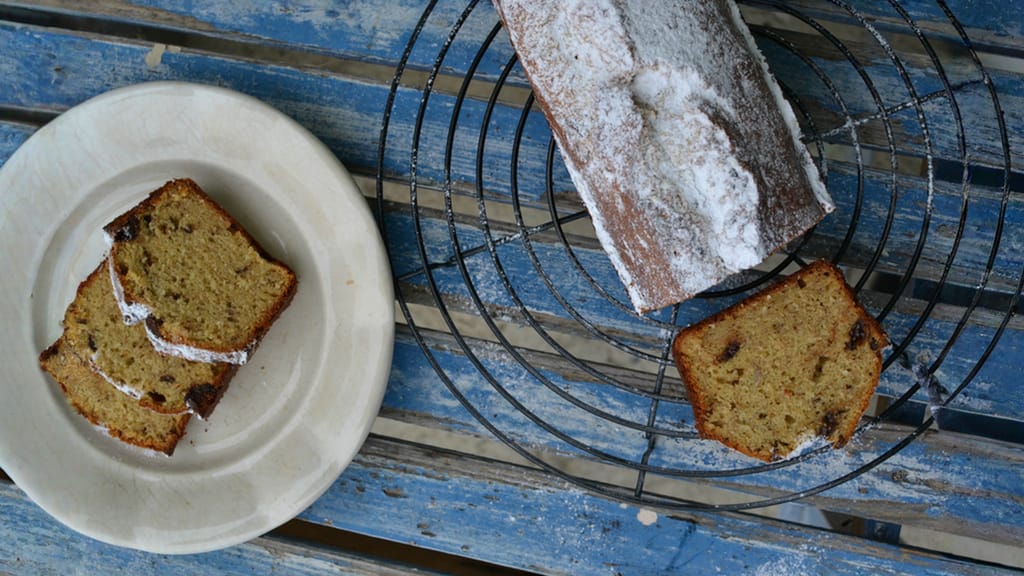
Banana bread
Banana bread — banana purée here carries half the sweetness as well as the moisture
Intense sweeteners replace sugar's sweetness but not its bulk — and in baking, that's a major problem. Stevia is roughly 200–300 times sweeter than sugar, sucralose around 600 times. Monk fruit doesn't have E-number sweetener status in the EU; as a novel food, only a specific water extract has been approved since 2024, so the typical "monk fruit sweetener" from recipes abroad isn't sold here — though you will come across it in foreign recipes. So for 100 g of sugar, you're sprinkling in a fraction of a gram, and the remaining 100 g of bulk is simply missing from the dough.
What you lose as a result:
The batter is thinner and the cake shorter, because the bulk that would have lifted it is gone.
Creaming butter achieves nothing, since there are no crystals to cut air into it.
The crumb dries out by the next day, because nothing is binding water.
Zero browning.
That's why they're almost never used on their own. Either reach for a ready-made blend where stevia is mixed with erythritol (erythritol adds bulk and also masks stevia's metallic edge), or mix it yourself: erythritol for the full bulk the sugar would have provided, plus enough stevia to match the sweetness. In that pairing, stevia is a seasoning, not the foundation.
In unbaked things — creams, mousses, iced coffee — intense sweeteners work fine on their own, because you don't want any structure from sugar there anyway.
Coconut sugar, muscovado and honey aren't sugar substitutes — chemically, they're still sugar, just with a different flavour and colour. Coconut sugar has around 95 g of carbohydrate per 100 g, practically the same as white sugar. Muscovado, demerara and cane sugar are all sucrose with a share of molasses. Honey is a mix of fructose and glucose.
That doesn't mean they're useless — just expect the right thing from them:
Muscovado and dark cane sugar give a caramel, slightly liquorice-like depth, and the molasses helps hold moisture. Excellent in gingerbread and biscuits.
Coconut sugar has a subtle caramel note and browns a bit faster. Swap it 1:1, just expect a darker crust and a slightly shorter baking time.
Honey and syrups bring their own distinct flavour, which you'll notice in a plain cake.
If your goal is less sugar in the bake, this group won't help you get there. Two things will: reaching for a polyol (erythritol, xylitol), or simply cutting the sugar in the recipe by 25–30% — most dough handles that without any other adjustment.
There are four cases where sugar can't be replaced, because what it's doing there isn't sweetening but structure: meringues, caramel, as food for yeast in leavened dough, and in crisp cookies meant to spread out into a flat disc.
Meringue. Sugar dissolves into the egg-white foam here and forms a syrupy film that holds the bubbles in place. Neither polyols nor stevia can form that film — the whites either collapse or turn damp after baking. Don't swap the sweetener here.
Caramel. Caramelisation is sucrose breaking down under heat. At 121 °C erythritol simply melts into a clear syrup and hardens into glass once cool — you won't get caramel's colour or flavour from it.
Leavened dough. Yeast ferments sucrose, glucose and maltose, but not polyols. You can cut the sugar right down, but leave at least a teaspoon in the recipe to get fermentation started.
Crisp cookies meant to spread into a flat disc. Spreading is driven by melting sugar. With erythritol, cookies stay in their original shape — which can be fine, but it's good to know beforehand.
In buttery biscuits like crisp almond cookies, sugar is both the sweetener and the shape regulator, so swapping it changes the appearance as well as the flavour.
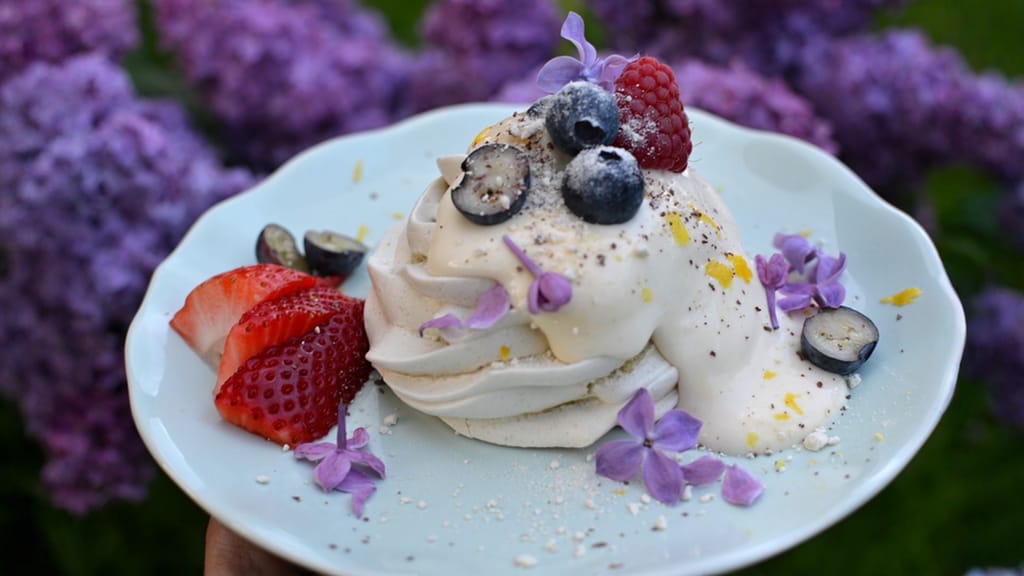
Lilac meringue kisses with lemon curd cream and fresh fruit
Lilac meringues with lemon curd — a good example of a dessert where sugar isn't the sweetener but the load-bearing structure
Don't start by swapping — start by cutting: reduce the sugar in the recipe by 25–30% and bake it as is. Most home and published recipes contain more sugar than they need, and this step won't break anything — you'll dodge all the trouble with browning, recrystallisation and aftertaste in one go.
When you're ready to go further, follow this order:
Pick a forgiving bake. Moist bundt cakes, muffins or carrot cake handle the swap best, because they rely on fat and fruit rather than a sugar-built structure. Save sponge cake, meringue and shortcrust pastry for later.
Replace half first. Leave half the sugar as is, swap the other half for a blend of erythritol and xylitol. You'll notice the difference, but the dough will behave almost normally.
Undersweeten slightly compared to what you'd expect. Substitutes hit the palate differently — sweetness arrives later and lingers longer. What tastes just right in the raw batter can taste too sweet in the finished bake.
Don't judge doneness by colour. Without browning, a pale crust is normal. Note the time and check with a skewer or thermometer, not by eye.
Let it cool and taste again a few hours later. Erythritol's recrystallisation and cooling effect only fully show up once it's cooled. Save your verdict until then.
One last thing: if this is your first time using a sugar substitute, bake half a batch. It'll save you the disappointment of a whole ruined tray.
An odd aftertaste is almost always down to the specific sweetener, not a botched recipe: erythritol has a cooling, menthol-like effect in the mouth, stevia leaves a slightly metallic or bitter finish, and xylitol tastes cleanest of the whole group. Erythritol's cooling sensation is more noticeable in cold desserts and barely detectable in a warm cake, so save it for bundt cakes and muffins. You can tone down stevia's metallic edge by using it for only a fraction of the sweetness and making up the rest with erythritol — on its own, stevia is the most pronounced-tasting option. Flavours that mask the aftertaste also help: cocoa, cinnamon, lemon zest or a pinch of salt work better than simply adding more sweetener.
They stay pale because neither erythritol nor xylitol browns, so you need to add colour by brushing the surface, not by baking longer. A beaten whole egg gives the darkest, glossiest crust; egg yolk with milk gives a medium golden colour; milk or cream alone gives a light, matte finish — brush just before the cake goes into the oven, and for yeasted dough, brush again halfway through baking. If you'd rather skip the brushing, you can spread a thin layer with honey on top or add a bit of cocoa to the batter. Baking longer won't add colour, it'll just dry the cake out, so stick to the timing and test with a skewer instead.
Yes — with polyols this is the most common side effect. Xylitol, maltitol and sorbitol are only partially absorbed in the gut, and larger amounts can cause bloating and a laxative effect. Sensitivity varies a lot from person to person: some people can eat three slices of cake with no trouble, while others react to a single biscuit — maltitol tends to be the worst tolerated. Erythritol is the most commonly used polyol in baking, but tolerance still varies, so try a small portion the first time. And don't serve a dessert made with polyols to guests as their first experience with it.
For icings and frostings, reach for finely ground (powdered) erythritol or a ready-made erythritol-stevia blend, because coarse crystals would feel gritty in an unbaked topping. Buttercreams and cream cheese frostings handle the swap more easily than batter does — you don't need browning or structure there, just sweetness and a bit of body. For icings meant to set firm, expect an erythritol version to be more brittle and less glossy than a sugar one. For runny glazes, it's better to use an intense sweetener plus a little starch for thickness.
No — allulose isn't approved in the EU, so you can't legally buy it in Czech shops. It falls under the Novel Food Regulation, and in 2025 EFSA concluded that its safety couldn't be established based on the available data, as the applicant didn't provide the additional information requested. It's widely sold in the US, though, and you'll come across it often in recipes from abroad, mainly because, unlike erythritol, it browns and doesn't recrystallise. If a recipe calls for allulose, substitute a blend of erythritol and xylitol instead, and accept that the crust will be paler.
Not as long as those made with sugar — sugar acts as a preservative because it binds free water that mould would otherwise use. A cake made with erythritol dries out faster and is best eaten within two days; with xylitol or honey it stays moist longer, up to four or five days in a well-sealed container. Baked goods made with fruit purée fare worst, since they're moist and go mouldy soonest. In every case, the safest bet is to slice it into portions and freeze it as soon as it's cooled.
One recipe worth heating the oven for, one tip, and one deal from the shop. Nothing else.