Heart-Shaped Macarons: Template, Piping Tips and Coloring for Valentine's Day
Heart-Shaped Macarons: Template, Piping Tips and Coloring for Valentine's Day
Updated Nov 17, 2026
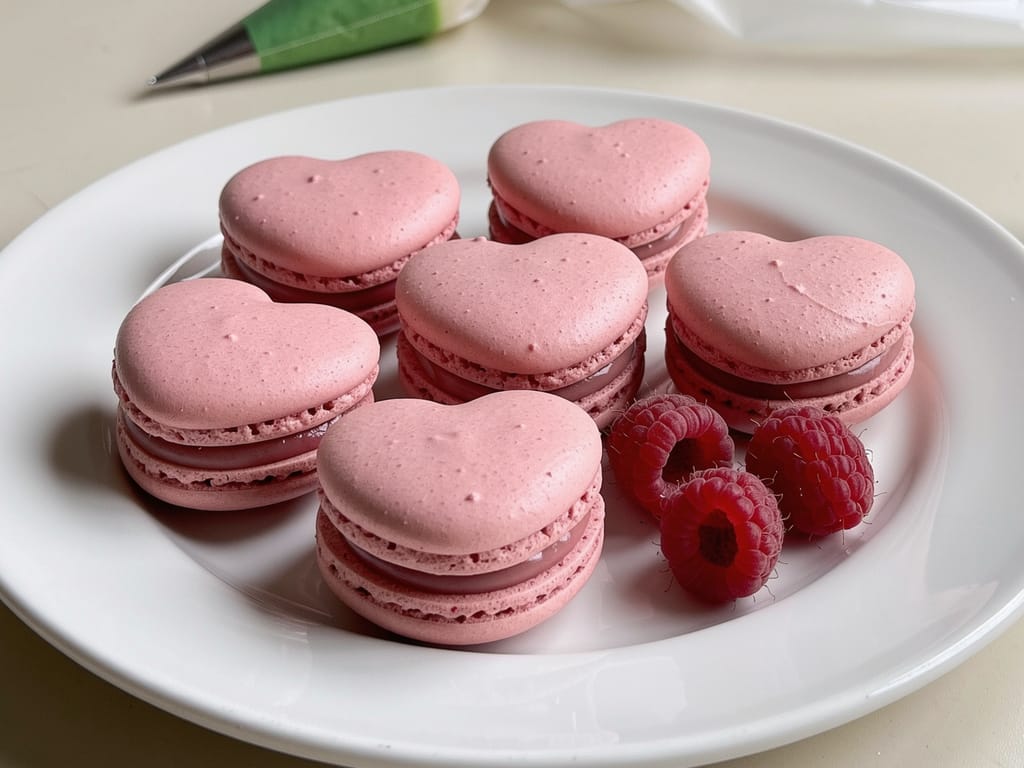
To make heart-shaped macarons, pipe two side-by-side drops with a round tip and pull them diagonally down into a single point (a V shape), with a template under your mat. The batter needs to be a little thicker than for round macarons, or the hearts will spread into circles. Everything else is the same as for classic macarons: drying before baking, baking and filling. Here you'll find only what's different for hearts.
How to Pipe Heart-Shaped Macarons
You pipe a heart in three movements: left drop, right drop, pull down into a point, then tidy it up with a toothpick. All you need is a plain round tip with an opening of about 8 mm and a piping bag held perpendicular to the mat.
Place the tip over the upper left lobe of the template, squeeze and let a drop flow out to fill the left lobe of the heart.
Without lifting the bag, pull diagonally down toward the point, gradually easing off the pressure until you're not squeezing at all by the end. Finish the point with a short flick to the side.
Repeat as a mirror image on the right: a drop in the right lobe, then pull down into the same point. The two halves merge in the middle.
To finish, use a toothpick right away to draw the batter into a sharp tip and pop any bubbles. While the batter is still fluid, it levels out on its own.
The pressure rule: more where the heart is wide, less where it narrows. If you press evenly, you'll get a heart with a thick, rounded point that also bakes unevenly.
For the basics – almond flour, meringue, macaronage and baking – see macarons step by step. If you want a tested shell recipe right away, try the salted caramel macaron recipe; you can pipe its shells into hearts in exactly the same way.
Did that help? We’ll send you more tips by email.
Seasonal baking plans, tested recipes and kitchen tricks that save you time. Unsubscribe in one click.
How Thick the Batter Should Be for Heart Macarons
For hearts, stop the macaronage a few folds earlier than for circles. The batter should be glossy and flowing like slow lava, but a ribbon of it drawn with a spatula should melt back in more slowly, in roughly 15–20 seconds instead of the usual 10.
Batter too thin: the lobes run together, the point rounds off and the heart turns into a drop or an egg.
Batter too thick: little peaks and a trail from the tip stay on the surface, so the heart isn't smooth and may crack.
Just right: the outline holds, but the tail left by the tip levels out on its own within a few seconds.
If you're not sure, pipe one test heart. If it spreads past the template line, don't mix the batter any further and pipe the hearts slightly smaller than the line. If a little peak stays on the surface, give the batter two or three more folds.
Heart Macaron Template: Which Size to Choose
The best size is a heart 3.5–4 cm wide. Once baked, it's roughly the same as a classic macaron 3.5 cm in diameter, and it fills just as easily.
3–3.5 cm: tiny hearts for a box of chocolates or to decorate a cake. They demand more precision, and the point is easily overbaked.
3.5–4 cm: the all-round size and the most forgiving.
5–6 cm: large hearts as a gift. They need thicker batter and 2–3 minutes longer in the oven.
Print the template on plain paper and slide it under the mat or parchment paper, leaving at least 2–3 cm between hearts. Turn all the hearts with the point in the same direction, which makes them easier to pair later. Before the shells dry, pull the template out so it doesn't absorb moisture or block airflow under the mat. The template shows through a thin perforated mat best; whether a mat or paper is better is covered in macarons on a silicone mat or on paper.
How Long to Let Heart Macarons Dry Before Baking
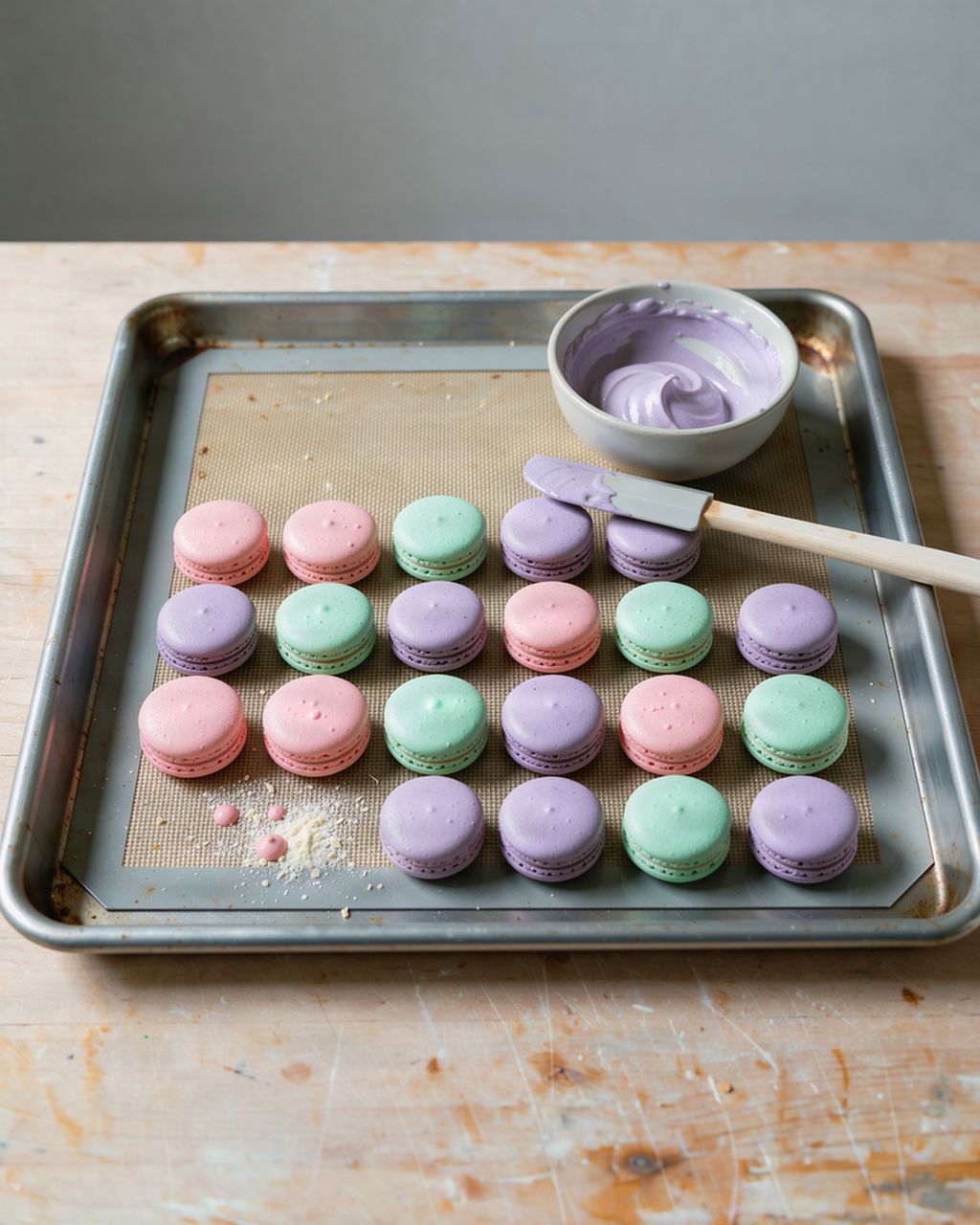
Let the piped hearts dry for 30–45 minutes, until a skin forms on the surface that doesn't stick to a fingertip. Hearts need the longer end of the range more than circles do: the point is thin and dries quickly, while the lobes are thicker and hold moisture longer. So check the lobes, not the point.
In a warm, humid kitchen it can take up to an hour. If your hearts crack on the lobes in the oven or have no feet, you'll find the cause and the fix in macarons crack and have no feet.
How to Color Macarons Pink and Red Without Cracking
Use gel or powder coloring, never liquid. Liquid coloring adds water, thins the batter, and the hearts lose both their shape and their feet.
When to color: add it to the meringue at the end of whipping, not to the finished batter. That way you don't have to mix the color in during macaronage, and you won't overmix the batter.
Pink: a small amount of gel is enough (a few drops for a batch with 3 egg whites). The shade lightens slightly after baking, so mix it a tone deeper than you want.
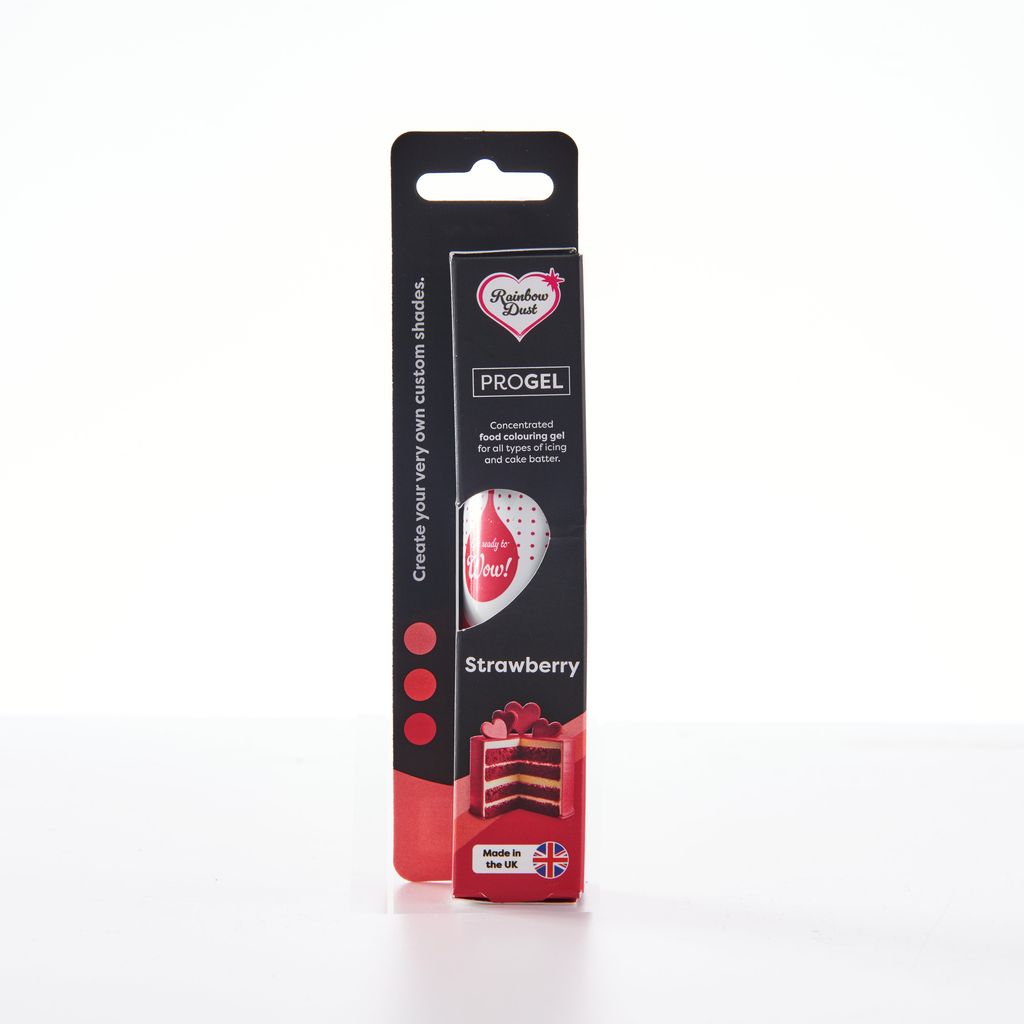
Red: it needs a lot of coloring, which makes it the riskiest. Reach for a concentrated gel or a powder coloring, and don't chase the shade with more gel once it's in the batter, because the batter thins out. The result tends to be a deep raspberry rather than a true red, so plan for that.
Baking without browning: pink and red quickly turn "rusty" in the oven. Bake at a lower temperature (around 140–150°C / 285–300°F, depending on your oven) and, for a longer bake, put an empty baking sheet on the top rack as a shield.
Exactly how much gel to use, and why too much coloring leads to cracks, is covered in the article on coloring macarons with gel coloring. You'll find gel and powder shades in the baking colors and food coloring category.
What to Fill Heart Macarons With for Valentine's Day
For Valentine's Day, the best match for pink hearts is a raspberry white chocolate ganache or a ruby chocolate ganache. Both are naturally pink, and their tart notes balance the sweetness of the shells.
Raspberry ganache: melt white chocolate with strained raspberry purée in place of part of the cream. The raspberry gives it color and tartness; strain out the seeds, or they'll crunch between your teeth in the filling.
Ruby ganache: ruby chocolate has its own fruity, slightly tart flavor and a pink color without any coloring. Heat it gently, because if it overheats or sits in the light for a long time, the shade can fade to beige.
White chocolate cream: a neutral base into which you stir a spoonful of raspberry paste or freeze-dried powder. White chocolate cream, not just for macarons works as a starting point; just leave out the coffee.
With hearts, pipe the filling as one drop in the center and a second into the point, or the point stays empty. For chocolate-to-cream ratios and how long to let filled macarons mature in the fridge, see macaron fillings: ganache, buttercream and fruit pastes.
How to Pair and Pack Heart Macarons as a Gift
Pair heart macarons by their outline, point included. After filling, let them mature in the fridge overnight, and put them into gift packaging only once chilled, keeping them out of the fridge for 2 hours at most.
Pairing: once the shells have cooled, line them up in rows by size and match the ones whose outline fits even at the point. With circles you can hide a small difference, but with a heart it shows right away.
Maturing in the fridge: leave the filled macarons overnight in an airtight container. The shell absorbs moisture from the filling and softens into the right texture.
Packaging: ideally a sturdy box with dividers or an insert, where the hearts lie on their sides or flat and don't get squashed. A cellophane bag works too, but only with a firm cardboard base, or the points will break off.
How long they keep out of the fridge: with ganache or fruit filling, 2 hours at most, and only 1 hour above 32°C (90°F) (USDA/FSIS). For the trip, pack them in a cooler bag, and tell the recipient to put them in the fridge and take them out 20–30 minutes before eating.
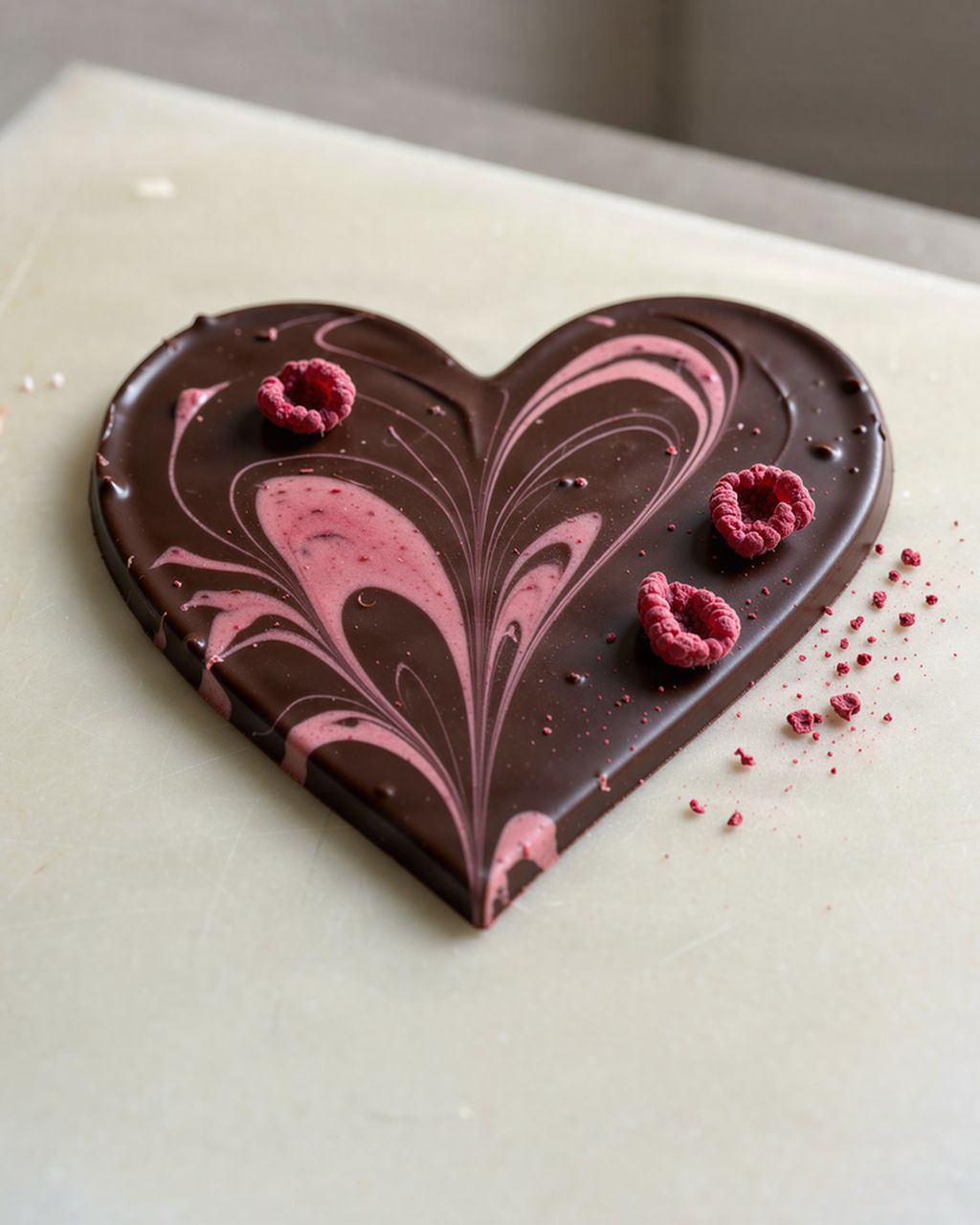
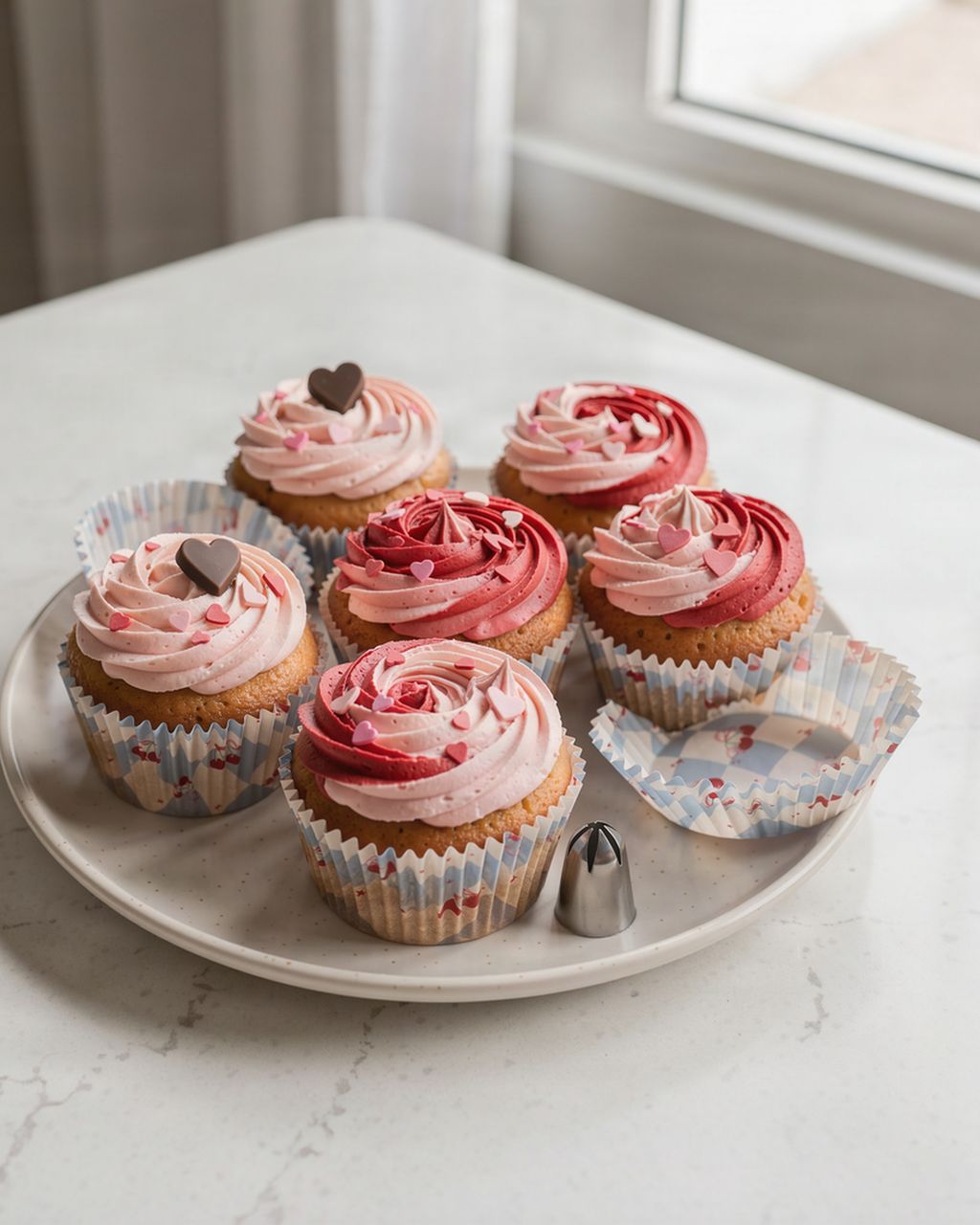
If you're planning a whole Valentine's Day, macarons fit into the plan for Valentine's Day at home as a sweet gift. And if you want to add something else, take a look at the no-mold chocolate heart or the Valentine's cupcakes with pink frosting.
Tools and colors for heart macarons
One Way
Piping Bags 36x20 cm, 100-PackKč 625.00


Frequently asked questions
Can you bake heart-shaped macarons in a silicone heart mold?
Probably not. A deep silicone mold with hollows stops macarons from forming feet and a smooth top. A flat mat or a sheet of paper with a template underneath works better, and shaped mats with printed outlines are fine as long as they're flat.
What piping tip should I use for heart macarons?
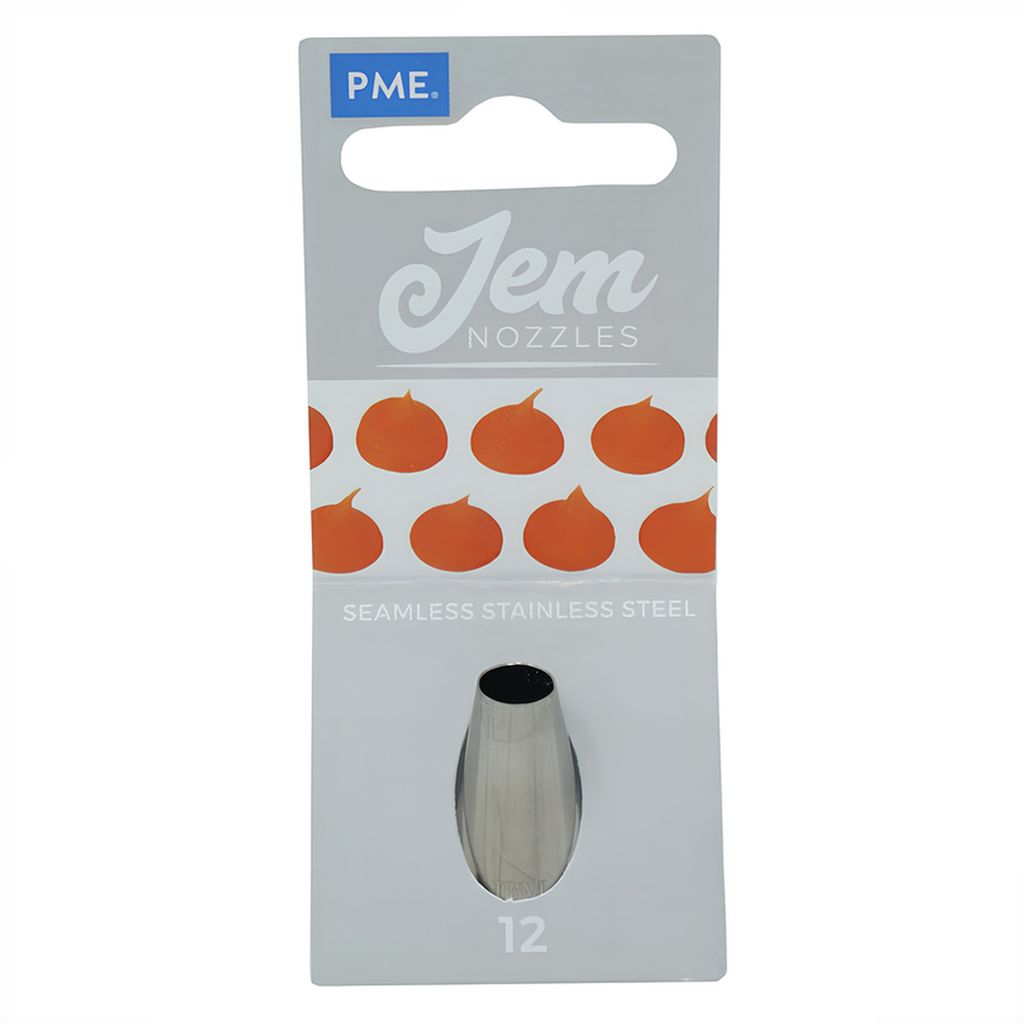
A plain round tip with an opening of about 8 mm (such as a JEM #12). A smaller opening slows the piping so you can't finish the heart in time, while a much larger one lets out too much batter at once and the lobes run together.
How many heart macarons does a batch of 3 egg whites make?
A batch with 3 egg whites (about 100 g) makes roughly 36–44 shells 3.5–4 cm wide, which is 18–22 filled hearts. Hearts use a little more batter than circles of the same width, and a few shells usually go to a test heart and unmatched shells.
How long do filled heart macarons keep?
In an airtight container in the fridge, 2–3 days from filling, and the day of maturing counts. Filled macarons can be frozen for up to a month and should be thawed slowly in the fridge so the shells don't turn damp.
Can heart macarons be colored naturally, for example with beet or raspberries?
It's possible, but risky. Freeze-dried raspberry or beet powder only tints the shells a pastel pink and often browns in the oven. Add it in a small amount in place of some of the almond flour, not on top of it, or the batter ratio will change.
Want tips like this every Thursday?
One recipe worth heating the oven for, one tip, and one deal from the shop. Nothing else.