Cakes for Men: Decorating Ideas for 18th, 40th and 50th Birthdays
Ball, Car or Book Cake: How to Bake, Carve and Cover It
Updated Nov 17, 2026
You can make a ball, car or book cake without any special pans. Bake the ball as two hemispheres in ovenproof bowls, and carve the car and the book from a sheet cake using a paper template. To hold its shape, the cake needs a dense, sliceable sponge, firm chilled filling under the covering, and supports for larger cakes. Here's the method for all three shapes, from pan to fondant.
A shaped cake comes down to two things: the pan you bake the rough shape in, and the carving that finishes it. For the three most common shapes, it looks like this:
Ball / soccer ball – pan: two identical ovenproof bowls (stainless steel or glass), or a hemisphere pan. Method: bake two hemispheres, level them, join them with frosting and refine into a ball with a knife.
Car – pan: a sheet pan or large rectangular pan. Method: stack 2–3 layers with frosting, chill, and carve the car's profile from the side and top using templates.
Book – pan: a sheet pan or rectangular pan. Method: trim one or two layers into a rectangle; for an open book, carve a shallow groove down the middle and gently round both halves.
All three shapes then get a thin coat of frosting, a chill, and a covering of fondant or buttercream. If you want a flat number or letter cut from a template, that's a different technique – you'll find it in the article number cake from a template.
Recipe of the week, one tip that saves you time and one deal from the shop. Unsubscribe in one click.
The next issue goes out on Thursday, November 26.
For a carved cake you need a dense, moist sponge with a fine crumb – a creamed butter cake (like Madeira or a pound cake batter baked in a sheet pan) or a moist chocolate cake made with oil or butter. This kind of batter can be cut with a sharp knife without crumbling and will carry the weight of the frosting and fondant.
Light, airy sponge isn't right for a ball or car. It tears under the knife, soaks up frosting and sinks under fondant. Use a classic light génoise sponge at most for a flat book, where you carve almost nothing.
Bake the cake a day ahead. Cooled, wrapped in plastic wrap and rested, it cuts much more cleanly than a fresh, warm one.
Chill it before carving. A cold cake doesn't crumble and the edges stay sharp.
Don't throw out the scraps. Mixed with a little frosting, they make a modeling paste for small details – mirrors, bumpers, the book spine – or cake pops.
Bake a ball cake as two hemispheres in two identical bowls, then level them and join them with frosting. A special hemisphere pan makes it easier, but you don't need one.
Prepare the bowls. They must be oven-safe – stainless steel or heatproof glass, not plastic or thin porcelain. Grease them thoroughly and dust with flour; for how to do this with different materials, see the article how to grease a baking pan.
Fill no more than two-thirds. The batter will rise into a dome in the bowl, which you'll trim off anyway.
Bake more slowly than a cake in a regular pan. A deep bowl cooks the center later than the edges, so use 150–160°C (300–320°F) instead of the usual 170–180°C (340–355°F). As a guide: a bowl 18–20 cm (7–8 in) across (about 1.5 l) filled two-thirds full needs 55–75 minutes, and a smaller bowl of about 15 cm (6 in) takes around 40–50 minutes. Check doneness with a skewer pushed into the center all the way to the bottom – it must come out dry.
Level and join. Trim the cooled hemispheres flat. After trimming, they're usually shallower than half a ball, so place a thin round layer of cake of the same diameter between them – the ball then won't look flattened.
Make a stable base. Trim the bottom hemisphere flat at the bottom so it won't roll, and set it on a firm cake board the same diameter as that flat area.
Refine the shape with a knife. After joining and chilling, smooth the transitions and bumps with a sharp knife, ideally using a round cardboard template that you turn around the ball.
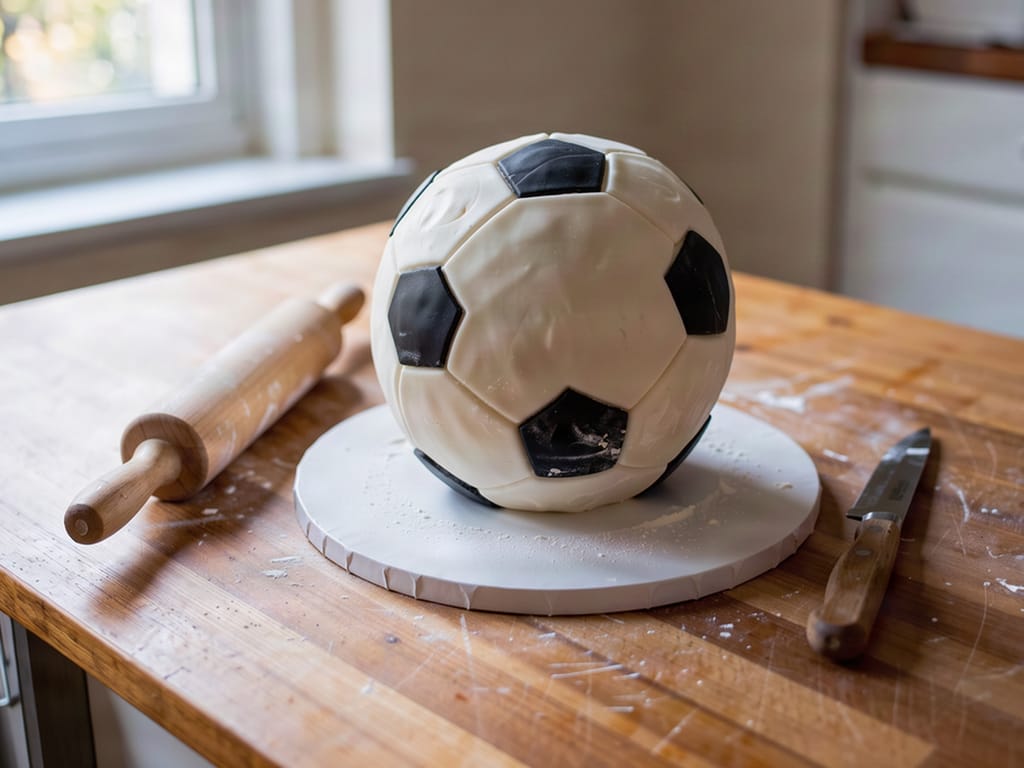
Build a soccer ball piece by piece, straight onto the frosting: coat the ball smoothly with firm frosting, chill it, then lay cut-out black pentagons and white hexagons of thin fondant tightly side by side on top. This avoids the folds you get when covering a ball with one piece. Alternative: if you can cover the ball with one sheet of white fondant, stick on only the black pentagons and draw in the hexagon lines with a knife or black coloring. Black fondant or frosting is best colored with gel coloring – for example ProGel gel coloring – Black (25 g) gives a deep black without thinning the fondant. You'll find more shades for jerseys, grass or wheels in the category cake colors and food coloring.
Carve a car cake from 2–3 rectangular layers stacked together, using paper templates of the side profile and the top view. You don't need a special car pan, and the result looks more like the exact car you want.
Bake the cake in a sheet pan or a large rectangular pan. If you have an adjustable cake ring, you can also shape it into a rectangle – how to seal it so the batter doesn't leak is covered in the article cake baked in a ring.
Draw two templates. The car's side profile (the height and shape of the hood, roof and trunk) and the top view. Cut both from parchment paper at the actual size of the cake.
Stack and chill. Spread a thin layer of firm frosting between the layers, level them and chill until the block is firm.
Carve the top view first, then the profile. Lay the template on top and trim around the outline. Then hold it against the side and cut the line of the hood, windshield and roof. Only at the end do you round the edges – a car has no sharp corners.
Bevel the bottom. Slightly angle the bottom edge inward along the sides, so the car looks like it's standing on its wheels rather than on its whole belly.
Make the wheels edible. Use discs of black fondant, chocolate cookies, or discs cut from cake scraps and coated in frosting. Make the windows from gray or black fondant, and the lights from white and yellow.
Always set the car on a firm rectangular board – it's long and narrow and would otherwise snap in the middle when you move it.
A book cake is the easiest of the three: a rectangular sheet cake trimmed into a book shape, with a shallow groove down the middle for an open book. You carve very little, so a lighter cake works here too.
Closed book: trim the cake into a sharp rectangle. Cover three sides of the "pages" with white or cream fondant and score horizontal lines into it with a knife. Let the covers of colored fondant overhang the pages by a few millimeters, like a real book, and round the spine slightly.
Open book: carve a shallow lengthwise groove down the middle and round both halves down from it toward the edges, so they look like curved pages. You can tuck a thin strip of cake under the edges to lift the "pages."
Cover with a picture: a printed image suits the covers or a page – how to stick it on and which frosting to use under it is covered in the article edible paper for cakes.
A book is wide and low, so it usually needs no supports – a firm board is enough. Only if you stack books like a tower does each one get its own board and the bottom ones get dowels (see below).
Under fondant on a shaped cake you need a frosting that sets firm once chilled and holds the edges: chocolate ganache or buttercream (Swiss or classic). Soft, watery fillings won't hold the shape and the fondant slides off them.
Ganache is the surest choice. For covering, make it thicker than for glazing – for dark chocolate roughly 2 : 1 (chocolate : cream), for milk chocolate about 3 : 1 and for white 3 : 1 to 4 : 1, because milk and white chocolate set less firmly.
Buttercream is good when you don't want a chocolate flavor. Which type is firmest and how to make it is covered in the article buttercream for cakes: classic, Swiss or with pudding.
Not suitable: whipped cream, mascarpone on its own, quark fillings or pudding without butter – they go soft under fondant, release water and the fondant dissolves on them.
The method is always the same: a thin first layer (crumb coat) traps the crumbs, you chill it, then add a second layer and smooth it as evenly as you can with a scraper. Every bump under the fondant will show through it.
Fondant gives a ball, car or book a smooth, "finished" look and sharp lines; buttercream is easier and tastier, but the shape will be softer and the details rougher.
Ball: it's hard to cover with a single sheet of fondant, because it bunches into folds at the bottom around the ball. So build the soccer ball piece by piece from cut-out pentagons and hexagons straight onto the frosting (method above); a continuous white covering with pentagons stuck on is an alternative for more experienced bakers. You can also do a ball without fondant: spread the frosting smooth and draw in the pattern.
Car: fondant pays off most here, because it highlights the hood and windows. Cover it in one piece and trim off the excess at the base.
Book: both work. Frosting with scored page lines looks cozy, while fondant gives a crisp book that looks straight off the shelf.
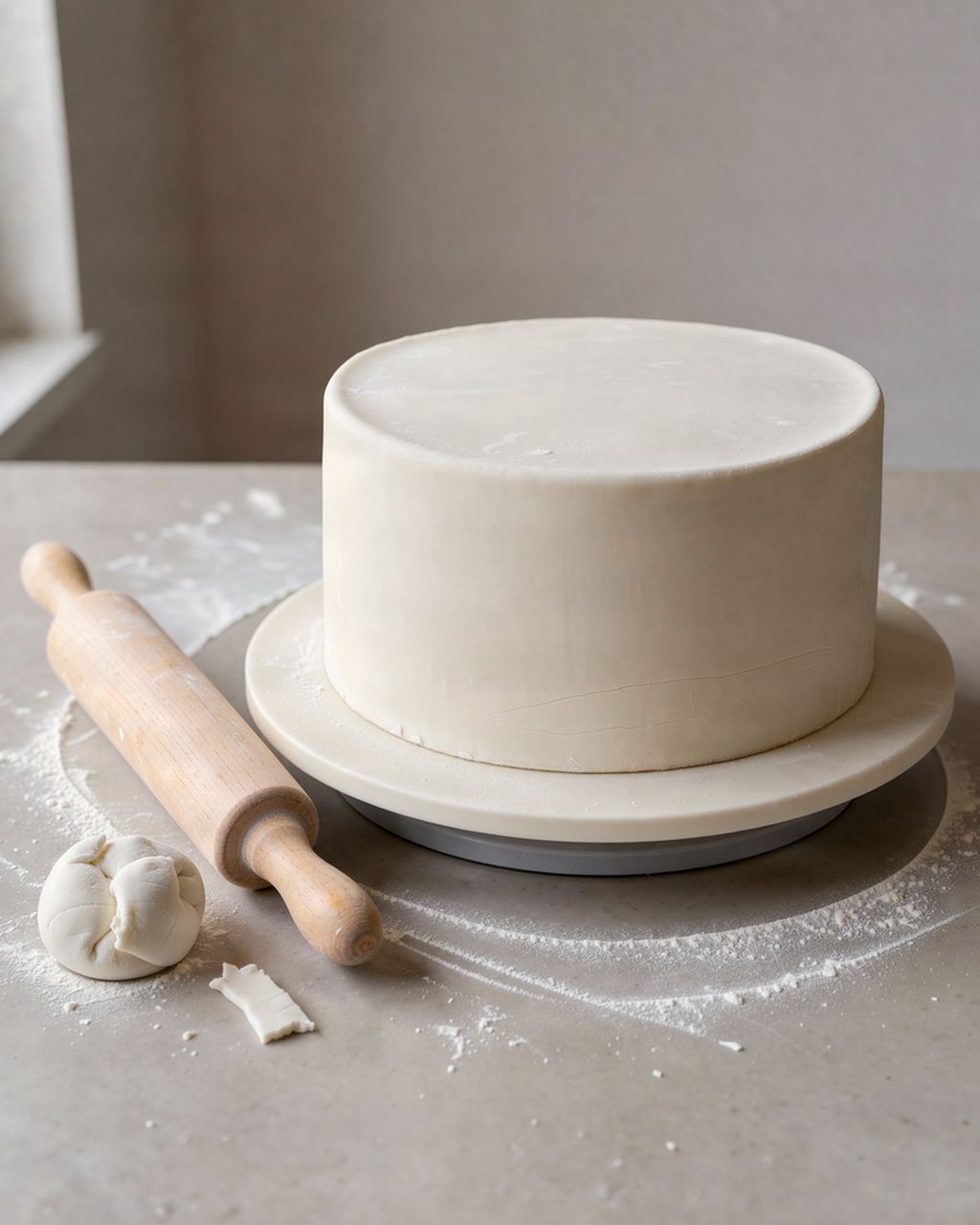
How to roll out fondant so it doesn't crack, and how to cover a cake with it without folds, is covered in the article fondant for cakes: rolling and covering. If you want to make your own fondant, see homemade marshmallow fondant. And ideas for decorating a cake with a kids' theme are in the article decorating kids' cakes.
Every shaped cake needs supports if it is taller than it is wide, or has something on top of it – a large ball, a car with a tall roof, a tower of books. A low book can get by with a firm board.
A cake board (cardboard or plastic) under each shape, ideally cut exactly to its footprint so it isn't visible.
Dowels (plastic or wooden cake dowels) pushed into the bottom tier and trimmed to its height. Another board and the top piece rest on them – the weight goes onto the dowels, not the cake.
For a ball, put the dowels in the bottom hemisphere and place a thin hidden board between the halves; otherwise the top half will slowly squash the bottom one.
Always chill before moving. Cold frosting holds its shape, warm frosting slides.
Where to store a shaped cake depends on the filling, not the covering.
A filling with whipped cream, quark, mascarpone, cream cheese or pudding belongs in the fridge. According to the US food safety agency USDA/FSIS, perishable foods like these shouldn't be left at room temperature for more than 2 hours, or more than 1 hour above 32°C (90°F). Keep that in mind for an outdoor party.
Fondant sweats in the fridge. When you take it out, condensation forms on it – let it evaporate on its own and don't touch it, or you'll leave blotches. Black and deeply colored areas are the most sensitive.
You can bake the cakes ahead and freeze them. Wrap them well in plastic wrap and put them in the freezer; according to USDA/FSIS, food kept frozen at −18°C (0°F) is safe indefinitely, and only flavor and texture change over time. Thaw them wrapped in the fridge and carve them while still cold.
A soccer ball cake needs 12 black pentagons and 20 white hexagons, just like a real ball. Roll out thin white and black fondant, cut the shapes with a paper template or cutter, and lay them tightly side by side on the chilled frosting, starting at the top and working down. For a more advanced version, cover the ball with a single sheet of white fondant, stick on only the pentagons, and draw the lines between the hexagons with a knife or black food coloring.
You can, but only from a dense one. Store-bought sponge layers aren't enough for a car because they're thin, airy and tear under the knife. A store-bought butter pound cake or a dense loaf cake from a rectangular pan works well: stack two or three pieces with frosting into a block, chill it, and carve it with a template just like a homemade cake. If the store-bought pieces are dry, brush them lightly with syrup before stacking, but not too much, or they'll go soft and won't hold their shape.
Transport a ball cake chilled, stuck with frosting to a larger firm board, in a box taller than the ball. The ball mustn't balance on a point, so trim the bottom flat. In the car, put the box on a level floor behind the seat, not on the seat, and take corners carefully.
The cleanest way to add lettering to a book cake is to use letters cut from thin fondant, or to write with a brush or a piping bag with a thin tip and frosting colored with gel coloring. Let the fondant dry for a little while first so it doesn't shift under the brush. You can also print the whole cover design on edible paper and stick it on.
One recipe worth heating the oven for, one tip, and one deal from the shop. Nothing else.