Mousse Cake Step by Step: Gelatine, Ring, and Acetate Strip
Baking a Cake in a Cake Ring: How to Wrap It So the Batter Doesn't Leak and How to Set the Diameter
Updated Nov 17, 2026
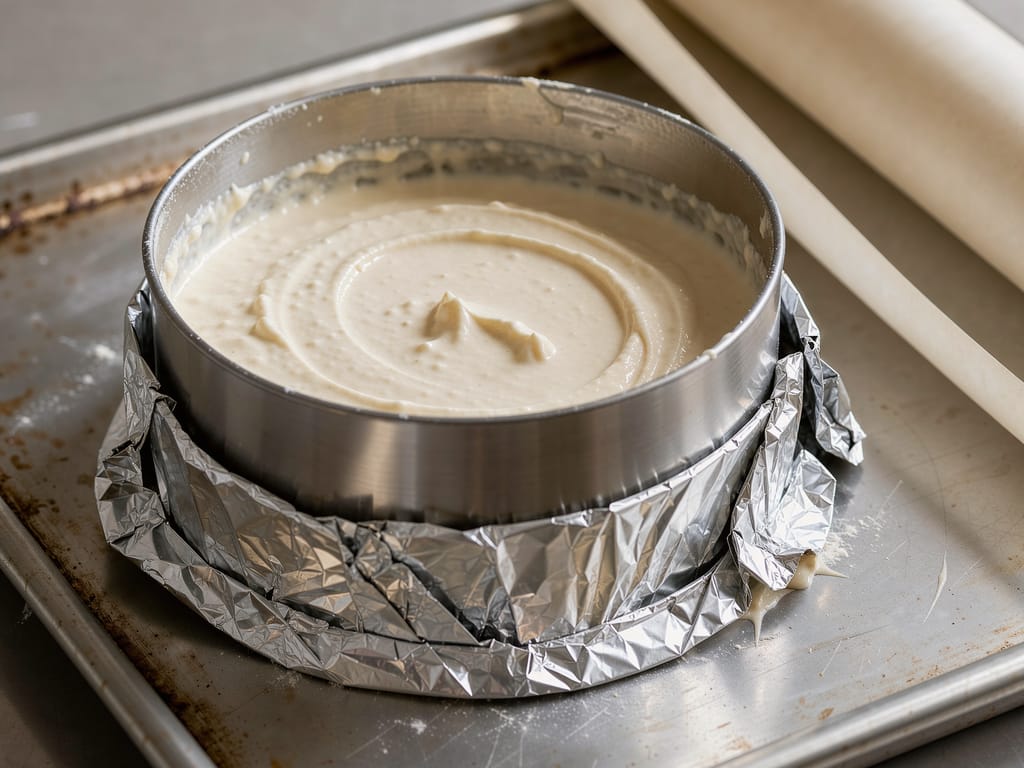
A cake baked in a cake ring won't leak if you wrap the underside in a double layer of aluminum foil plus parchment paper, pull them at least 3 cm (about 1¼ in) up the outside of the ring, and set the whole thing on a baking sheet. A cake ring is a pan with no bottom, so you have to make one yourself, and how well it seals depends mostly on how thick the batter is. Here's how to wrap the ring, how to set the diameter on an adjustable round or square ring, which batters work in it, and how to get the cake out without torn edges.
Wrap the outside of the ring in double foil and put parchment paper inside. That's the most reliable combination. The foil holds its shape and seals the bottom edge, and the paper keeps the cake from sticking so it comes out easily.
Tear off two wide squares of foil, each about 10 cm (4 in) larger than the diameter of the ring, and stack them (turn the second by 45° so the seams aren't in the same spot).
Put a square of parchment paper of the same size on top.
Stand the ring in the center and pull the paper and foil up along the outside wall. Press them firmly against it all the way around with your palm so there's no slack between the wall and the foil. It should come up at least 3 cm (about 1¼ in).
Line the inside wall with a strip of parchment paper, letting it stick out slightly over the rim. The paper clings to the wall if you lightly grease the inside of the ring first.
Move the whole thing onto a baking sheet, never straight onto the oven rack. The sheet supports the base and catches anything that does leak.
Parchment only, no foil? That's enough for a thick batter: line the baking sheet with paper, press the ring firmly onto it and you're done. But you can't fold paper on its own tightly enough to seal, so for anything thinner, add foil on the outside.
Sliding rings seal worse than fixed ones. Where the metal band overlaps there's a gap, and thin batter escapes there first. Press the wrapping down most carefully at that spot.
Seasonal baking plans, tested recipes and kitchen tricks that save you time. Unsubscribe in one click.
You bake a cake in a bottomless pan just as you would in a regular cake pan. The only differences are how you prepare the base and that you handle the baking sheet more carefully.
Set the diameter of the ring and lock it (see below).
Wrap the bottom in foil and parchment paper, and line the wall.
Put the ring on the baking sheet and only then pour in the batter. Don't carry a full ring, as the batter would be pushed out under the edge.
Fill it halfway, two-thirds of the height at most. The batter needs room to rise.
Bake according to your recipe. The batter decides the temperature and time, not the ring. Put the baking sheet in the middle of the oven and don't open the oven during the first half of baking.
Check doneness with a skewer pushed into the center. It should come out dry, with no sticky bits.
Let the cake cool in the ring on the baking sheet. A warm cake layer is soft and could bend when you remove the ring.
If you're just starting out and wondering whether to buy a ring at all, take a look at baking essentials for beginners.
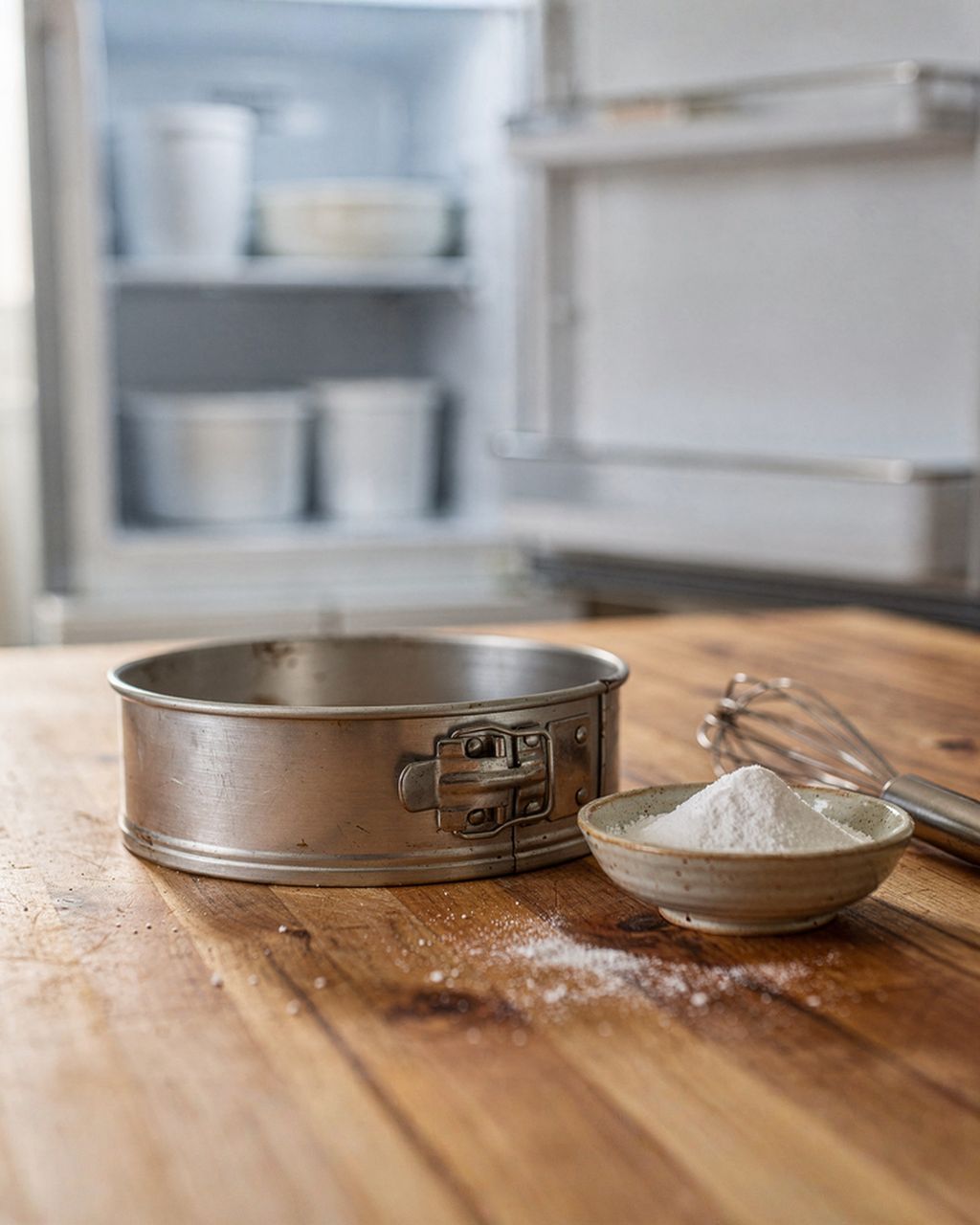
To set the diameter, expand or tighten the ring to the size you need and lock it with the clasp or screw. An adjustable, sliding or expandable ring is, in practice, all the same thing: a stainless steel band that slides over itself.
To adjust a round ring, loosen the clasp, expand the ring to the diameter you want and measure inside it with a ruler. Only then lock it.
Release the lock, meaning the clasp or locking pin.
Expand the ring to the number on the scale. Then measure the diameter inside with a ruler in two directions crossing each other. The scale is usually only a guide, and the ring can stretch into an oval.
Lock it. For its adjustable ring, Tescoma advises sliding the metal clasp about 2 cm (¾ in) from the free end so the band doesn't slip apart under the pressure of the batter.
Check that the ring stands level and sits on the baking sheet along its whole circumference.
At the largest diameter the overlap is shortest, which makes it the weakest spot. When you expand the ring all the way, wrap the outside especially carefully.
An adjustable square ring is made of four plates that slide into each other, so you set two sides separately and can make either a square or a rectangle, within the limits the ring allows. Patisse, for example, gives a range of 25–46 × 17–32 cm at a height of 5 cm, so the largest square you can make with it is roughly 32 × 32 cm.
Slide the plates out to the length you want and measure both sides and both diagonals. If the diagonals are equal, you have right angles.
The joins at the corners are four places where batter can escape. Pull the foil up at the corners and press the folded part against the wall.
Choose the largest baking sheet you can for a big square ring, so nothing hangs over the edge.
To scale the amount of batter, go by the area of the base: divide the new diameter by the old one and square the result.
From 18 to 24 cm: (24 ÷ 18)² ≈ 1.78× more batter
From 20 to 26 cm: (26 ÷ 20)² ≈ 1.69×
From 26 to 20 cm: (20 ÷ 26)² ≈ 0.59×
A round ring with a 20 cm diameter has an area of about 314 cm², roughly the same as a square with a 17.7 cm side. A deeper layer of batter bakes longer and a shallower one bakes faster, so go by the skewer test, not the clock. You'll find conversions for a roasting pan, a pot and other substitute pans in the article what to use instead of a cake pan.
A bottomless ring needs a thick batter that slides slowly off a spoon and holds its shape. Tescoma says as much for its ring: a thicker, less runny batter. The thinner the batter, the better the ring has to seal.
With just parchment paper on the baking sheet, you can bake without any trouble:
creamed and butter batters that you spread with a spatula
a crumbly linecké (Czech Linzer-style) base pressed into the ring. The dough is the same as for classic crumbly Linzer cookies
dense nut and carrot cake layers
With double foil on the outside, you can handle thinner batters too:
sponge batters. For example, a fluffy Génoise sponge layer is a light foam that flows until it starts to bake
quark (tvaroh, a Czech fresh curd cheese) fillings and cheesecake
Better to use a pan with a fixed bottom for:
pourable batters with a lot of milk or oil, which are as thin as pancake batter
With a thinner batter, get help from a pre-baked bottom layer. First pour in only a thin layer (about 1 cm), leave it in the oven for 5–10 minutes at the temperature from your recipe until the surface turns matte and stops moving, and then pour in the rest. The set layer seals the bottom edge of the ring.
The best way to get the cake out of the ring is to let it cool completely and line the wall with paper. Then you simply lift the ring up.
Let the cake cool in the ring. A lukewarm cake layer breaks when you handle it.
With no paper on the wall, run a thin knife or spatula all the way around the wall, with the blade pressed against the metal.
With a sliding ring, release the clasp and expand the ring slightly. It lets go on its own.
Lift the ring straight up and don't twist it.
Peel off the bottom paper only once the cake is on a board or plate: flip the cake onto a rack, peel off the paper and turn it back over.
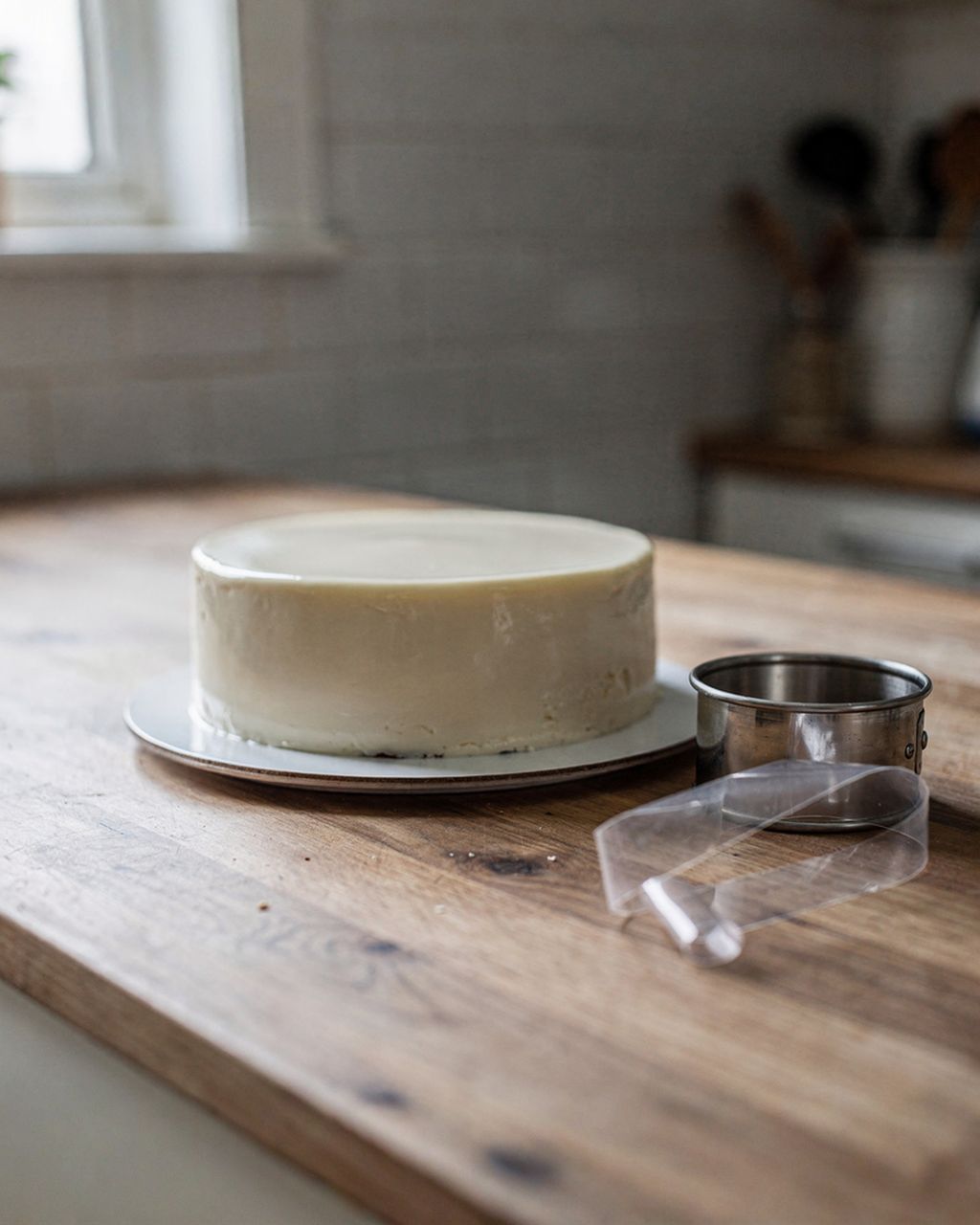
You can use the very same ring for cutting cake layers and assembling the cake, just without baking. For how to set cream, gelatin and film in it, we have the article mousse cake step by step.
For baking cake layers, a ring about 5–6 cm (2–2½ in) tall is enough, since you only fill the batter halfway to two-thirds. A taller ring (roughly 7–10 cm / 2¾–4 in) is mainly useful for assembling layered and mousse cakes, where you build up the cake layer, cream and filling inside it and leave it to set in the fridge.
If batter is leaking from the ring, leave the baking sheet in the oven and keep baking. The leaked batter bakes onto the sheet, and the ring usually seals itself after a while. Don't open the oven to press the ring down, because you'd only let the heat out and shake out more batter. Trim off the leaked edge after baking, and next time add a second layer of foil or thicken the batter.
It's better not to put a cheesecake in a cake ring into a water bath. The foil around the ring isn't watertight, so water seeps under the base. A safer option is to stand the ring on a baking sheet and put a separate pan of hot water on the lower oven rack. The steam does a similar job.
You can wrap a cake ring in foil alone, but the cake base sticks to it easily and tears when you remove it. If you don't have parchment paper, lightly grease the inside of the foil with fat and dust it with coarse flour (Czech hrubá).
Whether an adjustable cake ring can go in the dishwasher depends on the manufacturer. Tescoma, for example, allows it for its adjustable pan. Still, the moving parts and the scale last longer if you wash the ring by hand and dry it right away, so no water stays trapped in the overlap.
One recipe worth heating the oven for, one tip, and one deal from the shop. Nothing else.