Edible Cake Decorations: From Sprinkles to Dried Flowers
Edible Cake Paper: How to Stick It On, Which Frosting to Use and How Long It Lasts
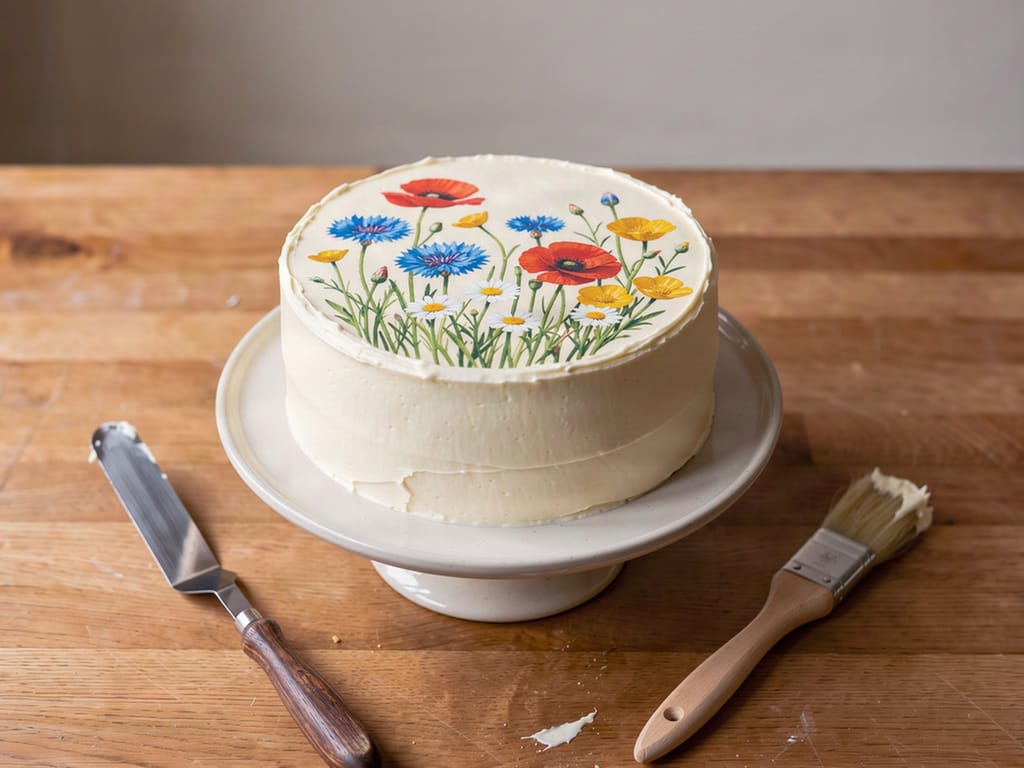
Updated Nov 17, 2026
Edible cake paper sticks best to a firm, drier surface – buttercream, ganache or fondant – and goes onto a chilled, smoothed cake. On whipped cream, quark or fruit it turns damp: a sugar sheet bleeds, and a wafer sheet curls and dissolves. What matters most is which kind of sheet you have – wafer (made from potato starch) or sugar (fondant-based). Below you'll find which frosting goes with which sheet, when to apply it, and how long the sheet keeps in its packaging and on the finished cake.
Wafer paper is a matte starch sheet that's afraid of water; sugar paper is a flexible sugar layer with richer print that melts into the surface on moist frosting. That's why each is applied differently:
Wafer (rice) paper – a thin, matte, slightly translucent sheet. Despite the name "rice paper," it's usually made from potato starch, water and oil (that's how the Italian maker Modecor describes it, for example). It's stiff and can be cut and shaped, but water makes it curl and dissolve. Print on it is a little paler.
Sugar (fondant) paper – a thin layer of sugar paste on a backing sheet. It has a richer, photographic print, is flexible, and on moist frosting it melts into the surface as if it were painted on. The trade-off: moisture makes it bleed, and in dry air it turns brittle.
In short: sugar paper needs a little moisture to stick, wafer paper needs as little as possible. Sugar is better for a photo on a cake; wafer is better for cut-out designs, sails, flowers and standing decorations.
Seasonal baking plans, tested recipes and kitchen tricks that save you time. Unsubscribe in one click.
The safest base for edible paper is buttercream, ganache and fondant – they firm up in the fridge, don't release water and can be smoothed perfectly. Whipped cream, quark cream and fruit are risky. Here it is, frosting by frosting:
Buttercream (American, pudding-based, Swiss) – sugar sheet: yes, apply it to freshly smoothed, still slightly tacky frosting. Wafer sheet: yes, but only on chilled, set frosting, otherwise it curls.
Chocolate ganache – sugar sheet: yes, on fresh or lightly moistened ganache. Wafer sheet: yes, best on set ganache with a thin coat of glue. It's the most reliable base of all.
Fondant – sugar sheet: yes, brushed with a very thin layer of water or edible glue. Wafer sheet: yes, with edible glue or a thin layer of glucose syrup, not water.
Whipped cream, mascarpone, žervé (a soft Czech cream cheese), cream cheese – sugar sheet: only right before serving, otherwise it bleeds. Wafer sheet: not directly – it curls and softens. The fix is a barrier (see below).
Fruit, jelly, mirror glaze – both sheets: no. Juice and gel dissolve the sheet.
The frosting under the paper should be smooth and level – every bump and bubble shows through the thin sheet. Any firm cake works as a base, for example a light Génoise sponge or a simple chocolate cake, which ganache suits naturally.
You stick edible paper on by laying it onto a smooth, chilled cake in one motion from the center outward and gently smoothing it with your palm. The method depends on the sheet: sugar paper needs slightly tacky frosting, wafer paper needs a dry surface and a thin layer of glue. As a rule: the less water, the fewer waves and bleeding colors.
Lay sugar edible paper onto freshly smoothed, slightly tacky frosting and smooth it with a dry palm from the center outward.
Frost the cake, smooth it and chill it for 20–30 minutes so the surface firms up.
If the sheet is soft from the heat and won't come off the backing, put it in the freezer for a few seconds – the backing then peels off more easily. If it's damp and sticky, leave it lying out in the air for a while.
Peel off the backing and lay the sheet on the cake. The frosting should be slightly tacky; if it has already dried completely, brush it very lightly with water or a few drops of frosting.
Smooth it with a clean, dry palm from the center outward. Don't stretch it or slide it around – a damp sheet tears.
Cover the edge with a decorative frosting border, pearls or sprinkles.
Stick wafer edible paper onto set, dry frosting with a thin layer of edible glue or glucose syrup on the back of the sheet.
Frost the cake and let the frosting set in the fridge – the surface must be firm and dry to the touch.
With a brush, coat the back of the sheet with a thin layer of edible glue, glucose syrup or a few drops of ganache. Never brush the front (printed) side.
Lay it on and press lightly. It works the same on fondant, just with even less glue.
On a whipped cream or quark cake, put edible paper over a barrier – a thin layer of firm frosting, a sheet of fondant or chocolate – so it never touches the moist cream. Three proven ways:
A thin layer of buttercream or ganache just where the image will go. The maker Icinginks recommends exactly this under images on whipped cream.
A sheet of fondant or marzipan (2–3 mm), onto which you stick the paper in advance and then lay the whole thing on the cake.
A disc of white chocolate – lay the image on spread chocolate, let it set, then place it on the cake as a decoration.
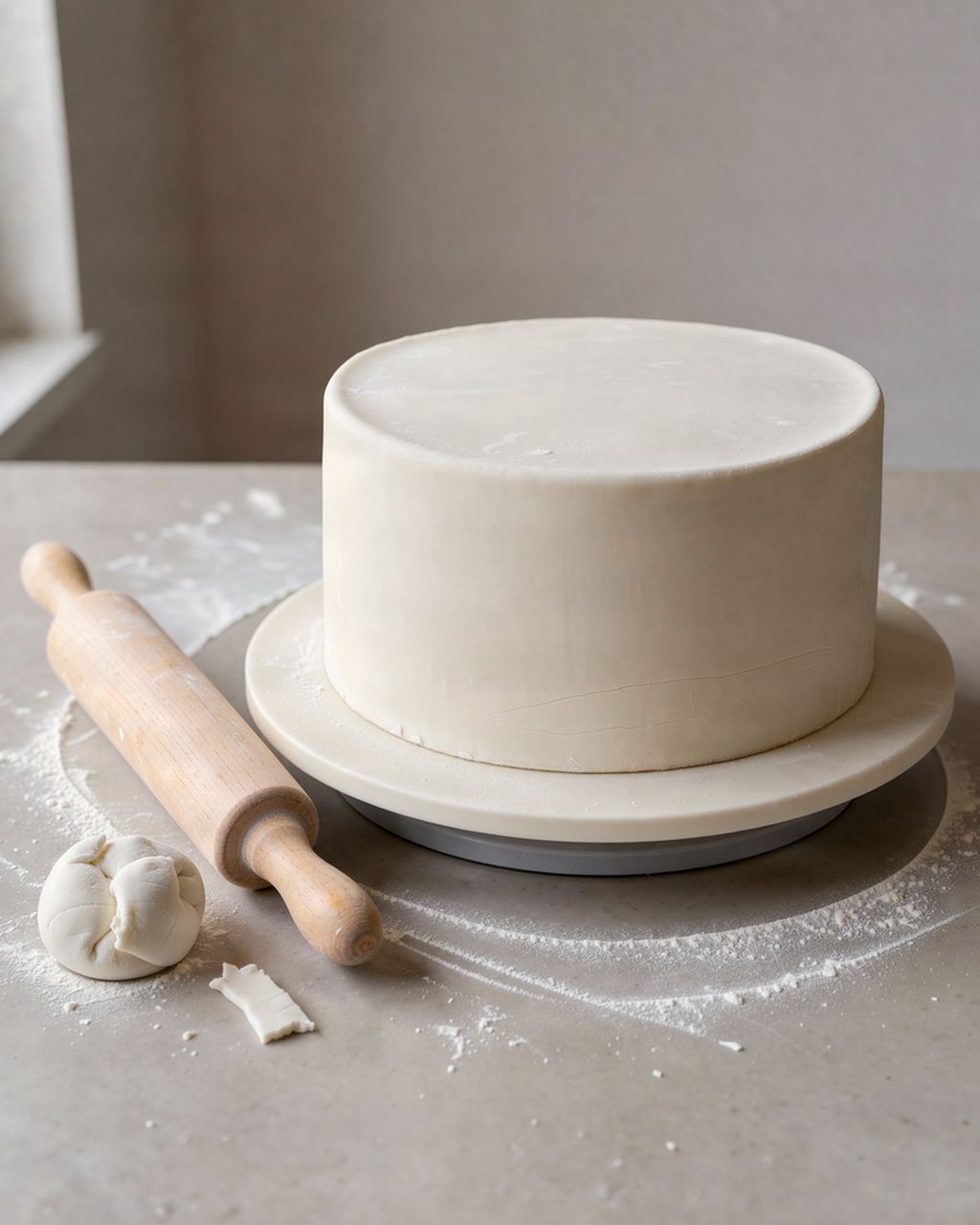
Put the sheet with the image onto the whipped cream only on the day of serving, and keep the cake in the fridge. For how to cover a cake smoothly with fondant so there are no waves under the paper, see fondant for cakes: icing, rolling and covering.
On a fruit cake, never lay edible paper directly on fruit or jelly – the juice dissolves it within tens of minutes. This is how it works:
Put the image on a fondant or chocolate disc and set that on the cake just before serving.
Divide the surface: the image on a buttercream circle in the center, fruit all around.
Stand wafer decorations (flowers, butterflies) upright in the frosting so they don't touch the fruit.
A typical problem case is a no-bake fruit cake with a moist filling – the image belongs on a separate disc there. For more on arranging fruit so a cake looks good even without a print, see decorating fruit cakes.
Put edible paper on the cake on the day of serving, ideally a few hours ahead – on buttercream and ganache, the morning is fine; on whipped cream, only right before serving. According to the maker Icinginks, an image can go on buttercream 24–48 hours and on fondant 2–3 days before serving, but the cake must then stay in a closed box in the fridge.
What moisture and heat do:
High air humidity (Icinginks gives above 60%) causes fading, softening and bleeding colors.
Direct sunlight quickly fades the print.
Condensation after taking the cake out of the fridge – water condenses on a cold cake and a sugar sheet can bleed. So don't take the cake out and put it back repeatedly, and leave it in its box after removing it from the fridge until the temperature evens out.
A finished cake with edible paper lasts as long as the filling under it – the paper itself doesn't spoil, the filling does. So safety is governed by the frosting, and appearance by the sheet:
Room temperature: don't leave a cake with a cream, quark or pudding filling out for more than 2 hours (only 1 hour above 32°C / 90°F; per USDA/FSIS, the rule for foods that need refrigeration).
Fridge: according to the USDA FoodKeeper, pastries and cakes with a cream or pudding filling keep 3–4 days. The same limit applies to a cake with an image.
Look of the image: according to Icinginks, an image stays nice up to 7 days in the fridge on buttercream and up to 10 days in the fridge on fondant. These limits concern appearance only – the frosting still determines safety, so the shorter limit wins.
Freezer: Icinginks states that a cake with an image can be frozen for up to 2 weeks. Thaw it slowly in the fridge, in a closed box, and expect that condensation may smudge the colors.
For a whipped cream cake, both the safe window and the visual window are shortest – eat it on the day you apply the paper.
Store unopened edible paper in its original sealed packaging, in a dry place at room temperature and out of direct sunlight – not in the fridge or freezer (that's what Czech sellers of Modecor sheets state). Moisture from the fridge makes the sheet curl and the colors bleed.
Shelf life:
Unprinted paper: 12–24 months according to manufacturers, if stored correctly; the date on the packaging always applies.
Printed paper: Czech sellers recommend using it within 4 weeks of purchase, because the print dries out and the sheet turns brittle. Go by what's on your sheet's packaging.
Sugar sheet is more sensitive than wafer – it dries out, cracks and is harder to peel off. So don't open it before you need it.
Seal the rest of an opened sheet back in a zip bag and press out the air.
Color wafer edible paper with dry powder or color mixed in alcohol, not water – water makes it curl. Your options:
Powder color with a few drops of vodka or pure alcohol – paint with a brush; the alcohol evaporates quickly and the sheet stays flat. Small amounts of alcohol evaporate, but for a children's cake it's better to reach for dry powder or an airbrush (see below).
Dry powder dusted on with a brush – soft gradients on flowers and leaves.
Airbrush – even areas and gradients, minimal moisture.
Gel color only in a very thin layer and heavily thinned with alcohol; undiluted, it makes the sheet twist.
Sugar sheet is harder to color at home – it dissolves as you paint. If you want your own design, it's easier to have it printed: at cake supply shops or photo labs that do edible printing, you supply your own image and get a finished sheet. It's printed only with edible inks in a special printer that has never printed with ordinary ink.
Edible paper is often free of gluten and milk, but it depends on the specific manufacturer – always read the ingredients on the packaging.
Wafer paper is usually made from potato starch (Modecor lists potato starch, water and oil, with no allergens). Some cheaper sheets, however, contain wheat starch (gluten) or soy – check this for a gluten-free celebration.
Sugar sheet contains sugar, starches, glucose syrup, the humectant glycerol, emulsifiers, thickeners and a coloring (usually calcium carbonate). It may also contain traces of allergens from production.
Edible inks and colorings are E-numbers. For the colorings E102, E104, E110, E122, E124 and E129, packaging in the EU must carry a warning that they may have an adverse effect on activity and attention in children (Regulation (EC) No. 1333/2008).
Titanium dioxide (E171) has been banned in food in the EU since 2022 (Commission Regulation (EU) 2022/63, following the 2021 EFSA opinion). If you find it in the ingredients of a sheet imported from outside the EU, better not to use it.
For a children's party with allergies, the rule is simple: if you want certainty, choose a sheet with clear ingredients from an established manufacturer. More ideas on what to put on a children's cake and what to leave off are in decorating children's cakes.
The most common problems with edible cake paper are curling, bleeding colors, a sheet that won't come off the backing, cracking and bubbles – almost always because of moisture or unsmoothed frosting. Here's what's behind them and how to avoid them:
The sheet curled – the wafer paper got too much water or the frosting was still soft. Next time, chill the frosting and use less glue.
The colors bled – a sugar sheet on whipped cream, condensation after taking the cake out of the fridge, or a humid room.
The sheet won't come off the backing – it's too damp (leave it in the air for a while) or, the opposite, soft from the heat (a few seconds in the freezer).
The sheet cracks – it's dried out or old. Don't buy printed sheets too far ahead.
Bubbles under the image – the frosting wasn't smooth. A smooth base is half the success.
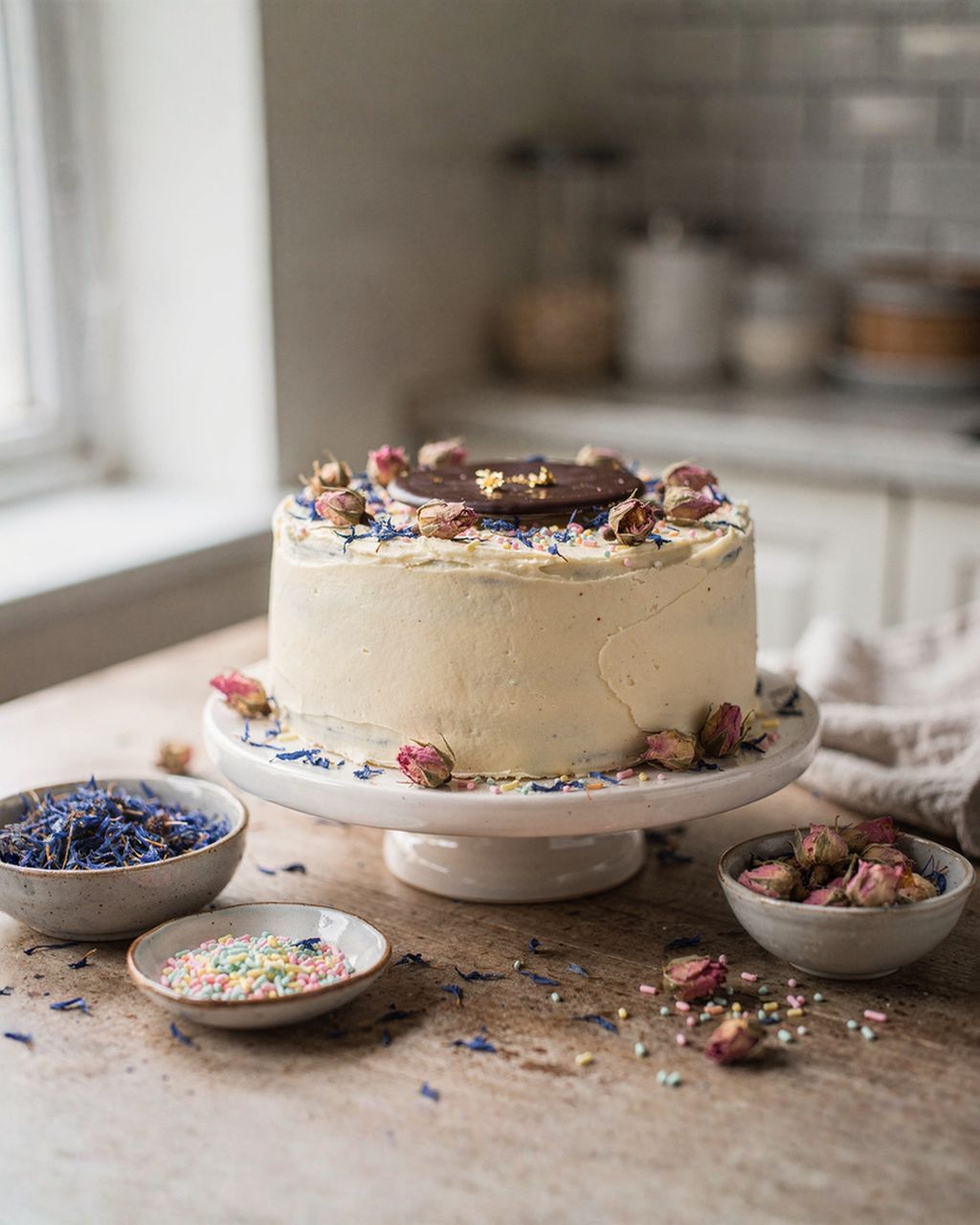
If you want to combine a print with sprinkles, gold or dried flowers, you'll find an overview in edible cake decorations.
Yes, edible paper holds on marzipan much as it does on fondant – a very thin layer of water or edible glue under a sugar sheet is enough. For a wafer sheet, use edible glue or a thin layer of glucose syrup instead, because water will make it curl. Smooth the marzipan before applying the sheet, since every bump shows through the thin paper.
Only briefly – heat, humid air and direct sun make the print fade and bleed, and the frosting under the sheet softens. Keep the cake in a closed box in the fridge until the last moment, set it in the shade outdoors, and don't leave a cake with a cream, quark or pudding filling out for more than 2 hours, or 1 hour if it's above 32°C (90°F). An image on fondant or ganache holds up best in the heat.
Yes, but mainly wafer paper – it can be cut with scissors or cut out with cutters, and it keeps its shape once dry, so it's used for flowers, butterflies or sails. Shape it with as little moisture as possible: lightly brush the edge with an almost dry brush, bend the sheet over a form (a spoon, a cone, aluminum foil) and let it dry completely. A sugar sheet can be cut too, but it's flexible and won't stand upright, so it suits flat designs better.
Yes, edible paper goes onto the sides of a cake in strips – sugar sheet works best, because it's flexible and wraps around the cake without cracking. Measure the cake's circumference (diameter × 3.14) and its height, lay the strip onto freshly smoothed buttercream or lightly moistened fondant, and press it on gradually with your palm. Split a longer circumference into two strips and hide the seam under a frosting border.
Cake supply shops and photo labs that print with edible inks on a special printer can make edible paper with your own picture. You send a photo, choose a wafer or sugar sheet and the size (circle, rectangle), and get a finished sheet. Use a printed sheet as soon as possible – Czech sellers recommend within 4 weeks.
One recipe worth heating the oven for, one tip, and one deal from the shop. Nothing else.