Sweet buns with silky vanilla custard
Crème Anglaise (English Custard Sauce): How to Cook It Without Curdling
Updated Oct 15, 2026
Crème anglaise is a pourable vanilla custard sauce made from milk, egg yolks and sugar. It thickens on the yolks alone – no starch, no flour. It won't curdle if you take it off the heat at 82–84°C (180–183°F) and strain it straight into a cold bowl. The whole trick comes down to a few degrees: go three degrees too high and you have sweet scrambled eggs. Below you'll find the ratios, the method, a spoon test for anyone without a thermometer, a rescue for when it does go wrong, and which vanilla to use.
Crème anglaise is a lightly thickened vanilla sauce – milk (or milk and cream), egg yolks, sugar and vanilla, heated slowly so the yolks thicken gently. Its consistency is like pouring cream: it flows, but it coats a spoon.
It's the base for plenty of other things:
a sauce for sweet buns, strudel, chocolate desserts and fruit,
an ice cream base – French-style vanilla ice cream is crème anglaise churned as it freezes,
the base for Bavarian cream – crème anglaise with gelatin and whipped cream, see Bavarian Cream: Vanilla Gelatin Cream Step by Step.
Don't confuse it with its thicker cousin: pastry cream (crème pâtissière) contains starch, is boiled until it bubbles and can fill choux rings. You'll find the differences and the method in The Secrets of Perfect Crème Pâtissière. Crème anglaise, by contrast, is never boiled – boiling is exactly what curdles it.
For 500 ml of liquid, use 5 egg yolks (about 85–90 g) and 80–100 g sugar, plus ½–1 vanilla bean. This makes roughly 600 ml of sauce, or 6 servings.
Liquid: whole milk alone gives a lighter sauce; half milk and half heavy cream (33%) gives a richer, slightly more stable custard. For ice cream, use a 1:1 ratio; for a sauce to go with a warm dessert, milk alone is fine.
Yolks: 4 yolks = a thinner sauce, 6 yolks = thicker and richer. With fewer than 4 yolks per 500 ml, the custard barely thickens at all.
Sugar: 80 g for a sauce to go with something sweet (sweet buns, chocolate), 100 g for ice cream – freezing dulls sweetness.
Vanilla: one whole bean per 500 ml gives a bold, "classic French" vanilla; half a bean is enough when the custard is just there to accompany something. For detailed amounts, see How Much Vanilla for Cookies, Custard and Sweet Braided Bread.
Insurance for beginners: 1 level teaspoon (about 5 g) of cornstarch mixed into the yolks pushes the curdling point up by a few degrees. Purists don't use it, and the flavor and texture are cleaner without it – but for a first attempt it's a legitimate safety net.
The method has five steps: infuse the vanilla in the milk, whisk the yolks with the sugar, temper, heat slowly to 82–84°C (180–183°F), and strain straight into a cold bowl.
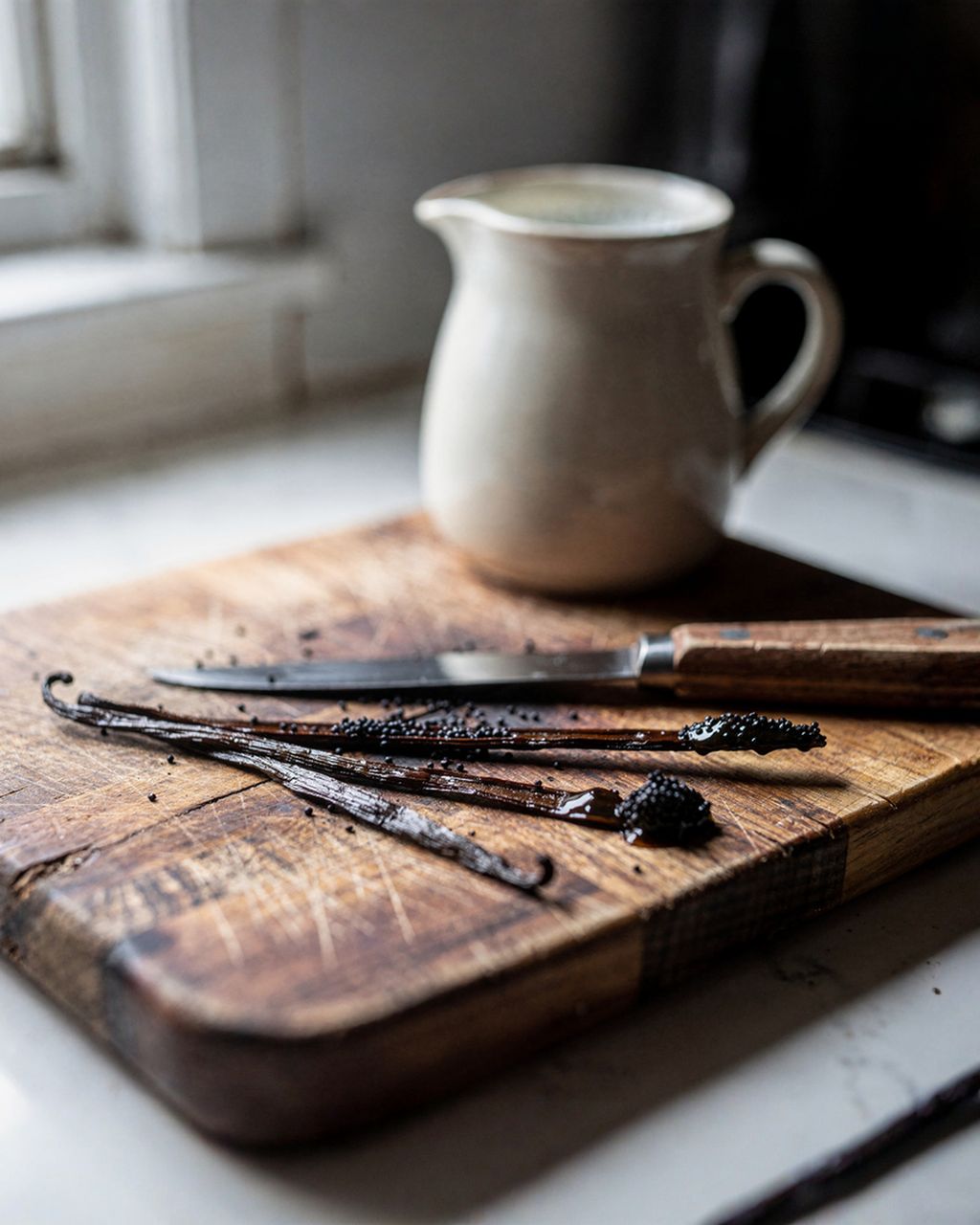
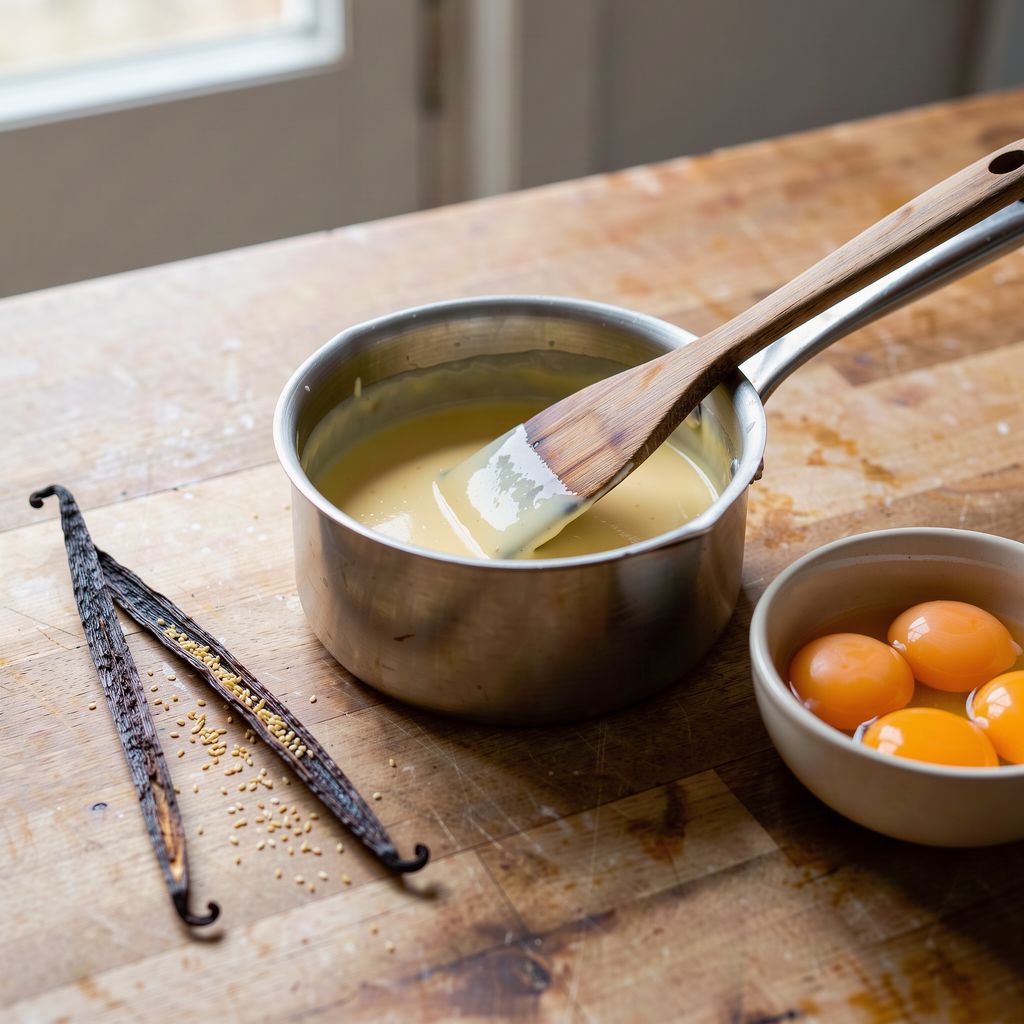
Infuse the vanilla. Split the bean lengthwise, scrape out the seeds with a knife and put both seeds and pod into the milk (and cream). Heat until almost boiling – the first small bubbles appear around the edges, at about 80°C (176°F) – then take it off the heat, cover and leave to infuse for 15–30 minutes. The longer it sits, the more flavor you draw out of the pod.
Whisk the yolks with the sugar – and do it right away. Whisk only until combined and slightly paler, not until foamy (foam makes bubbles in the custard and makes it harder to judge the consistency). Don't leave sugar sitting on the yolks without stirring: within minutes it draws out their moisture and forms hard little grains that won't dissolve in the custard.
Temper. Remove the pod, bring the milk back up to hot, and pour it into the yolks in a thin stream while whisking constantly, about a third first. This warms the yolks gradually so they don't curdle from the shock. Then pour in the rest and return everything to the pot.
Heat slowly and keep stirring. Over low heat (setting 4–5 out of 9 on an induction hob), stir with a silicone spatula in a figure-eight, constantly scraping the bottom and the corners of the pot – that's where the custard curdles first. A whisk can't reach into the corners. It takes 5–10 minutes, so don't rush.
Take it off at 82–84°C (180–183°F) and strain. As soon as the thermometer reads 82°C (180°F) (or it passes the spoon test at a lower temperature), lift the pot off the heat and strain the custard through a fine sieve into a cold bowl. The pot holds heat, and the custard would keep cooking in it past the limit.
A heavy-bottomed pot is much more forgiving than a thin stainless steel one. If you don't have a heavy-bottomed pot, you can heat the custard in a water bath – it takes longer and the temperature rises more slowly, so it's easier to stay on the right side of the limit.
Crème anglaise is done at 82–84°C (180–183°F) and curdles above 85°C (185°F). According to pastry sources including the Valrhona school, the ideal target is around 82°C (180°F). Egg yolk proteins begin to bond at around 65°C (149°F), so the custard thickens slowly, and from about 85°C (185°F) they bond all at once and form lumps.
So the window is only about 3°C wide. That's why an instant-read probe thermometer is worth it – for a few dollars it saves you dozens of ruined yolks. Measure in the middle of the pot, not near the bottom.
Crème anglaise is done when a line drawn with your finger across the back of the spoon stays sharp and the custard doesn't run back into it for at least 2 seconds. The French call this à la nappe – the custard coats the spoon like a tablecloth.
How to do it: dip a wooden spoon or a spoon into the custard, lift it out and run your finger across the back. If the line closes up right away, keep cooking and repeat the test.
Other signs you're getting close:
the foam on the surface disappears and the custard stops rippling glossily,
you feel slight resistance as you stir, and the spatula no longer glides as if through water,
the first steam starts rising from the pot.
The moment you see the first bubble, or feel graininess on the bottom, take it off the heat immediately and strain – you're right on the edge.
Crème anglaise curdles for five reasons: overheating above 85°C (185°F), too high a flame, carryover cooking in the hot pot, untempered yolks, and sugar left sitting on the yolks. In every case the yolks clump into lumps or grains instead of thickening gently.
Overheating. The most common mistake. Crème anglaise must never boil, not even briefly.
Too high a flame. The bottom and corners of the pot are hotter than the middle; while the center is at 75°C (167°F), flakes are already forming near the bottom. Low heat and constant stirring even it out.
The pot after you take it off the heat. Cast iron or a thick base holds heat for another minute or two. Custard you leave in the pot to "cool down for a moment" will push itself over the limit.
Untempered yolks. If you pour the yolks straight into hot milk, they curdle where they land before they have a chance to mix in.
Sugar left on the yolks. This doesn't show up as classic curdling but as tiny hard grains that the sieve catches, and the custard then thickens too little.
You can rescue lightly curdled custard with an immersion blender: pour it straight into a cold container, blend for 20–30 seconds and strain through a fine sieve. The lumps break up and the custard is smooth again, just a little thinner.
Stop the cooking. Immediately pour the custard into a cold bowl, ideally set in ice water. Every second in the pot makes it worse.
Blend. Use an immersion blender or a countertop blender on its highest setting for 20–30 seconds.
Strain. Through a fine sieve, and throw away whatever stays behind.
If the custard is completely curdled – it looks like curds floating in whey – a blender won't save it. It still tastes good, so use it as the egg custard for a bread pudding or for French toast, and make the crème anglaise again.
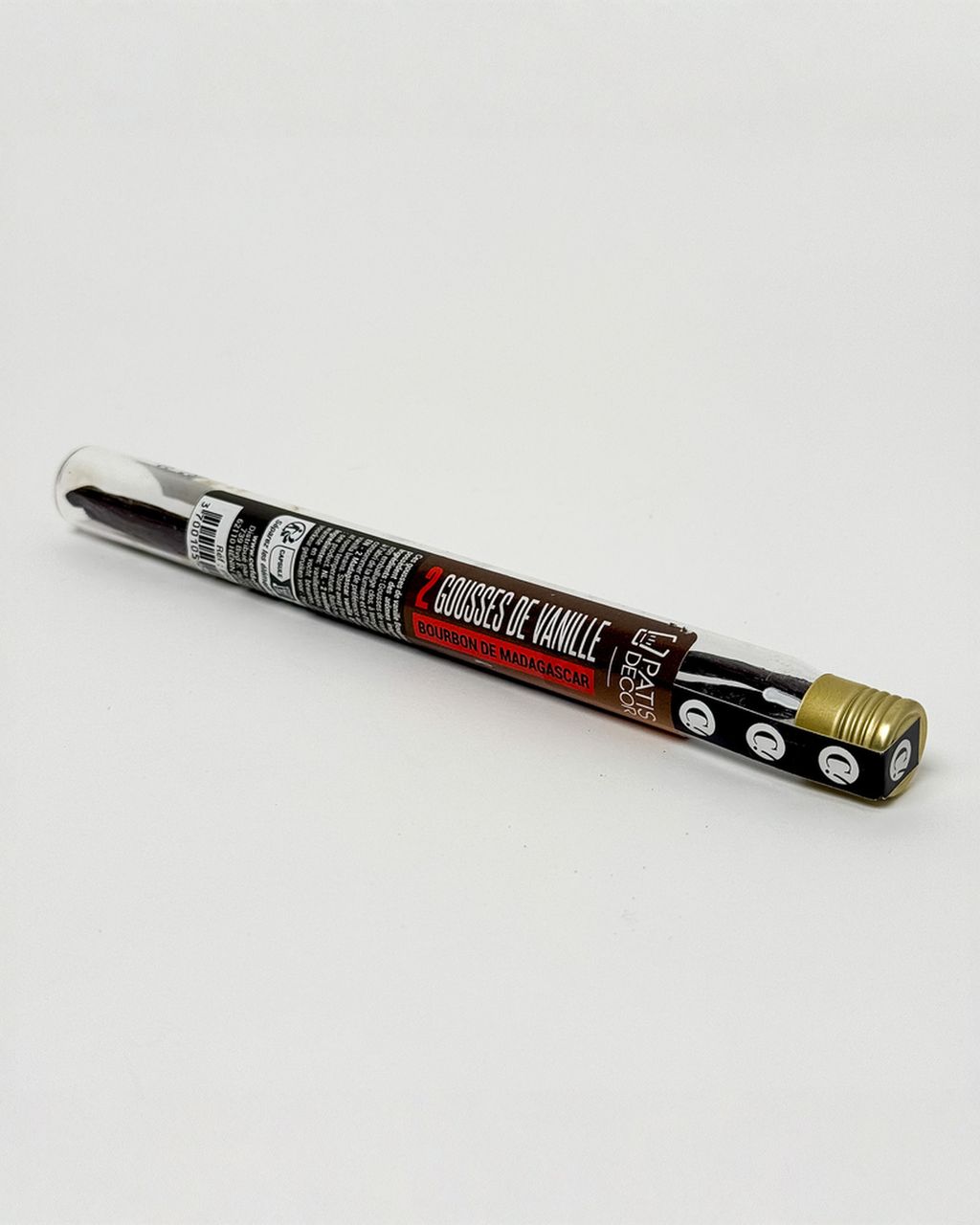
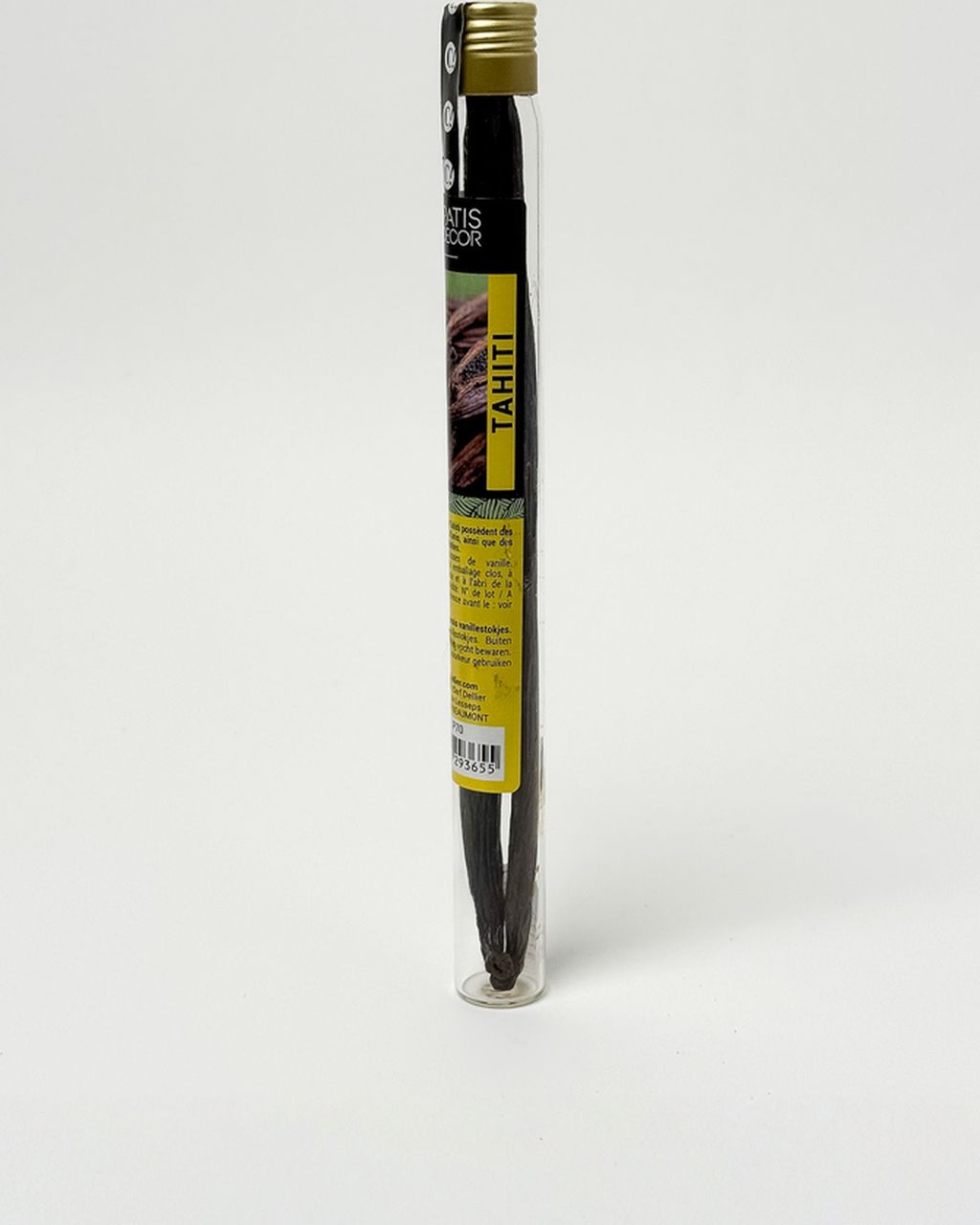
For a classic crème anglaise, reach for Madagascar Bourbon vanilla; for a more delicate, floral custard to go with fruit, choose Tahitian. In a milky sauce, where the vanilla has nothing to compete with, the difference between them is easier to taste than in baked goods.
Madagascar Bourbon (Vanilla planifolia) – full, creamy, "classic" vanilla. It contains more vanillin (usually around 1.5–2.5%, depending on curing) and tastes exactly the way you imagine vanilla custard should. A versatile choice that suits chocolate, strudel and sweet buns. You'll find the beans and other varieties in the vanilla section on Yumsto.
Tahitian (Vanilla tahitensis) – noticeably less vanillin but more of other aromatic compounds, mainly anise-like ones. It smells floral, of cherries and lightly of anise. Great in a custard for strawberries, peaches or berries, where Madagascan vanilla would overpower the fruit with sweetness. The beans tend to be plumper and moister.
Vanilla paste or good-quality extract – these work too. Add the paste (1 teaspoon ≈ 1 bean) straight to the milk, and the extract (1–2 teaspoons) only to the cooled custard so the alcohol and aroma don't escape. The flavor is flatter, and extract won't give you visible seeds. You'll find the ratios in What to Substitute for a Vanilla Bean.
Vanilla sugar – synthetic vanillin only, without the layers of real vanilla. It isn't suited to a custard where vanilla is the main flavor.
Don't throw away the used pod: rinse it, dry it and bury it in sugar – in a few weeks you'll have vanilla sugar. Read more about the varieties in The Vanilla Bean: Types, Price and How to Use It.
Crème anglaise is served lukewarm or chilled, never hot – best with warm yeasted and puff pastry desserts, chocolate and baked fruit.
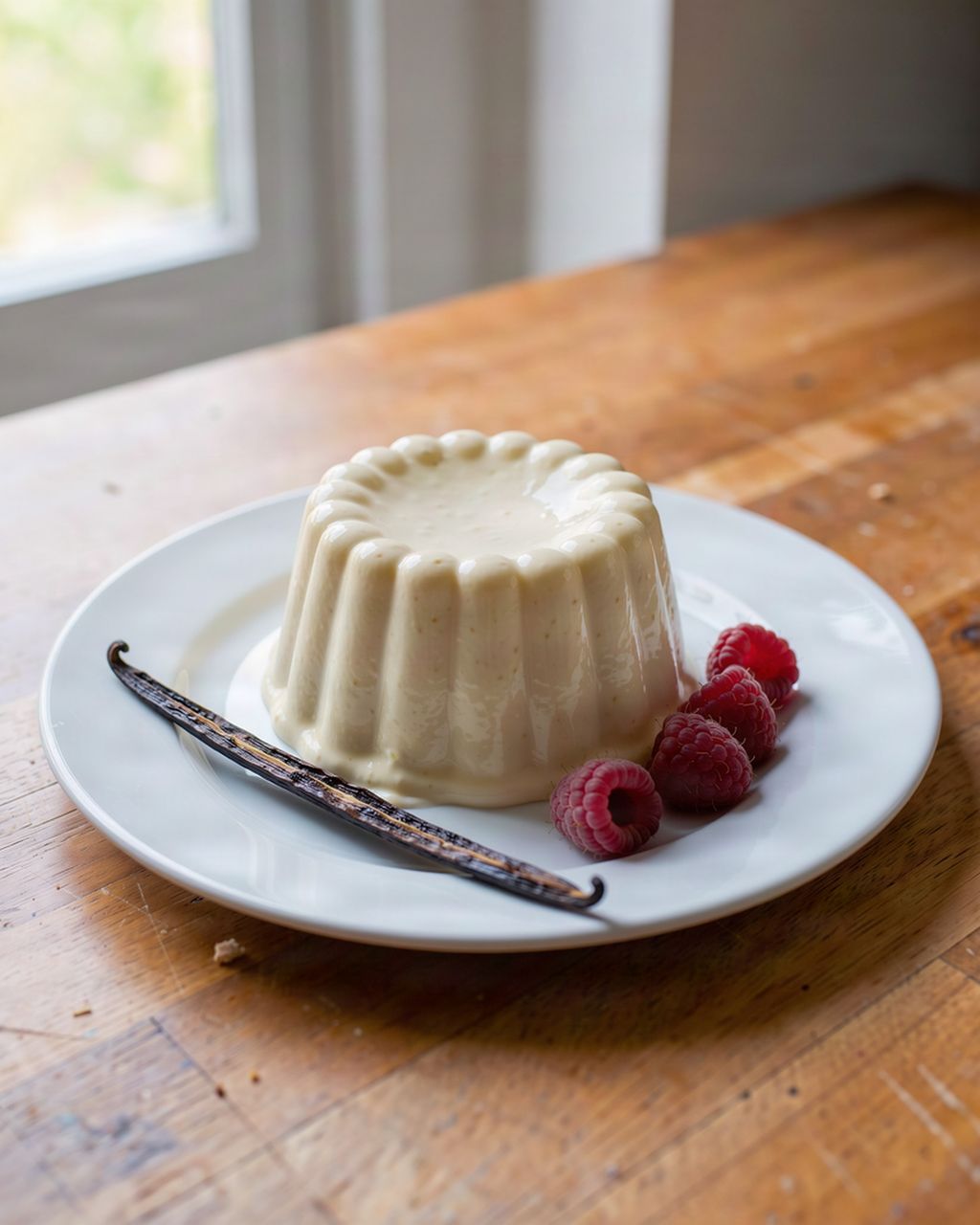
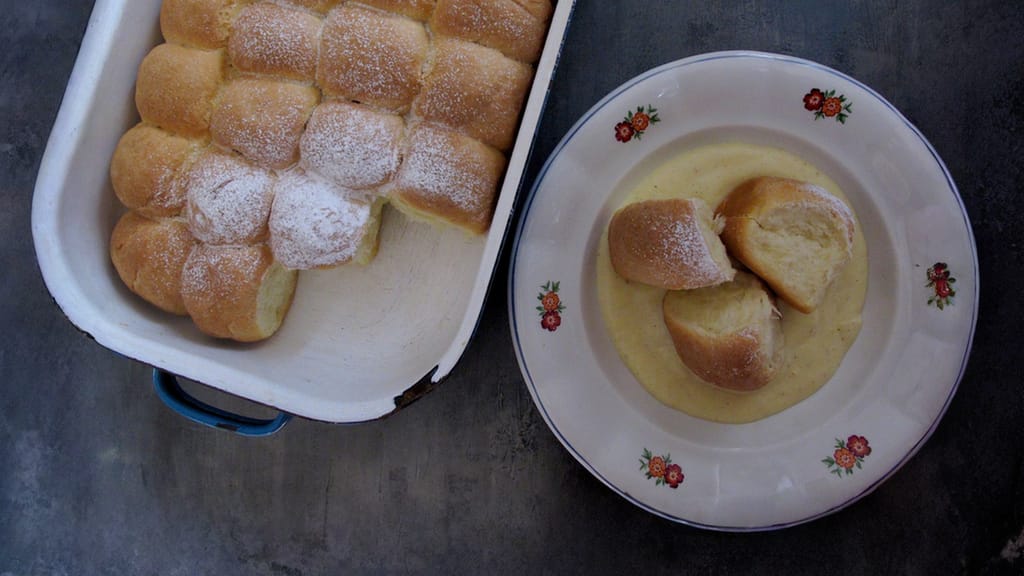
A Czech classic: sweet buns with a delicate vanilla custard.
With warm apple strudel made from homemade stretched dough, pour the custard on the plate under the slice, not over it – the pastry stays crisp.
With chocolate desserts, such as the most chocolatey chocolate cake – vanilla softens the bitter chocolate.
With baked pears, plums or berries.
As the sauce under floating islands (île flottante) – poached meringues on a pool of crème anglaise.
And watch out for mix-ups: chaudeau served with sweet buns is not crème anglaise. Chaudeau is whisked from wine, egg yolks and sugar over steam until frothy – you'll find the recipe in sweet buns with chaudeau sauce.
Sweet buns with silky vanilla custard
Sweet buns with delicate vanilla custard – a classic with crème anglaise
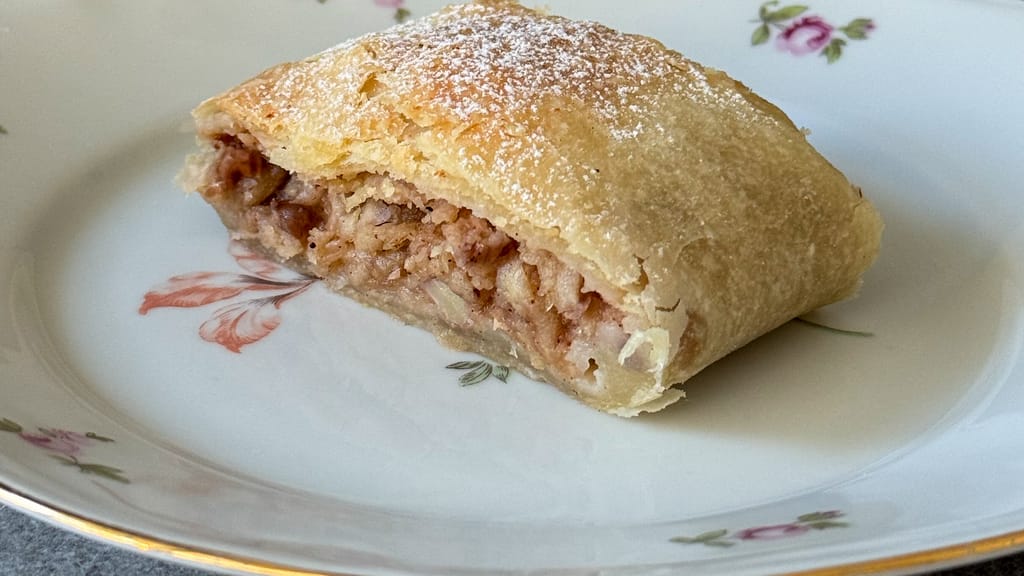
Apple strudel with homemade stretched pastry
Apple strudel from homemade stretched dough, served with crème anglaise
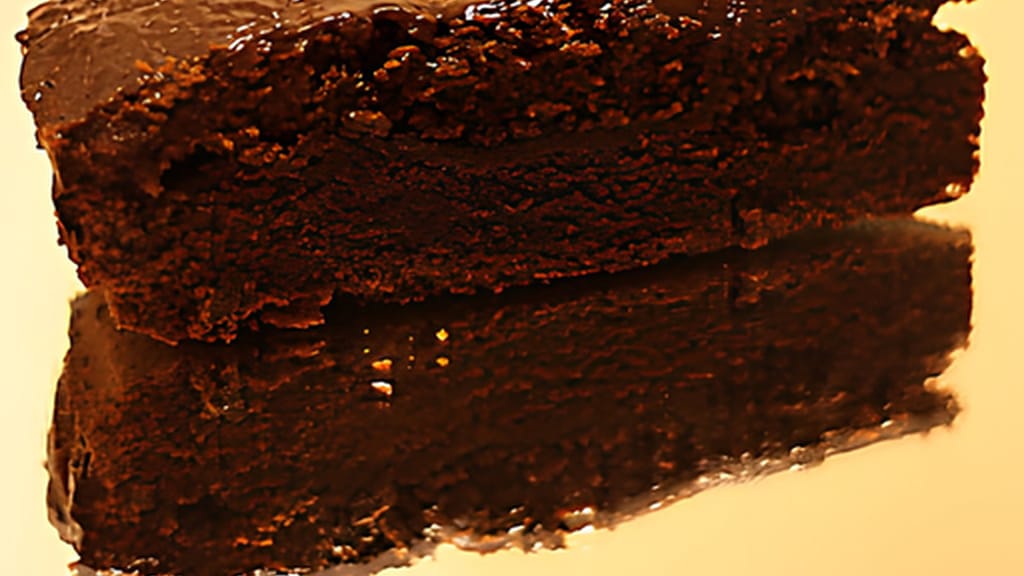
The most chocolatey chocolate cake
The most chocolatey chocolate cake with vanilla sauce
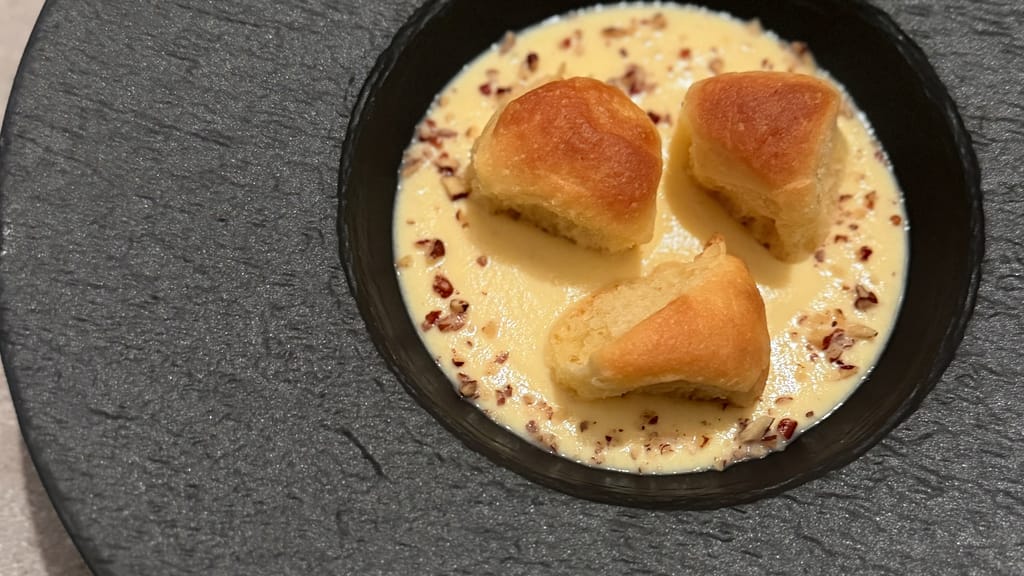
Fluffy sweet buns with chaudeau (egg custard) sauce
Soft sweet buns with chaudeau sauce – a wine-based alternative to crème anglaise
Crème anglaise keeps in the fridge for 2–3 days in a covered container, with plastic wrap pressed onto the surface. Just stir it before serving; if it has thickened more than you'd like, loosen it with a spoonful of cold milk. If you need to warm it, do so gently in a water bath, never to a boil.
We don't recommend freezing crème anglaise as a sauce – it separates and turns grainy once thawed. It's much better to freeze it right away in an ice cream maker, churning as it freezes: crème anglaise is exactly the base for French-style vanilla ice cream.
You can make crème anglaise with whole eggs, but it curdles sooner because egg white sets at around 62–65°C (144–149°F). It's harder to judge, and the result is also thinner and less creamy. Save the whites for meringues or floating islands instead.
Crème anglaise can be made with lactose-free milk exactly as with regular milk. Of the plant-based drinks, oat or soy work best, with one extra yolk per 500 ml. Plant-based drinks contain less fat (and oat drinks less protein too), which is why you need the extra yolk. Almond drink makes a very thin sauce.
Crème anglaise is most often thin because it was taken off the heat below 80°C (176°F), when the yolks hadn't yet thickened. It can also be thinner if you use fewer than 5 yolks per 500 ml, or milk alone with no cream. It always thickens further as it cools, so judge warm custard by the spoon test, not by how it pours.
One recipe worth heating the oven for, one tip, and one deal from the shop. Nothing else.