Beef Gelatin Powder 200 Bloom
Bavarian Cream: Vanilla Custard Set with Gelatin, Step by Step
Updated Oct 15, 2026
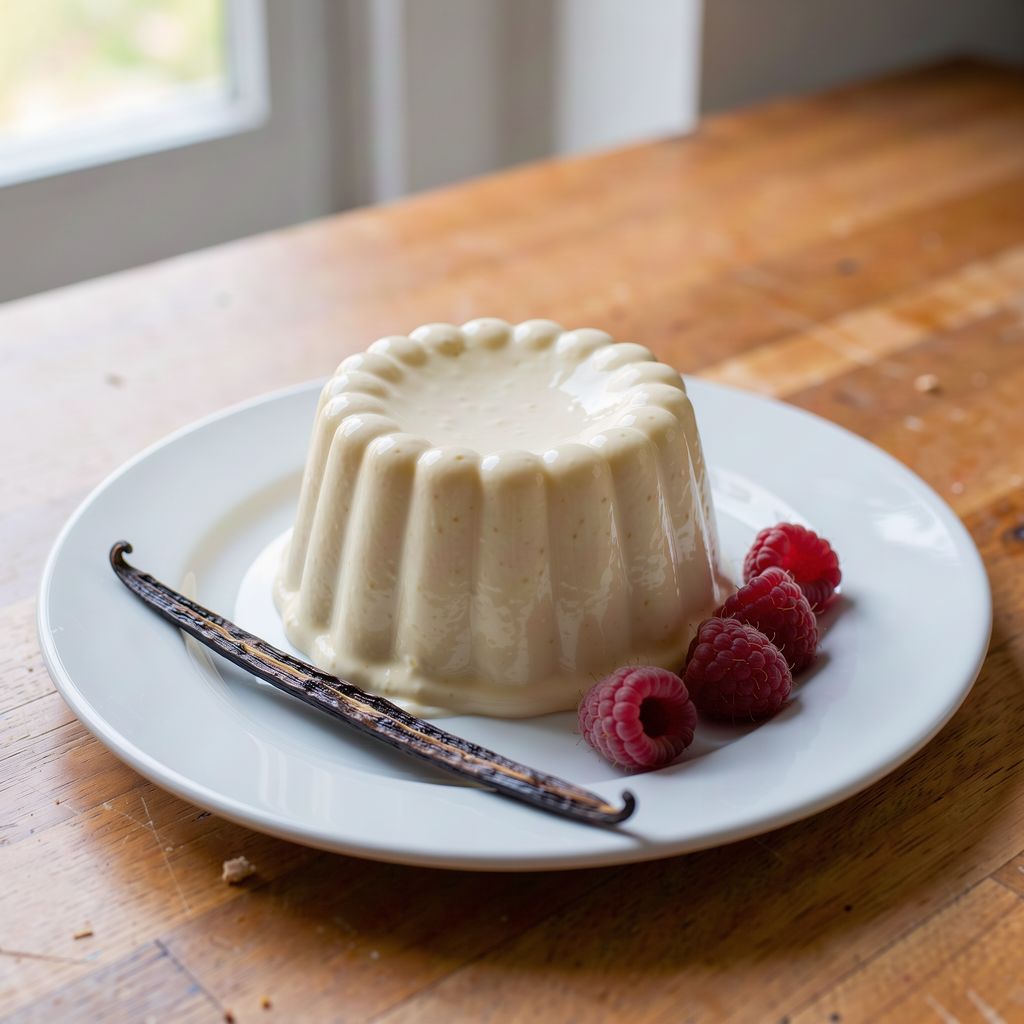
Bavarian cream (crème bavaroise) is a vanilla crème anglaise set with gelatin and lightened with whipped cream. Once chilled, it holds its shape, unmolds cleanly and slices into a cake layer, yet it melts on the tongue like a cloud. The whole technique comes down to three numbers: heat the crème anglaise to 82–84 °C (180–183 °F); use about 9–10 g of 200 Bloom gelatin per 1 litre of finished cream (less for glasses, and no more than 12 g for a tall mold); and fold in the whipped cream once the base has cooled to roughly 20–22 °C (68–72 °F). Here you'll find the ratios, the method step by step, and the reason each step works.
Bavarian cream is made of three components: crème anglaise (milk, egg yolks, sugar, vanilla), gelatin and whipped cream. It's the combination of egg yolks and air that sets it apart from similar desserts:
Panna cotta – cream, sugar and gelatin, with no egg yolks and no whipping. It's denser and creamier. For comparison, try our classic panna cotta, step by step.
Pudding – thickened with starch, not gelatin. It won't hold a shape or slice.
Mousse – the air comes mainly from egg whites or whipped cream, and it doesn't need to contain gelatin.
Bavarian cream – the egg-based custard is richer than panna cotta, the whipped cream makes it lighter than pudding, and the gelatin makes it hold its shape.
In French pastry, Bavarian cream is a classic. It's often credited to the chef Marie-Antoine Carême. It got its name in the early 19th century, probably after Bavaria or one of the Bavarian Wittelsbachs, but nobody knows its exact origin. Today it's made as individual molded desserts, in charlottes and as layers in cakes.
For 6 servings of about 140 ml each (roughly 850 ml of finished cream) you need:
250 ml whole milk
1 vanilla bean
3 egg yolks (about 50–55 g)
70 g sugar
8 g powdered gelatin, 200 Bloom, plus 40 ml cold water to bloom it
250 ml heavy whipping cream with 33% fat or higher
Adjust the gelatin to what you plan to do with the cream (for this 850 ml batch, which works out to roughly 7–12 g per litre):
For glasses (not unmolded): 6 g. The cream is softer and creamier.
For unmolding or for a cake: 8 g. It holds reliably and won't turn rubbery.
For a tall mold, a buffet or a warm room: 10 g at most. Any more and it starts to taste like rubbery jelly.
These figures are for gelatin with a strength of 200 Bloom. For any other strength, use our article Bloom gelatin: what the number means and how to convert strength. You'll find all the setting agents we carry in one place, in the gelling agents and thickeners section.
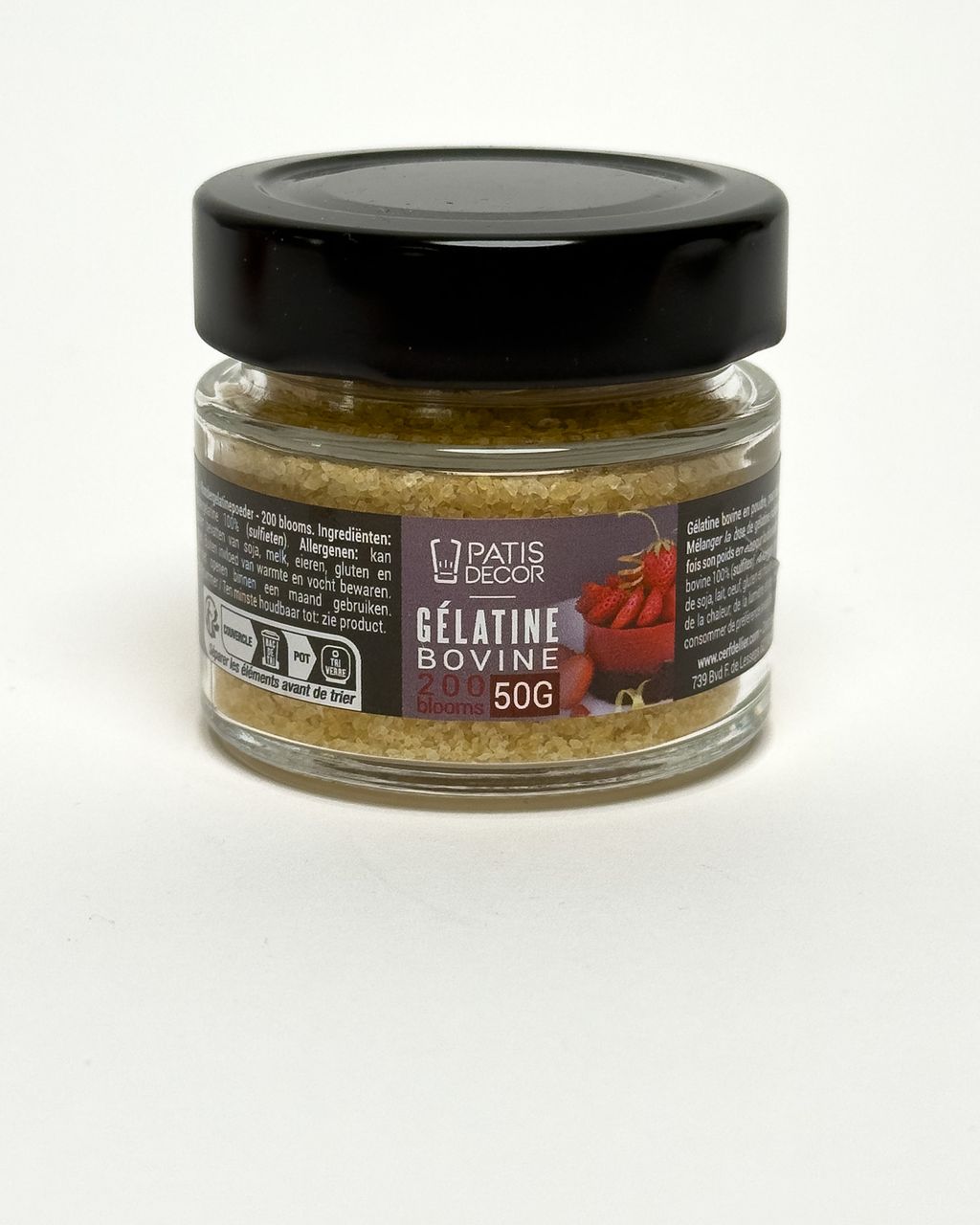
The easiest choice for Bavarian cream is powdered gelatin, 200 Bloom. You can weigh it to the gram, and the result comes out the same every time. That's what we sell too: Patisdécor powdered beef gelatin, 200 Bloom. It suits this cream perfectly, because beef gelatin has no off-flavor and 200 Bloom is the standard most pastry recipes are written for.
An honest comparison with the alternatives:
Sheet gelatin works just as well. But the weight and strength of the sheets vary by brand, so measuring by the number of sheets is less reliable. If your sheet gelatin is labeled 200 Bloom, go by weight, not by the number of sheets.
Supermarket gelatin with no Bloom listed can be weaker or stronger. The cream will then either not set or set like rubber.
Agar isn't suitable here. It sets at around 40 °C, so it would set before you could fold in the whipped cream. It also gives a more brittle, crumbly texture. For a vegetarian (gelatin-free) version, follow our article What to use instead of gelatin.
To learn how to bloom and dissolve gelatin without lumps, read How to use gelatin: sheet vs. powdered.
The best choice for Bavarian cream is a real vanilla bean. Bavarian cream is really just vanilla, milk and cream, so nothing covers up the vanilla flavor. The seeds also give the cream its characteristic black flecks.
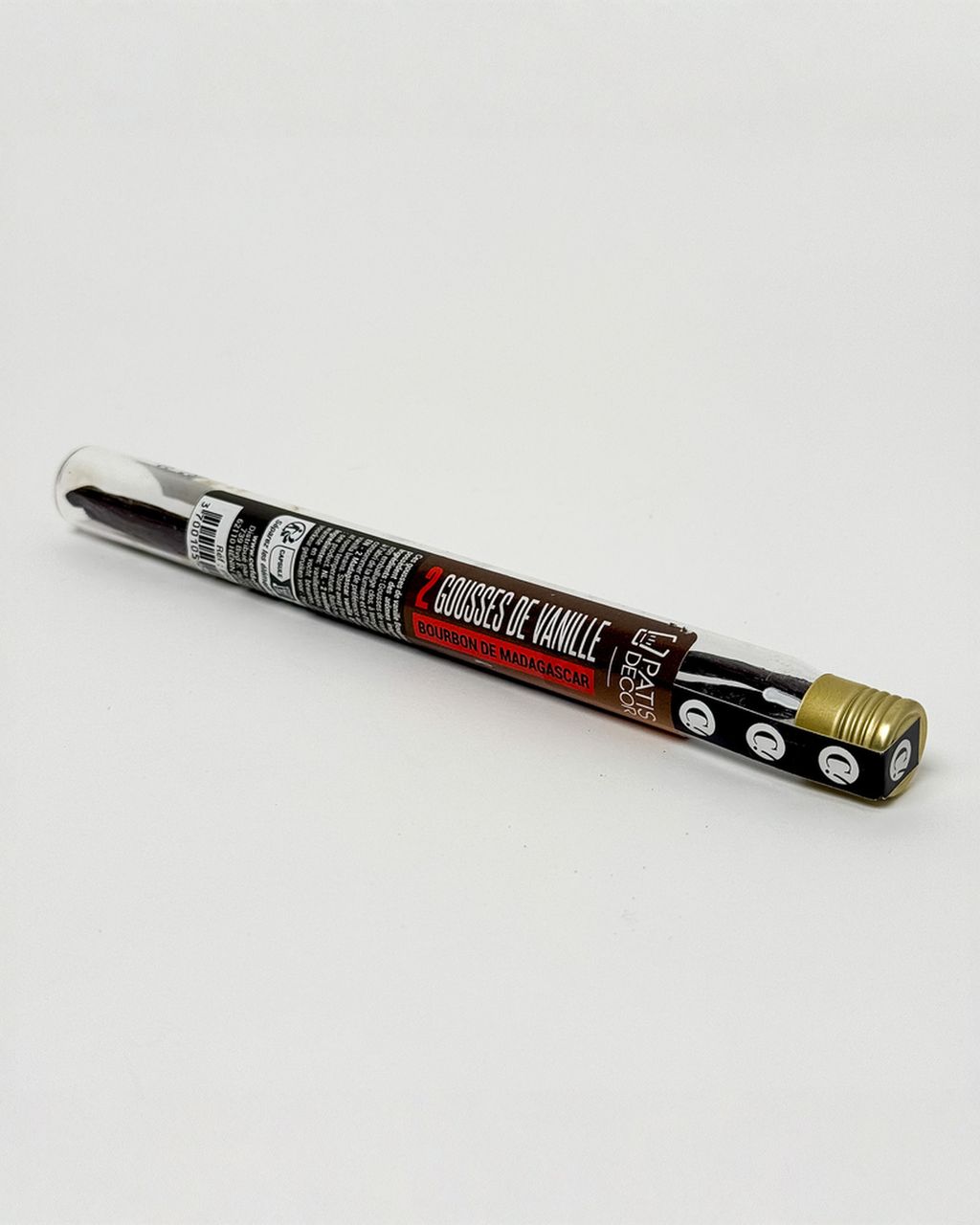
Madagascar Bourbon: creamy, sweet, "classic vanilla" flavor. It's the safest choice for a pure vanilla Bavarian cream. We carry Madagascar Bourbon vanilla beans in packs of 2.
Tahitian: floral, slightly anise-like. A great fit when you're serving the cream with fruit.
Ugandan: earthier and more pronounced. It pairs well with a chocolate or coffee version.
Vanilla paste or good-quality extract: a fine substitute. Use 1 teaspoon in place of 1 bean, and add it to the warm custard, not to boiling milk.
Vanilla sugar (vanillin): the flavor will be flat and artificial. Don't use it in a cream where vanilla is the star.
Don't throw away the scraped pod. Rinse it, let it dry and tuck it into a jar of sugar. In a few weeks you'll have your own vanilla sugar.
The method has six steps: bloom the gelatin, cook the crème anglaise to 82–84 °C (180–183 °F), dissolve the gelatin in it, cool the base to about 20–22 °C (68–72 °F), fold in the whipped cream and let the cream set.
Bloom the gelatin. Pour 40 ml cold water over 8 g powdered gelatin and let it stand for 10 minutes.
Cook the crème anglaise. Bring the milk to a boil with the split vanilla bean and scraped seeds. Meanwhile, stir the yolks with the sugar just until combined; there's no need to whisk them until foamy. Pour the hot milk over them in a stream, stirring constantly, then return everything to the pot. Over low heat, stir with a spatula until the custard reaches 82–84 °C. You can tell without a thermometer: the custard coats the back of a wooden spoon and a finger drawn across it leaves a clean line. Above 85 °C the yolks curdle. If you also like thicker cooked creams, take a look at crème pâtissière, step by step.
Dissolve the gelatin. Take the custard off the heat and stir in the bloomed gelatin. At this temperature it dissolves in a few seconds. Then strain the custard through a fine sieve to catch the vanilla pod and any bits of curdled yolk.
Cool the base to 20–22 °C. Set the bowl in ice water and stir. The custard should feel cool against your lip and start to thicken slightly, a bit like drinkable yogurt. This is the most important step of the whole method.
Fold in the whipped cream. Whip the cream only to soft peaks: it holds its shape, but the tip flops over. Fold in a third first to lighten the base, then the rest. Fold with a spatula in a circular motion from the bottom, so as much air as possible stays inside.
Let the cream set. Pour it into glasses or molds right away. Glasses need only 4 hours in the fridge; for unmolding, allow at least 6 hours, ideally overnight.
Almost every failed Bavarian cream comes down to temperature in one of two steps: the crème anglaise was too hot, or the base wasn't properly cooled when you folded in the whipped cream.
The cream separated into two layers (dense at the bottom, foamy on top): the base was still too warm and runny, so the whipped cream deflated and floated up. Next time, chill it until it begins to thicken.
There are rubbery lumps or strings in the cream: the base had already started to set (below roughly 18 °C) and the whipped cream didn't blend in smoothly. You can rescue it by dipping the bowl in warm water for a few seconds and stirring the cream.
The cream is grainy or smells like scrambled eggs: the crème anglaise went past 85 °C. A sieve or an immersion blender will fix slight curdling, but not heavy curdling.
The cream doesn't hold its shape: the gelatin is missing or didn't dissolve. Or it has a strength other than 200 Bloom.
The cream is stiff and rubbery: there was too much gelatin. For this volume, don't use more than 10 g.
The whipped cream is buttery and the cream is coarse: the cream was overwhipped. Soft peaks are enough; stiff whipped cream won't fold into the base.
To unmold a set Bavarian cream, dip the mold in hot water for 5–10 seconds, turn it upside down onto a plate and give it a short shake. With silicone molds, you can simply peel the mold away carefully. The dessert releases even more easily if you put it in the freezer for an hour first.
Where Bavarian cream works well:
As a stand-alone dessert in molds or glasses, with raspberry sauce or caramel. You can prepare the glasses a day ahead.
Charlotte: the cream poured into a mold lined with ladyfingers. The principle is the same as in our quark and berry charlotte, except you use Bavarian cream instead of the quark filling.
A layer in a cake: pour the cream into a ring set over the cake base and let it set. For how to handle the ring and acetate, read Mousse cake, step by step.
Bavarian cream has four common variations: chocolate, coffee, fruit and liqueur. The basic method stays the same; you only change what goes into the crème anglaise:
Chocolate: stir 80 g chopped dark chocolate (60–70%) into the hot crème anglaise. The cocoa butter firms the cream up a little, so 6–7 g of gelatin is enough.
Coffee: add 2 teaspoons of instant espresso to the milk, or steep 30 g of coffee beans in it for 20 minutes and then strain them out.
Fruit: replace half of the milk with fruit purée (raspberry, strawberry, apricot). Add the purée only to the finished crème anglaise, so the acid doesn't curdle the yolks. Increase the gelatin to 9 g, because acidic purée weakens it.
Liqueur: add 2–3 tablespoons of rum or Grand Marnier to the lukewarm base. With larger amounts of alcohol, the cream sets less well.
Covered, Bavarian cream keeps in the fridge for 2 days. It is at its best the day after you make it, because by then the gelatin has fully set. Cover it with cling film so it doesn't pick up fridge smells. After that, the whipped cream starts to weep.
You can freeze Bavarian cream, but once thawed it will be wetter and less smooth. It keeps in the freezer for about a month if well wrapped so it doesn't absorb odors. Thaw it slowly in the fridge overnight, not at room temperature.
Done properly, yes: the yolks are heated to 82–84 °C while you cook the crème anglaise, which is generally considered sufficient heat treatment. That only applies if the custard really reaches that temperature, though. The wooden spoon test is only a rough guide, and a thermometer is the only way to be sure. Store the finished cream in the fridge. This is general food preparation information, not medical advice; pregnant women, small children and people with weakened immunity should check with a doctor.
For a layer 4 cm high in a 20 cm cake ring, you need about 1.25 litres of Bavarian cream, which is roughly 1.5 times the batch in this article. For an 18 cm ring, about 1 litre is enough. Scale the gelatin in the same proportion.
One recipe worth heating the oven for, one tip, and one deal from the shop. Nothing else.