Why Did My Cinnamon Rolls Explode or Flatten? Proofing, Rolling and Filling
Why Did My Cheesecake Sink in the Middle? Causes and How to Stop It
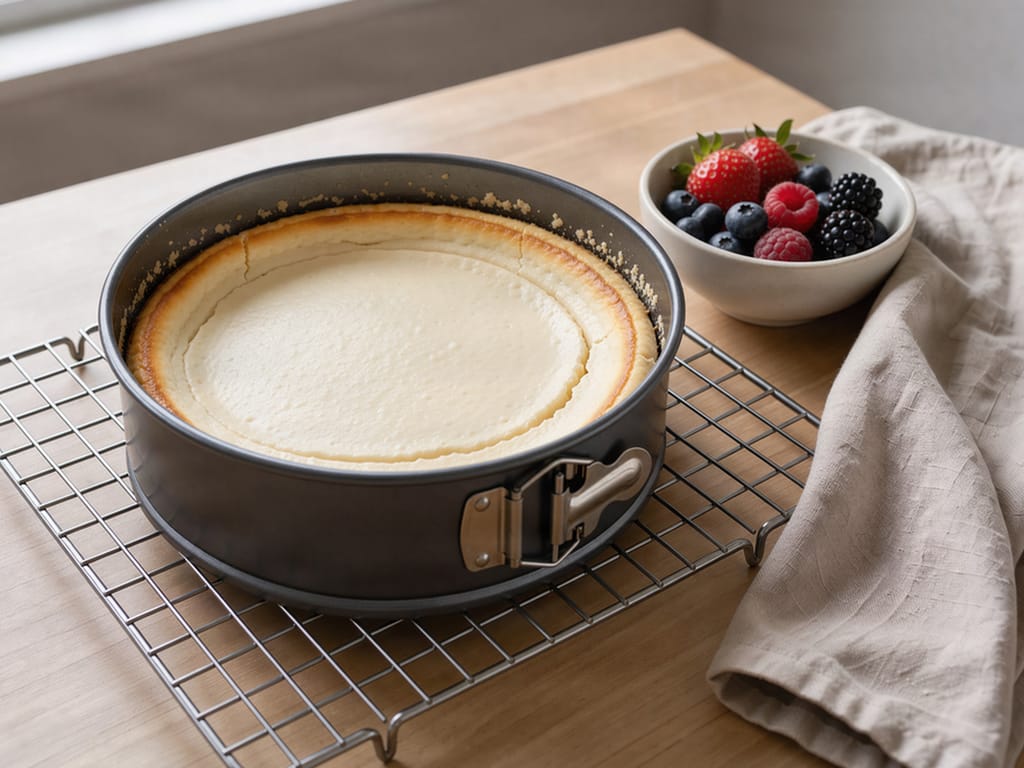
A cheesecake sinks in the middle most often because too much air was beaten into the batter, so it puffed in the oven and collapsed as it cooled, or because the center was underbaked. Cooling too fast and an oven that runs hot make it worse. A small dip is normal; a deep crater isn't.
A baked cheesecake is a custard: cream cheese (or in Czech kitchens often tvaroh, a fresh quark cheese), sugar and eggs that set gently in the oven. It has no flour structure to speak of, just egg proteins setting around the cheese.
If air is trapped in that custard, it expands in the heat and the cheesecake puffs up, sometimes above the rim of the pan. As it cools, the air contracts, and the soft center falls. If the center was also underbaked, it falls further.
The usual causes, most common first:
Too much air from beating on high speed or whipping after the eggs went in.
Underbaked center.
Cooling too fast, from oven to cold kitchen.
Oven too hot, which makes the cheesecake puff fast.
Recipes with whipped egg whites, which are designed to rise and settle.
A slight settling in the middle is normal. It is the deep crater that tells you something went wrong.
A tested recipe and one tip that makes it work. Unsubscribe in one click.
Coming up: December 3, St Nicholas bread men, December 10, soft honey gingerbread, and December 17, cocoa Linzer cookies with apricot.
Cheesecake batter wants to be smooth, not fluffy.
Soften the cream cheese fully first, so it blends smoothly without long beating. Cold cream cheese makes lumps, and beating harder to fix them adds air.
Use low speed and a paddle, not a whisk attachment.
Add eggs last, one at a time, and mix only until each disappears.
Scrape the bowl often so you don't need extra mixing to catch lumps at the bottom.
Tap the pan gently on the counter before baking to bring large bubbles up, or run a skewer through the batter.
Lumpy batter and too-cold ingredients are covered in our guide to grainy or lumpy cheesecake.
Cheesecakes are taken out of the oven when the center still wobbles, because they keep setting as they cool. Take them out too early, though, and the soft center sinks and stays wet.
How to tell it's done:
The edges are set and slightly puffed, and a ring of about 5–8 cm (2–3 inches) around the edge doesn't move.
The center jiggles in one piece like set jelly when you nudge the pan, not in ripples like liquid.
A thermometer: King Arthur Baking and America's Test Kitchen take a classic baked cheesecake out when the center reads about 65 °C (150 °F).
That doneness point is below FDA's 71 °C (160 °F) for egg dishes. FDA lists pregnant women, young children, older adults and people with weakened immune systems as higher-risk groups for foodborne illness. If you bake for them and the center stays below 71 °C (160 °F), follow FDA's advice and use pasteurized eggs.
If the center is still liquid after a full chill, the cheesecake was underbaked; our guide to cheesecake that won't set covers what to do.
A sudden drop in temperature makes the cheesecake contract quickly, while the center is still soft. The edges, which have stuck to the pan, hold, and the middle drops. Fast cooling is also the classic cause of cracks.
Turn the oven off and leave the cheesecake inside with the door slightly open for up to an hour. Count that time toward the 2-hour limit below, then refrigerate.
Run a thin knife around the edge once it comes out, so the cheesecake can shrink away from the pan evenly instead of tearing.
Cool it on a rack at room temperature, away from drafts. Don't leave it out for more than 2 hours, or 1 hour above 32 °C (90 °F), according to USDA FSIS.
Then chill it, covered, in the fridge, usually overnight, before slicing.
Our guide to cheesecake cracking has more on cooling and the water bath.
Cheesecake bakes best low and gentle. A hot oven makes it rise fast, brown and crack, then sink.
Ovens can run hotter or cooler than the dial. An oven thermometer shows the real temperature.
Fan or conventional? A fan oven cooks the surface faster. If your recipe is written for conventional heat, check it, and use the lower setting your recipe gives for fan.
Use a water bath if the recipe calls for it: the pan sits in a larger tray of hot water, wrapped in foil to keep water out. The moist, gentle heat keeps the cheesecake from puffing and setting unevenly.
Middle shelf, away from the top element.
Basque cheesecake is the exception: it is baked very hot on purpose and is meant to puff, burnish and collapse. See Basque vs New York cheesecake.
Some cheesecakes always settle more than others.
Japanese-style cotton cheesecake and other recipes with whipped egg whites rise like a soufflé and settle as they cool. Bake them gently and cool them slowly.
Czech tvarohový koláč (quark cake) and other quark-based cheesecakes often puff and then settle, because quark has more water than cream cheese.
Crustless and lighter cheesecakes with less fat set more softly.
For these, a shallow dip is part of the style. Fill it with fruit and nobody minds.
A cheesecake usually sinks because the batter had too much air beaten into it, so it puffed up in the oven and fell as it cooled, or because the center was underbaked. Mix on low speed, bake until the center just wobbles, and cool it gradually.
Yes, a baked cheesecake normally settles a little as it cools, often leaving the center slightly lower than the edge. A deep crater, a cracked rim or a wet center points to too much air, underbaking or a fast cool.
Yes, beating cheesecake batter on high speed, or whipping it after the eggs go in, traps air. The air expands in the oven, the cheesecake puffs like a soufflé, then sinks and often cracks as it cools. Mix on low speed until just smooth.
A sunken cheesecake is fine to eat if it is fully baked and set. If the center is still liquid after chilling, it is underbaked. Don't serve it as it is; see our guide to cheesecake that won't set for how to rescue it. A properly baked cheesecake comes out at about 65 °C (150 °F), the doneness point King Arthur Baking and America's Test Kitchen use, which is below FDA's 71 °C (160 °F) for egg dishes, so use pasteurized eggs if you are baking for pregnant women, young children, older adults or anyone with a weakened immune system.
You can't make a sunken cheesecake rise again, but you can fill the dip with a topping. Fruit compote, sour cream topping, whipped cream, ganache or caramel all level it out. Chill the cheesecake fully, covered, before topping.
A water bath helps. It keeps the oven moist and the heat around the cheesecake gentle, so the batter puffs less and sets more evenly. That reduces both sinking and cracking.
One recipe worth heating the oven for, one tip, and one deal from the shop. Nothing else.