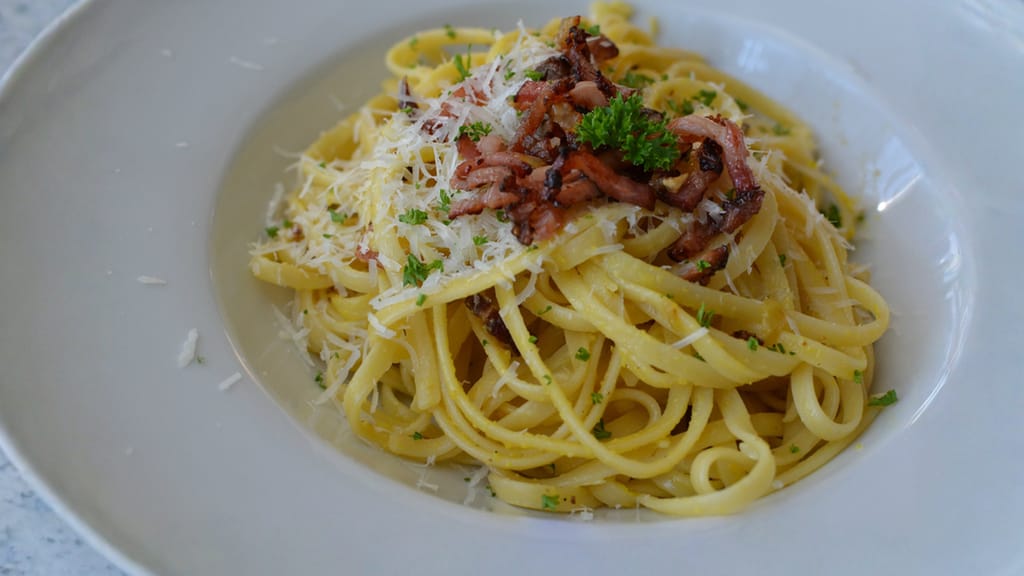
Spaghetti carbonara
Spaghetti: Carbonara, Aglio e Olio, Bolognese and Meatless Recipes, and How to Cook It
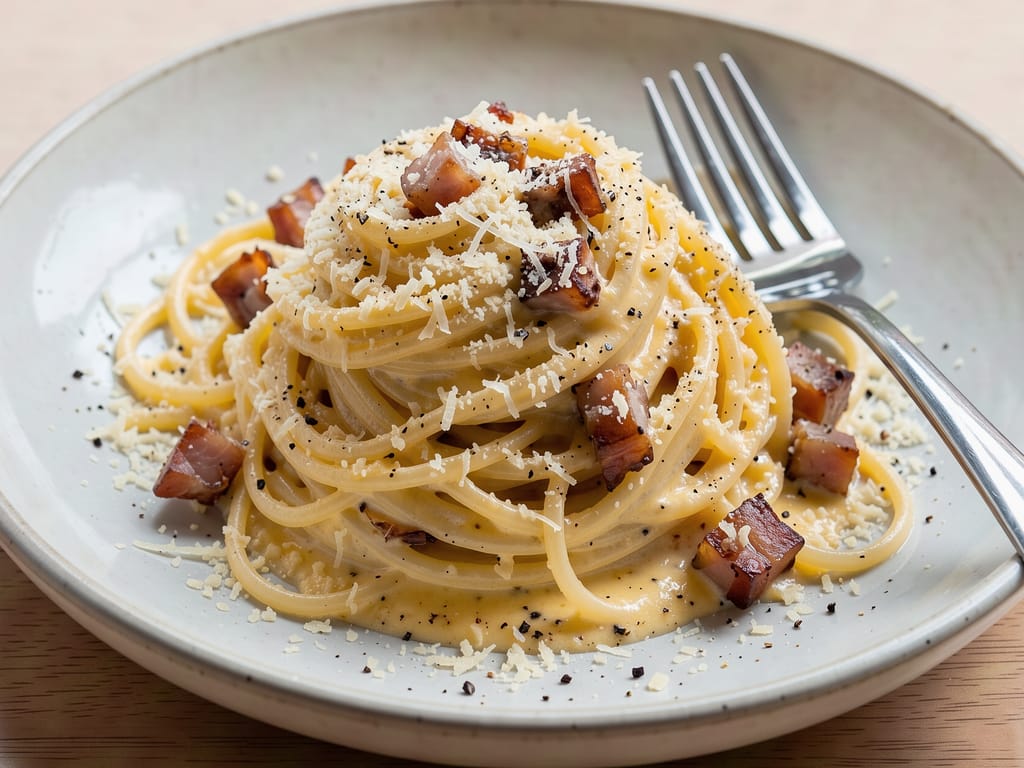
Spaghetti cooks best in generously salted water, 80–100 g dry per person, and it's finished in the pan with the sauce and a ladleful of the cooking water. The starch in that water turns oil, eggs or cheese into a glossy sauce that clings to every strand. Below you'll find a real carbonara with no cream, aglio e olio, pomodoro, bolognese with ground meat, spaghetti with shrimp, with chicken and meatless versions, plus what to do with leftover spaghetti after the holidays.
Spaghetti won't stick if it has enough water, goes in at a full rolling boil, and gets stirred during the first two minutes. That's the whole secret. Oil in the water doesn't help: it coats the noodles with a thin film that the sauce then slides right off.
This method works for every recipe in this article:
Allow roughly 1 liter of water per 100 g of pasta. In a large pot the boil returns quickly after the pasta goes in, and the strands have room not to stick together.
Salt the water once it's boiling (how much is below).
Add the spaghetti, give it a few seconds to soften and sink under the surface on its own, then stir right away with tongs or a wooden spoon. The first few minutes are when it sticks most, because starch is released from the surface.
Cook it 1–2 minutes less than the package says. It will finish cooking in the pan with the sauce and soak up the flavor.
Before draining, scoop out a cup of the cooking water. Never rinse cooked pasta, because you'd wash off the starch the sauce clings to.
For details on other shapes, cooking times and pasta for salads, see our guide to how to cook pasta, how much water and salt, and how to keep it from sticking. Here we stick to spaghetti and the sauces behind Italian recipes.
For a main course, allow 80–100 g of dry spaghetti per person, or even 120 g for a hearty appetite or a very simple sauce. In Italy pasta is the primo piatto, the first course before the meat, so about 80 g is the usual figure there; in Czech homes it's often the whole lunch or dinner.
Cooked spaghetti roughly doubles in weight: 100 g dry becomes about 200–250 g on the plate, depending on how long you cook it.
A 500 g package feeds four to five adults.
For a hearty meat sauce (bolognese), 80 g is enough; for aglio e olio, where there's little sauce, 100–120 g is better.
The classic Italian rule is 10 g of salt per 1 liter of water, which is roughly a heaping teaspoon per liter. The water should taste clearly salty, but not like seawater. Salt in the water is your only chance to season the pasta itself from the inside; salting the sauce afterward doesn't make up for it, and the dish tastes flat.
For sauces with very salty ingredients, such as bacon, pecorino, Parmesan, capers or olives, cut back to 7–8 g per liter. You'll be adding cooking water to the sauce, and it carries that salt with it. Add the salt once the water is boiling: it dissolves immediately and leaves no white spots on the bottom of the pot.
The water spaghetti cooks in is cloudy with dissolved starch, which works as a binder: it joins fat (olive oil, butter, bacon fat) with liquid and cheese into a smooth, glossy emulsion. Without it, oil runs to the bottom of the plate and cheese clumps.
Lift the spaghetti with tongs straight from the pot into the pan with the sauce, or drain it and keep a cup of the water aside.
Add the first ladleful, about 50–80 ml for two servings, and stir vigorously and shake the pan over low heat for a minute or two. Italians call this mantecatura.
It's done when every strand is coated in a glossy film and no puddle of oil is left in the pan. If the sauce is thick, add another spoonful of water.
The less water you cook in, the more starch it contains. For sauces that rely only on an emulsion (aglio e olio, carbonara), you can happily cook the spaghetti in less water, around 0.7 liter per 100 g, and stir it more often.
Good dried spaghetti is made from durum wheat (semola di grano duro on the package) and has a matte, slightly rough surface. That comes from pushing the dough through a bronze die (trafilata al bronzo), and sauce clings to it far better than to smooth, shiny noodles. You can tell after cooking, too: the water is cloudier, and so better for an emulsion.
Thickness decides the sauce. Thin spaghettini (about 5–7 minutes) suit oil-based and light tomato sauces, classic spaghetti (8–11 minutes) handles almost anything, and thick spaghettoni (12–14 minutes) can carry carbonara and a thick meat sauce.
One recipe and one tip every Thursday until the end of the year. Unsubscribe in one click.
For the holidays: the morning of December 24, carp roasting times by size and December 31, New Year’s Eve canapés.
A real carbonara has just five ingredients: spaghetti, eggs or egg yolks, grated sheep's-milk pecorino romano, pork cheek guanciale and plenty of freshly ground black pepper. Cream, onion, garlic and mushrooms don't belong in it. The creaminess comes not from dairy but from eggs thickened by the heat of the hot pasta and bound with starchy water. In Czech it's called špagety po uhlířsku: carbonaro means charcoal burner in Italian, and one explanation of the name is that heavily ground pepper looks like coal dust.
Guanciale is harder to find in Czech shops, so at home it's usually replaced with pancetta or English-style bacon; Parmesan instead of pecorino gives a milder, less salty flavor. It's still carbonara, just a little gentler.
Our recipe for spaghetti carbonara with English-style bacon and Parmesan uses 400 g of spaghetti, 150 g of bacon, 4 eggs and 150 g of Parmesan for four servings and is ready in 22 minutes. The bacon is fried in olive oil until it renders its fat and crisps slightly, and the eggs are simply whisked briefly with a fork together with the cheese and pepper. Go easy on the salt, since both the bacon and the cheese are salty. On the plate, top with the reserved Parmesan and chopped parsley.
If you want a richer, more golden sauce, try linguine carbonara with egg yolks, bacon and Parmesan. The principle is the same, except that instead of whole eggs it uses 6 yolks and 100 g of Parmesan per 400 g of linguine, whisked into a thick, pale mixture, and flat noodles instead of spaghetti.
The eggs in carbonara won't scramble if you combine them with the pasta off the heat. Egg whites begin to set at around 62°C (144°F), yolks thicken at around 65°C (149°F), and on a hot pan the sauce turns into scrambled eggs within seconds. In a water bath, stirring constantly, the egg and cheese mixture can be safely heated to 71°C (160°F), as described in the box below.
Cook the spaghetti until just al dente and set aside a cup of the cooking water.
Pour off some of the rendered bacon fat, leave a little in the pan and coat the pasta in it.
Take the pan off the heat and let it cool for half a minute.
Pour in the pasteurized eggs with cheese (or the mixture heated to 71°C beforehand as described in the box below) and stir quickly and steadily, adding pasta water by the spoonful.
The sauce should be glossy, flowing and about as thick as thin pudding. It will thicken further on the plate.
Carbonara firms up as it cools, so take it to the table right away, and it helps to warm the plates. If it starts to turn grainy, add a spoonful of hot water and keep stirring; that only helps at the very start, though, since scrambled eggs won't turn smooth again.
The ratio for one serving, if you want to scale the recipe yourself: 100 g spaghetti, 1 egg yolk plus about half a whole egg, 25–30 g grated cheese and 30–40 g bacon or guanciale.
Spaghetti aglio, olio e peperoncino is the quickest sauce Italy has: olive oil, thinly sliced garlic, dried chili, parsley and pasta water. Nothing else, not even cheese; in both Naples and Rome it's traditionally served without. The simplicity comes with one condition: the garlic must not burn.
The whole technique rests on four things:
A cold pan. Put the oil, garlic and chili in the pan while it's still cold and heat them slowly over low heat, so the garlic releases its flavor into the oil instead of burning on the surface.
Straw color. The garlic should only turn lightly golden, a pale golden color; dark brown garlic turns bitter and ruins the whole sauce.
Stop it with a ladle of water. As soon as it begins to turn golden, add pasta water: the temperature drops sharply and the garlic stops darkening.
Emulsion. Stir the al dente spaghetti vigorously in the pan for a minute or two until the oil and water form a milky, cloudy sauce, and finally stir in the chopped parsley.
Aglio e olio is the perfect last-resort dinner when the fridge is empty: everything you need keeps for months in the pantry.
Spaghetti pomodoro is spaghetti with a smooth sauce of tomatoes, olive oil, garlic and basil that cooks for only 15–20 minutes. No meat, no extra vegetables: the whole flavor rests on the tomatoes. In winter, reach for canned peeled tomatoes or passata; fresh winter tomatoes from the shop taste watery.
The sauce is done when it thickens and the oil separates on the surface into orange droplets; that's the sign the water in the tomatoes has cooked off and the flavor has concentrated. Tear the basil in only at the end, because it loses its aroma when cooked. Finish the spaghetti in the sauce with a little pasta water, as with all the others.
For a tomato sauce with a sharper kick, cook spaghetti allo scarpariello with tomatoes, pecorino and Parmesan. For two servings, 320 g of spaghetti meets 125 g of halved cherry tomatoes, 225 g of passata, garlic, chili flakes and basil. The sauce simmers for about 15 minutes, a handful of fresh tomatoes goes in only at the end so they stay juicy, and finally grated pecorino romano and Parmesan are stirred in vigorously with a ladle of pasta water. The result is creamy without a drop of cream; the whole recipe takes 40 minutes.
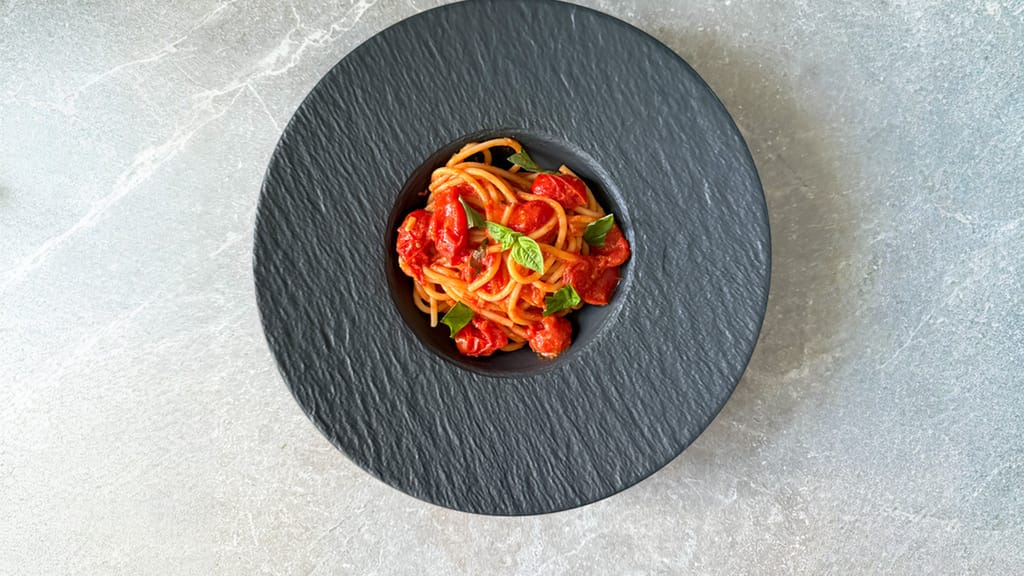
Spaghetti allo scarpariello: a quick recipe from naples
Spaghetti allo scarpariello: tomato sauce with pecorino and Parmesan
Bolognese sauce (ragù alla bolognese) is ground meat slowly simmered with vegetables, wine and tomatoes, and its real secret is time: two to four hours over low heat. A quick "bolognese" in twenty minutes is just ground meat in tomatoes. In Bologna, by the way, it's served with wide tagliatelle, not spaghetti, but spaghetti bolognese has become well established in Czech homes and there's no reason to give it up.
The technique in four steps:
Soffritto. Dice the carrot, celery and onion finely and sauté slowly. The finer, the more they break down during the long cooking and the smoother the sauce will be.
Brown the meat, don't boil it. Add the ground meat to a hot pot and break it up with a wooden spoon so no lumps remain. If you dump too much into a small pot at once, it releases water and, instead of browning, simmers to a gray color.
Wine and tomatoes. Deglaze with wine and let it cook off completely, until the meat starts to catch lightly on the bottom; that is what gives the sauce depth. Then add the tomatoes or tomato paste.
Long, lazy simmering. Keep it covered so the sauce only bubbles lazily, adding a splash of water now and then so it doesn't scorch.
Ground meat must be cooked through: 71°C (160°F) inside, measured with an instant-read thermometer, with no pink pieces. In a two-hour simmer that happens by itself, but with a quick ground-meat version, check the temperature before adding the tomatoes.
Our recipe for sugo bolognese, a slow-cooked bolognese sauce, is built on 500 g of ground pork, 100 g of English-style bacon, carrot, celery and onion, 200 ml of red wine and tomato paste, seasoned with nutmeg. It simmers for at least two hours, ideally four, and is served with 350 g of spaghetti and Parmesan; allow just under five hours in all, though most of that is just waiting. For more ideas for ground meat beyond pasta sauce, see the article what to cook with ground meat.
Ragù is even better the next day, so it pays to make a double batch. Divide the finished sauce into shallow containers so it cools quickly, and refrigerate it within 2 hours of cooking. The US food safety service FSIS gives 3–4 days in the fridge for cooked leftovers and 2–3 months in the freezer for stewed meat dishes, when they keep their best quality.
Reheat only the portion you'll eat, and only once, until the sauce is bubbling throughout and hot all the way through, which means 74°C (165°F). Thaw frozen sauce overnight in the fridge, not on the counter.
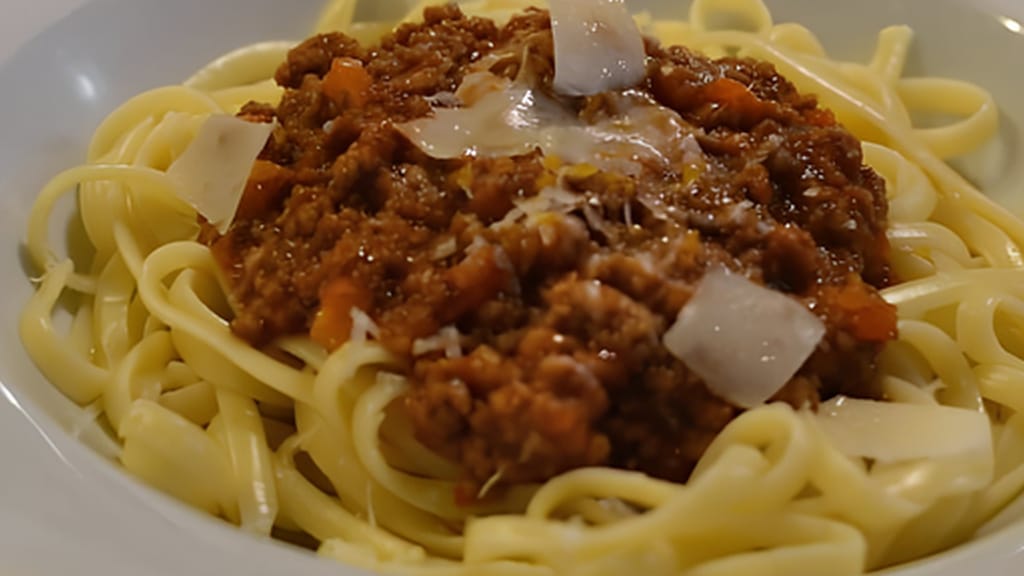
Sugo bolognese: slow-cooked bolognese sauce
Slow-cooked bolognese sauce made with ground pork, served with spaghetti
Spaghetti with shrimp is made like aglio e olio with shrimp: garlic and chili in olive oil, shrimp for just a few minutes, a squeeze of lemon and pasta water. Shrimp are done in 2–3 minutes, and that's also the most common mistake: overcooked, they shrink into rubbery rings.
Thaw frozen shrimp overnight in the fridge, not on the counter, and pat them dry with a paper towel before searing, otherwise they simmer in their own liquid instead of browning. Sear them in the garlic oil until they're pink all over and the flesh is pearly opaque, not glassy. Then take them out of the pan, combine the spaghetti with pasta water in it, and return the shrimp only at the end, just to heat through. A handful of chopped parsley and a little grated lemon zest finish the sauce. You proceed the same way with a seafood mix, only sear it a minute or two longer, until the water evaporates.
If you'd like fish instead of shrimp, try spaghetti with tilapia, olives and cherry tomatoes. The tilapia fillets are thawed in the fridge, dried and cut into pieces, then browned with onion in olive oil and butter, tomatoes, olives and whipping cream are added, and everything is combined with 400 g of spaghetti and cooking water; in 30 minutes you have dinner for four. The fish is done when it flakes into opaque pieces; FSIS gives 63°C (145°F) for fish, measured at the thickest point.
Don't leave cooked seafood or fish standing out: refrigerate leftovers within 1 hour and eat them by the next day.
Squid ink spaghetti is pasta colored with cuttlefish ink, which gives it a black color and a delicate, lightly salty flavor of the sea. It suits seafood, but also a simple plate with cheese. Black spaghetti cooks just like regular, but you can't tell by color whether it's done, so taste it.
Our quickest recipe, squid ink spaghetti with sun-dried tomatoes and mozzarella, is ready in 10 minutes: 200 g of black spaghetti for two servings, 50 g of sun-dried tomatoes in oil, one mozzarella and a drop of olive oil. Black, red and white on the plate look festive, so it also suits a New Year's Eve dinner when you don't want to stand at the stove.
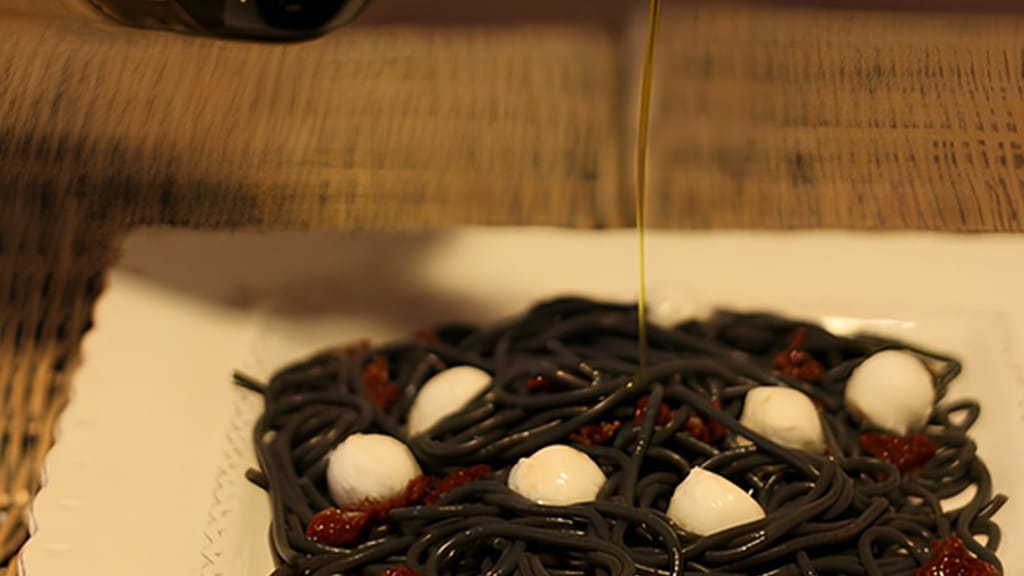
Squid ink spaghetti with sun-dried tomatoes and mozzarella
Squid ink spaghetti with sun-dried tomatoes and mozzarella in 10 minutes
For spaghetti with chicken, boneless chicken thighs are best, because they don't dry out in the pan as fast as breasts. Cut the meat into pieces, pat dry, brown until golden in oil, and only then add the vegetables and sauce: tomato, spinach, or just garlic, lemon and pasta water. Chicken must be cooked through: 74°C (165°F) in the thickest piece, measured with an instant-read thermometer, with no pink inside and clear juices. After cutting raw chicken, wash the cutting board, knife and your hands before touching vegetables or herbs.
The best meatless spaghetti rests on vegetables that cook down into the sauce: pumpkin, tomatoes, zucchini, spinach or sun-dried tomatoes. The aglio e olio, pomodoro and scarpariello above are meatless on their own; here are two more recipes.
Autumn spaghetti with hokkaido pumpkin and spinach: diced pumpkin goes in with sautéed onion and garlic, is topped up with about 150 ml of water and simmered covered until tender. Then 300 g of spinach is wilted in it for two to three minutes, the mixture is combined with 400 g of spaghetti and pasta water, and it's sprinkled with toasted pumpkin seeds on the plate. It contains no meat, eggs or cheese and is ready in 33 minutes.
Asparagus spaghetti with sun-dried tomatoes and Parmesan: onion is sautéed in the oil from a jar of sun-dried tomatoes, then the tomatoes and asparagus cut into four-centimeter pieces are added, with the tips going in only for the last two minutes so they stay crisp. Everything is combined with the spaghetti using half a cup of cooking water and sprinkled with Parmesan; ready in 28 minutes.
The pumpkin version belongs to September–November, the asparagus one to April–June.
A note on cheese: Parmesan and pecorino are both traditionally made with animal rennet. If you avoid that too, look for cheese made with microbial rennet on the label, or stick to the cheese-free pumpkin version. For more ideas for the whole week, see the article meatless meals, from Czech classics to quick vegetable dishes.
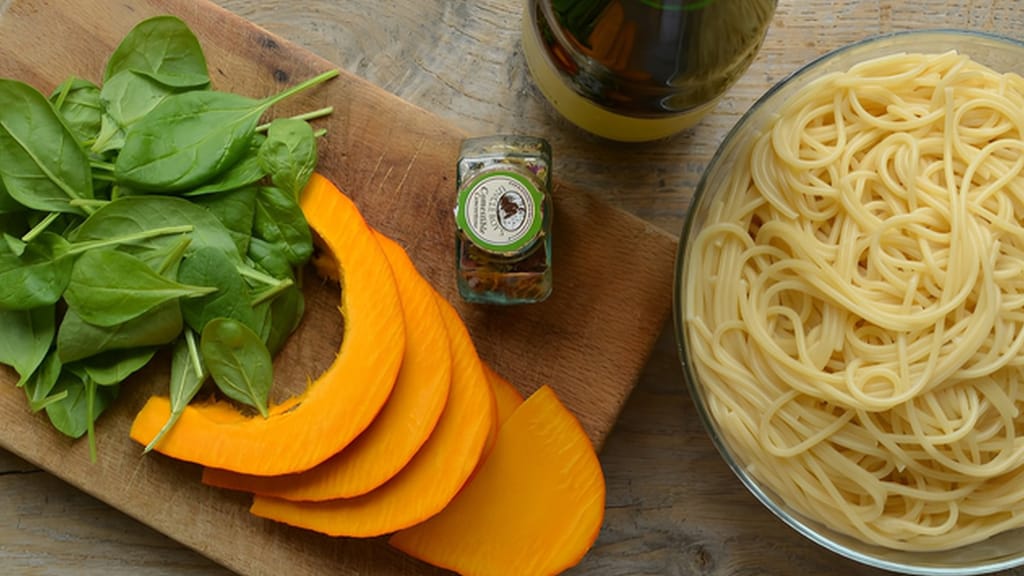
Autumn pumpkin & spinach spaghetti
Autumn spaghetti with hokkaido pumpkin, spinach and pumpkin seeds
Between Christmas Eve and mid-January, spaghetti is the ideal dish: quick, cheap and simple after days at the oven. It's most useful in three situations:
New Year's midnight. Aglio e olio or carbonara are Italian classics of the so-called spaghettata di mezzanotte, the midnight plate after the celebration. You can make either in a quarter of an hour from pantry staples.
Leftovers from the fridge. Dice a bit of smoked meat, ham or roast and use it in place of bacon in a sauce of garlic, oil and pasta water. Heat the cooked meat in the sauce until hot all the way through, which means 74°C (165°F).
Leftover cooked spaghetti. Mix it with beaten eggs and grated cheese and fry in a pan on both sides until golden as a thick pancake; in Naples this is called frittata di pasta. The eggs must set completely, with nothing runny left inside. Or transfer the spaghetti to a baking dish with sauce and cheese and bake it; for inspiration, see the article baked potatoes and pasta bakes from one baking dish.
Refrigerate cooked spaghetti within 1 hour and sauces within 2 hours of cooking; FSIS gives 3–4 days in the fridge for cooked leftovers. We cover how to store and freeze it so it doesn't fall apart in the article how long cooked pasta keeps in the fridge and how to freeze it. And when you tire of spaghetti, you'll find more pasta shapes and sauces with chicken and ground meat in the roundup what to cook with pasta.
Spaghetti is most often ruined by too little water, too little salt, and sauce poured on top instead of being combined in the pan. The full list:
A small pot. In two liters of water for half a kilo of spaghetti, the noodles stick into one clump.
Oil in the water. It doesn't prevent sticking, and the sauce then won't cling to the noodles.
Unsalted water. The pasta tastes flat even if the sauce is bold.
Rinsing after cooking. It washes off the starch and the sauce runs off.
Cooking until soft. The spaghetti cooks another minute or two in the pan, so it should come out of the pot al dente.
Sauce on the side. Spaghetti with sauce ladled over it on the plate never tastes like spaghetti combined in the pan with cooking water.
Cheese in boiling sauce. Over high heat it seizes into rubbery strings; add it off the heat or over low heat.
Burnt garlic. A few extra seconds and the whole sauce is bitter. Garlic belongs in the oil slowly, never in smoking oil.
Cream in carbonara. It makes it a different, heavier sauce and overpowers the eggs and cheese.
Classic dried spaghetti takes 8–11 minutes, thin spaghettini 5–7 minutes and thick spaghettoni 12–14 minutes. Always go by the package, and cook it 1–2 minutes less if you'll finish it in the pan with the sauce. It's ready when it's pliable but still has a slight resistance in the center when you bite it. Fresh egg spaghetti needs only 2–3 minutes.
Spaghetti isn't broken because a long strand wraps around the fork and picks up the sauce, while short pieces slide off. Breaking it doesn't make anything easier anyway: stand the spaghetti in boiling water, wait a few seconds for the bottom to soften, and the rest sinks in by itself. If you're cooking for small children, though, feel free to break it, since it will be easier for them to eat.
The safest approach is to time it the other way around: finish the sauce first and add the spaghetti to the water when the sauce is almost done, because drained noodles stick into a clump within minutes. If they must wait, leave them in the colander only briefly, return them to a warm pot, drizzle with a spoonful of oil or butter, add a little cooking water and toss now and then. Before serving, combine them with the sauce in the pan, and another ladleful of water will loosen them again. Don't rinse them in cold water, because you'd wash off the starch the sauce clings to.
Carbonara reheats badly because the eggs keep setting as they heat and the sauce turns grainy, so it's best eaten right away. Put leftovers in the fridge within 1 hour of cooking. Reheat them in a pan with 1–2 tablespoons of water over low heat, stirring constantly, until hot all the way through, which means 74°C (165°F). It will be drier and less creamy, but still tasty.
Hard aged cheeses suit spaghetti best: Parmesan for delicate and creamy sauces, and sheep's-milk pecorino romano for carbonara and sharper tomato sauces. Grate it finely just before using, because pre-grated cheese melts less well due to the anti-caking agents. In Italy, cheese is traditionally not served with seafood sauces or aglio e olio.