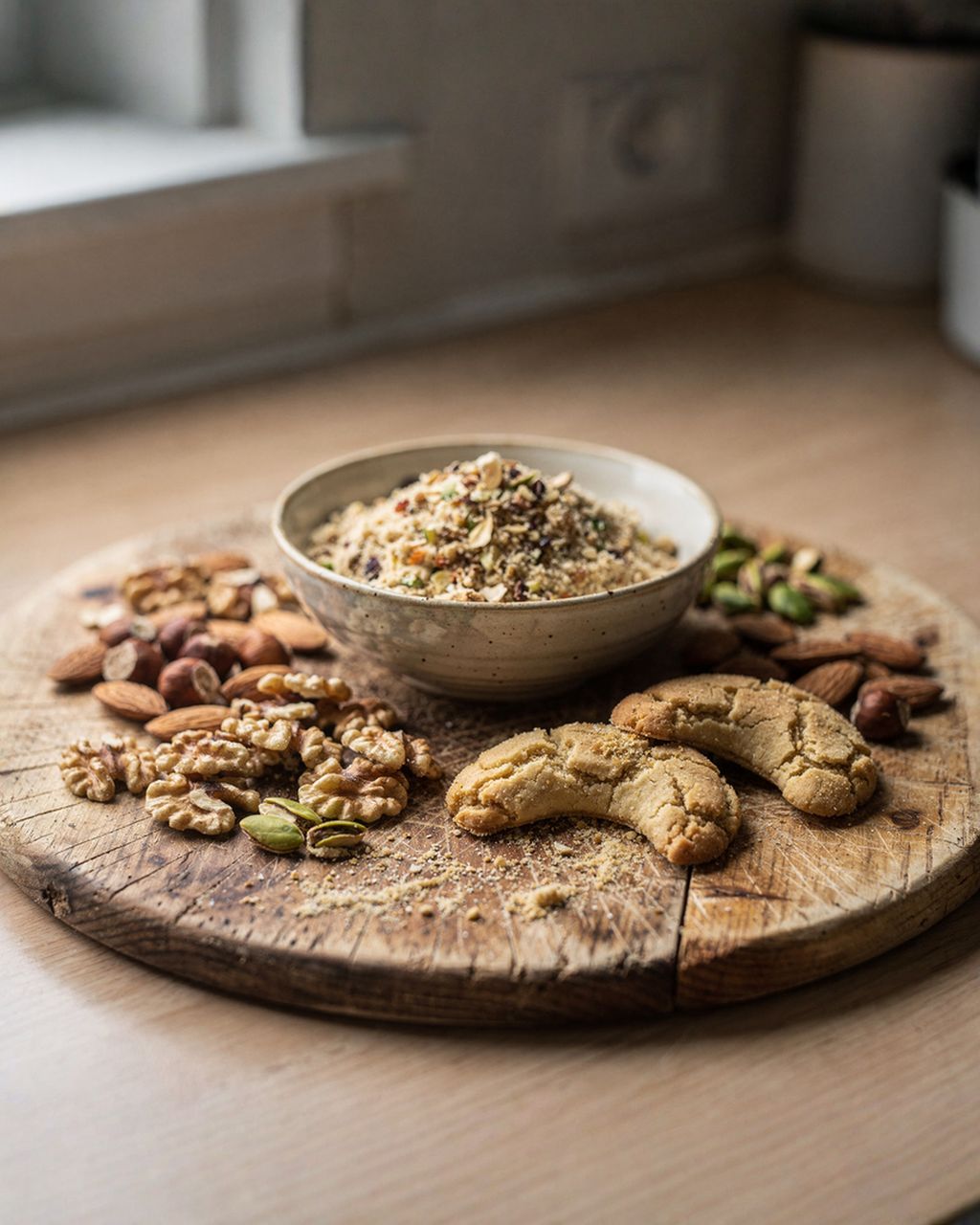
Types of Nuts for Baking: How They Differ and What Goes Where
Nuts for Baking: How to Toast, Skin and Grind Them Without Making Nut Butter
Updated Oct 17, 2026
Toast baking nuts in the oven at 300–350 °F (150–175 °C) for 5–14 minutes, depending on the type, until they smell fragrant and are golden all the way through. You can skin hazelnuts by rubbing them in a kitchen towel while they're still hot. Grind nuts only once they're completely cool, in short pulses and with a spoonful of the sugar or flour from your recipe. Otherwise they release their oil, and instead of a loose, fluffy meal you end up with a sticky paste. Below you'll find temperatures and times for every type of nut, how to skin hazelnuts and almonds, and a grinding method that keeps the meal dry.
Toasting gives nuts a deeper, nutty-caramel flavor and dries them out, so they turn crisp and grind more easily. The flavor comes from the Maillard reaction, the same browning that gives bread crust its color. It barely happens in a raw nut, but in an oven above roughly 300 °F (150 °C) it gets going in earnest.
What toasting does for you:
Flavor. Toasted hazelnuts taste noticeably more "nutty" in cookies than raw ones.
Crunch. The moisture evaporates, and once cool the nut is hard and brittle.
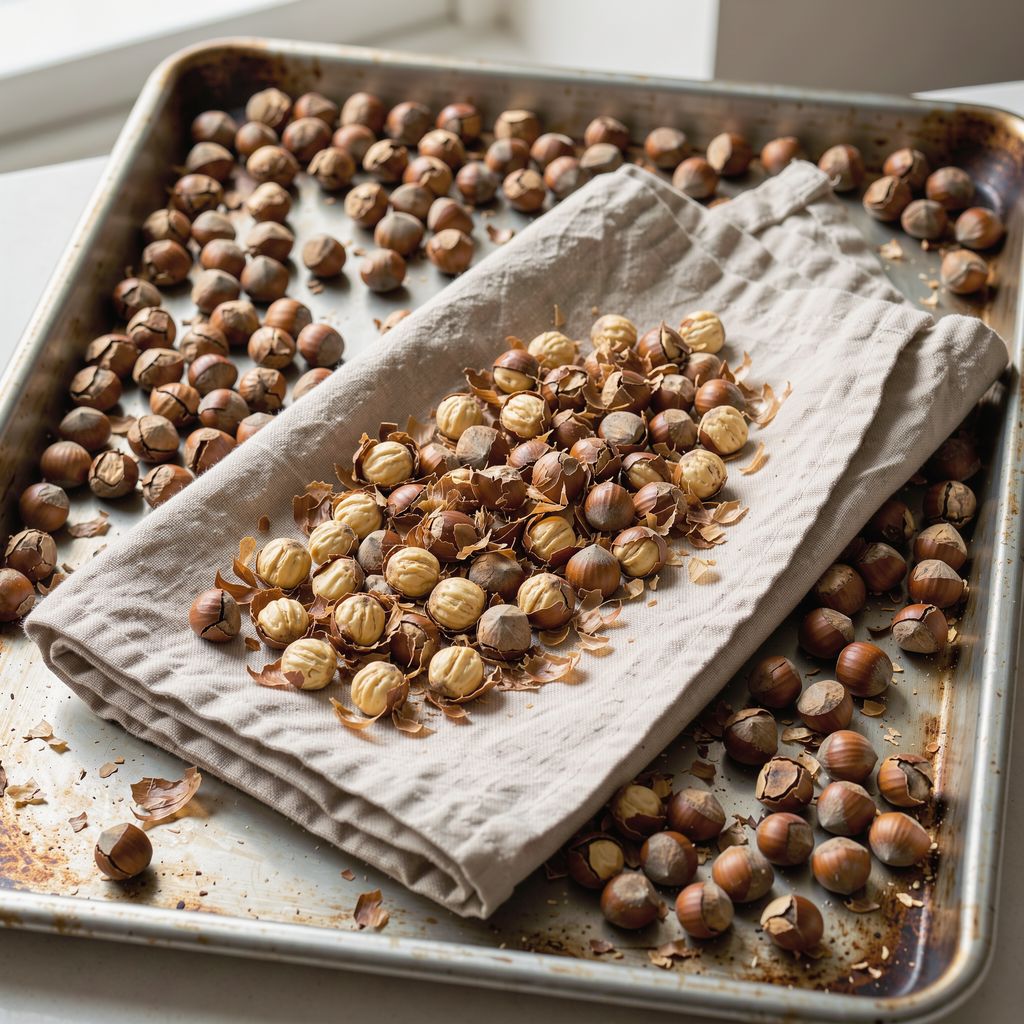
Skinning. After toasting, hazelnut skins crack and come off in a kitchen towel.
Dry meal. A dry nut grinds more easily and turns greasy less readily.
When not to toast: nuts that go on top of a cake toast in the oven as it bakes, and pre-toasted ones would burn on the surface. And for pale cookies where you want a white color, raw blanched almonds are the better choice.
Buy nuts raw, unsalted and untoasted, so you control how far they're toasted. You'll find them among the baking ingredients. Which nut suits which dough is covered in Types of Nuts in Baking: How They Differ and Which Goes Where.
Toast nuts at 300–350 °F (150–175 °C) (10 °C lower with a fan oven) for 5–14 minutes, depending on size and type. Most nuts do best at 320–350 °F (160–175 °C), while fatty macadamias and pistachios need 300–320 °F (150–160 °C). The more fat a nut has and the smaller it is, the lower the temperature and the shorter the time it can take:
Hazelnuts, whole: 175 °C (350 °F), 10–14 min
Almonds, whole, with skins: 170–175 °C (340–350 °F), 10–12 min
Almonds, blanched: 170 °C (340 °F), 8–10 min
Sliced and flaked almonds: 160 °C (320 °F), 4–7 min
Walnut halves: 165–170 °C (330–340 °F), 7–10 min
Pecans: 165 °C (330 °F), 6–9 min
Cashews: 165 °C (330 °F), 8–12 min
Macadamias: 150–160 °C (300–320 °F), 8–10 min
Pistachios: 150–160 °C (300–320 °F), 5–8 min. Any longer and they lose their green color
Chopped nuts: same temperature, cut the time by about a third
How to do it:
Spread the nuts on a baking sheet in a single layer. Piled on top of each other, they toast unevenly.
Place the sheet in the middle of the oven.
Halfway through, shake the sheet or stir the nuts.
As soon as you take them out, tip them off the sheet into a bowl or onto a plate. A hot sheet keeps cooking them, and a few extra minutes make the difference between golden and bitter.
Treat the times as a guide. Ovens often differ from the set temperature by 10–20 °C, so watch the first batch from the shortest time. If you want to be sure, check the real temperature with an oven thermometer.
Nuts are done when they smell nutty and, once broken open, are pale golden inside, not white. The color of the surface can mislead you, especially with almonds and hazelnuts that still have their skins, since you can't see through them.
Smell: as soon as you smell the nuts in the kitchen, start checking. A sharp, acrid smell means they're already past the line.
Cut: take out one nut, break it open and look at the center.
Skin: on hazelnuts it cracks and starts to peel.
Crunch: a hot nut is often still a little pliable and only turns crisp as it cools, so taste one once it's cool.
A dark brown center and a bitter aftertaste mean the nuts are overtoasted. Don't use them in cookies, because the bitterness will override everything else.
In a skillet, dry-toast nuts over medium heat for 3–6 minutes, stirring the whole time. Use no oil, a single layer and no more than about 150 g (5 oz) at once. A skillet suits smaller amounts, sliced almonds and toppings you need right away.
Sliced and flaked almonds, pine nuts: 2–4 min, they brown in a flash
Chopped walnuts or hazelnuts: 3–5 min
Whole nuts: 5–7 min, but they cook through less well than in the oven
A skillet heats from below, so the nuts brown on the outside before they do inside. For whole hazelnuts or almonds you plan to grind, use the oven instead, where they toast evenly all the way through. Even from a skillet, tip them onto a plate right after toasting.
There are two ways to skin hazelnuts: rubbing them in a kitchen towel after toasting (quick, but the skins don't all come off) or boiling them in baking soda (a clean kernel, more work). Almonds are skinned by blanching in boiling water. With hazelnuts, the choice depends on how much leftover skin bothers you.
Hazelnut skin is thin, papery and slightly bitter. In dark cookies or a nut cake it disappears. In vanilla crescent cookies and pale creams, it leaves dark specks and a bitter note.
Toast the hazelnuts at 350 °F (175 °C) for 10–14 minutes, until the skins crack. Tip them, still hot, into a clean kitchen towel, wrap them up and let them rest for a minute or two. The steam loosens the skins. Then rub them vigorously through the towel with your palms, as if you were scrubbing laundry.
Most of the skin usually comes off, but the rest clings tight. Don't try to force it off, since it doesn't matter in most recipes.
Tip the skinned nuts into a colander and shake it over the sink or outdoors, so the loose skins fall through and blow away.
Use an old towel, because the skins will stain it brown.
If the skins won't come off at all, the nuts are underdone. Put them back in the oven for 2–3 minutes.
If you want hazelnuts without a single bit of skin, boil them for 3–4 minutes in water with baking soda. The alkaline water breaks down the skin so that it slips off the cooled nut between your fingers.
In a pot of at least 3 liters (3 quarts), bring 500 ml (2 cups) of water to a boil. Use a big pot, because baking soda foams up fiercely.
Add 3 tablespoons of baking soda, then about 150 g (5 oz) of raw hazelnuts.
Boil for 3–4 minutes. The water will turn black. That's dye from the skins, not a mistake.
Fish out one nut into cold water and try pushing the skin off with your finger. If it comes off easily, drain them.
Rinse the nuts under cold water and squeeze each one out of its wet skin.
Dry them with a towel and toast at 350 °F (175 °C) for 12–15 minutes. They're damp, so they need a little longer.
After the baking soda, the nuts must be completely dry before you start grinding. A damp nut turns greasy in the grinder even more than a warm one.
Pour boiling water over the almonds, leave them in it for 1 minute, drain and cool under cold water. Then just squeeze each one between your thumb and forefinger, and the kernel slips out of its brown skin.
Don't leave them in the water longer than a minute, or they'll go soft and soak up water. Spread the skinned almonds on a towel and let them dry overnight, or dry them in the oven at 100 °C (210 °F) for about 15 minutes. Only once they're dry can you toast or grind them.
Ground nuts turn greasy because the grinder blades break open the fat-filled cells and warm them by friction. The released oil then glues the meal into a paste. It's exactly the process that makes nut butter. You just want to stop it in time.
The risk rises with fat content. According to food composition databases (such as the US USDA), per 100 g they contain roughly:
pecans: ~72 g fat
walnuts: ~65 g
hazelnuts: ~61 g
almonds: ~50 g
pistachios: ~45 g
That's why walnuts and hazelnuts turn greasy far more readily than almonds. Three things push things further toward paste: heat (nuts straight from the oven, long grinding), moisture (nuts not dried enough after blanching or the baking soda method) and a big batch in a small container, where the nuts keep circling around the blades.
Here's how to get loose, fluffy ground nuts: grind them cool and dry, add 1–2 tablespoons of the sugar or flour from the recipe per 100 g (3½ oz) of nuts, and grind in short pulses in small batches. Step by step:
Cool them. After toasting, let the nuts cool for at least 30 minutes. Even better, put them in the freezer for 15–20 minutes.
Add sugar or flour. Take it from the amount in the recipe and don't add anything extra, so the dough ratio stays the same. Powdered sugar or flour soaks up the released oil and the meal stays loose.
Pulse. Run the grinder for 1–2 seconds at a time, not continuously. After 4–5 pulses, shake the contents or scrape them off the sides.
Grind in batches. No more than 150–200 g (5–7 oz) at once, and even less in a coffee grinder.
Sift. Return the coarse bits left in the sieve to the next batch. Don't keep grinding everything over and over until every last bit is fine.
What to grind with:
A hand-cranked nut and poppy seed grinder (with a drum) grates the nuts without heating them and almost never makes paste. It's the most reliable choice for hazelnuts and walnuts for cookies.
A chopper or a food processor with the blade is quick, but only in pulses and with sugar.
A countertop blender and a coffee grinder run at high speed and heat the nuts the most. They suit small batches and almonds, which turn greasy the least.
For cookies, feel free to chop walnuts with a knife or grate them. They have so much fat that in a food processor they start turning greasy almost immediately.
For delicate shaped cookies, grind nuts fine. For toppings and fillings, grind them coarse. Fine meal disperses evenly in the dough and the dough holds its shape, while coarse pieces tear it.
Fine (like coarse flour): vanilla crescent cookies, Linzer cookies with pistachios, pistachio crescent cookies.
Medium (a fine crumb): nut mixtures and fillings, for example in hollow nut crescents, and nut doughs like the nut Easter lamb cake.
Coarse or chopped: toppings, streusel, and nuts on top of sheet-pan gingerbread and cakes.
Nuts ground too coarsely or unevenly are one reason crescent cookies crumble. There's more in Why Vanilla Crescent Cookies Break When You Roll Them in Sugar. Store-bought almond flour isn't the same as ground almonds: it tends to be finer and is often defatted, so it behaves differently in dough (see the FAQ below).
It's best to toast and grind nuts a day, or at most a few days, before baking. Toasted nuts lose their aroma faster than raw ones, and ground nuts go rancid fastest, because the broken cells expose all the fat to air.
Whole toasted nuts: in a sealed jar in a cool place for about 1–2 weeks.
Ground nuts: in a sealed container in the fridge for 1–2 weeks, in the freezer for 2–3 months. Add them straight from the freezer to the dough, with no need to thaw.
Smell them before use: a bitter, musty or rancid smell (like old oil) means the nuts are gone, and nothing will save them.
How to store raw nuts from your whole supply so they last until Christmas is covered in How to Store Nuts So They Don't Go Rancid.
You can toast nuts in the microwave, but they cook less evenly and the flavor is weaker than from the oven. Spread them in a single layer on a plate and microwave on full power in 1-minute bursts. Stir between bursts and count on 3–5 minutes in total. Be careful: they keep cooking for a little while after you take them out.
You don't have to skin hazelnuts for vanilla crescent cookies, but skinned ones give lighter, more delicate cookies. The skins leave dark specks in the dough and add a slightly bitter note. After toasting, just rub the nuts in a kitchen towel. A few leftover bits of skin won't hurt.
Toasted nuts are most often bitter because they're overtoasted. Just a few extra minutes, or leaving them to keep cooking on a hot baking sheet, is enough. Burnt bits of skin also add bitterness, as do nuts that were already rancid before toasting. You can spot those by their sharp, rancid smell even when raw.
You can use almond flour instead of ground nuts in Christmas cookies, but use 10–15% less than the amount of ground nuts the recipe calls for. Store-bought almond flour tends to be finer and is often defatted, so it absorbs more liquid and the dough would turn out drier. Adjust the consistency as needed. Going the other way, if a recipe calls for almond flour and you only have ground almonds, swap them 1:1.
One recipe worth heating the oven for, one tip, and one deal from the shop. Nothing else.