Hollow walnut crescents
Walnuts: How to Shell Them Fast and Tell if They've Gone Rancid
Updated Oct 17, 2026
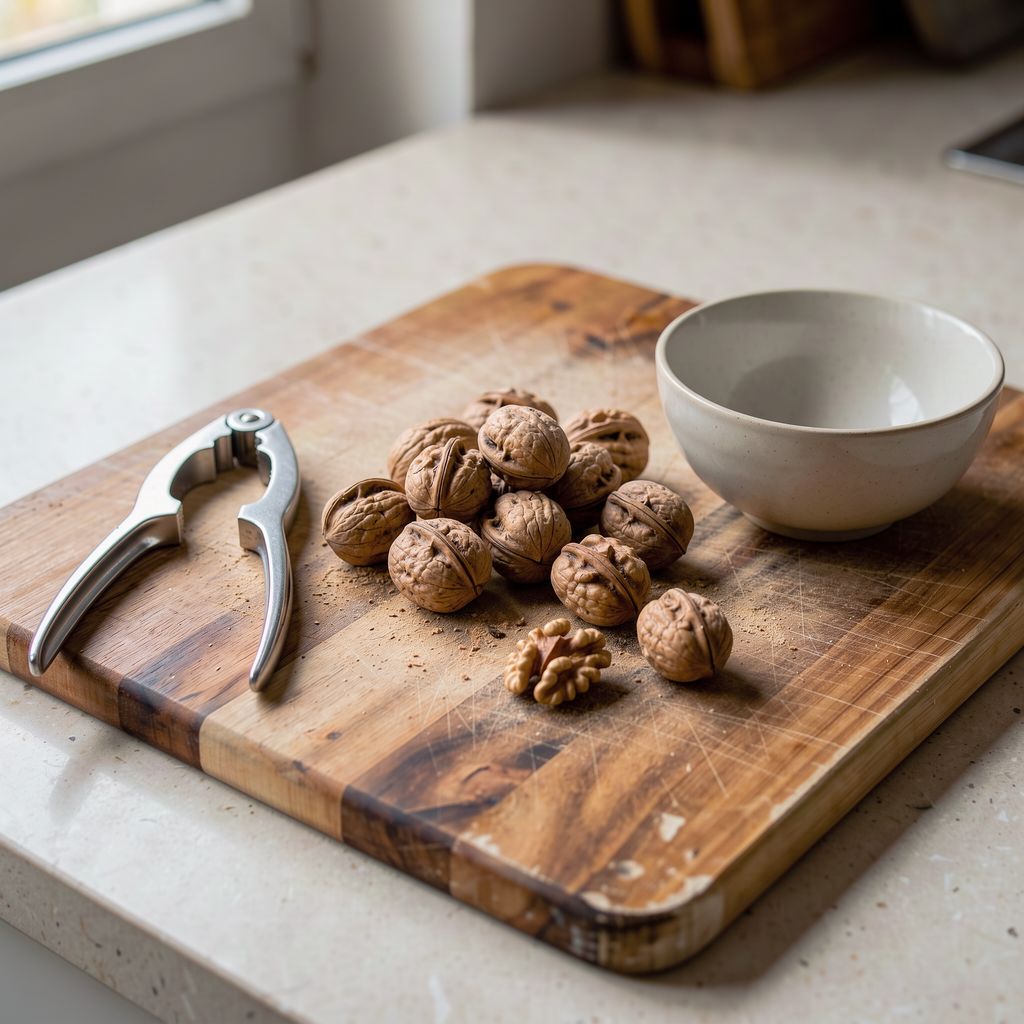
The quickest way to shell walnuts and keep the halves whole is to crack the shell along the seam, not across it. Use a nutcracker, a small hammer, or a knife tip slipped into the slot at the base. If you're cracking a whole bucketful, soak the nuts in hot water for 15–30 minutes: the shell loosens and the kernels crumble less. And to tell whether a kernel has gone rancid, trust your nose first. A fresh walnut smells mild and sweet, while a rancid one smells like paint or window putty and tastes bitter and sharp.
There are three fast ways to shell walnuts. Pick one based on how many nuts you have and whether you want halves or pieces:
Along the seam — a nutcracker or small hammer on the pointed tip of the nut. This is the quickest route to whole halves, and ideal for anything from a handful to a kilo.
Soaking in hot water — the shell softens and the kernel breaks less. It's worth it for a bucketful of walnuts from the garden.
Hammer and tea towel — the fastest option when the kernels are headed for the grinder anyway and shape doesn't matter.
Keep in mind that 1 kg of in-shell walnuts gives you roughly 400–500 g of kernels, depending on the variety and how well the nuts have matured.
You'll get whole walnut halves if you press on the pointed tip and the flat bottom so the shell splits along the seam. The shell is made of two halves held together by that seam. Press along the seam and the shell opens like a clam, leaving the kernel intact. Press across it and you crush the shell and the kernel with it.
Nutcracker: place the nut so the jaws press on the tip and the flat bottom (not on the sides, where the seam runs). Squeeze slowly until you hear a crack, then release. The shell will split along the seam.
Hammer: stand the nut on its flat bottom, tip up, and give the tip one short tap. Use a sharp rap, not brute force.
Knife: on the bottom of the nut there's a small slot where the halves meet. Slip the tip of a blunt knife or a flat screwdriver into it and twist. The shell opens along the seam. It's slower, but it gives the prettiest halves. Watch your fingers and keep the blade pointed away from your hand.
Soaking is the best trick for large quantities. Put the in-shell nuts in a bowl, cover them completely with boiling water, put a lid on, and leave for 15–30 minutes. Then drain and rinse the nuts with cold water. The shell soaks up a little water and softens, and the kernel becomes more pliable, so it doesn't crumble when you crack it.
If you don't want to wait, put the nuts in a pot of cold water, bring it to a boil, and boil for no more than 5 minutes. Any longer and the kernels start to darken.
One catch: soaked kernels are damp. Before storing them, spread them in a single layer and let them dry for 1–2 days at room temperature, or finish drying them in the oven at no more than 40 °C (104 °F) with the door slightly ajar. A damp nut put in a jar will start to mold within a few days.
The fastest way to break walnuts with a hammer is to wrap a handful in a clean tea towel or a cloth bag, set it on a cutting board, and give it a few blows. This works when you're going to grind the kernels into a filling or chop them into dough anyway, so halves don't matter. Then pick the kernels out of the broken shells. The towel keeps the fragments together, so nothing flies around the kitchen. Pick out any small bits of shell carefully before grinding, because they're an easy way to crack a tooth.
A woody partition in the middle holds the kernel in the shell, and that's where the halves usually break. You'll get a whole kernel if you only open the shell along the seam and then snap out the partition before pulling out the kernel.
Open the shell along the seam and peel off one half.
Use your fingers or a toothpick to break off the thin partition between the two halves of the kernel.
Ease the kernel out gently without prying. It will either fall out on its own or come loose with a light push from underneath.
If the kernel holds on tight, soak the nuts in hot water (see above). A damp kernel is flexible and doesn't break.
The variety matters too: some walnuts have a thin shell and a loose partition, while others have a hard, thick shell and a fused partition from which nobody can get a whole kernel. Don't waste your patience on those varieties. Just crack them into pieces.
The most reliable way to spot rancid walnuts is by smell and taste, and only then by eye. Go through these signs:
Smell: a fresh kernel smells mild, sweet, and slightly woody. A rancid one smells sharp, like oil paint, varnish, linseed oil, or window putty.
Taste: a fresh nut is mild and slightly sweet. A rancid one is bitter, sour, and keeps scratching your throat for a while after swallowing.
Kernel color: under the skin, a fresh kernel is creamy white and the skin is light golden. A rancid kernel darkens to yellow-brown and looks oily, almost translucent.
Texture: a fresh kernel snaps with a crack. An old one is rubbery, bends, and looks shriveled.
Why do nuts go rancid so easily? Roughly two thirds of the kernel is fat, and according to nutrition databases most of it is polyunsaturated. These fatty acids oxidize fastest when exposed to oxygen, light, and heat. Oxidation produces a whole range of volatile compounds. According to the Grilo and Wang (2021) study (opens in a new tab), hexanal is the most abundant among them, but other aldehydes and alcohols build up alongside it, and together they give rancid nuts that typical "paint" smell. Shelled kernels go rancid faster than nuts in the shell, because the shell protects them from air and light. You'll find how to store nuts so this doesn't happen in the article How to Store Nuts So They Don't Go Rancid.
A slightly astringent taste doesn't mean the nut is rancid. The thin brown skin on the kernel contains tannins, and these are always astringent, less so in fresh nuts and more so in darker skins. Here's how to tell the difference:
Astringency from the skin is dry and puckering, and it fades quickly. The kernel itself smells clean.
Rancidity is greasy and sharp, and it lingers in your mouth. The kernel also smells like paint.
If only the astringency bothers you, soak the kernels in hot water for a minute and rub the skin off with a tea towel, or toast the nuts briefly. Nothing rescues rancidity, though. Toasting only masks it for a moment, and you'll carry all of it into your dough.
A good walnut in the shell feels heavy for its size and doesn't rattle when you shake it. A light nut that rattles inside has a dried-out, shriveled kernel, or none at all.
Shell: whole, with no cracks or small holes. A hole means pests, and a crack lets air in, so the nut goes rancid faster.
Shell color: light, evenly brown. Dark spots are often just a cosmetic flaw from the husk, but crack those nuts first and check them.
From the garden: let freshly harvested nuts dry in the shell for 2–4 weeks, spread in a single layer in an airy spot. They're ready when the partition inside snaps with a dry crack and the kernel breaks with a snap instead of bending.
Don't want to crack nuts at all? Buy shelled kernels from the new harvest, ideally, meaning autumn onward, and in packaging where you can see them: light, intact, with no oily sheen. You'll find more baking ingredients here with us.
Red walnuts are varieties of the English walnut (Juglans regia) with a red to purple kernel skin. It's a natural trait of the variety, not dye. Under the skin, the kernel itself is creamy, just like in ordinary walnuts.
Two varieties are best known:
Rote Donaunuss (red Danube nut) — an old Austrian variety from the Danube region, with medium-sized nuts and a wine-red skin. It's also grown in Czech gardens.
Robert Livermore — a Californian variety bred in the 1990s by crossing with a red-skinned walnut tree and patented in 2001. It has large nuts with a thinner shell, and according to the breeders the kernel comes out easily.
Red walnuts are usually said to taste milder and less astringent than ordinary ones, but take that as an impression, not a rule. A lot depends on the harvest. You crack them just like other walnuts. In the kitchen they pay off where you can see them: on top of a cake, in a salad, or on a cheese board. When soaked in hot water, the skin can release a little color, so add them to a light cream at the very end.
Don't mix them up: a red skin is fine, but a yellow-brown, oily kernel is not. Skin color says nothing about freshness. Smell does.
Keep whole halves for where they'll be seen. Pieces and fragments go into dough and the grinder. Here are a few recipes where walnuts take the lead:
Whole halves for garnish: baked figs with goat cheese, walnuts, and honey or apple and walnut salad with crispy sage.
Chopped pieces: blue cheese dip with walnuts or garlic baked camembert-style cheese stuffed with walnuts.
Ground and soaked: hollow walnut crescent cookies, beetroot and walnut brownies or homemade walnut milk.
Always taste one nut from the batch before using it. A single rancid piece in the filling will outweigh a whole tray of cookies.
Hollow walnut crescents
Hollow walnut crescent cookies made with ground walnuts
From 1 kg of in-shell walnuts you'll get roughly 400–500 g of kernels. Well-matured varieties with thin shells give more. Varieties with hard, thick shells and a fused inner partition, or nuts with shrivelled kernels, give less.
Don't eat rancid walnuts. They taste unpleasant, and the flavor carries over into the whole dish. Oxidized fats give nuts a bitter, sharp taste, and no treatment, not even toasting, removes rancidity. Always throw out a moldy nut, no exceptions.
Freshly harvested walnuts still have moist, soft kernels, so they stick to the shell and break apart. Let them dry in the shell for 2–4 weeks, spread in a single layer in an airy spot. They're ready when the partition inside snaps with a dry crack.
Walnuts in the shell keep for about a year in a cool, dry place. Shelled kernels keep for only a few months, or longer in the fridge or freezer. The article How to Store Nuts So They Don't Go Rancid covers this in detail.
Yes. Walnut kernels that have been soaked in hot water must be dried fully before storing, or they'll start to mold. Spread them in a single layer for 1–2 days at room temperature, or finish drying them in the oven at no more than 40 °C (104 °F).
One recipe worth heating the oven for, one tip, and one deal from the shop. Nothing else.