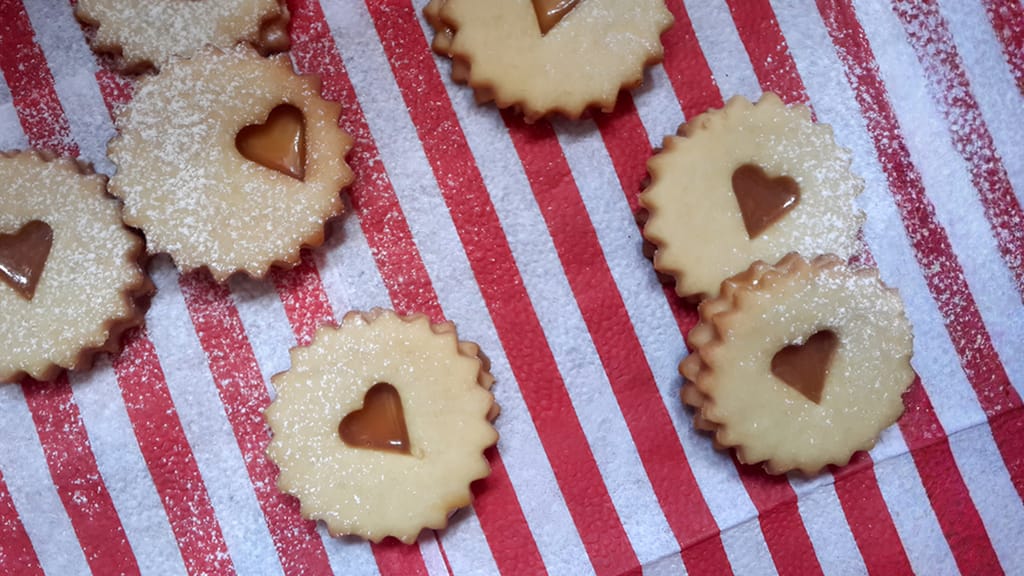
Linzer cookies filled with salted caramel
How Long Filled Christmas Cookies Keep — and What to Fill Them With
Updated Sep 26, 2026
Filled Christmas cookies keep anywhere from 2 days to 4 weeks, and it's the filling that decides — not the dough. Buttercream made from pure butter and icing sugar keeps 2–3 weeks in the fridge, dark chocolate ganache 7–10 days, custard or cream cheese filling just 2–3 days. The rule behind this is simple: the more sugar and fat a filling has, and the less free water, the longer it lasts. Below you'll find a breakdown by filling type, five tricks for extending shelf life, and a timing plan so your cookies stay fresh right through to Christmas — not fall apart three weeks early.
Filled Christmas cookies keep anywhere from 2 days to 4 weeks depending on the filling: sugar- and nut-based fillings 3–4 weeks, buttercream 2–3 weeks, ganache 5–10 days, custard and cream cheese filling 2–3 days. Here's the breakdown from longest-lasting to most fragile — these figures apply to cookies stored in a sealed tin in the fridge at 4–8°C:
Caramel, fruit butter, thick jam: 3–4 weeks
Nut and marzipan filling: 3–4 weeks
Buttercream made from butter and icing sugar (no milk): 2–3 weeks
Dark chocolate ganache, 2:1 ratio: 7–10 days
Milk or white chocolate ganache: 5–7 days
Buttercream with egg yolk or egg white: 3–5 days
Custard, cream cheese and whipped cream filling: 2–3 days
In a cool pantry or larder up to 10°C, count on roughly half these times. At room temperature (20–22°C), only egg- and milk-free buttercream keeps safely — for 4–5 days; everything else belongs in the fridge.
And here's one more thing people mix up: shelf life and taste aren't the same thing. Cookies filled with ganache are still perfectly safe after ten days, but the biscuit will have long since soaked up moisture from the filling and lost its crunch. That's a different problem from spoilage, with a different fix — we cover it below in the section on softening.
Filling spoils faster than dough because it contains free water — water that microorganisms can actually access. A baked biscuit has a water activity of around 0.3; a cream made with milk or cream cheese sits above 0.85, and that one figure is what really decides how long filled cookies last.
Plain baked cookies are essentially a desert: mould and bacteria have nothing to drink there, which is why they keep for weeks in an ordinary tin. Freshly baked biscuit has also just been through the oven, so it's practically sterile.
Filling is a different world entirely. Food safety standards use a water activity threshold of 0.85 — below that, common pathogenic bacteria can't multiply and the product doesn't need refrigeration; above it, they can. And that's exactly the range creams made with milk, cream, cream cheese or custard fall into.
Sugar and fat act as a brake in two different ways:
Sugar binds water. In a thick caramel or jam with 60% sugar or more, there's plenty of water present, but it's chemically bound — microorganisms simply can't get to it. That's why jam doesn't spoil even though it's moist.
Fat displaces water. Butter is around 82% fat and at most 16% water, and in buttercream even that remaining water gets coated in fat and dissolved sugar.
The third factor is cleanliness. A baked biscuit is sterile; filling isn't — microorganisms get into it from a spoon, a piping bag, or fingers. That's why two identical batches of buttercream can end up differing in shelf life by a whole week.
Five fillings last the longest: caramel, thick fruit butter or jam, nut or marzipan filling, dark chocolate ganache, and buttercream made from pure butter and icing sugar. What they all have in common is the same thing — lots of sugar or fat and almost no free water. Everything based on milk, cream, cream cheese or raw egg, on the other hand, spoils fastest.
Now let's go through them one by one.
Buttercream whipped from just butter and icing sugar keeps 2–3 weeks in the fridge. Add a spoonful of milk or cream, though, and you drop to 5–7 days — and that's the one change people make almost automatically, just to make the cream a bit softer.
Need to loosen it up? Add more softened butter, a spoonful of rum, or strong espresso cooled to room temperature. Not milk.
Use icing sugar, not caster sugar. Fine sugar dissolves in the fat and binds water; coarse crystals just sit in the cream and turn grainy after a few days in the fridge. We go into why this matters for the dough itself too in our article on icing sugar vs. caster sugar in Christmas baking.
Flavour it without adding water: scraped vanilla, cocoa, instant coffee powder, a splash of rum. Lemon juice and fruit purée both shorten shelf life.
Versions made with a cooked sugar syrup (Italian or Swiss meringue buttercream) taste lighter but contain egg white — and that means the fridge, used up within 3–5 days.
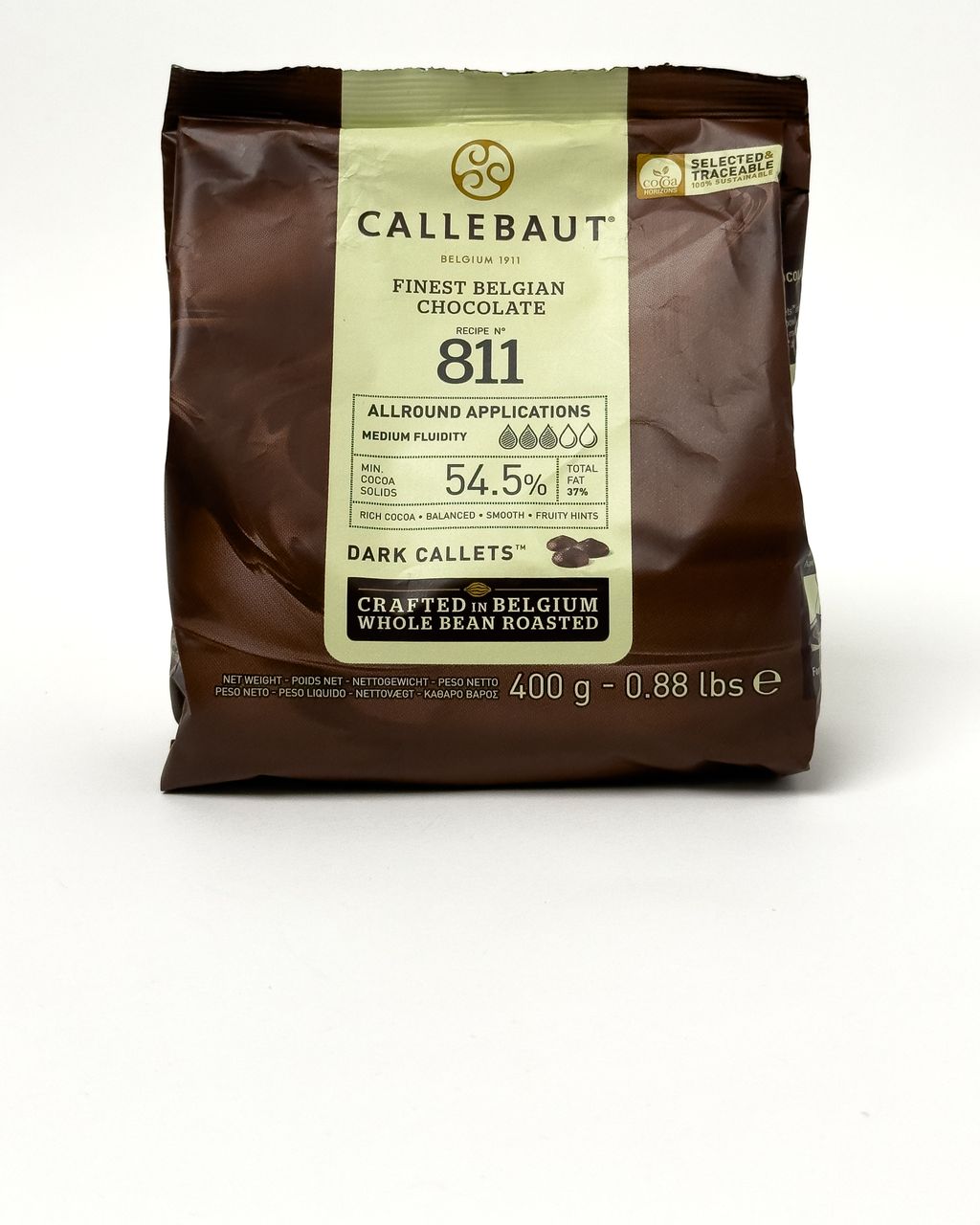
Ganache at a 2:1 ratio (two parts dark chocolate to one part cream) keeps 7–10 days in the fridge and is just firm enough to pipe and stack cookies without them squashing. A 1:1 ratio gives a softer cream, but with more water and a shorter life — count on 5 days.
White and milk chocolate need more chocolate, since they contain less cocoa butter: use a 3:1 ratio. Even so, it keeps for a shorter time than dark chocolate ganache.
Swap some of the cream for butter, about a third of it. You keep the flavour and lose some of the free water.
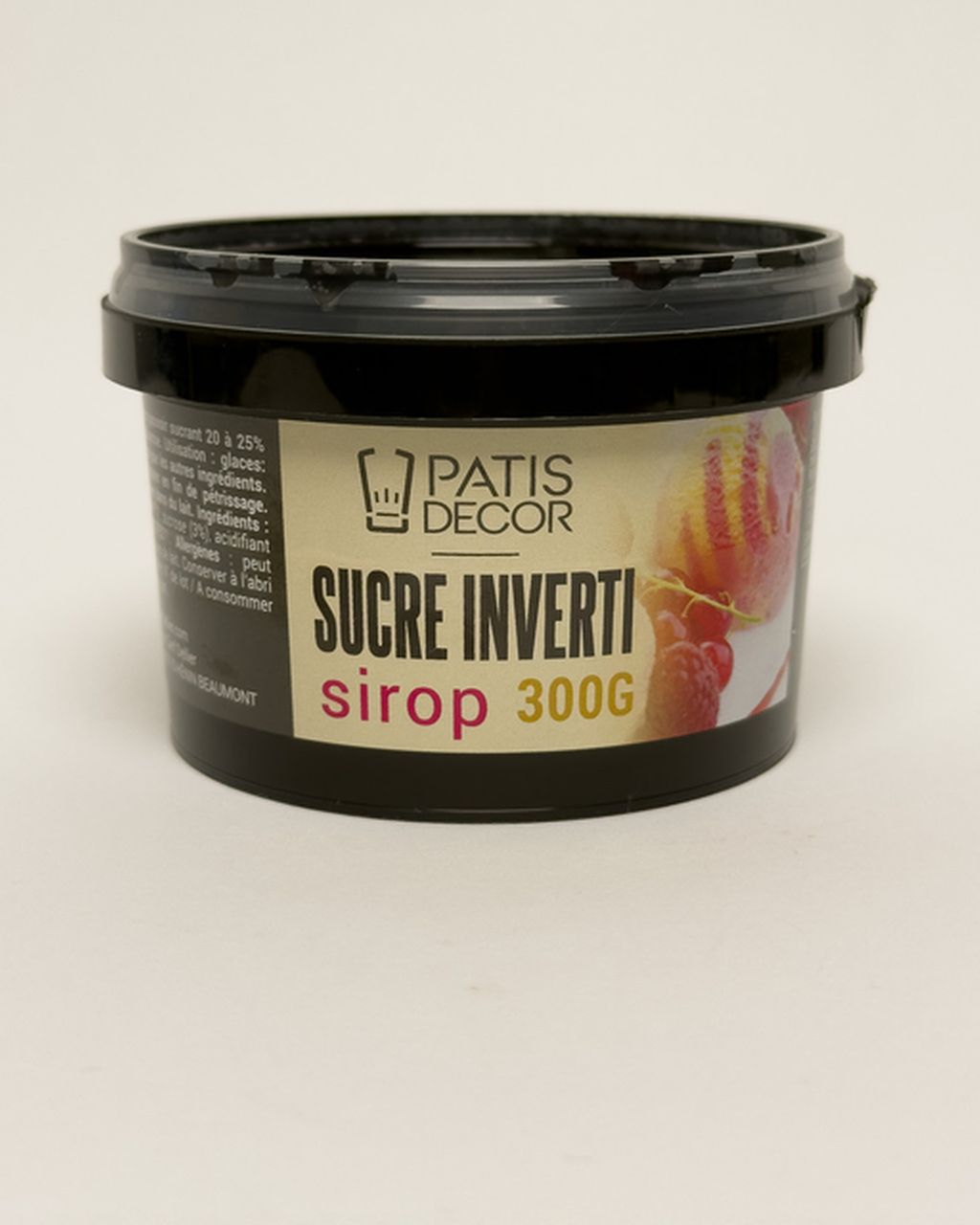
Add invert sugar or glucose syrup, at 5–10% of the ganache's weight. It binds water, extends shelf life, and also stops the ganache from turning grainy after a week.
Cream that's actually been brought to a proper boil is worth the effort: a short boil knocks down the initial microbial load, so the ganache keeps longer in the fridge than one made with just-warmed cream.
Let finished ganache firm up at room temperature before piping, not in the fridge — otherwise you'll end up with hard little lumps of cocoa butter in it.
Sugar-based fillings keep 3–4 weeks and are the safest choice when you're baking well ahead or sending cookies around the family. It sounds odd for caramel, which is cooked with cream and butter, but the sugar concentration is high enough to reliably bind the water.
Use a thick jam, not a runny stewed-fruit one. Soft apricot preserve with low sugar content is, shelf-life-wise, more fruit than preservative. If yours is runny, reduce it in a pan by about a third and let it cool.
Salted caramel has the added benefit of salt, which lowers water activity a bit further still.
Fruit butter (povidla-style plum spread) is a classic for exactly this reason — it's cooked down to a thickness where nothing can grow.
One downside: sugar-based fillings feel moist to the touch and soak into the biscuit faster than buttercream does. The fix is a chocolate barrier — see the tricks below.
Linzer cookies filled with salted caramel
Linzer cookies filled with salted caramel — the longest-lasting filled cookie there is

Salted caramel cream - great for macarons and more
Salted caramel cream as a long-lasting filling for cookies and macarons
A mix of ground nuts, icing sugar and a spoonful of rum keeps 3–4 weeks and is the traditional filling for hollow crescents and stuffed walnuts alike. Marzipan works the same way — it's essentially almonds and sugar, fat and preservative in one.
The only real risk here isn't microbial, it's flavour: nuts turn rancid. The fat in ground nuts oxidises within a few weeks, and the filling ends up tasting of old paint. So grind nuts just before using them, and store whole nuts cool and in the dark.
If you want a softer filling, don't add milk — use softened butter or a couple of spoonfuls of thick jam instead.
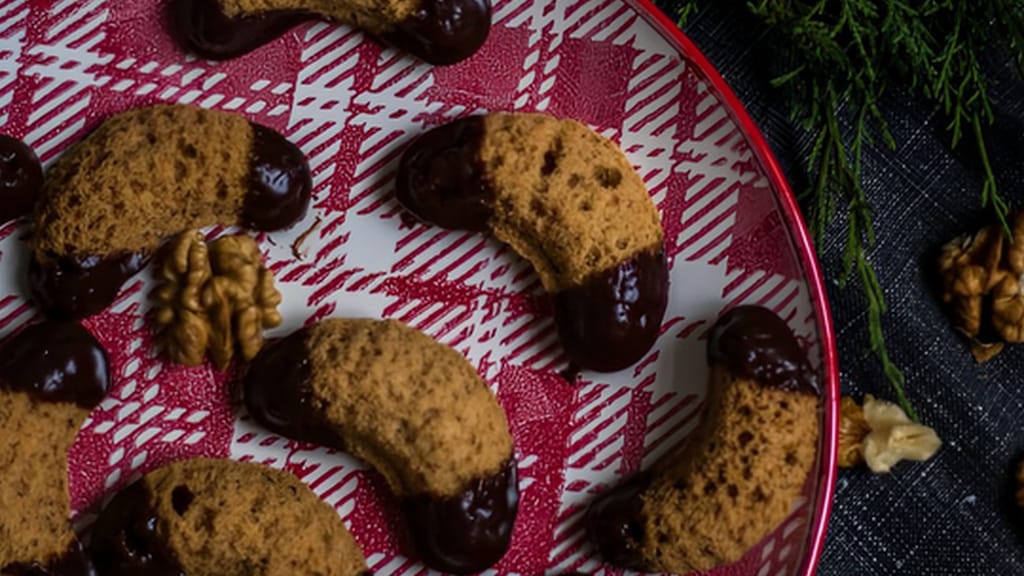
Hollow walnut crescents
Hollow nut crescents — the classic for a long-lasting nut filling
Cream cheese, mascarpone, whipped cream and custard don't belong in cookies meant to keep. They last just 2–3 days — which is roughly how long it'll take for them to vanish from the tin, and only if it's already Christmas Eve, not before.
Cream cheese and cream-based fillings: high water activity, needs refrigeration. If you want to use one, fill the cookies on the day you're serving them.
Custard filling: starch and milk are an ideal environment for microorganisms. On top of that, it releases water after two days and turns the biscuit soggy.
Whipped cream: it collapses and weeps whey before it even has a chance to spoil.
Raw egg yolk or egg white: this raises a safety issue as well as a shelf-life one — see the warning below.
Rum cream for wasp-nest pastries is a special case, and it depends on the recipe. A version built on butter, icing sugar and rum keeps a good two weeks. A version made with soaked sponge fingers and milk is as fragile as custard — refrigerate and use within three days.
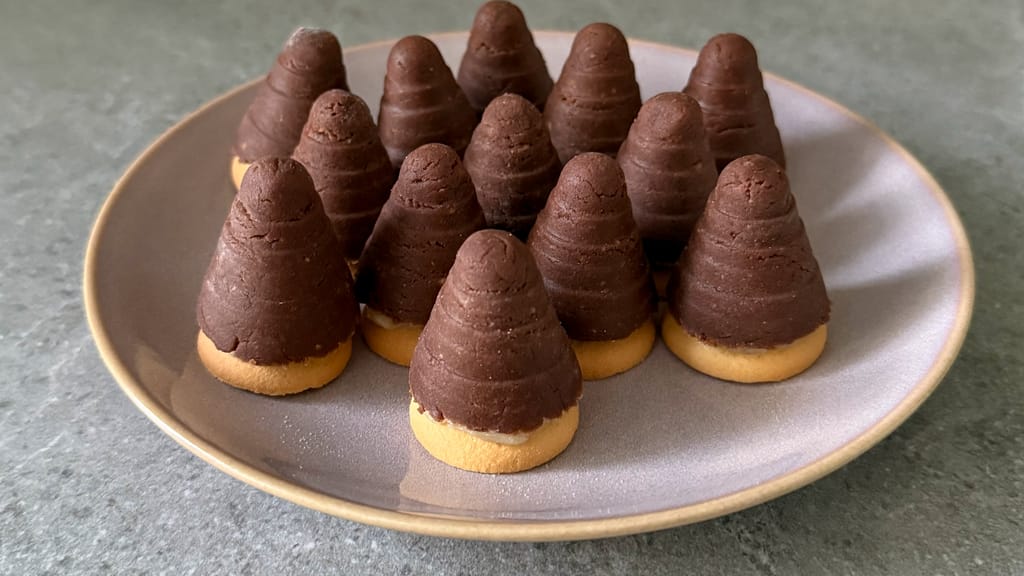
Grandma's traditional wasp's nest cookies with rum cream
Traditional wasp-nest pastries with rum cream — the butter-based version that actually keeps
You can extend the shelf life of pretty much any filling with five moves: swap liquid for fat, add invert sugar, add alcohol, separate the filling from the biscuit with a layer of chocolate, and work cleanly. Each one takes just a few extra minutes.
Swap liquid for fat. Anywhere a recipe calls for milk or cream, try softened butter instead. The cream will be thicker, taste better, and its water activity will drop.
Add invert sugar or glucose syrup, at 5–10% of the filling's weight. It binds free water, prevents crystallisation, and it's exactly what bakeries do to keep fillings fresh in the display case.
Alcohol: 1–2 tablespoons of rum, brandy or eggnog liqueur per 250g of filling. It has an antimicrobial effect and suits festive flavours perfectly.
Build a chocolate barrier. Brush the inside of the biscuit with a thin layer of melted chocolate, let it set, then fill. Chocolate is waterproof — the cookie stays crisp for several extra days. For jam and caramel fillings, this makes the single biggest difference you can make.
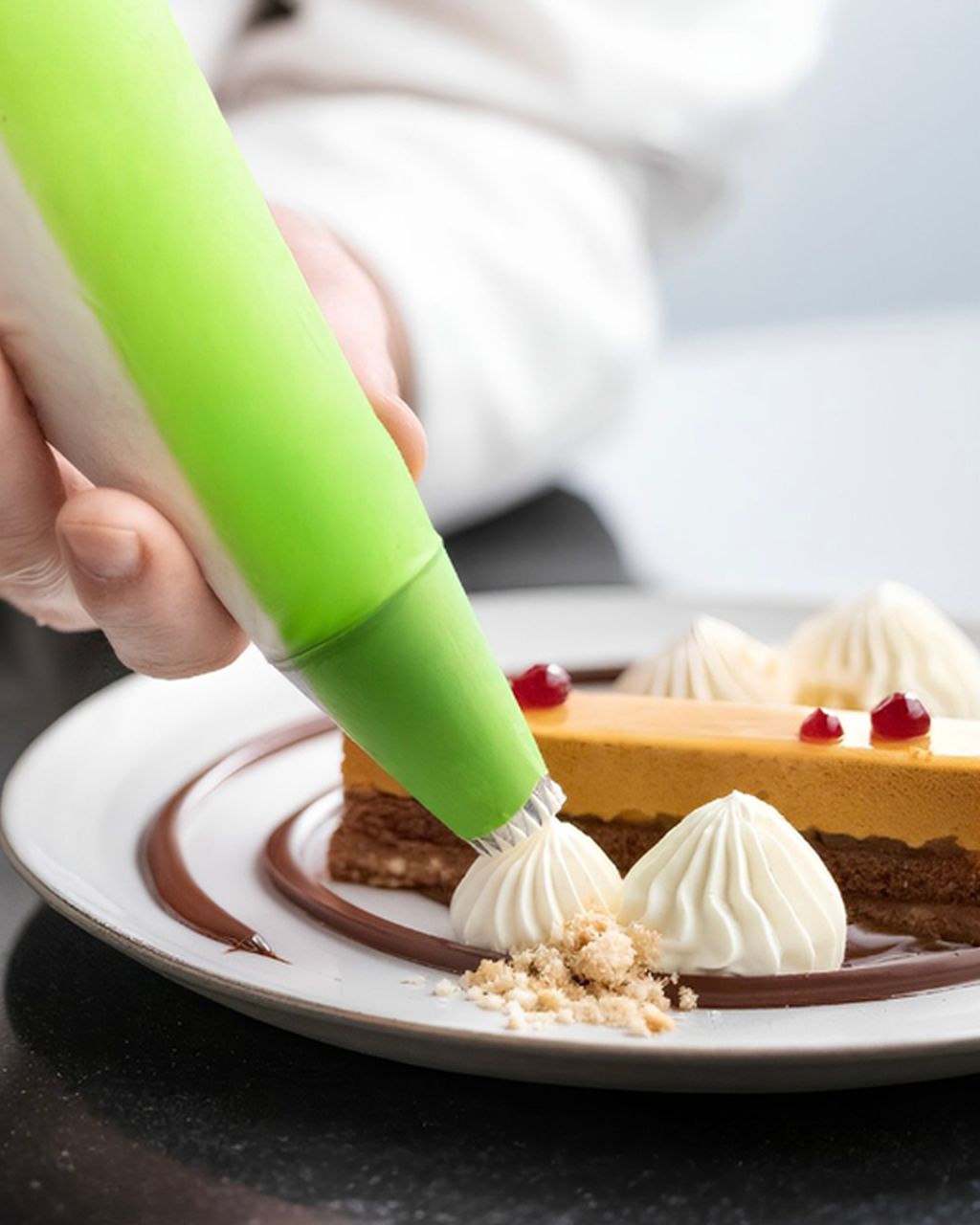
Work cleanly. A single-use piping bag, a clean spatula, no fingers, and never scrape leftover cream back into the bowl. Let the filling cool to room temperature before piping, rather than leaving it to sit for two hours in a warm kitchen.
Fill cookies no earlier than a week before Christmas; for fragile fillings, two to three days ahead. Shelf life is counted from the moment of filling, not from baking — and that's the most common mistake: the biscuits themselves keep for a month, so people bake them in November, then fill them straight away and ruin the whole batch.
Here's a timeline that actually works:
Late November to early December: bake the shells — linzer halves, hollow crescents, wasp-nest bases. Store them somewhere dry, or freeze them straight away.
One week before Christmas: make the filling and fill anything that keeps well — caramel, jam, nut filling, buttercream, ganache.
Two days ahead: fill anything with cream cheese, whipped cream, or custard, if you really want to use them.
Add sugar dusting and icing last, once the filling has set — otherwise moisture from underneath will melt the icing.
For exact timing on individual types, check our Christmas cookie baking calendar. And if you want to get the shells baked ahead of time in November, take a look at our guide to freezing Christmas cookies and dough — for filled cookies, the freezer is often more useful than the biscuit tin.
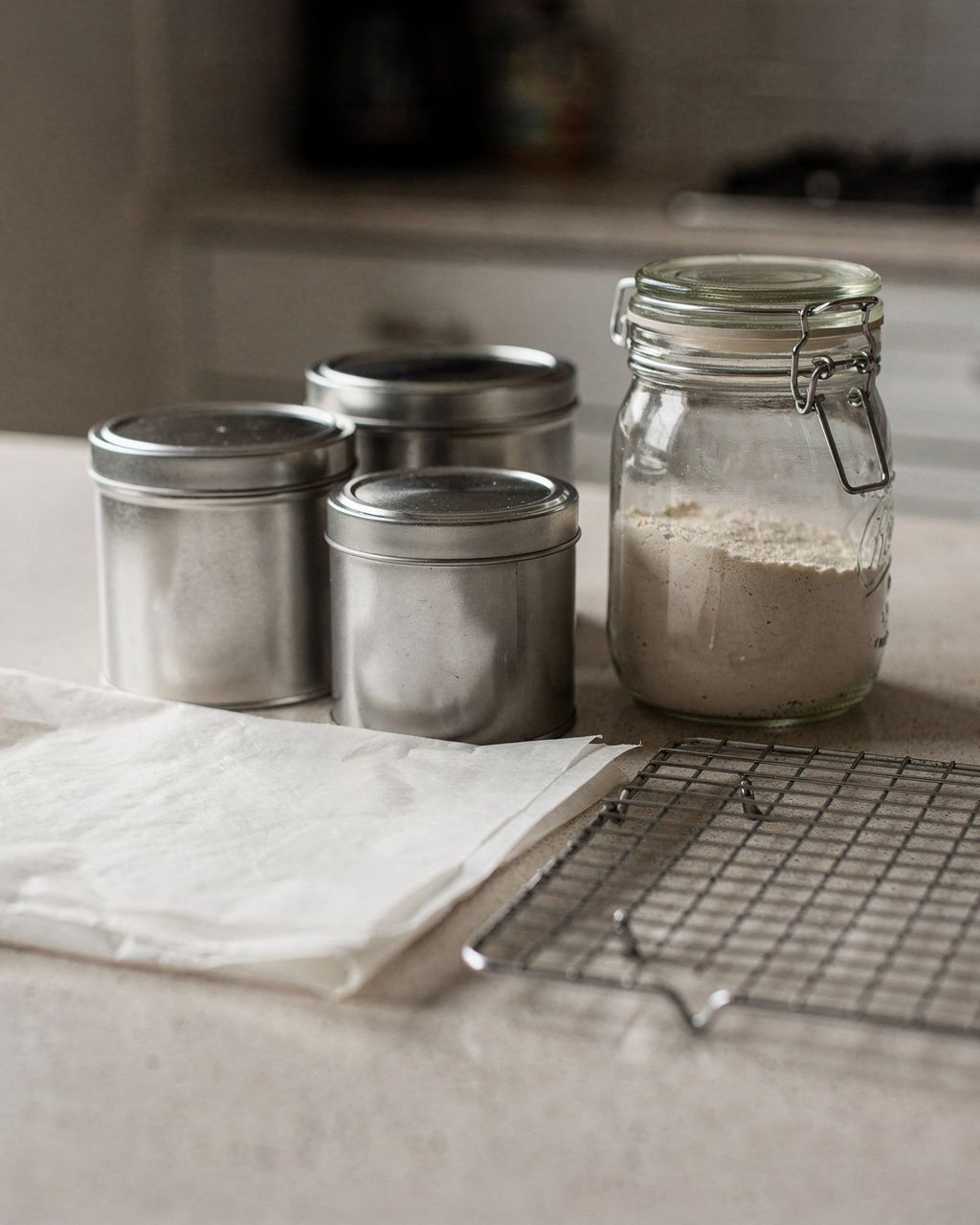
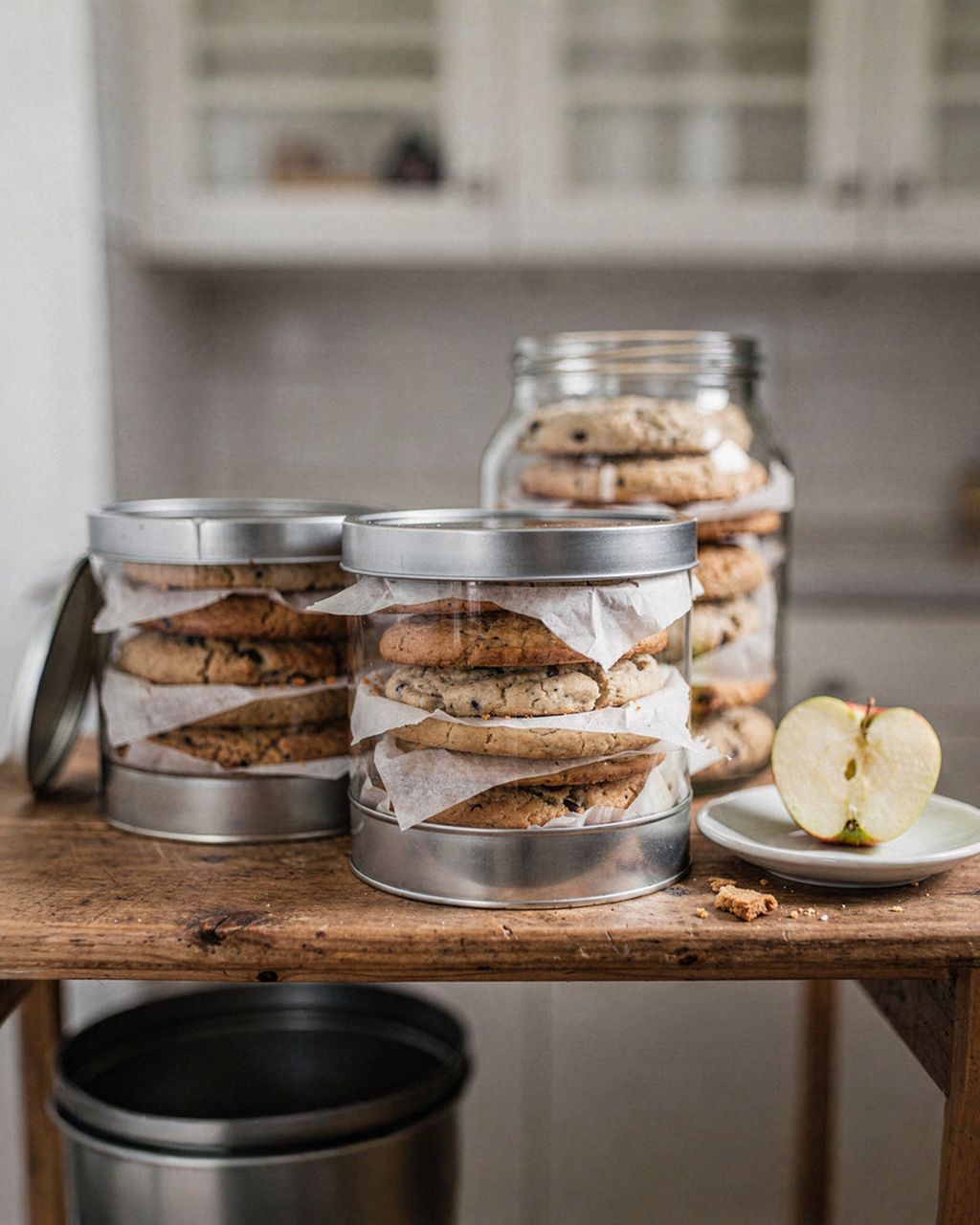
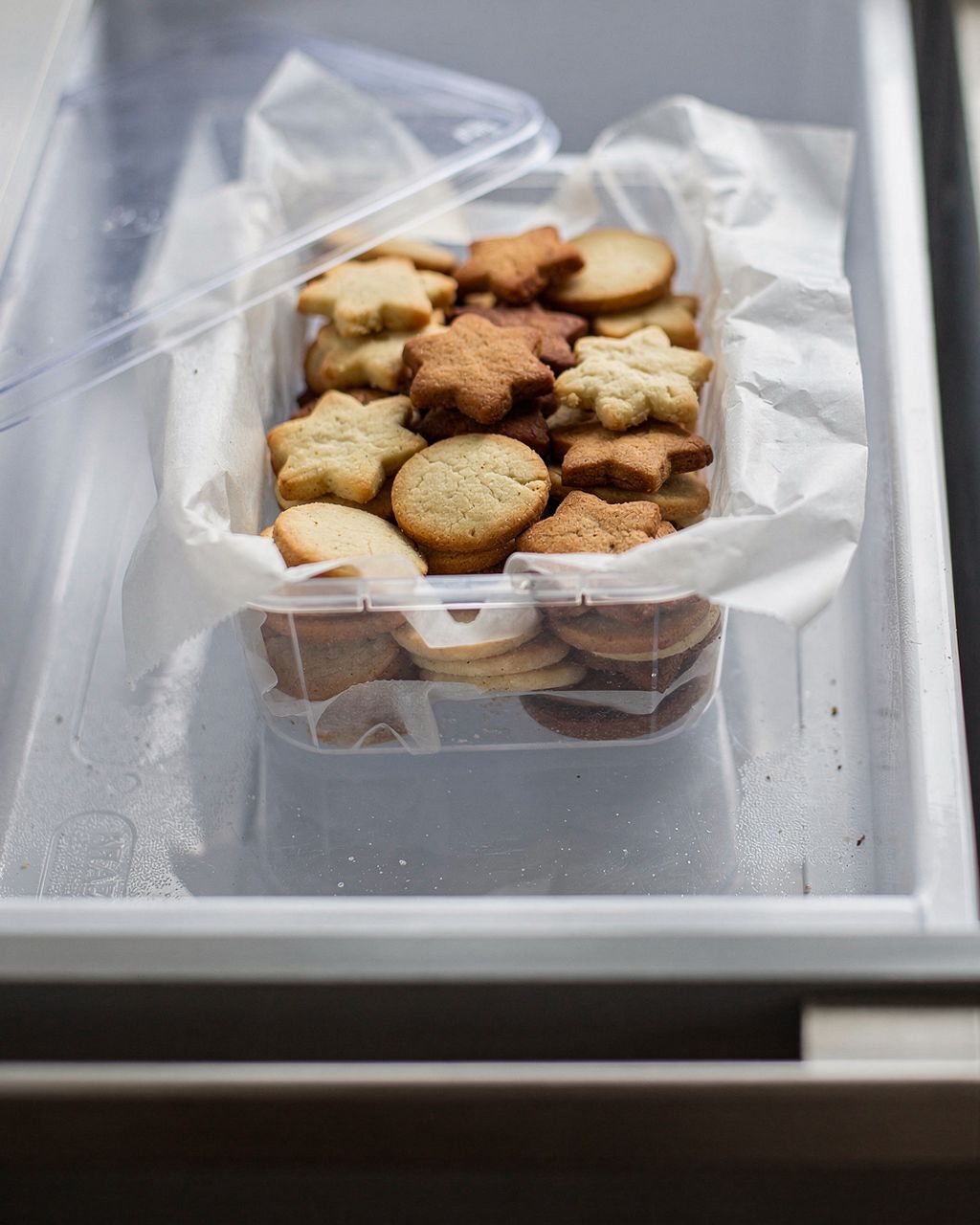
Filled Christmas cookies belong in a sealed tin in the fridge at 4–8°C, or in a cool pantry that stays reliably under 10°C. Nothing in between really works.
A balcony or unheated garage is not a fridge. Temperatures there swing between -5°C and +15°C depending on the weather, and every warm spell causes condensation on the cold cookies. That condensation soaks the biscuit and the icing, and speeds up mould far faster than a warm kitchen ever would.
Store filled cookies separately from dry ones. In the same tin, moisture will migrate from the cream into the crescents, and by the next day everything's gone soft.
Layer with baking paper, not paper towel — that turns soggy and sticks to moist filling.
Only close the tin once the filling has cooled and set. Warm filling in a sealed tin creates steam, which condenses on the lid.
Take them out 20–30 minutes before serving. Buttercream at 5°C is hard and flavourless; at 18°C, it comes alive.
For the rest of the rules — which containers to use, where to keep the icing, how to avoid mixing up different types — see our guide to storing Christmas cookies.
Softening isn't spoilage — it's moisture migrating from the filling into the biscuit, and it happens every single time. Water in a sealed tin always tries to even itself out: the filling sits at a water activity of around 0.6–0.8, the biscuit at 0.3, and that gap closes over two to five days. The biscuit softens; the filling firms up slightly.
For some types, that's actually the point. Filled gingerbread is meant to soften — that's the whole reason it needs to rest. We explain why that works in our piece on why gingerbread goes hard. With linzer cookies, though, it's the opposite problem: you want a crisp biscuit, not a chewy one.
What to do about it:
A chocolate barrier between the filling and the biscuit delays moisture migration by three to four days.
Use a firmer filling. A cream that pipes cleanly and holds its shape contains less free water than one that spreads and runs.
Use less filling. A 2–3mm layer is plenty; a thick layer softens the biscuit twice as fast.
Bake the shells a shade darker. A well-baked linzer biscuit has lower moisture and can take more. If yours goes hard on its own, though, the problem lies elsewhere — see our guide to why linzer cookies turn hard, and how to keep them crisp.
Fill later. The simplest fix of all.
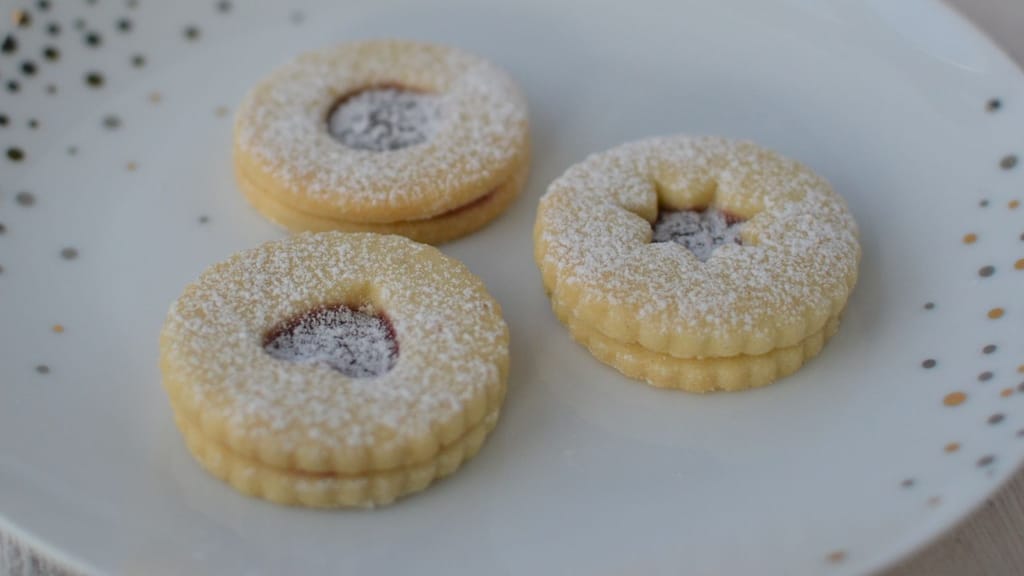
Classic christmas cookies: delicate linzer cookies
Classic crisp linzer cookies — the base that filled Christmas cookies start from
You can't reliably tell whether filled Christmas cookies are past their best just by looking — so write the filling date on the tin lid and go by that. Here are the warning signs to watch for:
Smell. Buttercream starts smelling of old oil or cheese before anything is visible. Nut filling smells rancid, sickly-sweet and bitter. Cream cheese and cream fillings smell sour.
A sour or sharp taste. If a bite stings on your tongue, spit it out and bin the rest of the tin.
A sticky, wet or collapsed filling surface that used to be matte and firm.
The filling has released water, and there's liquid pooling at the bottom of the tin.
Anything fuzzy or discoloured in patches — mould spreads even where you can't see it, so cutting off the affected bit isn't worth it. The whole layer goes.
And a general rule that holds for the whole of Christmas baking: if you're wondering whether it's still good, it isn't.
Yes, but only some fillings. Buttercream, ganache, caramel and nut filling all freeze well and keep 3–6 months in the freezer — freeze them right after filling, while the filling is still fresh, not after a week sitting in the fridge. Custard, cream cheese and whipped cream fillings release water on thawing and fall apart; don't freeze those. Always defrost slowly in the fridge, and only open the container once it's fully thawed, or water will condense inside.
Plan on roughly 250–350g of filling for 100 sandwiched cookies, so 2.5–3.5g per piece. For 4cm linzer-style cookies that works out to a 2–3mm layer, which is also the sweet spot for shelf life — a thicker layer softens the biscuit twice as fast. For hollow crescents and wasp-nest pastries filled on the inside, allow more, around 5–6g per piece.
Cookies with cream cheese, whipped cream, custard or raw egg yolk should sit out at room temperature for no more than 2 hours before going back in the fridge. Plain buttercream made just from butter and sugar, with no eggs or milk, can safely sit out a whole evening. A practical fix: put out smaller batches and top up from the fridge, rather than leaving the whole tin out in the warm all through the holidays.
Dark chocolate ganache made with a high-fat plant-based whipping cream alternative, in a 2:1 ratio, works best — it keeps 5–7 days in the fridge, a bit shorter than the 7–10 days you'd get with the same ratio using dairy cream, since plant-based alternatives contain more water. A second reliable option is a nut or marzipan filling, or thick fruit butter, which never contained milk to begin with and keeps 3–4 weeks. Dairy-free margarine or baking fat can be used in buttercream, but it usually contains more water than butter, so the cream ends up softer and keeps roughly a third less time.
Split, grainy buttercream is almost always a temperature problem, and it can be rescued. If it's grainy and runny, it's too cold: set the bowl briefly in a lukewarm water bath and whip again. If it's glossy and melting, it's too warm: chill it for 10 minutes in the fridge and whip again. Both the butter and the finished cream want to be around 18–20°C. If it stays sandy even after whipping, caster sugar was used instead of icing sugar, and that grain won't dissolve at this point.
One recipe worth heating the oven for, one tip, and one deal from the shop. Nothing else.