Want tips like this every Thursday?
One recipe worth heating the oven for, one tip, and one deal from the shop. Nothing else.
Beef Gelatin vs. Pork Gelatin: How They Differ and When You Can Swap Them
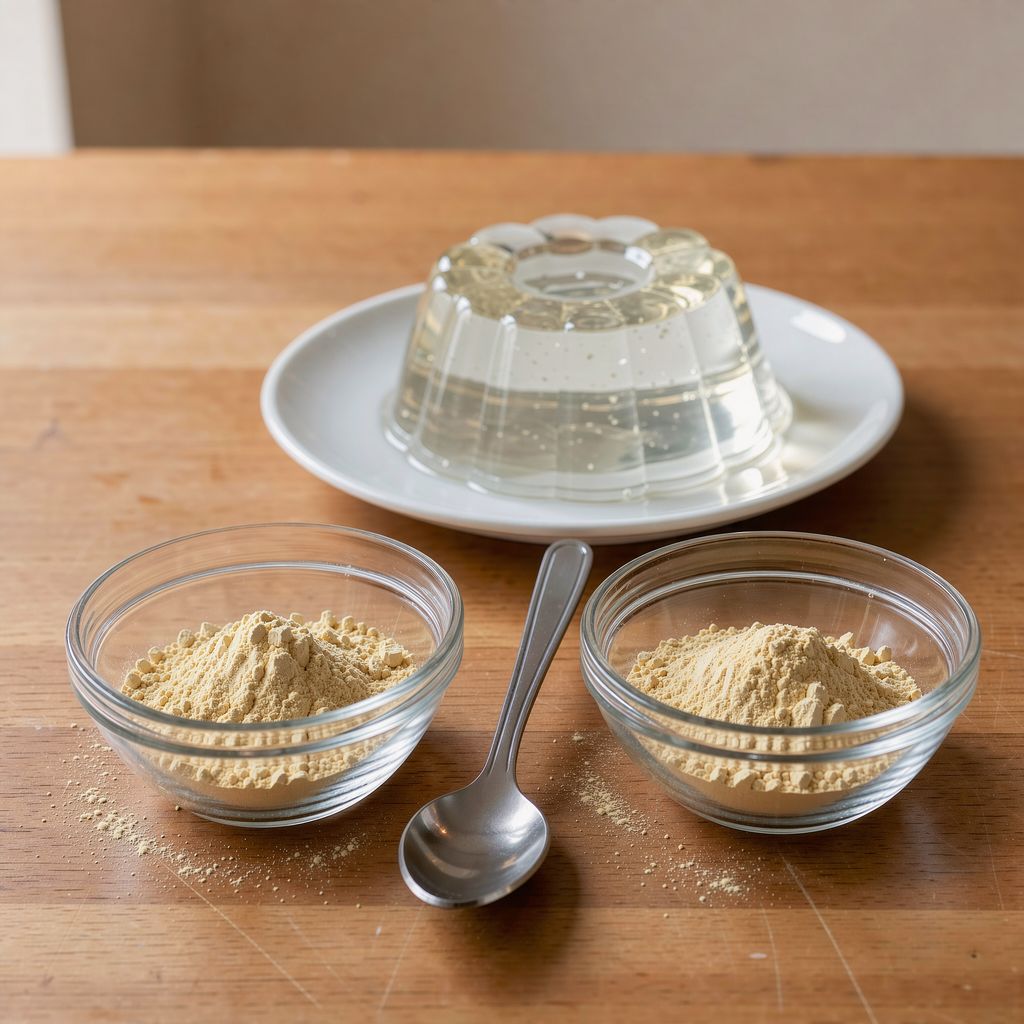
Updated Oct 17, 2026
Beef gelatin and pork gelatin can be swapped 1:1 by weight in a recipe, as long as they have the same Bloom number. The main difference is which animal they come from, and that matters for halal and kosher diets, not for whether your cake sets. Gel strength comes down to Bloom, not to the cow or the pig. Below, you'll find how the two really differ, when you can taste or see the difference, and how to adjust a recipe if the gelatin in your pantry has a different strength from the one the recipe calls for.
Beef and pork gelatin differ in their raw material (beef hides and bones vs. pork skin) and in how they're made, but in the kitchen they behave practically the same at the same Bloom. Both are animal proteins obtained from collagen: the dry powder is roughly 85% protein, and the rest is mostly water. Both dissolve in a warm liquid and both set when chilled.
Pork gelatin is made mainly from pork skin, usually by the acid process (so-called type A).
Beef gelatin is made from beef hides and bones, mostly by the alkaline process (type B), sometimes by the acid process (type A).
Gel strength (Bloom) falls in a similar range for both, most often 160–250 Bloom in baking and pastry. According to manufacturers, pork makes a slightly clearer, finer gel.
Taste and smell: well-refined gelatin is neutral whatever it's made from. Beef may smell faintly after soaking, but you won't notice it in the finished cream.
So for home baking, the rule is simple: look at the Bloom number first, and the animal second.
Beef gelatin isn't stronger than pork gelatin on its own: gel strength is set by the Bloom number, not by the animal. A 200 Bloom beef gelatin sets just as firmly as a 200 Bloom pork gelatin. Both beef and pork gelatin are sold in a range of Bloom grades, so always check the number on the package.
The Bloom number tells you how much force it takes to depress a standard 4 mm gel. The higher the number, the firmer the gel you get from the same amount of powder. We go into detail in our article Bloom gelatin: what the Bloom number means and how to convert gelatin strength.
In practice:
140–160 Bloom — a softer, wobbly gel.
180–220 Bloom — the all-round pastry strength for creams, mousse, panna cotta and marshmallows.
230–260 Bloom — firm gels, glazes and desserts that need to hold sharp edges.
At the same Bloom, swap the gelatin 1:1 by weight and leave the method unchanged. If the Bloom differs, adjust the amount like this:
new amount = original amount × √(original Bloom ÷ new Bloom)
There's a square root because gel firmness grows roughly with the square of the amount of gelatin, whereas it grows only in direct proportion to Bloom. Examples using 200 Bloom beef gelatin:
The recipe calls for 10 g of 200 Bloom pork gelatin → use 10 g of 200 Bloom beef gelatin.
The recipe calls for 10 g of 160 Bloom gelatin → use 9 g of 200 Bloom beef gelatin (10 × √0.8 ≈ 8.9 g).
The recipe calls for 10 g of 250 Bloom gelatin → use 11 g of 200 Bloom beef gelatin (10 × √1.25 ≈ 11.2 g).
Weigh it on a digital scale accurate to 0.1 g; a teaspoon is too imprecise for gelatin. And if the recipe uses sheets, convert them to grams first: a sheet usually weighs 1.7–2 g, but depending on strength it can be 2.5–3.3 g. For how to work with sheets and powder, how long to soak and how much water to use, see How to use gelatin: sheet vs. powder.
In most desserts you can't tell beef and pork gelatin apart. The difference only shows in perfectly clear jellies, delicate aspics and very firm gels. In a cream, mousse, cheesecake-style filling or classic panna cotta, the cream, chocolate and fruit mask any slight difference. Only these three situations deserve attention:
Perfectly clear jellies made from water, wine or light juice. Pork gives a slightly cleaner, colorless gel, while beef may have a faint yellowish tinge. You won't see it in a colored fruit jelly.
Delicate clear aspics and broths, where gelatin is almost the only flavor. Reach for the most neutral gelatin you can find, and above all don't boil it: overheating above about 80 °C (176 °F) harms flavor and strength equally for both types.
Very firm gels and glazes. Here a high Bloom is what counts, so look for a number around 230–260 Bloom on the package.
The mouthfeel is practically the same at the same Bloom: both gelatins melt at roughly 27–35 °C (81–95 °F), below body temperature, which is why a gelatin dessert melts so pleasantly in your mouth.
Beef gelatin can be halal and kosher, but only with certification; the word "beef" alone doesn't guarantee it. Pork gelatin is not halal, and it will never receive kosher certification from mainstream (Orthodox) certifying authorities.
Halal: the animal must be slaughtered according to Islamic rules, and the whole origin of the raw material must be traceable. Look for a halal certificate on the package.
Kosher: beef is among the permitted animals, but slaughter must follow Jewish ritual (shechita) and the product must carry kosher certification. Kosher and halal certification do not substitute for each other.
Vegetarians and vegans: neither gelatin is an option. Use agar or pectin instead. They work differently, though, and can't be swapped 1:1. The article Types of gelling agents: pectin, agar and gelatin explains the differences.
If you're baking for guests who don't eat pork, beef gelatin is the simplest route. For strict halal or kosher, though, always go by the certificate on the specific package.
For home baking, the most practical choice is beef gelatin powder at around 200 Bloom. It's versatile, easy to measure in grams, and because it isn't pork, you can also bake with it for guests who don't eat pork.
Beef powder, 200 Bloom — cake creams, mousse, panna cotta, marshmallows, fruit fillings. We carry it as Patisdécor 200 Bloom beef gelatin powder.
Pork gelatin sheets from the supermarket — good when the recipe calls for sheets directly. Manufacturers don't always state the strength in Bloom; sheets are graded to set roughly similarly, but not exactly the same, so for precise conversions go by the information on the package.
Fish gelatin — an alternative for pescatarians; here too, follow the Bloom number on the package.
Beef gelatin at 200 Bloom is a good fit for homemade chocolate mint marshmallows; the sugar syrup method is covered in How to make marshmallows at home. For a firm cake cream, you'll find Mascarpone cream: why it curdles or turns runny and how to make it firm enough for a cake useful, and for fruit fillings, Fruit cake filling that doesn't weep.
You'll find agar, pectin and other setting helpers together in the gelling agents and binders category.
One sheet equals roughly 1.9–2.2 g of 200 Bloom beef gelatin powder, depending on the sheet's strength. A lighter sheet of about 1.7 g with a high Bloom (around 250) equals about 1.9 g, while a heavier sheet of about 2.5 g (160 Bloom) equals about 2.2 g. The most reliable approach is to follow the manufacturer's information on the package.
Dry beef gelatin powder keeps after opening for as long as the date on the package, as long as you store it somewhere dry and tightly sealed. Moisture is its worst enemy: the powder clumps and dissolves less well.
A faint smell after soaking is normal for beef gelatin and disappears in the finished dessert. If the smell is strong or unpleasant, the gelatin was most likely stored badly or got damp, and it's best not to use it.
Yes. Just soak the beef gelatin in cold water, then dissolve it at 50–60 °C (122–140 °F), for example in a small portion of the cream. Stir the dissolved gelatin into the rest of the cream, which should not be ice-cold, or it will seize into rubbery strings.
One recipe worth heating the oven for, one tip, and one deal from the shop. Nothing else.