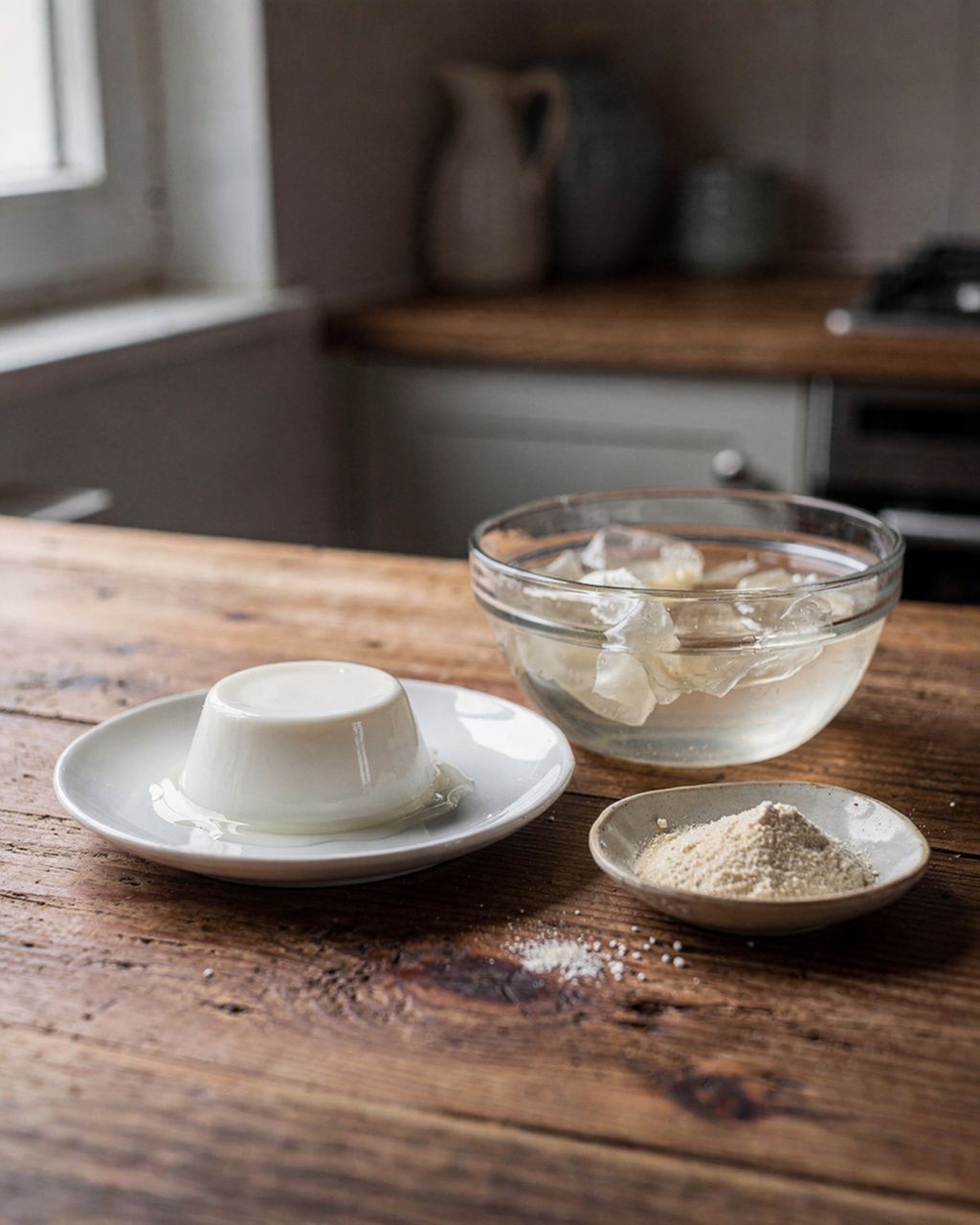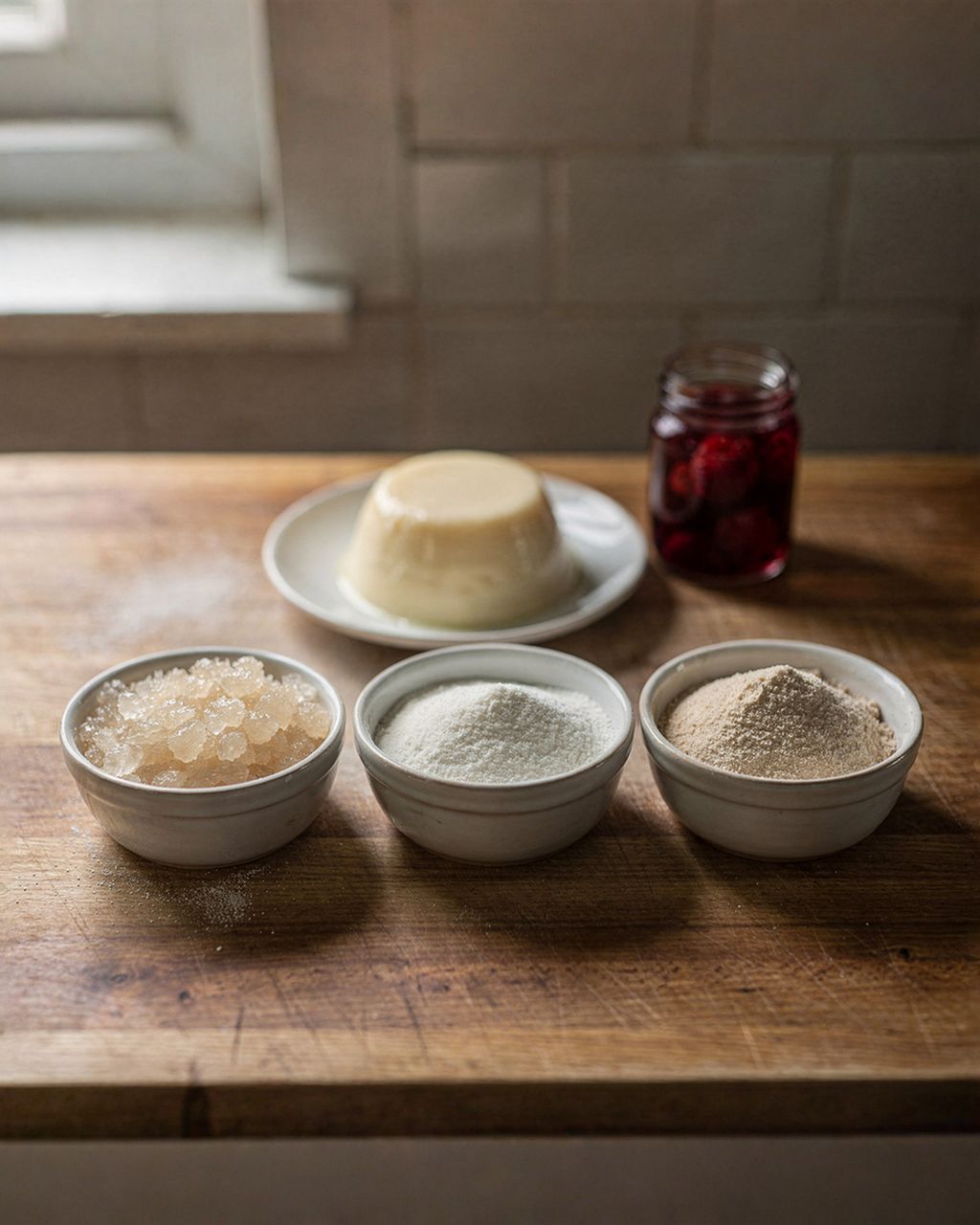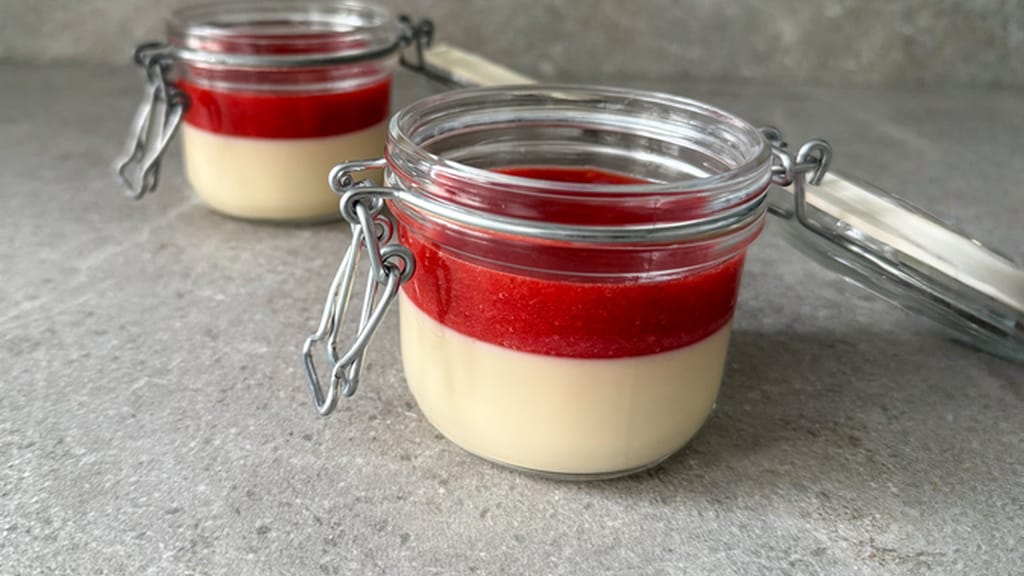
Panna cotta: a simple italian dessert ready in no time
Gelatin Bloom Strength: What the Number Means & How to Convert It
Updated Oct 6, 2026
Bloom gelatin is gelatin labelled with a Bloom number, which tells you how strong it is — the higher the number, the firmer and faster the jelly sets. Standard powdered gelatin for baking sits around 200 Bloom, while leaf gelatin is sold in grades from bronze to platinum. Once you understand what that number actually means, you'll stop wondering why your panna cotta sets runny one time and rubbery the next — and you'll be able to convert any recipe to whatever gelatin you've got in the cupboard.
Bloom is the unit that measures gelatin's strength: it tells you how many grams of weight are needed to press a standard set gel down by 4 mm without breaking it. So a value of 200 Bloom means it took 200 g to do that.
Chemist Oscar T. Bloom devised the test and patented it in 1925, and it's still carried out the same way today:
a lab dissolves the gelatin into a 6.67% solution,
lets it set for 17–18 hours at 10°C (50°F),
presses a 12.7 mm plunger exactly 4 mm into the gel,
the force measured in grams is the Bloom number.
This makes the number comparable across brands and countries. A pack labelled "200 Bloom" means exactly the same thing whether you're in the Czech Republic, France, or the US.
Most gelatins fall somewhere between 30 and 300 Bloom; in everyday cooking you'll typically meet a range of roughly 100–260. Leaf gelatin is sold in grades that correspond to strength:
Bronze – about 125 Bloom, each sheet weighs around 3.3 g
Silver – about 160 Bloom, each sheet around 2.5 g
Gold – about 190–220 Bloom, each sheet around 2 g
Platinum – about 230–250 Bloom, each sheet around 1.7 g
Notice that the weaker sheets are heavier. Manufacturers do this on purpose: one sheet of any grade should set roughly the same amount of liquid. That's why recipes written in "sheets" work across grades — but only approximately, and only if you're counting sheets rather than grams.
Powdered gelatin for baking and pastry work is most commonly 200 Bloom — the same strength as gold leaf gelatin. You can swap between them gram for gram, one to one.
The strength of gelatin doesn't just determine whether a dessert sets — it also shapes how it behaves. The higher the Bloom, the higher the setting and melting point, and the shorter the setting time. In practice:
Firmness – more Bloom means a firmer gel from the same amount of gelatin.
Speed – stronger gelatin sets faster. Handy for mirror glaze or layered cakes, where you don't want to wait hours between layers.
Melting point – a gel with a higher Bloom holds its shape longer on the table before it starts to soften. Weaker gelatin melts faster in the mouth and feels more delicate.
Quantity – stronger gelatins need less of it, so the end result tastes cleaner and looks clearer, with less gelatin flavour coming through.
So it's not simply a case of "more is better." A creamy panna cotta that should barely hold its shape is fine with a weaker gelatin used in the right amount. For marshmallows or a sliceable fruit jelly, you want strength.
The most accurate method uses a square root: new amount = original amount × √(original Bloom ÷ new Bloom). Gel firmness doesn't rise in a straight line with the amount of gelatin — it rises roughly with the square of it, which is why the square root comes in.
Two examples:
A recipe calls for 10 g of 160 Bloom gelatin, but you have 200 Bloom: 10 × √(160 ÷ 200) = 10 × 0.89 ≈ 8.9 g.
A recipe calls for 6 g of 250 Bloom gelatin, but you have 200 Bloom: 6 × √(250 ÷ 200) = 6 × 1.12 ≈ 6.7 g.
You'll also find a simpler linear formula out there (amount × Bloom = amount × Bloom). For small differences — say 180 vs. 200 — it gives practically the same result. For bigger jumps between strengths, the square-root method is more accurate. The linear calculation gives you less than you need when moving to a stronger gelatin (8.0 g instead of 8.9 g in the first example above), and more than necessary when moving to a weaker one (7.5 g instead of 6.7 g in the second).
Any conversion is only as good as the number on the pack. That's why it's worth keeping a gelatin in your kitchen with a clearly stated Bloom value — you'll find an overview among gelling agents and binders. If there's no number on the label, you can't convert it — only guess.
Leaf and powdered gelatin set liquids exactly the same way — the difference is purely in dosing and convenience.
Leaf gelatin is easy to dose by the sheet, but sheets from different brands vary in weight. If a recipe gives you a gram amount, weigh your sheets to check.
Powdered gelatin can be weighed precisely to a tenth of a gram, and once you know its Bloom you can convert it to anything. For pastry work, where grams matter, it's the more reliable choice.
200 Bloom powder equals gold leaf gelatin, gram for gram. If a recipe calls for "3 sheets of gold gelatin" and you're using powder, go with roughly 6 g.
As a rough guide, use 0.8–3% gelatin relative to the weight of the liquid, depending on how firm you want the result. For 500 ml (2 cups) of liquid with 200 Bloom gelatin:
A delicate, barely-set panna cotta – 4–5 g (0.8–1%)
A cream or mousse for a cake that needs to hold a clean slice – 5–7 g (1–1.4%)
A panna cotta meant to be turned out of its mould – 6–8 g (1.2–1.6%)
A sliceable fruit jelly – 10–15 g (2–3%)
What's in the liquid also affects the dose. Acidic fruit and alcohol weaken the gel, while fat and sugar firm it up slightly. So add a touch more gelatin to an acidic purée. For which cake filling to pick and where each one works best, see our guide to types of cake fillings.
Soak gelatin in cold water first, then dissolve it into a warm mixture — but never boil it. Here's the method:
Soak it. Sprinkle powdered gelatin into 5–6 times its weight in cold water (6 g of gelatin into 30–36 g of water) and let it bloom for 5–10 minutes. Submerge leaf gelatin in plenty of cold water, then squeeze out the excess gently.
Dissolve it. Stir the bloomed gelatin into a mixture that's around 50–60°C (120–140°F), or dissolve it briefly in the microwave or over steam.
Don't boil it. Prolonged boiling breaks down the gelatin, and the gel sets weaker than it should — you lose exactly the Bloom strength you paid for.
Temper it. When adding dissolved gelatin to a cold cream, stir a few spoonfuls of the cream into the gelatin first, then fold that back into the whole batch. Otherwise it seizes into rubbery strands in the cold mixture.
Pastry chefs often prepare powdered gelatin in advance as what's called a gelatin mass — soaked in five times its weight in water, then set in the fridge. They simply weigh off and melt what they need as they go.
You'll notice it most in desserts where gelatin is the main structural element: panna cotta, which should wobble gently once turned out, and marshmallows, which need a firm, springy structure. We cover how gelatin behaves when whipped into a hot syrup in our guide on how to make marshmallows at home. Give it a try with these recipes:
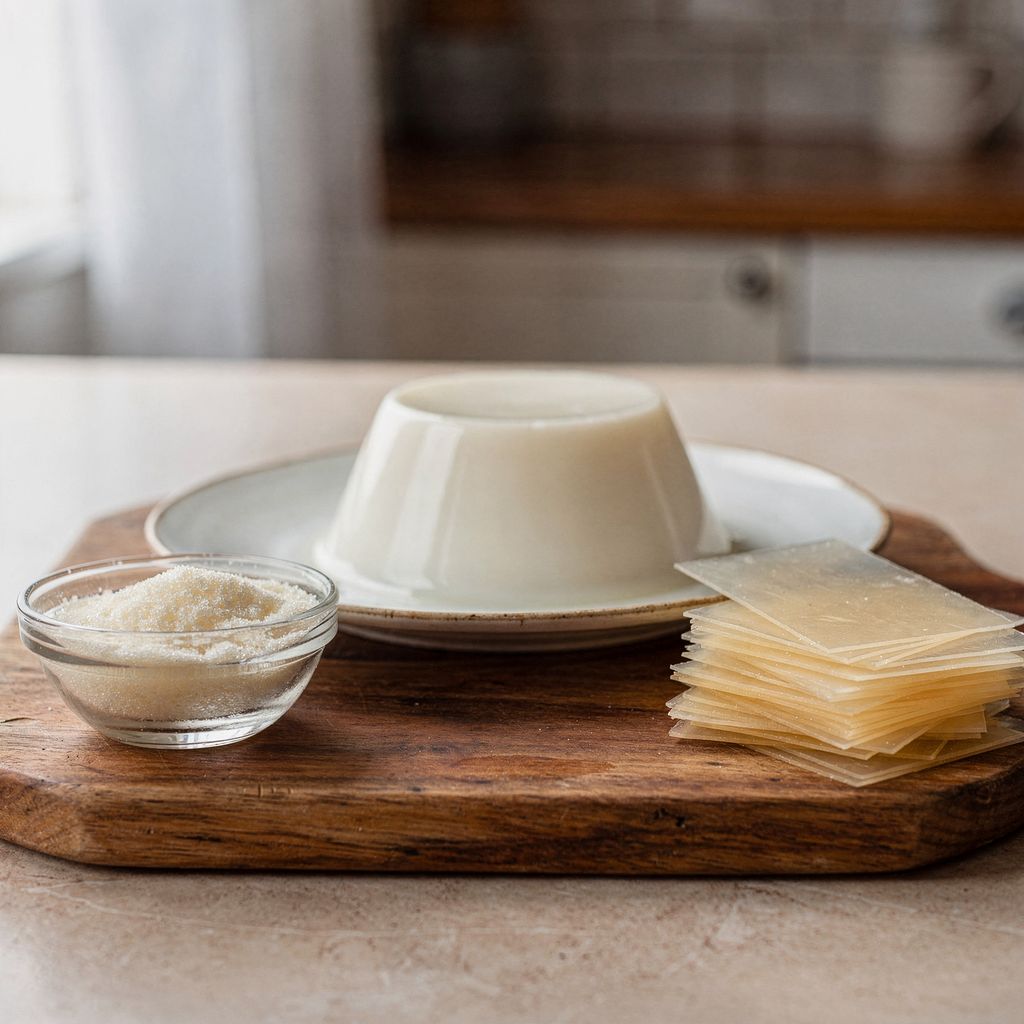
Panna cotta: a simple italian dessert ready in no time
Panna cotta: a simple Italian dessert that shows you exactly whether you've got the gelatin dose right
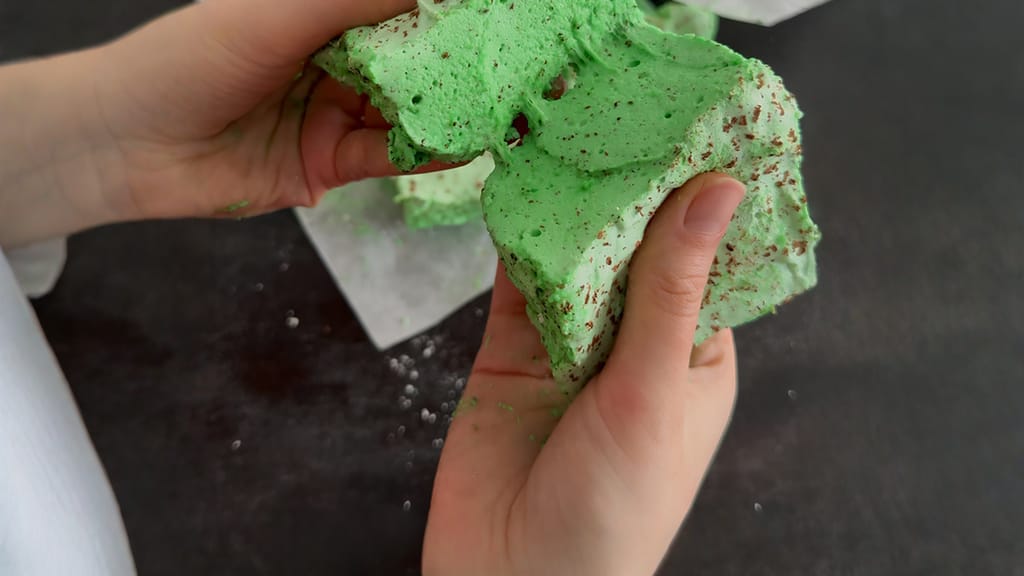
Homemade mint chocolate marshmallows
Homemade mint chocolate marshmallows – 200 Bloom gelatin at full strength
For home baking, one reliable gelatin with a known strength is all you need. The most versatile choice is powdered beef gelatin at 200 Bloom — it matches gold leaf gelatin, so you can follow Czech recipes without converting anything, dose it precisely by weight, and convert it to any other Bloom using the formula above. Store it dry and well sealed — moisture does it far more harm than time does.
At the same Bloom number, beef and pork gelatin set in practically the same way, so you can swap them gram for gram in a recipe. The main difference is their origin, which matters if you don't eat pork. It's the Bloom that counts, not the animal.
You can replace gelatin with agar, but not by Bloom and not gram for gram — agar is far stronger and sets differently. For 500 ml (2 cups) of liquid, use roughly 1–2 g of agar for a soft gel, or 3–5 g for a firm, sliceable one. Unlike gelatin, agar needs a brief boil, and the resulting gel is more brittle rather than springy like gelatin's.
Fresh pineapple, kiwi, papaya, figs and ginger contain enzymes that break down the protein in gelatin, so the gel won't set no matter the Bloom. Briefly cooking the fruit, or using the canned/stewed version instead, solves this — heat destroys the enzymes.
Dry gelatin stored in a dry place and well sealed lasts for years and only loses strength very slowly. The real problem is moisture: damp powder clumps together and sets more weakly. If you're not sure about yours, do a small test batch in the fridge before using it in a cake.
Mousses and creams made with gelatin can be frozen, but plain jellies generally can't — they release water and lose their structure on thawing. In frozen cakes and mousses, the fat and sugar in the mixture help by slowing down the formation of large ice crystals.
One recipe worth heating the oven for, one tip, and one deal from the shop. Nothing else.