Royal Icing Mix for Flawless Decorating Detail
Hand-Painted Gingerbread Cookies: How to Paint on Icing with Gel Color and Gold
Updated Oct 17, 2026
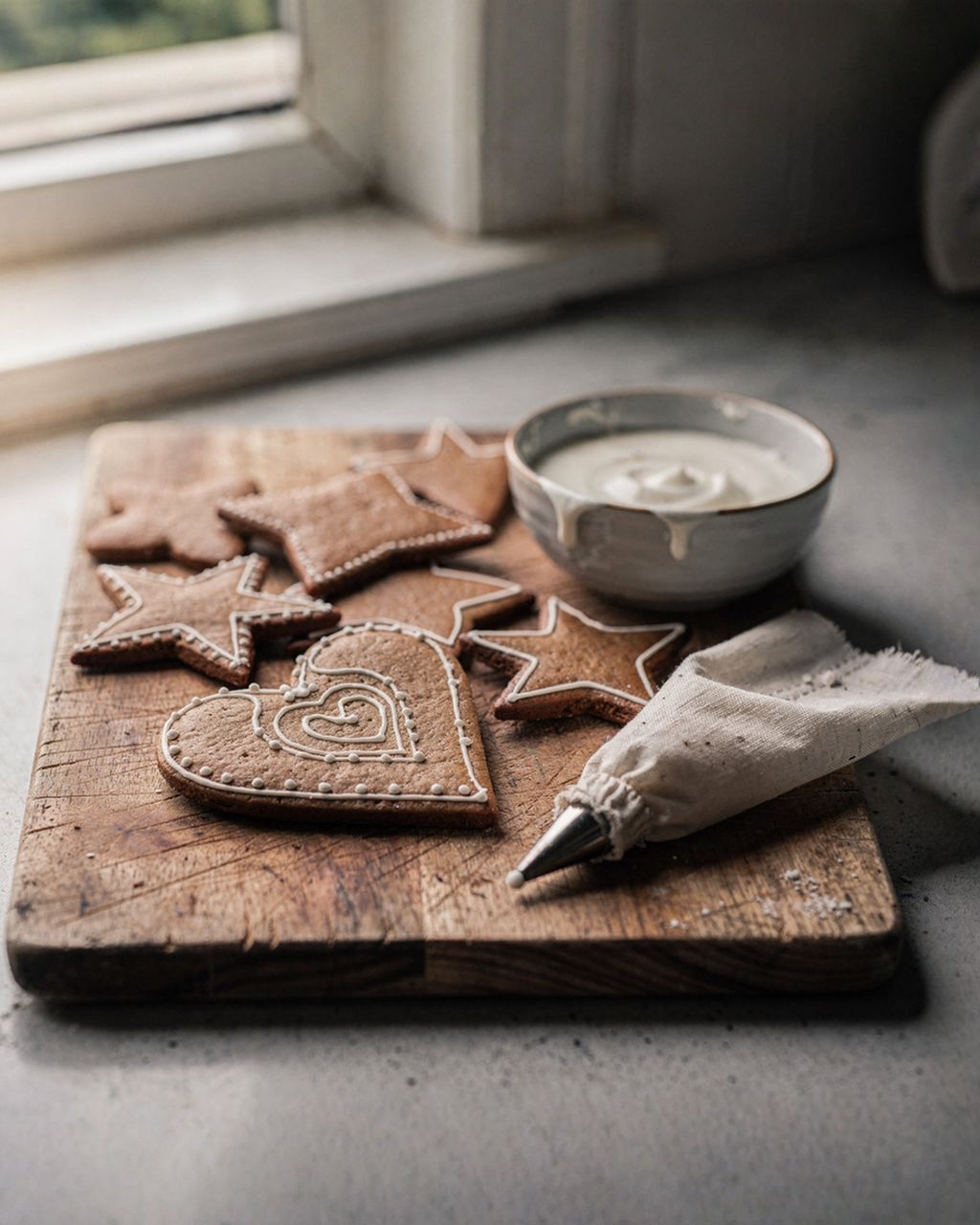
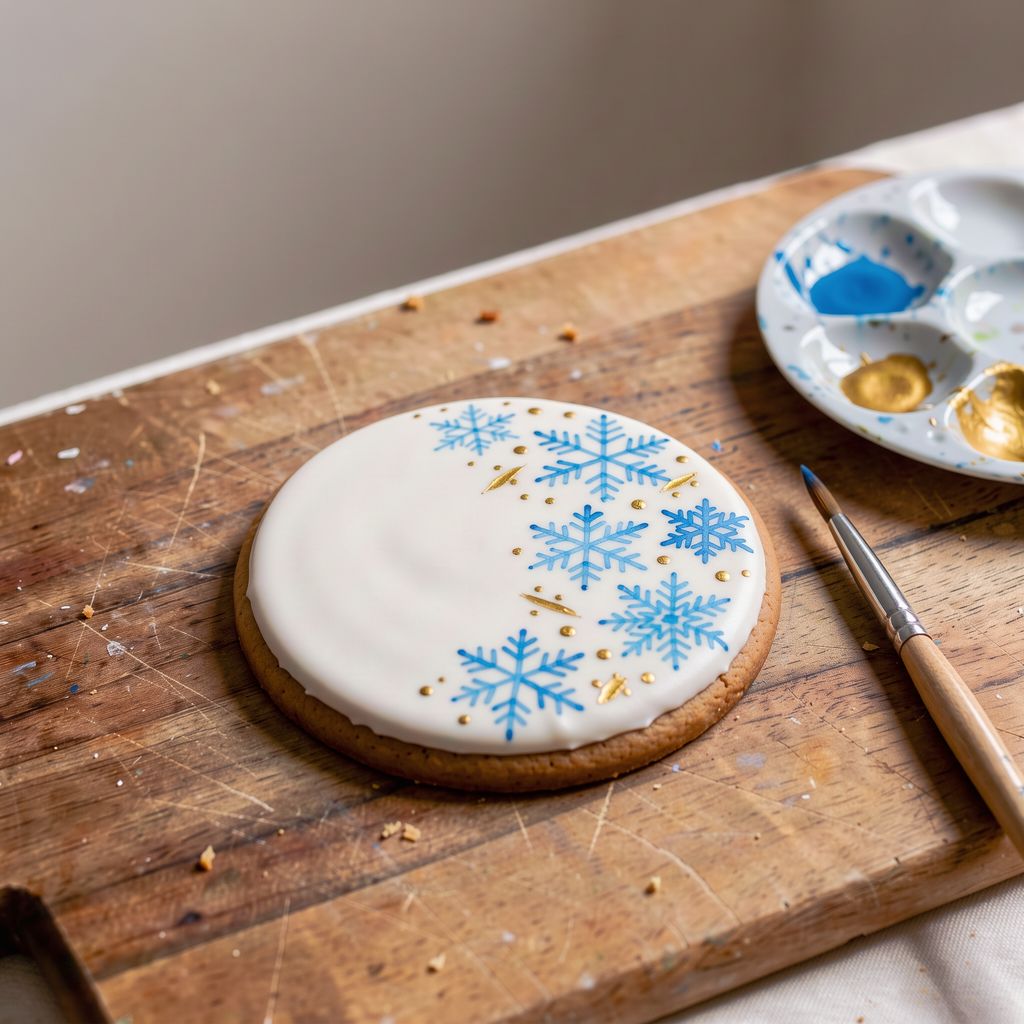
Hand-painted gingerbread cookies start with fully dried white icing (ideally royal icing). You paint on it with a thin brush and gel color thinned with a few drops of alcohol. The alcohol evaporates quickly, the color stays put, and the icing doesn't dissolve. You don't need a steady hand with a piping bag, just patience and a fine brush. Below you'll find thinning ratios, how to choose brushes, how to make gold paint from edible dust, and above all how to layer colors so nothing bleeds.
You can only paint on icing that dries rock hard and has a smooth, non-porous surface. The best choice is royal icing (an icing made from egg white or dried egg white and powdered sugar). Soft icing made from powdered sugar and water or lemon juice stays damp underneath, so the brush disturbs it and the color soaks in.
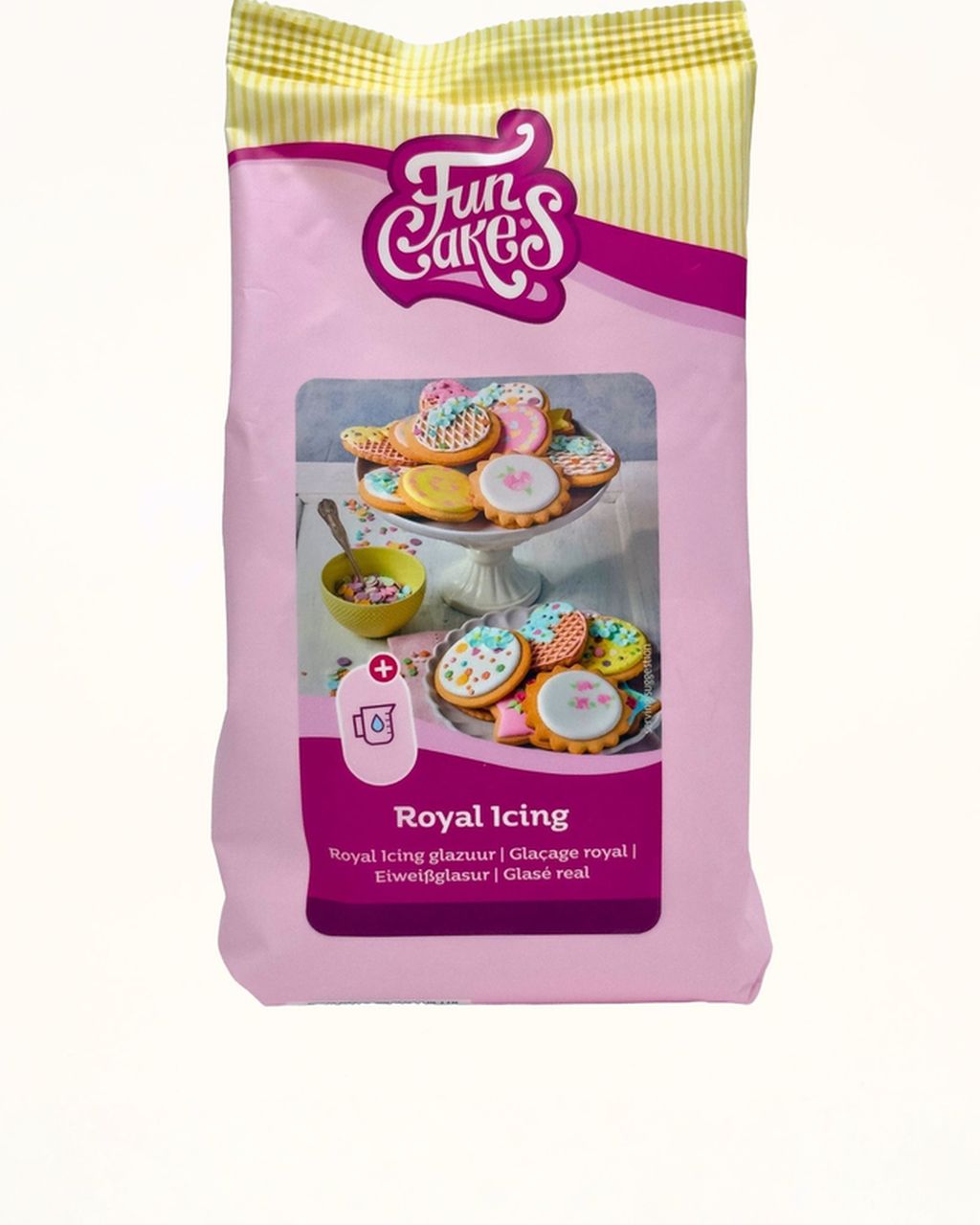
Royal icing is the best choice. It dries to a hard white surface that can take several layers of color. At home, mix it from egg white and roughly 200–250 g of powdered sugar per egg white, or use a ready-made mix such as Royal Icing for Perfect Details, which you just mix with water for the same consistency every time.
Rolled fondant paints well too, but it's softer and absorbs more moisture, so thin your color even more sparingly.
Plain powdered sugar and water icing isn't suitable for painting. It stays brittle and dissolves under the brush.
For how to apply the icing, flood the surface and pipe the outline, see Decorating Gingerbread Cookies Step by Step. Here we start once your cookie is flooded with a smooth white surface.
A flooded surface of royal icing needs to dry at least 8–12 hours, ideally overnight. Thin lines need only 1–2 hours. You can't tell by looking at the surface: after an hour it feels dry to the touch, but under the thin crust it's still soft and the brush will dent it.
Dry at room temperature, not in the fridge, where the icing draws in moisture.
In a humid kitchen (cooking, drying laundry) it dries more slowly. A slightly open window or a fan helps.
Test: gently press the edge of the surface. If it doesn't give and leaves no mark, you can paint.
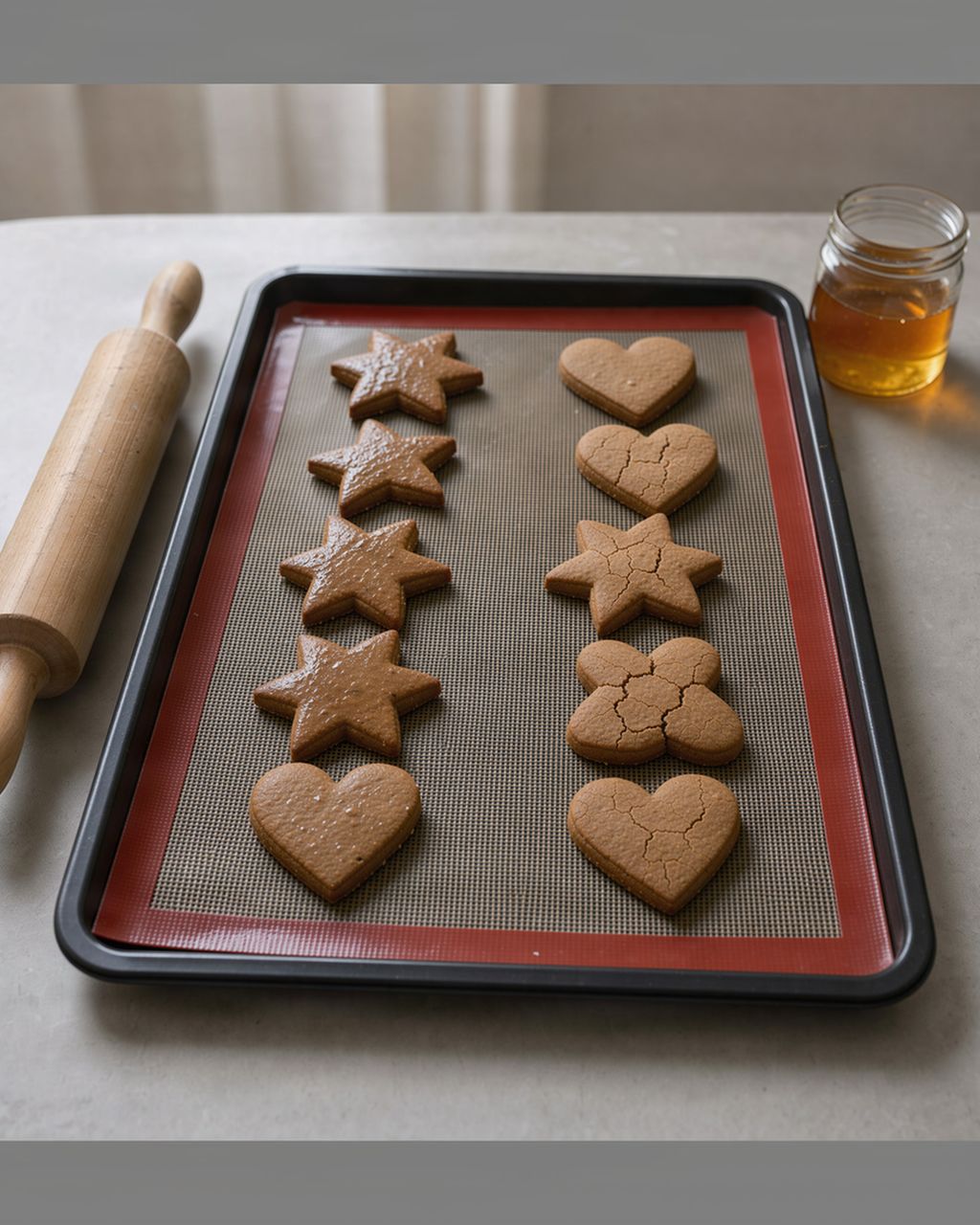
The gingerbread itself should be baked and completely cool. A soft honey dough like Soft Gingerbread Cookies is ideal under painted icing, because it softens further in the tin and the icing holds. For why the dough has to rest and how to roll it into an even surface (painting on a bumpy cookie is difficult), see Gingerbread Cookie Dough.
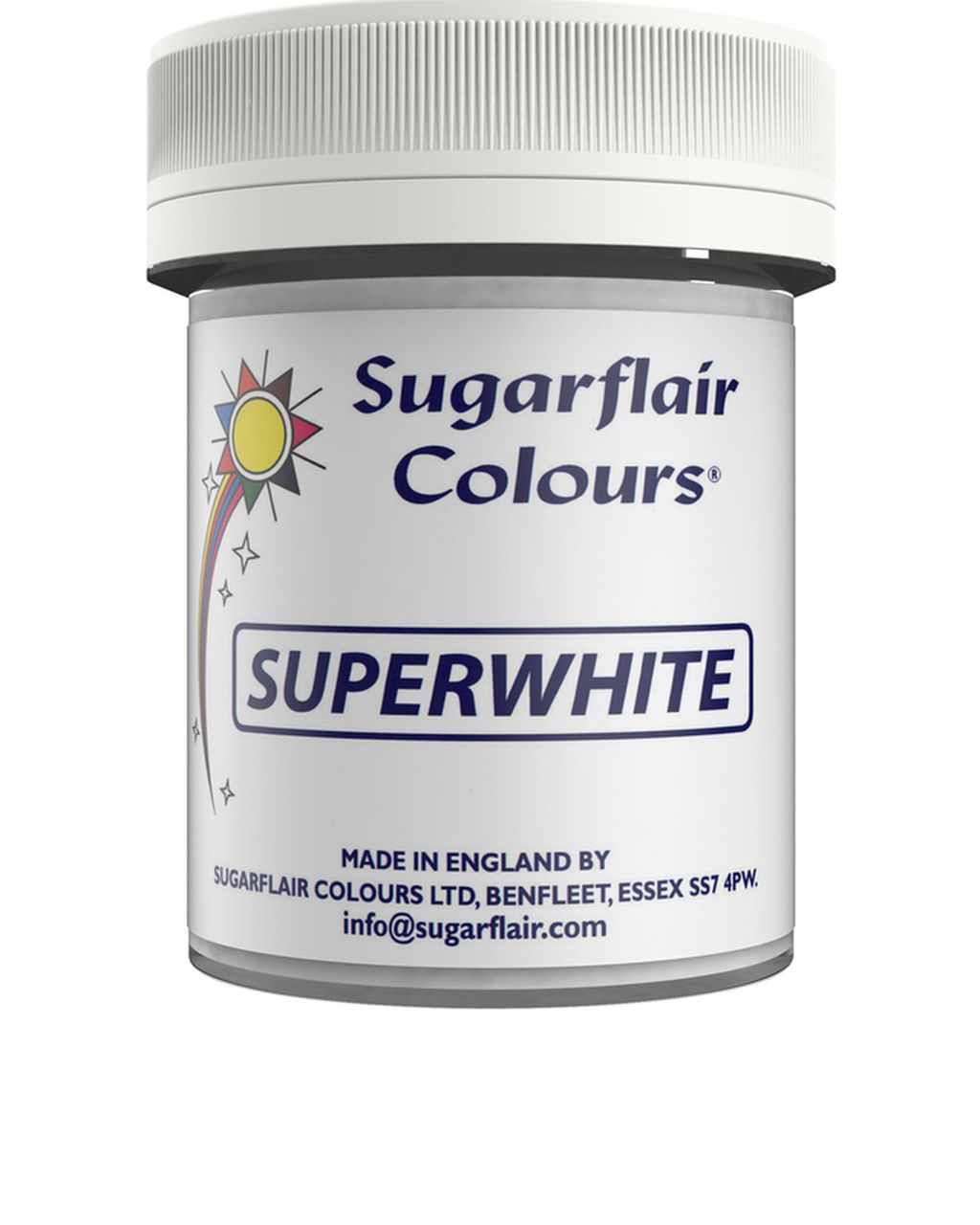
Super white turns the icing into a clean white base, so painted colors look brighter. On a yellowish icing made from fresh egg whites, blue turns greenish and pink turns gray.
For 250 g of icing, you need roughly a knife tip to ¼ teaspoon of Sugarflair Super White icing color. It's an E171-free version that whitens with calcium carbonate (E170). Add it gradually, as more isn't better.
Super white is useful on the palette too: add a drop to thinned color and instead of a translucent watercolor you get an opaque pastel color, for example for snow on a green fir tree or the whites of eyes on a colored background.
Ready-made icing mixes tend to be whiter than homemade icing from egg whites, so you need less super white or none at all.
Thin gel color with clear alcohol, not water. Alcohol evaporates in seconds, so it has no time to dissolve the icing, whereas water soaks into the sugar and leaves pits and blotches on the surface.
Vodka, 40% works and everyone has it at home, but it contains roughly 60% water. Add it strictly by the drop and don't go over the same spot repeatedly, or the icing will start to dissolve and pit.
Stronger clear alcohol (food-grade spirit, clear fruit brandy over 50%) dries faster and the icing holds up better. If you have it, it's the better choice.
Clear lemon or vanilla extract is common in recipes from abroad. It's harder to find in the Czech Republic and adds a delicate aroma.
Alcohol evaporates from a thin layer before you wrap the cookies, and no taste remains. Use a white palette (a small plate, a tile, plastic lids) so you can see the true shade.
Start with these gel-to-alcohol ratios:
Watercolor (translucent color): a toothpick tip of gel + 4–6 drops of alcohol. The color is runny and leaves a pale stain on a paper towel.
Rich color for details: a toothpick tip of gel + 1–2 drops of alcohol. The consistency of liquid honey.
Opaque pastel: as for the rich color + a drop of super white.
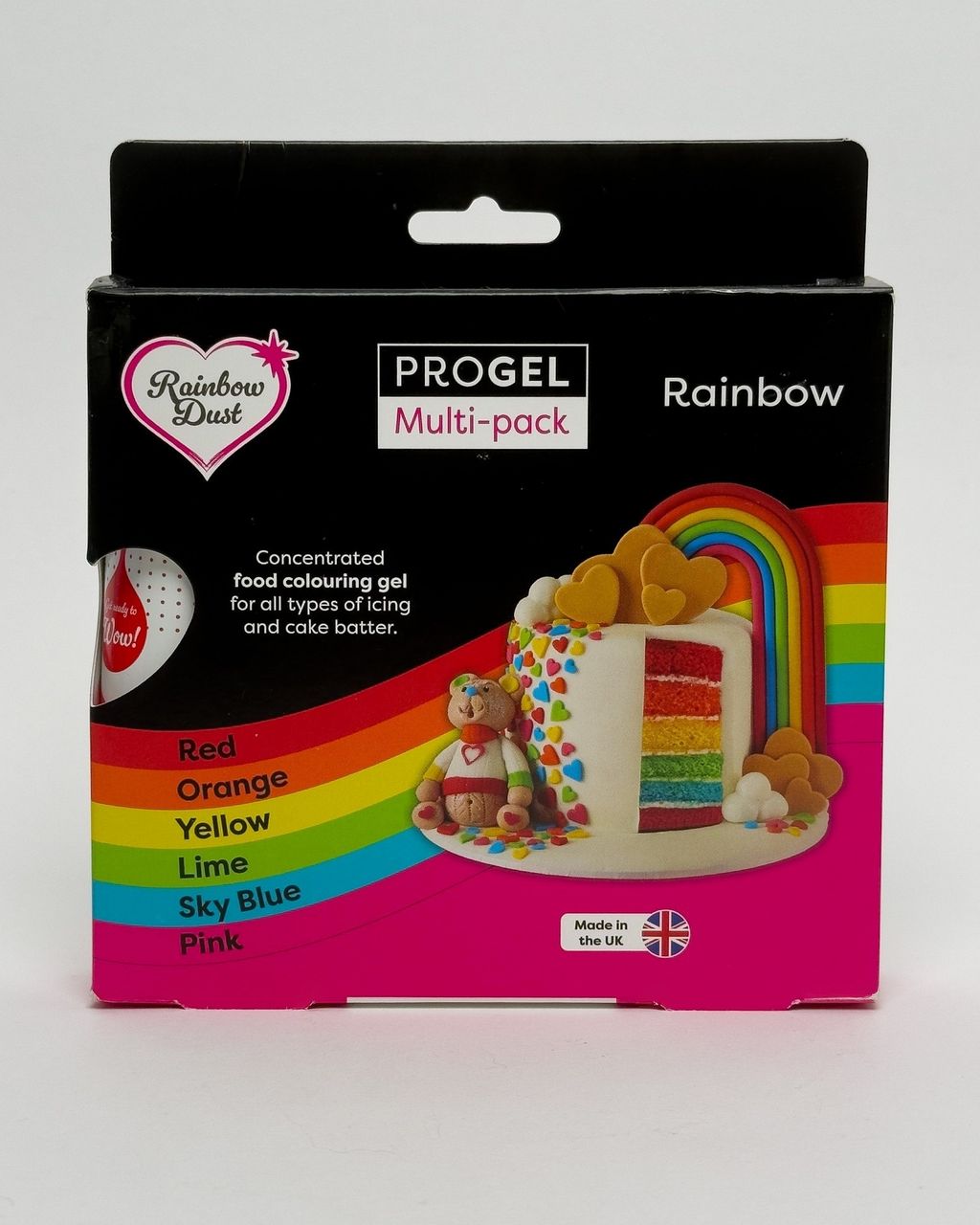
Gel colors are concentrated, so a few drops of each are enough for a whole tray of cookies. The six basic shades in the ProGel Rainbow Set can be mixed further on the palette: fir green from blue and yellow, plum purple from red and blue. You'll find more shades, and chocolate colors too, among the food colors and decorating dyes.
For painted gingerbread cookies you need 2–3 new synthetic brushes that you use only for food: a fine round one for lines, a medium round one for filling areas, and a flat one for shading.
Round no. 00–0 for outlines, dots, lashes, and lettering.
Round no. 2–4 for filling areas, leaves, and cheeks.
Flat 4–6 mm for blending, shading, and gilding edges.
Synthetic bristles don't shed and can be washed in hot water. Art-supply brushes are fine as long as they're new and reserved for food. Never use a brush that has ever touched acrylic or oil paint. Between colors, rinse the brush in alcohol and wipe it on a paper towel.
Colors don't bleed when you paint from light to dark, with very little liquid, and let each layer dry for 5–10 minutes. Work in four steps: underpainting, mid-tones, details and outlines, gold. Bleeding is almost always a sign that there's too much liquid on the brush or the icing wasn't dry yet.
Underpainting: the lightest watercolor tone across the whole design (light blue sky, pink cheek). Let it dry.
Mid-tones: a richer color in the shadows and main shapes. Pause again.
Details and outlines: the darkest color with a fine brush. Always do black or brown lines last, or you'll smudge them.
Gold: the very last layer (see below).
To keep anything from running, watch for these while painting:
After dipping, always lightly wipe the brush on the edge of the palette or a towel. It should be damp, not dripping.
Go over each spot once or twice, not ten times. Repeated scrubbing dissolves the sugar under the color.
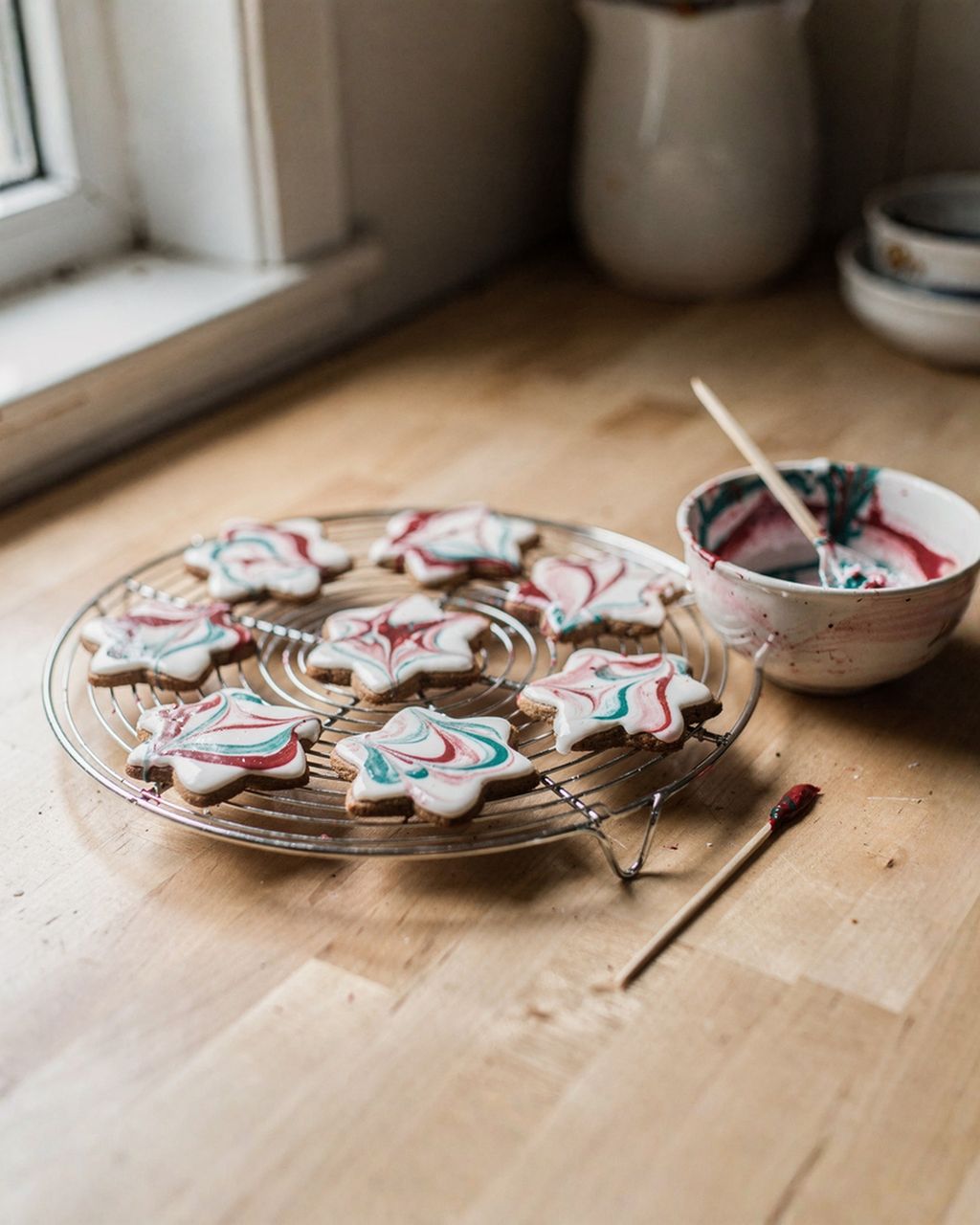
Want a soft gradient? Lay down a rich color and immediately pull a clean, barely damp brush into it. Unlike marbled icing, where colors blend while wet, here you work on a dry base and you control the gradient.
Made a mistake? Gently lift dried color with a clean brush dampened with alcohol and blot it right away with a towel. With a dark color on white a shadow will remain, so it's better to paint over the mistake with part of the design.
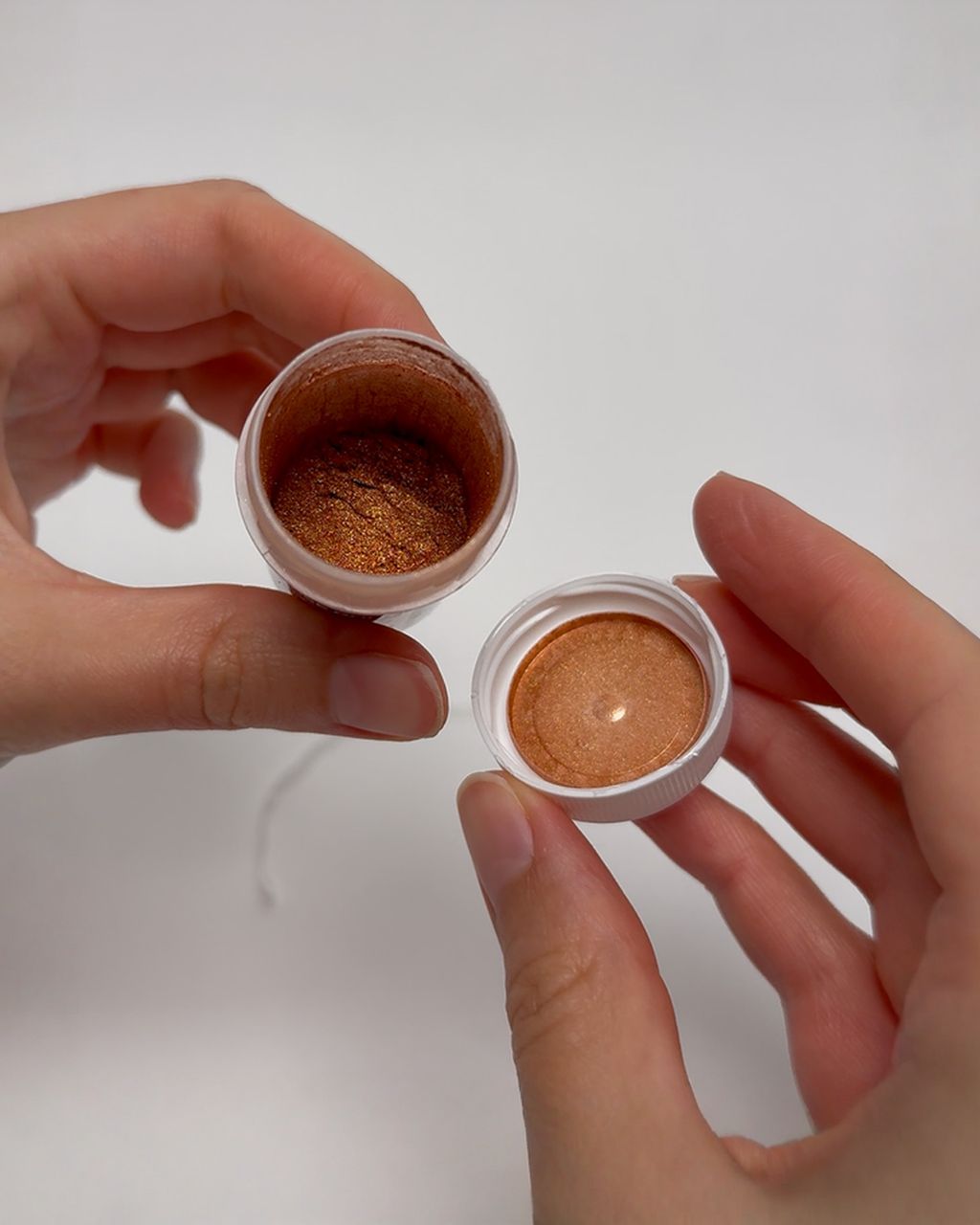
Make gold paint for gingerbread cookies from edible luster dust mixed with a few drops of alcohol into a thick paste, roughly ¼ teaspoon of dust to 3–5 drops. It should have the consistency of warm honey, because gold that's too thin is translucent and dull.
Paint gold only on fully dry colors, as the final step. The metallic shine turns gray on wet color.
The dust settles in the alcohol, so stir the paint on the palette before each dip.
For rich gold, apply two thin layers with a pause in between rather than one thick one. A thick layer cracks and flakes off as it dries.
Gold stands out most on a dark base (burgundy, dark blue, green) and on small details: star edges, pine needles, bells, dots.
Mind the difference between "edible" and "decorative." Some glitter dusts are sold only as non-toxic decorations for non-edible parts (ribbons, figurines). For a cookie that will be eaten, use only dust labeled edible, with an ingredient list on the package. Since August 2022, the EU also no longer permits E171 (titanium dioxide) in food, so it's best not to use older stock from abroad. We carry an edible Edible Glitter Dust – Rosy Gold, which gives a warmer, slightly pink gold tone. For a big luxurious accent (say, one leaf on top of a gingerbread house), there are also real edible gold leaf sheets, but these aren't painted on. You lay them on with tweezers.
You can decorate gingerbread cookies with four tools: a brush (gradients, watercolor areas, gold), edible markers (lettering, especially with kids), a piping bag (sharp lines and relief), and an airbrush (even gradients over a large area).
Brush + gel color gives soft gradients, shading, "watercolor" designs, and gold. It's slower, but the most artistic.
Edible markers are quick and clean for lettering and simple pictures, especially with kids. You can't do gradients or gold with them. They're sold in baking supply shops, and we don't carry them yet.
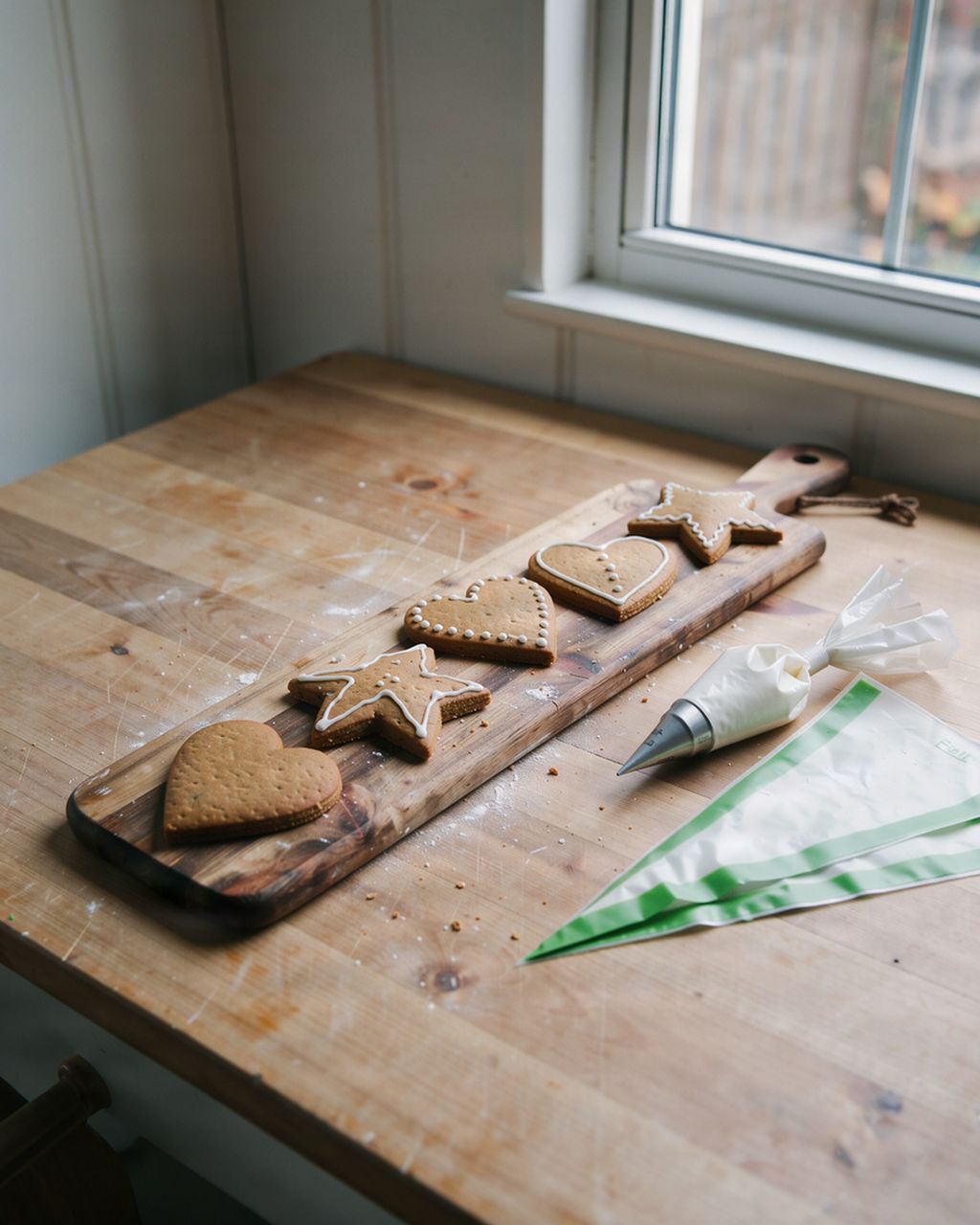
Piping bag with a tip makes relief lines, lace, and dots. For which tool to choose for the finest possible line, see Piping Bags for Gingerbread Cookies.
Airbrush makes even gradients over a large area, but it's expensive equipment that doesn't pay off for a few trays.
The prettiest result is often a combination: outline with a piping bag, a surface flooded with white, the design with a brush, and gold on top.
Leave painted cookies lying flat for 1–2 hours at room temperature before you stack or wrap them. With gold, it's better to leave them overnight. In a dry airtight tin, honey gingerbread cookies then keep for 3–4 weeks, and neither the color nor the gold changes.
Store in a dry tin or individually in cellophane bags, not in the fridge, as condensed moisture makes the colors bleed.
Keep them out of direct sunlight, which fades colors over time.
Parchment paper between layers protects the gold from rubbing off.
When hanging them on a tree or packing them in a gift box, hold each cookie by the edges, not by the painted surface. For how to bake them so they hold up on a string, see Gingerbread Cookies for the Tree.
You can paint without alcohol. Thin the gel color with a drop of water, but the result is weaker and the icing dissolves more easily. Use the bare minimum of water and don't go over the same spot twice. For kids, edible markers are the easiest option.
Yes. Mix powdered food color with a few drops of alcohol, just like gel, and you'll get a rich color. Store-bought liquid food colors are less suitable. They contain a lot of water, so they soften the icing and the colors bleed.
Pits and blotches appear when too much liquid gets into the icing: a brush that's too wet, going over the same spot repeatedly, or vodka with a high water content. Use less liquid, a stronger alcohol, and go over each spot only once or twice.
You can, but you risk bleeding colors, because moisture condenses on the icing as the cookies thaw. Wrap them individually and airtight, then let them thaw in the closed container at room temperature for several hours before opening it. That way the condensation settles on the container, not on your painting.
Yes. Paint the design in advance on a separately dried disc or plaque of royal icing (a so-called transfer). Once it's dry, stick it onto the cookie with a dab of icing. This works well for intricate pictures you don't want to risk painting directly on a baked cookie.
One recipe worth heating the oven for, one tip, and one deal from the shop. Nothing else.