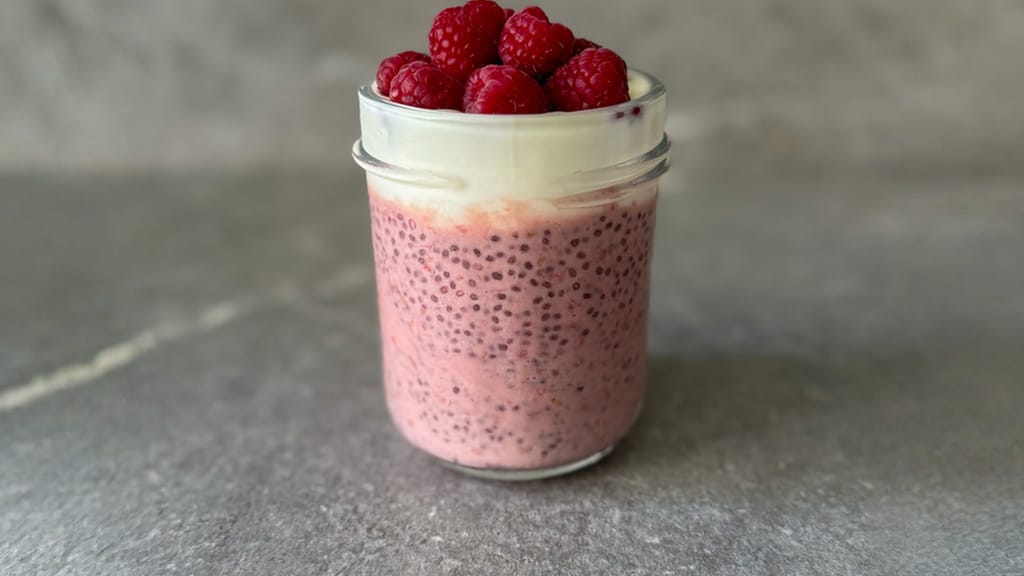
Raspberry chia pudding with yogurt
Chia Pudding: Ratio, Soaking Time, and Recipes with Yogurt, Coconut Milk, and Quark
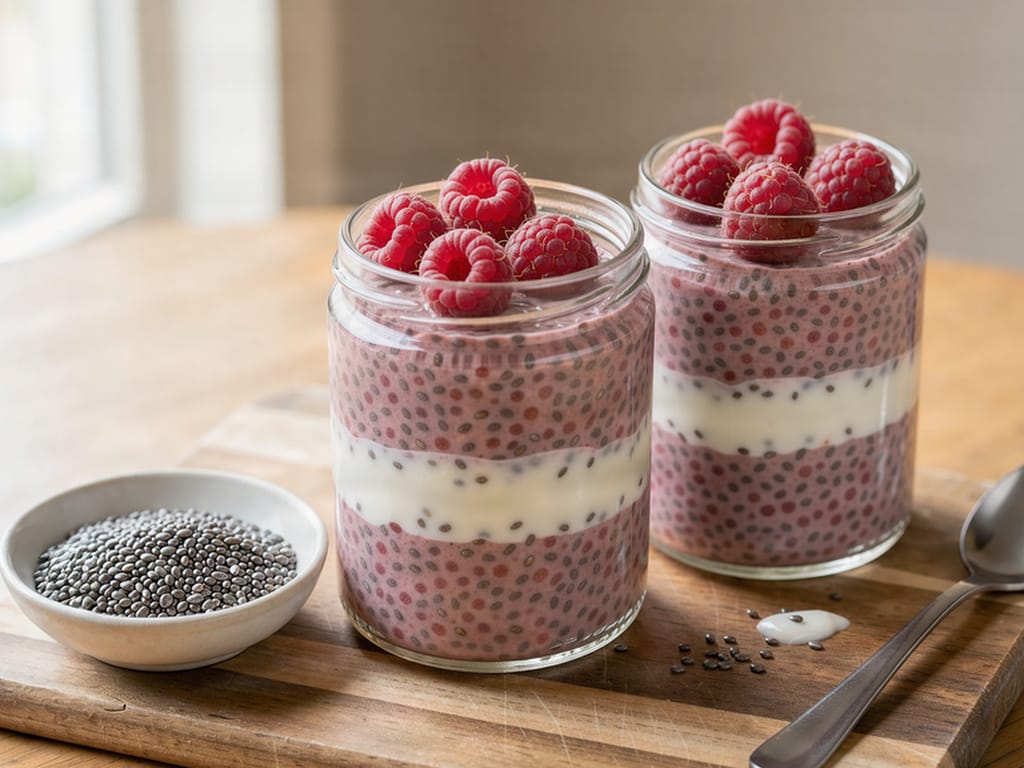
To make chia pudding, stir 4 tablespoons of chia seeds (about 50 g) into 250 ml of milk, stir again after 5 minutes, then refrigerate for at least 2 hours, ideally overnight. A 1:5 ratio by weight gives a thick pudding that holds on a spoon, while 1:7 is creamier, the classic breakfast texture. Below you'll find why pudding sometimes stays runny or clumps, plus versions with yogurt, coconut milk, and quark (tvaroh, a Czech fresh curd cheese), with banana or mango, single servings, chia jam, and chia in baking.
The basic ratio for chia pudding is 1 part chia seeds to 5 to 7 parts liquid by weight. In spoons, that means 1 level tablespoon of seeds per 60 ml of milk, or 4 tablespoons per cup (250 ml). A level tablespoon of dry seeds weighs about 12 g according to commonly cited figures, and a heaping one about 15 g. So it pays to weigh the seeds the first time, then remember what your own tablespoon looks like.
Three textures to choose from:
Thick, holds on a spoon and layers well: 50 g chia (4 tablespoons) to 250 ml milk, ratio 1:5.
Creamy, the classic breakfast texture: 35–40 g chia (3 tablespoons) to 250 ml milk, ratio roughly 1:7.
Thinner, almost like tapioca in milk: 25 g chia (2 tablespoons) to 250 ml, ratio 1:10.
Why so much liquid? The seeds have a coating that swells into a gel when wet. According to Harvard's Nutrition Source, they can absorb up to ten times their weight, so for a thick or creamy pudding there's some capacity to spare, and that spare capacity decides whether you get a pudding or a soup.
The liquid matters too. Whole cow's milk sets faster and thicker than thin plant-based drinks (almond, rice, oat), which need an extra spoonful of seeds. Canned coconut milk (often labeled coconut extract on the package) and yogurt need fewer seeds, as we'll get to below. Count any fruit purée you stir into the liquid toward the volume: 100 g of blended raspberries is almost 100 ml of extra liquid.
One recipe and one tip every Thursday until the end of the year. Unsubscribe in one click.
For the holidays: the morning of December 24, carp roasting times by size and December 31, New Year’s Eve canapés.
Chia pudding can be eaten after 20–30 minutes, sets properly after 2 hours in the fridge, and has its best texture the next morning. You can taste the difference. After half an hour the seeds are coated in gel but still slightly crunchy inside. After two hours the pudding is uniform. Overnight the seeds soften completely and the flavor of the sweetener, vanilla, or fruit spreads through the whole thing.
You can rely on this timeline:
5 minutes: first stir, the seeds start sticking together.
15–20 minutes: second stir, the liquid visibly thickens.
2 hours: the pudding holds its shape and can be layered in glasses.
8–12 hours (overnight): the smoothest texture, ideal for making ahead for the morning.
Let the pudding set in the fridge, not on the counter. It swells a little more slowly when cold, but calmly and safely. If you're in a hurry, use room-temperature milk and stir the seeds more often over 10 minutes. Warm (not hot) liquid speeds up swelling a little, but then get the pudding into the cold as soon as possible.
Lumps come from skipping the second stir, while runny pudding usually means too few seeds or too much liquid. In the first minutes after you pour them in, the seeds stick to each other and to the bottom of the container. What sticks never comes apart again and sets into a lump with a dry core, while thin milk is left above it.
The most common causes and fixes:
You stirred only once. Stir right after adding the seeds, again after 5 minutes, and once more after 15–20 minutes. In a jar with a lid, a good shake is enough.
You dumped the seeds in all at once. Sprinkle them slowly into the liquid while whisking or stirring with a fork.
Too few seeds for a thin plant-based drink. Add a spoonful of chia, stir, and leave for another hour.
Fruit juice got into the pudding. Thawed fruit releases a lot of liquid. Add it on top just before eating, or count it in the ratio.
Too short a rest. After 20 minutes the pudding will always be thinner than it will be by morning.
Runny pudding is easy to rescue: stir in 1–2 tablespoons of seeds and leave it in the fridge for at least an hour. Thick as concrete? Stir in milk a spoonful at a time until it reaches the consistency you want. Mash lumps with a fork, or briefly blend the whole pudding with an immersion blender. You get a smooth cream that resembles classic vanilla pudding, and this version also suits anyone who dislikes the texture of whole seeds.
Basic chia pudding needs only seeds, milk, and a little sweetener. This version makes 2 servings, and all the variations below build on it.
Pour 250 ml of milk into a jar with a lid, add 1–2 teaspoons of syrup or honey and a pinch of salt to bring out the sweetness.
Add 40 g of chia seeds (3 level tablespoons and a little more) and stir right away, or close the jar and shake.
After 5 minutes, stir again and break up any clumps at the bottom.
After another 15 minutes, stir a third time and refrigerate for at least 2 hours, ideally overnight.
In the morning, stir the pudding, thin it with a spoonful of milk if needed, and top with fruit, nuts, or granola.
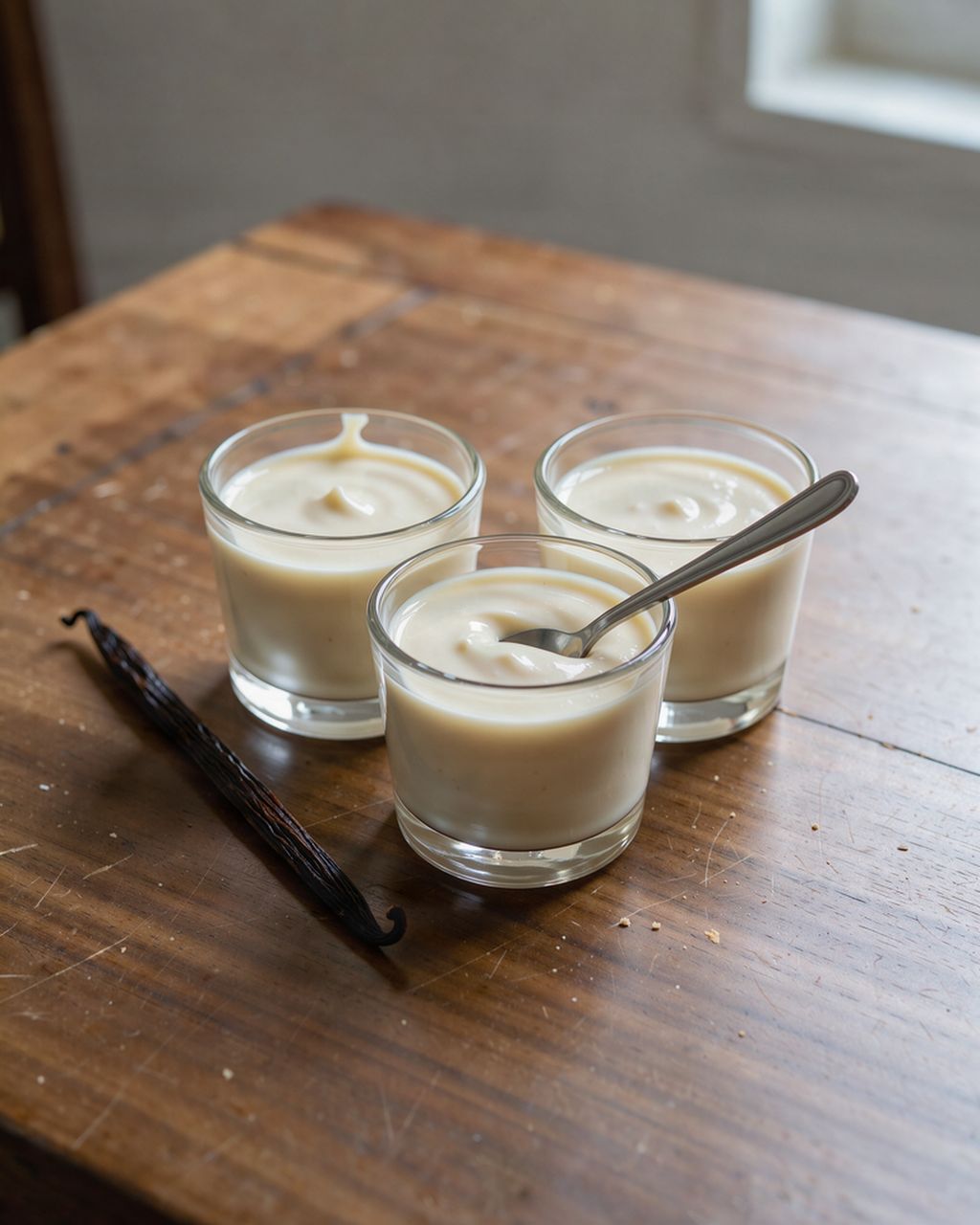
A little goes a long way for flavor. Seeds scraped from half a vanilla pod, such as Tahitian vanilla pods, give the pudding a grandmother's-kitchen taste. A teaspoon of cocoa stirred into the milk makes a chocolate version, and a teaspoon of cinnamon with grated apple makes a wintery one. Add the sweetener to the milk beforehand and taste. Sugar or syrup is harder to stir into the finished pudding.
Chia pudding is one of the easiest recipes for breakfast that you make in the evening and simply take out of the fridge in the morning. If you're looking for more ideas for a sweet morning, check out sweet breakfasts you can make a day ahead.
Chia pudding made with yogurt needs less than half the seeds of a milk version, because yogurt is already thick on its own. For 150 g of plain yogurt, 10 g of chia is enough, just under a tablespoon. If you use the milk ratio, you get a mass so dense you can't eat it with a spoon. It helps to combine yogurt and milk 1:1 and use 2 tablespoons of seeds per 250 g of the mixture.
Yogurt has another advantage: tartness. It balances sweet fruit so the pudding doesn't taste like a kids' dessert. Greek yogurt gives a thicker, creamier result, ordinary plain low-fat yogurt a lighter one. Let yogurt pudding sit overnight. Seeds in a thick mixture swell more slowly because the liquid has a harder time reaching them.
A more common and prettier route is to layer the yogurt: make the milk chia pudding separately and alternate it with yogurt in a glass. That's how this raspberry chia pudding with yogurt is built, with chia swelling in almond drink blended with raspberries and a spoonful of Greek yogurt on top.
Raspberry chia pudding with yogurt
Raspberry chia pudding with yogurt: almond drink with raspberries, chia, and a layer of Greek yogurt
For a greener, bolder version, try matcha chia pudding with raspberries and yogurt. The one trick you need to know: first whisk the matcha into a little warm water to make a smooth paste, otherwise you'll end up with green lumps in the milk. Bittersweet matcha with cooked-down raspberries, Greek yogurt, and pistachios holds its own even on a New Year's Eve table.
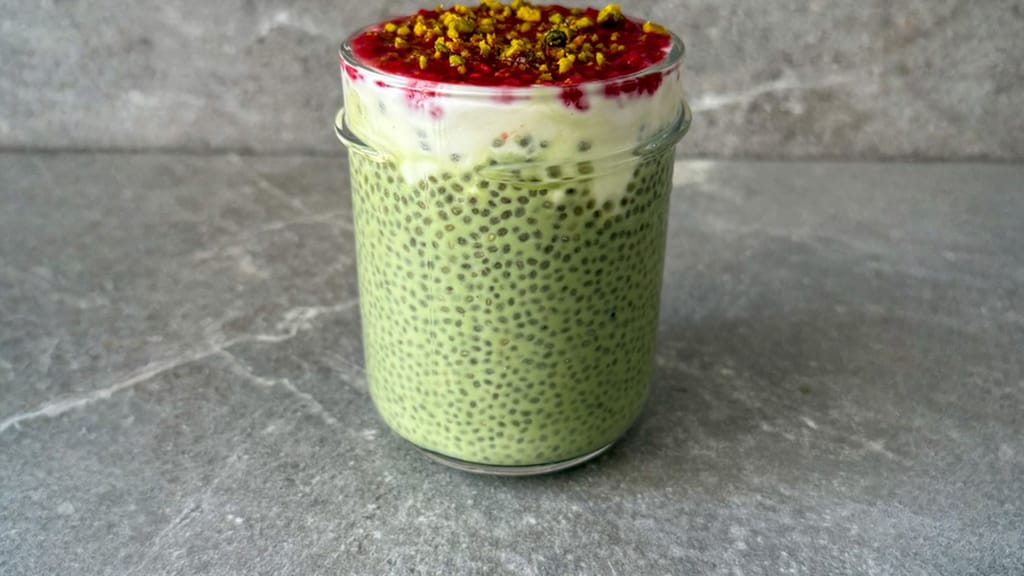
Matcha chia pudding with raspberries and yogurt
Matcha chia pudding with raspberries, Greek yogurt, and pistachios
Chia pudding made with coconut milk is the creamiest version, and it depends mainly on which coconut milk you pick. For 250 ml of full-fat canned coconut milk, 30 g of chia (2.5 tablespoons) is enough. Boxed coconut drink needs the full amount, 40–50 g of seeds per 250 ml.
The best option is a combination: half canned coconut milk, half water or another milk. The pudding is creamy but not heavy, and the coconut flavor doesn't overpower the fruit. Shake or stir canned milk well before measuring. The fat settles on top, and without mixing, one jar would be fatty and the next watery. In the fridge the coconut fat firms up, so stir the pudding in the morning and let it stand on the counter for 5 minutes before eating.
Coconut goes well with tropical fruit (mango, pineapple, passion fruit), with lime zest, or with a teaspoon of cocoa. The method is the same as for the basic recipe: stir, stir again after 5 and 15 minutes, then refrigerate overnight.
For chia pudding with quark (tvaroh, a Czech fresh curd cheese), blend the quark with milk and fruit into a smooth cream and stir the seeds into it. Quark on its own is too dry, and the seeds wouldn't have anything to soak up. A 1:1 ratio of quark to milk is a good start, and then you need only about 15 g of seeds per 250 g of cream.
That's exactly the ratio behind this quark chia dessert with berries: low-fat quark, milk, raspberries, blueberries, and banana blended smooth, plus 15 g of chia. It needs no sugar or syrup, since the sweetness comes from the ripest banana you have, brown spots and all.
Quark gives the pudding body and a slightly tangy dairy flavor that reminds you of quark cream. It also works with other fruit: frozen sour cherries, baked apple with cinnamon, or the mandarins left over after the holidays in January. Let frozen fruit thaw in the fridge before blending, otherwise the cream gets too cold and the seeds swell more slowly.
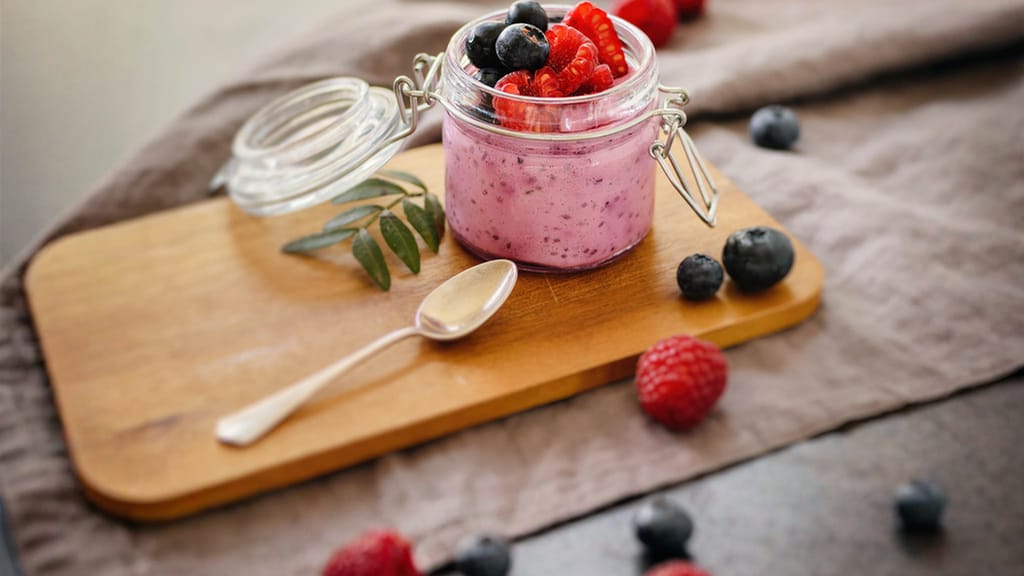
Curd cheese chia dessert with forest fruit
Quark chia dessert with berries, sweetened only by a ripe banana
Blend banana into the liquid for chia pudding, and put mango on top as a purée. A blended ripe banana sweetens and thickens the pudding, so you can cut back on both seeds and sweetener. For 250 ml of milk and one medium banana, 30 g of chia is enough. Don't put sliced banana into pudding overnight, because it browns and turns mushy. Add the slices in the morning.
Mango is very juicy. Blend it straight into the pudding and it thins it out, and leave it in cubes overnight and it releases liquid. That's why it works best as a separate layer, as in this chia dessert with mango purée: a yogurt and banana base with chia sets overnight, and in the morning fresh mango purée and shredded coconut go on top.
This recipe also shows how few seeds a yogurt base needs: 10 g per 150 g of cream. Banana and yogurt are thick, and the chia only firms them up enough to eat with a spoon. You can tell mango is ripe by its fragrance at the stem end and by how it gives slightly under your thumb. Leave a hard mango on the counter for a few days to ripen.
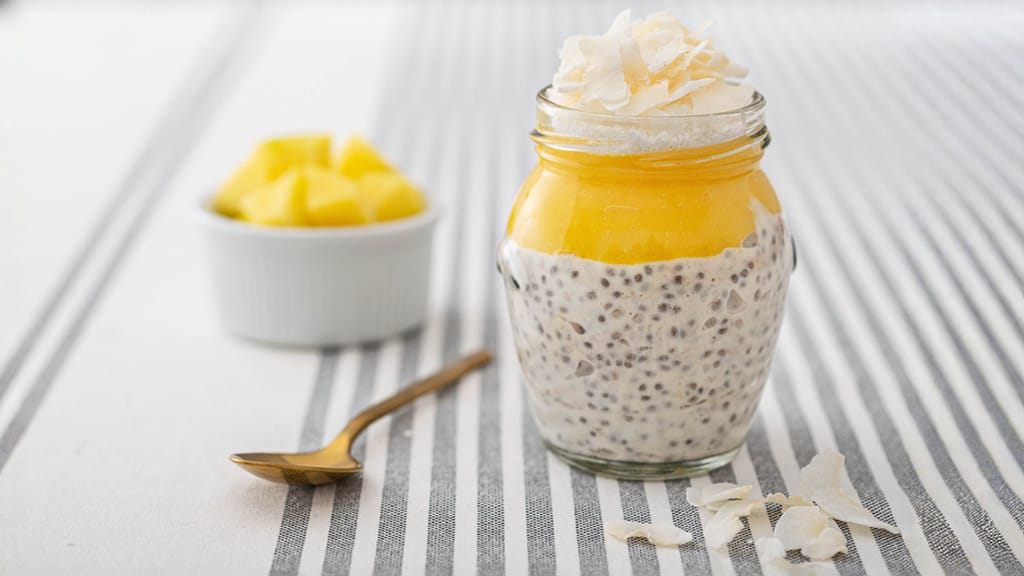
Chia pudding with mango purée
Chia dessert with mango purée: yogurt with banana, chia, and a layer of mango
For 1 serving of chia pudding, 2 tablespoons of chia seeds (about 25 g) and 125 ml of milk, or half a cup, is enough. That's a 1:5 ratio, a thick pudding that, once stirred and set, fills a small glass (around 150 ml). If you want it creamier, use 1.5 tablespoons of seeds (20 g) for the same amount of milk.
A quick overview for one serving:
with milk: 25 g chia + 125 ml milk + 1 teaspoon syrup,
with yogurt: about 14 g chia (a heaping tablespoon) + 75 g yogurt + 75 ml milk,
with canned coconut milk: 15 g chia + 60 ml coconut milk + 60 ml water,
with quark: 8 g chia + 60 g quark + 60 ml milk + a few pieces of fruit.
Make a single serving right in the glass you'll eat it from or take to work. You have fewer dishes, and instead of stirring you can just shake a jar with a lid. If you want a supply for several days, make three servings straight into three jars. Each keeps separately, and no spoon that has been in your mouth goes into it.
If you want chia in the morning and don't have time to wait, add a spoonful of seeds to warm porridge. That's exactly what this oatmeal with fruit, cashews, and chia seeds does: the chia cooks right with the oats in the milk and swells quickly in the hot porridge. If you're wondering how many oats to use per amount of milk in general, we have a separate guide on how to cook oatmeal and what ratio of oats to milk to use.
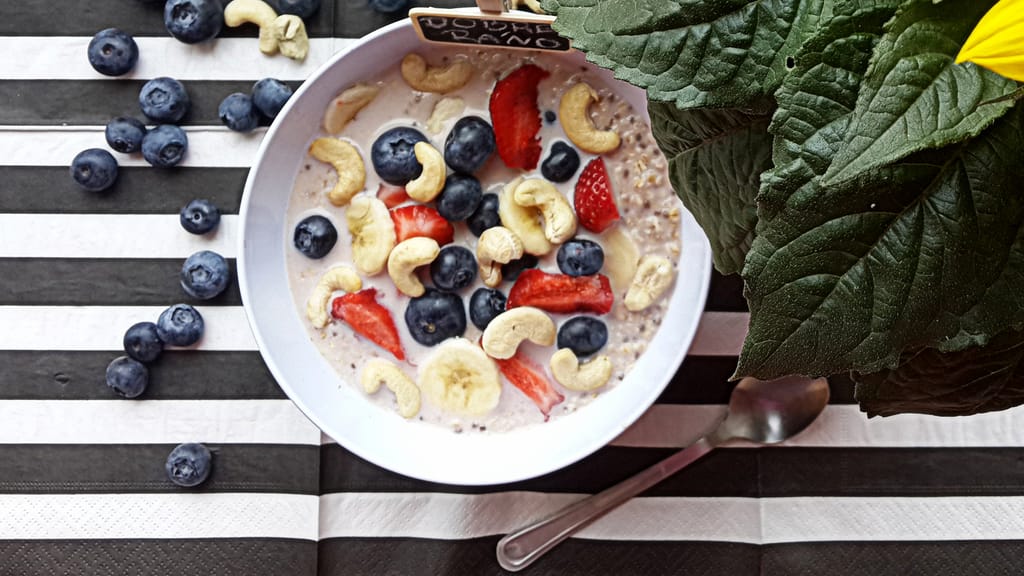
Oatmeal porridge with fruit, cashews and chia seeds
Oatmeal with fruit, cashews, and chia seeds cooked right in the milk
Make chia jam from mashed fruit and chia seeds, which thicken the juice in place of pectin sugar and cooking. The usual ratio is 1–2 tablespoons of seeds per 250 g of fruit. Juicy strawberries and raspberries need more, denser plums or mango less. Mash the fruit with a fork or blend it briefly, stir in the seeds, sweeten to taste, and refrigerate for at least 2 hours, ideally overnight.
For a way to use chia jam at breakfast, see breakfast with strawberry chia jam: strawberry chia jam layered in a glass with oats soaked in coconut milk, fresh strawberries, and pecans. The recipe makes 3 servings, so you have breakfast for three days.
Chia jam tastes more like fresh fruit than classic preserves, because it isn't cooked. For the same reason, it won't keep for months in the pantry. Store it in the fridge and use it within a few days, like the pudding. It's good on pancakes, in yogurt, on toast with quark, or as a filling between two layers of pudding.
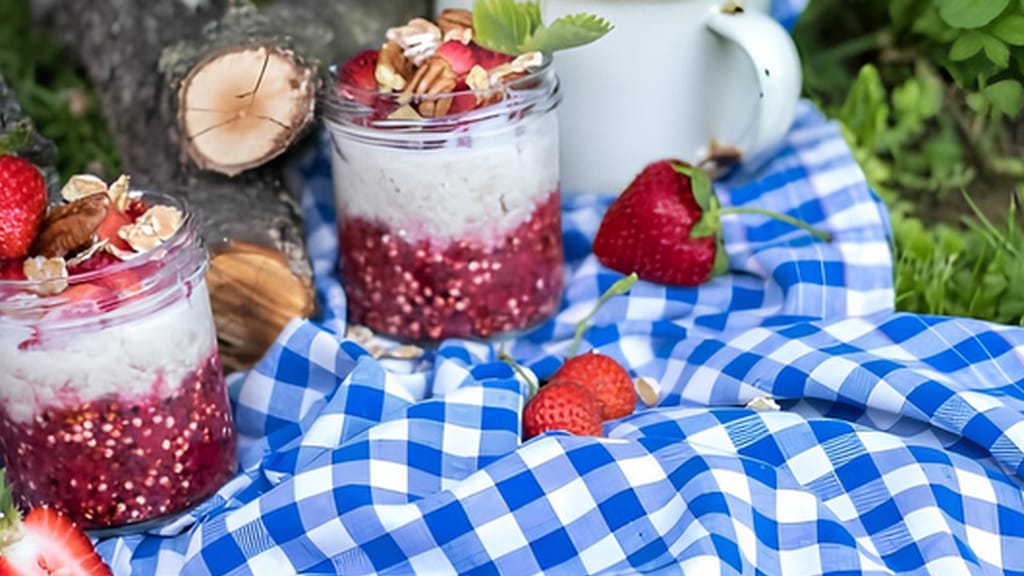
Breakfast with strawberry chia jam
Breakfast with strawberry chia jam and oats in coconut milk
In baking, chia seeds do two things: dry, they add crunch, and swollen, they bind moisture in creams, doughs, and fillings. In bread, rolls, or cookies you can sprinkle them in like poppy seeds, 1–2 tablespoons per 500 g of flour, and they stay slightly crunchy in the oven. In a quark or fruit cream, by contrast, they soak up excess moisture and firm the cream, so it holds its shape even without gelatin.
The second use is what this rhubarb tart with quark and chia seeds relies on. Chia stirred into quark with honey absorbs moisture, so the cream doesn't run on the crisp base under the stewed rhubarb, and the tart can be left to set in the fridge and sliced cleanly.
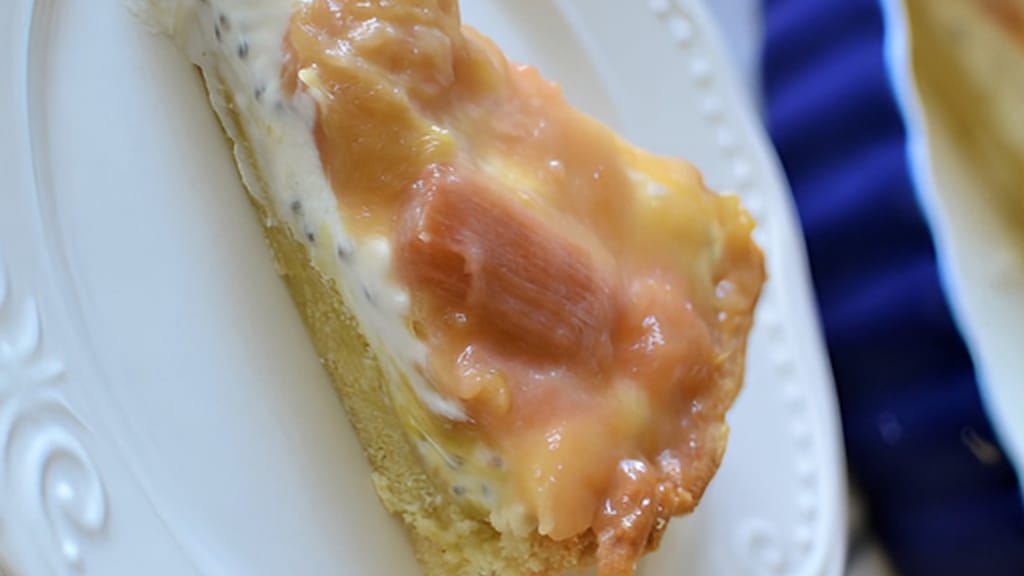
Rhubarb pie with curd cheese and chia seeds
Rhubarb tart with quark cream firmed up with chia seeds
Chia can also stand in for an egg in dense batters such as muffins, gingerbread, or pancakes: 1 tablespoon of seeds and 3 tablespoons of water, left for 10–15 minutes, make a gel that replaces one egg. It won't give the fluffiness of whipped egg whites, though, so it isn't suitable for sponge cake or meringues.
Chia cream is also a handy layer in no-bake desserts. A thick 1:5 pudding can be layered with crushed cookies and fruit in glasses or in a pan. You'll find more ideas in the article on no-bake desserts made with cookies, ladyfingers, and mascarpone.
Chia pudding belongs in the fridge, and we recommend eating it within 2–3 days of making it. Pudding made with milk, yogurt, or quark is a dairy product with everything that goes with that, so it has no business sitting on the counter during the day. For a breakfast at work, carry it in a cooler bag or put it in the fridge as soon as you arrive. Add fruit, granola, and nuts just before eating: fruit releases juice and dry toppings would go soft.
For a supply, make portions separately in jars with lids. Pudding with fresh fruit stirred in (blended raspberries, banana) keeps toward the shorter end of that window, because fruit ferments and browns over time. If the pudding starts to smell sour or yeasty, or the surface changes color, throw it out.
Don't eat dry chia seeds by the spoonful, with or without a little water. Dry seeds washed down with water can swell in the esophagus and block it, and a case of a person with swallowing difficulties has been described. That's why you should always let them soak first. In smoothies, sprinkle them into the finished liquid mixture and let them stand for a while. For inspiration on balancing a smoothie, see the article on smoothie recipes and ratios of fruit, vegetables, and liquid.
Chia pudding suits the festive week between Christmas and New Year because you make it ahead and it uses up leftovers. For a New Year's Eve brunch or New Year's Day breakfast, mix the glasses the evening before and just add fruit in the morning. Guests help themselves, nothing needs frying, and nobody has to stand at the stove.
A few ideas for using up holiday leftovers:
Mandarins and oranges: peeled segments on top, grated zest in the milk.
Leftover whipped cream or mascarpone: a spoonful in the pudding makes it creamier, but expect the same fridge life.
Crumbled Christmas cookies: sprinkle on in place of granola just before serving, or they go soft.
Gingerbread spice and cinnamon: a teaspoon in the milk, and the pudding tastes like Christmas gingerbread.
Frozen summer fruit: thaw in the fridge, mash into chia jam, and layer with yogurt.
For New Year's Eve, make the thick 1:5 version and layer it in small glasses with whipped yogurt and raspberries. It looks like a dessert, takes ten minutes to make, and sets in the fridge by midnight. In January, when everyone is looking for simple, quick breakfasts, just mix three jars on Sunday evening and you're set until Wednesday.
Yes, chia seeds swell in water just as well as in milk, but the pudding will be less creamy and flatter in flavor. So combine water with fruit purée, cocoa, or canned coconut milk, say half and half. The ratio stays the same, roughly 40 g of seeds per 250 ml.
You can, but after thawing it tends to be thinner and slightly watery, because ice crystals break up the gel around the seeds. Thaw it in the fridge, stir it well, and add a teaspoon of fresh seeds if needed. It's better to freeze the fruit purée on its own and make the pudding fresh.
Classic chia pudding uses whole seeds, which give the typical texture similar to tapioca. Ground seeds thicken the liquid faster and make a smooth cream, but it tends to be grayish with a stronger nutty flavor. You can also get a smooth pudding from whole seeds by blending it after it has set.
Yes, you can. Make it as usual, then briefly warm it in a saucepan or microwave in the morning, stirring and thinning it with a spoonful of milk. It loosens a little with heat. A quicker route to a warm chia breakfast is to add a spoonful of seeds to oatmeal as it cooks.
A bitter or musty taste usually means old or badly stored seeds whose oil has gone rancid. Store chia seeds in a sealed container in a dry, dark, cool place, and smell them before use. If they smell of fish or oil paint, throw them out.
One recipe worth heating the oven for, one tip, and one deal from the shop. Nothing else.