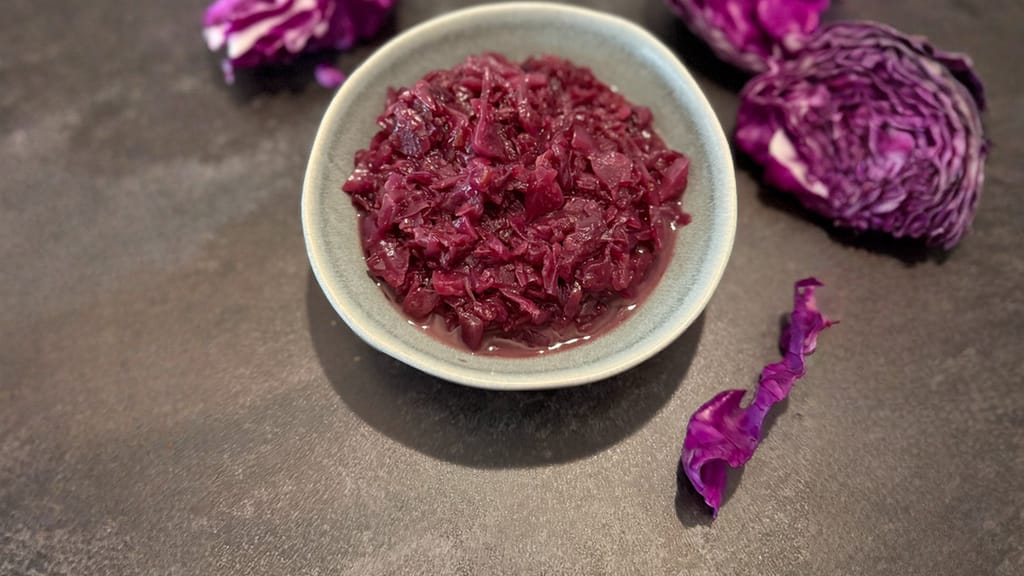
Sweet and sour braised red cabbage
Red Cabbage: How to Cook It Fresh or from a Jar and How to Season It
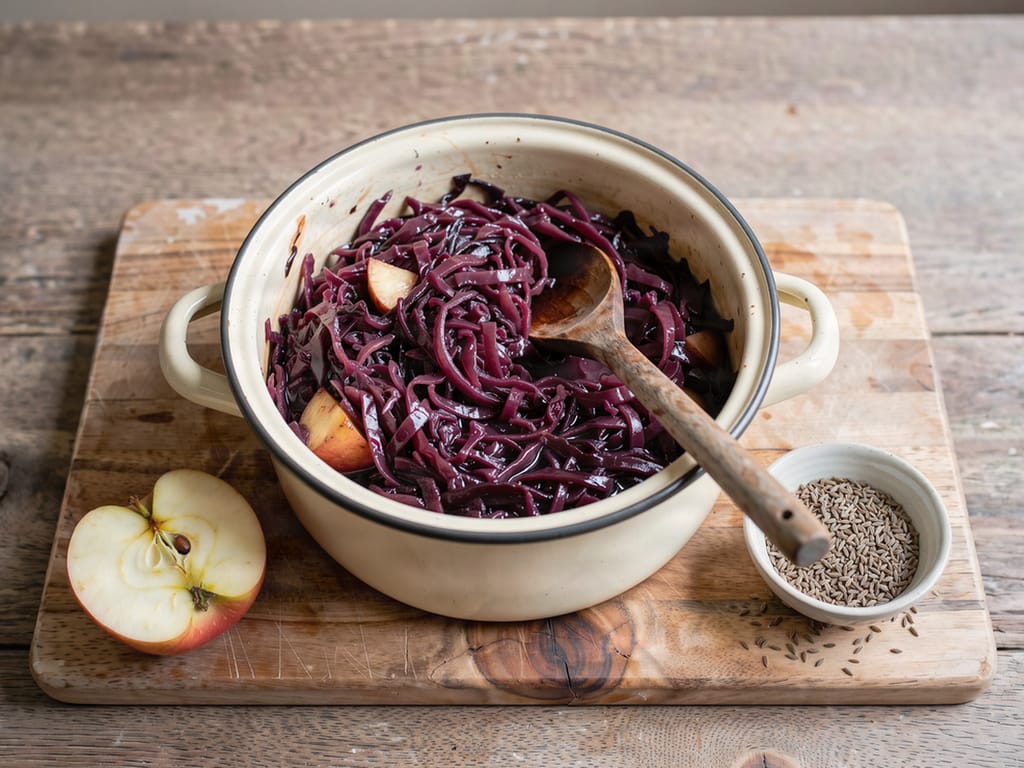
Updated Nov 17, 2026
To cook red cabbage, sauté shredded cabbage with onion in lard, add a splash of water, acidify with vinegar, sweeten with sugar or an apple, and braise until tender. The key is balance: acid keeps the rich wine-red color, sugar rounds it out, and salt and caraway finish it off. The same logic applies to jarred cabbage – you're just starting halfway along. Below you'll find the basic method, seasoning ratios, ways to thicken the cabbage and how to can it safely.
To cook red cabbage from a fresh head, shred it, sauté it in lard with onion, add vinegar, sweeten it, and braise it covered until tender. For 1 kg (2.2 lb) red cabbage (about one small head), you'll need:
2 tablespoons lard or goose fat (or butter or oil)
1 onion, finely chopped
3–4 tablespoons vinegar (malt, apple cider or wine) or 100 ml (about 1/3 cup) red wine plus 1–2 tablespoons vinegar
1–2 tablespoons sugar or 1 grated tart apple
1 teaspoon salt and 1 teaspoon caraway seeds
100–150 ml (about 1/2 cup) water for deglazing
Here's how:
Quarter the head, cut out the core and shred it into thin strips. The thinner the strips, the more tender the result.
Sauté the onion in the fat until translucent, add the sugar and let it caramelize lightly – it gives the cabbage depth.
Add the cabbage, stir to coat it in fat, and pour in the vinegar right away. Acid protects the color: the pigments in red cabbage (anthocyanins) are wine-red in acidic conditions and turn blue and even green in alkaline ones (which looks gray in the pot).
Add the salt, caraway and water, cover and braise over low heat. Stir now and then and add a little more water if needed.
The cabbage is done when it's tender but the strips still hold their shape and look glossy. Only then adjust the seasoning – the sourness and sweetness mellow as it braises.
If you'd like a tried-and-tested step-by-step method, find it in the recipe for sweet-and-sour braised red cabbage.
Sweet and sour braised red cabbage
Sweet-and-Sour Braised Red Cabbage – Step-by-Step Recipe
Seasonal baking plans, tested recipes and kitchen tricks that save you time. Unsubscribe in one click.
Jarred red cabbage is already cooked and acidified, so you just need to heat it through and round it out with fat, onion and spices – there's no need to cook it longer, as it would only turn mushy. Heated on its own, it tastes flat and a bit sour. Here's how to rescue it:
In 1 tablespoon lard or butter, sauté half an onion, with a teaspoon of sugar if you like.
Tip in the cabbage with some of the brine (if it's too sour, you can drain the brine and replace it with a little water or wine).
Add a pinch of caraway, and if you like a grated apple or a spoonful of cranberries, and heat through, stirring occasionally, until it steams and the onion blends into the cabbage.
Taste and balance: soften overly sour cabbage with sugar or apple, and wake up bland cabbage with a drop of vinegar and salt.
Watch the salt – jarred cabbage is usually already salted, so salt only at the end. And store the rest of an opened jar according to the manufacturer's label, which tells you how long it keeps in the fridge.
Red cabbage rests on three things: acid, sweetness and salt. As a starting point for 1 kg (2.2 lb) cabbage, use 3 tablespoons vinegar to 1–2 tablespoons sugar, roughly 2:1, and adjust to taste.
Acid comes from vinegar, wine or lemon – choose one or combine them:
vinegar – malt vinegar is the most neutral, apple cider vinegar fruitier, wine vinegar milder
red wine – adds color and depth, but it isn't very acidic on its own, so add a spoonful of vinegar
lemon juice – for fine-tuning at the end
Sweetness comes from sugar, fruit or jam:
sugar – white or brown, ideally lightly caramelized with the onion
apple – grated, it breaks down in the cabbage and sweetens it naturally
cranberry or red currant jam, honey – a fruity sweetness that suits game and goose
Spices that go well with red cabbage:
caraway – the Czech classic
bay leaf, allspice, cloves – a more Christmassy, "roasted" flavor
cinnamon or star anise – use sparingly, a small piece is enough
How to tell what's missing: cabbage that "bites" needs sweetness. Cabbage that is sweet but flat needs acid. Cabbage that is balanced but bland needs salt – the most commonly overlooked one.
The simplest way to thicken red cabbage is to uncover it and let the excess liquid cook off – the flavor concentrates at the same time. If you need to bind the juices, you have five options besides evaporation: raw potato, all-purpose flour, starch, grated gingerbread or an apple.
Raw potato – for 1 kg (2.2 lb) cabbage, finely grate one small potato, stir it in and simmer briefly. The starch thickens without changing the flavor.
All-purpose flour – mix 1 tablespoon into a little cold water, pour into the cabbage and simmer until the floury taste disappears.
Cornstarch or potato starch – 1 teaspoon mixed into cold water thickens quickly and clearly; a short simmer is enough.
Grated gingerbread – a traditional trick for game: it thickens and adds spiced sweetness.
Apple – grated, it cooks down and lightly binds the cabbage.
Thicken only at the end and a little at a time. The cabbage keeps thickening for a while, so what's just right in the pot tends to be thicker on the plate a few minutes later.
Only can red cabbage as a pickle in a vinegar brine. Cabbage is a low-acid vegetable, and without enough acid Clostridium botulinum can multiply in the jar, and its spores aren't destroyed by an ordinary boiling water bath. The acid from the vinegar is a safety measure here, not just flavor.
What to follow:
Vinegar with 5% acidity (malt vinegar is often 8%, which is also fine) and a brine with at least as much vinegar as water – this is the general rule for pickled vegetables according to Oregon State University Extension.
Never reduce the vinegar or add water – that would lower the acidity below the safe limit. Adjust the sweetness with sugar, not the acidity.
Stick to a tested recipe, including the processing time; don't improvise the method by eye.
Don't can braised sweet-and-sour cabbage in jars. You have no way to measure the acidity of cooked cabbage at home, and there is no tested processing method for it. Freeze it instead for storage (see below).
Cooked red cabbage keeps 3–4 days in the fridge and is best used within 3–4 months in the freezer – both according to the US food safety agency USDA/FSIS guidance for leftovers. It stays safe in the freezer longer, but loses quality.
Put cooled cabbage in the fridge within 2 hours of cooking; don't leave it longer at room temperature (USDA/FSIS).
Freeze it in flat bags or containers in portions – it thaws faster and more evenly.
Red cabbage freezes very well, and the next day after resting it often tastes even better – the spices meld.
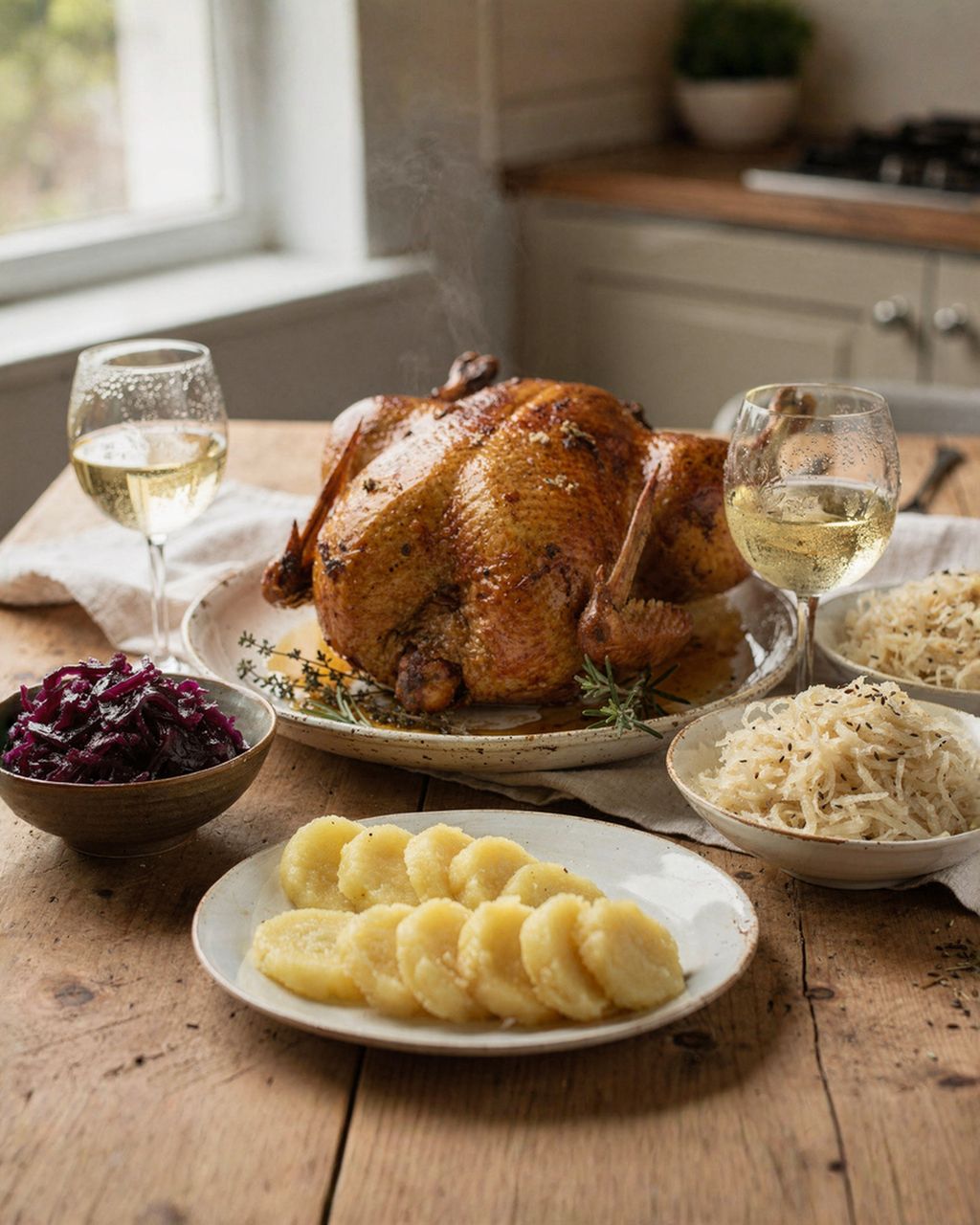
Braised red cabbage is a classic side for roast goose, duck, pork and game – its acidity balances the fatty meat. For pork, you can bake it right in with the recipe for slow-roasted pork with red cabbage. If you're preparing goose, the St. Martin's menu shows when to reach for red cabbage and when for white.
More ideas:
raw salad – shredded cabbage salted, massaged and drizzled with vinegar and oil, with apple or orange
in a wrap, tacos or burger – quickly pickled strips add crunch and tang
with potato dumplings and lokše (Czech potato flatbreads) – and leftover braised cabbage too
natural dye – a red cabbage infusion dyes eggs blue, as we describe in the article on natural egg dyeing
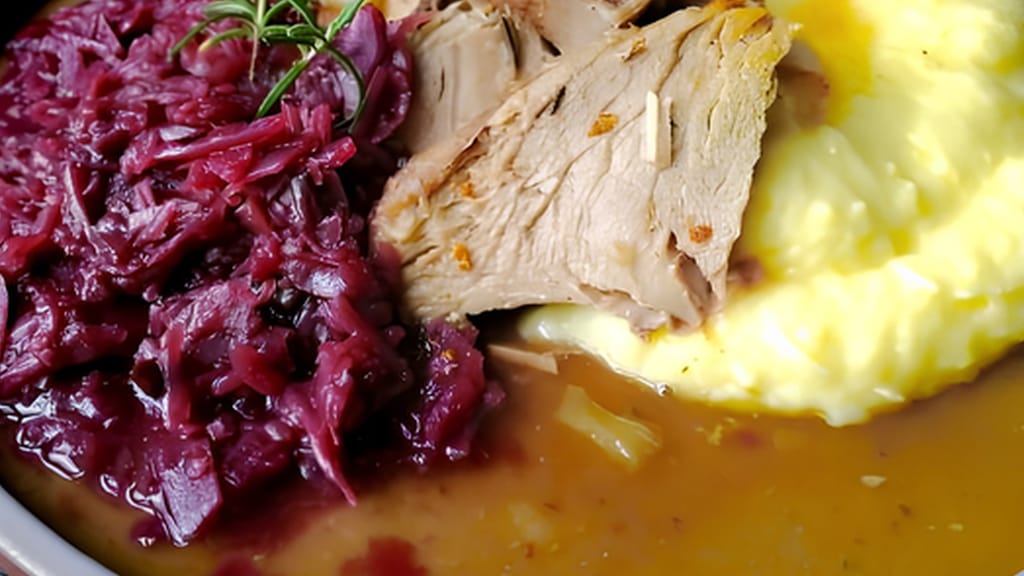
Slow-roasted pork with red cabbage
Slow-Roasted Pork with Red Cabbage
Reheat red cabbage in a pot over low heat with a spoonful of water or a small piece of butter, stirring occasionally, until it's steaming throughout. According to USDA/FSIS, leftovers should be reheated to 165°F (74°C) inside.
Shred the red cabbage, massage it with salt, pack it into a jar and cover it with a hot brine of vinegar and water in a 1:1 ratio with sugar to taste. Let it cool, then put it in the fridge and eat it within a few days – this is a quick pickle for serving, not canning for storage, so you don't sterilize the jar and you keep it only in the fridge.
Red cabbage turns blue when it lacks acid. Its pigments, anthocyanins, are wine-red in acidic conditions, purple in neutral ones, and in alkaline conditions (such as hard tap water) they turn blue and even green, which looks gray in the pot. Stir in a spoonful of vinegar or lemon juice and the color returns within a few minutes. That's why vinegar goes in right at the start of braising.
For one side-dish serving, plan on about 150–200 g (5–7 oz) of raw red cabbage, so a 1 kg (2.2 lb) head serves 5–6 people. Cabbage shrinks as it braises, but the liquid and onion roughly make up for the loss. For a bigger holiday lunch, lean toward the upper end – the cabbage reheats and freezes well, so leftovers won't go to waste.
One recipe worth heating the oven for, one tip, and one deal from the shop. Nothing else.