- Season
- All year
- Price
- Low
Calories and nutrition
per 100 g
379 kcal
Calories
0.3 g
Protein
93.5 g
Carbs
0.4 g
Fat
Vanilla Pudding Powder
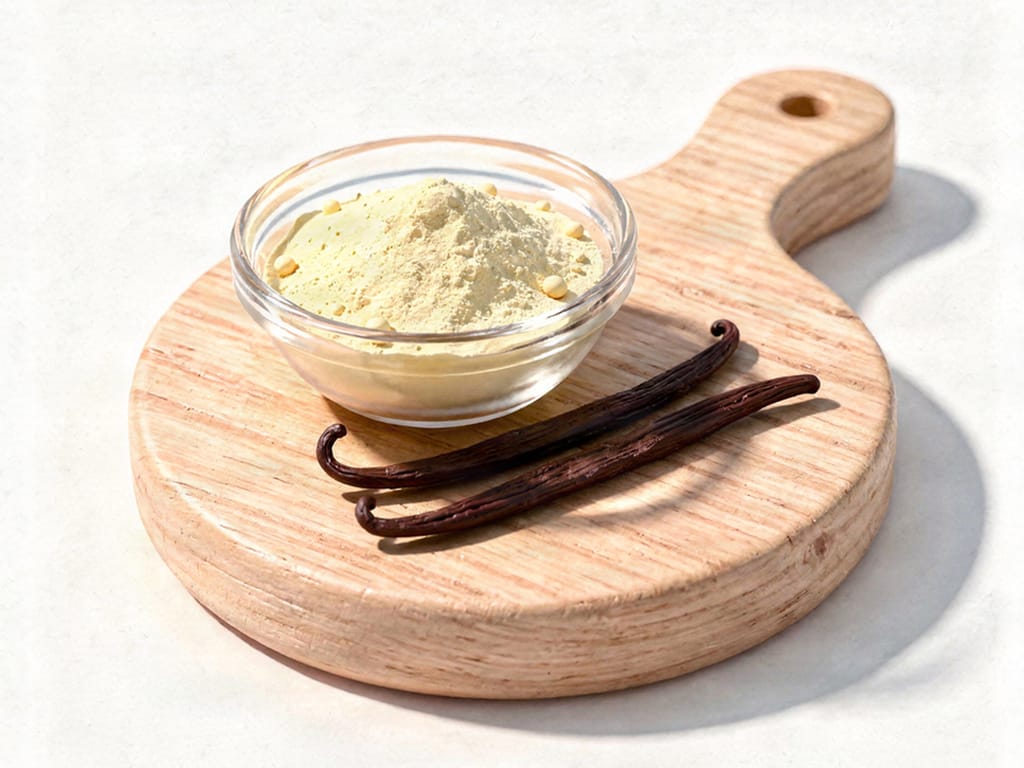
Vanilla pudding powder is a mix of cornflour (cornstarch), flavouring and colouring that you cook with milk and sugar to make vanilla pudding. One sachet (about 37–40 g) is whisked into cold milk and cooked with 500 ml milk and 30–40 g sugar; it usually contains no eggs and no sugar.
per 100 g
379 kcal
Calories
0.3 g
Protein
93.5 g
Carbs
0.4 g
Fat
Keep sachets somewhere dry and cool, away from spice mixes, and go by the best-before date. Close an opened sachet well or tip it into a jar, as the powder absorbs moisture and smells.
The powder does not belong in the fridge. Cover cooked pudding with film pressed onto the surface so no skin forms, chill it and eat it within 2 days.
There is no need to freeze the powder. We do not recommend freezing cooked pudding: the starch gel weeps water and turns grainy when thawed.
Check how much milk the sachet needs; standard sachets are for 500 ml. If you want the taste of real vanilla, choose a pudding that lists vanilla extract or ground vanilla pod, not just flavouring. Cornflour is gluten-free, but people with coeliac disease should buy pudding labelled "gluten-free", such as the Labeta range. Instant puddings that you only mix with cold milk are a different product and usually already contain sugar. The powder should be free-flowing, without lumps.
A homemade mix: for 500 ml milk, 40 g cornflour, 40–50 g sugar, a pinch of salt and vanilla (seeds from a pod or a teaspoon of vanilla extract). The pudding will be creamy white rather than yellow; only egg yolks turn it yellow.
Potato starch, but about a quarter less (around 30 g per 500 ml), cooked only until it thickens, as it thins with long stirring. In baking, the same weight of cornflour with vanilla sugar replaces pudding powder.
Take about a third of 500 ml milk and whisk the sachet into it until smooth. Bring the rest of the milk to the boil with 30–40 g sugar, take it off the heat and pour in the mixed powder, whisking constantly. Return to the heat and cook for about a minute, stirring all the time, until thick. For a firmer pudding for cakes and slices, cook 2 sachets with 700–750 ml milk.
Use leftover cooked pudding as a filling for pancakes, between sponge fingers or in a layered dessert in a glass. Add an opened sachet of powder to a bundt or traybake batter in place of the same amount of flour.
Roughly what a spoon or cup weighs, filled the way you usually would.
3 g
1 teaspoon
8 g
1 tablespoon
It is cooked with milk on the hob; the microwave works too if you stir every minute. The cooked pudding is eaten on its own, with fruit or whipped cream, used as a filling for doughnuts, choux buns and slices, and as the base of pudding buttercream for cakes. The dry powder goes into bundt cakes and traybakes, replacing some of the flour and adding vanilla aroma and a yellow colour.
Vanilla pudding powder is a dry mix that you cook with milk to make vanilla pudding. Its base is cornflour (cornstarch), which thickens the milk as it cooks. Flavouring and colourings are added, usually carotenes and riboflavin, which give the pudding its typical yellow colour; some brands add salt, milk powder or cream. A standard Czech sachet, such as Dr. Oetker, holds 37–40 g and is made for 500 ml milk. It contains no sugar; you add it while cooking. "Vanilla flavour" on the pack means flavouring, usually vanillin, not real vanilla. Premium puddings with real vanilla list vanilla extract or ground vanilla pod. Pudding powder contains no eggs; it is essentially what is sold in Britain as custard powder.
Cooked pudding tastes sweet of vanilla and milk, with a smooth, thick and creamy texture. The vanillin flavour is strong and simple, the familiar "packet" taste; pudding with real vanilla smells rounder and less sharp. Made with whole milk it is creamier than with semi-skimmed.
Seasonal baking plans, tested recipes and kitchen tricks that save you time. Unsubscribe in one click.
3 min read
Vanilla pudding powder is mostly cornflour. The standard Dr. Oetker vanilla pudding sold in Czechia, for example, lists only cornflour, flavouring and the colourings carotenes and riboflavin. Carotenes and riboflavin give the pudding the yellow colour it would otherwise get only from egg yolks. Premium versions add natural vanilla flavouring, ground vanilla pod, salt, milk powder or cream.
Classic pudding powder contains neither sugar nor eggs. You add sugar to taste while cooking, and there are no eggs in packet pudding at all. Once cool, it sets thanks to the starch, not eggs as in an egg custard.
The classic ratio is 1 sachet (37–40 g) to 500 ml milk and 30–40 g sugar, that is 2–3 tablespoons. Manufacturers specify semi-skimmed milk; with whole milk the pudding is creamier. This pudding holds its shape on a spoon and serves 4.
You change the thickness with the amount of milk. For a softer pudding in glasses or as a sauce, use 600 ml milk per sachet. For a firm pudding for cakes, slices and doughnut fillings, cooks typically use 2 sachets to 700–750 ml milk. That is the pudding layer in the custard slab cake or the rhubarb cake with custard and curd cheese.
Lumps form when starch hits hot milk without being mixed in first. The starch grains on the outside of a clump swell instantly and seal the dry powder inside. That is why the powder is always mixed into some cold milk first and poured into boiling milk while whisking.
Thin pudding is usually undercooked: the starch only thickens fully after about a minute of boiling. A scorched bottom comes from too high a heat and too little stirring. Rescue lumpy pudding with a stick blender or by pushing it through a sieve. Prevent a skin by pressing film directly onto the surface.
Cooked and cooled pudding is beaten with butter to make pudding buttercream for cakes and cookies. To stop it curdling, the pudding and butter must be at the same room temperature; the details are in pudding buttercream.
The dry powder also goes into batters. In bundt cakes, traybakes or cookies it replaces the same weight of flour, making the crumb finer, softer, vanilla-scented and pale yellow.
You can mix your own pudding from starch and vanilla. For 500 ml milk use 40 g cornflour, 40–50 g sugar, a pinch of salt and the seeds from a vanilla pod or a teaspoon of vanilla extract. The method is the same as for a sachet: mix the starch into cold milk, pour it into hot milk and boil for a minute from the first bubbles.
Homemade pudding made with plain starch is creamy white with black flecks of vanilla; it turns yellow only with egg yolks. Exact ratios for vanilla and chocolate pudding are in homemade pudding from scratch.
Egg-free custard powder was invented in 1837 by the English pharmacist Alfred Bird, reportedly for his wife, who could not eat eggs; his custard powder is still sold today. In central Europe, pudding powder was popularised mainly by Dr. August Oetker, who began selling it in the 1890s. Cooking with milk and sugar turned it into a quick home dessert that still belongs in Czech cakes, slices and doughnuts.