Dill sauce with slow-roasted beef
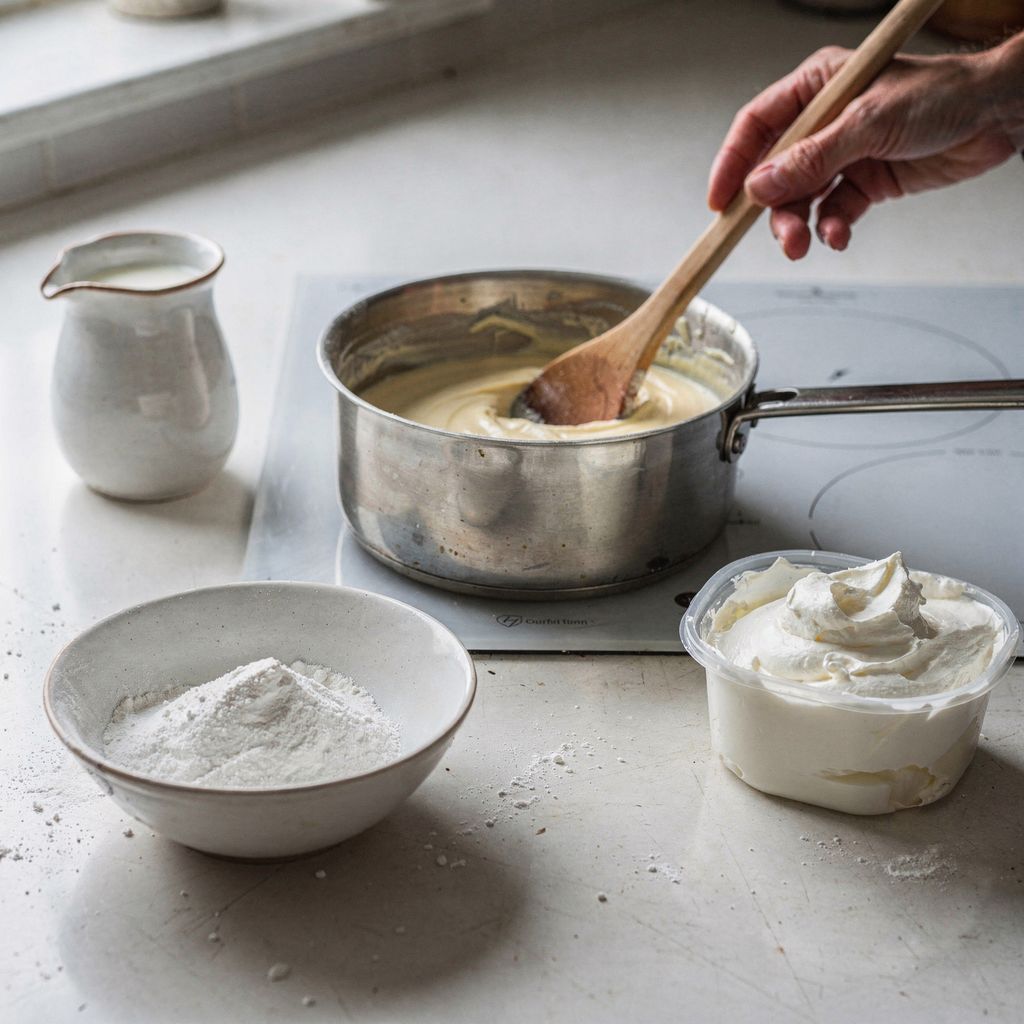
Updated Aug 28, 2026
There are six ways to replace cream in a sauce: milk thickened with cornstarch, sour cream, crème fraîche, or an oat, soy, or coconut alternative. Which one you pick comes down mainly to fat content — fat is what holds the milk protein together, so the less fat a substitute has, the sooner your sauce will curdle, and the more you'll need to lean on starch and good timing to save it. Below you'll find how much fat each substitute has, what it can handle when heated, what it does to flavor, and how to stir it in so it stays smooth.
You can replace cream in a sauce six ways: milk with cornstarch, sour cream, crème fraîche, or an oat, soy, or coconut alternative — they mainly differ in fat content and how well they hold up to heat.
Milk with cornstarch — when it's mostly about thickness and a neutral, milky flavor. The cheapest, most accessible option, and it can handle even longer simmering.
Sour cream (around 15% fat) — when you want tangy depth. Stir it into a hot sauce only at the very end, off the heat.
Crème fraîche (30%+ fat) — the same tangy flavor as sour cream, but it can handle boiling.
Oat-based alternative (around 13%) — the most neutral of the plant-based options, behaving closest to dairy cream when cooked.
Soy-based alternative (around 14%) — holds its emulsion best, but carries its own beany flavor.
Coconut milk or cream (typically around 20%) — the highest fat among plant-based options, can handle boiling and reduction, but its flavor takes over the whole sauce.
If you want one all-purpose solution: crème fraîche and coconut cream handle the widest range of situations, since they both have enough fat to survive boiling.
Cream substitutes range from 3.5% to 35% fat: full-fat milk 3.5%, oat-based around 13%, soy-based around 14%, sour cream most commonly 10–17%, coconut milk typically around 20%, and crème fraîche 30% and up. For comparison — under Czech food regulation (Decree No. 397/2016 Sb.), whipping cream must contain at least 30% fat (30–35% and above is classed as heavy/whipping cream); "cooking cream" is a commercial label, usually sitting at 10–12% fat.
Full-fat milk — 3.5%
Cooking cream — 10–12% (15% and 20% versions are also sold)
Oat-based cream alternative — around 13%
Soy-based cream alternative — around 14%
Sour cream — at least 10% by regulation; most commonly sold at 10–12% and 15–17%, with richer fermented creams around 30% also available
Full-fat coconut milk and coconut cream — roughly 14–29% depending on the brand, typically around 20%; always check the label
Crème fraîche — 30% and up, typically 30–35%
Whipping cream — 30–35%
The threshold that actually matters sits at around 20% fat. Below that, plan on never letting the sauce boil. Above 30%, most manufacturers and standard practice agree the substitute can handle a brief boil even in an acidic sauce.
It's the milk protein that curdles, not the fat. Casein in milk and cream holds together until acidity, high heat, or salt throws it off balance — then the proteins clump together and a smooth sauce turns grainy. Fat physically gets in the way: fat globules bond to the casein before it has a chance to clump on its own. The more fat, the more stable the sauce — that's why whipping cream can be boiled and milk can't.
Three triggers also stack on top of each other:
Acidity — wine, lemon, tomatoes, vinegar, sauerkraut. The strongest trigger of all.
Heat — the problem starts at a full boil, not with gentle reheating. A bare simmer is fine; a rolling boil isn't.
Salt and reduction — the more you reduce a sauce, the more concentrated the salt and acid become, and the closer you get to the point where the protein gives up.
Plant-based alternatives don't have this problem at all, since they contain no casein. Instead of protein, they're held together by added oil, an emulsifier (lecithin, sucrose esters), and a stabilizer (xanthan, guar, carrageenan) — that's why you'll often spot rapeseed oil listed alongside oats in an oat cream's ingredients. They can still split, though, just for a different reason: a hard boil or a shock of cold liquid can break their emulsion.
Milk with cornstarch replaces cream anywhere the goal is mainly thickness and smoothness rather than rich flavor — in dill sauce, horseradish sauce, mushroom sauce, or anything you're thickening anyway. The cornstarch does two jobs at once: it thickens, and it wraps the milk proteins in a network that keeps them from clumping, so the milk curdles far less easily than it would on its own.
Ratio: for 250ml of full-fat milk, use 1 level tablespoon (about 10g) of cornstarch for a thick sauce, or 1 teaspoon (5g) for a light thickening. Potato starch thickens more strongly — use roughly a third less.
Method:
Mix the cornstarch into cold milk or water until smooth. Never sprinkle dry starch straight into a hot sauce.
Pour it in a thin stream into the sauce (taken off a hard boil) while stirring constantly.
Let it simmer for about a minute. Starch fully gelatinizes somewhere between 62 and 80°C — undercooked, it tastes starchy and the sauce will thin out again as it cools.
Full-fat milk (3.5%) is essential for this method. Semi-skimmed will give you a watery sauce — the starch will thicken it, but it won't bring the flavor back. For something closer to real cream, stir in a spoonful of butter at the end, off the heat.
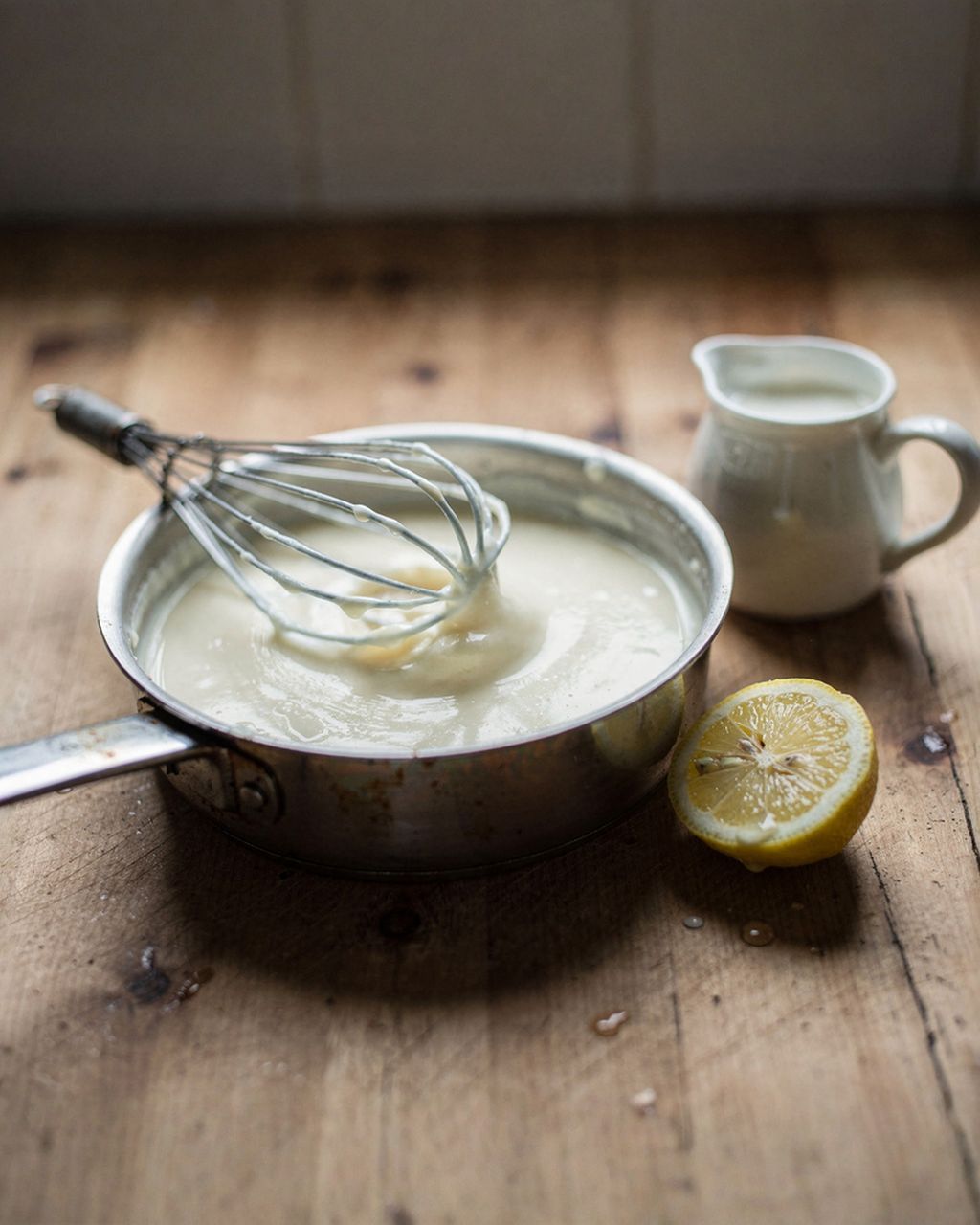
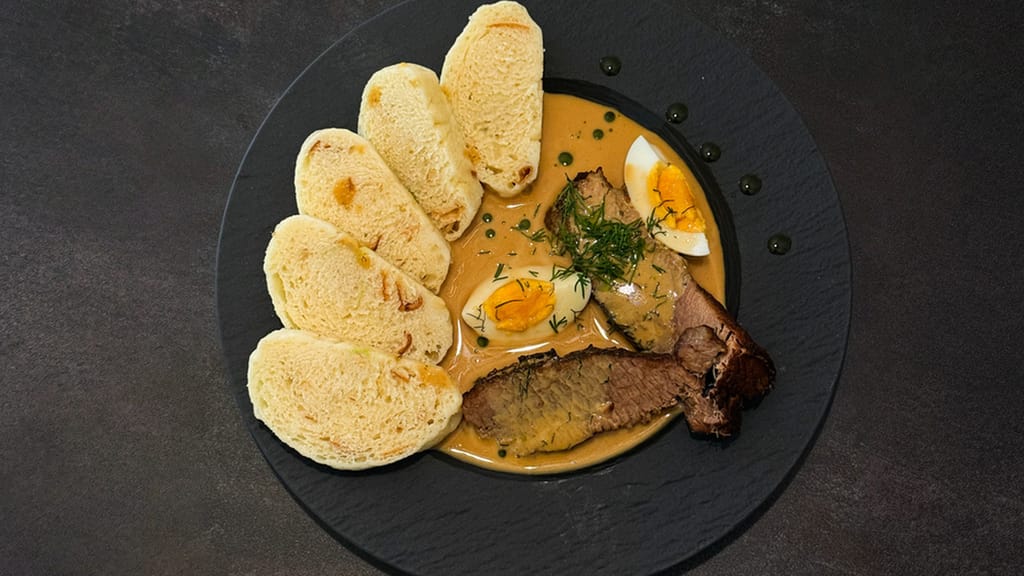
Dill sauce with slow-roasted beef
Dill sauce with slow-roasted beef — a classic where milk with cornstarch fully replaces cream
Sour cream is a substitute for flavor, not stability. With a fat content most commonly at 10–17% and its own natural acidity, it packs both curdling triggers into one tub — so it belongs in a hot sauce only right at the very end.
How to add it without ending up with lumps:
Take the sauce off the heat and let it settle for a moment — you want it hot, not bubbling.
Temper it: stir a few spoonfuls of the hot sauce into the sour cream in a bowl, mix well, then pour the whole mixture back into the pot.
Stir it in with a whisk and don't cook it any further.
If you need to simmer the sauce a bit longer, back up the sour cream with a teaspoon of cornstarch mixed directly into it. The starch network keeps the proteins apart even through a brief simmer — it's the same trick behind most cuisines that regularly cook with cultured dairy.
Flavor-wise, expect a noticeably tangier taste with a slight curd-like note. In dill sauce, kulajda soup, or mushroom soup, that's a plus. In a delicate herb sauce or a sweet one, it'll overpower everything else.
Crème fraîche is the only tangy substitute you can bring to a full boil. The difference from sour cream isn't the culture — it's the fat: crème fraîche has 30% or more (typically 30–35%), while sour cream sits around 15%. That fat is enough to protect the protein even in a wine- or lemon-based sauce. Watch out for light versions (crème fraîche légère, around 15% fat) — those behave like sour cream and shouldn't be boiled.
In practical terms, that means:
You can stir it straight into a hot sauce and let it bubble away.
It replaces whipping cream at a 1:1 ratio — comparable fat content, just with added tang.
It's thicker and richer than sour cream, but less tangy — keep that in mind when seasoning.
It can be whipped, so it also works anywhere you'd otherwise reach for whipping cream.
If you can't find it, the closest substitute is whipping cream seasoned with a spoonful of lemon juice or sour cream. But add that acid after boiling, not before.
Plant-based alternatives won't curdle from acidity — they have no casein to curdle in the first place. What they can do instead is split into oil and water if you break their emulsion. All three are essentially water, vegetable oil, a bit of the named ingredient, and stabilizers at their core — they mainly differ in flavor and in what they can handle in the pot.
Oat-based alternatives behave closest to dairy cream when cooked, and in an everyday savory sauce, they're the hardest to detect. The most common version has 13% fat — slightly more than dairy cooking cream at 10–12% — and alongside oats, you'll find rapeseed oil, lecithin, and xanthan gum on the label. Those stabilizers are exactly why it holds together.
Flavor: lightly sweet, grainy. In a savory sauce, balance it out with salt and acid, or it'll taste bland.
Boiling: it can handle a brief simmer, but not a long reduction — the sweetness concentrates and starts to dominate.
Thickening power: weaker than dairy cream. Plan on an extra teaspoon of cornstarch.
Soy-based alternatives hold their emulsion better than any other plant-based substitute, even through long stirring or reheating. The standard cooking version has 14% fat; it's based on sunflower oil and shelled soybeans (around 5.5%), plus an emulsifier and three different stabilizers.
Flavor: the most noticeable of the "neutral" options — beany, faintly sweet. It disappears into a mushroom or garlic sauce, but not into a delicate herb one.
Boiling: handles it best of all the plant-based cooking alternatives.
Watch for temperature shock: it can't curdle via casein, but suddenly combining cold soy cream with a boiling acidic liquid will still break the emulsion. Temper it the same way you would sour cream.
Coconut is the most stable plant-based substitute because it has the most fat — full-fat coconut milk and coconut cream range roughly between 14 and 29% across brands, typically landing around 20%. It handles boiling, reduction, and long simmering, and it's the only plant-based substitute that can genuinely rival whipping cream in this respect.
The trade-off is flavor. Coconut takes over a sauce completely, so use it where it belongs — in curries, in lime-and-ginger soups, in chili-braised vegetables. Not in dill sauce.
Two practical details:
Light versions (roughly 7–17% fat) aren't suited for sauces. They're mostly water; a sauce made from them stays thin and tastes watered-down.
Don't shake the can before opening if you want a thick sauce. The fat settles at the top — use that solid layer as coconut cream, and save the watery liquid underneath for thinning things out.
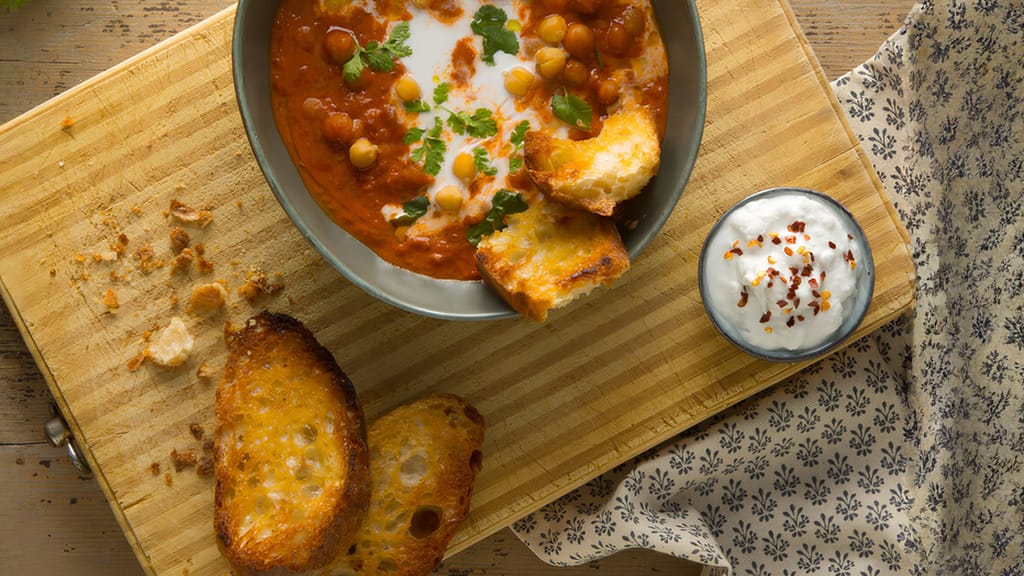
Chickpea curry with coconut cream and fresh apple juice
Chickpea curry with coconut cream — a sauce where coconut doesn't replace cream, it elevates it
To stir a substitute in without curdling, let it come to room temperature, take the sauce off the boil, temper it with a few spoonfuls of the hot sauce, and pour it in in a thin stream while stirring constantly. This method works for any dairy substitute under 25% fat:
Let the substitute come to room temperature. Cold liquid hitting a boiling sauce is the fastest route to lumps.
Take the sauce off a hard boil. Either let it barely simmer, or take it fully off the heat.
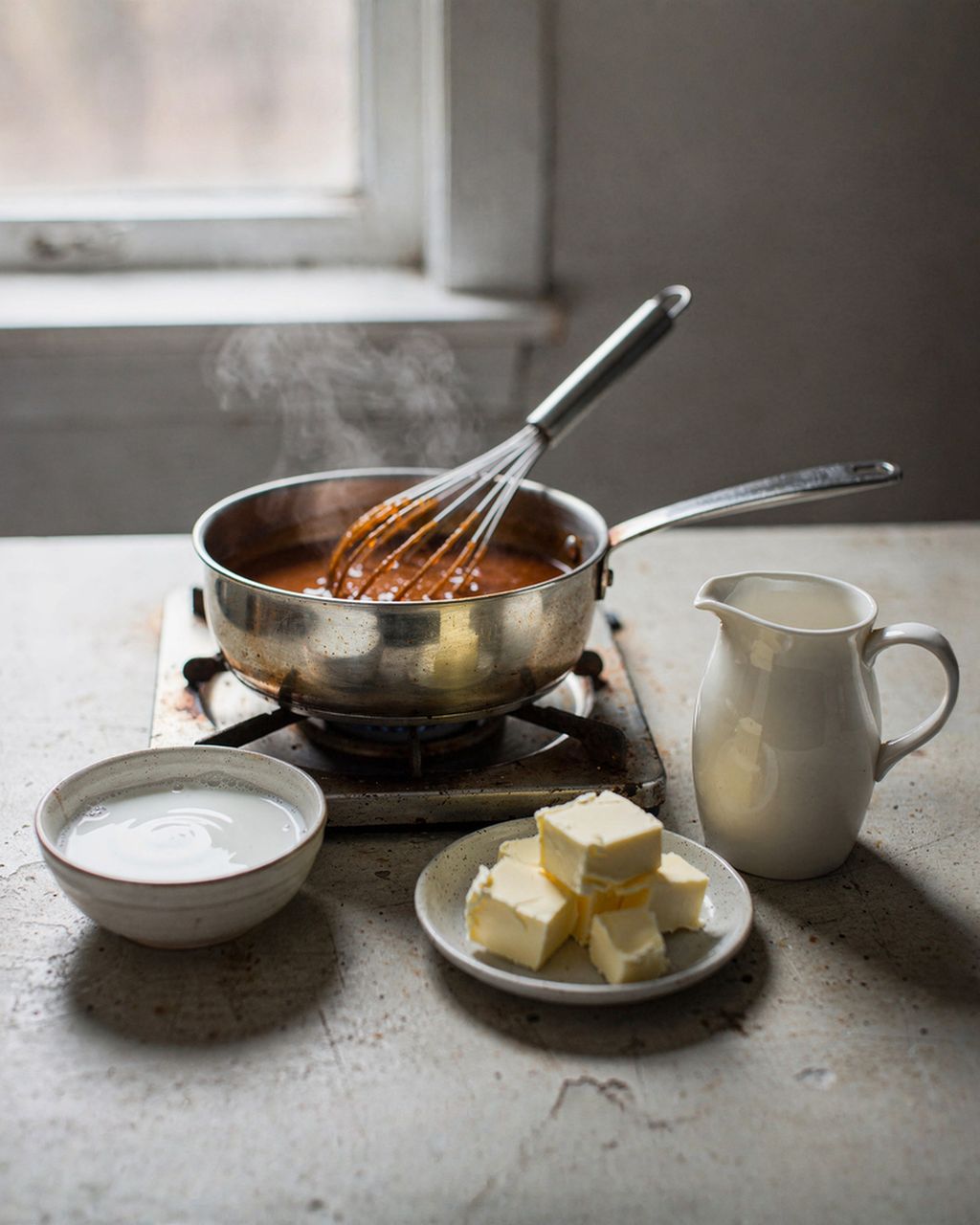
Temper it. Stir a few spoonfuls of the hot sauce into the substitute, mix, then pour it back into the pot.
Stir while pouring it in, in a thin stream — never all at once.
Adjust salt and acid at the very end. Salting before adding the substitute means salting a more concentrated liquid.
If you still need to simmer it, back it up with starch — mix a teaspoon of cornstarch directly into the substitute before pouring it in.
And if it curdles anyway, don't toss the sauce: blend it with an immersion blender or push it through a fine sieve. That saves a slightly grainy sauce almost every time.
Don't substitute cream for three things — baking/gratins, reduction as a technique, and whipping; everywhere else, a substitute will hold up just fine.
Baking and gratins. At 180°C in the oven, a low-fat substitute will reliably curdle. Heavenly gratin potatoes live and die by cream with 30%+ fat.
Reduction as a technique. When a sauce is meant to form by evaporating cream down to a thick base, milk with cornstarch can't fake that — you'll end up with thickened water, not depth.
Whipping. Crème fraîche, coconut cream from a chilled can, and oat cream specifically labeled for whipping can all be whipped. Cooking cream and sour cream can't.
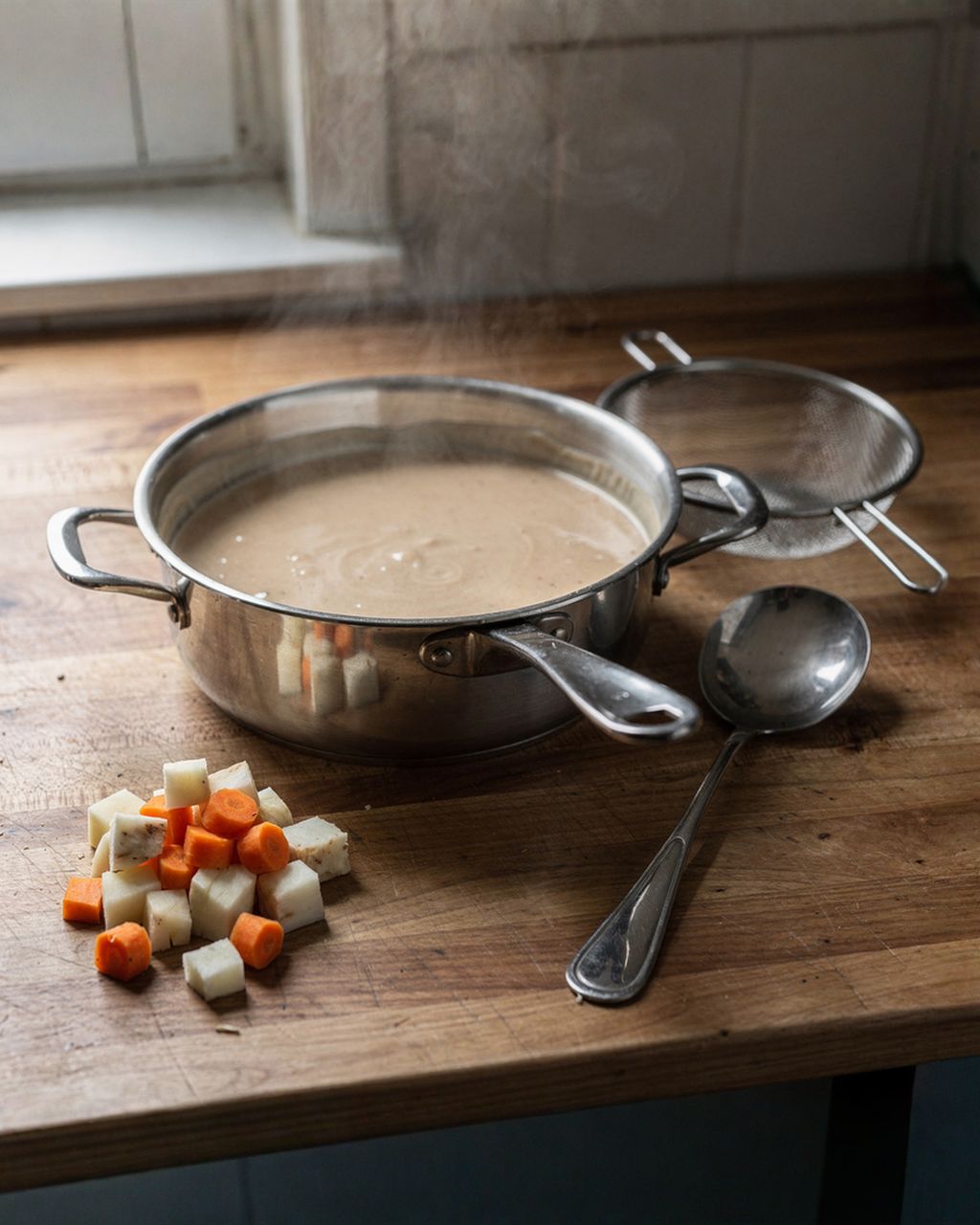
And then there's a whole category of sauces that never needed cream as much as you'd think. Czech-style beef in cream sauce (svíčková) is built on a blended root-vegetable base — cream there is for rounding out flavor, not for thickness, so you can get away with less than you'd expect.
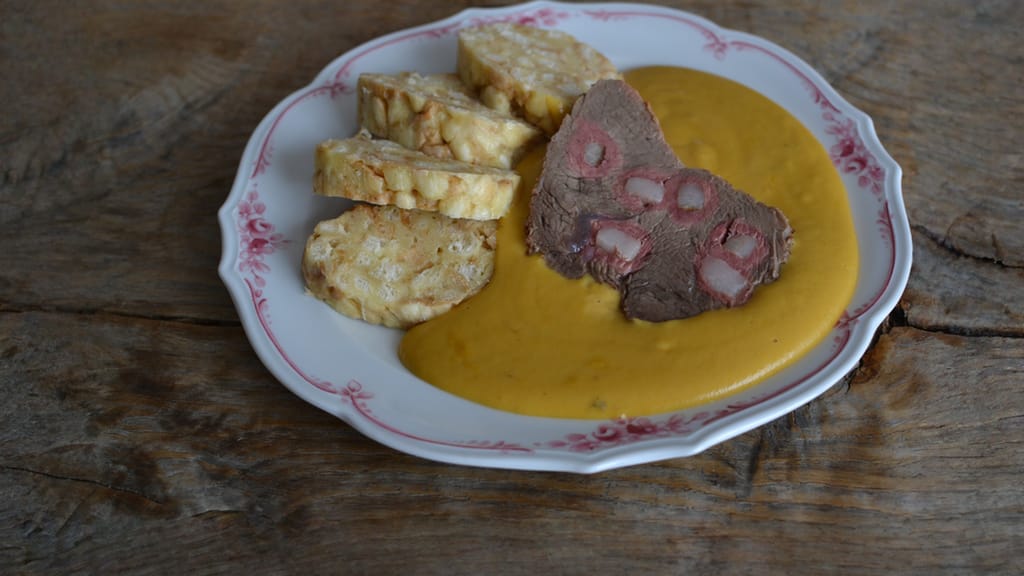
Sunday lunch: perfect homemade svíčková (czech beef sirloin in creamy vegetable sauce)
Perfect homemade svíčková — a sauce thickened by root vegetables, where cream just rounds out the flavor
In the finished sauce, two things really matter: how much fat the substitute has (that's what carries flavor and creaminess) and whether it has a flavor of its own — coconut and soy will take over the sauce, milk with cornstarch will leave it flat.
Milk with cornstarch — thickness, yes; flavor, no. The sauce turns smooth but stays flat.
Sour cream — adds tang and a slight curd-like note, thickens more than dairy cream.
Crème fraîche — tangy without losing creaminess, thick and stable even when boiled.
Oat — the most neutral, but sweetish and weaker at thickening.
Soy — the most stable, with its own beany flavor that you'll need to mask with something else.
Coconut — the creamiest and most stable, but flavor-wise, it's a different sauce entirely.
One thing holds true across the board: a substitute with less fat carries flavor worse. Fat is what dissolves and holds onto the aromas from onion, mushrooms, spices, and stock. If you're cutting back on fat, compensate by building up more flavor elsewhere — more caramelized onion, mushroom stock, a spoonful of butter, or hard cheese stirred in at the end.
Most cream substitutes go in at a 1:1 ratio — 200ml of cream equals 200ml of crème fraîche, or an oat, soy, or coconut alternative. For milk with cornstarch, still use 200ml, but add 1 level tablespoon (about 10g) of cornstarch, or your sauce will stay thin. For sour cream, use 150–200ml and adjust seasoning for tanginess — it thickens more than cream and adds a noticeably sour taste.
You can, but only off the heat and preferably in thicker sauces. Plain yogurt usually has 0.1–3.8% fat, and Greek-style yogurt ranges from 0 to 10% depending on the brand — even the richest version is below the point where it can handle heat, so it'll curdle almost instantly in a hot sauce. Whisk it with a teaspoon of cornstarch, temper it with a few spoonfuls of the hot sauce, then stir it into the pot only after taking it off the heat. Curd cheese (like quark) is even more delicate and only works blended with a splash of milk and added right at the very end.
Coconut and soy hold up best, oat the worst. Freezing breaks the emulsion, so after thawing you'll see oil droplets on the surface — with coconut and soy, you can fix this by slowly reheating the sauce and blitzing it with an immersion blender. Sauces based on milk and cornstarch, on the other hand, thin out after thawing because the starch network breaks down — just thicken them again while reheating.
Emulsions tend to break during repeated reheating and sudden temperature changes, not necessarily during the initial cooking. Reheat the sauce slowly over low heat, stirring constantly — never blast it on high heat or microwave it without stirring. If the oil has already separated, stir in a splash of hot water or stock and whisk vigorously — in most cases, the emulsion will come back together.
Chilled coconut cream or an oat-based cream specifically labeled for whipping — regular oat or soy cooking cream won't whip up. Chill a can of full-fat coconut milk overnight in the fridge, scoop off just the solid layer from the top, and whip that; don't use the watery liquid underneath. Crème fraîche can be whipped too, but it stays tangy, so it works better with fruit than in a sweet cake filling.
One recipe worth heating the oven for, one tip, and one deal from the shop. Nothing else.