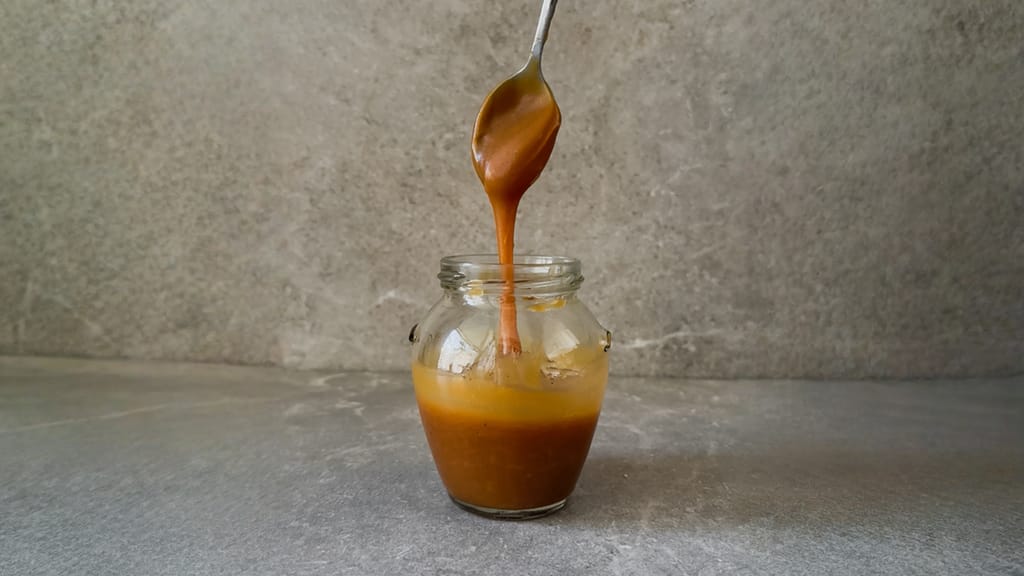
Homemade caramel sauce with just 4 ingredients
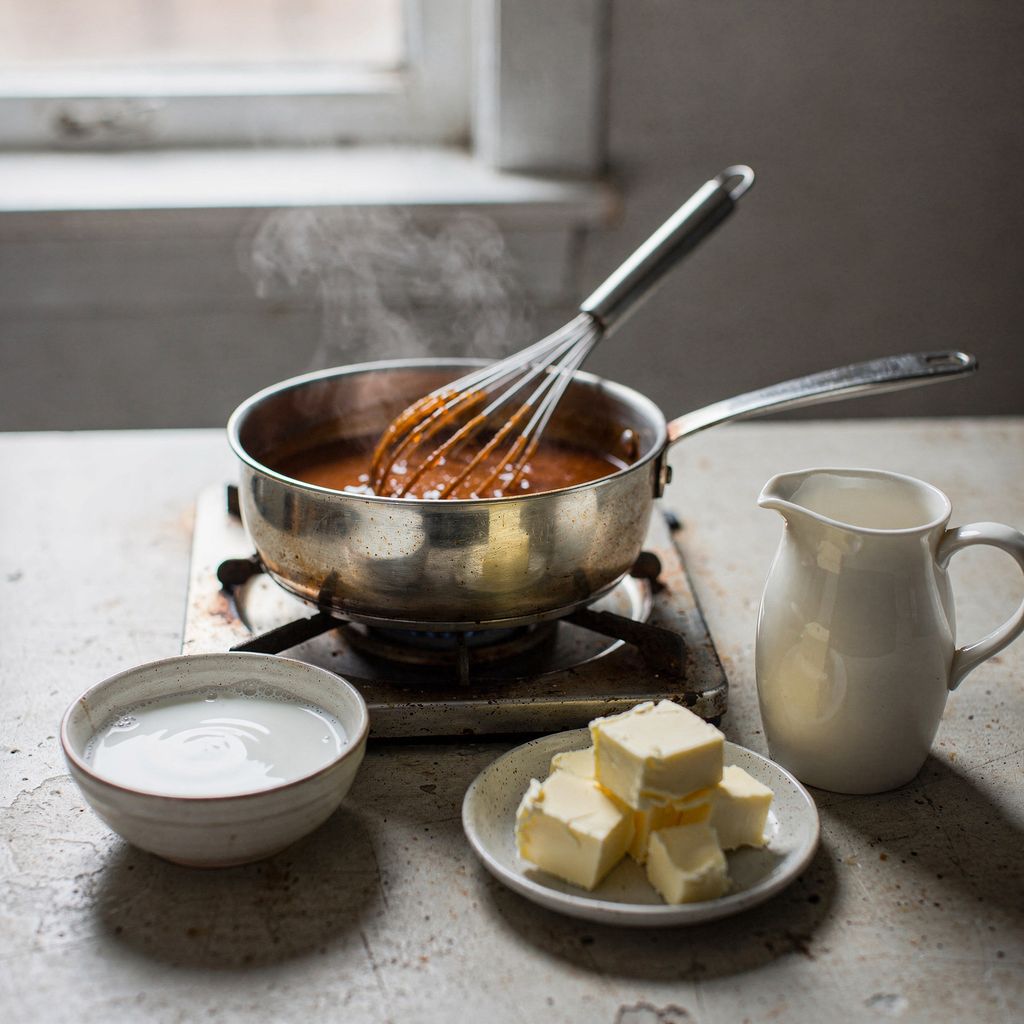
Updated Aug 28, 2026
You can thicken a sauce without flour (that is, without a classic roux made from plain flour) in eight different ways, and each one comes with its own dose and its own tolerance for boiling. For about 500ml of sauce, you'll need roughly 15–20g of cornflour, 10–15g of potato starch, 0.5–1.5g of xanthan gum, 150–250g of well-cooked root veg, 100–150ml of cream, 2 egg yolks, or 30–60g of cold butter — and the eighth method, reduction, needs nothing but time. This article is your one-stop reference: the doses, the temperatures, and above all, the things recipes never tell you — what each thickener can survive, and what will wreck it.
You can thicken a sauce without flour using cornflour, potato starch, reduction, vegetables, cream, egg yolk, butter or xanthan gum. Doses for 500ml of medium-thick sauce (one that coats the back of a spoon):
Cornflour — 15–20g (1.5–2 tbsp), mixed with 3–4 tablespoons of cold liquid, then simmered for 1–2 minutes. Handles a brief boil and reheating fine.
Potato starch — 10–15g (1–1.5 tbsp), stirred in off the boil at 70–80°C. Must not be boiled.
Reduction — nothing extra needed; simmer 500ml down to roughly 300–350ml, 10–25 minutes in a wide pan.
Root vegetables or potato — 150–250g of veg, or 1 floury potato (120–150g), cooked until soft and blended.
Double/whipping cream (33%) — 100–150ml, simmered for 5–10 minutes. Thickens through fat content rather than volume.
Egg yolk (liaison) — 2 yolks, tempered, kept under 82°C. Must never come to the boil.
Cold butter (monter au beurre) — 30–60g in cubes, off the heat. Adds shine and body, not real thickness.
Xanthan gum — 0.5–1.5g, sprinkled in a pinch at a time while blending. Works in cold sauces too.
One rule applies to all of them: a sauce firms up as it cools. Take it off the heat slightly thinner than you want it on the plate.
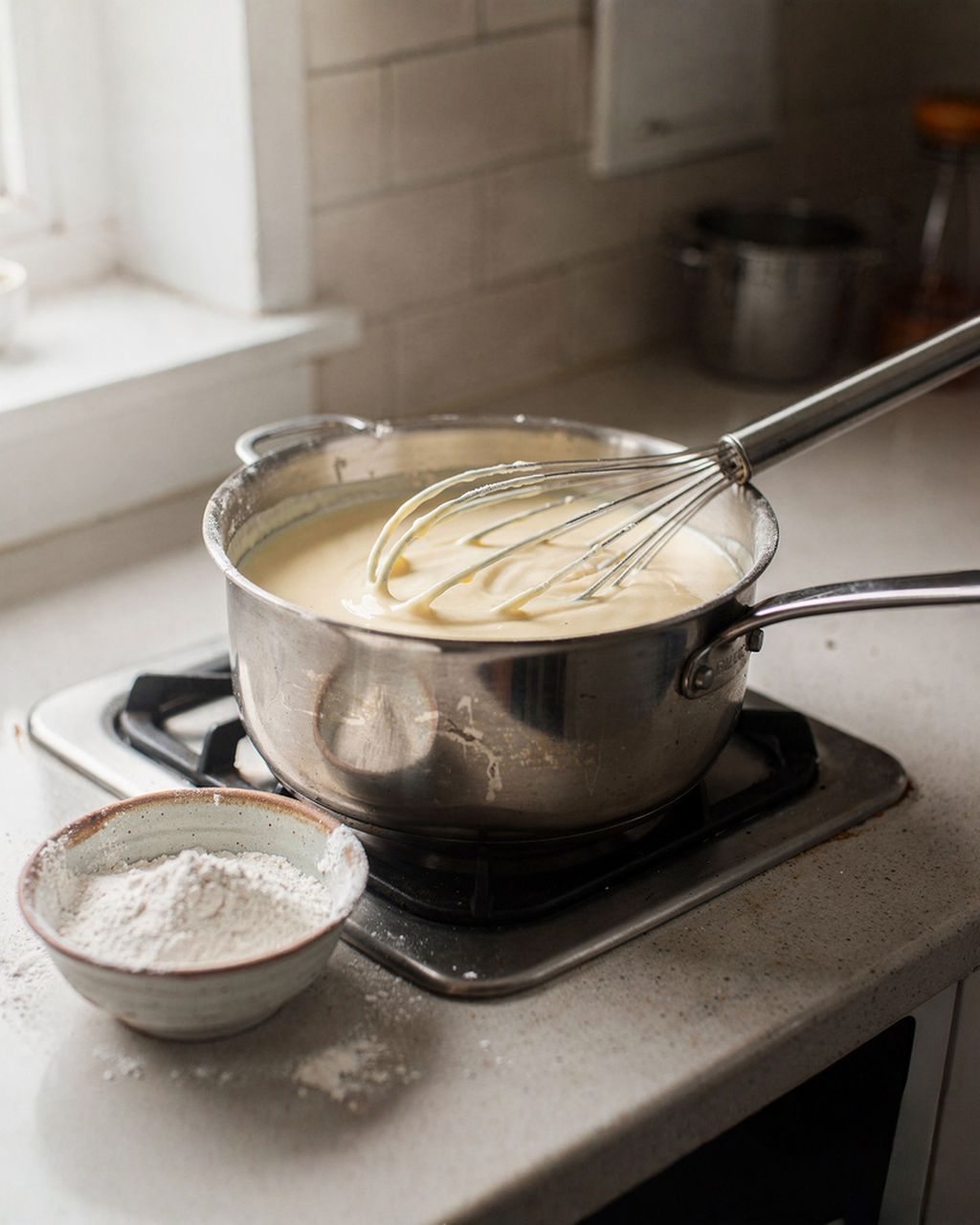
For 500ml of sauce, use 15–20g of cornflour (1.5–2 tbsp), and always mix it first into cold liquid, roughly 1 part starch to 2–3 parts water, stock or milk. Only then pour this slurry into the hot sauce while stirring constantly.
Dose depending on what you're after:
Light, for spooning over meat — 8–10g per 500ml
Medium, coats a spoon — 15–20g per 500ml
Thick, for dumplings or under meat — 25–30g per 500ml
Cornflour starts swelling at around 62°C, and gelatinisation is essentially complete by about 72°C — but it only reaches full thickness once the sauce comes to a bubble and simmers for 1–2 minutes. Don't skip this step, for two reasons: without it, the sauce hasn't hit its final thickness yet (so you'll be tempted to add more starch than you actually need), and it'll be left with a raw, floury aftertaste.
Compared with potato starch, it's noticeably more robust. It can handle a brief boil and being reheated the next day, but not an hour of hard boiling — long bubbling and rough stirring will break the thickening back down. For sauces that simmer for a long time, stir it in only in the final minutes. The downside: the result is slightly cloudy and opaque. You won't notice this in a dark sauce, but you will in a clear stock.
Potato starch thickens more powerfully than cornflour, so 10–15g is enough for 500ml — roughly two-thirds of the cornflour dose. The key difference, though, is temperature: it swells starting at just 58–65°C, well below boiling, and a longer simmer or vigorous stirring will break down its chains. Within a few minutes the sauce thins back out, and you can't rescue it with more of the same starch.
Here's how to work with it:
Take the sauce off a hard boil down to 70–80°C — just barely trembling.
Pour in the cold slurry and stir for 20–30 seconds.
Serve. Don't put it back under the lid for twenty minutes or bring it back to the boil.
That bit of care rewards you with a sauce that's clear and glossy — which is why potato (and equally, arrowroot) starch is the go-to for fruit glazes, sweet-and-sour sauces, and anywhere you want the colour to show through. It's not the right choice for a sauce that needs to sit on the hob for an hour; for that, reach for cornflour and stir it in only at the very end.
Reduction means boiling off water until the sauce thickens itself — from 500ml down to roughly 300–350ml, a drop of 30–40% in volume, which takes 10–25 minutes. Use a wide pan, not a narrow saucepan: what matters is the surface area, not the burner's power, and a wide pan can easily cut the time in half.
It's the only method that intensifies flavour instead of diluting it — which is why it's the backbone of restaurant-style sauces made from stock and demi-glace. But it comes with three catches:
Salt concentrates right along with the flavour. Season after reducing, or you'll end up with a sauce that's unbearably salty.
It takes time. If you're standing over the hob with pasta already cooked and waiting, reduction isn't the method for you.
It doesn't work on everything. A sauce heavy in dairy proteins or acidic tomatoes is more likely to catch on the bottom and turn bitter during a long reduction.
A good compromise: reduce by a quarter for flavour, then finish the rest with starch or butter. Reduction is also the principle behind caramel sauce — sugar and cream thicken through evaporation, not by adding anything.
Homemade caramel sauce with just 4 ingredients
Homemade caramel sauce from 4 ingredients — a sauce thickened purely by reduction
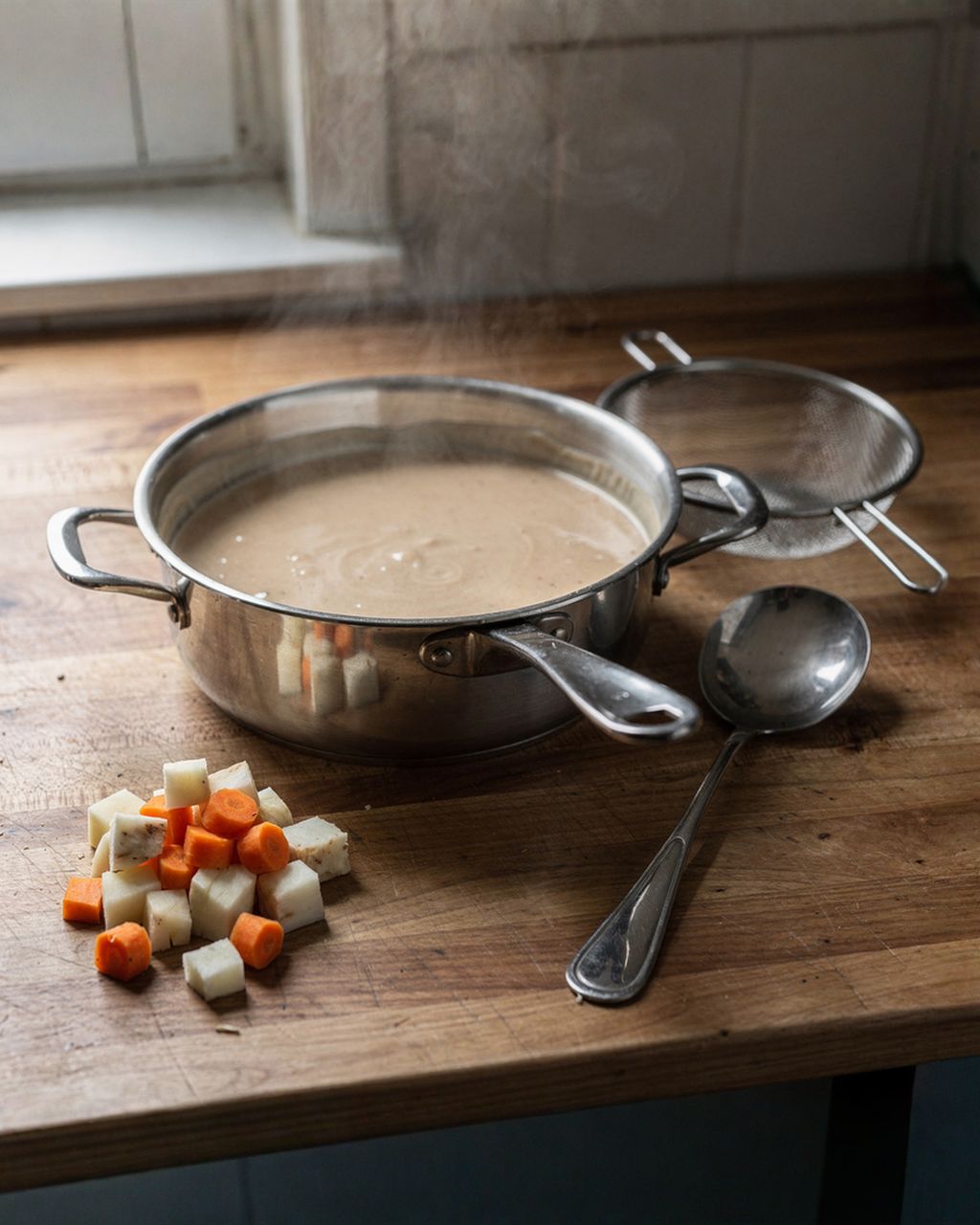
For 500ml of sauce you need 150–250g of root vegetables (carrot, celeriac, parsley root) or one medium floury potato, 120–150g — cooked until soft directly in the sauce, then blended with a stick blender. It thickens thanks to pectin and the starch released from cooked cells, and unlike flour, it adds flavour instead of diluting it.
More store-cupboard options, again for 500ml:
Red lentils — 40–60g, cook down to soft in 15–20 minutes and disappear completely
Instant mashed potato flakes — 1–2 tablespoons stirred in, works within a minute
Blended roasted vegetables — squash, pepper, onion; 150–200g
Soaked crustless white bread — 30–50g, the same principle behind Spanish romesco
One trap to watch for: over-blend the potato and the sauce turns gluey. Breaking the cells open releases potato starch, which creates a rubbery texture. Blend briefly, check every few seconds, and if it's already happened, a spoon of butter and a splash of hot stock whisked in by hand will ease the stickiness — though the texture won't fully bounce back.
Plenty of proper Czech-style beef-in-cream sauce (svíčková) skips the roux entirely — thickness comes from passed-through root vegetables and the roasting juices.
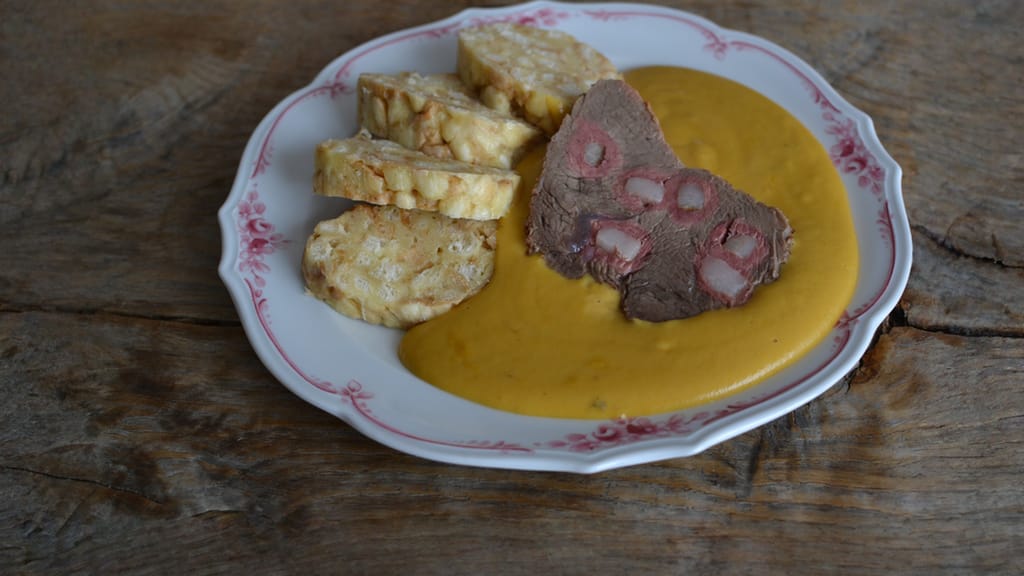
Sunday lunch: perfect homemade svíčková (czech beef sirloin in creamy vegetable sauce)
Sunday lunch: perfect homemade svíčková — a sauce thickened with root vegetables and cream
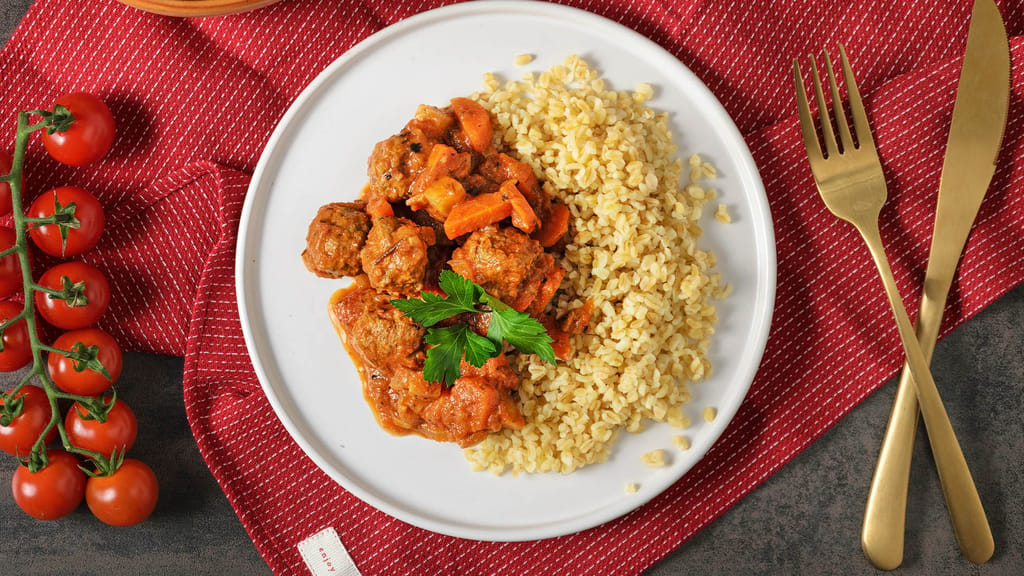
Meatballs in vegetable sauce
Meatballs in vegetable sauce — blended vegetables as the sole thickener
Cream on its own doesn't thicken a sauce — it's the fat left behind once the water cooks off that does the thickening. For 500ml, use 100–150ml of whipping cream with at least 30–33% fat and let it bubble gently for 5–10 minutes until the volume settles back down.
Here's why the fat content matters so much:
30–36% cream can be reduced — it thickens and holds together.
12% cream or milk can't be reduced — the proteins curdle before they ever get a chance to thicken. Use starch with these, not reduction.
Soured cream and crème fraîche carry extra acidity that speeds up curdling even further. Temper them and stir in towards the end, off a hard boil.
Cream is also the most common reason a sauce ends up grainy: a combination of acidity (wine, tomatoes, lemon), salt and a hard boil will reliably split it. If that happens, don't try to force it back together by whisking harder — take it off the heat and fix it with cold and fat.
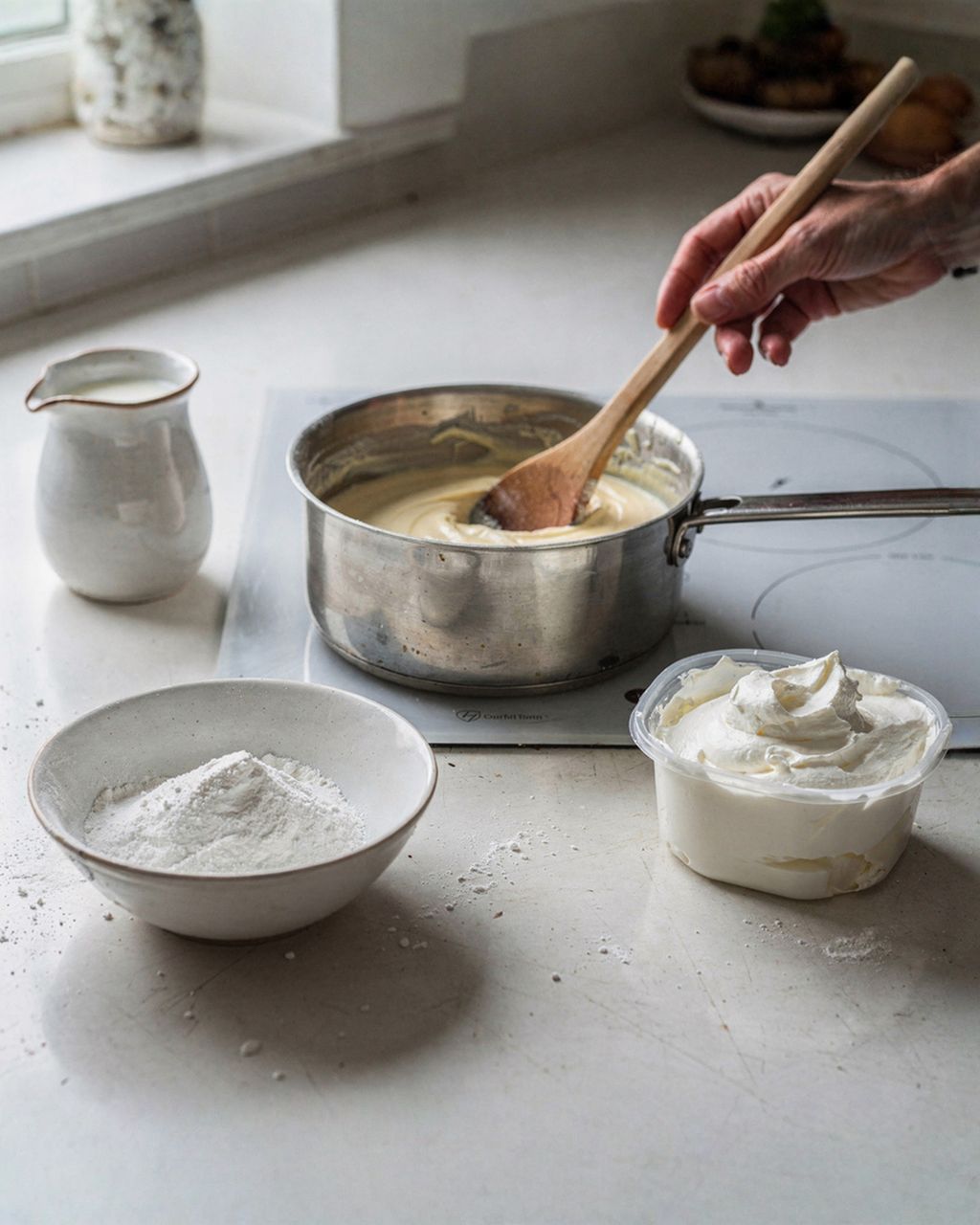
For 500ml of sauce, use 2 egg yolks, ideally whisked with 100ml of cream — the fat in the cream pushes the curdling point higher and gives you more of a safety margin. Yolk won't thicken much, but it gives the sauce a silky, velvety texture that no starch can match.
A method that won't go wrong on you:
Whisk the yolks with the cream in a larger bowl.
Temper it: pour in the hot sauce one ladleful at a time, whisking as you go, until you've added at least three ladlefuls — this warms the mixture up gradually.
Pour the tempered mixture back into the pan off the heat and stir.
Return to the lowest heat and hold it at 70–80°C until the sauce coats the back of a spoon.
The limit is a hard one: egg yolks alone start to curdle from around 65°C, but with cream they hold up to 82–85°C — go above that and you've got scrambled egg in your sauce. Never let it come to the boil, and never reheat it hard afterwards. A sauce thickened with yolk is a right-now dish, not a next-day one.
The same principle underpins hollandaise sauce, except there the fat carrier is butter instead of cream.
Easy & quick hollandaise sauce
Easy, quick hollandaise sauce — an egg-yolk emulsion in practice, temperature control included
Whisk 30–60g of cold butter, cut into roughly 2cm cubes, into 500ml of sauce — off the heat, into a sauce at around 70–80°C, one cube at a time, swirling the pan rather than whisking hard. The fat disperses into tiny droplets, and within thirty seconds the sauce gains thickness, shine and a fuller flavour.
What you need to know:
The butter must be cold. Melted butter just separates on the surface and leaves you with a greasy puddle instead of a sauce.
The emulsion is fragile. Boiling will break it, and so will sitting on the hob too long. This is the very last step before serving, not something you prep ahead.
If it splits, whisk in an ice cube or a tablespoon of ice-cold water. The sudden cold usually pulls the emulsion back together.
It won't give you dumpling-gravy thickness. Monter au beurre nudges a sauce up one notch, not three. For a bigger thickening effect, pair it with starch or reduction.
For 500ml of sauce, just 0.5–1.5g of xanthan gum is enough — roughly ¼ to ½ a teaspoon — though it's best to weigh it, since we're talking tenths of a gram and a teaspoon can hold anywhere from 2.5 to 3.1g depending on how it's scooped. That works out to 0.1–0.3% of the sauce's weight: the lower end gives a light thickening for spooning over food, the top end a sauce that coats a spoon properly.
How to work with it:
Sprinkle it in a pinch at a time while blending or whisking vigorously. Dump xanthan gum in all at once and it clumps into slimy lumps that no amount of blending will break up.
No cooking needed. It thickens cold or hot liquid alike within a few dozen seconds, so it works even in cases where starch would need to be simmered.
Let it rest for a minute before judging the thickness. The full effect kicks in with a slight delay, and over-thickening is a pain to fix.
Overdoing it is obvious immediately — the sauce turns slimy and stringy. There's no fixing that state except by diluting it.
Its big advantage is resilience: xanthan's viscosity stays stable from freezing point right through boiling, across a pH range of roughly 2 to 12, and even survives freezing and thawing. So unlike starch, it holds up in acidic sauces with wine, lemon or tomato, through long boiling, and through freezing. And because it's flavour-neutral and gluten-free, it works anywhere flour or starch just aren't an option.
Cornflour, blended vegetables, reduction and xanthan gum all survive boiling and being reheated the next day; cream and potato or arrowroot starch survive only reheating, not boiling; egg yolk and a butter emulsion survive neither. The most common mistake isn't actually the wrong dose — it's the wrong moment, adding a thickener to a sauce that then gets boiled again.
Survives boiling and next-day reheating — cornflour, blended vegetables, reduction, xanthan gum (which also handles acidity and freezing). Fine for anything cooked ahead.
Survives reheating only, not boiling — cream, potato starch and arrowroot. Add these towards the end.
Survives neither — egg yolk and a butter emulsion. Finish these off right before serving.
Two extra things recipes never mention:
Acid breaks down starch when the two are simmered together for a long time. Add wine, vinegar or lemon after thickening the sauce, or it'll mysteriously thin back out ten minutes later. If the acidic ingredient has to simmer for a while, thicken with xanthan instead — acidity doesn't bother it.
Starch-thickened sauces don't freeze well. Cornflour releases water on thawing and leaves the sauce grainy. If you're planning to freeze it, thicken after thawing instead, use waxy cornflour (which holds up better), or use a vegetable purée — that freezes without any issues. That said, even waxy starch eventually releases water after repeated freezing and thawing.
Thin out an over-thickened sauce with hot liquid, 30ml (2 tbsp) at a time, off a hard boil, with a thirty-second pause between additions — and, crucially, with the right liquid. Cold water poured into a hot sauce shocks both the temperature and the flavour.
Depending on the cause:
Over-thickened with starch — add hot stock or milk, whatever liquid the sauce is built on. Water works too, but it dilutes the flavour, so always taste and re-season afterwards, plus add a touch of acidity.
Reduced too far — water alone won't cut it here, since the flavour has concentrated into pure saltiness. Add unsalted stock, cream, or pasta cooking water instead.
Gluey from over-blended potato — don't blend it any more, that only makes it worse. Whisk in a spoon of butter and a splash of hot stock by hand; it'll ease the stickiness, even if it won't disappear completely.
Set solid in the fridge overnight — that's completely normal, starch firms up as it cools. Reheat gently over low heat and whisk in 50–100ml of liquid; it'll return to how it was.
Grainy, not just thick — that's not a thickness issue. Take it off the heat, strain through a fine sieve, and try whisking in a splash of cold cream.
Prevention beats fixing: add your thickener in two batches instead of all at once. Add half the calculated amount, let it come to the boil (1–2 minutes for starch), then judge the thickness. You can always thicken a thin sauce further. Fixing an over-thickened one always costs you some flavour.
Thickening is only half the battle with sauces. These four guides cover the situations that tend to crop up right after.
For a litre of medium-thick sauce, go with 30–40g of cornflour or 20–30g of potato starch. The amount scales in a straight line with volume, so it's simply double what you'd use for 500ml. Mix it into 6–8 tablespoons of cold liquid and add it in two batches — once you've overdone it with a bigger volume, it's harder to fix.
Cornflour, potato starch, rice starch and arrowroot are all gluten-free, as are xanthan gum, blended vegetables, pulses and reductions — gluten only comes from flour, breadcrumbs and a classic roux. Two things to watch out for, though: instant mashed potato flakes, ready-made thickening mixes and stock cubes can contain wheat starch or flour, so it's worth checking the label for the crossed-grain symbol. And if you're cooking for someone with coeliac disease, think about cross-contamination too — use a separate sieve and a separate container for flour.
For a cold sauce, use xanthan gum: 0.3–0.5g per 250ml, sprinkled in a pinch at a time while blending, will thicken it in under thirty seconds with zero heat involved. The other option is an emulsifier — a teaspoon of mustard, a tablespoon of mayo or Greek yoghurt will turn an oil-based dressing into a thick emulsion. Starch won't work here: without heating it to 60–70°C it never swells properly, and you're left with a raw, floury taste.
Nothing evaporates in a slow cooker, because the lid sends condensation straight back down — so you need to add thickness rather than boil it away. The easiest fix is to cook with the lid slightly ajar on high for the last 30–45 minutes, or stir in a slurry of 15–20g cornflour per 500ml and let it cook through on high for 20–30 minutes. Never add starch at the start of a long slow-cook programme — after hours at a low simmer, the thickening effect breaks back down.
Yes, both work as emergency store-cupboard thickeners. Instant mashed potato flakes will thicken 500ml of sauce with just 1–2 tablespoons in under a minute, and the flavour is pretty much neutral. Fine breadcrumbs, at 20–30g, also work, but they'll slightly roughen the texture and add a bready note — better suited to rustic sauces and stews than to something you'd pour over meat.
Hard, aged cheese will thicken a sauce, but only a little, and it risks splitting into fat and stringy bits. For 500ml, use 60–100g of finely grated Parmesan or Grana Padano, add it off the heat in handfuls to a sauce under 80°C, and stir until melted. Melting cheeses like cheddar hold together better if you toss them in a pinch of starch first before adding them in.
One recipe worth heating the oven for, one tip, and one deal from the shop. Nothing else.