Sunday lunch: perfect homemade svíčková (czech beef sirloin in creamy vegetable sauce)
Updated Aug 28, 2026
Svíčková can be thickened without roux and without a speck of flour: the body comes from pureed root vegetables, reduced liquid, and cream — in exactly that order. Flour is a shortcut that strips the sauce of both flavor and color. It adds volume, but no taste, so you end up re-seasoning, re-souring and re-sweetening just to get back to where you were before you thickened it. This guide walks through all five tools you actually have — vegetables, reduction, cream, starch and gingerbread — and, more importantly, shows how to layer them so the thickness gets dialed in right at the end, once you already know exactly how the sauce tastes.
Five things thicken svíčková, and flour isn't one of them:
Root vegetables — pureed carrot, parsnip and celeriac carry most of the body. This is the foundation, not an add-on.
Reduction — simmering off liquid uncovered thickens the sauce and intensifies its flavor at the same time. The only thickener that adds nothing.
Cream — the fat gives body and creaminess, not just a white color. High-fat, added right at the end.
Starch — cornstarch or potato starch, mixed into cold liquid first. An emergency brake, not a foundation.
Grated gingerbread — mainly for flavor, thickening is a bonus. One to two tablespoons per litre of sauce.
The order isn't arbitrary. Vegetables and reduction do their work during cooking, cream goes in just before the end, and starch and gingerbread are corrections right at the very end. Flip that order and thicken before the flavor is dialed in, and you'll spend the rest of the evening trying to re-season a sauce that no longer has anywhere to go.
Vegetables thicken and add flavor at the same time — flour only thickens. That's the whole difference.
Cooked-down carrot, parsnip, celeriac and onion break down into millions of tiny particles that, together with pectin, hold the liquid in suspension. That's what thickens the sauce, and it thickens on its own terms: every extra spoonful of thickness is also an extra spoonful of flavor. Flour does the exact opposite. It adds volume with no taste, so the finished sauce then needs extra salt, acid and sugar just to get back to where it started.
On top of that come three practical problems:
Color. A pale roux lightens svíčková and makes it look flat. Instead of a velvety beige with a brown undertone, you get a dull, pastel sauce.
Raw flour taste. If the roux isn't cooked long enough, a floury off-flavor lingers in the sauce that nothing else can fix.
Lumps. Cold flour dropped into hot liquid instantly forms a gel coating while staying dry inside. Skip flour entirely and you skip this problem altogether.
In fairness: roux in svíčková isn't a sin, and plenty of family recipes use it, usually stirred into the cream. It's just a shortcut people reach for because they put too little vegetable in the pot — not because it actually belongs in the foundation.
For 1kg of meat, count on 500–600g of root vegetables plus one large onion. That's roughly double what most roux-based recipes call for — which is exactly why those recipes need the roux in the first place.
A ratio that works well is carrot : parsnip : celeriac around 2 : 1 : 1, plus extra onion:
Carrot brings sweetness and the orange undertone that gives the sauce its signature color.
Parsnip brings aroma and a gentle bitterness that balances the sauce.
Celeriac has the most body and the most earthiness. Overdo it and it drowns out everything else, hence just a quarter share.
Onion breaks down completely and gives you clear thickness for free. Don't skimp on it.
For liquid, use 700ml to 1 litre of stock for this quantity. Less liquid at the start means less evaporating later — and fewer chances to overcook the sauce.
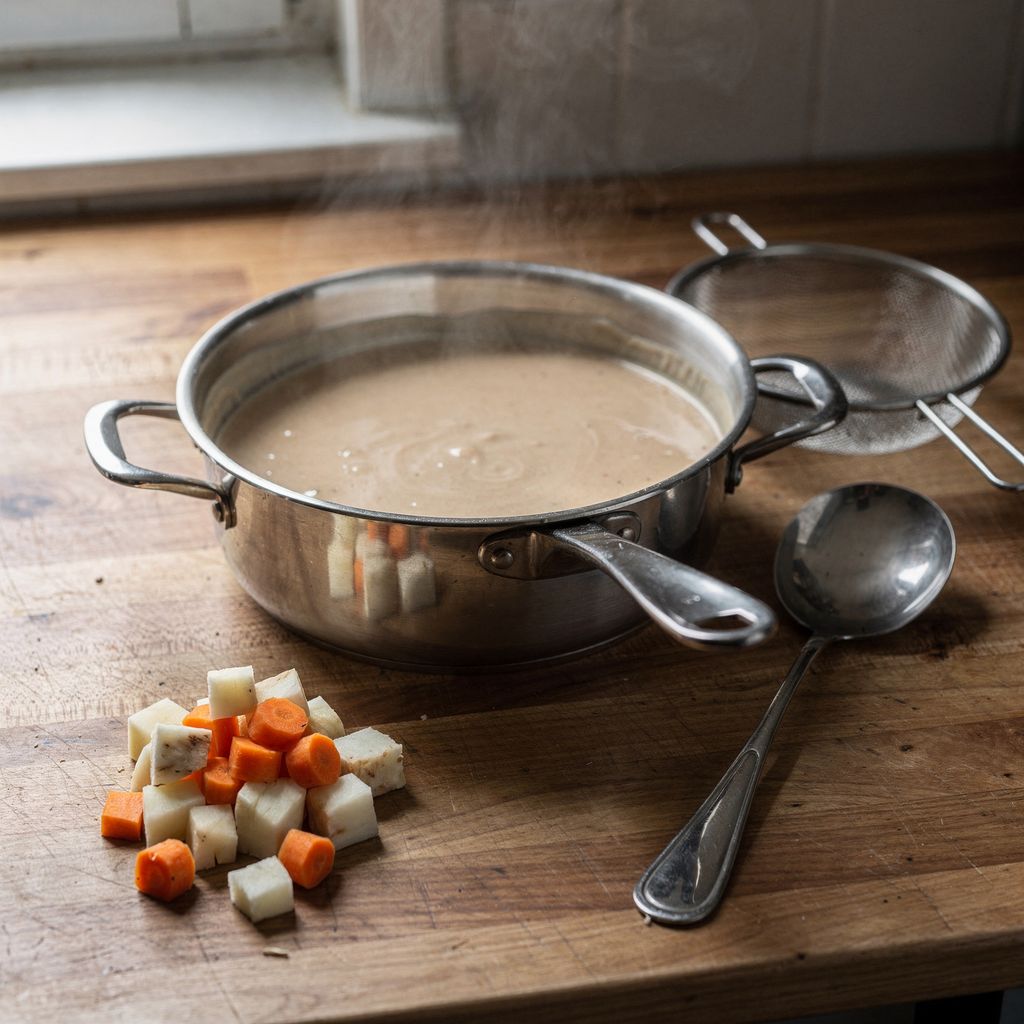
One step that really pays off: cut the vegetables into rough 2cm cubes and sauté them in fat until deep goldenthe goal is a golden-brown rim on the edges of the cubes, not just translucent onion. A spoonful of sugar helps here too — caramelization adds depth and a brown tone you simply can't get any other way. The moment that rim appears, stop: vegetables browned any darker start bringing bitterness into the sauce instead of sweetness.
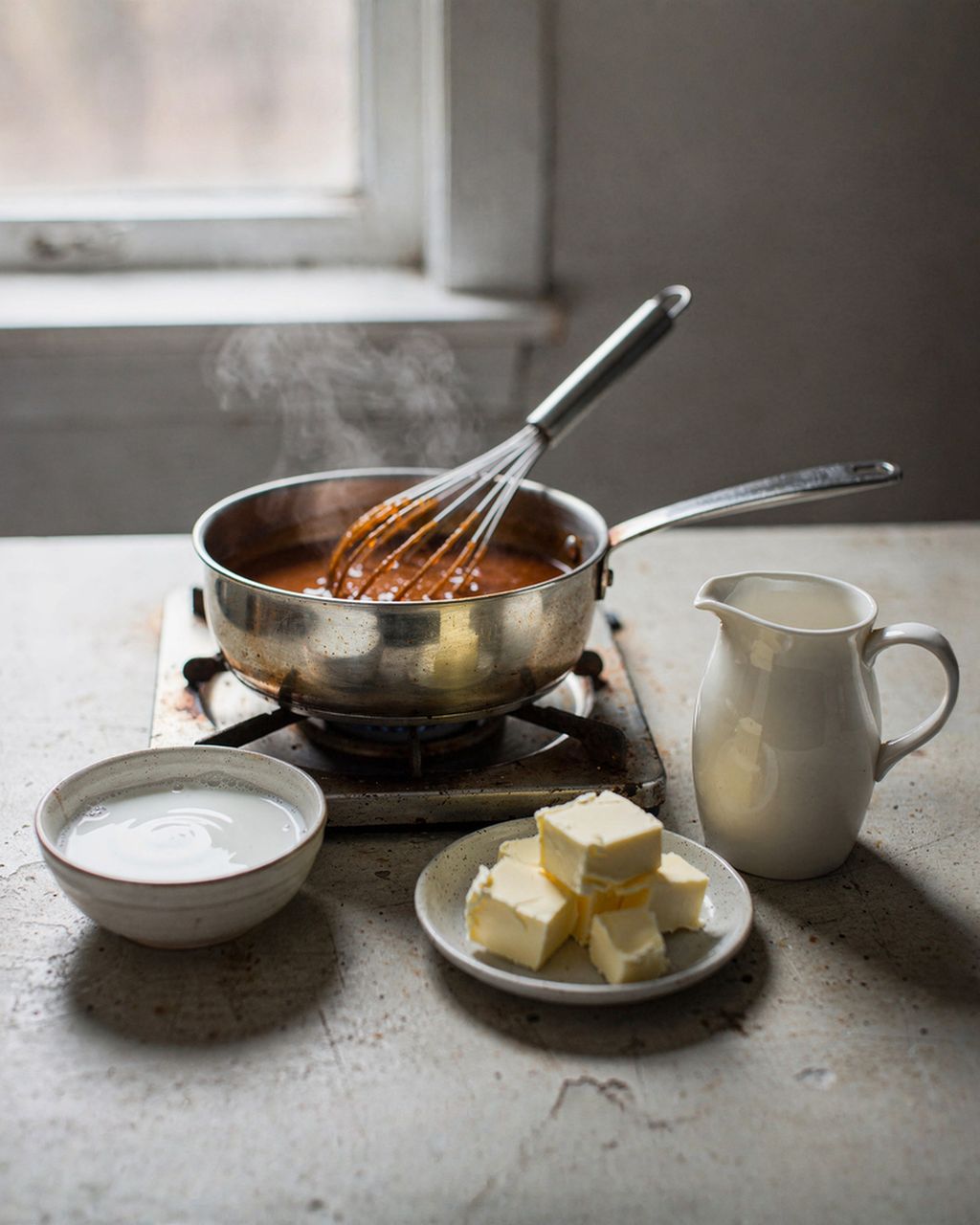
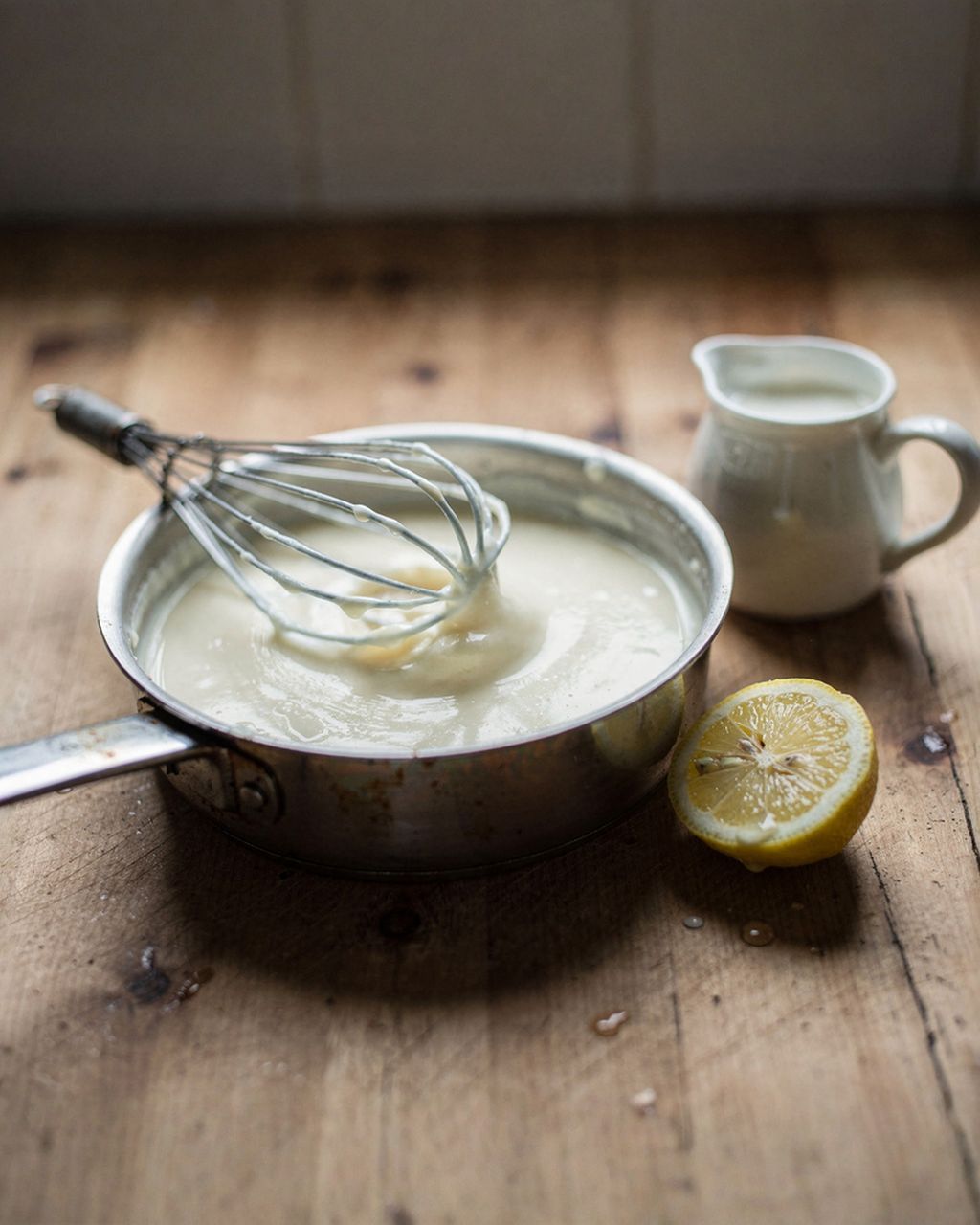
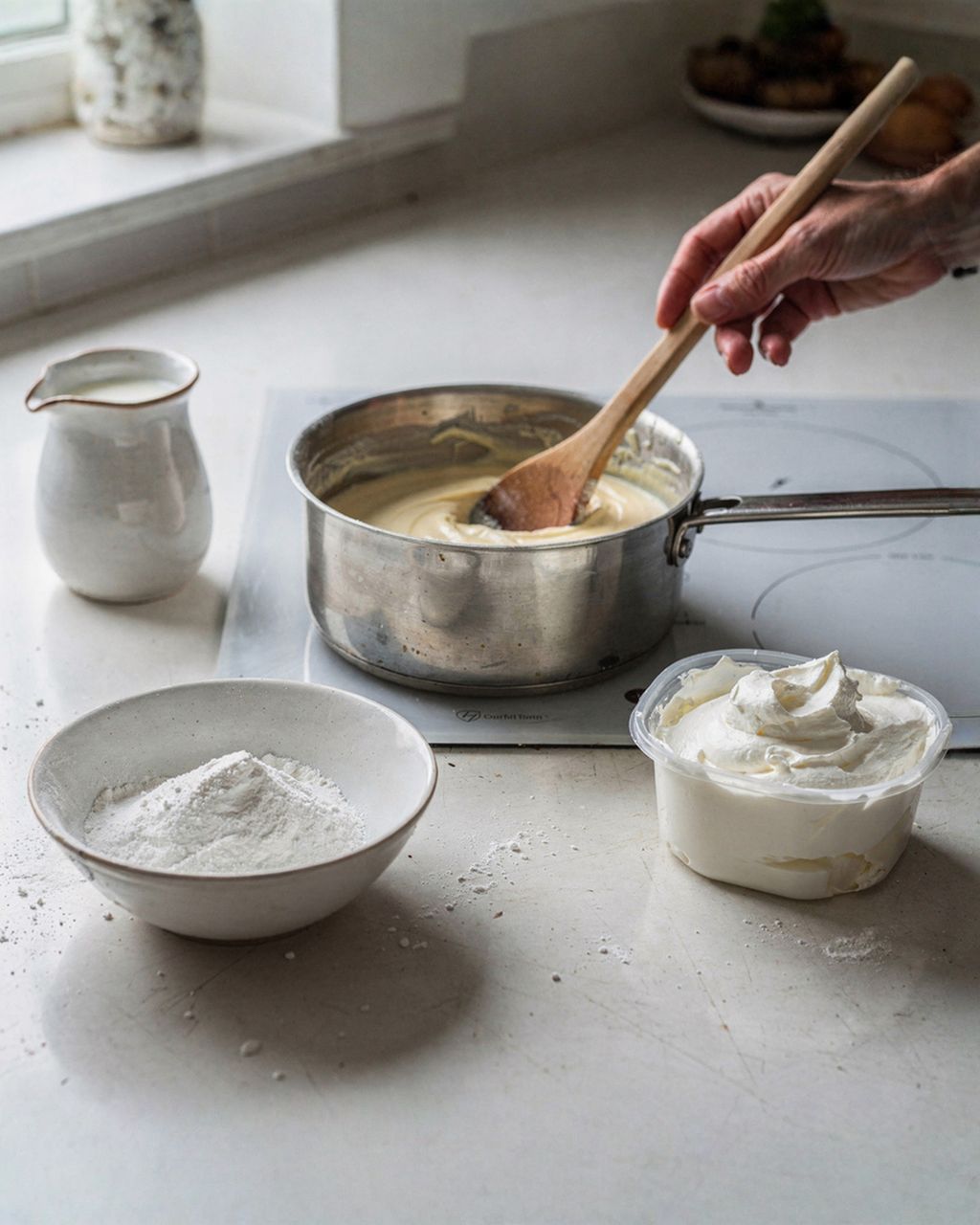
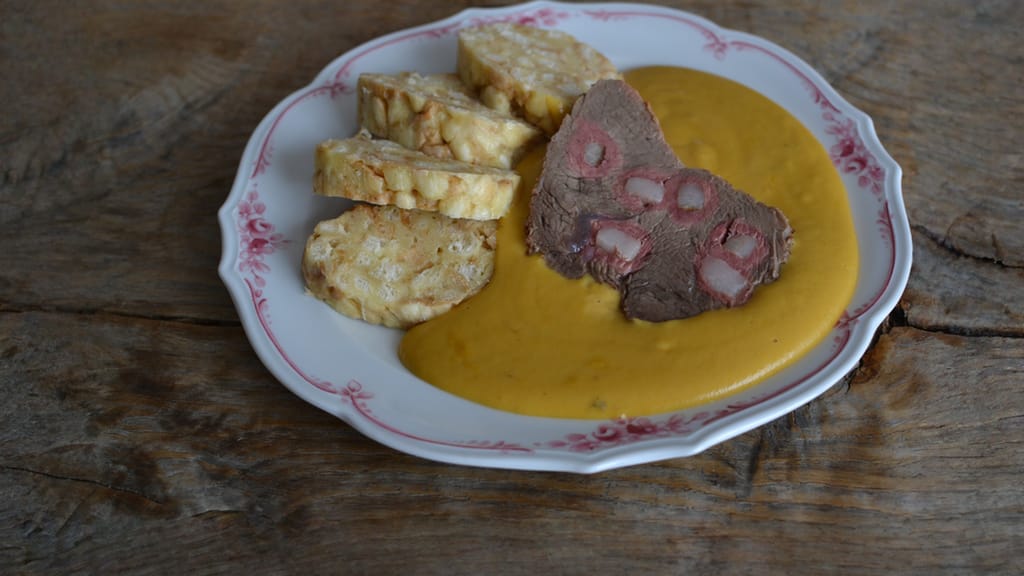
Sunday lunch: perfect homemade svíčková (czech beef sirloin in creamy vegetable sauce)
The full method, step by step: perfect homemade creamy svíčková
Blend svíčková with a stick blender for 2–3 minutes at around 80°C, never at a full boil. The difference between a "blended" sauce and a truly "smooth" one is exactly those extra few minutes — twenty seconds won't cut it.
Step by step:
Fish out every whole spice — bay leaf, allspice, peppercorns, juniper, thyme. A blended bay leaf will turn the sauce irreversibly bitter and there's no fixing it. Take the meat out too and set it aside somewhere warm.
Pull the pot off the boil and let the sauce drop to around 80°C. Blending while it's bubbling pumps air into the sauce and lightens its color.
Submerge the stick blender fully to the marked line and tilt the pot slightly so the head stays under the surface. Otherwise you'll spray hot sauce across the whole kitchen.
Blend for 2–3 minutes, moving the blender around the pot the whole time so no pocket of unblended vegetable survives anywhere.
A countertop blender gives an even smoother result, but only fill it halfway with hot liquid and leave the vent open in the lid. Trapped hot steam will blow the lid right off.
One trap to avoid: never blend a sauce that has potatoes in it or one that's already been thickened with starch. The starch granules will break apart and turn the sauce into sticky glue. A purely vegetable purée doesn't have this problem, so blend that one as long as you like.
Push svíčková through a fine sieve set over a second pot, pressing it through with the back of a ladle in a circular motion. This is the one step that actually makes the sauce properly smooth: a blender handles most of the work, but celeriac fibers, bits of peel and scraps of onion never fully break down — and those are exactly what you feel as grittiness on your tongue.
The method is simple:
Set a fine sieve over a second pot.
Ladle in the sauce and press it through with the back of the ladle in a circular motion.
Every so often, scrape the underside of the sieve — that's where the most finished sauce clings, and a lot of people throw it away without realizing.
You should be left with two to three tablespoons of dry fiber in the sieve. If there's a lot more than that, you didn't blend enough — tip it back and run it through the blender again.
The sauce will lose a bit of volume after passing through the sieve and end up slightly thinner than it looked in the pot. That's normal, and it's exactly why thickness gets dialed in after passing it through the sieve, not before. If you're short on volume, splash a little hot stock through the sieve to top it back up.
An alternative if you don't want a fully restaurant-smooth sauce: pass only half of it through the sieve and stir it back into the unpassed half. The result is fine but still has a bit of texture — and that often suits a family-style svíčková better anyway.
Of all the thickeners, reduction is the best, because it doesn't add anything — it only removes water, which in turn intensifies everything already in the sauce.
How to do it: pour the sauce into a wide pot, take the lid off, and let it simmer gently for 15–25 minutes. A wide surface evaporates liquid far faster than a tall narrow pot, so the shape of the pot matters more than the strength of the heat. A hard boil won't help — it'll just scorch the bottom.
When to use it: when the sauce is thin after sieving and tastes weak. Reduction fixes both problems at once, and it's the one situation where a single step solves two issues.
When not to use it: when the flavor is already strong or the sauce is already salty. Reduction concentrates salt and acidity exactly the same way it concentrates everything else — a lightly salted sauce can turn unpleasantly salty after just twenty minutes of simmering. Which is why the hard rule is: salt, vinegar and lemon only after reducing, never before. This is the single most common mistake people make with svíčková.
And always reduce before adding cream. Once cream is in the sauce, a long simmer is no longer safe.
Reach for starch only right at the very end, and only if the sauce still doesn't coat the back of a spoon after reduction and cream. It's a correction, not a foundation.
Dosing: one level teaspoon (about 3g) per 500ml of sauce is a gentle nudge; one heaped tablespoon (about 12g) per 500ml gives a noticeably thick sauce. Start with half of what you think you need — you can always thicken further, but thinning back out is much harder.
Potato starch (Solamyl) thickens at a lower temperature, gives a glossy, almost translucent finish, and works instantly. But it breaks down with prolonged boiling and the sauce thins out again, so stir it in off a hard boil, warm it through for a minute, and you're done.
Corn starch needs a brief simmer, about a minute, to lose its raw taste. The finish is a shade duller but more stable — useful if the sauce is going to sit warm for a while or get reheated later.
For a beige svíčková, dullness doesn't matter, so choose based on whether the sauce will spend more time on the stove. Starch granules start swelling anywhere from about 56°C (potato) to 72°C (corn) depending on the type — below that temperature nothing thickens, you just cloud the sauce. And factor in the lag: the sauce only fully thickens after about a minute of gentle heat, not the instant you pour it in. Wait before adding another dose.
For a detailed comparison of every thickener, with exact ratios, see our dedicated guide on how to thicken a sauce without plain flour.
Grated gingerbread only thickens the sauce mildly — its real job is flavor: honey, cinnamon, cloves, star anise and ginger, all in one tablespoon.
Traditionally, gingerbread is used to thicken sweeter sauces served with game — rosehip, plum and dark sauce. In svíčková, it's a family variation, not the standard. Some people swear by it, others consider it heresy. Try it on a small batch before committing a whole pot to it.
If you're going for it:
Dose: 1–2 tablespoons of grated gingerbread per litre of sauce. Any more and the sauce turns brown and starts tasting like a gingerbread dessert with meat in it.
It has to be firm gingerbread meant for grating — the kind with honey and spice that used to be deliberately left to go stale. Soft, filled gingerbread will just dissolve into sweet mush in the sauce.
Stir it into the hot sauce and give it 5–10 minutes to fully dissolve. Then blend or sieve the sauce again, otherwise it'll stay grainy.
Cut back on sugar elsewhere. Gingerbread carries both sweetness and spice at once. Once it's in, reduce the sugar and add a splash of vinegar or lemon so the sauce doesn't tip too far into sweet.
So gingerbread is really a flavor decision first. If thickness is your only concern, reach for reduction or starch instead — you'll get the same result without rewriting the sauce's flavor profile.
Cream goes into svíčková as the last major ingredient: after reduction, before the final thickness adjustment. It only simmers briefly and gently after that, or it will curdle.
Use whipping cream with 31% fat or more. Higher fat content holds up far better against acid and heat and gives the sauce genuine body, not just a white color. Low-fat cream curdles readily in svíčková.
Temper it. Spoon a few tablespoons of hot sauce into the cream, stir, and only then pour that mixture back into the pot. Cold cream poured straight into a boiling, acidic sauce is the single most reliable way to get curdled flecks.
How much: 200–250ml per litre of sauce is the standard amount. Keep in mind the cream also thins the sauce out, which is exactly why thickness gets adjusted after it goes in, not before.
After the cream, just warm it through, up to 85°C, and don't let the sauce boil.
If your cream keeps curdling, it almost always comes down to one of four causes: the sauce was soured with vinegar or lemon before the cream went in, the temperature crept past 85°C, the sauce was already quite salty after reducing, or it kept simmering after the cream was added. The order that fixes all of it is always the same: reduce, let it cool a few degrees, stir in tempered cream, and only then adjust salt and acid at the very end.
And if you don't want cream for whatever reason, the best stand-ins in svíčková are sour cream or crème fraîche (stir it with a few spoonfuls of sauce off the heat first), full-fat coconut milk — though that brings its own flavor along with it — and blended cashews soaked in hot stock. All three behave differently from cream: they tolerate even less heat, so stir them into the sauce once it's off the burner and don't let it cook any further.
Properly thick svíčková coats the back of a spoon, and a line drawn through it with a finger holds its shape for a moment before closing back up. And you only test for this once the flavor is fully dialed in — never before.
The order of steps at the end:
Flavor first. Salt, acid, sweetness. Thickness without flavor is a dead end — you can't fix a thick, bland sauce after the fact.
Thin and weak on flavor? Reduce it. That solves both at once.
Thin, but the flavor is right? Stir in the reserved pureed vegetables, or use a starch slurry.
Too thick? Loosen with hot stock or milk in 50ml splashes, stirring thoroughly each time. A lukewarm liquid makes the sauce "settle" and look thicker than it actually is for a moment.
Salt and vinegar or lemon come dead last, after every bit of thinning and thickening is done. Anything that changes the volume also changes the salt concentration.
Two practical tests. The spoon test: the sauce should coat the spoon in a thin, even layer, not run off it like stock. The plate test: a spoonful poured next to the dumpling should spread slowly and stop — not pool into a puddle, but not sit there like purée either.
And finally, the thing most people forget: the sauce thickens further as it cools, and again overnight. If you're making it a day ahead, leave it a shade thinner than you want it on the plate. You'll end up loosening it again anyway when you reheat.
Thickening follows the same three rules across every sauce: sort the flavor first, thicken second, and add any thickener in small doses right at the end. For everything else — exact ratios for each thickener, why cream curdles, and what to swap in when you're missing an ingredient at home — check out these guides.
Yes — a potato masher and a fine sieve can stand in for a blender, it just takes more work. Cook the vegetables a bit past fully tender, mash them right in the pot, then push the whole sauce through a fine sieve with the back of a ladle. It takes roughly twice as long as blending, and more solids get left behind in the sieve, so the sauce loses noticeably more volume than it would with a blender. Splash a little hot stock through the sieve afterward to bring the volume back up.
Svíčková thickens as it cools because the milk fat in the cream firms up, and sauces generally get more viscous as the temperature drops — that's completely normal, you haven't done anything wrong. If the sauce was finished with starch, there's also starch retrogradation on top of that, so it firms up even more. Reheat it slowly over low heat, stirring constantly so it doesn't catch on the bottom, and loosen it with hot stock or milk in 50ml splashes until it's back to its original consistency. Never let it come to a boil: cream that survived the first round of cooking will curdle much more readily on a second one.
Yes, svíčková sauce freezes well — ideally before the cream goes in, so you stir that in fresh when you reheat it. A sauce thickened with just vegetables and reduction survives the freezer best. Sauces finished with cornstarch tend to break down in the freezer and weep water once thawed, because freezing damages the starch's gel structure. The same goes for potato starch — native starches generally release water after thawing; only modified starches, which you can't buy at a regular shop, hold up well. Thaw slowly in the fridge overnight, and when reheating, whisk the sauce well or give it a quick blitz with a blender to bring the emulsion back together.
It can be, as long as you check the gingerbread, instant stock and mustard. The base of vegetables, cream and potato or corn starch contains no gluten. But gluten can hide in grated gingerbread (usually made with wheat flour), some instant stocks and bouillons, and certain mustards. And the classic side dish, bread dumpling, is wheat-based by definition. If you're cooking for someone with coeliac disease or gluten intolerance, check the label on every processed ingredient and consult a specialist about the specific dietary approach.
A grey tinge means the sauce is missing browning — the vegetables were simply simmered instead of being sautéed to a deep golden color first. Cut the vegetables into roughly 2cm cubes and sauté them in fat until golden, until the edges have a proper golden-brown rim — not just until the onion turns translucent — a spoonful of sugar can help here too. Sear the meat hard on all sides so a brown crust forms on the bottom of the pot, then deglaze that with stock. Blending while the sauce is boiling also knocks the color back by pumping air into it — blend around 80°C, not while it's bubbling.
One recipe worth heating the oven for, one tip, and one deal from the shop. Nothing else.