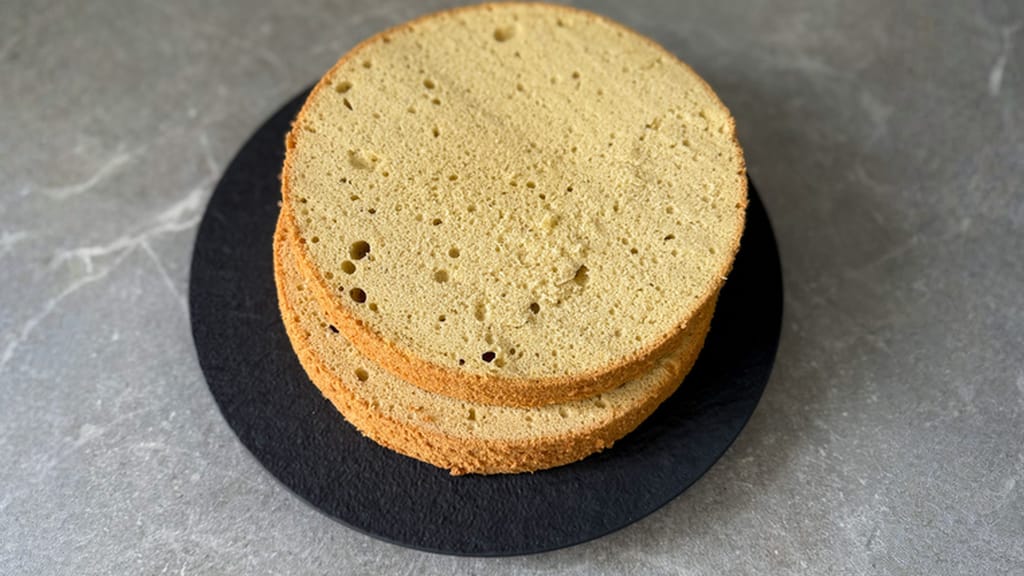
Light and airy génoise sponge cake
Sunken Sponge Cake: 7 Causes and How to Prevent It
Updated Oct 8, 2026
A sponge cake sinks in the middle most often because it's underbaked, the oven isn't actually at the temperature it shows, or the egg foam deflated before it even made it to the tin. Sponge cake has almost no raising agent of its own — it's held up purely by air trapped in the eggs, and that structure has to set before the oven cools down or the bubbles burst. We'll walk through all seven causes, show you how to spot yours from the shape of the collapsed cake, and explain what to do differently next time.
A sunken sponge cake almost always comes down to one of these seven culprits:
Underbaked centre: the structure hasn't had time to set.
Oven running hotter or cooler than it shows: usually cooler, sometimes hotter.
Opening the door during the first half of baking.
Deflated egg foam: the eggs weren't whipped enough, or the flour was folded in too roughly.
Too much air or raising agent: the batter rises higher than its structure can support.
Greased tin sides: the batter has nothing to cling to and slides back down.
Thermal shock after baking: a hot cake left in a draught or put straight in the fridge.
Often two causes strike at once — a slightly cold oven combined with too short a baking time, say, so the centre looks done but isn't. That's why it's worth first checking what the shape of your sunken cake tells you. It'll save you from fixing the wrong problem.
The shape your cake collapsed into is a clue to what went wrong. Cut it open and look at the cross-section:
Only the centre has sunk, with a wet, dense streak inside: the cake is underbaked. Either the oven was too cool, or you pulled it out too soon.
The whole cake is low and dense, not just the middle: the foam deflated. The eggs weren't whipped enough, or the batter knocked back when the flour was folded in.
It rose tall first, often with a cracked dome, then the whole thing dropped: there was too much air or raising agent in the batter, or the oven was too hot.
It sank halfway through baking, shortly after you opened the door: the structure hadn't set yet, and the temperature drop knocked it down.
The sides pulled away and slid inward, leaving the cake looking like a "hat": the tin's sides were greased or lined with paper, so the batter had nothing to grip.
There's a dense, shiny layer on the bottom: the problem happened during folding, same as with deflated foam. The butter was too cold and sank to the bottom, or the flour wasn't fully incorporated.
Once you've spotted your pattern, jump to the matching cause below.
If you pull the cake out before the proteins in the egg have set and the starch has gelatinised in the middle, the centre will sink as it cools. The edges firm up first in the oven because they're closer to the hot tin — but the centre needs extra time. The inside of a sponge is done at roughly 95–99°C (203–210°F), which you can check with a probe thermometer.
Signs it's actually ready:
A skewer inserted into the centre comes out dry, with no wet crumbs clinging to it.
The surface springs back: press it gently with a finger and the dent should bounce back immediately. If the dent stays, it needs more time.
The edges start pulling away slightly from the tin, and the cake has stopped "sizzling".
A sponge cake in a 20–24 cm (8–9½ in) tin typically bakes for 25–35 minutes at 170–180°C (340–350°F). Treat that as a rough guide only — the test matters more than the timer.
A sponge sinks in an inaccurate oven because, in a too-cool oven, the structure doesn't set in time, while in a too-hot one, the surface sets before the centre has baked through. Home ovens routinely run 10–25°C (18–45°F) off their dial setting, and the thermostat lets the temperature drift up and down during baking rather than holding steady. A sponge handles this far worse than a denser creamed batter would.
How to check:
Hang an oven thermometer (the hanging dial type) in the middle of the rack. Let the oven preheat for 20 minutes, then compare its reading with your dial setting. If they differ, adjust your setting by the gap next time. It's the cheapest, most reliable way to find out what your oven is actually doing.
A digital probe thermometer measures the inside of the cake, not the oven air — useful for checking doneness, but it won't reveal a miscalibrated oven.
No thermometer? Bake on the middle shelf and preheat for at least 15–20 minutes — not just until the indicator light goes off, since that often happens before the walls are properly heated through.
We go into how oven temperature affects baking more broadly in our article on why cookies bake at a lower temperature.
A sponge sinks if you open the oven door during the first half of baking: the temperature drops sharply and the unset bubbles shrink back. So leave the door shut for roughly the first 20 minutes (more than half the total bake time). Opening the door lets the oven temperature drop by dozens of degrees within seconds. The bubbles in the sponge contract as they cool, and since the batter around them is still liquid, there's nothing to hold them up. The centre caves in — and it won't rise again.
Watch through the window instead, or switch on the oven light. Only open the door once the surface is golden and firm and you want to test with a skewer — then close it again quickly.
If the egg foam deflates or isn't whipped enough, the sponge stays low, or rises briefly before dropping. A classic sponge isn't raised by a leavening agent — it's raised purely by the air whipped into the eggs.
What matters most:
Whisk long enough. Whip the eggs with sugar for roughly 8–12 minutes, until a thick ribbon falls from the whisk and briefly holds its shape on the surface.
Warm the eggs. Whisking over a bain-marie at 40–45°C (104–113°F), as pastry chefs do, helps build a more stable foam. That's the principle behind a light, airy génoise sponge.
Sieve the flour and fold it in gradually. Add it in 2–3 batches, folding with a spatula in a scooping motion from the bottom up — never stirring with a whisk. Stop as soon as the flour disappears.
Pour in the butter warm, not lukewarm. Mix it with a spoonful of batter first, then fold that into the rest. Cold butter starts to set, knocks the air out of the foam, and sinks to the bottom.
Get the batter into the oven straight away. The foam loses air every minute it sits in the bowl, so have the oven fully preheated before you even start whisking.
Light and airy génoise sponge cake
A light, airy génoise sponge that won't sink: whisking over a bain-marie, step by step
A sponge can also sink when the batter holds more air or baking powder than its structure can bear. If you whip egg whites until they turn dry and clumpy, or add more baking powder than the recipe calls for, the bubbles grow bigger than the batter's walls can support. The cake puffs up over the rim of the tin in the oven, then collapses.
Whip egg whites to firm, glossy peaks — smooth, never dry or crumbly.
Measure baking powder with a levelled teaspoon, and don't add extra "just to be safe".
Fill the tin to roughly two-thirds full. Overfilling makes the cake overgrow and then collapse.
A sponge sinks or pulls inward if the sides of the tin are greased or lined with paper, or if you cool it too quickly after baking. As a sponge bakes, it climbs the sides of the tin. Grease the sides or line them with paper, and the batter slides back down them, pulling the cake inward as it cools. So line only the base with parchment and leave the sides bare — you can always loosen the cake with a knife once it's cooled, if needed. We cover when to reach for paper and when to grease the tin in our article on parchment paper, a silicone mat, or a greased tin.
What happens after it comes out of the oven matters just as much:
Let it cool in the tin on a wire rack, away from draughts and never in the fridge.
Some pastry chefs drop the tin once onto the worktop from about 10–20 cm (4–8 in) right after taking it out of the oven. This releases hot steam quickly and reduces shrinkage. The trick is common with Japanese-style sponges — try it on a recipe you already know well first.
Very light sponges baked in an ungreased tube pan are cooled upside down. Without this, they'd collapse under their own weight.
You usually don't need to throw out a sunken cake. If it's fully baked and just low or dipped in the middle, you can still use it:
Level it off. Trim the higher edges down to match the centre with a sharp bread knife, then flip the cake upside down so the flat base becomes the top. We show how to slice it into layers in our article on how to cut a cake into layers.
Fill the dip with frosting. Under a layer of buttercream or ganache, no one will spot the unevenness.
Crumble dense trimmings and bind them with frosting into cake pops, or layer them into a trifle-style dessert in a glass.
If the centre is still raw, wet batter, there's no saving it. Putting it back in the oven won't help — once the structure has collapsed, it won't rise again, and the edges would dry out in the meantime. Cut out the raw part and use the rest as trimmings.
Want to just bake it again right away? Try our step-by-step génoise sponge, or for a bit of inspiration, the traditional Portuguese Pão de Ló sponge.
You can bake a sponge in a fan oven, but set the temperature 10–20°C (18–36°F) lower than you would for conventional baking — typically 160–165°C (320–330°F). Circulating air sets the surface faster, so the sponge can easily crack and stay underbaked in the middle. If your oven allows it, top-and-bottom heat is the safer setting for sponge cake.
Once cooled, a sponge cake wrapped in cling film keeps for 1–2 days at room temperature, or around 2–3 months in the freezer. Wrap it tightly so it doesn't dry out or pick up odours. Defrost it still wrapped, ideally overnight in the fridge, then slice and fill once fully thawed.
You can bake a sponge in a silicone mould, but it sinks more easily than in a metal cake tin. Silicone conducts heat more slowly, and the batter has nothing firm to cling to on the soft sides. Place the mould on a baking sheet, add 5–10 minutes to the baking time, and check it's done with a skewer.
Let a sponge cake cool completely — usually 1–2 hours at room temperature, ideally wrapped overnight. A warm cake squashes and crumbles when sliced, while a rested one has a firmer structure and cuts cleanly into thin layers.
A rubbery sponge is usually the result of overmixing after adding the flour, or overbaking. Prolonged mixing develops gluten in the flour, while prolonged baking dries the cake out. Fold the flour in with a spatula only until it just disappears, and take the cake out as soon as a skewer comes out dry.
One recipe worth heating the oven for, one tip, and one deal from the shop. Nothing else.