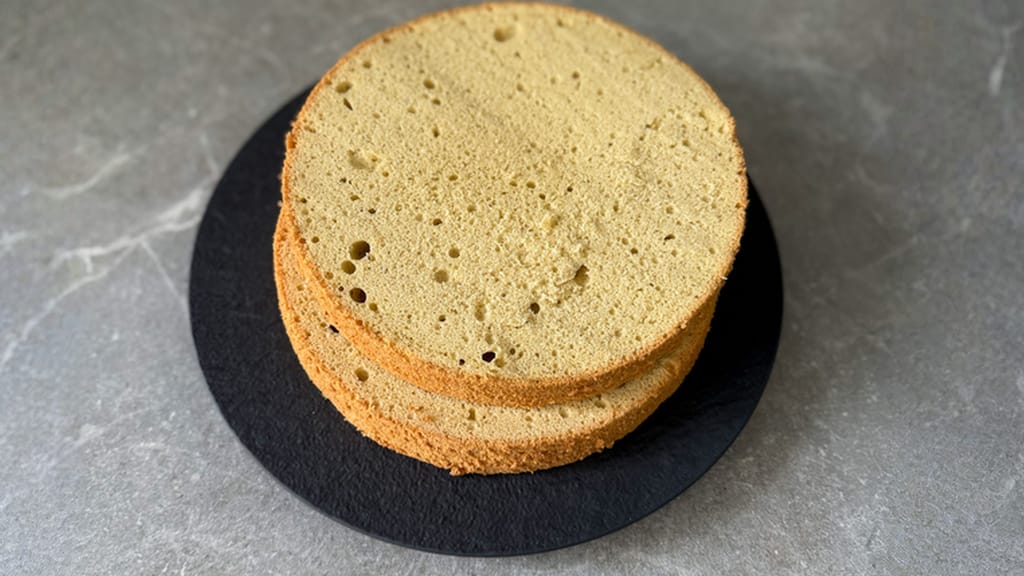
Light and airy génoise sponge cake
Sponge Cake Batter: Egg, Sugar and Flour Ratio and How Long to Whip for a Light, Fluffy Crumb
Updated Oct 17, 2026
Sponge cake batter is held up by nothing but the air in the eggs. For every egg (about 50 g without the shell), use 25 g sugar and 25 g plain (all-purpose) flour, and whip the eggs with the sugar for 8–12 minutes, until they turn pale and thick enough to leave a trail when you lift the whisk. After that, the job is simply not to lose that air: fold in the flour with a spatula, never a whisk, get the batter into the tin right away, and bake in an oven that has properly preheated. Here's the method step by step, with the reason each step works.
The basic ratio for sponge batter is 1 egg : 25 g sugar : 25 g flour. In other words, the sugar and flour weigh the same, and the egg weighs about twice as much as either. It's the old Czech "a spoonful per egg" rule, just converted to weight, because spoons vary and scales don't.
4 eggs (about 200 g) + 100 g sugar + 100 g flour → a sponge for a 20–22 cm tin
6 eggs (about 300 g) + 150 g sugar + 150 g flour → a 24 cm tin (for a 26 cm tin, use 6–7 eggs)
optional: a pinch of salt and, for 4 eggs, 1 tablespoon (about 15 g) lukewarm water for a moister crumb
Why it works: the eggs create the foam, the sugar stabilises it (it strengthens the walls of the air bubbles), and the flour sets the shape once baked. More flour means a drier, denser sponge. More sugar means a moister but heavier foam that rises less easily. A classic sponge has no baking powder; the air is the only raising agent.
The ratio can handle these variations:
Chocolate sponge: replace 15–20% of the flour with cocoa (for 100 g flour, that's 80 g flour + 20 g cocoa).
Starch: you can replace up to a quarter of the flour with cornflour (cornstarch) or potato starch. The crumb will be finer and more tender.
Butter (génoise): 20–30 g of melted, lukewarm butter per 4 eggs keeps the sponge moist for longer, but it weighs down the foam, so you need to be more careful when whipping.
Flour: plain (all-purpose) flour is the safest choice. Semi-coarse flour works too, though the crumb will be a bit coarser. Coarse flour isn't suitable.
Whipping warm gives the most stable foam and the most even crumb, while cold is simpler and perfectly good at home as long as your eggs are at room temperature. The third and most common Czech route is the separated sponge (yolks and whites whipped separately), which is the most forgiving.
Warm (whole eggs, French génoise): whisk the eggs with the sugar over a pan of gently simmering water until the mixture reaches 40–45 °C (104–113 °F), clearly warm to your finger but not hot. Then take the bowl off the pan and keep whisking until it has cooled. The warmth dissolves the sugar and loosens the egg proteins, so the foam grows faster and survives the folding in of the flour and butter.
Cold (whole eggs): take the eggs out of the fridge at least an hour ahead. Cold eggs will whip, but more slowly and to a smaller volume. Allow for longer whipping.
Separated sponge: whip the yolks with half the sugar until pale and foamy, and the whites with the rest of the sugar to stiff, glossy peaks. Fold the whites into the yolks, then the flour. This version works well even with a hand mixer and tolerates a short wait. It does come out a little drier, though.
When to choose which: for a layer cake that you'll slice into layers, warm whipping is best. For a quick everyday sponge or an Easter lamb sponge cake, the cold or separated method will do. If you want to roll the sponge, bake it as a thin sheet on a baking tray (see below).
Whip whole eggs with sugar for 8–12 minutes with a stand or electric mixer on its highest speed, or 12–15 minutes with a hand mixer. But go by how the foam looks, not by the clock:
The volume roughly triples.
The colour is pale cream, almost white, not yellow.
The trail (ribbon): when you lift the whisk, the foam runs off in a thick ribbon that sits on the surface for 3–5 seconds before it dissolves. Try writing an "8" with it: if you can see the whole figure before it vanishes, you're done.
For the last 1–2 minutes, turn the speed down to medium. This breaks large bubbles into small, even ones, so the foam is firmer and the crumb finer.
The most common mistake is under-whipping. The foam looks fluffy after just three minutes, but it's still thin, and the large bubbles burst as soon as you add the flour. The result is a flat sponge with a dense, rubbery layer at the bottom. At home, you can hardly over-whip whole eggs with sugar. With egg whites on their own you can: once they turn dull and grainy, you've gone too far.
Sift the flour and fold it in with a spatula in 2–3 batches, using a motion from the bottom up, and stop as soon as the last dry patches disappear. The whole thing should take about a minute.
Sift the flour (with the starch or cocoa, if you're using it) twice: once into a bowl beforehand, and again straight over the foam. It becomes airy and won't form lumps that you'd then have to mix out.
In batches: each time, sift about a third of the flour over the surface of the foam.
With a spatula, not a whisk or mixer: cut the spatula down through the middle to the bottom, sweep it along the base to the edge and up over the surface. At the same time, turn the bowl a quarter turn. That takes roughly 10–15 strokes per batch.
Watch the bottom: flour and butter both sink, so always sweep the spatula along the base.
Butter (if using): first mix it with 2–3 tablespoons of the finished batter, and only then fold this lighter mixture back in. Plain melted butter would sink to the bottom and deflate the foam.
Once folded, the batter must not wait. The foam starts losing air straight away, so have the tin and oven ready before you start whipping.
For a sponge made with 4 eggs, reach for a tin 20–22 cm in diameter; for 6 eggs, a 24 cm tin. The batter should come about halfway up the tin, because it rises by almost half as it bakes.
Line the base with a circle of baking parchment.
Don't grease or flour the sides. As it bakes, the sponge grips the walls and "climbs" up them. On a greased wall it slides and then sinks after baking. Once it has cooled, loosen it from the edge with a thin knife.
A cake ring or springform tin is the most practical, because you can lift the finished sponge out without turning it over. If you don't have the right size at home, have a look at tins and baking accessories.
A different tin, a different ratio: the amount of batter changes with the surface area of the tin, not its diameter. A 26 cm tin has 70% more area than a 20 cm one, which is why it needs 6–7 eggs, not 5.
For a baking tray (a roulade or slab cake), 4–5 eggs are enough for a tray of roughly 30 × 40 cm, with a layer of batter about 1 cm thick.
Bake sponge in a tin at 170 °C (340 °F) top and bottom heat (or 160 °C / 320 °F fan) for 25–35 minutes. A thin sheet on a baking tray bakes at 190–200 °C (375–400 °F) for just 8–10 minutes. Don't open the oven for the first 20 minutes.
Oven temperature is the most common hidden culprit. In ordinary home ovens, the number on the dial and the real temperature inside can easily differ by 10–30 °C. At a lower temperature, the foam bursts before the flour has time to set, and the sponge sinks. At a higher temperature, the surface sets and cracks while the middle stays raw. If your sponge keeps falling even though you whip properly, check the real temperature with an inexpensive Patisse oven thermometer: hang it in the middle of the rack and let the oven heat for at least 15–20 minutes, not just until the indicator light goes off. Any reliable dial or digital thermometer with an oven probe will do the same job. The point is to know the true number.
The sponge is done when:
the surface is golden and springs straight back when lightly pressed with a finger
the edges start to pull away from the tin
a skewer inserted in the middle comes out clean and dry
Cooling: leave the sponge in the switched-off oven with the door ajar for 5–10 minutes, then move it to a wire rack and let it cool in the tin. It's best to cut it into layers the next day. Once rested, it's firmer and crumbles less. If it has sunk anyway, we go through the causes in the article Sunken sponge cake: 7 causes and how to prevent them.
The most reliable sponge cake base recipe is génoise: whole eggs whipped with sugar over gentle heat, with 25 g sugar and 25 g flour per egg. Try it with the recipe for a fluffy génoise sponge cake base. It's exactly the method most layer cakes are built on. And once you've mastered the round sponge, take a look at how sponge is baked in Portugal: Pão de Ló, traditional Portuguese sponge cake.
Light and airy génoise sponge cake
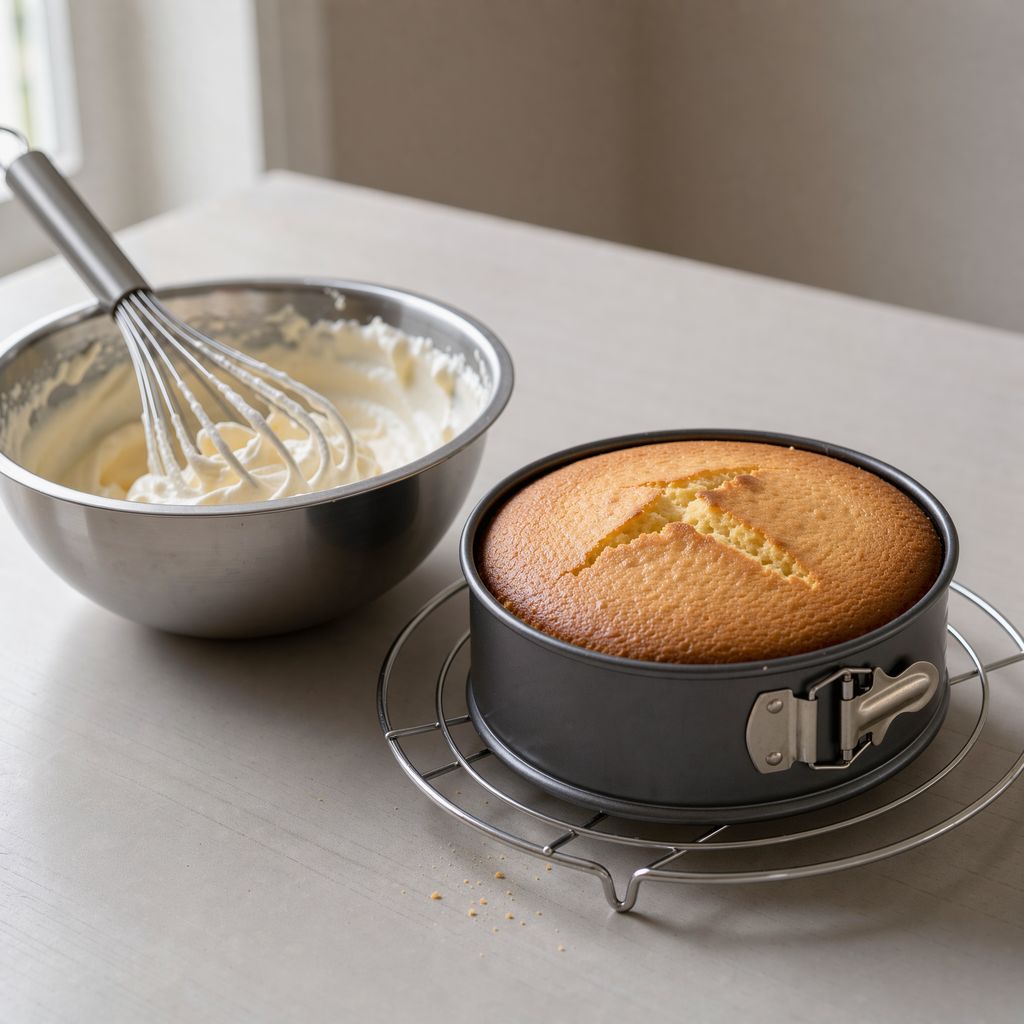
Fluffy génoise sponge cake base: sponge batter whipped over gentle heat
Baked sponge keeps wrapped in cling film for 2–3 days at room temperature and up to 2–3 months in the freezer. You can freeze it whole or already cut into layers. Thaw it while still wrapped so moisture doesn't condense on the surface. Layers actually slice more easily from a partly frozen sponge.
You can swap the caster (superfine) sugar in sponge batter 1:1 for fine cane sugar or powdered (icing) sugar, but you can't leave it out entirely, because it holds the foam together. You can cut it to about 20 g per egg, but with less sugar the foam collapses faster and the sponge turns out drier. Erythritol and similar sweeteners stabilise the foam less well, so expect a lower, more crumbly sponge. Honey and syrups aren't suitable, as the extra liquid weighs the foam down.
To cut a sponge into even layers, let it rest until the next day and use a long serrated knife held level while you slowly turn the sponge. First mark the height of the layers around the edge with toothpicks or a shallow score so you have a guide. Cut with short strokes just a few centimetres in, turn the sponge a little and carry on until the cuts meet in the middle. Two wooden strips of equal height placed on either side of the sponge, or a cake wire leveller, also work as a guide. A sponge made with 6 eggs and about 5 cm tall will comfortably give you three layers.
Yes, you can bake a gluten-free sponge, because its structure comes mainly from the egg foam. Replace the wheat flour with the same weight of a fine gluten-free flour blend, or a mix of rice flour and starch at roughly 1:1. The crumb will be a little more delicate, so let it rest until the next day before cutting.
For a square tin, scale the batter by surface area. A 20 × 20 cm tin (400 cm²) is roughly equivalent to a round 22 cm tin, so 4–5 eggs. For a 30 × 20 cm tin (600 cm²), use 6–7 eggs.
One recipe worth heating the oven for, one tip, and one deal from the shop. Nothing else.



