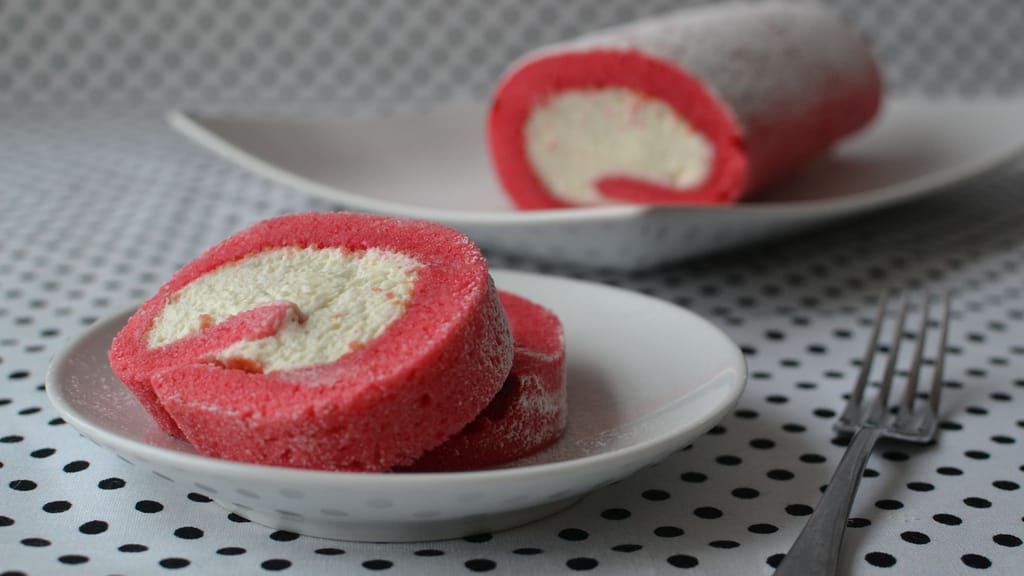
Fluffy pink swiss roll with cream cheese filling
Sponge Cake for a Swiss Roll: How to Bake and Roll It Without Cracks
Updated Oct 17, 2026
A Swiss roll sponge doesn't roll without cracks thanks to a miracle recipe. It comes down to three things: spread the batter on the pan in a thin, even layer (about 1 cm), bake it hot and fast (around 200 °C / 390 °F for 8–10 minutes), and roll it while it's still warm. When a roll cracks, it's almost always overbaked: the moisture evaporates from the sponge and it loses its flexibility. Here you'll find the whole process, from the baking pan to rolling up the filling, plus what to do when something goes wrong.
Swiss roll sponge is thinner and more flexible than the sponge used for layer cakes. It isn't baked in a tall tin but as a sheet on a baking pan, and it has to bend without breaking.
More eggs, less flour. A typical ratio for a 30 × 40 cm (12 × 16 in) baking pan is 4 eggs, 80–100 g sugar and 80–100 g plain flour. The eggs give flexibility and the flour gives structure. The more flour, the more brittle the sponge.
A thin layer. The batter is only 8–10 mm deep on the pan and bakes to about 1–1.5 cm. A cake base can be as tall as 5 cm.
A short bake. A thin sheet bakes in a few minutes, so the moisture stays inside. That moisture is exactly what lets you roll it.
An extra spoonful of water or oil (about 1–2 tablespoons for 4 eggs) makes the sponge softer and more resistant to cracking. Feel free to add it if your rolls have been cracking.
Whisking the eggs with sugar is the same as for any sponge: whisk until the foam turns pale, doubles in volume and falls from the whisk in a slow, distinct ribbon. Here we focus on what's different for a roll: the pan, the baking and the rolling. If you want a tall sponge for a layer cake, go for the recipe for a fluffy Génoise sponge cake base instead.
Pour the batter into the middle of a pan lined with baking parchment and spread it toward the corners with an offset spatula or a wide scraper, to a layer 8–10 mm thick. The edges and corners must be as high as the centre.
A 30 × 40 cm (12 × 16 in) pan suits a batch made with 4 eggs. For a smaller pan, use less batter, otherwise the sponge will be too thick and will crack from the inside when you roll it.
Stick the paper to the pan with a few drops of batter in the corners so it doesn't move while you spread.
Spread briefly. A few strokes and that's it. Every extra stroke knocks air out of the foam.
Watch the edges. A thin edge bakes before the centre, dries out and is the first part to crack when you roll. If your edges come out thinner, simply trim them off after baking.
You'll find an offset spatula, a scraper and other tools for a thin sheet among the baking tins and bakeware tools. You can also manage with the back of a large spoon, but you'll need more patience with the corners.
Bake the sponge at 200 °C (390 °F) with top and bottom heat (or 180 °C / 355 °F fan) for 8–10 minutes. A thicker sheet may need 12 minutes. Slow baking at 160–170 °C (320–340 °F) does work, but the sponge bakes longer and dries out more.
How to tell it's done:
the surface is light golden, not dark brown,
when you press it lightly with a finger, it springs back and leaves no dent,
it doesn't stick to your finger,
the edges are only just starting to pull away from the paper.
Don't open the oven during the first few minutes. The temperature would drop and the foam could collapse. Start checking no sooner than minute 7. With a sheet only 1 cm thick, every minute counts: two extra minutes and a soft sponge becomes a dry sheet that snaps.
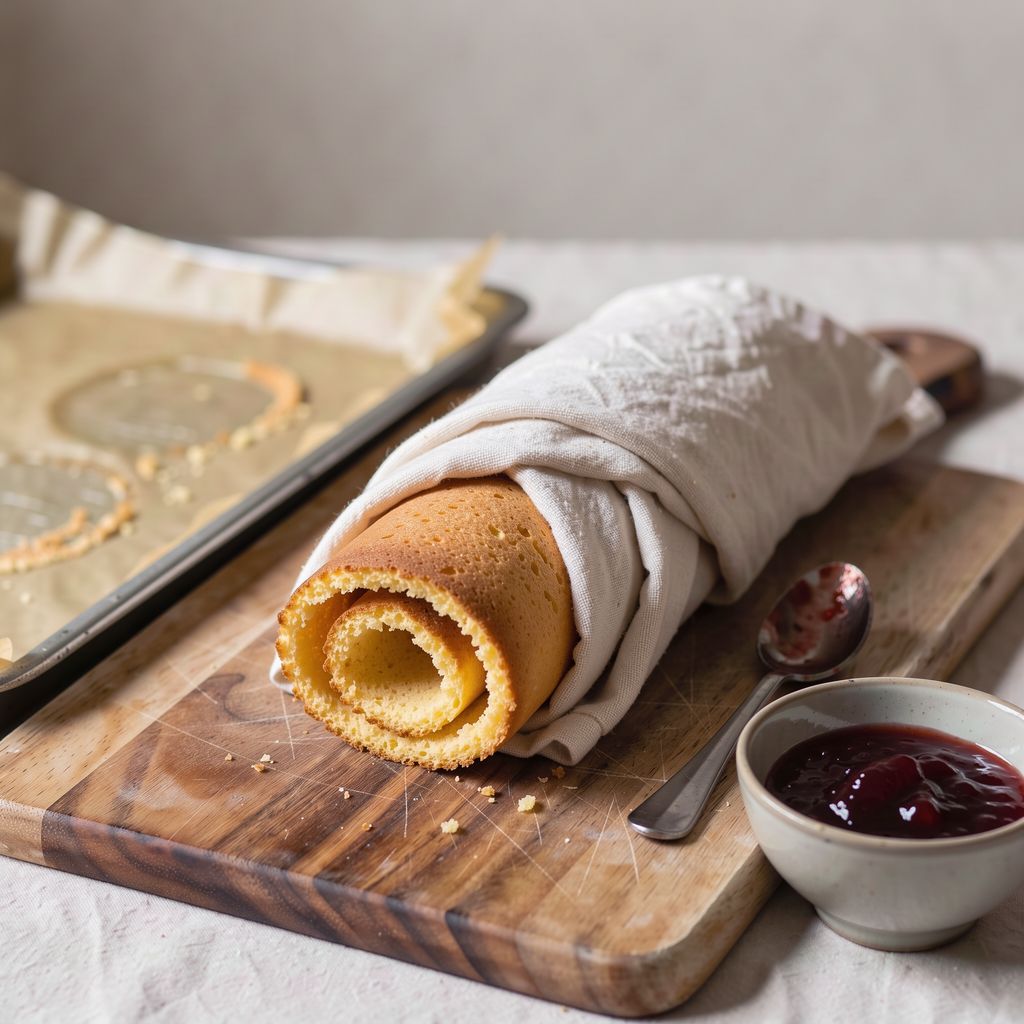
Roll the sponge up right after taking it out of the oven, while it's still hot, together with the kitchen towel. While warm it's flexible and "remembers" the shape of the roll. Once cooled, the sheet just breaks.
Prepare the towel before baking. Spread a clean cotton kitchen towel (free of fabric softener and detergent scent) on the counter and dust it with powdered sugar, or with cocoa for a chocolate roll. Instead of sugar, you can dampen the towel and wring it out well.
Turn the sponge out onto the towel paper side up, as soon as it comes out of the oven.
Peel off the paper. If it sticks, brush it with a damp pastry brush or lay a damp towel on it for a minute. The steam will loosen it.
Trim off any dry edges if they're hard. That's where a crack usually starts.
Roll the sponge up with the towel loosely, not tightly. Rolling from the short side (30 cm) gives a thicker roll with more turns, while the long side gives a thinner, longer roll.
Let it cool seam side down for about 30–60 minutes, until it's just lukewarm or cold.
Carefully unroll the cooled sponge, spread it with a 0.5–1 cm layer of filling and roll it back up along the same curls, this time without the towel. The sponge already has its shape, so it will roll up again on its own.
Unroll only as much as you need. Don't press the sponge completely flat; just loosen it.
Leave 2 cm at the end without filling, or you'll push it out when rolling.
Start with a thin layer of jam or marmalade, then the cream. The jam glues the sponge together and the cream doesn't slide on it.
The filling must be spreadable, not runny and not stiff from the fridge. A thin cream soaks in and the roll slides apart. A stiff cream can't be spread and tears the sponge. If you want a whipped cream filling that holds its shape even after slicing, firm it up following the article on stabilised whipped cream with gelatine. For a quark or mascarpone filling, a quark cream that holds its shape works well. Fresh fruit releases juice, so cut it into smaller pieces, let it drain in a sieve and add it to the roll just before rolling.
Roll tightly and turn the seam side down. Then wrap the roll in cling film or baking parchment and leave it in the fridge for at least 2 hours so the filling firms up and slices neatly.
Slice with a sharp knife dipped in hot water, wiping it after each cut. Feel free to trim the ends, so the roll looks cleaner.
A Swiss roll most often cracks for one of six reasons: it's overbaked, it has thin edges, it was rolled cold, it has too much flour, it's too thick, or the filling was stiff.
Overbaking. This is cause number one. Shorten the time, check your oven with a thermometer and bake at 200 °C (390 °F) rather than baking for a long time at a low temperature.
Thin or dry edges. Spread evenly and trim off hard edges before rolling.
The sponge cooled before you rolled it. Prepare the towel in advance and roll within a minute of taking it out of the oven.
Too much flour or too few eggs. Stick to a ratio of roughly 1 egg to 20–25 g flour and add a spoonful of water or oil.
A sheet that's too thick. More batter on a small pan bends like a thick board. A layer of 8–10 mm is the limit.
A stiff filling. Cold cream straight from the fridge tears the sponge as you spread it. Let it soften for a while.
If a crack does appear, don't throw it away. Small cracks on the surface can be covered with powdered sugar or a thin layer of cream or chocolate. Cut a broken sponge into cubes and layer it with cream and fruit in glasses as a dessert. And if even an ordinary sponge cake keeps collapsing on you, read through the 7 causes of a sunken sponge cake base.
You can try the whole process in practice with the recipe for a fluffy Swiss roll with quark cream. Quark cream is fresher and lighter on the palate than buttercream, and it spreads easily, so it suits a first roll well.
Fluffy pink swiss roll with cream cheese filling
Fluffy Swiss Roll with Quark Cream
Replace 20–25 g of the flour with the same amount of good-quality Dutch-process cocoa and sift it in together with the flour. Cocoa dries out the batter more than flour does, so add an extra spoonful of water or oil and bake for about a minute less. Dust the kitchen towel with cocoa instead of powdered sugar so no white patches are left on the dark sponge.
A Swiss roll sponge doesn't need baking powder, because well-whipped eggs will make it fluffy on their own. Baking powder (about ½ teaspoon for 4 eggs) works as insurance if you're not sure about your whisking. The sponge does tend to come out a little drier and more crumbly, though.
You can bake the sponge a day ahead if you roll it up warm in a kitchen towel and, once it has cooled, wrap it in cling film. Leave the towel inside so the sponge doesn't dry out. It keeps in the fridge until the next day. Fill it only once the filling is ready.
A Swiss roll with whipped cream, quark or mascarpone keeps for about 2 days in the fridge, wrapped in cling film. It's best on the second day, when the sponge has soaked up a little of the cream. If it has fresh fruit in it, eat it within 24 hours, because the fruit releases juice and the sponge turns soft.
Yes, you can freeze a Swiss roll, ideally one filled with buttercream or a quark-based cream and without fresh fruit. Wrap it tightly in cling film and it will keep in the freezer for about a month. Thaw it slowly in the fridge overnight. A roll filled with whipped cream often loosens and weeps water after thawing.
One recipe worth heating the oven for, one tip, and one deal from the shop. Nothing else.