Bublanina with summer fruit and crunchy crumble
Updated Aug 28, 2026
Freezing fruit so it stays loose comes down to one trick: let it freeze first spread out in a single layer on a tray, and only then tip it into a bag. A solid ice block doesn't appear in the freezer by accident — it forms because damp pieces touch each other as they freeze. If they can't touch, three months from now you'll be able to shake out exactly as many raspberries as you need and leave the rest frozen. Below you'll find the full method: which fruits can go into the freezer raw, which need sugar or syrup, how long each keeps, and how to bake with frozen fruit without thawing it first.
Fruit sticks together because of surface water, not because of the fruit itself. After washing, a thin film of moisture stays between two raspberries; that film freezes before the fruit inside does and welds neighbouring pieces together like glue. The more pieces touching each other, the bigger the chunk of ice you'll pull out in the end.
The other half of the problem is freezing speed. Slow freezing grows large ice crystals that tear through cell walls; the faster fruit freezes, the smaller the crystals stay and the less damage they cause. A home freezer freezes slowly — which is exactly why a thin layer on a tray and the quick-freeze function help so much. You'll notice the difference immediately: a slowly frozen raspberry turns to mush once thawed, while a quickly frozen one holds its shape.
So a block becomes a block if you do any one of these three things:
Put wet fruit straight into a bag. The single most common mistake.
Dump everything onto the tray in one big heap. Pieces in the middle take hours to freeze and fuse with everything around them.
Overload the freezer with warm food. The temperature rises, freezing slows down, and crystals grow bigger.
All three problems are solved by one extra step — flash-freezing on a tray.
Flash-freezing is a simple six-step process: line a tray with paper, spread the fruit in a single layer, freeze for 2–6 hours, check firmness, tip into a bag, and label it. The whole extra effort takes about three minutes.
Line the tray with baking paper. Fruit placed directly on metal will freeze onto it, and you'll tear the skin off when you lift it. Paper or a silicone mat solves this.
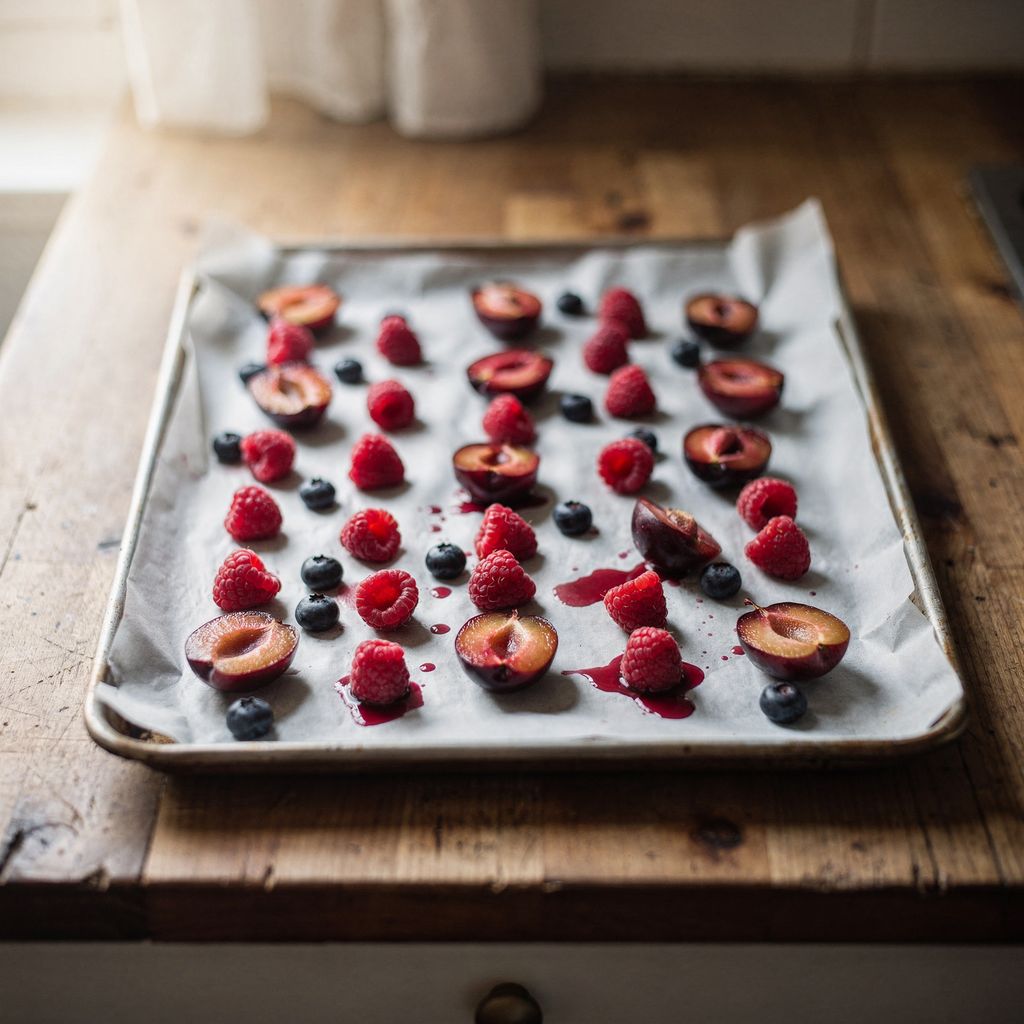
Spread the fruit in a single layer so the pieces don't touch. A gap the width of your little finger is enough. Better to use two trays than cram everything onto one.
Put the tray in the freezer for 2–6 hours. Small berries are usually ready in about two hours; apricot or peach halves need more like four to six.
Check the firmness. A piece needs to be hard all the way through — if you press it with your fingernail and it gives, leave it another hour. Under-frozen fruit will fuse together in the bag.
Tip into a bag or container and press out the air. Do this quickly, before the surface has a chance to get damp again.
Label with the date and type. In four months you won't be able to tell frozen redcurrants from frozen blueberries — trust us.
If your freezer has a quick-freeze function, switch it on about an hour beforehand. And don't put in more than about a kilo of fruit at once — a bigger batch raises the temperature inside and slows down freezing for everything else.
Prep has one goal: get the fruit onto the tray dry, clean, and already in the form you'll want to use it in. Nothing gets fixed once it's in the freezer.
Dry it more thoroughly than feels necessary. Spread washed fruit on a tea towel and let it dry for at least 20 minutes. It's best not to wash raspberries and blackberries at all — they soak up water and fall apart; just pick out any leaves.
Remove stems, stones and peel right away. You won't be able to stone a frozen cherry or peel a frozen peach.
Cut to the size you'll actually use it in. Plums into halves or quarters, apples into roughly 5 mm slices, rhubarb into 2 cm pieces. Thawed fruit cuts terribly.
Freeze fruit at its best, not at its worst. The freezer won't rescue or improve the flavour — unripe fruit stays sour and rotten fruit stays rotten. Use up anything with a soft spot right away, and only freeze the firm, fragrant pieces.
Exception for plum dumplings: freeze plums whole, pit and all, for dumplings. They hold their shape far better than halves and won't turn to mush during cooking.
Freeze raw and completely sugar-free anything with a firm skin that doesn't brown in the air: strawberries, raspberries, blueberries, blackberries, redcurrants, gooseberries, cherries, sour cherries, plums, rhubarb, and grapes. This is also exactly the fruit that stays genuinely loose after flash-freezing.
Strawberries — better frozen cut into halves or quarters. A whole strawberry freezes slowly from the outside in and comes out watery once thawed.
Raspberries and blackberries go on the tray individually and into the bag very gently afterwards — they're fragile even frozen.
Redcurrants and gooseberries are the most rewarding of all: protected by a tough skin, they stay loose for months, and you can shake them straight from the bag into a crumble cake.
Cherries and sour cherries — pit them first. Strain off any juice that runs out and freeze it separately in a silicone ice-cube tray.
Plums — halve them and freeze skin-side down so the juice stays inside.
Rhubarb needs nothing at all — just cut and freeze; it gets cooked anyway once thawed.
Grapes freeze whole and are eaten straight from frozen, like a sweet.
Sugar or syrup is needed for fruit that browns in the air: apples, pears, peaches, nectarines, apricots and figs. The browning is caused by an enzyme called polyphenol oxidase, which turns phenolic compounds in the fruit into a brown pigment in the presence of oxygen. The freezer slows this process down but doesn't stop it — after a few weeks a frozen apple turns rusty brown.
Sugar and syrup both work the same way: they coat the surface and physically cut it off from oxygen. Added ascorbic acid (powdered vitamin C) also actively slows browning, according to standard home-preserving guidance, because it reacts with oxygen before the fruit does.
But let's be honest: fruit packed in sugar or syrup won't stay loose. It freezes into one solid mass that you either chip pieces off or thaw whole. That's a conscious trade-off — for apples and peaches, colour and flavour win out over looseness, since you'll be using them for strudel or stewed fruit all in one go anyway.
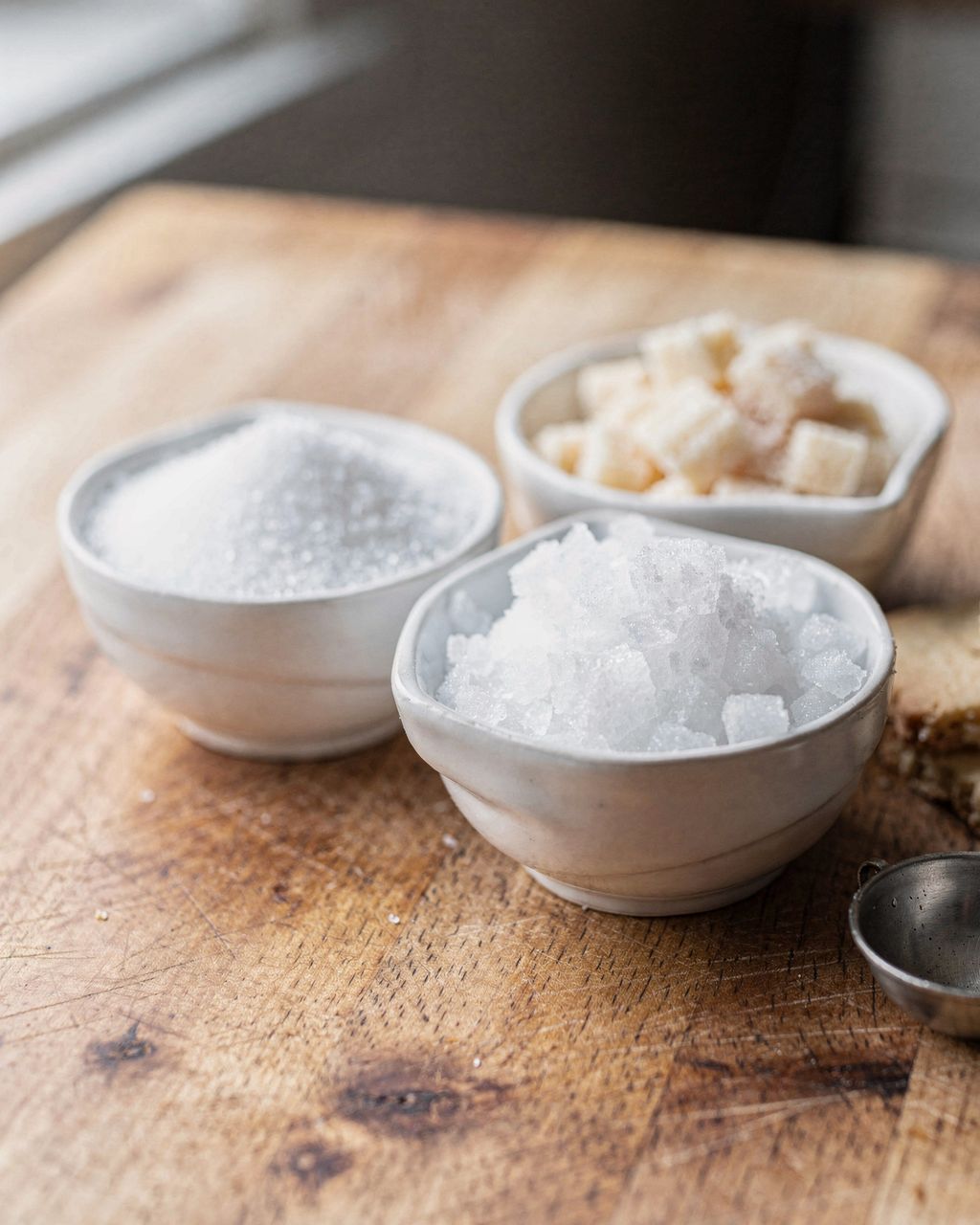
A sugar coating means mixing chopped fruit with 150 g of sugar per 1 kg of fruit, which protects it from browning during freezing. After mixing, let the fruit sit for 15 minutes so the sugar dissolves into its own juice. Then pack it into a container, leave 2 cm of headspace, and freeze.
The sugar isn't there for sweetness — it draws a bit of water out of the fruit and forms a syrupy film around the pieces. When you come to bake with it later, remember the fruit is already sweetened, and cut back the sugar in your recipe accordingly.
If you want extra insurance against browning, dissolve 1–2 g of ascorbic acid per kilo of fruit in three tablespoons of cold water, sprinkle it over the fruit, and only then add the sugar. In a pinch, juice from half a lemon per kilo works too — weaker, but it works.
Syrup is the best protection for colour and flavour you can manage at home, and it suits peaches, apricots and pears that you plan to serve later as stewed fruit.
Make a syrup from about 600 g sugar per 1 litre of water and let it cool completely — hot syrup will cook the fruit.
Stir into the cooled syrup about 1.5 g ascorbic acid per litre — for apricots, use more, about 2.5 g per litre.
Pack the fruit into a container, pour over the syrup so the fruit is fully submerged, and leave 2–3 cm of headspace — water expands as it freezes, and otherwise the container will crack.
Push down any pieces that float back under the surface with a scrunched-up piece of baking paper. Anything sticking out above the liquid will turn brown.
At a steady –18°C, berries keep for 8–12 months, raw stone fruit for 6–9 months, fruit in sugar or syrup for up to 12 months, and citrus and juices for 4–6 months. Broken down by type:
Berries (strawberries, raspberries, blueberries, blackberries, redcurrants): 8–12 months
Stone fruit raw (plums, apricots, peaches, cherries): 6–9 months
Stone fruit in sugar or syrup: up to 12 months
Apples and pears sliced with sugar: 6–8 months
Fruit purées and pulps: 6–8 months
Citrus fruit, fruit juices and zest: 4–6 months
Rhubarb: 8–12 months
These are quality guidelines, not safety limits. Fruit that's stayed below –18°C the whole time is still safe to eat even after a year and a half — it just looks and tastes worse and worse. A practical rule of thumb: use up what you froze this August before next summer's harvest arrives.
The biggest enemy isn't time — it's fluctuating temperature. Every time you open the freezer, and every partial thaw-and-refreeze, melts the surface a little and refreezes it, and the ice crystals grow bigger each time. That's why fruit lasts longer in a chest freezer than in a fridge-freezer compartment.
Pack frozen fruit into flat bags in portions with the air pressed out, and add a second layer of packaging for anything you're storing longer than six months. The culprit is sublimation: fruit gets freezer burn when ice on its surface evaporates directly into the air inside the bag — without ever melting. What's left behind are dry, greyish, tough patches that aren't unsafe to eat but taste lifeless. The more air in the packaging, the faster this happens.
Press out the air, not the fruit. With a bag, press the air out with your palm, working from the bottom up to the seal. A vacuum sealer is ideal, but it'll crush raspberries — use a gentler setting or flash-freeze them first.
Pack flat. A flat bag freezes faster, takes up less space, and lets you snap off a chunk easily.
Pack in portions you'll actually use. 300 g for a crumble cake, 150 g for a smoothie. Repackaging already-frozen fruit just increases the risk of it clumping together.
Double-wrap for long-term storage. An extra bag, or a container around the bag, slows sublimation down considerably.
Label with the type, weight and date. Three seconds now saves you a guessing game in six months.
Add frozen fruit straight into the batter still frozen, toss it in flour or starch first, and add 5–10 minutes to the baking time. Thawing fruit before baking is the surest way to end up with a soggy, sunken, colour-bled cake — thawed fruit releases all its juice into the batter before it's even had a chance to bake through.
Toss the fruit in 1–2 tablespoons of plain flour or starch. The coating soaks up the first burst of juice and also slows the fruit from sinking to the bottom of the pan.
Fold it into the batter at the very last moment, right before pouring into the pan. The shorter the contact time, the fewer colour streaks bleed through.
Add 5–10 minutes to the baking time. Frozen fruit cools the batter down and slows baking. Test with a skewer, not the clock.
For juicy fillings, add an extra tablespoon of starch. This mainly applies to sour cherries, redcurrants and rhubarb.
Fruit scattered on top can handle more. If you're not sure, arrange it on the batter rather than folding it in.
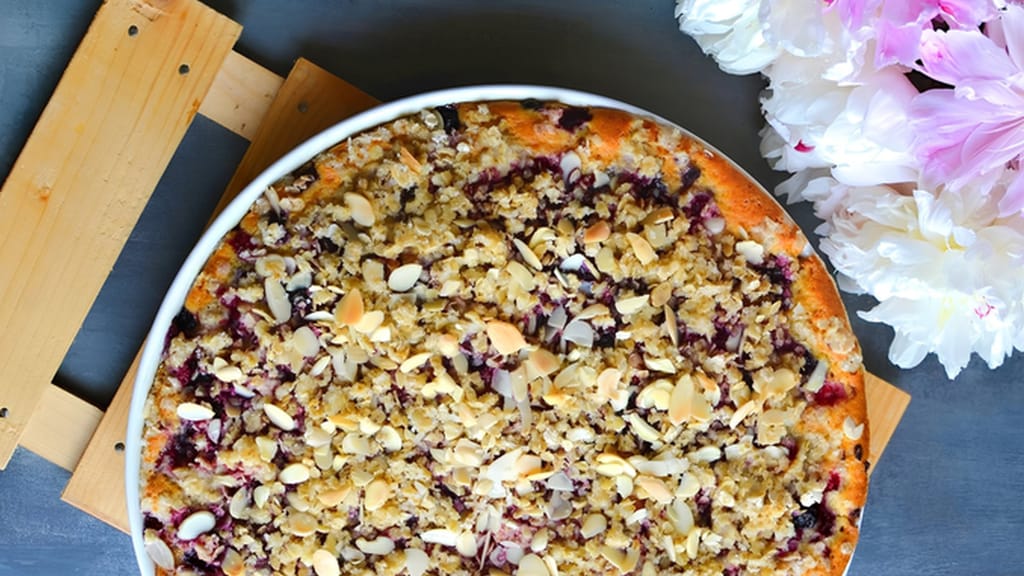
A crumble cake ('bublanina') is the most forgiving bake there is for this — the batter takes five minutes and the fruit goes in straight from the bag.
Bublanina with summer fruit and crunchy crumble
Summer fruit crumble cake with a crunchy streusel topping — the perfect recipe for frozen berries straight from the freezer
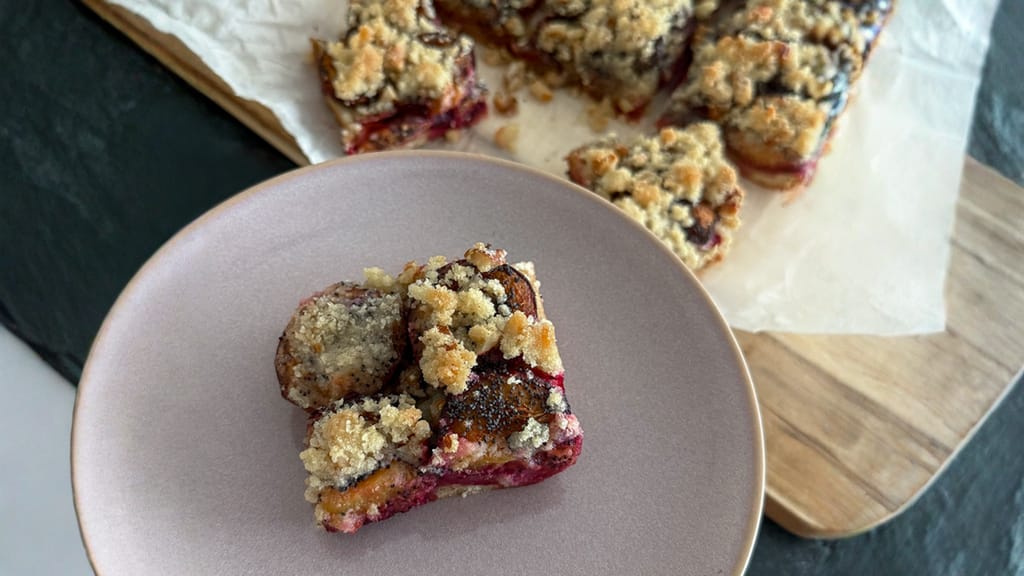
Yeasted plum cake with walnut crumble
Yeasted plum cake with a walnut streusel — for frozen plum halves, no thawing needed
Use frozen fruit straight from frozen in five things: smoothies, homemade ice cream and sorbet, morning porridge, yeasted cakes, and plum dumplings.
Smoothies — frozen fruit stands in for ice and won't water down the flavour. Try a mixed berry smoothie or a strawberry and mint smoothie.
Homemade ice cream and sorbet — frozen blueberries blended with honey are the base of blueberry ice cream with honey, thyme and vanilla.
Morning porridge — a handful of frozen berries stirred into hot vanilla millet porridge with forest fruit melts straight into juice in the bowl.
Yeasted cakes — frozen blueberries hold up even with a curd cheese filling, see yeasted blueberry buns with curd cheese and streusel.
Plum dumplings — frozen plums with the pit in hold their shape better than fresh ones, see potato dough plum dumplings.
Thaw fruit when the extra juice would be a problem or when you need to cut it — three situations call for this: strudel and rolled fillings, jams and fruit butters, and cake decoration or cold desserts.
Strudel and fillings wrapped in stretched dough. A wet filling turns the dough soggy from underneath. Let apples thaw in a sieve over a bowl, boil the drained juice down into a syrup separately, and stir it back into the thickened filling. On a homemade stretched-dough apple strudel that's the difference between a crisp bottom and a soggy one.
Jams, fruit butters and stewed fruit. Everything ends up in the pot anyway here, so you can happily thaw the fruit overnight in the fridge, juice and all — the juice is a bonus in jam.
Cake decoration and cold desserts. A frozen raspberry sitting on cream will release a little pink puddle within ten minutes. Thaw it beforehand in a sieve and pat it dry.
Always thaw in the fridge, not on the counter — the fruit thaws evenly and stays cold the whole time. And use thawed fruit within 24 hours.
Break up a solid block mechanically, not with heat. Lay the bag flat on the counter and give it a few good whacks against the surface, or roll a rolling pin over it — the pieces usually snap apart right where they were touching.
What not to do: don't run the bag under hot water or put it in the sink. The surface will thaw, the fruit will release juice, and it'll refreeze into an even worse clump than before.
If the block just won't break apart, don't fight it — use it whole. Clumped berries are still perfectly good for jam, syrup, stewed fruit, or a cooked-down sauce for curd cheese. Staying loose is a matter of convenience, not quality. And next time: drier fruit, more spread out on the tray, longer flash-freezing.
Fruits with high water content and a delicate structure that turns to mush after thawing don't belong in the freezer: melon, cucumber, whole pears, and even a banana still in its peel. Melon and grapes can only be frozen for eating straight from frozen, not for later cooking. Always freeze banana peeled and sliced into rounds — otherwise you'll never get it out of the skin. Don't freeze whole apples or pears either — always slice them and treat with sugar or ascorbic acid first.
Always wash fruit before freezing, with one exception: don't wash raspberries or blackberries — just pick out any leaves or debris. Washed fruit needs to be completely dry before it goes on the tray — every drop of water on the surface is exactly what welds the pieces together. Spread it in a single layer on a tea towel and give it at least 20 minutes to dry; stone fruit can use a full half hour. Washing after thawing doesn't work either — soft fruit falls apart and turns waterlogged under the tap.
You can, but only for fruit packed in sugar or syrup — for loose frozen fruit, a container is the worse choice. A container leaves air around the pieces, which speeds up freezer burn on the surface, and it's harder to fit into the freezer. For fruit in syrup, though, a container is essential, since a bag won't hold liquid. Choose a sturdy, freezer-safe container (thin plastic cracks at –18°C) and leave 2–3 cm of headspace for expansion.
Freezer-burned fruit shows dry, greyish, lightened, tough patches on the surface and a heavy layer of frost inside the bag. It's not unsafe to eat, but the flavour has faded and it'll bake up dry and juiceless. Other warning signs are browning on apples and peaches (oxidation) and a solid layer of ice at the bottom of the bag, which means it thawed and got refrozen at some point. Badly freezer-burned fruit can still be rescued by cooking it down into a syrup or sauce — but skip it for a crumble cake.
The freezer doesn't cook fruit — it's cold storage, not heat treatment. What genuinely changes in the freezer is texture and flavour, and that mostly depends on how fast the fruit froze and how stable the temperature stayed afterwards. Fruit loses the most quality from long storage, fluctuating temperatures, and thawing in water — that's when the colour fades and the flavour disappears. In practice: freeze fast, store below –18°C, use within a year, and thaw in the fridge.
One recipe worth heating the oven for, one tip, and one deal from the shop. Nothing else.