An unconventional christmas eve menu: fresh potato salad
Updated Sep 18, 2026
Potato salad keeps in the fridge for 1 to 5 days depending on the dressing — the classic mayo version lasts 3 to 4 days. But that's only true if you chill it quickly, store it in an airtight container, and keep your fridge at 4°C (39°F) or below. Salad made with homemade mayo from fresh egg yolks only holds up for 1 to 2 days, while a mayo-free version with a vinegar or oil dressing can go 4 to 5 days.
Potato salad keeps in the fridge for 1 to 5 days depending on the dressing: 1–2 days with homemade mayo, 3–4 days with store-bought mayo, 4–5 days with a vinegar or oil dressing, and 2 days with added deli meat or fish. So it's the dressing that decides, not the potatoes — the more raw egg yolk and moist raw veg in the salad, the shorter your window. At 4°C (39°F) or below, in an airtight container, here's what to expect:
With store-bought mayo: 3–4 days. It's made from pasteurised egg yolks and has a noticeably lower pH (typically 3.6–4.1), so it starts off in much better shape than anything homemade.
With homemade mayo: 1–2 days. Raw egg yolk is the weakest link in the whole salad. Go ahead and make it, but eat the salad that day or the next.
Mayo-free, on a vinegar or oil dressing: 4–5 days. The acid lowers the pH, and most bacteria struggle to grow in it.
With deli meat, ham, or fish: 2 days. The salad is then only as stable as its most perishable ingredient — the meat or fish.
With chopped raw onion: plan on a shorter window. Onion releases water and dilutes the dressing — the salad turns thinner and spoils faster.
Store-bought packaged salad: until the use-by date, or within 24 hours of opening, unless the manufacturer says otherwise. The date on the pack applies to the sealed package. Once you open it, a new, shorter clock starts running.
These timeframes are a ceiling, not a guarantee. If the salad spent two hours sitting out, or your fridge runs at 8°C, they no longer apply.
Potato salad spoils faster than other leftovers because three culprits converge in it at once — Staphylococcus aureus from hands, Listeria monocytogenes, which grows even in the fridge, and Clostridium perfringens, whose spores survive cooking the potatoes — and once the salad is mixed, it never gets cooked again. Cooked potato offers them an almost ideal environment on top of that: a high pH (around 6), plenty of moisture, and soft starch that's basically food ready to eat. That's why potato salad is one of the most common carriers of staph food poisoning, which shows up mainly in hand-prepared dishes like potato or ham salad.
What each of these three actually does:
Staphylococcus aureus. A perfectly healthy person can carry it on their hands and in their nose. It gets into the salad during chopping and mixing. The nasty part is that it produces a heat-stable toxin — one that survives even tens of minutes of boiling. So reheating won't get rid of it. According to the US FSIS, this is exactly why it shows up so often in outbreak reports tied to hand-made salads.
Listeria monocytogenes. This one multiplies even in the fridge, at temperatures around 0–4°C. Cold slows it down but doesn't stop it — which is why even a perfectly chilled salad won't last a week. The Czech food safety authority (SZPI) has even pulled packaged potato salads from shelves over listeria.
Clostridium perfringens. Its spores survive the potatoes being cooked and start growing if the salad cools down slowly. It's not undercooking that causes this — it's slow cooling.
The practical takeaway: with potato salad, it's not about "cooking it through" — it's about how fast you chill it and how clean your hands are.
Store potato salad at 4°C (39°F) or below, and don't leave it out of the fridge for more than two hours — or just one hour above 32°C (90°F). The danger zone is 4–60°C (39–140°F) — in that range, under ideal conditions, bacteria can double roughly every 20 minutes. The entire safety of potato salad comes down to how little time it spends in that zone.
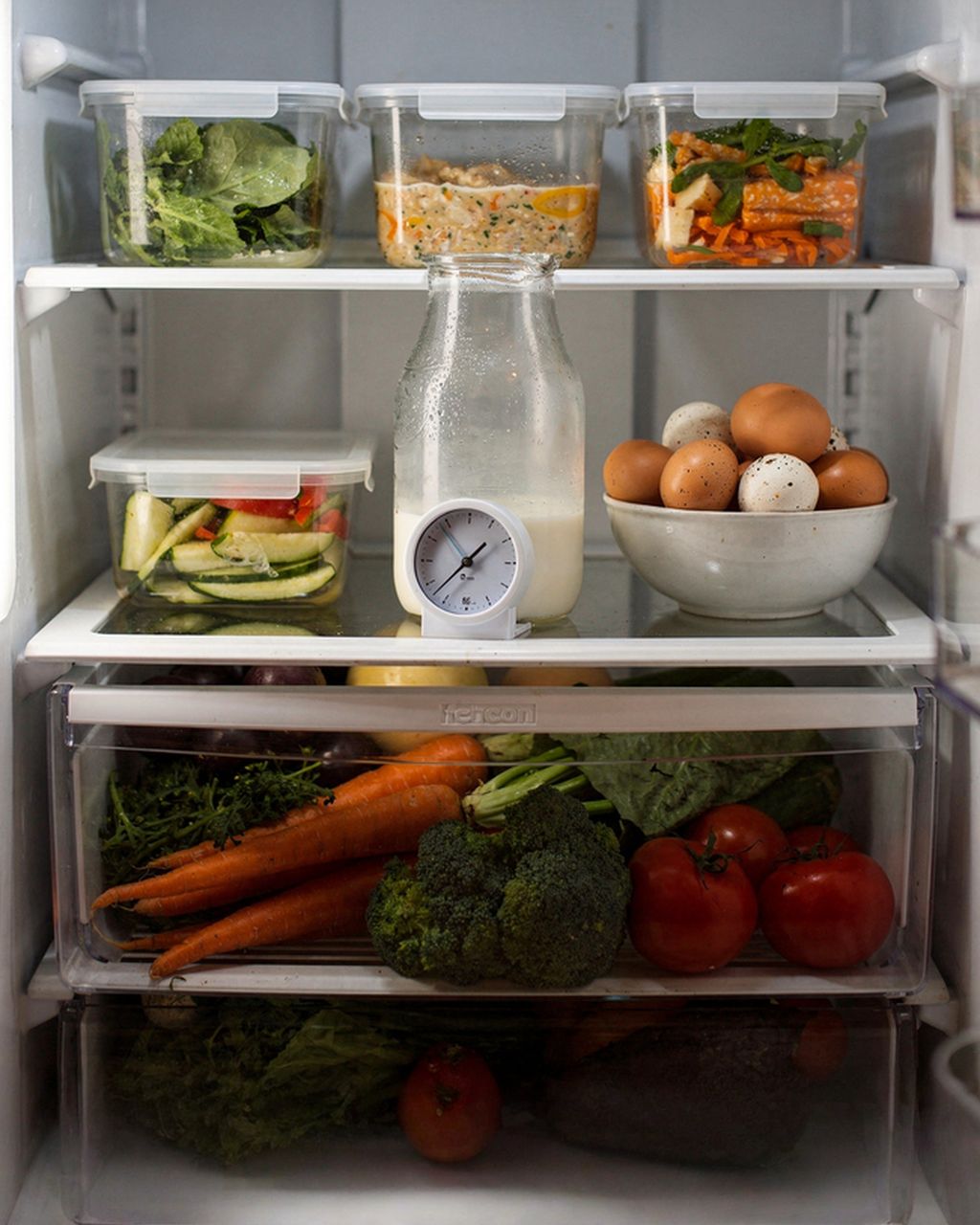
Fridge: 4°C or below, ideally 2°C (36°F). Listeria still grows below 4°C, but its growth speeds up noticeably with every extra degree. Keep the salad at the back of the bottom shelf, not in the door — the door is the warmest spot in the fridge and warms up every time it's opened.
Room temperature: no more than 2 hours. After two hours out of the cold, FSIS guidelines say the salad doesn't go back in the fridge — it gets thrown out. Chilling it again won't undo bacteria that have already multiplied or toxin that's already formed.
Above 32°C (90°F) — summer, garden parties, cars: just 1 hour. In the heat, the limit is halved, because a bowl of salad reaches ambient temperature within minutes.
Cooling after cooking: from 57°C to 21°C within 2 hours, then from 21°C to 5°C within another 4 hours — 6 hours total, at most. This two-stage method, based on the FDA Food Code, is standard practice in professional kitchens and works just as well at home. The logic is simple: the biggest risk is in the upper half of that danger zone, so get through it as fast as possible.
Meat or sausage going into the salad: heat to 74°C (165°F) at the centre, then chill it right away. That temperature reliably kills off salmonella and listeria in the raw ingredient — but slow cooling afterwards would undo all that work.
Bottom line: no more than six hours should pass between taking the potatoes off the stove and getting the finished salad below 5°C in the fridge. And less is always better.
Chilling it quickly is the single thing that will genuinely buy you extra days. A big bowl of warm salad can easily take five hours to cool down in the fridge — and it spends that whole time in the danger zone.
Chill the potatoes separately, before mixing them in. Drain them, spread them out in a single layer on a baking sheet, and let them cool in the open air. A sheet pan has a huge surface area; a pot doesn't.
Never stir mayo into warm potatoes. The heat breaks the emulsion and hands bacteria their ideal temperature at the same time. Cold to cold, always.
Use shallow containers, no more than 5 cm (2 in) deep. One big bowl cools far more slowly than three shallow containers. This is the single most effective trick in this whole article.
Split the salad up right from the start. One container for today, and a second one sealed and pushed to the back of the fridge that you don't open again. An unopened container will keep noticeably longer than one that gets a spoon dipped into it all evening.
Don't use an ice bath once mayo is already mixed in. Shock-chilling doesn't do the emulsion any favours; an ice bath belongs with the plain potatoes, before mixing.
Seal the lid after a few minutes of venting, but get it into the fridge straight away. A few minutes on the counter so the container doesn't steam up, then lid on and into the fridge; for a thicker layer, just rest the lid on top loosely until the salad's cold. Don't wait for it to cool down completely first — that's old advice that keeps it sitting exactly in the danger zone you're trying to avoid.
The most reliable sign is your nose — smell gives it away first: a sour, yeasty, or sharply "fizzy" smell instead of that mustard-and-mayo aroma. The moment you catch that smell, stop right there.
Other signs to watch for:
The dressing looks watery and separated. Clear liquid pooling at the bottom, mayo broken into little grains.
It's stringy, slippery, or the surface feels tacky. A slimy film is a classic sign of bacterial overgrowth.
Bubbles or a bulging lid. A bulging container means fermentation and gas building up inside. Don't even open a container like that over your food.
A change in colour. Grey-pink, greenish, or bluish patches, or a fuzzy coating.
A sour or sharp, off taste. But don't run this test — tasting it is the worst possible way to check, since it only takes a tiny amount of staph toxin to make you sick.
And the most important point: a salad with none of these signs can still be risky.Staph toxin doesn't change the smell, taste, or appearance. That's why the calendar and the thermometer decide, not your nose. If the salad's past its window or has been sitting in the warmth, it doesn't matter how fine it looks.
You can extend potato salad's shelf life with four things: clean hands and tools, acid in the dressing, adding onion at the plate rather than mixing it in, and always serving with a clean spoon. Most of the extra days you gain come from what happens before mixing, not after.
Clean hands and a clean board. Staph gets into the salad from hands. Washed hands, a clean cutting board, and a clean container (not the one last year's salad sat in) will extend the shelf life more than any ingredient will.
Add some acid. A spoonful of vinegar, mustard, or pickle juice lowers the pH and makes life harder for bacteria. It also tastes better the next day, so it's a win twice over.
Save the onion for the plate. Raw onion releases water into the salad, so it's better to add it just before serving. If you want it mixed in, blanch it in boiling water first.
Serve with a clean spoon and put it straight back in the fridge. Never eat straight from the container, and don't leave the bowl sitting out on the table for everyone to help themselves whenever. Serve half, and keep the rest sealed in the fridge, starting its own fresh clock.
And one thing that doesn't work: freezing it as a safety net. More on that next.
Don't freeze potato salad made with mayo — it'll turn into a watery mush once thawed. This happens for two independent reasons at once:
The mayo breaks down. Water in the emulsion freezes into ice crystals, which melt again on thawing and cause the oil to separate. What's left is a curdled, grainy sauce. Stirring won't fix it.
The potato turns watery and grey. Frozen starch retrogrades — on thawing it releases water and breaks down into a mealy, spongy texture with a slightly brownish tinge.
And most importantly: freezing doesn't reset the clock. Bacteria don't die in the freezer, they just go dormant, and any toxin that's already formed won't disappear just because it's frozen. A salad that was borderline before freezing will still be borderline after thawing.
If you need to get ahead of things, freeze the components, not the finished salad — cooked meat or fish can go in the freezer, but mayo and potatoes shouldn't. Always make the finished salad fresh, ideally the day before serving.
Make your Christmas Eve potato salad on the afternoon or evening of December 23rd — that leaves just one day until Christmas Eve, keeping you safely within the window, while giving the salad time for the flavours to come together. Mixing it on the 21st or 22nd is a gamble with the mayo version, because by the evening of the 24th you're already on day three.
A schedule that actually works in practice:
December 22nd: boil the potatoes and eggs, chill them, and keep them in the fridge separately. Cooked potato holds up fine in the cold on its own.
December 23rd: chop everything, mix the dressing, split it between two shallow containers, and refrigerate at 2–4°C.
December 24th: take out only the portion you're serving. Keep the second container sealed.
No more than 2 hours on the table. Candles and a warm kitchen shrink that window faster than you'd expect.
Leftovers: with store-bought mayo, you're good through the 25th and 26th; with homemade mayo, there shouldn't be any — eat salad mixed on the 23rd by the evening of the 24th.
Since we're on the subject of the Christmas Eve table, here's how long carp keeps in the fridge and how to store it — both the fish and the salad boil down to the same two numbers: temperature and time.
You'll find exact ratios and methods in the recipes below — their shelf life mainly comes down to how much mayo is in the mix.
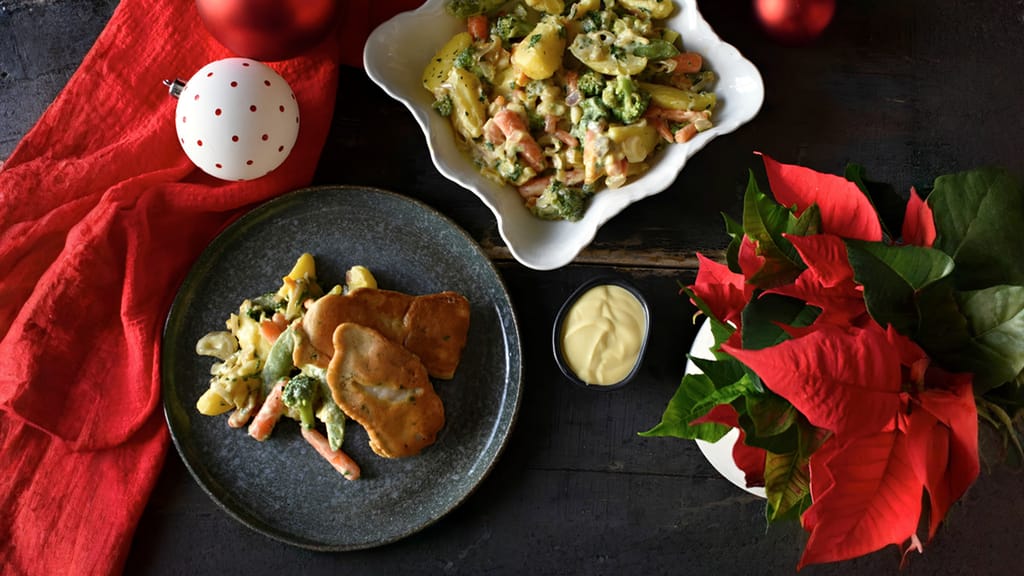
An unconventional christmas eve menu: fresh potato salad
Fresh Christmas Eve potato salad — a lighter dressing that keeps longer in the fridge than the classic mayo version
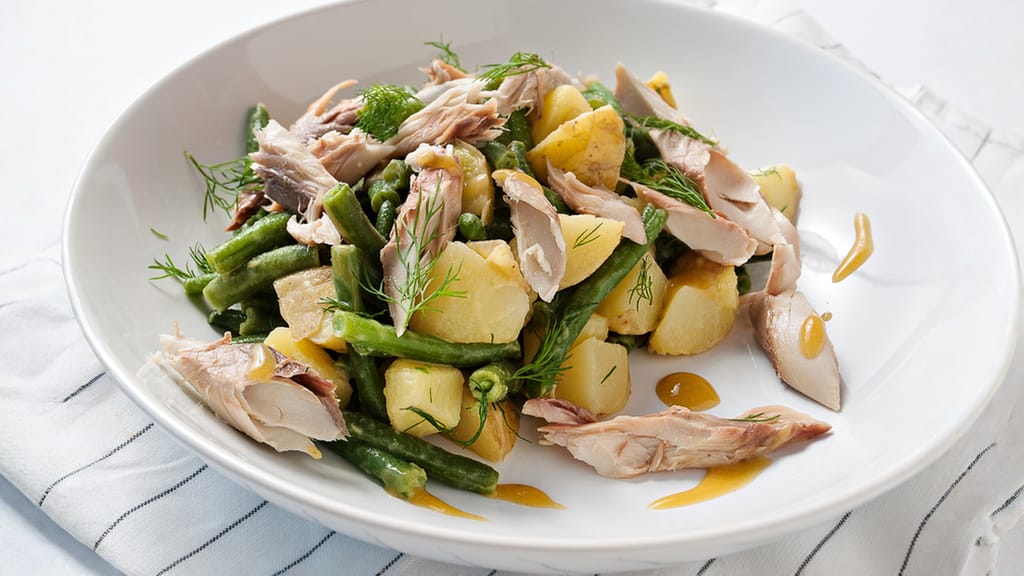
Potato salad with green beans and smoked mackerel
Potato salad with green beans and smoked mackerel: plan for a shorter window here, just two days in the fridge
Divine homemade mayonnaise
Amazing homemade mayo for potato salad — and why that means you'll want to eat it within two days
Eat store-bought potato salad within 24 hours of opening, unless the label says otherwise. The use-by date on the pack only applies while it's sealed — once opened, air and spoon bacteria get in. Transfer it from the tub into an airtight container and keep it at 4°C (39°F) or below.
Skip homemade potato salad made with raw egg yolk during pregnancy, and with other versions, only eat it fresh and well chilled. The concerns are listeria, which can multiply even at fridge temperature, and salmonella from raw eggs — both carry much higher risks during pregnancy. A safer choice is salad made with store-bought mayo from pasteurised egg yolks, eaten the same day. Ask your doctor for specific guidance.
Potato salad turns watery because salt draws liquid out of the vegetables and starch releases water as it cools — not because of the mayo. On its own, this isn't a sign it's gone off: if the salad smells normal and is still within its window, just give it a stir. To avoid this, salt the vegetables before mixing, let them release their water, and drain it off.
Only transport potato salad in a cool bag with ice packs, and count on a maximum of two hours from taking it out of the fridge to serving it. In a hot car, the salad can climb past 32°C (90°F) within minutes, which cuts that limit down to just one hour. Ideally, travel with the container pre-chilled, filled right to the top, and don't open it until you arrive.
Let potato salad sit out only briefly before serving — the flavour opens up a bit, but that time still counts toward your two-hour limit outside the fridge. So only take out the portion you're actually putting on the table, and keep the rest sealed and chilled. A bowl left sitting on the table all evening is the classic reason potato salad doesn't even make it through its stated shelf life.
One recipe worth heating the oven for, one tip, and one deal from the shop. Nothing else.