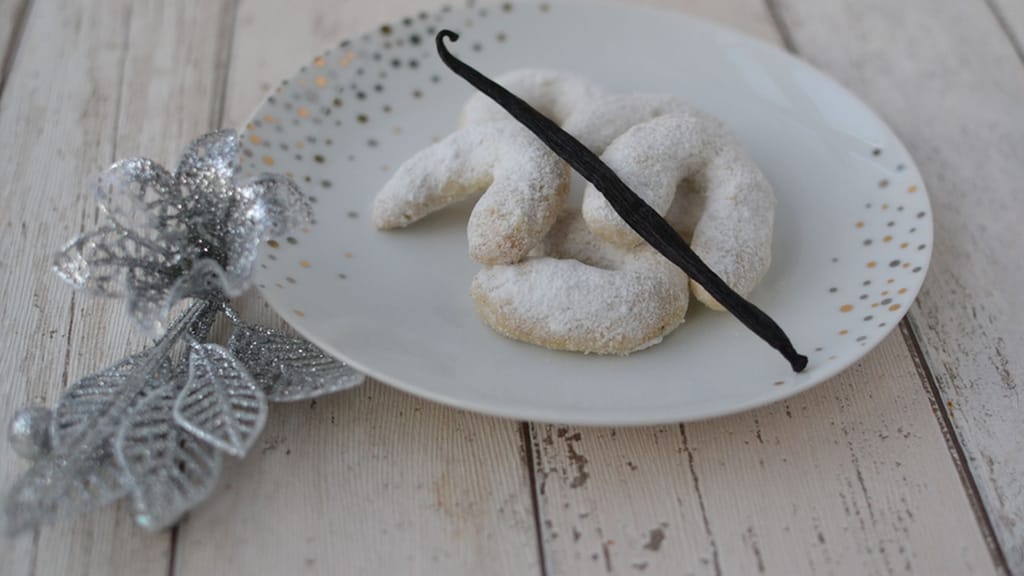
The best christmas cookies? vanilla crescents, of course!
Dipping Christmas Cookies in Chocolate: How to Get a Shine That Won't Smudge
Updated Oct 8, 2026
Dipping Christmas cookies in chocolate works beautifully once you nail two things: use real chocolate with cocoa butter (couverture), and dip at the right working temperature – for dark chocolate that's 31–32°C/88–90°F. Done right, the chocolate sets within minutes, turns glossy, snaps when you bite into it, and leaves no smudges on your fingers or in the storage tin. When chocolate smears, it's almost always because it was simply melted rather than properly tempered. Below you'll find which chocolate to choose, a step-by-step dipping guide, and how to store your cookies so they don't turn grey before Christmas.
If chocolate smears, it means it wasn't tempered properly – the cocoa butter has set into unstable crystals that melt at room temperature or simply from the warmth of your fingers. According to the literature, the stable crystal form of cocoa butter (the so-called Form V) melts at around 34°C/93°F – just below mouth temperature. That's exactly why well-tempered chocolate stays firm in your hand yet melts beautifully on your tongue.
The usual suspects behind dull, sticky or greyish coatings:
Chocolate that was simply melted and left to set on its own. It hardens slowly, stays soft and dull, and within days develops grey streaks (fat bloom).
Added fat – butter, coconut oil or vegetable oil. These thin the chocolate out, but also soften it and rob it of both shine and snap.
Water or steam. Just a few drops from a bain-marie are enough to seize the chocolate into a lumpy paste.
Cold cookies straight from the fridge. Chocolate sets on them instantly in a thick layer, and as they warm up, condensation forms – leading to sugar bloom, that whitish powdery film.
Overheated chocolate. Above roughly 50°C/122°F for dark chocolate (even lower for milk and white), it can scorch and thicken.
The best choice for dipping cookies is couverture – a chocolate with a higher cocoa butter content, which flows thinly and, once tempered, sets with a lovely shine and snap. A good bar of eating chocolate also works well; compound chocolate (chocolate coating) is the fallback option. Here's an honest comparison:
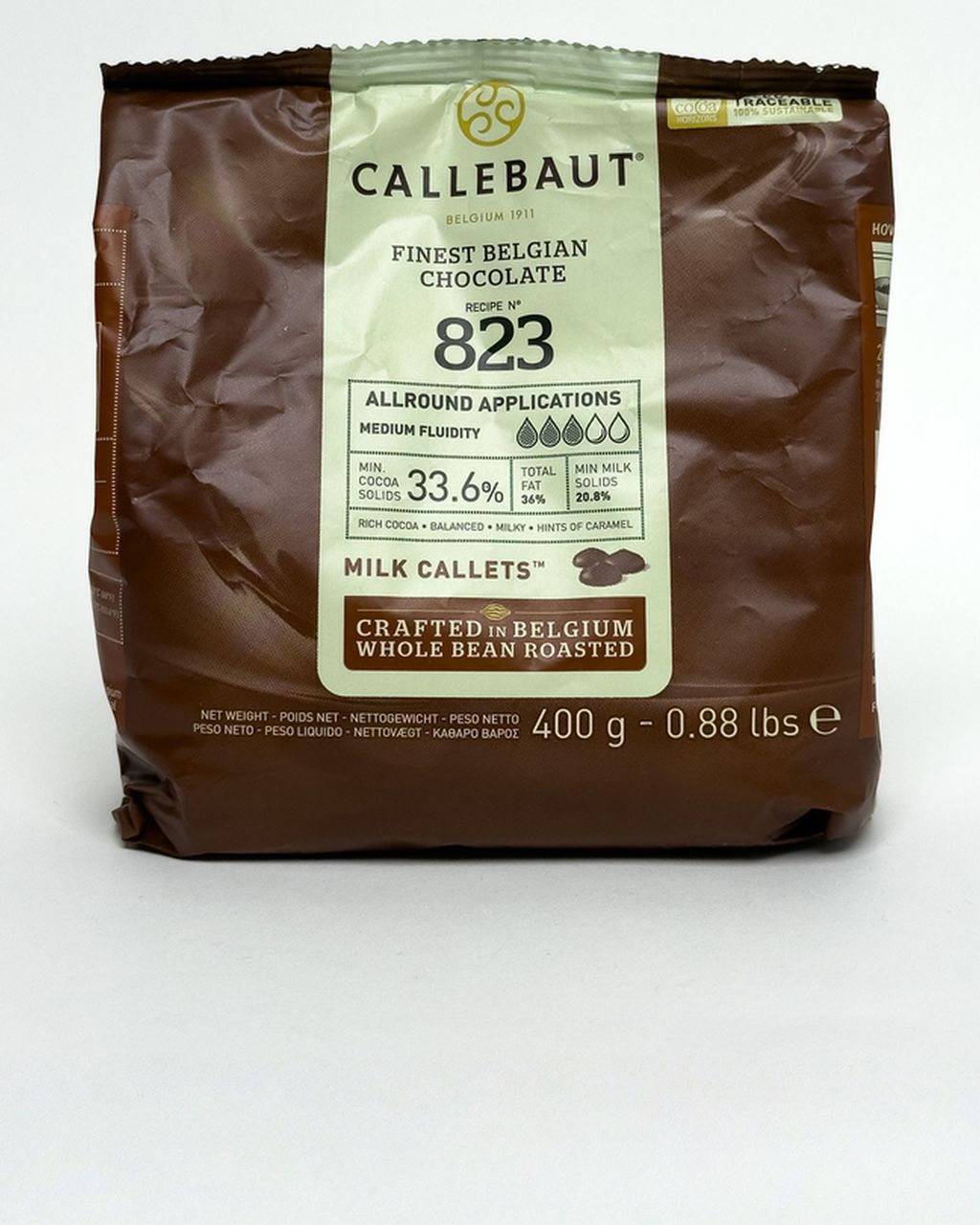
Couverture (e.g. Callebaut callets). Flows thin, leaves an even, thin layer, and sets glossy with a nice snap. It does need tempering, but the small callets make that quick and easy. Best flavour and best looks.
Good-quality bar chocolate. Can also be tempered and tastes great, but tends to be thicker – meaning a heavier coat and more dripping off the tips. Perfectly fine for a smaller batch of cookies.
Baking chocolate. Often lower in cocoa butter and thicker in consistency. It doesn't dip as well; the differences are explained in our article on couverture vs. baking chocolate.
Compound (cocoa) coating. Here the cocoa butter is replaced with vegetable fat, so no tempering is needed – it sets almost on its own. The trade-off is flavour: it's waxier, less "chocolatey", and melts more slowly in the mouth. We don't sell compound coating ourselves, but if you're short on time and simplicity matters more than perfection, it's a legitimate shortcut.
Chocolate with coconut oil stirred in. A popular trick for "thinning" chocolate. It flows more easily, but sets softer and smears – exactly the problem you're trying to avoid.
Watch the labelling: under Czech food law, genuine couverture can legally be called "chocolate coating" too. What matters is the cocoa butter content, not the word "coating" – compound coating replaces that cocoa butter with vegetable fat instead.
For shine that actually lasts, reach for couverture. Callebaut 811 callets (dark, 54.5% cocoa) are ideal for dipping: according to the manufacturer they have medium fluidity (3 drops) and a working temperature of 31–32°C/88–90°F. For more delicate cookies, milk Callebaut 823 works well, and white Callebaut W2 is great for contrasting stripes and splatters. We go into what these numbers mean and when to use which in our guide to Callebaut 811, 823, W2 and RB2.
Yes – if you want shine and a coating that won't smear, you need to temper the chocolate before dipping. Skip tempering and even real chocolate will set dull and soft, turning grey within days.
You'll find the full method (seeding, tabling on a marble slab, and the bain-marie technique) in our guide, how to temper chocolate for a perfect shine. For dipping, the main thing to remember is the working temperature you should dip at:
dark chocolate: 31–32°C/88–90°F (Callebaut 811: 31–32°C/88–90°F)
milk chocolate: 29–31°C/84–88°F (Callebaut 823: 29–30°C/84–86°F)
white chocolate: 28–30°C/82–86°F (Callebaut W2: 28–29°C/82–84°F)
Exact figures vary slightly by brand – always check the packaging. No thermometer? Here's a quick test: dip the tip of a knife or a strip of baking paper and let it sit at room temperature. Properly tempered chocolate will set within 3–5 minutes, looking glossy with no streaks. If it's still wet or turning grey after 10 minutes, temper it again.
Dip room-temperature, fully cooled cookies into tempered chocolate, let the excess drip off, wipe the underside, and set them down on baking paper. In detail:
Prep the cookies. They need to be completely cool and at room temperature (ideally 18–22°C/64–72°F) – not straight from the fridge or a cold balcony. Brush off any crumbs, as they'll clump up in the chocolate.
Set up your station. A tray or board lined with baking paper or a silicone mat, a fork or tweezers, and a clean, dry cloth. Everything needs to be bone dry.
Melt plenty of chocolate. Aim for at least 200–300 g, even if you'll use less. A small amount cools too quickly and doesn't give you enough depth to dip into properly. A deep, narrow bowl works better than a wide, shallow plate.
Temper the chocolate and check it with the knife test (see above).
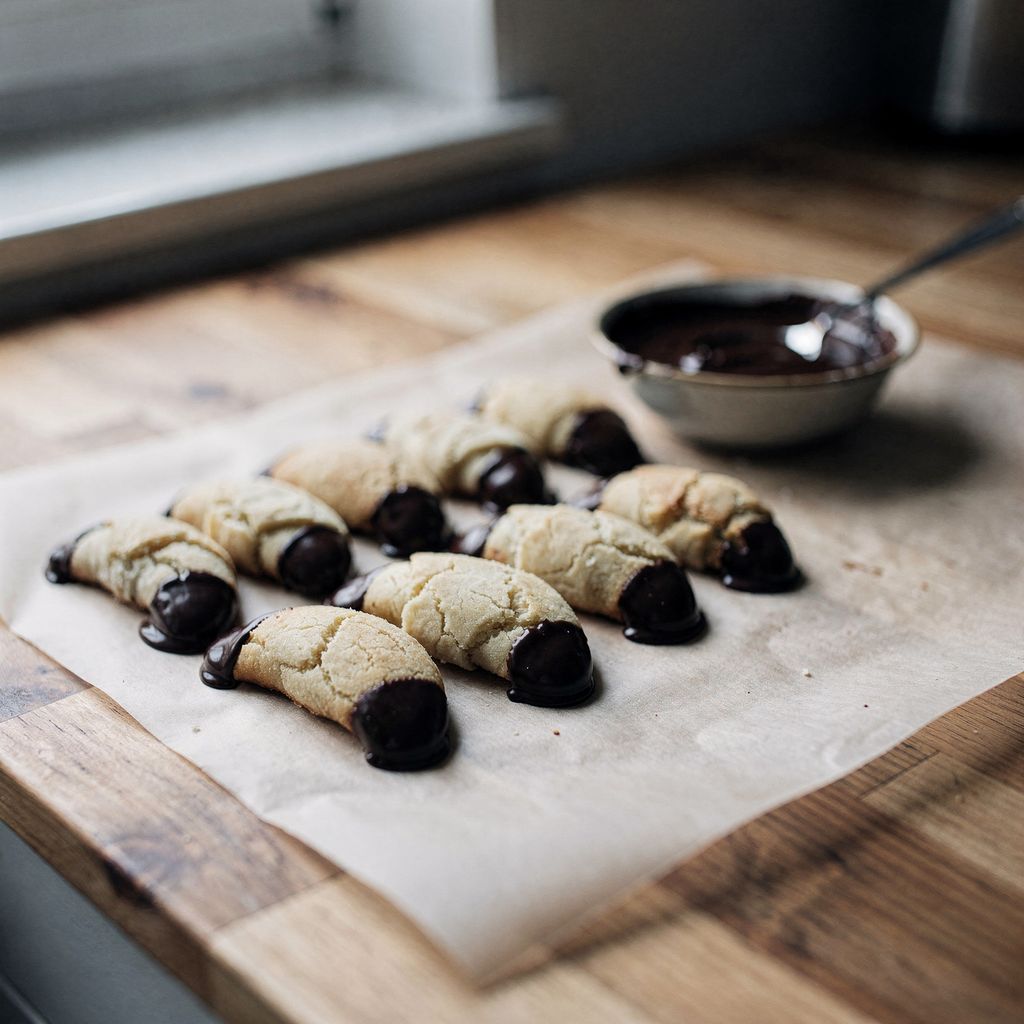
Dip in one smooth motion. Submerge the part you want coated – the tips of crescents by 1–2 cm, half a round biscuit, or the whole piece balanced on a fork.
Let it drip for 3–5 seconds, tap gently against the edge of the bowl, and wipe the underside against the rim. This stops a "foot" forming – a pool of chocolate spreading out around the base of the cookie.
Set it down on the baking paper and don't touch it again. Add sprinkles or chopped nuts straight away, while the chocolate is still wet.
Let it set at room temperature (ideally 16–20°C/61–68°F). You can pop the tray in the fridge for 5–10 minutes, but no longer – otherwise you risk condensation and a grey film.
Keep an eye on the chocolate as you go. Stir and check the temperature every few minutes – more on that in the next section.
Chocolate thickens as you dip because it's cooling and continuing to crystallise – bring it back to working temperature with a brief reheat, not by stirring in fat. In practice:
Warm it in small increments: 5–10 seconds in the microwave, or a few seconds over a bain-marie, then stir thoroughly. The goal is to nudge the temperature up by about 1°C/2°F, not blow past the working temperature.
Watch the upper limit. Dark chocolate above roughly 34°C/93°F, milk above 32°C/90°F, and white above 31°C/88°F will lose its temper (for Callebaut 811 / 823 / W2 the manufacturer gives this as 34.5 / 32.5 / 31.5°C or 94/90/89°F) – past that point, you'll need to re-temper it.
If it keeps thickening even within the right temperature range, it's over-crystallised. Warm it gently to the top of the working range – dark to 32°C/90°F, milk to 31°C/88°F, white to 30°C/86°F, no higher – or stir in a couple of spoonfuls of melted, untempered chocolate of the same type. Then dip straight away.
If using a bain-marie, watch out for steam. The bowl shouldn't touch the water, and the water shouldn't be simmering or bubbling.
If your chocolate still feels too thick even at the right temperature, our article on how to thin chocolate so it flows better covers ways to loosen it without losing the shine, such as adding cocoa butter. White chocolate is more prone to overheating, so it's also worth reading how to melt white chocolate without it seizing.
The cookies most often dipped in chocolate are vanilla crescents, linzer biscuits, gingerbread, coconut macaroons, nutty cookies and petit fours. Each one calls for a slightly different approach:
Vanilla crescents – they're still warm when rolled in vanilla sugar, so let them cool completely first, then dip just the tips, about 1–2 cm. Tap off any loose sugar before dipping so it doesn't fall into your chocolate bowl. Here's our basic vanilla crescent recipe.
Linzer biscuits – best to dip half the round, or just the base. Sandwich them with jam beforehand and let the jam set, so it doesn't bleed into the chocolate. Try our crumbly linzer biscuit recipe.
Gingerbread – dip the base or a corner, then decorate the rest with royal icing. Give our soft gingerbread cookies a try.
Coconut macaroons and nutty cookies – dip just the base and set them upside down, so you get a flat, glossy surface; smaller pieces can be dipped whole on a fork.
Petit fours and sandwiched cookies – these are coated from the top: set them on a wire rack over a tray and spoon the chocolate over. Let any filling set in the fridge first, then bring the cookies back to room temperature before coating.
For a nice contrast, once the dark pieces have set, drizzle them with white Callebaut W2 chocolate from a piping bag with the tip snipped off. For a coloured version of white chocolate, see our article on how to colour white chocolate. For more ideas and ingredients, head to our Christmas cookies page.
The best christmas cookies? vanilla crescents, of course!
Vanilla crescents, ready for dipping their tips in chocolate
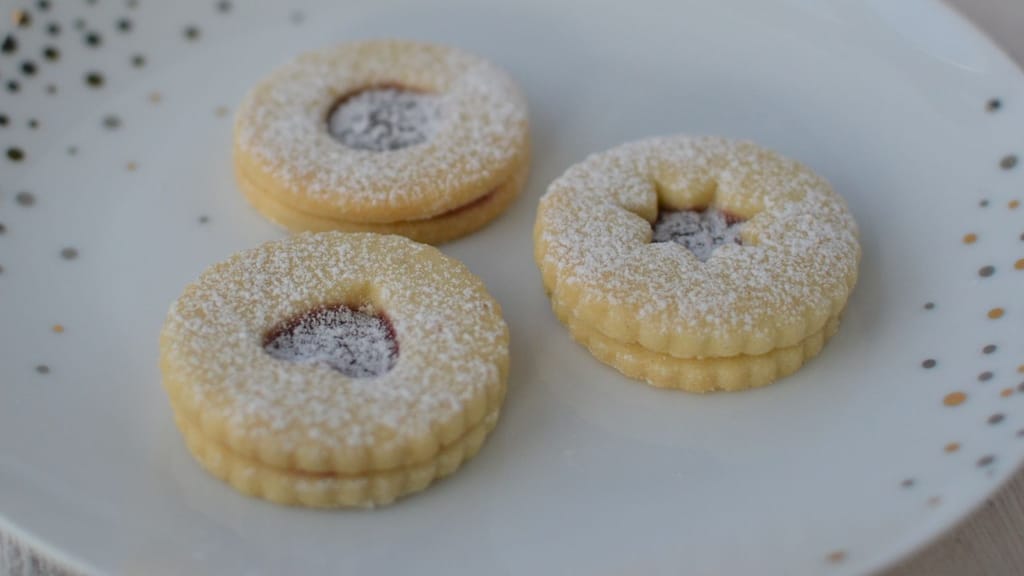
Classic christmas cookies: delicate linzer cookies
Crumbly linzer biscuits with a chocolate-dipped half
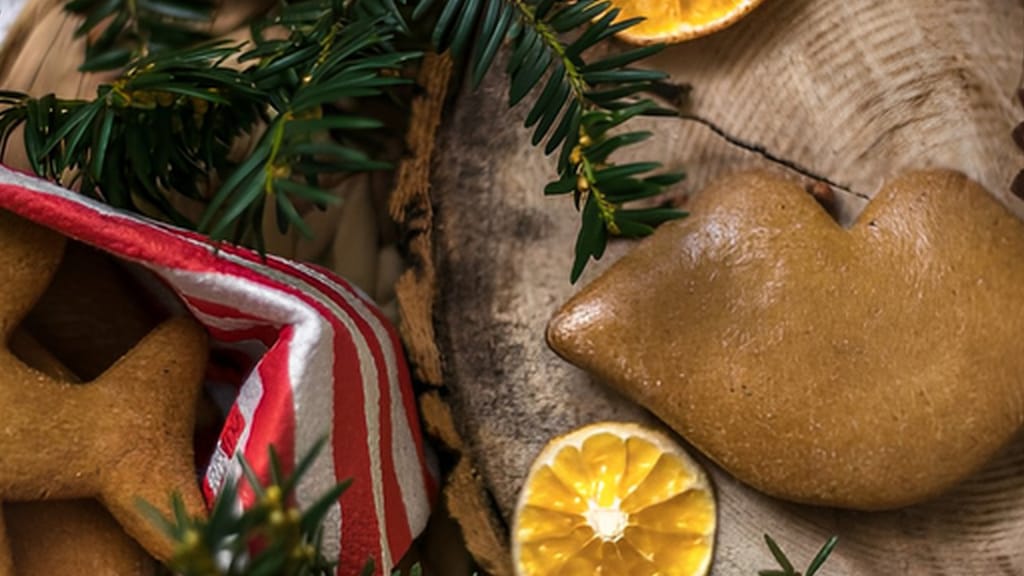
Soft gingerbread cookies
Soft gingerbread cookies with a chocolate-dipped base
Store dipped cookies in a sealed container somewhere cool, ideally at 12–18°C/54–64°F, and avoid sudden temperature swings. Both grey streaks (fat bloom) and that whitish powder (sugar bloom) are caused mainly by swings between warm and cold, plus moisture.
Layer with baking paper between the cookies so the glossy surfaces don't rub against each other.
Keep them away from radiators or a warm windowsill – the chocolate will soften, then turn grey once it cools back down.
Only use the fridge as a last resort. If you do, keep them in a well-sealed container, and let it warm up to room temperature for an hour before opening, so no condensation forms on the chocolate.
Keep soft-filled cookies separate from dry ones, so moisture doesn't transfer between them.
For more on why chocolate turns grey and how to store it generally, see our article how to store chocolate and why it turns grey.
Chocolate on dipped cookies cracks most often when the layer is too thick or the cookies were cold when dipped. Dip cookies at room temperature, and always let any excess chocolate drip off so the layer stays thin.
Properly tempered chocolate sets at 16–20°C/61–68°F within 5–10 minutes, and fully crystallises by around the next day. You can pack the cookies into a tin as soon as the chocolate no longer feels sticky to the touch; untempered chocolate takes much longer to dry and stays soft.
You can freeze chocolate-dipped cookies, but the chocolate often turns dull or whitish after thawing due to condensation. If you're planning to freeze, it's better to freeze the plain cookies and dip them in chocolate after thawing. If they're already dipped, thaw them in a sealed container and only open it once they've reached room temperature.
Yes, you can easily melt chocolate for dipping in the microwave – just heat it in 20–30 second bursts, stirring well each time. Dark chocolate shouldn't go above roughly 50°C/122°F, and milk or white above 45°C/113°F. After that, temper it, and only heat in short 5–10 second bursts from then on.
For dipping the tips or halves of cookies, you'll typically use around 100–150 g of chocolate per tray, but melt at least 200–300 g so you have enough depth to dip into properly and it doesn't cool too quickly. Let any leftover chocolate set on baking paper and reuse it next time.
One recipe worth heating the oven for, one tip, and one deal from the shop. Nothing else.