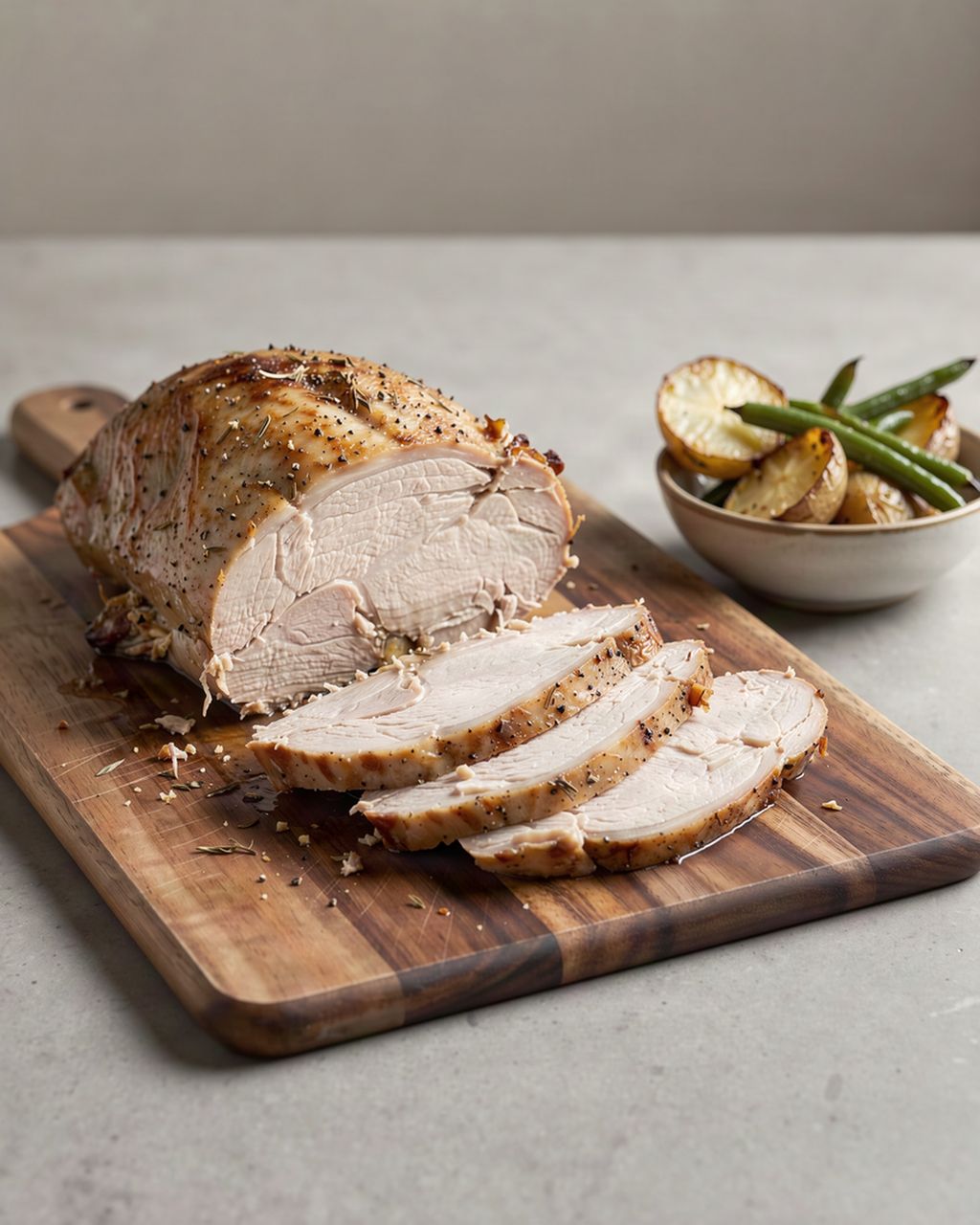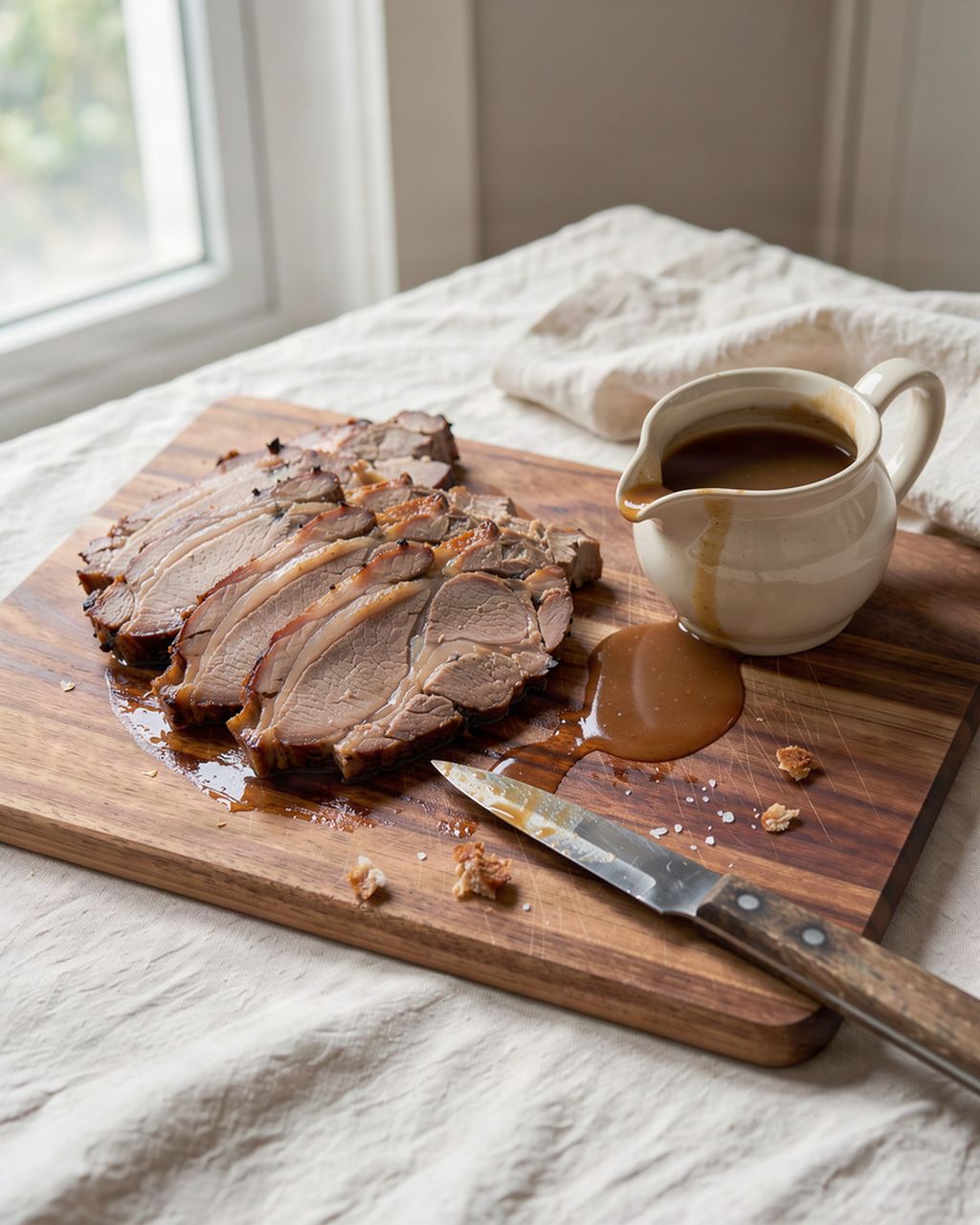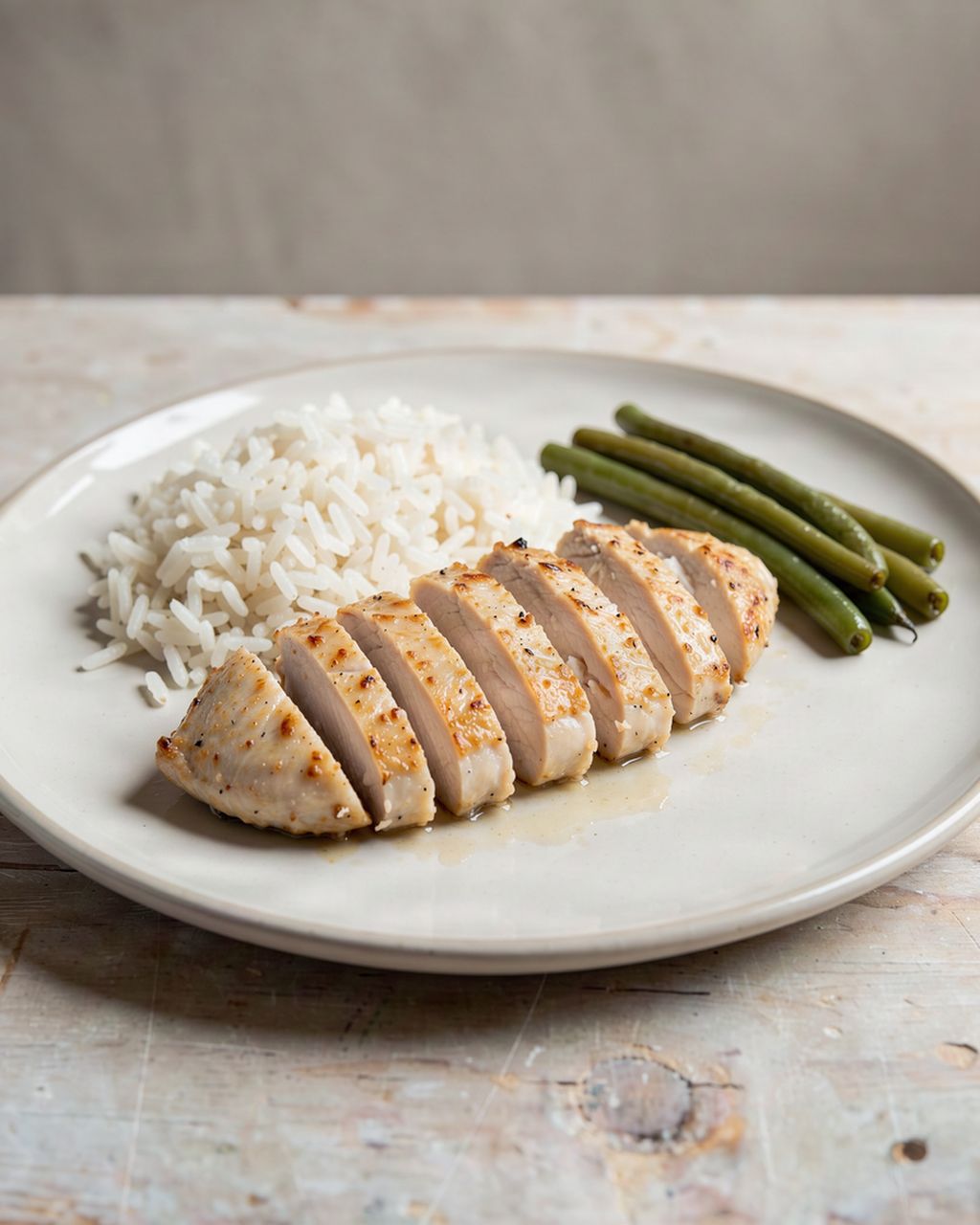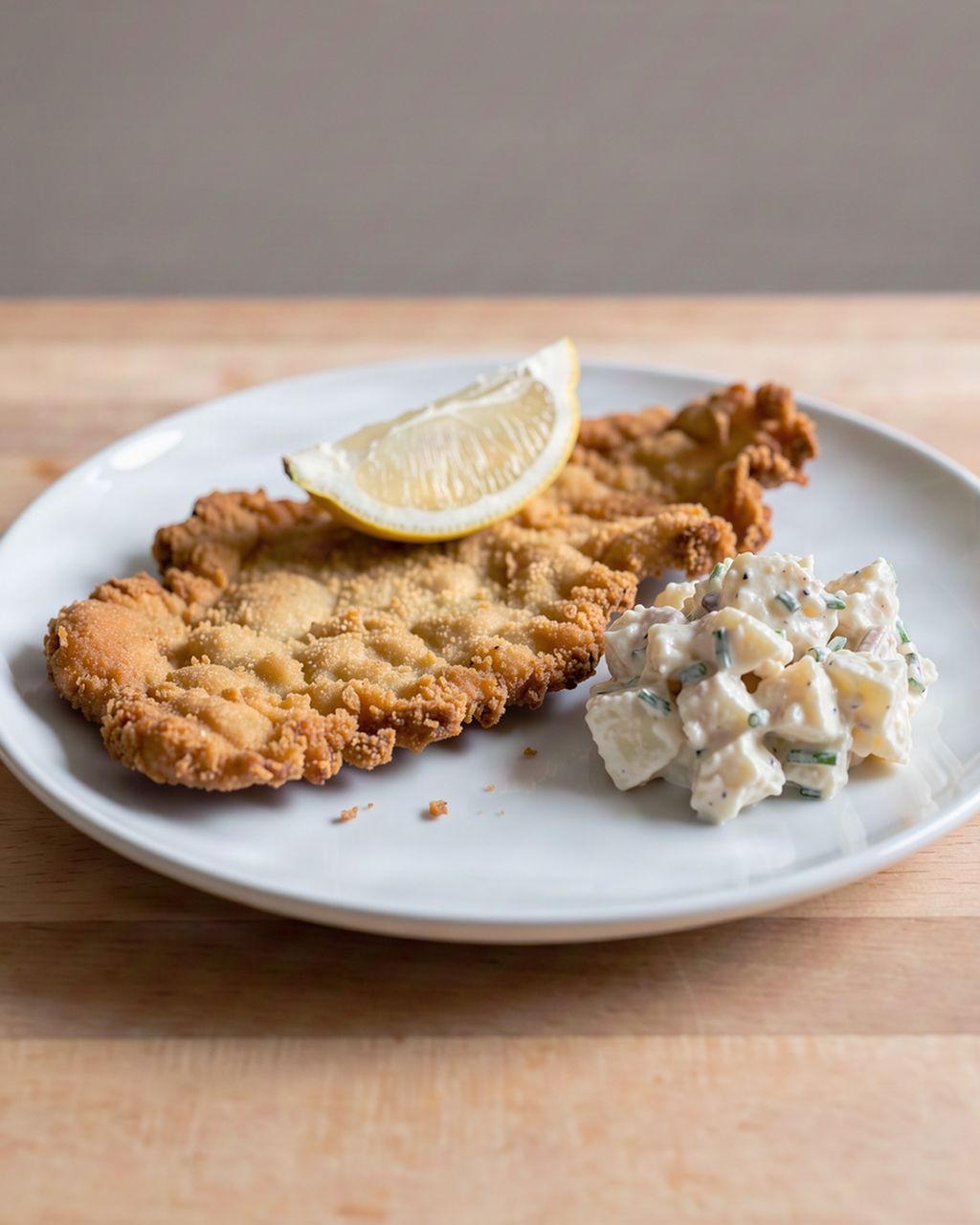
Chicken roulades with four fillings
Chicken Roulades and Meat Roulades: Fillings, Tying and Oven Roasting
Updated Nov 20, 2026
To make chicken roulades, pound the breast to an even thickness, salt it, spread on the filling leaving a border, roll it up tightly, tie it with kitchen twine, brown it until golden and finish it in the oven until the center reaches 74°C (165°F). The same method works for a turkey roulade and for veal roulades; mainly the thickness of the meat and the cooking time differ. Below you'll find fillings that work, knots that hold and the mistakes that make a roulade leak or dry out.
A chicken roulade takes six steps: pound, salt, fill, roll, tie and bake. Each has a reason, and if you skip one, you'll notice it on the plate.
Pound the cutlet to an even thickness of about 1 cm. Evenly thick meat cooks at the same rate, so the thin edge doesn't dry out before the center is done.
Salt both sides. Salt on the inner side seasons the meat where you can't reach it from the outside.
Spread the filling, leaving a 1–2 cm border around the edge. When you roll, this border presses together and seals the filling inside.
Roll tightly from the shorter side, without air pockets.
Tie with kitchen twine or secure with toothpicks.
Brown on all sides in a skillet until golden, then finish in the oven or braise under a lid until a thermometer in the center reads 74°C (165°F).
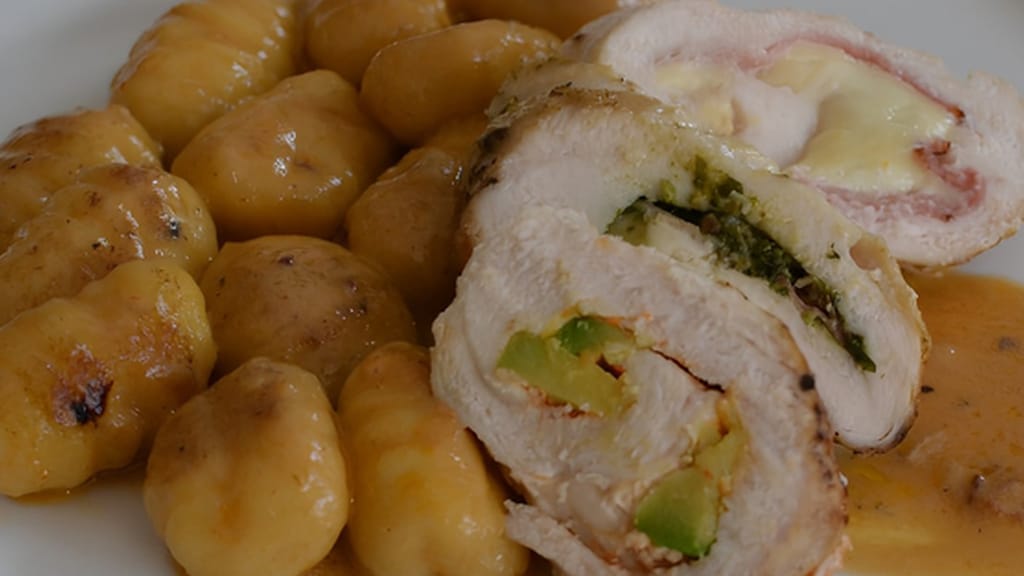
The easiest place to start is chicken roulades with four fillings: from one batch of breasts you make four flavors at once, from wild garlic to mango chutney with brie, and find out which filling holds best in a roulade.
Recipe of the week, one tip that saves you time and one deal from the shop. Unsubscribe in one click.
The next issue goes out on Thursday, November 26.
You can make a chicken roulade from thin breast cutlets or from a whole breast opened like a book; cutlets give smaller, portion-sized roulades, while a whole breast gives one larger, juicier roulade. A cutlet makes a roulade that is just right for one serving, while a whole breast holds more juice and shows a nicer spiral when sliced.
Cutlets: quicker, each roulade is a portion, ideal for several fillings at once. Bake for a shorter time, because thin meat dries out fast.
Whole breast opened like a book: cut lengthwise about two thirds of the way through, open it out and pound it flat. You get a larger sheet without holes.
If you're buying skinless chicken breasts, pick pieces of similar size so all the roulades finish cooking at the same time. Don't rinse the meat before filling, just pat it dry with a paper towel: a wet surface browns poorly, and tap water splashes bacteria across the counter.
The whole-breast method is shown in the chicken roulade with goat cheese and wild garlic: you pound the breast, spread it with wild garlic, drained goat cheese and sun-dried tomato, and instead of baking it, braise it in stock made from its own bones.
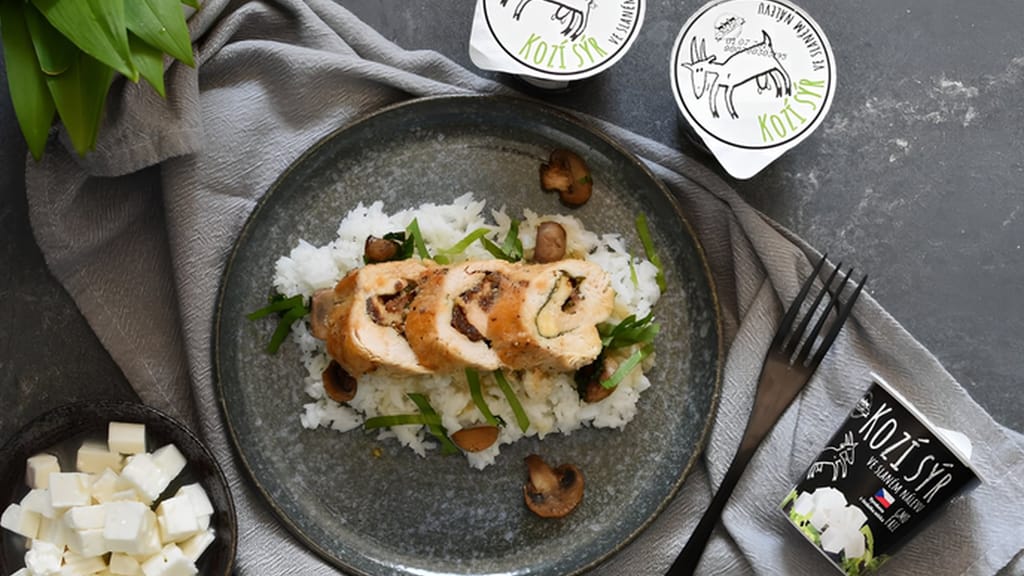
Chicken roulade with goat cheese and wild garlic
Chicken roulade with goat cheese and wild garlic, braised in broth
A chicken roulade needs a filling that is bold in flavor and doesn't release much water. Chicken breast is mild on its own, so it needs salt, fat or acidity from the inside.
Combinations that work:
ham and cheese (the classic; salty ham seasons the meat for you)
sun-dried tomatoes with goat cheese or mozzarella
wild garlic, pesto or an herb paste
mustard with bacon
sweet-and-sour chutney with a soft cheese such as brie
bread-and-egg stuffing
Three rules to keep the filling inside: a thin layer (about 5 mm), well-drained moist ingredients, and never cheese all the way to the edge of the meat. Runny cheese is the most common reason a roulade "weeps" in the oven.
Ham and cheese is the most reliable filling, because the ham acts as an inner wrapper: it holds the cheese together and salts the meat. On a pounded, lightly salted cutlet, lay a slice of ham so that it covers almost the whole surface, put a strip of cheese on it just down the middle and roll up. Choose a cheese that melts but doesn't run like water: Edam, Gouda or Emmental. Brown on all sides and finish in the oven at 180°C (350°F) until it reaches 74°C (165°F) inside; for smaller roulades made from cutlets, that's around 20 minutes.
For a more pronounced version, use cured ham, such as Parma ham. It is saltier and drier than cooked ham on the bone, so it adds flavor to the chicken without releasing water; go lighter on the salt on the cutlet.
Spinach makes a juicy chicken roulade, as long as you get the water out of it. Fresh leaves can go in as they are; thaw frozen spinach and squeeze it thoroughly in your hands or through a kitchen towel. Spread a little chopped garlic over the cutlet, add a cheese that holds its shape, and lay the spinach on top. Roll, tie and bake just like the ham version.
This principle is shown by the turkey roulade with spinach and provolone, which we cover below in the turkey section. You can transfer it to chicken breast one to one; the roulade will just be smaller and ready sooner.
Sun-dried tomatoes give a roulade concentrated sweet-and-sour flavor and almost no water, which makes them ideal for a filling. Let the tomatoes drain on a paper towel and cut them into strips; you need only a few, as the flavor is strong. They pair best with fresh goat cheese, mozzarella or basil. Goat cheese is soft, so put it just down the middle of the cutlet and tie the roulade more tightly.
You'll find exactly this combination in the chicken roulade with goat cheese and wild garlic above.
Chicken roulade with stuffing is an Easter and Sunday classic: instead of cheese, there is a bread-and-egg mixture inside. Moisten diced rolls with milk whisked with an egg, add chopped parsley or chives, salt and nutmeg, and let it soak for a while. The mixture should be moist but not runny, so you can spread it with a spoon. Spread it in a thin layer on the pounded sheet of meat, roll, tie and bake right away at 180°C (350°F) for about 25 to 35 minutes, depending on size. The stuffing inside has to cook through just like the meat: count on 74°C (165°F) in the center, not just in the meat near the edge.
If you like a bolder stuffing, take a look at the Easter stuffing with smoked meat and wild garlic. That one is baked separately in a baking dish at 180°C (350°F) for 30 to 40 minutes; for the roulade, take only the idea from it and make the mixture thicker.
To keep a roulade from leaking, you need three things: a border of meat without filling, a tight roll and a tie that holds along the whole length. A single toothpick at the end isn't enough, since roulades most often open in the middle.
Kitchen twine (cotton, undyed and plastic-free):
Place the roulade seam side down.
Slide the twine under one end, pull tight and make a double knot.
Don't cut it yet: run the twine along the roulade, and every 2 to 3 cm slide it under the roulade and pass it through under itself, forming a loop. Tighten and continue.
At the other end, turn the twine back along the underside and tie it to the starting end.
A simpler option is separate loops: one loop of twine every 3 cm and a double knot. It holds just as well, but there are more knots to untie.
Toothpicks and skewers suit smaller roulades made from cutlets. Push them in at an angle across the seam so they go through both layers of meat, and count them so none ends up on a plate. Silicone roasting bands can be reused and come off in one movement.
These also help:
Let the roulade rest in the fridge for 10 to 15 minutes before cooking. The cold cheese and butter in the filling melt later, and the meat firms up in the meantime.
Sear the seam side first. The proteins tighten in the heat and "glue" the seam shut.
You can wrap a chicken roulade in slices of bacon or cured ham. The wrap pulls the roulade in like a stocking and holds its shape even without twine.
Bake chicken roulades in an oven heated to 180°C (350°F) until they reach 74°C (165°F) in the center; roulades made from cutlets usually take 20 to 25 minutes, and a large roulade from a whole breast 35 to 45 minutes. The time is only a guide; the temperature in the center decides.
The best result comes from combining skillet and oven:
Brown the roulade on all sides in hot oil until golden, about 5 to 6 minutes. The crust adds flavor, and the drippings in the pan are the base of the sauce.
Transfer to a baking dish and finish in the oven. Don't wash the pan with the drippings.
Insert a probe thermometer into the center of the thickest roulade, ideally right into the filling.
Let the finished roulade rest for 5 to 10 minutes under loosely laid aluminum foil. The juices return to the meat and the filling firms up a little, so the slices hold together.
The second option is braising: pour broth or wine around the browned roulade, cover with a lid and keep it on low heat until it reaches the target temperature. A braised roulade is juicier, while a baked one has a crispier surface.
Don't chase a higher oven temperature with chicken roulades. At 220°C (425°F) the surface dries out and darkens before the center, with its cold filling, is cooked through.
A turkey roulade is made just like a chicken one, only from a larger piece: 700 g of skinless turkey breast is enough for one large roulade or four smaller ones for four people. Turkey meat is denser and thicker, so you almost always have to open it out or cut it into slices and pound them flat.
Two Yumsto recipes show both approaches:
Turkey roulade stuffed with white asparagus: four smaller slices with cured ham and an asparagus spear inside, which gives the roulade a firm core and makes rolling easier.
Creamy risotto with turkey roulade: one large sheet from a breast opened like a book, with provolone and spinach inside and a 1–2 cm border without filling so the cheese doesn't leak out during braising.
For turkey, the same target temperature applies as for chicken, 74°C (165°F) in the center. A large roulade made from a single sheet needs longer in the oven or under the lid, so this is where you'll appreciate a thermometer most.
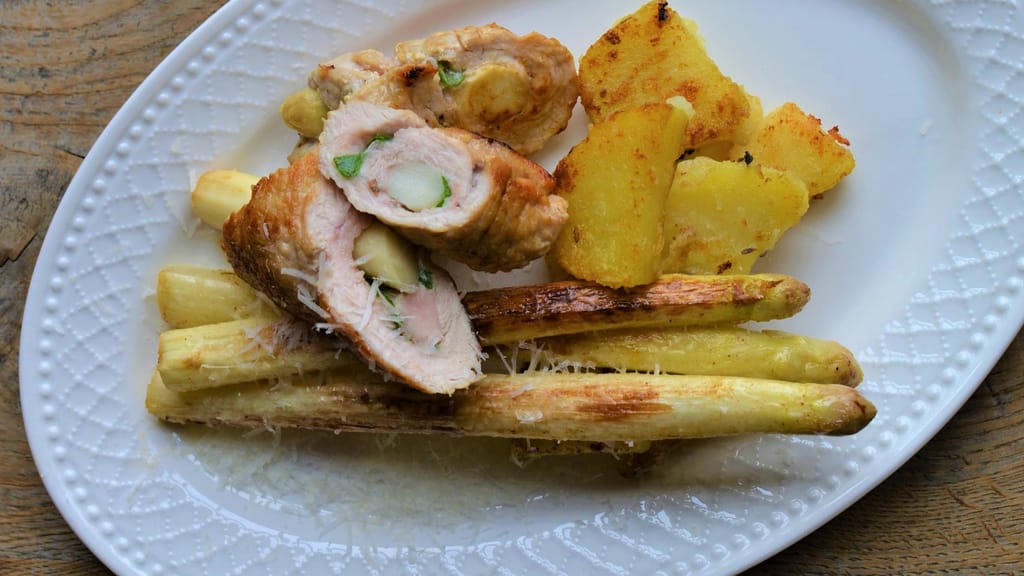
Turkey roulade stuffed with white asparagus and roasted asparagus
Turkey roulade stuffed with white asparagus and cured ham
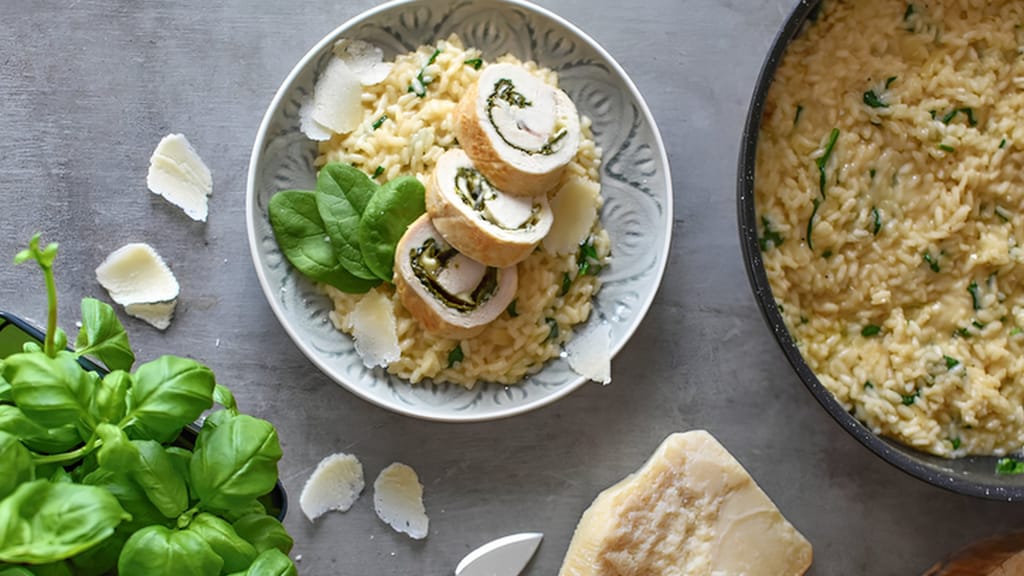
Creamy risotto with turkey roulade, spinach and gran moravia cheese
Creamy risotto with turkey roulade stuffed with spinach and provolone
Veal roulades are the quickest of the meat roulades: thin slices brown in a few minutes and braise briefly. The best known is Italian saltimbocca with cured ham and sage, which you can leave flat or roll into small roulades.
The Yumsto saltimbocca made with veal shoulder is ready in about 35 minutes and is worth trying for one trick: you coat the roulades in all-purpose flour, which helps them turn golden and also thickens the white wine sauce. The roulades are done when they reach at least 74°C (165°F) in the center and a fork slides through them without resistance.
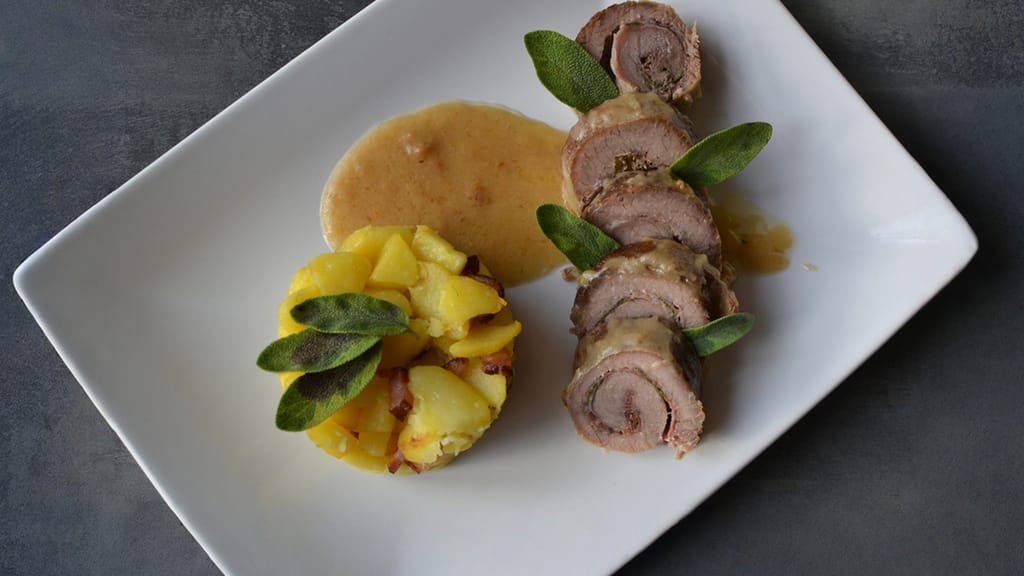
Veal saltimbocca – roll-ups with prosciutto and sage
Veal saltimbocca: roulades with cured ham and sage
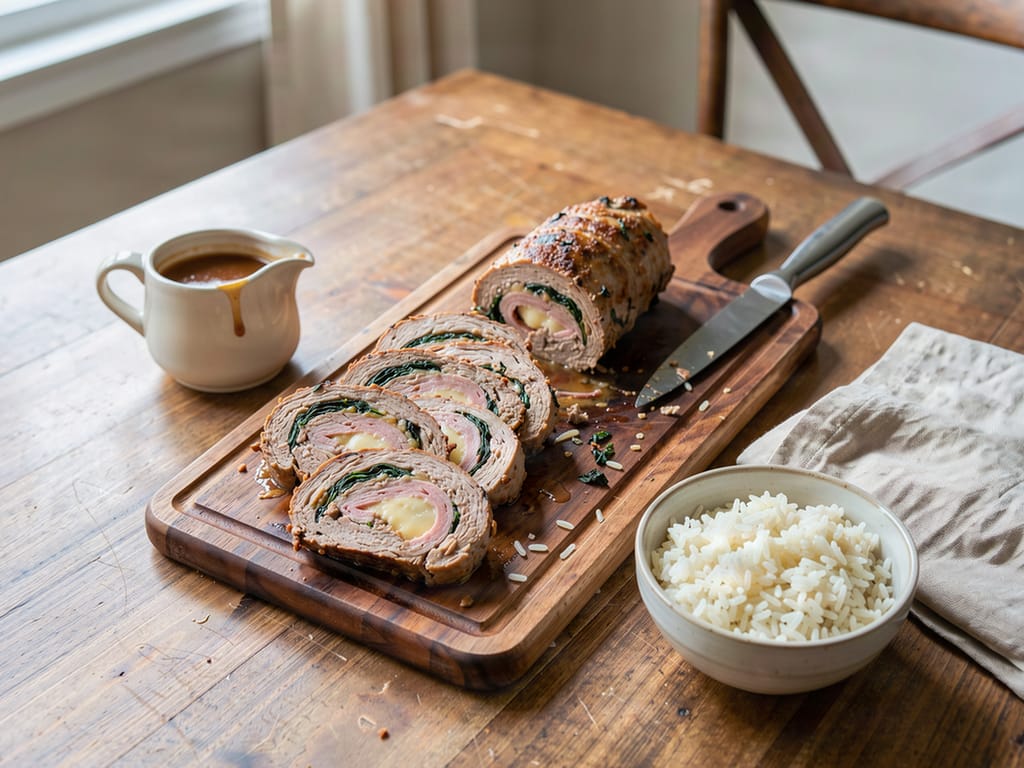
A meat roulade made from ground meat is really a stuffed meatloaf: instead of a slice of meat, you spread out a flat layer of ground meat, fill it and roll it up. It needs neither a mallet nor twine; the parchment paper and the egg in the meat hold it together.
How to do it: Mix ground meat (pork, beef or half and half) with an egg, a roll soaked in milk, chopped onion, salt, pepper and marjoram. Spread it on parchment paper into a rectangle about 1.5 cm thick, top with the filling and, using the paper, roll it up like a jelly roll. Press the seam together with your fingers, transfer the roulade seam side down to a baking dish and bake at 180°C (350°F) until it reaches 74°C (165°F) in the center, in the filling; for a roulade made from 1 kg of meat, that's usually about an hour.
Fillings for a ground meat roulade:
hard-boiled eggs laid in a row (the yolk ends up in the middle of each slice)
pickles and bacon
spinach with garlic and cheese
roasted pepper and cheese
A meat roulade with spinach works just as it does with chicken: squeezed-dry spinach, garlic and a cheese that holds its shape. Tip: don't mix the ground meat too long, only until it comes together. Overworked meat turns tough and rubbery once baked.
A meat roulade from pork collar (krkovice) is juicier and more forgiving than chicken, because the collar is marbled with fat. You cut a whole piece of pork collar in a spiral: slice lengthwise about 1.5 cm from the edge, stop before cutting all the way through, turn the meat slightly and continue until you unroll one long sheet. Pound it to an even thickness, salt it, spread on the filling (bacon, onion, mustard, pickles or spinach), roll tightly and tie with loops along the whole length. Brown on all sides, add water or beer, and bake covered at 160 to 170°C (320–340°F); a roulade from 1 kg of pork collar needs 1.5 to 2 hours to become tender.
From pork loin (boneless pork roast) you make a roulade with the same spiral cut, except the meat is leaner, so bake it for a shorter time and under a lid: a roulade from 1 kg of loin is usually done at 170°C (340°F) in 45 to 60 minutes, once it reaches 74°C (165°F) in the center, in the filling. According to USDA FSIS, stuffed meat is measured in the center of the filling, not in the meat, and the filling must reach at least 74°C (165°F); 63°C (145°F) with 3 minutes of rest applies only to an unstuffed whole cut.
A meat roulade stuffed with ground meat combines both: you spread a sheet of pork collar or loin with a thin layer of seasoned ground meat and roll it up. Here the ground meat is the filling, so the center of the roulade must reach 74°C (165°F), whether the ground meat is pork, beef, chicken or turkey.
Zucchini rolls are a fresh vegetarian starter to go with a meat roulade: you spread grilled zucchini slices with a cheese filling and roll them up like meat. They suit a turkey or chicken roulade because they are cold, fresh and ready in under half an hour.
The Yumsto version with fresh cream cheese, feta and herbs teaches one rule that applies to meat as well: spread the filling only on cooled slices, since on warm zucchini it would melt and run. The rolls shouldn't stand on the table for longer than 2 hours.
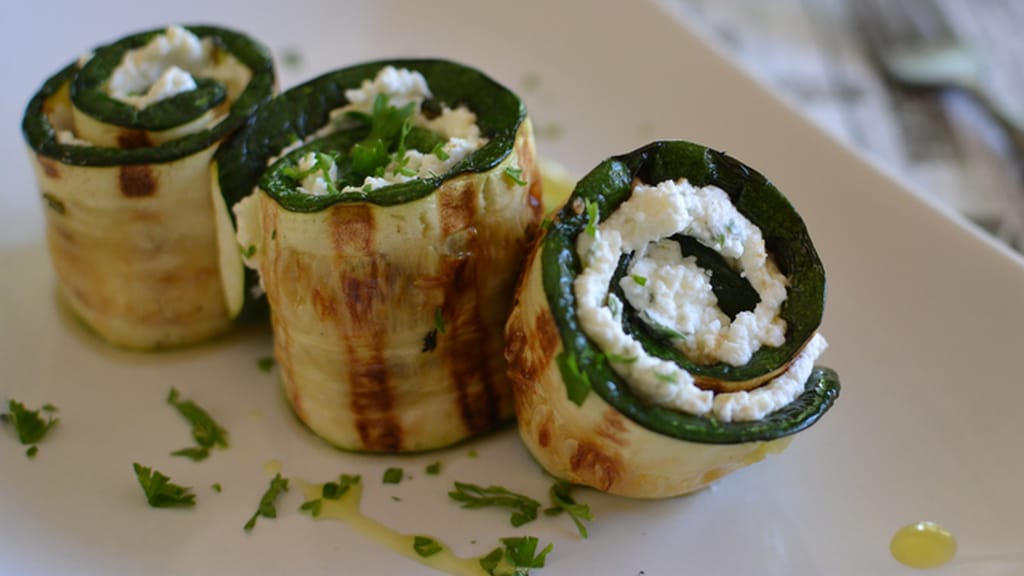
Grilled zucchini roll-ups with lučina cream cheese
Grilled zucchini rolls with cream cheese and feta
Meat roulades call for a side that soaks up the pan sauce: rice, boiled potatoes, mashed potatoes, gnocchi or pasta. For the turkey roulade with spinach, the side is simply risotto; for the one with asparagus, roasted potatoes and asparagus from the same pan.
Always make the sauce from the pan drippings: after browning, pour broth, wine or coconut milk into the pan, scrape up the browned bits from the bottom with a wooden spoon and let it bubble hard until it thickens. Mustard, a spoonful of cream or a piece of cold butter at the end gives it a gloss.
With a roulade made from pork collar or ground meat, Czech classics fit well: bread dumplings (houskové knedlíky), braised cabbage and plenty of thick gravy. And if you're preparing a salad to go with the roulade, the ones you make for schnitzel will do too: potato, cucumber or cabbage salad.
Chicken and meat roulades most often go wrong because of five mistakes: unevenly thick meat, too much filling, a wet filling, cooking without a thermometer and slicing straight out of the oven.
Unevenly thick meat. The thin edges dry out and the thick center stays raw. Pound from the center toward the edges with the flat side of the mallet, and don't bash, just spread.
Too much filling. An overfilled roulade can't be rolled tightly and the filling leaks through the seam. A layer of about 5 mm is enough.
A wet filling. Unsqueezed spinach, or goat cheese or mozzarella straight from the brine, release water and the roulade steams instead of browning.
Cooking without a thermometer. Chicken breast is only a few degrees from "still raw" to "dry as paper". A thermometer is the cheapest insurance for juiciness.
Slicing straight out of the oven. The juices run onto the board and the filling spills out. Five to ten minutes of rest solves both.
Slice with a sharp knife, on the diagonal, into slices 1.5 to 2 cm thick. Remove the twine or toothpicks before slicing, not after.
Fill and bake the chicken roulade on the day you serve it. You can pound the meat a day ahead and keep it covered in the fridge. A filling of ham, cheese or spinach can be prepared in advance, but mix a bread-and-egg stuffing only right before filling. Never leave a roulade with bread or egg stuffing raw overnight. If you want some in reserve, freeze the roulade after baking.
Refrigerate a baked meat roulade within 2 hours of cooking and eat it within 3 to 4 days, which is what the US agency USDA FSIS recommends for cooked leftovers. Store it whole in a sealed container, because sliced meat dries out faster.
Yes, you can freeze a baked and cooled chicken roulade, and according to USDA FSIS, frozen cooked leftovers keep their best quality for 3 to 4 months. Freeze it whole or in thicker slices, wrapped tightly, thaw it in the fridge and reheat it covered with a little broth so it doesn't dry out.
Allow about 150 to 180 g of raw meat per person, which for chicken breast is roughly half a breast or one large breast cutlet. Yumsto recipes for turkey roulade use 700 g of turkey breast for four servings.
Reheat the roulade cut into thicker slices in a skillet over low heat, covered, with a few spoonfuls of broth or sauce. Heat it until it is hot all the way through, at least 70°C (158°F) for 2 minutes inside the slice. Steam warms the meat without drying it out, while a microwave on full power dries the edges of the slices before the center is heated.
Yes, a chicken roulade without cheese works well with a filling of ham, bacon, sun-dried tomatoes, pesto or a wild garlic herb paste. Without cheese there is also less risk of the filling leaking out, so toothpicks are enough to hold the roulade closed.